And yet, here we are a year later, and we learn of the significantly polluted waters of Tokyo Bay, the intended site for triathletes and open-water swimmers.
According to Inside the Games, the Tokyo Metropolitan Government conducted a water quality test in Tokyo Bay over a 21-day period, which is a sample size as long as the actual Games themselves. The results, which were shared at an October gathering of the IOC Coordination Commission in Tokyo, showed “levels of E. Coli up to 20 times above the accepted limit and faecal coliform bacteria seven times higher than the permitted levels.”
This Asahi News article quoted organizers as saying that “an inflow of raw sewage caused below-standard water quality in more than half of tests conducted.” Officials explained that “heavy rain caused overcapacity at sewage processing plants, and some of the untreated sewage flowed into Tokyo Bay,” and that “they are considering such measures as installing triple layers of a screen that can block the flow of coli bacillus.“
Is there any consideration to move the venue for the triathlon and the open-water swimming events?
Sports Director of the Tokyo 2020 Organizing Committee, Koji Murofushi, shut that idea down, stating that “measures will be taken so that we can provide an excellent environment for the sports.”
The truth of the matter is, there have been signs in the area planned for the Olympic events for years warning people not to swim in the bay. Will the organizers figure out to clean up this act? We’re a little more than a thousand days away. Tick tock.
International Olympic Committee (IOC) Vice President John Coates (L) and President of the Tokyo 2020 Olympic and Paralympic organizing committee Yoshiro Mori attend a news conference in Tokyo on Wednesday. Photo: REUTERS
The budget for the 2020 Tokyo Olympics ballooned from $7.5 billion, presented during the bid process in 2013, to $30 billion a few years later.
Conscious of the distaste the citizens of most major cities have for holding an Olympic Games, the International Olympic Committee has been working hard to get the Tokyo Olympic Organizing Committee to slash the budget. Currently it stands around $12 billion. But John Coates, who is the head of the IOC’s Coordination Commission for the 2020 Tokyo Olympics, wants to get the number down further.
“That’s the target that we think should be achievable not just by Tokyo but by all summer organizing committees,” said Coates, referring to the new goal of $11 billion. “What we are trying to do is create a situation where there is no strain on the public purse.”
A likely target of the budget knife is the Olympic Village, where Coates believes that the level of service can be diminished enough to reduce the budget significantly.
For example, The Washington Post said Coates gave an example of “shortening the length of time athletes are allowed to stay,” or to make beds transferrable, “which would mean shuffling athletes or team staff out early to make room for those who might be competing later in the Games.”
Another example, explained in Japan Today, is cutting staff for the Olympic family lounges, which according to Coates, operate at only 40% capacity on average.
However, Rich Perelman, editor of the Sports Examiner calls Coates out on the challenge of trying to nickle-and-dime down the costs of the Olympic Village by focusing on service. He points to the fact that the number of athletes have risen every Olympics since 2004. The Rio Olympics hosted 11,238 athletes, well over the 10,500 recommended in the Olympic Charter.
The 2020 Tokyo Olympics are expected to have a higher count. And while there are hints that the IOC wants the various national olympic committees to cut the number of participating athletes and officials, Perelman points out that the IOC is contributing to the increased headcount by encouraging the introduction of new sports, like surfing, sport climbing and skateboarding.
The IOC and the Tokyo 2020 organizers are further complicit in exacerbating the costs for the coming Games by adding – unnecessarily – five sports, 18 events and 474 more athletes (not to mention support staff – to the Games program because the events will supposedly “appeal to youth.”
This is part two highlighting the powerful black and white photos of the opening day ceremonies of the 1964 Tokyo Olympics, 53 years ago yesterday. The photo above, from this series compiled by Fuji Film, captured one of the most dramatic moments of the Tokyo Games.
The sacred flame that lit the Olympic cauldron, which burned for the 16 days of the Tokyo Olympics, was initially lit 51 days earlier on August 21 in Olympia, Greece. The flame then travelled through 12 countries in Eurasia, including Turkey, Lebanon, Iran Thailand, Malaysia and Taiwan, before landing in Japan. The flame was distributed to four torches, which then made their way through all prefectures in Japan. The four flames came together in Tokyo and the final torch bearer was Yoshinori Sakai, a university runner selected because he happened to be born on August 6, 1945 in Hiroshima, the day the world entered the nuclear war age.
After the Olympic cauldron was lit, the flag bearers of the 93 nations formed a semi-circle around the lectern, where Japanese gymnast Takashi Ono, stood. Ono, a veteran participating in his fourth Olympics, who accumulated 5 golds and 13 total medals since the 1952 Helsinki Games, delivered the athlete’s oath.
In the name of all competitors, I promise that we shall take part in these Olympic Games, respecting and abiding by the rules that govern them, in the true spirit of sportsmanship, for the glory of sport and the honor of our teams.
After the oath, 8,000 pigeons were released. I’m sure it was a spectacular image on television and in the newspapers and magazines, but it was a bit of an annoyance to athletes and spectator alike who tried and failed to dodge the guano bombs of the birds who were probably less than thrilled with being cooped up in cages and then suddenly released into the air above the stadium. One athlete told me that the water pressure in the Olympic Village dropped drastically as everyone showered at the same time to rid themselves of their unwanted opening day souvenir.
October 10, 1964. In the annals of 20th century Japanese history, it was truly a day to remember.
It was minutes before the commencement of the 1964 Tokyo Olympics, the flags of 93 nations rising into a clear blue sky. The above photo was snapped and compiled into a set of photos by Fuji Film commemorating the XVIII Olympiad’s opening ceremony, which began at 2pm on Saturday, October 10, 1964, 53 years ago today.
The athletes would have to deal with cold and wet conditions for much of the Tokyo Olympics, but that day, the 5,500 athletes marched into the National Stadium under perfect conditions. As tradition has it, the host nation’s team marches into the Stadium last. Expectations were high for Team Japan, with a goal set of 15 gold medals. They actually achieved 16, third best after the US and USSR.
The President of the Organizing Committee for the Games, Daigoro Yasukawa, can be seen above introducing the International Olympic Committee President, Avery Brundage. In the official report which offered a post mortem of the Games from an operational perspective, Yasukawa expresses gratitude to the people of Japan.
…it was because Japanese in all walks and interests of life worked together in close and harmonious cooperation—all with one basic goal—that these Games might be an unqualified success. This spirit permeated into the Organizing Committee, and was to be found also in the sports associations and the many cooperating organizations involved. This surely is the only factor that enabled success in our organization efforts.
At the end of the Second World War, in the aftermath of the Hiroshima and Nagasaki bombings, the Emperor’s voice was heard over the radio for the first time by his Japanese subjects. The Emperor asked his people to surrender, to “bear the unbearable, and endure the unendurable.” Nineteen years later, the Emperor is presiding over the Olympics, an event symbolizing peace and unity, in a city that was unrecognizable from its bombed-out shell in 1945. As noticed in this Japan Times article, the scene depicted in this photo may have been striking to many Japanese as the only person standing in the stadium was the Emperor – a role reversal of sorts in a very different time.
After the Emperor declared the XVIII Olympiad open, the Olympic Flag was brought into the stadium by Japanese self-defense forces, the embroidered satin flag initially brought in by the Mayor of Rome, the site of the XVII Olympiad. The flag was raised exactly 15.21 meters into the air. That was the distance Mikio Oda hopped, skipped and jumped to win the gold medal in the triple jump at the 1928 Amsterdam Olympics, Japan’s first ever gold medal.
Imagine it’s October 9, 1964 and you have this ticket to the Opening Ceremonies of the 1964 Tokyo Olympics on the next day.
This is the day over 5,000 athletes and the entire population of Japan has been waiting for – the start of a new Japan.
And by the looks of it, your ticket is in a prime location – Q-57, 5 UPP. I’m not 100% sure where that seat is on the map provided on the back of the ticket, but my guess is the area I highlighted in blue.
If it is indeed that section, you are in an honored section. Since the design of this ticket is different from the tickets generally sold, these may be for special guests, as indicated by the word “SPECIAL” written on the ticket’s map.
Special perhaps because in 5 UPP, Q-57, you will be seated very near the center of the stadium, almost directly opposite the Olympic cauldron, where a teenager from Hiroshima, born on the day an atomic bomb was dropped on his city, would climb the steps and light the Olympic flame.
Less than 50 meters in front and below you will be seated Emperor Hirohito, who will launch the Games.
And thousands of the world’s best athletes will march into the stadium by your seat, as if they are marching for you.
Don’t lose that ticket. It’s going to be quite a show.
When József Sütő lined up for the marathon at the 1964 Tokyo Olympics, the Hungarian didn’t know any of the other 67 competitors in the race, except for the then-world record holder, American Buddy Edelen, and the reigning Olympic champion from Ethiopia, Abebe Bikila.
When Sütő hit the halfway point in the marathon, Bikila was indeed firmly in the lead. Slightly behind him was Jim Hogan of Ireland. Ron Clarke of Australia was third, but pressing hard on Clarke were Sütő, Kokichi Tsuburaya of Japan, and Demissie Wolde of Ethiopia.
“Mr. Tsuburaya was in this group, but I did not know at the time who he was,” Sütő explained in an interview with me. “I saw of course that he is Japanese but I did not know more.”
József Sütő (77), Kenji Kimihara (73) on the day of the memorial run, photo by Rajzó-Kontor Kornélia
And yet, it was that race that established a life-long tie between those two runners, who never met except in that single competition on October 21, 1964. Fifty years later, Sütő would return to Japan and pay respects to the Japanese marathoner who won the bronze medal at the Tokyo Olympics, and then subsequently and sadly took his own life four years later.
At this own expense, Sütő flew out to Japan to attend the 32nd Tsuburaya Memorial Meet, an annual series of running events held in the city of Sukagawa, Fukushima, the hometown of Kokichi Tsuburaya. This was October, 2014, which meant that he would be running in the memorial only two days before the 50th anniversary of the marathon of the Tokyo Olympics.
As explained in this article, Sütő ran in the 5k race, and at the age of 78, ran it in a respectable 27 minutes and 8 seconds. More importantly, he ran it in the race with teenage boys, aged 13 to 15. Sütő understands symbolism, the importance of being a role model, which is why he ran with the boys. When Sütő was growing up in Hungary, his hero was Sándor Iharos, one of the best distance runners in the world in the mid-1950s, a world record holder in the 1500-, 2,000- and 5,000-meter distances.
But Sütő also understands how he represents history, and his linkage to Japan and the 1964 Olympics, one of the defining moments of its history in the 20th century, as well as to the marathon itself. He had arrived in Tokyo on October 18th and was immediately whisked north to Sukagawa. He ran the race on October 19th. On October 20th, he attended a tour of the museum dedicated to the memory of Kokichi Tsuburaya, and then returned to Tokyo for a meeting with representatives of Japan’s National Olympic Committee on October 21st.
The meeting began at 3pm, and exactly 17 minutes into the meeting, Sütő interrupted the conversation by saying “Gentlemen, 50 years ago on this date and at this moment I was taking the turn into the Olympic stadium….and I’ll cross the finish line in a moment!”
I’ve only had the opportunity to exchange emails through an intermediary/translator named Rajzó-Kontor Kornélia, who kindly offered to assist me in communicating with Sütő . Through Rajzó-Kontor’s help, as well as the brilliant articles she wrote on Sütő’s visit to Japan in 2014, I can see that Sütő appreciates the enormity of Japan’s moment in 1964, and as he learned after leaving the Tokyo Olympics, the physical and mental trials Tsuburaya endured after the Tokyo Games. Sütő never met Tsuburaya, but he knows him, and likely wishes he could embrace him.
After completing his race at the Tsuburaya Memorial Meet that beautiful October day, he revealed his thoughts to reporters, as explained by Rajzó-Kontor:
Sütő told the local television viewers the same thing he had said in the cemetery the day before; that he had been thinking of Tsuburaya and thanking him as he ran. Sütő said he believed he would have run the distance “hand in hand” with Tsuburaya, were he still alive.
NOTE: Many, many thanks to Rajzó-Kontor Kornélia for the time she took to translate my questions from English to Hungarian, personally meet with József Sütő, and then translate his responses from Hungarian back to English.
The Tokyo Olympic Organizing Committee was ready for the hordes of foreigners to descend upon their shores, preparing processes, rules and documentation that made it clear to officials, workers and volunteers in the 1964 Tokyo Olympic bureaucracy who an Olympian was or wasn’t.
So when Ted (Theo) Mittet came to Japan as a rower on the US Olympic Team, he had his documents. I know this because he kept them in a box over the past five decades, and he graciously allowed me to rummage through it.
The image at the top of the article is his Identify Card. Sent about five months in advance to some 7,900 competitors and officials, blank identify cards were provided to all National Olympic Committees (NOC) or International Sports Federations (ISF). Those NOCs and ISF’s in turn filled in the cards and handed them to the athlete.
From the Official Report of the Organizing Committee – The Games of the XVIII Olympiad Tokyo 1964
These identity cards, were for all intents and purposes, a passport within Japan, and so Japanese officials took the time and effort to design a card appropriate for its level of importance. Not only was the paper manufactured with waterproof texture paper, and watermarked to prevent forgery, the card included a serial number that was fed into an IBM computer system. That serial number was also printed on a vinyl case designed to further protect the document.
The identity card allowed the athlete or official free passage on all related Olympic transportation, free admission into parks, zoos, museums, as well as free access to trains, buses and trams in Tokyo.
In the case of athletes like Mittet, their case was blue. My father was a journalist at the Tokyo Games, and his identify card case was red.
As described in this post, Mittet traveled through Japan. In as much as he could, he likely used identity card to travel, but he may have also used his railway pass, one issued to all Olympians. This pass may have been more to explain which train lines the foreigners were allowed to use, as the document kindly shows in red which lines they can board free of charge.
Inside the Olympic Village, Olympians had access to the dining halls. Each individual was provided with a book of meal coupons, which they could use breakfast, lunch and dinner in any of the dining halls they wanted. The picture below is of Mittet’s coupon book, with coupons left for only October 28, several days after the end of the Olympics.
As one can imagine, the Japanese organizers thought deeply about how the foreigners would interact with the Japanese at the countless number of touch points in Tokyo, and believed that easily recognizable documentation in English would become in certain instances the instant translation of an unspoken exchange.
“Having established procedures and protocol the Japanese organisers devised a document of reference for (almost) every forseeable contingency,” wrote Doug Ibbotson of the Evening News, in an article entitled Tokyo – Marvel of Efficiency and Goodwill. “This resulted in the distribution of mountains of paper which, I regret to say, frequently was jettisoned into the waste basket. However, once a document was in existence, the lesser officials were happy, for it became the sole arbiter in any dispute between Western Logic and the Oriental Mind.”
Paper work – one reason why the 1964 Tokyo Olympics were considered one of the smoothest operations in Olympic history.
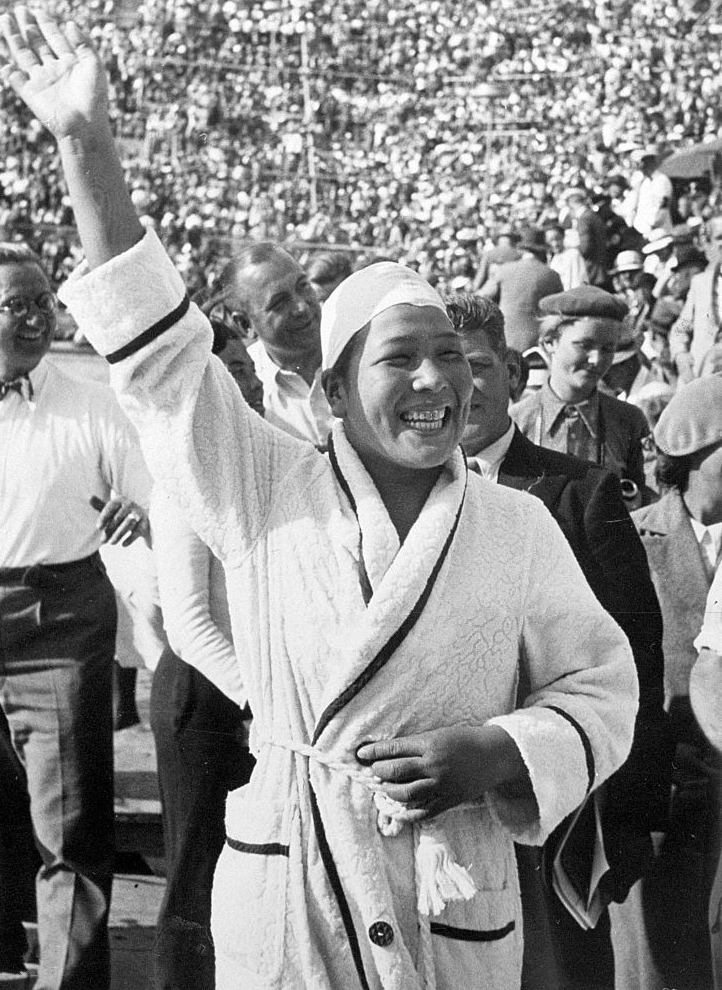
Hideko Maehata waving to the crowd after winning gold in Berlin
It was a slight, perhaps. The first and most famous of films about the Olympics – Leni Riefenstahl’s documentary about the 1936 Berlin Olympics, entitled Olympia, did not include the winner of the women’s 200-meter breast stroke. That’s because the winner was a Japanese, Hideko Maehata, who beat out a German named Martha Genenger.
But that’s OK. When Maehata returned to Japan after her gold-medal winning performance in Berlin, she was a national celebrity. Eight other Japanese won gold medals at the Berlin Games, but they may not have gotten the media attention that Maehata did. As Robin Kietlinski explains in her seminal book, Japanese Women and Sport, national radio was bringing the world to all of Japan, led by Nihon Hoso Kyokai, or NHK. Established in 1924, Maehata’s race was one of the first events to be covered live, broadcasted to Japan via satellite.
And according to Kietlinski, they had the man who brought the excitement of the moment alive for Japanese listeners – Kasai Sansei – whose shrieks of excitement and shouts of “Maehata ganbare” brought the swimming stadium of the Imperial Sports Field in Berlin to the homes of people all across Japan. In this NHK documentary, Maehata’s cousin, Tomizo Hase, was asked about his recollections of listening to that famous radio broadcast:
We were all nervous, out palms sweating. We said to each other, we really hope she wins. There were about 10 people inside and many more outside. What a heavenly feeling it was. Some of us cried in joy, saying she’s done great.
In her book, Kietlinski provides a transcript in English of that broadcast. To listen in Japanese and get the sense of excitement Japanese felt in 1936, go to the 25 second mark of the video below.
Maehata and Genenger are side by side. Ah, Maehata pulls ahead! She’s in the lead! She’s a little bit ahead. Fifty meters down. 100 meters down. Fifty meters left to go. Maehata is a little bit ahead! Ah, Genenger is coming. Come on, come on! Maehata is in danger, she’s in danger! Go for it! Maehata go for it!
They turned, the swimmers just now turned and Maehata holds onto a slight lead. C’mon Maehata. Go for it! (Repeated four more times) Forty meters left to go. (Repeated four times) Maehata is ahead! Maehata is ahead! Genenger is coming. It’s just a very small lead by Maehata. Go for it Maehata! (Repeated four times) Twenty-five meters left to go! Maehata’s lead is small, it’s very small! Maehata! Go for it Maehata! (Repeated eleven times)
Maehata is in the lead! (Repeated six times) Five meters left to go! Four meters left! Three meters, two meters. Maehata is ahead! Maehata has won! (Repeated eighteen times) By a small margin Maehata is the champion! Thank you Ms Maehata, the Japanese flag will fly today. Thank you! For the first time in the history of women’s swimming the Japanese flag will fly.
Hideko Maehata (center) on the Podium with Martha Genenger (right) and Inge Sorensen of Denmark (left)
Hideko Maehata swam 10,000 meters a day. So taking the two-week boat trip from Japan to the West Coast of the United States was a piece of cake for the native of Wakayama, Japan. It was the last 200 meters, in the pool, that were going to be painful.
After winning her heat in the 200-meter breaststroke by nearly 3 seconds, she lined up for the finals. And in a tough-fought nail biter, a 16-year old Australian named Clare Dennis set an Olympic record and edged out Maehata by a tenth of a second.
According to Robin Japanese Women and Sport, in her book Japanese Women and Sport, Maehata was welcomed back home in Japan as a hero, but the 18-year-old, while proud was disappointed. Was it worth training so hard again, and trying again for gold in 1936, or should she put an end to the long hours in the water and get married as society at the time required. Kietlinski explained that Maehata received letters from her fans making both sides of the argument.
According to this NHK mini-documentary of Maehata’s life, it was the Mayor of Tokyo at that time, Hidejiro Nagata. Nagata, proud of Japan’s incredible accomplishments at the 1932 Los Angeles Olympics, was putting together his plan for Tokyo to host the 1940 Olympics, met the returning Maehata and insisted that she go for it again in Berlin.
If only you had won that gold medal. It’s so frustrating. Don’t forget the bitter taste of defeat. Let it drive you to do better four years from now at the Berlin Olympics.
And so, Maehata decided to aim for gold and glory at the 1936 Berlin Olympics. She doubled her regimen, swimming 20 kilometers a day, the water hiding the tears of pain. She noted that her victory in LA was denied by such a tiny margin that perfecting her start was essential. She worked on her launch from the starting block by practicing 100 starts a day, her toes bleeding from the wear and tear.
The training was so grueling I cried as I swam. But at those times, I reminded myself that if I failed to overcome the pain, and fall short in Berlin, I would be the laughing stock of Japan.
And so, despite being cheered on by thousands as she boarded the ship for Europe and ultimately Berlin in 1936, she did so with considerable anxiety. In fact, as the NHK video explains, based I believe on what she described in her own autobiography, she found herself alone on the deck of the ship, looking over the waves, thinking that if she did not win, she would jump into the ocean on the return trip and kill herself.
This was the first Olympics in Berlin, otherwise known as the Nazi Olympics as it was presided over by der Führer, Adolph Hitler. The home field advantage for the German athletes was significant, and Maehata’s biggest competitor in the 200-meter breast stroke was a 20-year-old from Krefeld, Germany, Martha Genenger.
Genenger sent the first warning shot, winning her first round heat in 3:02.9 seconds, setting an Olympic record. Maehata fired back in her first round heat with a time one second better, re-setting the Olympic record. In the semi-finals, no records were set, but no other competitor came anywhere close to Genenger’s or Maehata’s times. The finals were to be a showdown between the German and the Japanese.
It was 4pm on August 11, 1936. Maehata was in lane 6. Genenger was in lane 7. Even in the early part of the race, Maehata pulled ahead. And for the remainder of the 150 meters, Maehata clung to the lead. When her hand touched the wall, she was not sure who had won.
When I reached the finish line I l gasped for breath and looked across at the next lane and saw that Genenger was already there. And I thought I had lost.
In fact, Maehata had persevered by a mere sixth tenths of a second. She had fulfilled the command of the Mayor of Tokyo. She had realized the dreams of an entire nation.
And she could get on with her life. In 1937, Maehata married a doctor, retiring from swimming. She raised two children, and when she greater flexibility after her children grew up, she started a swimming school in 1967. She saw that after the war, the Japanese were weak in swimming. She felt that she could contribute by focusing on mothers, teaching them the joys of swimming. If mothers understand and enjoy swimming, she believed, so will their children.
Maehata suffered a stroke while teaching, at 68. She was told she would never walk again, which was fuel for her competitive fire. So she pushed herself. “I still have the drive inside,” she said in the NHK documentary. “When I have a tough day, I recall my days as a competitive swimmer, and it’s like someone is yelling at me that I have to be stronger. The fact that I am still alive and active today is thanks to that inner strength.” Amazingly, a year later, Maehata returned to the pool and resumed her coaching duties.
In 1995, at the age of 80, Maehata, one of the most famous sports figures of the early 20th century in Japan, passed away.
Airbnb helped find accommodations for 85,000 people during the 2016 Rio Olympics. That is, according to Fortune Magazine, 17% of the approximate 500,000 local and foreign tourists who visited Rio during the 2016 Rio Olympics.
Handling spikes in tourist traffic during big-tent events like the Olympics, World Cup, or industry conventions is a challenge, even more so in cities like Tokyo that are already at high occupancy rates during normal weeks. Services like Airbnb have business model which connect travelers with individuals who commonly offer up their own apartments or houses and sometimes more personalized service, for fees often lower than the hotel chains.
As the “Official Alternative Accommodation Services Supplier” of the 2016 Rio Olympics, Airbnb can argue that it put cash directly in the hands of Brazilian citizens, and helped the government and organizing committee deal with room over-capacity during the Olympics. According to this Fortune article, 421,000 arrivals stayed at Airbnb rooms in Brazil in 2015. In 2016, the year of the 2016 Olympics, the number of arrivals doubled to more than 1 million.




You must be logged in to post a comment.