1964 Paralympics_poster

The 1964 Tokyo Olympics ended on October 24, 1964 to universal praise. On November 12, 1964, the Thirteenth International Stoke Mandeville Games for the Paralysed, otherwise known as the 1964 Summer Paralympics, also ended in success, and arguably with greater impact.

The Tokyo Paralympics helped maintain momentum, as the number of nations grew from 17 to 21, events from 57 to 144, and participants from about 180 to 375. As D. J. Frost wrote in his excellent paper entitled, Tokyo’s Other Games: The Origins and Impact of the 1964 Paralympics, “they were widely hailed as a success and credited with giving ‘hope, courage, and self-confidence to Japan’s physically disabled’.” The 1964 Paralympics raised awareness significantly for people around the world, particularly in Japan, and added to the tremendous global goodwill developed via the organization of the Olympic Games a few weeks before.

Incredibly, in contrast to the five years of planning and organizing devoted to the Tokyo Olympics, the Tokyo Paralympics came together quite suddenly, with an official organization to plan and execute the games coming together only in mid-1963. While the Paralympics and Olympics are a joint deal for host cities today, that was not the case in the 1960s. When the first Paralympics were held after the Rome Olympics in 1960, Frost wrote that “a mere handful of people in Japan were aware of their existence.” In other words, the idea of organizing an international competition for disabled athletes prior to 1962 was essentially non-existent. Frost tells the incredible story of how very quickly, how a small group of people established new organizations, created public awareness, built consensus among local and national leaders, raise funds and then actually run the event.

Again, citing a good chunk of Frost’s research, here is the timeline of disabled sports in Japan, which demonstrates the sudden alacrity with which Japan made the 1964 Paralympics a reality.

September 1960 – A Lone Japanese Meets the Father of the Paralympics: At the 1960 Rome Olympics, there were over 160 athletes, and likely dozens if not hundreds other Japanese scouting out the Rome Games in search of information and ideas to prepare them for their own Games in 1964. But there were zero representatives from Japan at the 1960 Paralympics in Rome, which was held in mid-September. The closest there was to a Japanese representative was Hanako Watanabe, the wife of the head of the Rome bureau for the Kyodo News Agency. Watanabe did have an academic background in labor and welfare policy, but more importantly, she had access to the father of the Paralympic movement, Ludwig Guttmann. It is said the two met and talked about the possibility of holding a similar event in Japan after the Tokyo Olympics.

1964 Paralympics_dartchery
From the book, Tokyo Olympiad 1964_Kyodo News Agency

February 1961 – The First Major Document in Japanese on Disabled Sports: Matao Okino, the director of the Japanese branch of the World Veterans Federation (WVF), received materials about disability sports from the head office in Paris. Interested in bringing greater attention to the topic in Japan, Okino joined with Masatora Hieda, the head of the National Disability Rehabilitation Training Centre, to translate the materials and prepare a 157-page booklet, titled ‘Sports for the Disabled’.

April 13, 1961 – An Influential Workshop: Two emerging experts appeared at a workshop on disability rehabilitation training, where Okino gave a talk entitled “Elevating Sports for the Disabled in Japan,” while Watanabe shared her experiences in Rome during the Paralympics. According to Frost, Watanabe’s influence was not insignificant. Hieda acknowledged that Watanabe’s introductions to Guttmann, to labor and welfare experts, and to media via her husband, were key to building this ragtag network of disability sports community.

May, 1961 – The First Official Organization Devoted to Disabled Sports: Okino meets Guttmann at an international congress for the WVF in Paris. This leads to an agreement to form an official organization to promote disability sports in Japan. This group, the Association for the Promotion of Sports for the Disabled, was formed in August, and was made up of representatives of 24 groups related to disabled people. However, Okino and his colleagues were still not quite confident they could organize a Paralympics in Japan, and few concrete actions resulted.

October 22, 1961 – The First Disabled Sports Competition in Japan: All movements need a spark. Arguably, the spark happened away from the ivory towers of Tokyo, in the fields of Oita, Kyushu in Western Japan. Dr. Yutaka Nakamura, and a local government official, Atsushi Hirata, organized Japan’s first competition for disabled athletes. Their success, while not highly publicized, became the model for a practical application for the thinkers in Tokyo.

March, 1962 – The Lions Club and Asahi Shimbun Offer Their Weighty Support: Now that people in Japan could see what a Tokyo Paralympics might look like, supporters began to emerge. Susumu Iimuro, a leader of a large volunteer service organization called Lions Club International, joined hands with Muneyoshi Terada, an official of the Asahi Shimbun Social Welfare Organization to announce that they would be very supportive if Japan hosted the Stoke Mandeville Games, which was then the official name of the Paralympics. They announced “across-the-board support.” Terada then led the creation of a concrete plan to bring the Paralympics to Japan, the decision to establish a preparatory committee, and then consensus-building meetings with relevant officials in the Health and Welfare Ministry.

May 10, 1962 – A Committee is Finally Formed: The Preparatory Committee is formed, made up of 21 individuals, who go on to make one of the more important decisions they will make: selected Yoshisuke Kasai, the then chairman of the Association for the Promotion of Social Welfare, to lead this committee. Kasai is generally recognized as a powerful driving force in realizing the 1964 Paralympics.

May 30, 1962 – Lions Club Leads the Fundraising: The Preparatory Committee asks the Lions Club to help them raise funds, and resolves to send Japanese disabled athletes to the annual Stoke Mandeville Games in London.

1964 Paralympics_prepping for the Games
Preparatory work for the 1964 Tokyo Paralympics

July 1962 – The First Japanese Disabled Athletes in International Competition: Two men from Oita prefecture are sent to England to participate in the International Stoke Mandeville Games, the first Japanese to do so.

August, 1962 – The Crown Prince Supports: Of all the acts and decisions made towards building awareness about the disabled in society and the impact sports can have on the health of disabled athletes, one of the strategically important ones was involving the Crown Prince of Japan, Akihito, and his wife the Crown Princess, Michiko. The fairy story of a commoner meeting the Crown Prince on a tennis court, leading to a royal wedding covered feverishly by the media, was still strong in the hearts of the Japanese. So when the Crown Prince met with members of the preparatory committee, and stated afterwards that he hoped that the Paralympics would become a reality in Tokyo in 1964, media coverage and subsequently favorability by the public towards the Paralympics grew. Riding the wave of support, Prime Minister Hayato Ikeda pledged government assistance.

May 13, 1963 – It’s Official: The Health and Welfare Ministry approved the incorporation of a newly formed committee, the Organising Committee for the Paralympic Games in April, and a few weeks later, on May 13, Kasai sent a letter to Guttmann and his fellow committee members of the Stoke Mandeville Games of their intent to host the 1964 Stoke Mandeville Games in Tokyo, after the Tokyo Olympics.

At that stage, once the plan was in place, superior Japanese skills in execution took over, ensuring that the five-day event from November 8 to November 12, 1964 took place flawlessly.

Police investigate a pickup truck used in an attack on the West Side Highway in Manhattan
Police investigate a pickup truck used in an attack on the West Side Highway in Manhattan_Reuters

On Tuesday, October 31, 2017, Sayfullo Saipov rented a truck in Passaic, New Jersey, and less than an hour later around 3pm was barreling down the scenic Hudson River Bike Path, mowing down runners, pedestrians and bikers alike. Victims and fatalities were found at different points along this 10-block killing spree, finally ending when his truck crashed into a school bus parked outside Stuyvesant High School.

Saipov was gunned down and captured by police who happened to be in that area investigating another incident. By the time the day ended, 6 people were killed on the spot, with two more dying later in the day.

This was the worst terrorist attack on New York City since September 11, 2001.

I feel pained at the loss of life and the inability to make sense of the murderous actions of this terrorist in my home town of New York, the frustration heightened by the fact that Saipov was apprehended outside my high school alma mater. Stuyvesant was only four blocks from the World Trade Towers, and thus ended up serving as a triage center for those injured and dying after the 9/11 attacks. On Tuesday, it served yet again as a backdrop to incomprehensible hatred.

A few weeks ago, the Economist Intelligence Unit (EIU) published their 2017 Safe Cities Index. In the dimension of “Personal Security”, which reflects the level of urban crime, violence or the likelihood of terrorism, New York City ranked 25th out of 60 cities surveyed. After seeing citizens run down on a bike path on a sunny afternoon, one might wonder why that ranking isn’t worse.

terror lower west side Stuyvesant

But on the whole, when EIU looks at all factors of security relevant to big cities, including digital, health and infrastructure safety, New York City ranks fourth safest in the world for cities with populations of 15 million or more.

At the top of the list, as the safest of the biggest cities, is Tokyo. In fact, Tokyo continues as the safest city in the world, maintaining its EIU reign since 2015. With the coming 2020 Tokyo Olympics, the public and private sectors in Japan are both working on measures to improve security, particularly in regards to digital security. While bombs and gun attacks are concerns, even in super safe Japan, great attention is being paid to ensuring Japan’s power grids, transportation systems, and digital platforms are not compromised now, or doing the 2020 Tokyo Olympics.

The Japanese are highly detail oriented and biased towards checking and re-checking for points of weakness and flaw, which is something I and many others can take comfort from if we dare to think about how creative and diabolical terrorist and crime organizations can be.

And yet, how do you protect against someone renting a truck and plowing into a crowd?

Sacred Flame in Kagoshima 1
Sacred Flame during torch relay in Kagoshima in September, 1964

It was called the Flame of Hope – a flickering flame kept alive in a boat lantern in the city of Kagoshima. Until it wasn’t.

The sacred flame came to Japan after being ignited in Olympia, Greece, and traversing South, Southeast and East Asia. When the flame arrived in Kagoshima on September 9, 1964, one of the many torch relay runners, a sports store owner, took his torch back home with the flame still alive. When the principal of the local elementary school saw the flame, he said he wanted his students to see it.

The Lantern that Held the Olympic Flame

And thus was born the idea to keep the Olympic flame alive, where it finally settled in a city youth training center. It was called the Flame of Hope. And for decades, residents of Kagoshima would over the years request the honor of using the Olympic flame to ignite fires for weddings, festivals and camp outings. For all intents and purposes, the Flame of Hope became an Eternal Flame, at least that is what the people of the youth training center dedicated to protecting.

Then one day in November, 2013, the flame went out, although no one really knew that until recently. In reports that came out only last week in October 2017, the head of the youth training center admitted this: “I saw with my eyes that the flame went out on November 21,” he added. “We re-lit the fire and kept it going for about two weeks, but I thought that was not good.”

According to that AFP report, the head of the center was feeling considerable pressure at that time as the news of Tokyo’s selection for the 2020 Olympics was bringing considerable attention to Kagoshima and the legacy of the eternal flame from 1964. “At that time, I could not say something that could destroy (people’s) dreams,” added the official, who declined to be named.

With so many people requesting use of the Flame of Hope, the guilt over deceiving the public had reached its breaking point, so he recently decided to come clean. In the past four years, the Flame of Hope had actually been re-lit by a magnifying glass and sunlight in December, 2013.

To be fair, the Olympic flame has a history of being extinguished, particularly those held by runners during torch relays, most recently when striking teachers disrupted the torch relay prior to the 2016 Rio Olympics.

But you have to feel for the employees of the Kagoshima youth training center – to see hope flicker out before their very eyes. Fortunately, hope takes on many forms, and still fuels expectations for greatness in 2020.

Closing Ceremonies_Mixing_Games of the XVIII Olympiad_IOC
From the book, Games of the XVIII Olympiad_IOC

On Saturday, October 24, a national effort to restore pride to a defeated nation and demonstrate to the world that Japan was indeed back, ended at the Closing Ceremonies on the final day of the Tokyo Olympiad.

The ceremonies began with Emperor Hirohito entering the National Stadium. And then began the march of the athletes – perhaps less march, more flood. Here’s how it was reported in The Official Report of the XVIII Olympiad:

The flags of all participating nations were marched into the Stadium by standard bearers at 5 o’clock with the names of the nations held high. The athletes followed into the field behind them without distinction of nationality and like a flood water released from its gates. All lined up together in an orderly manner in the area behind the flags. There was a feeling of deep emotion with the completion of the Games, and a peaceful hush descended on the Stadium.

Closing ceremony 6
From The Official Report of the XVIII Olympiad

When the athletes had all entered the stadium, the national anthem of Greece was played as that nation’s flag was raised, followed by the flags of Japan and Mexico, accompanied to the playing of the Mexican national anthem. The president of the IOC, Avery Brundage, then officially closed the Tokyo Summer Games, and proclaimed hope for a successful Games in Mexico City four years later:

I call upon the youths of all countries to assemble four years from now at Mexico City and there to celebrate with us the Games of the XIX Olympiad. May they display cheerfulness and concord so that the Olympic torch will be carried on with ever greater eagerness, courage and honor for the good of humanity throughout the ages.

Closing Ceremonies_IOC Flag_Games of the XVIII Olympiad_IOC
Fromthe book, Games of the XVIII Olympiad_IOC

As The Tokyo Olympic Hymm B played, the Olympic flame dissipated into the blackness of the night. In the dark and the quiet, the Olympic flag was lowered and carried off the field by members of the Self-Defense Forces, their solemn march highlighted by a single spotlight.

And suddenly, blossoming from the dark canvas of the field, red-orange flames ignited from hand torches held by hundreds of female college students who formed an oval around the stadium track. As Auld Lang Syne wafted through the Autumn air, the students rotated and waved tehir torches that “made a most impressive and magnificant spectacle as their flames…rotated like a gigantic undulating wave,” according to the Official Report.

Closing ceremony 5_Tokyo Olympiad_Kyodo News Agency
From the book, Tokyo Olympiad_Kyodo News Agency

It was finally time to leave. As the athletes marched out of the stadium, the electronic signboard lit up with the words “Sayonara! We Meet Again in Mexico City in 1968!” The Emperor left the stadium, and then the evening sky exploded in a blaze of fireworks.

Closing Ceremonies_Sayonara_Games of the XVIII Olympiad_IOC
From the book, Games of the XVIII Olympiad_IOC

Thus ended one of the most significant milestones in Japan’s march to recovery and prosperity in the 20th Century.

Closing Ceremonies Ticket_front

If you had this ticket to the Closing Ceremonies of the XVIII Olympiad on Saturday, October 24, 1964, 53 years ago today, you would have had honored seats. Like this ticket to the Opening Day Ceremonies, you would likely have been watching the pageantry from this area marked in red on the ticket’s stadium layout. That would have placed you directly across from the Olympic Cauldron, and some distance behind Emperor Hirohito of Japan.

You would have seen a different march of the athletes from that on Day One. On October 10, in the daylight of a beautiful Autumn afternoon, the athletes of 93 nations marched in order and in an orderly fashion. On October 24, after the tension of months of intense training and two weeks of pressure-cooker competition, the athletes were ready to party. They did not march in order of their country or even in an orderly fashion. Athletes of different nations mixed as they strolled, ran, and lollygagged their way into and around the stadium.

Closing Ceremonies Ticket_back_marked

And as the November 2, 1964 issue of Sports Illustrated described it, the team from New Zealand likely drew the attention of the Emperor with their antics.

The butane Olympic flame had been turned off and a blazing “SAYONARA” flashed on the scoreboard in capital letters. At that moment of opportunity, a maverick group of nine New Zealand athletes had a second thought. Grinning preposterously, they broke ranks and began loping around the track in one last ceremonious romp, pausing in their progress to dance impromptu jigs and to sing sudden songs.

In front of the imperial box, they repeated their comic opera for Emperor Hirohito himself, bowing from the waist in an exaggerated series of jerks. Distance Runner Bill Baillie threw the Emperor a record-breaking kiss (of the numbers who had stood in his imperial presence, no one had ever done that before). Remarkably, nobody hurried to intervene. The Emperor smiled in spite of himself, and doffed his Western hat.

That doesn’t happen every day. And you would have had a fine seat to witness it!

NZ team bowing
Members of New Zealand team bowing to the Emperor, from the book, XVIII Olympiad Tokyo 1964_Asahi Shimbun
Geesink vs Kaminaga 2_Tokyo Olympics Special Issue_Kokusai Johosha
Geesink and Kaminaga, from the book, “Tokyo Olympics Special Issue_Kokusai Johosha”

It was Friday, October 23, 1964.

The Nippon Budokan was packed. But perhaps there was a sense of resignation at this, the penultimate day of the 1964 Tokyo Olympics.

Despite the fact that three Japanese judoka, Takehide Nakatani, Isao Okano and Isao Inokuma had already taken gold in the first three weightclasses over the previous three days, there was considerable doubt that Akio Kaminaga could defeat Dutchman, Anton Geesink, in the open category.

After all, Geesink shocked the judo world by becoming the first non-Japanese to win the World Championships in 1961. More relevantly, Geesink had already defeated Kaminaga in a preliminary bout. So while the Japanese, including Crown Prince Akihito and Princess Michiko who were in the Budokan, were hoping Kaminaga would exceed expectations, all they had to do was see the two judoka stand next to each other to be concerned – the 2-meter tall, 120 kg foreign giant vs the 1.8-meter tall, 102 kg Japanese.

Even though judo purists know that skill, balance and coordination are more important to winning than size, deep down many likely felt that the bigger, stronger foreigner was going to win. After all, the bigger, stronger US soldiers and their allies had defeated the Imperial forces of Japan in the Pacific War.

And so Geesink did, defeating Kaminaga handily, sending the Japanese nation into a funk.

That was late in the afternoon on October 23. About 13 kilometers southwest of the Nippon Budokan and the site of Kaminaga’s defeat, the Japanese women’s volleyball team was preparing for their finals at the Komazawa Indoor Stadium. They too were going up against bigger, stronger adversaries, from the USSR.

In this case, however, there was a lingering sense that their magical women of volleyball would defeat the Soviets. They had in fact already done so at the World Championships in 1962, walking into the lioness’ den in Moscow and winning the finals. So when nearly every citizen in Japan had settled in front of their televisions that Friday evening, having the choice of four channels to choose from to watch the match, they were gearing up to explode in celebration.

And yet, Geesink had just sunk Kaminaga, as well as Japan’s hopes of sweeping gold in the only sport at the Olympics native to Japan. Maybe we just aren’t big enough, or strong enough, some may have thought.

Hirobumi Daimatsu, coach of the women’s volleyball team, accepted the challenge and worked over the years to train his players to compensate for relative weaknesses in size and strength, with speed, technique and guts. And much to the relief and joy of the nation, the Japanese defeated the Soviet Union in straight sets: 15-11, 15-8 and a tantalizingly close final set, 15-13.

Japan's Women's Volleyball team victorious 1964_Bi to Chikara
Japan’s Women’s Volleyball team victorious from the book, Bi to Chikara

And on that Friday evening, the day before the final day of Japan’s two-week Olympic journey to show the world that they were a nation to be recognized and respected, a team of diminutive Japanese women took down the larger Soviet women.

Whatever lingering sting from Kaminaga’s loss remained, whatever bad feelings of boycotts by the Indonesians or the North Koreans may have left, even perhaps, whatever shame that came from “enduring the unendurable” after the nation’s defeat in the Second World War, may have washed away in that moment the ball fell to the ground for the final point of the match.

On that day, Japan was a nation re-born – young, confident, world-beaters.

Nat Geo_The Albion jazz cabaret
Mirror reflects the gaudy glare of a subterranean café on the Ginza. The Albion, a favorite of foreign visitors, features frantic jazz blared over loudspeakers, with house lights that blink eerily to the rhythm. Waitresses in white-satin toreador pants dance, rather than walk, about their chores.

This is part three exploring the words of William Graves, and photos of Winfield Parks, staff of the monthly magazine National Geographic. Graves and Parks spent weeks, if not months in Japan, uncovering the insight that would make Japan in 1964 comprehensible to the West.

In the pictures in this post, Graves and Parks try to help us understand the “leisure boom” of the times, and to show us how Tokyoites played. As (the predominantly male) Western journalists at the time often did, they focused on the night life. Graves tracked down a woman named Reiko, who worked as a hostess at a nightclub called Hanabasha.

In Tokyo nightclub slang, Reiko is what is known as a toranshista garu – “transistor girl” – one who, as the name suggests, is small, compact, and full of energy.

The dance floor resembled the platform at Shinjuku Station in rush hour, so Reikko and I settled for a napkin-sized table in a corner. We talked of Tokyo’s reija boomu – the “leisure boom” – and the city’s fantastic wealth.

“This year, most richest one,” Reiko began. “Japanese call this Year of Tatsu – Year of Dragon. Dragon stand for rich.”

NatGeo_asakusa
Tokyo at play invades Asakusa, a vast neon-trimmed amusement and shopping district that rivals the famed Ginza. Stalls sell everything from cameras to Buddhist funerary images. Advertisement beneath a merchant’s shop sign offers bargains in suits.
Nat Geo_Shichi Go San Cafe Asakusa
Stately chorus line strikes a graceful pose of Shichi-go-san Café in the Asakusa amusement district. Low-priced restaurants in this area serve as an inexpensive substitute for geisha houses, where dinner, rice wine, classical dancing, and song can cost $100 a person. These dancers, who double as waitresses, perform beneath a canopy of artificial maple leaves.
Nat Geo_driving range
Head down, spike heels set, a lunch-hour golfer tees off at the three level driving range in downtown Shiba Park. Tokyo’s fastest-growing sport, gorufu counts fanatics among corporation presidents and salesgirls. Post-war American influence on women extends far beyond fashions and golf links. From voteless status before 1947, Japanese women have risen to fill presidencies of colleges, cabinet posts, and seats in the Diet.
Nat Geo_kids playing in park
Breathtaking leap lifts a Tokyo schoolgirl twice her height on Japan’s high-flying version of the seesaw. Instead of straddling a plank, young enthusiasts grasp the bars and soar in standing position. Like many Japanese, these pupils enjoy freedom from prewar uniforms and taboos against coeducation.
Nat Geo_playing ball on the docks
Start of a mighty swing promises a hit in a dock workers’ lunch-hour game. During spring and summer, noon whistles signal pick-up games in parks, dead-end streets, and eve on rooftops.

Nat Geo_shipbuilder

This is part two of a series on the October 1964 National geographic article called “Tokyo The Peaceful Explosion,” a fascinating portrait of Tokyo on the eve of the 1964 Tokyo Olympics. Staff writer, William Graves, and staff cameraman Winfield Parks provide a mosaic of life in the most populated city in the world at the time.

Change in Japan was fast and furious. In a conversation between Graves and an economist and editor for NHK, Hiroshi Narita (whom Graves calls “Nick”), they try to understand the secret of the emerging Japanese miracle.

I mentioned what everyone notices first about Tokyo – its fantastic prosperity. Shop windows were full, crowds on the streets were handsomely dressed, and thousands on thousands of sleek Japanese cars choked the streets. Nick nodded happily.

“Even to Americans, the figures are staggering,” he said. “In construction, Tokyo starts 800 major new buildings a year, more than two a day. The city’s – and Japan’s – economic growth rate runs about 10 percent a year, the highest in the world. In 1959 the rate rose to almost 18 percent; now people are talking about the recession.” He smiled.

“We have a stock market, too, and it’s doing just what yours is. Since 1949, for example, a share of Canon Camera Company stock has multiplied 865 times in value.”

“What’s behind it all?” I asked, trapping an elusive piece of shrimp with a chopstick.

“We are,” Nick said simply. “The Japanese people. You’ll get other answers – postwar aid, protective tariffs, new markets in Asia, and all of these things have helped. But basically the boom is built on Japanese brains, skill, and fantastic energy.”

Nat Geo_car factory
America-bound, a gleaming new truck rolls through the assembly line of the Nissan Motor Company automotive works between Tokyo and Yokohama. Of more than a million Japanese cars and trucks produced yearly, Nissan makes one in five. Bright-red paint brands this vehicle an export; japan reserves the color for its fire engines.
Nat Geo_electronics factory
Miniature television undergoes inspection at Sony Corporation, Tokyo’s astronomically successful postwar electronics manufacture. With 15 million sets in operation, Japan ranks second only to the United States in television ownership.
Nat Geo_railway construction
Sparks from a welder’s torch shower a streetcar track. To spare daytime traffic, repair crews work from dusk to dawn.
Nat Geo_fish market
Shed-full of tuna, fresh from the sea, awaits purchasers at the dockside Central Wholesale Market in Tokyo. An immense distribution center, the market handles 1,800 tons of fish and 3,300 tons of vegetable every day. To examine fish quality in the shed’s gloom, buyers wield flashlights, their badges of office.
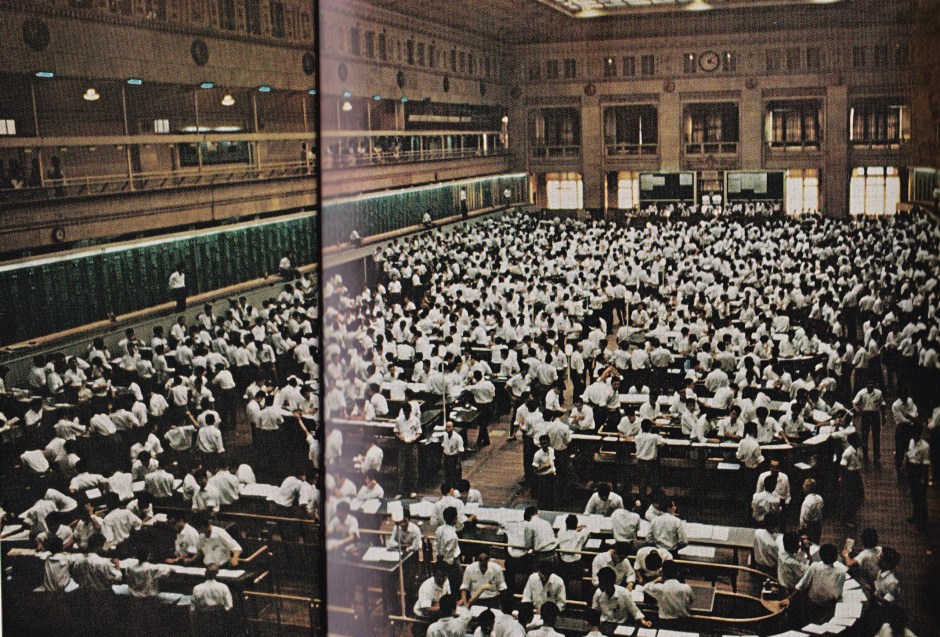
Nat Geo_Tokyo Stock Exhcange
Wall-to-wall carpet of white shirts hides the floor of Tokyo’s Stock Exchange, barometer of Japan’s explosive postwar growth. Some stocks sell for 800 times their 1950 values.
Nat Geo_city official
Shoji Koyama headed the Tokyo Metropolitan Assembly in 1963 sharing administration of the capital with a governor, Ryotaro Azuma. Portraits of past Assembly presidents line a wall of his chamber in the Metropolitan Government Office. Mr. Koyama now serves in the Diet, Japan’s national legislature. Though it includes almost 11 percent of Japan’s population, Tokyo until recently had less than 5 percent representation in the Diet. A revision in apportionment laws has raised the percentage to 7.
NatGeo_crowded train
“Sumimasen – very sorry….” Railway guards in a Tokyo station pack rush-hour cars to bursting with hapless commuters. Skyrocketing population threatens to cripple the Japanese capital; even now its 10,500,000 residents make it the world’s largest city. Long-suffering Tokyoites joke grimly about their city’s “crush hour.” Miraculously, scenes such as this morning jam a the Shinjuku Station produce few injuries.

Tokyo is not a city. Tokyo…is an explosion.

The crowds, the traffic, the lights, the smog, the noise, the peace, the plenty, the interplay of East and West, the exotic…. William Graves, staff writer for the monthly magazine, National Geographic, stayed in Tokyo for weeks if not months with cameraman Winfield Parks in an attempt to paint a picture of Tokyo in 1964 with words and photos.

Tokyo is not easy to love at first sight. In daylight, from the air, it resembles an enormous coffee stain, blotting the green velvet of the surrounding farm country. Seen from the ground, it lies blurred under layers of smog – a city wrapped in soiled cotton wood.

At night, however, Tokyo bursts through its somber wrapping. Then the city is aflame with neon, its low hills pulsing like great beds of coals, with crimsons, lavenders, greens, and golds of flashing electric signs announcing nightclubs, coffee bars, truck tires, television sets, cameras – everything that Tokyo owns or makes in some 57,000 factories.

Here are a few of the pictures and words from that National Geographic article, a portrait of an explosion.

Nat Geo_young women in red
Gone are wooden clogs and traditional kimono. Among Japanese young women, high heels and chic-knee-length dresses are everyday attire. Tokyo’s huge Ginza department stores tempt shoppers with top European designs. Copies in inexpensive Japanese cottons and rayons have all but driven classic styles from sight. Young Tokyo saves the conservative kimono and sashlike obi for ceremonial days or family occasions. Sign beneath American fashion magazines advertises a gift shop called “Yours.”
Nat Geo_smoggy Tokyo Harbor
Curtain of smog over Tokyo Harbor gives a coppery cast to the waterfront, one of many centers for the Japanese shipbuilding industry, now the world’s largest. Desperate for living space, Tokyo dumps its fresh trash into the bay and covers it with soil to create new land.
Nat Geo_danchi
Like immense cinder blocks, low-cost apartment houses rise amid factories and oil-storage tanks. Danchi, as Tokyoites call the developments, ease the crushing pressure of Tokyo’s housing shortage. Families with moderate incomes may rent a bedroom, kitchen, and living room for $20 a month.
Nat Geo_the home
Husband enjoys his ease, just as his father did, while wife clears the dishes I their three-room apato. Tokyoites call them and their neighbors danchi zoku – “apartment-house tribe.”
Nat Geo_traffic
Grill-to-bumper flood chokes a Tokyo street. During rush hours it may take half an hour to negotiate a downtown block. Beginners’ tests are strict but, once licensed, drivers develop an individual style. A sharp horn blast signifies, “Look out! I am about to do something extraordinary.”


Nat Geo_cars vs people
Evasive Action lifts a pedestrian clear of the pavement in his dash for safety. Tokyo traffic – dodging risks are high: on the city’s streets, a thousand die in a year.
Avery Brundage_cover of The Four Dimensions of Avery Brundage
Avery Brundage, from the cover of the book, The Four Dimensions of Avery Brundage

The dry weather and powerful winds of California combine to threaten America’s most populous state with frightening wildfires that seem to appear out of nowhere, taking on a violent and devastating life of their own. The fires that suddenly broke out in Northern California on October 9, 2017, have resulted so far in dozens of deaths, and untold financial loss – one of the worst fires in recent memory.

Unfortunately for Californians, wildfires in summer are a potential threat to life and property every year.

On September 22, 1964, a brush fire broke out in the mountains east of Santa Barbara, a city north of Los Angeles. It is also where the then-President of the International Olympic Committee, Avery Brundage, lived. Only weeks prior to the commencement of the 1964 Tokyo Olympics, Brundage was actually in San Francisco, getting ready to leave for Tokyo when the fires began their assault. By the time Brundage got to his home in La Piñeta, the damage to his mansion was done. Here is the September 25 report from AP:

Santa Barbara, Calif. (AP) – A massive, uncontrolled brush fire yesterday killed one firefighter, burned 34 others and left scores of homes destroyed, including the mansions of educator Robert Maynard Hutchins and the Olympic Games’ Avery Brundage.

Some 1,800 firefighters braced for the predicted return of hot wind form the interior – the so-called “devil wind” of California lore. Wednesday night it whipped the fire to spreading fury and caused mass evacuations of more than 5,000 from their homes.

The Forest Service, after helicopter surveys yesterday, reported 78 homes destroyed. They ranged in value from $12,000 to the $100,000 – $200,000 residential palaces in the exclusive suburb of Montecito.

The fire that destroyed the Brundage home_The Four Dimensions of Avery Brundage
The fire that destroyed the Brundage home, from the book, The Four Dimensions of Avery Brundage

Brundage’s home was likely at the $200,000 range. But what caused him particularly heartache was the loss of his art collection. Famed for his expertise in Asian art, Brundage had such a huge collection that he needed to find new homes for it. A good part of it ended up in the Asian Art Museum of San Francisco, which is fortunate, because around a thousand pieces were destroyed in the fire.

As explained in the book, The Games Must Go On – Avery Brundage and The Olympic Movement, by Allen Guttman, staff from the nearby Montecito Country Club, which Brundage owned, were able to save only a few items of his collection, “but the house and almost all of the art treasures in it were destroyed.”

When he surveyed the ruins in person the day after the fire, he told reporters “the whole house was filled with irreplaceable treasures Mrs. Brundage and I collected from all over the world. There were dozens of pieces she particularly liked. And there were ancient Greek and Japanese pottery, Etruscan works, Japanese swords and Roman and Egyptian sculpture.” He was quite naturally, “sick at heart.”

Guttman explained that Brundage’s wife was already in Tokyo awaiting her husband, and that Brundage’s friends in Japan were doing everything they could to keep the news of the fire and their home from her.

Brundage arrived in Tokyo, filled with ambivalence, keeping the sadness at bay from his wife, and preparing himself for the opening of Asia’s first Olympiad.

Guttman wrote of Brundage’s appreciation for Asian philosophies and poetry. This one is by Lao Tzu in his collection of poems The Way of Life:

How can a man’s life keep its course

If he will not let it flow?

Those who flow as life flows know

They need no other force:

They feel no wear, they feel no tear,

They need no mending, no repair

The first home_ of Avery Brundage_The Four Dimensions of Avery Brundage
The home of Avery Brundage destroyed by the fire, form the book, The Four Dimensions of Avery Brundage