Oh to be a child again – to not care what others think, to ask questions randomly and endlessly, to see only friendship in others, and possibility in anything….
And so it is inspirational to me that the Tokyo 2020 Organizing Committee decided to have elementary school children in Japan select the mascots of the Tokyo 2020 Olympic and Paralympic Games. On December 7, 2017, the organizers finally unveiled the top three mascot designs, which will be put to a vote of schoolchildren held from December 11 of this year to February 22 of 2018.
Initially, to my adult eyes, they kind of look and feel similar, perhaps because they are generally all humanoid, and of the same dimensions. To me, the Olympic mascots of candidates A and B are quite similar in their big-eye and big-ear look. But on closer inspection, candidate C is different, with the pronounced application of Japanese fairy tale characters – the fox (kitsune) and the raccoon (tanuki).
Candidate B’s Paralympic mascot is also from Japanese lore, an animated representation of the koma-inu, the lion-dog creature that you often see at the entrance of shrines. Candidate A tries to employ the checkered design of the official Tokyo2020 logo, which to me, feels kind of forced, something a committee member would recommend.
But again, my adult eyes are not the filter – the mascots are for the kids.
Having said that, the finalists in this competition were decidedly selected by adults. As this list of jury panelists show, only adults selected the final three designs. And these were very commercial adults, people who have succeeded in marketing product to children and young adults: experts from toy companies Bandai and Takara Tomy, from comic publishers Shueisha and Shogakukan, children’s book publisher Poplar, game producers Bandai Namco and Square Enix, anime producer Toei Animation and stuffed doll manufacturer Sega Interactive.
So the Tokyo 2020 mascots, when they are voted on by schoolchildren in the coming weeks, aren’t entirely springing from the fertile minds of children. But at least they have a say. The question is – will moms and dads the world over, when the time comes, have a say in whether to buy or not.
Kader Rahman, Sarinder Dillon at Indian Recreation Club in Hong Kong
They were the lowest seeded team, and had already lost their first three matches to Malaysia, Belgium and Canada. Their fourth match at the 1964 Tokyo Olympics was against India, a global field hockey powerhouse and a favorite to win gold.
But somehow, Hong Kong – a team of part-time players, primarily bankers who stayed fit in amateur clubs – held India scoreless in the first half of play. That would be akin to Team USA basketball team being tied 20-20 at the half in an Olympic first rounder against Team Haiti, for example. In the half-time huddle, the India coaches and players must have been scratching their heads wondering why they weren’t trouncing Hong Kong.
In the second half, Honk Kong had lost two of their regular defenders to injuries, and eventual gold medalist India went on to score six unanswered goals to indeed trounce Hong Kong, a team that would go 0-6-1 and place 15th of 15 teams in Tokyo.
But that was OK. After all, the players from Hong Kong were in one sense, lucky to be in Tokyo at all. Sarinder Dillon was left half on that Hong Kong field hockey team, and recalled in late 1963 that there was an outside chance Hong Kong could make the cut for the Tokyo Olympics, so they had better be ready just in case.
Hong Kong was outside the top 16 before the Olympics. But we were told that there was a good chance that one of two teams might drop out, so the president of the Hong Kong Hockey Association told us that training would start in January and that we should turn out. We thought, “this is a golden opportunity.” Hopefully a team or two would drop out, so we had to get fully fit and develop as players.
In the subsequent months, the field hockey teams from France and Poland would drop from the list, allowing Hong Kong’s field hockey team to qualify. Now it was up to the players. “We were 17 players, almost all of us bankers,” Kader Rahman, who played right half, told me.
I worked for Bank of America, others Hong Kong Bank, for example. And in those days, bankers played field hockey in amateur leagues. But when we realized that we had a chance at the Olympics, we worked at our offices from 9 am to 5pm, then took a bus to King’s Park and played a match every night. On Sundays, we played two matches. It was tough training for ten months, and most of the time, we still had not qualified.
Eventually, the Hong Kong Hockey Association selected 30 players from the various clubs for special training, eventually whittling down the team to 17 – all from different clubs. Due to the international nature of Hong Kong at the time, it was a very multi-cultural team with 7 Portuguese, 3 Indians, 2 Pakistanis, 3 Malays, and an Irishman and a Scot – all Hong Kong permanent residents. “When we walked around the Olympic Village with Hong Kong on the back of our jackets, other athletes were amazed at our team make up,” said Dillon. “We had no Chinese on the team as the few who played in Hong Kong were from the lower divisions. We all spoke English, but would sometimes talk to each other in Chinese. This further amazed the other athletes.”
In addition to the training on top of their day jobs, the members of the field hockey team were tasked with raising funds themselves. The head of the Hong Kong Hockey Association, who doubled as the Olympic squad’s team manager, went to many companies appealing for contributions. In the end, each team member was still required to put up a thousand Hong Kong dollars each of their own money to help pay for airfare, as well as the required fee for board and lodging in the Olympic Village.
Since Dillon was a student, he was asked to pay only 130 Hong Kong dollars, which his school kindly covered. But Dillon could not escape other duties required. In early September, weeks prior to the start of the Tokyo Olympics, the Olympic torch made its way through Asia, coming to Hong Kong via Manila. As Dillon was the youngest HK Olympian, he drew the short straw and got assigned midnight guard duty of the Olympic torch, to ensure its safety before it took off for Taipei the next day.
The Hong Kong Field Hockey Team of 1964; Sarinder Dillon seated on the ground lower left, Kader Rahman standing far right
Like the torch, the Hong Kong team made it to Tokyo, enjoying the awesomeness of a global event decades before television and the internet could bring instantaneous news and images to our homes and hands. Sarinder recalls his amazement at seeing his field hockey heroes from India and Pakistan in the Olympic Village, and naiveté at thinking that the song he repeatedly heard was the Olympic theme, only to learn it was the American national anthem.
But feelings of awe and wonder were often muffled by the reality of the Games. From October 11 to 18, Hong Kong lost their first 6 matches scoring only 2 goals to the oppositions’ 25. Their final match was against Germany, a team made up of East Germans that would eventually place 5th in the Olympic tournament. The German team and fans in the stands were expecting a rout, a shut out, based on Hong Kong’s previous matches.
Hong Kong did not comply. They scored a goal in the first half to lead the mighty Germans 1-0. In fact, they led the Germans throughout the match. With minutes to go, the players on the Hong Kong team could taste victory, a moment all underdogs dream of – a chance to shine on the biggest stage of them all.
“We were playing a blinder, out of our usual selves,” said Rahman. But then, Hong Kong, with a mere two minutes to go, was assessed a penalty resulting in a short corner chance for Germany. And when the ball flew through the air towards the line of Hong Kong players, it somehow hit the shoulder of one of the defenders and deflected into the goal. When the final whistle blew, it was Germany 1 – Hong Kong 1.
And that was the last time a team from Hong Kong, of any sport, participated in the Olympics. “Our team was 100% amateur compared to other countries in 1964 we played,” reflected Rahman. “Our results were not great, but we enjoyed our time. And today, our hockey team remains the only team from Hong Kong to go to the Olympics.”
The inaugural ANOC World Beach Games are coming to San Diego in 2019. Wake boarding, beach volleyball, beach wrestling, beach handball, bouldering among many other events will be on display at Mission Beach. Mix sand and sun, with youth and sports and you get something less formal and more participative than the Olympics.
In fact, Chief Executive Officer of the ANOC World Beach Games Sand Diego 2019, Willie Banks, calls it the “anti-Olympics Games – fresh and fast paced, more community based, more of a festival feel.”
I had the opportunity to sit down with Banks in Tokyo as he was in town on business His career path is a model for athletes who wonder what to do after spending so much of their youth training and competing. Banks was one of the premier triple jumpers, breaking the world record in 1985 with a hop, skip and a jump of 17.97 at the USA Outdoor Track and Field Championships, a record that lasted over a decade.
Banks competed at the 1984 Los Angeles Olympics and the 1988 Seoul Olympics. In 1994, he was deputy venue director of the Rose Bowl for 8 games of the FIFA World Cup in the United States, where the finals between Brazil and Italy were held. In 1996, Banks was the director of athletes service at the Atlanta Olympics. And over the years, he has been a consultant to cities bidding to be Olympic hosts. Today, in addition to serving on the executive committee of the World Olympians Association, he runs his own company, HSJ Incorporated, which markets an artificial turf called Fieldturf in Japan and Taiwan.
Banks, who grew up in San Diego, is looking forward to bringing the world to his neighborhood. “The most important part of these Games is that we will have fun and the athletes and spectators will enjoy, which will build a wonderful brand,” he said.
All Japanese were united in ensuring that visiting foreigners left the country believing that Japan was the friendliest country in the world. Of course, in a society built on trust and assumptions that all people are intent on doing good, free riders and scam artists may sometimes think they are the one-eyed-king in the country of the blind. But if you’re going to cheat in such a society, you better be good.
An article in the October 3, 1964 edition of The Yomiuri tells the story of a scam artist wannabe who failed in his scam, but perhaps gained food for thought. Saburo Komuro walked up to a food stall outside in Kamata, and sat down for a hot bowl of “oden” on a cool October evening. He proceeded to mumble his way in explaining that he was in fact an Olympian on the Chinese Olympic judo squad.
The Yomiuri October 3 1964
Of course, the Japanese owner of the stall was very proud to be serving a visiting Olympian, and began to “lavish beer and oden on Komuro,” with complements. How could this food stall owner know that there were no judo competitors from Hong Kong or Taiwan, the only countries at the Tokyo Olympics related to China? Komuro was likely very pleased with himself, enjoying a lovely feast of boiled eggs, fishcakes, daikon in a warm broth, while bringing joy to this hard-working food stall owner.
But sometimes, anything that can go wrong, will go wrong.
A person who was actually Chinese sat down at the oden food stall. When told that he was sitting next to an Olympian from China, he immediately began talking in Chinese to Komuro, who of course couldn’t understand a word. It quickly dawned on the food stall owner that this was no Olympian sitting in front of him, only a fraud. A fight ensued, and in a weird twist, Komuro took off to the police box to explain how he had been wronged, only to be arrested.
Theo Ted Mittet, Dick Lyon, Geoff Picard, Ted Nash at Toda Rowing Center; from the collection of Theo Ted Mittet.
Catch. Drive. Release. Recovery. The four phases of the rowing stroke are simple. The ability for more than two people at a time to execute them in synch is not.
When the straight four crew from the Lake Washington Rowing Club arrived in Tokyo for the 1964 Summer Olympics, they were in synch and they were ready. “We believed we had a great chance to win gold,” reflected Theo (Ted) Mittet), who sat in the bow.
As Dick Lyon, who sat in the number two seat in front of Mittet in the shell, told me, after winning the US Trials, the team of Ted Nash, Phil Durbrow, Lyon and Mittet were running very fast times – doing 500-meter sprints in 1 minute 27 or 28 seconds, which was better than the times Nash’s gold medal winning team at the 1960 Rome Olympics.
Left, Geoff Picard and Bob Schwartz of the Harvard crew and Theo with back to picture, in the Tokyo Olympic dining hall; from the collection of Theo Ted Mittet.
When the crew from America lined up against Great Britain, the Netherlands, Argentina and Italy, they were raring to go. The stroke, Nash, got Team USA off to a flying start, and at the halfway mark of 1,000 meters, Nash and his team were “open water,” (more than a length) up on second place Britain. The Americans had, what they call, swing. Until disaster struck.
As Nash recalled in Peter Mallory’s book, The Sport of Rowing, with the US shell comfortably ahead, the rower behind him, Durbrow, suddenly coughed up blood on and over Nash’s right shoulder. Lyon told me that at the 1,200-meter mark, the boat suddenly turned sideways, and he could see that Durbrow was having trouble breathing. “He was swinging in his seat and he had no power in his arms,” said Lyon. Here’s how the situation was described in Mallory’s account:
Nash: The boat slowed and we stopped. We came to a complete stop. Then Phil said, “I’m okay. Let’s go.” We were screaming by everybody once again, but Phil had a second episode of blood loss, and the guys in the bow, who could see his condition, yelled down to me, “Phil’s really hurting. Please paddle.”
Mittet: I remember the absolute disbelief of watching Phil’s blade falter. How could this be? What was wrong? Our feelings and concerns shifted totally to Phil in an instant – we knew that this was serious.
This was a disaster. The coxless four from the USA still managed to cross the finish line. In fact, they completed their heat with a time of 6:56.40, over 5 seconds ahead of the Netherlands. Britain finished first and advanced to the finals, but because Nash’s team recovered enough to finish, they were still eligible for the repechage, a second chance for all the crews that did not finish first in their heat.
And yet, Durbrow was in the hospital. The team that only magically came together after trying countless variations of 17 different people, was now forced to re-make the team with an alternate, Geoff Picard, who was in Tokyo for just such a scenario. With the finals only two days away, Nash’s straight four were no longer expecting to win gold, and were feeling that a medal of any color would be wishful thinking at best.
And yet, expectation and reality, as they saw, and would eventually see, are often at odds. In the case of the LWRC coxless four, recovery followed quickly upon release.
Nash, Picard, Lyon and Mittet in Tokyo; from the collection of Dick Lyon.
Ted Nash, Phil Durbrow, Dick Lyon and Ted Mittet in Seattle; from the collection of Dick Lyon.
It didn’t bode well in New York.
Four men from the Lake Washington Rowing Club (LWRC) in temperate Seattle came to hot and muggy New York to compete in the US rowing trials on August 29, 1964.
Ted Nash was the veteran and star of the crew of the straight four without coxswain. He had won gold for the United States in the straight four rowing competition at the 1960 Rome Olympics, the only American team to win gold. Dick Lyon, Phil Durbrow and Theo (Ted) Mittet filled out the boat, coming together in a very short time to compete in Tokyo for the 1964 US Olympic rowing squad.
But first they had to win the trials, held at Orchard Beach Lagoon in New York.
At the US rowing trials at Orchard Park, New York, kneeling in front of teammates: Ted Nash, Phil Durbrow, Dick Lyon and Theo (Ted) Mittet; from the collection of Dick Lyon.
According to Stanford University rower, Lyon, the crew from LWRC got in a practice start with a team from the Detroit Boat Club, just before the heats were to begin. Ted Nash broke the edge of his oar blade on one of the maple flagpoles floating on Styrofoam that formed the lane lines. “We barely made it back to the line in time after sprinting back to the NYAC boathouse to get another oar,” Lyon was quoted in the book, The Sport of Rowing, by Peter Mallory.
After winning their heat, Lyon told me that as the team was preparing for the final, Mittet said quite urgently that he had to pee, which meant that he had to sprint 100 yards to the boathouse, and then another 100 yards back. Mittet made it back to the line in time for the start, and they got in a couple of hard sprints in just before engaging in one of the toughest physical activities one can do – 2,000 meters of rowing to absolute exhaustion.
Rowing as a team is very difficult. It’s not a matter of getting the best rowers together in a shell and expecting them to perform. It’s more a matter of finding a group of rowers that feels a rhythm, that leads to a seemingly effortless flow, and results in unchained speed.
Durbrow was in Laos with the US Army when he got his orders to report to Stan Pocock in Seattle. Pocock was the coach of the Lake Washington Rowing Club and Durbrow’s coach at Menlo College and Melbourne Olympian, Duvall Hecht, had strongly recommended Durbrow. When Durbrow arrived in Seattle, he felt like the odd man out. Pocock was looking for the men who would build a powerful crew of eight, as the eights are the heavyweight class of rowing, and thus the glamour event in rowing competitions. Durbrow joined 16 others who were already competing in two squads of eights, wondering where a 17th would fit in.
And yet, try as he might, Pocock could not find the right mix of eight, his teams losing to squads that were not Olympic quality. So in early July, Pocock agreed to disband the crews of eight so that the rowers could find the right combinations of pairs and fours. Nash quickly grouped with Lyon, and when Durbrow got on the scene, they found a natural to sit behind Nash, the powerful stroke. So Nash, Durbrow and Lyon would try any and every combination of the remaining 14 rowers at Lake Washington, and met mainly with disappointment.
Mittet, who grew up on the shores of Lake Washington, and had rowed from the age of 16, was late to the LWRC trials. By the time the eights were disbanded, most of the small boat team decisions had already been made, except for the straight four. But when Mittet jumped into the shell with Nash, Durbrow and Lyon, “from the first stroke, I was awakened to a level of rowing that I had never imagined possible,” as Mallory quoted Mittet as saying. Mallory also quoted Durbrow as saying, “we were trying every conceivable combination of oarsmen in a number of fours that went out every day. Boats that I expected to be super fast felt heavy or ungainly, but one time, Ted Nash, Ted Mittet, Dick Lyon and I went out together with Nash stroking, it felt light and quick.”
The three would continue to experiment with other rowers to sit at the back of the scull, but whenever they rotated to Mittet, they found their rhythm and speed again. After countless combinations, Nash made the decision at the end of July to add Mittet to complete the team of four, and commit to getting ready for the Olympic trials to be held 6 weeks later.
When Nash and his three teammates got to New York for the Olympic trials, they felt confident. Lyon told me that the game plan was to explode off the start with a powerful 40-plus stroke per minute rhythm, and then to ease down to 35 or 36 after a minute, which is about 350 meters of the 2,000-meter race. But Nash, who sat at the stern of the boat as the stroke, the rower who sets the pace, decided to maintain a high pace. Lyon said that for the first 1,000 meters, the crew kept the pace around 39 strokes. “We had never practiced for that long,” Lyon told me. “I don’t remember that we talked about this, but Ted is an extraordinarily enthusiastic person, so we just kept it up for the first 1,000 meters.”
The crew of Nash, Durbrow, Lyon and Mittet won handily, beating the Harvard crew by nearly 3 seconds with a time of 6 minutes and 23.1 seconds.
From the collection of Dick Lyon.
“We were extremely fit,” Lyon said. “We were doing two or three workouts a day, including work outs with weights, running stairs. There were naps in between those thousands of miles of rowing.”
The team was confident. The rowed together exquisitely. The handily won the US trials. They believed they had a great chance for gold in Tokyo. And yet, they heard some great times coming out of Europe – 6 minutes and 19 seconds in one case.
And of course, there is always the unexpected. A shocking turn of events awaited the straight four team in Tokyo.
1964年、ザ・ビートルズはアメリカを席巻する。彼らの前途は、そしてどこまでも続くその成功は、誰からの助けも必要としていなかった。彼らの記者会見からもわかる事がだが、彼らの宿泊先での悪ふざけ、エド・サリバンショーへの出演や、ワシントンDC・フロリダへの旅といったリバプールから来たこの4人の若者は、アメリカ人が一緒に街へ繰り出したいと願う友の様な存在であった。ロン・ハワード監督の映画、「The Eight days a Week」に映るのは、ジョン、ジョージ、ポール、そしてリンゴの4人が、共に過ごす時間を心から楽しんでいる姿である。
1964年、ブルガリアの走り幅跳び選手として東京オリンピックに参加していたダイアナ・ヨーゴバは、私に宛てた手紙の中でこう話している。きつい練習の合間に取る休憩時、彼女は女子寮の中にあったミュージックホールへ行き、好きな音楽を聴いた。彼女のお気に入りの一つが「With the Beatles」というアルバムで、これは1963年11月に発売されたものであった。傍らで行われている生け花レッスンを横目で見ながら、そこから漂う花の香りを楽しみつつ、彼女はお気に入りの曲を聴いた。All My Loving, Please Mister Postman, Hold me Tight, I Wanna Be Your Man.
I was fortunate to enjoy a walking tour of Meiji Jingu (aka Meiji Shrine) through my university alumni group on a beautiful autumn Saturday morning recently. We were led on the tour by a Shinto priest at Meiji Jingu, Taisuke Kadosaki, who provided a wonderful description of the shrine’s history and customs as we ambulated through what is often called the lungs of Tokyo.
Here are a few of the fun facts gained on the tour:
Omotesando: a street akin to the Champs-Élysées in Paris or 5th Avenue in New York, Omotesando leads up to Meiji Jingu, and literally means “the entrance of the path to the shrine.”
80,000 Shinto Shrines in Japan: Most shrines in Japan are over a thousand years old. Meiji Jingu is yet to turn 100.
Kami: Shinto shrines are places to pay respects to “kami,” translated as a mixture of such words as spirit, angel, or deity of nature, things or people. There are kami for the wind, for rice, for rivers and for emperors. For example, famed anime character Totoro is a tree kami. The kami at the heart of Meiji Jingu is Emperor Meiji, who died in 1912.
Not Quite Nature’s Handiwork: In 1916, work was begun for a shrine dedicated to Emperor Meiji after his death. Over 100,000 trees from all over Japan were transplanted in a desolate part of Tokyo called Yoyogi. In other words, the woods inside Meiji Jingu – a symbol of Japan’s love for nature – is completely man made.
Pointing to Amaterasu, the Sun kami.
Sake and Rice: On the shady peaceful dirt path through the woods on the way to the shrine halls, you see barrels of sake on your right and casks of wine on your left. Sake is made from rice, a staple of Japan, and was granted from the sun kami, Amaterasu at the beginning of time. Rice and rice wine are two key offerings to “kami”. The casks of wine represent the modern era Emperor Meiji helped usher into Japan.
Red Wine: In the late 19th century and early 20th century, Emperor Meiji opened up Japan to the West with treaties, Western clothes, and wine. In fact, when his doctor informed the Emperor that he had diabetes and should diminish his sake intake, the good doctor recommended red wine in its place. Once the wineries of Burgundy in France heard about that, they sent bottles of their best red wine to Emperor Meiji every December.
A Most Popular Place After New Year’s Day: In 1920, Meiji Jingu welcomed 500,000 people when it opened. Every year, 10 million people visit Meiji Jingu, the first 3 million in the first three days of the year coming to make wishes for the new year.
100th Birthday: In 2020, Meiji Jingu will have its 100th birthday. It is currently going through a renovation, the most apparent part is the re-plating of the copper rooves of the shrine’s halls. What most people will remember are light green rooves, the product of copper oxidating over decades. The very day of our tour, the roof of the main hall was uncovered, displaying a bright and shiny copper finish.
Put Your Name on Meiji Jingu for 3,000 Yen: If you want to help finance the renovation of Meiji Shrine, you can donate JPY3,000 for a copper plate that will adorn the roof of one of the halls of the shrine. On one side of the plate, you can write your wish for the future and your name.
My tiny bit of Meiji Jingu.
One of the wonderful insights shared by Kadosaki-san on the tour was about the Japanese, and whether they are religious or not.
“Many Japanese will say, ‘I’m not religious’. But in reality,” Kadosaki-san told us, “our daily lives are very close to Shinto.” He then cited several examples:
Children dressed up for Shichi-Go-San and new-born babies are brought to shrines to celebrate their growth and health
Cars are brought to shrines to be blessed.
Weddings are held at shrines. In fact, eighteen wedding ceremonies were scheduled the day of my tour.
Kadosaki-san also explained that from the moment the sun rises, people are sweeping the shrine grounds, cleaning floors, and wiping rails and handles. Washing the hands and rinsing the mouth inside the shrine grounds is also a custom. If you assume Japan is a culture of cleanliness, it’s possible this culture emerged from the practices and beliefs of the shrine.
If you’re in Japan, or planning a trip, you may want to visit peaceful and rejuvenating Meiji Shrine, or one of the other 80,000 shrines in Japan.
For a more detailed explanation of Kadosaki-san’s description of Shintoism and Meiji Jingu, click here.
Paul Maruyama is an Olympian, a member of the judo team, representing the USA at the 1964 Tokyo Olympics. Paul Maruyama is also an author, and the story he has to tell is personal…and incredible.
This is the story of the approximately 1.5 million Japanese who were essentially abandoned in the northern part of China, then called Manchuria, after the Pacific War. Overrun by the military of the Soviet Union, which had just declared war on Japan, Japanese military men and civilians alike were rounded up and sent to labor camps in the Soviet Union, while women and children were left in highly insecure and unsafe circumstances, including robbery and rape.
Maruyama wrote about this time in history because his father actually played a major role in ensuring safe passage of the 1.5 million Japanese in China back to Japan. In his book, Escape from Manchuria, Maruyama tells the incredible story of how his father, Kunio Maruyama, and his friends, Hachiro Shinpo and Masamichi Musashi worked together to get to Tokyo and meet General Douglas MacArthur, and convince him to send military ships to China and repatriate their countrymen.
When producers from NHK, the giant government broadcaster, read the Japanese version of Paul Maruyama’s book, they recognized the incredible human drama amidst the geo-political churn of post-war China and Japan, and decided to produce a two-part dramatization of those events.
On consecutive Saturdays of March 24 and 31 of 2018, NHK will broadcast their dramatized version of “Escape from Manchuria.” The Japanese title of the drama is “Doko ni mo Nai Kuni,” which I suppose can be loosely translated to “A Country that is Nowhere.”
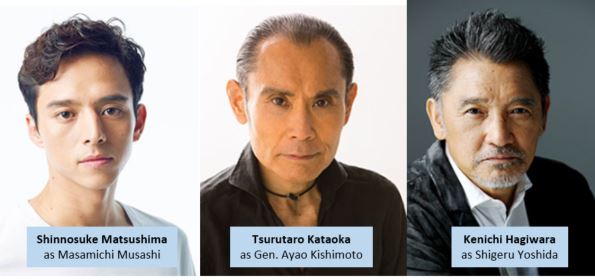
In addition to filming in China, NHK has invested in talent, recruiting some of the biggest names in Japanese television and film. Seiyo Uchino (内野聖陽) will play Paul’s father, Kunio Maruyama, while Yoshino Kimura (木村佳乃) will portray Paul’s mother, Mary Maruyama. Other well known actors like Taizo Harada (原田泰造), Misako Renbutsu (蓮佛美沙子), Shinnosukke Matsushima (満島真之介), Tsurutaro Kataoka (片岡鶴太郎), and Kenichi Hagiwara (萩原健一) fill out the all-star cast.
Prior to a recent trip to Japan, Maruyama made a sortie to Shanghai, China, where he was able to observe filming on a studio lot. A street was re-created to look like a Japanese community in Shenyang, complete with store front signs in Japanese and Chinese, filled with despairing Japanese citizens, and aggressive Russian soldiers. Maruyama, who was in Manchuria with his family at the age of six, took on the scene with wonder and pride, filled with emotion.
“When I see this set and the recreation of streets of Manchuria, the actors, all the extras, the staff, here because of a book I wrote, it’s kind of overwhelming. But I’m happy because we’re able to tell a part of Japanese history that is not well known.”


 I had the opportunity to sit down with Banks in Tokyo as he was in town on business His career path is a model for athletes who wonder what to do after spending so much of their youth training and competing. Banks was one of the premier triple jumpers, breaking the world record in 1985 with a hop, skip and a jump of 17.97 at the USA Outdoor Track and Field Championships, a record that lasted over a decade.


You must be logged in to post a comment.