This is part two of the photographs taken by Dick Lyon, member of the United States rowing team. After his four-man coxless team won the bronze medal at the Toda Rowing course, Lyon had the time to walk around Tokyo with his Bronica Camera. Here are a few of them:
Outside a candy store – It’s a common story during the 1964 Olympics: the best athletes in the world visibly sticking out in homogenous Japan, particularly those who hovered around 200 cm tall. Lyon’s rowing teammates, who joined him in these perambulations around the Olympic Village in Yoyogi, were no exception. Here is Lyon’s rowing mate, Theo Mittet, with two giggling women from the candy shop. Note Mittet’s fancy footwear.
A pub in Tokyo that appears to be connected to a racetrack – The signs appear to list names of horses and jockies. These “taishyuu sakaba” were low-cost drinkeries for the everyday salaried worker, whom, I suppose, had a love for the horses. This one lists all items as selling for 100 yen, or some 28 cents at the time.
A man studying the horse racing data of the day – This image of intent concentration belies the fact that the Japanese government ultimately decided that this form of gambling was a necessary form of recreation for the average citizen, as well as the well as the tax revenue it generated. The Japanese government thought briefly in the early 1960s about banning such forms of gambling, but thought better of it, according to this report.
Shimbashi Station – In 1964 and today, this was the hangout for salarymen where they ate and drank in the many tiny eateries underneath and near the train tracks.
Ginza and the San Ai Building – In 1964 and today, Ginza is the upscale shopping area of Tokyo, and has for a long time been considered the most expensive real estate in the world. A symbol of Ginza glitz and glamor has been the San Ai Building, a glass tower that has gleamed electric light since it opened in 1962, a couple of years before the Olympics.
A View from Tokyo Tower – In 1964, the Tokyo landscape around Tokyo Tower was flat. And yet, my guess is that 19 years before, at the end of the Second World War, after enduring considerable firebombing by allied planes, the landscape would have been considerably flatter. In less than two decades, Tokyo was re-built and transformed, a miraculous revival for the world to see.
Dick Lyon was in Japan for the 1964 Tokyo Olympics, and was a member of the bronze-medal winning team of the American coxless fours. And after a tense week of competition in the week of the Tokyo Olympiad, Lyon had a week to enjoy the Olympics as a spectator, and Japan as a tourist.
Lyon and his friends ventured into a public bath, bought sweets in a Ginza boutique, got around in subways and taxis, took the newly-launched Bullet Train to Kyoto, and climbed Mt Fuji.
Like so many athletes, Lyon bought a camera – a Bronica SLR, from a company called Zenza Bronica, founded by Zenzaburo Yoshino. Yoshino was fascinated by photography and cameras, and started a small camera store in Kanda, Tokyo, selling foreign cameras.
Eventually, Yoshino’s business became very popular among GI’s during the Allied post-war occupation of Japan. With profits from his store, Yoshino invested in a factory to manufacture luxury watch cases and lighters. Soon after he was also manufacturing cameras of his own design, the Bronica.
Lyon shared with me some of the pictures he took with his Bronica, a fascinating look into a time capsule from 1964.
Children on a street in Tokyo – It’s late October, and undoubtedly a tad chilly, but kids in Japan, then and now, are commonly seen wearing shorts in the Fall.
A little girl skipping rope – no social commentary here, just a wonderful shot of a girl having a fun time!
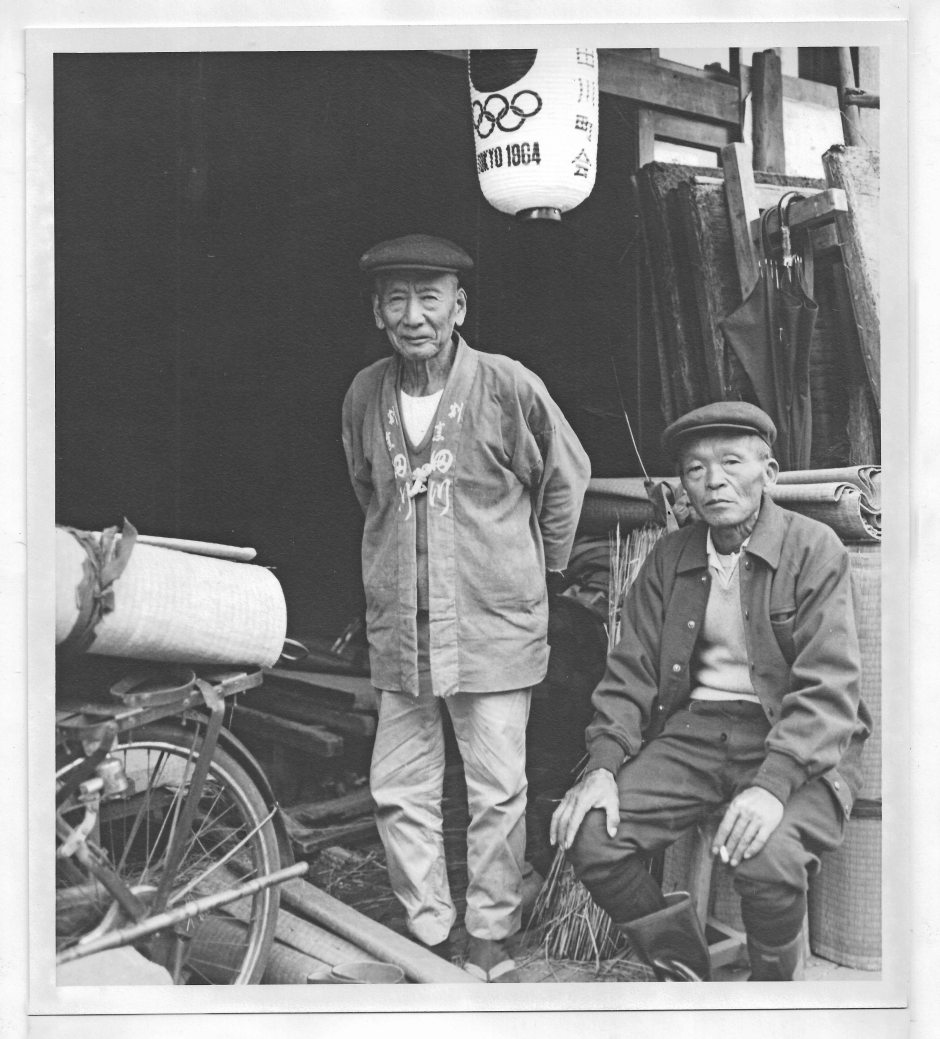
Two elderly gentlemen in Tokyo – this is likely in front of a small light manufacturing operation or repair shop, with two members of the commerce association of some town in Tokyo called Tagawa. I love the Olympic lantern – would love to find one that still exists!
A bricklayer at work – A wonderful shot of a day laborer, likely prepping the façade of a building for a set of steps, as an elderly lady looks on.
A day laborer taking a rest – This somewhat elderly man is wearing the shoes of the farmer or construction worker: the “tabi,” with its distinctive split-toe design. Since this is Tokyo, he was probably employed in construction. The hat, however, is a nice touch.
A man on his “Ri-ya-kaa”– Here’s a gentleman who owns his own business, or works for a business that needs to transport heavy items, like alcohol bottles, sacks of rice or bags of vegetables. This vehicle is called “ri-ya-kaa” based on an extrapolation of an English word: “side car”. The side car is the carriage that you sometimes see attached to a motorcycle. The Japanese figured if you can call that part a “side car”, then attaching something similar to the back could be called a “rear car”. (I didn’t know this!)
Billy Mills at the University of Kansas, from the collection of Billy Mills
It was a very hot day, and I was running in the back of the pack. As I came by Easton he said, “Billy, get up where you belong; get up in front.” Another lap went by, and I heard him say, or I thought I heard him say, “Get up where you belong or get off the track.” And I thought, You know, there’s a third way to do this, and it’s my way. I’m a senior in college. I can do it my way, which is to run in the back and come up slowly.
When Easton said that again, I walked off the track. He sent for me and said, “Why did you quit?” I answered, “Coach, I didn’t quit. You said to get up in front or get off the track. I got off the track.” “You quit,” he said. All the pressures I was feeling I took out on this man who was really trying to help me. By walking off the track I may have appeared to be protesting against my coach, but in reality was protesting against society. I don’t think he ever understood that.
Billy Mills, who would later take the world by surprise at the 1964 Tokyo Olympics, was an angry young man, as you can tell from his own words, published in the book, Tales of Gold. A Native American of the Lakota tribe, he developed into such a strong distance runner that he earned a scholarship to the University of Kansas. As described in a previous post, Mills struggled with the transition to life outside the reservation.
Coach Bill Easton
Bill Easton was the coach of the track team at the University of Kansas. During Coach Easton’s tenure at KU, from 1947 to 1965, his track teams won 39 conference championships, including eight years in a row from 1952-1959. By the time Billy Mills met the KU coach, Easton had the supreme confidence that comes from consistently winning. And yet, Mills and Easton were like oil and water. Mills felt that Easton was a symbol of all the barriers society threw in his face, and after the altercation described at the top of this post, Mills quit the track team.
I had a love-hate relationship with Easton. I wanted to please him, but I wanted to do things my way, the way I knew was best for me. And the hostility that grew out of all the blatant and subtle rejections that society was throwing at me I took out on him, and he really had no idea I was doing that. I was trying to find answers to questions I couldn’t even express, and my coach was not a sociologist or a psychologist. He couldn’t determine where I was coming from. So during my years at Kansas my track career languished.
After getting his degree in education, Mills joined the United States Marine Corps, and moved to the Marine Corp Base in Virginia, called Quantico, where he was immediately asked to join the track team. It was there he met former Annapolis track coach, Earl “Tommy” Thomson. Thomson was a gold medalist in the 110-meter hurdles, representing Canada at the 1920 Antwerp Olympics. But more importantly, as Mills told me, Thomson was a mentor.
Coach Easton, he broke me. Tommy Thomson, he was my mentor. He was totally deaf. He would read lips. He was the first white man I ever trusted. He helped me. He came up to me and said, ‘I don’t want to coach you. I’d like to be your mentor. But you have to let me inside,’ he said, holding his hand near my chest. I learned that word, ‘mentor,’ from my dad. He’s saying this in a gentle way. I believe the creator sent him to me because he’s talking like my dad.
In the exchange below, Mills is explaining to me that Thomson had a way of dealing with Mills’ sensitivities, and asking the right questions to get to the truth.
Thomson asked me, ‘what you do you want to do?’ I said ‘I want to go to the Olympics.’ He said, ‘Why the Olympics?’ I said, ‘Don’t you think I can?’ I’m defensive. He asked, ‘What do you want to do at the Olympics?’ I said, ‘Win a medal.’ He asked, ‘Why a medal?’ I replied, ‘Don’t you think I can?’ He said, ‘Which medal?’ I said to him, ‘I want to win the gold medal.’ He said, ‘Now we know.’
In the summer of 1964, Mills is running well approaching the Olympic trials. But in a race prior to the trials, Coach Easton is in the stadium. And for Mills, all he has to do is see Mills and he turns into a confused cacophony of emotions. He said that he confronted Easton and made it clear he did not want to see or hear him. “I cannot run in your presence. I could do well in Tokyo, but if I hear your voice, I will drop out.”
Billy Mills Crossing the finish line, from the book Tokyo Olympiad 1964_Kyodo News Agency
Easton stayed away. Mills went to Tokyo, and seemingly out of the blue, went on to become the first and only American to win the 10,000 meter race at the Olympics.
A day after the winning the gold medal, a Japanese woman came up to Mills with a letter, and asks him to open it. The letter was from Coach Easton.
Dear Billy, I saw the greatest race of my life. You are the greatest Jayhawker of all. It was an honor to coach you.
The woman then pointed out Easton, who had made the trip to Tokyo. “When I saw him, we grabbed each other and cried.”
White House Menu 1964_from the collection of Dick Lyon
You’re at the White House, enjoying Breast of Chicken Georgina, Rice Pilaf and Eggplant Provençale. You’re seated at the table with Lynda Johnson, the daughter of the most powerful man in America at the time. But you’re also chatting at your table with some of the greatest athletes of 1964.
This is where Dick Lyon, bronze medalist in the coxless fours, found himself on Tuesday, December 1, 1964, at a fete for the US Olympic Team medalists who competed at the Tokyo Olympiad several weeks earlier, hosted by President Lyndon B. Johnson.
“We didn’t shake hands with President Johnson,” Lyon, a rower from California, told me. “He was probably meeting with General Westmoreland, or someone. It was a busy time for them. But we got to shake hands with the vice president, Hubert Humphrey.”
Dick Lyon with his bronze medal_from the collection of Dick Lyon
In addition to the president’s daughter and a staff member of the White House, those seated at Lyon’s table were some of the most celebrated athletes of the Olympics: 10,000 meters gold medalist Billy Mills, fastest man-in-the-world gold medalist Bob Hayes, 110-meter hurdles champion Hayes Jones, double-gold medalist swimmer Donna deVarona, as well silver and bronze medalists in the modern pentathlon, yachting, and shooting.
Lyon shared with me a picture of the actual menu, which he passed around the table for their signatures. Here are the names of those at Lyon’s table, just in case you aren’t experts in graphology.
This is Part 2 of a breakdown of the amateur film by George and Lilian Merz.
The Merz’s, who won an award for their summary of the XVIII Olympiad in Tokyo, stayed primarily around the National Stadium, so their view of the Olympics was primarily track and field. But on occasion, they trained their cameras at events outside the National Stadium, as well as on non-sporting events. Their footage of the ceremonies have been more effectively captured elsewhere, but their human interest forays are interesting at times.
US Team Opening Ceremony
Opening Ceremony: 1:25 – It’s the Opening Ceremony at the National Stadium on October 10, 1963. At the 3:12 mark, the US team enters the stadium. The men on the US team are wearing cowboy hats, and it appears that is all you see in their sea of members. The women however aren’t wearing any hats. President Johnson, who is believed to have had the hats sent to the Olympians, probably didn’t think it was appropriate for women to wear these cowboy hats. What struck me was how small the female crowd was. When I looked it up, of the 346 people on the US Olympic squad, only 79 were women. And many of them were likely swimmers who had to compete in the next few days, so were likely not allowed to march in the opening ceremony. Interestingly, the men who dominated the US sailing team brought up the rear, not in cowboy hats, but in sailor caps. Also great footage of the balloon released, the Olympic flag raised and the cauldron lit, in a jam-packed stadium. At the 8:36, Merz has footage of the Emperor and Empress of Japan in the stands!
Huckster Girls: 12:25 and 13:56 – That’s what Merz calls the women selling food and drink in the National Stadium. I can’t tell what snacks they were selling, but they were selling a bottle of Coca Cola for 50 yen. At 360 yen to the dollar, that’s about 13 cents!
Nature Boy: At the 14:32 mark, Merz films an unusual looking Japanese man outside the National Stadium, whom he dubs “nature boy”. He’s bald headed and bare chested, except for a sash, and holding a banner. The sash says “Make Your Body as Naked as Your Face!”. His banner basically says the same thing, further emphasizing that nudity is healthy, and that he belongs to some sort of nudist association. In modest Japan, this is the last thing I would have expected to see in this documentary.
Rain Rain Rain: You can see at the 17:16 mark a sea of umbrellas. On certain days, it simply rained through the day.
Press Seats and TV Monitors: As you can see at the 16:44 mark, the press section in the National Stadium had little TV monitors so that the press could watch the action up close.
Eating Bento: I don’t know what the guy is eating, but I’m sure it was good! At the 23:16 mark you can see the spectators sitting on wood-slat benches, and this particular man enjoying a bento. He appears to be sitting in a covered section of the stadium too.
4×100 Swimming Relay Men’s: 5:26 – The Merz’s visit the National Gymnasium and fil the second heat of the men’s 4×100 swimming relay, which the Americans win handily.
Field Hockey Men’s: 25:24 – The Merz’s take a break from the National Stadium and head to the Komazawa Stadium to watch a field hockey match between Germany and Kenya.
Basketball: 25:48 – The Merz’s then head to the National Gymnasium Annex to see men’s basketball. Unfortunately, the footage is too dark to tell which players are from which countries.
Closing Ceremony: 27:38 – And finally, here was footage of the closing ceremony. The film is dark, but you can see the Olympic flame extinguished – a blurry light extinguished, the Olympic Flag lowered, to be send to Mexico City, and an fireworks display to cap off an incredible two weeks.
It is so hard to find footage of the 1964 Tokyo Olympics, beyond a few newsreel samples and clippings from Kon Ichikawa’s documentary of the 1964 Olympiad. One of the few, great samplings of footage from the 1964 Olympics is a film produced by George and Lilian Merz, amateur filmmakers.
Not only do you get to see a few great events and athletes, you get a feel for the atmosphere in Tokyo and in the stadiums.
Part 1 of this breakdown of the Merz’s documentary focuses on the athletes and the competitions. Part 2 focuses on the opening and closing ceremonies, as well as things happening beyond the cut-throat world of high performance competition. The numbers below are the minute marks of the video where you can find what I am describing.
Track
100-Meters Men’s: 8:51 – Watch Bob Hayes in the first semi-final heat of the 100-meter spring in lane 6. You can see Bob Hayes again at the 24:33 mark in this exciting 4X100 meter finals, with Hayes coming from behind to win gold for the US handily.
100-Meters Women’s: 14:17 – Wyomia Tyus wins 2nd heat of 100-meter sprint in a spirited race.
200-Meters Men’s: 15:50 – Here’s great film of the finals of 200 meter dash, American Henry Carr, pouring it on at the finish
400-Meters Women’s: 16:14 – At this mark, you can see Australian Betty Cuthbert beat Brit Ann Packer in the women’s 400 meters final
80-Meter Hurdles Women’s: 17:56 – Men and women run hurdles on a slick track. The Merz’s show footage of a Canadian woman being carried off the track. They call her “Miss Wengerson”, but I suspect it is someone named Marion Snider of Toronto, whom I wrote about here. The film returns to the women’s hurdles at the 20:44 mark.
Female hurdler carried off the track after the 80-meter competition
Women’s Pentathlon: 12:08 – Here is the 80-meter hurdles part of the pentathlon
400-meter Hurdles Men’s: 13:59 – Watch American Rex Cawley win in the 400-meter hurdle finals
800-Meter Women’s: 21:45 – Great footage again of the women’s 800 meters final, with Ann Packer taking gold, coming from behind to win.
1500-Meter Men’s: 23:27 – Here we can see double-gold-medalist, New Zealand’s Peter Snell, winning the men’s 1500, going from last to first. The race started in misty, low visibility conditions, but by the end of the race you can see Snell victorious by 10 meters.
3,000-Meter Steeplechase Men’s: 10:38 – Great footage of a 3k steeple chase heat
5,000-Meters Men’s: 18:31 – Great film of the rain and slick track that Bob Schul and other 5000 meter runners had to deal with, as well as Schul’s great streak at the end to win gold.
10,000-Meters Men’s: 6:30 – The Merz’s spend their greatest length of footage on the incredible 10,000 meter race, which Billy Mills won in a surprise finish. The film goes on to show IOC president, Avery Brundage, awarding Mills with his gold medal, kimono-clad medal bearers behind Brundage.
Pole Vault Men’s: 9:13 The Merz’s spend time watching pole vaulters warming up and practicing, with a bit of slo mo.
Discus Throw Men’s: 11:18 – Here’s footage of the men’s discus competition, including US Olympic legend, Al Oerter.
Triple Jump Men’s: 12:40 – Watch triple jumpers Labh Singh of India, and slo mo of Ira Davis of US
Javelin Women’s: 13:30 – See a few throws in the women’s javelin
Shot Put Men’s and Women’s: 15:11 – Footage of the men’s shot put finals, including gold medalist Dallas Long; with the women’s shot put at 21:19
Shot Put Women’s: 19:48 – Day Five brought great weather, and the Merz starts with women’s discus throw. You can see the only American women’s shot putter, Olga Connolly, at the 20:19. For some reason, Merz calls Connolly Polish born, when actually she was born in Czechoslovakia.
High Jump Men’s: 25:03 – Here’s footage of the men’s high jump competition, featuring Valery Brumel and John Thomas.
Hammer Throw Men’s: 17:28 – Rain dominated Day Five, with rain hammering the fans as the hammer throwers slipped around their ring as they tossed their hammers
Equestrian Jumping: 26:18 – Here’s something I hadn’t realized. One of the equestrian events were at the National Stadium, not at the venue in Karuizawa. The infield were set up for the complex set of jumps for the Grand Prix Jumping competition.
Phil Knight and Bill Bowerman, co-founders of Blue Ribbon Sports (BRS) had thrown down the gauntlet. Despite being in a successful relationship since 1964 with Japanese sports shoe manufacturer, Onitsuka Tiger, and in the middle of an exclusive 3-year agreement to market the increasingly popular Onitsuka Tiger sneakers in the United States, the relationship in early 1973 had disintegrated.
At the end of 1971, BRS produced and sold sneakers under its own brand – Nike, thus challenging the integrity of their agreement with Onitsuka. But it was BRS which fired the first legal shot, filing a suit against the Kobe-based manufacturer, Onitsuka Company. As explained in Sneaker Wars Part 8, Knight and Bowerman believed that Onitsuka had breached their agreement by soliciting other distributors in America before the end of their agreement. Onitsuka then countersued claiming that their trademarks were violated and that they did not solicit other partners in the US until after BRS began marketing Nikes.
According to Kenny Moore in his book, Bowerman and the Men of Oregon, BRS and the leaders of Nike were facing an existential crisis. “If Onitsuka won, BRS would lose the exclusive right to sell the shoes Bowerman had designed. ‘This lawsuit,” Bill said, ‘is win or die.'”
You can read up on the details of the trial in Moore’s book and various articles on the internet. In the end, a federal judge ruled in Blue Ribbon Sports’ favor, although allowing both companies to market the same shoes in the US, under the condition that BRS had the right to sell them under the trademarked names, including the Cortez, according to this article in The Oregonian.
In the end, Onitsuka Company agreed to pay BRS an out-of-court settlement to end their legal conflict. It took a while to agree to an amount acceptable to both parties, but they finally did. When it came time to sign the agreement and receive payment, Phil Knight and a member of his company’s board, Doug Houser, went to meet the lawyers from Onitsuka company. Houser went on to explain the bizarre interaction that ensued:
The Onitsuka lawyer explained the unorthodox payment method as the result of the difficulty of transferring money out of Japan. He encouraged Knight and Houser to sign some documents.
“And I said, ‘Is that X dollars?'” Houser said.
“And they gulped and said, ‘Well no. It’s illegal to bring that much money out of Japan. And we couldn’t’ bring it all. That’s all you get. But it’s a lot of money and you ought to sign.’ They knew we were desperate and needed money badly.
“But it was grossly unprofessional. Grossly wrong. Morally wrong. Everything about it stunk.
“And Knight said, ‘Eff you. We’re out of here.’
“And we left the conference room and went out into the lobby, punched the elevator button and just like in the movies, just when the elevator opened, the conference room door opened and they hollered, ‘Don’t leave. We’ve got the rest of the money.’
“So we went back into the conference room, they opened a door to an adjoining conference room where there was a second steamer trunk and they said, ‘Now sign the papers.’
After they had officials from BRS’ bankers count the money to assure that their agreed-upon amount was paid in full, Knight signed the papers that brought an end to their legal conflict, and breathed new life into BRS. From that point on, Nike, the goddess of Victory and an emerging brand, began to spread her wings and fly.
When you walk through Meiji Shrine, a peaceful oasis of green in the middle of Tokyo, your pulse rate drops and you forget the hustle bustle of one of Asia’s most dynamic mega-cities. Its location next to the National Stadium for the 1964 Tokyo Olympics and the Olympic Village made the wooded park of Meiji Shrine a wonderful place for runners to train, a la middle distance double gold medalist, Peter Snell.
When images of the planned National Stadium for the 2020 Olympics were released, there was a mixture of groans and puzzlement. Globally renown architect, Zaha Hadid, presented a design of sleek modernity. Frankly, I thought it looked like a bicycle helmet, somewhat out of place in its surroundings.
National Stadium and Meiji Shrine on Google Maps
Then suddenly, in July, 2015, Prime Minister Shinzo Abe scratched plans for the design of the new National Stadium planned for the 2020 Tokyo Olympics. It was revealed that the estimated cost of the stadium ballooned from JPY252 billion, from the original proposal of JPY130 billion, an approximate difference of USD1 billion. Scrapping Hadid’s design meant a massive delay, resulting in a particularly embarrassing broken promise. Plans to have the new national stadium host the 2019 Rugby World Cup also had to be scrapped, resulting in a move of the tournament to Yokohama.
TOCOG quickly put together another search for a stadium designer. And suddenly, Kuma Kengo, whose design was selected, was in the spotlight. Not only will the cost of the Kengo stadium be closer to the originally proposed estimate (JPY150 billion), the design of the stadium will more seamlessly blend into the environment.
Kuma has built a reputation for his use of wood, and plans to employ wood, particularly wood grown in all prefectures of Japan, to fashion a stadium that folds into the relatively green surroundings, as he explains in this Nippon.com interview:
Instead of the old-fashioned idea of putting up a huge monument, my idea is to create a stadium that people will remember as part of the Meiji Shrine outer gardens, the wooded area in which it’s located. And we’re planning to uncover the Shibuya River, which was put underground during the rapid-growth years, and have it flow at surface level through the stadium grounds. I believe that creating something sustainable for future generations, with the surrounding nature open to the public, is a more important considerations than the physical shape of the edifice, and so that’s what I’ve been focusing my efforts on.
Kuma was 10 years old when the 1964 Olympics came to Tokyo. He remembers witnessing the rapid growth of the post-war years, and being amazed in particular by the two complementary buildings of the Yoyogi National Gymnasium, built for the aquatic and basketball events. According to the Nippon.com article, he remembers often visiting the First Gymnasium designed by legendary architect, Tange Kenzo. “The light shining down from the windows in the high ceiling made the water of the pool sparkle. I was captivated by this sublime sight, and that was what made me decide that I wanted to become an architect.”
Over the years, Kengo has become known for his use of wood in his designs, in ways that recall times when wood was the primary construction material, layered, and exposed to the elements. Design website, Icon, describes Kengo’s work in detail:
Kuma’s approach is perhaps best illustrated by a series of buildings he has built in and around a small town called Yusuhara on Japan’s southern Shikoku island. The Yusuhara Town Hall (2006) sits under a roof and frame of Japanese cedar in a traditional structural arrangement, but one that gives off more than a hint of high-brutalism in the strong articulation of its thick beams and columns. The outside features a series of timber panels of various dimensions, alternating with glazed panels – a genuinely interesting take on the “barcode” facade.
Yusuhara hotel and shops
A small hotel and market (2010) that Kuma built nearby is just as unconventional, with a curtain wall on the main facade made of straw bales and bamboo that can actually be opened out to allow light and ventilation through – a very odd combination of rustic material and hi-tech detailing. But the wooden bridge building (ICON 101) that Kuma built over a road to link a spa and hotel on the outskirts of the town is stranger still. Here is a version of traditional Japanese roof construction blown up to super-large scale, a series of single wooden elements all overlapping and stepping up towards the bridge itself. It is this radical re-imagining of a historic building material or method of construction that one sees time and time again in Kuma’s work.
I’m truly excited for the debut of Kengo Kuma’s national stadium. I feel it will not only be appreciated for its uniquely Japanese sensibilities, but will be a lasting legacy of the 2020 Games, a fitting complement to its green surroundings, particularly the peaceful Meiji Shrine.
“I want to go beyond the era of concrete,” Kuma, 62, said in this Japan Times interview. “What people want is soft, warm and humane architecture. We will show the model of a mature society in the stadium. That’s the way to live a happy life relying on limited natural resources from a small land.”
French fencers Jean-Claude Magnan and Cathérine Rousselet-Ceretti on bicycles, from the book Bi to Chikara
The bicycles of the Olympic Village were the invaluable commodity of the 1964 Tokyo Olympics. Olympians scrambled to find or keep a bicycle so that they were ensured of easy transport around the vast grounds of the Village.
But bicycles, even in the hands of the best athletes in the world, were sometimes considered an accident waiting to happen.
American gymnast, Makoto Sakamoto told me of one night in an area that was so dark, he ended up “running (my bicycle) into a three-foot pond”. Gold medalist distance runner, Bob Schul, explained in his autobiography, In the Long Run, that the bicycles were not exactly one size fit all, which could be dangerous to the big athletes.
The bikes didn’t last long, however, as the rate of breakdowns was very high. On one occasion we witnessed a comical sight involving just such a “breakdown!” A Russian weight lifter, who weighed close to 300 pounds, attempted to ride a bike. To top it off he placed his friend on this shoulders. Almost immediately the bike broke in two pieces with this huge man and his friend tangled among the works. Fortunately no one was hurt, but this was one bicycle that would not be ridden again during the Olympiad.
Australian swimmer Dawn Fraser on a bicycle, from the book The Olympic Century XVIII Olympiad
According to an October 19, 1964 UPI report, US swimmers were banned from using the bicycles for fear of injury.
None of the athletes cycling about the Olympic Village – on the more than 700 available bicycles – are U.S. swimmers. Bicycle riding, the most popular form of transportation among Olympic sportsmen and women, is strictly forbidden to American swimmers – at least until after they have competed in the games. The no bicycling edict came from the team’s swimming coaches, who claim that bicycling tightens up a swimmer’s muscles instead of relaxing them for competition.
I doubt the US swimmers heeded that ban. But marathon legend, Abebe Akila, may have wished his coach banned him from bicycles. In a biography about Bikila, the barefoot champion of the 1960 Rome Olympics, who went on to repeat his golden performance at the 1964 Tokyo Olympics, would get around on the bicycles like everyone else. Unfortunately, he wasn’t a very experienced cyclist. Here’s how Tim Judah explained, in his book, Bikila – Ethiopia’s Barefoot Olympian, how a bicycle caused the marathoner more grief than he needed.
Marathoner Abebe Bikila on a bicycle, from the book Bi to Chikara
Bikila, not used to riding one, tried one out and the experience almost ended in disaster. On the second day Bikila came in with a bandaged hand. He had fallen while bicycling. He had gone to the hospital where he had been spotted by some journalists. Terrified, Bikila had not dared ask the hospital to take care of his knee, which was more seriously hurt, and so he had hidden the injury until he could get Niskanen (his coach) to look at it.
In the meantime, vastly exaggerated reports of Bikila’s condition were flashed around the world, prompting a telegram from Addis Ababa, expressing concern, Niskanen wrote. “They had made a mountain out of a molehill. There was no more cycling for Abebe. It was bad enough getting over his appendix operation.” In the days that followed there was no let up in the pressure. Bikila was a world sporting celebrity and Niskanen had to fight hard to give him space.
Olympic Village Theater and Bicycles, from the October 23, 1964 edition of the magazine Asahi Graf
The Olympic Village of the 1964 Tokyo Olympics really felt like a community. After all, it was, up to 1964, the gated neighborhood for US military families, a symbol of the continued American military presence in Japan.
Without a doubt, one of the lasting memories of the Olympians’ positive experience of the 1964 Summer Games was the availability of bicycles throughout the Olympic Village. The Tokyo Olympic Organizing Committee had bicycles donated by Marukin Bicycle Manufacturing and Matsushita Electric Industrial and had them placed in all parts of the Village. The concept was if you saw an unattended bicycle, you could get on it and ride it anywhere in the Village. When you got off it and parked it, the bicycle was then available to any other person in the Village.
Members of the French Olympic Team on bicycles, from the book, Bi to Chikara
Olympian rower, Ted Nash, expressed his appreciation of the bicycles and Japanese hospitality in this post.
The reception was spectacular, the cleanliness and orderly fashion amazed us, the thoughtfulness of our hosts – the Japanese – was a constant surprise – They provided 750 new bicycles within the Olympic Village grounds on a “no-owner” basis. We simply found a vacant bike, rode it anywhere, left it there, and it was fair-game for anyone else – the seats never had a chance to cool off. Bus schedules, tours, eating and training facilities, were excellent with no measure spared to make the athletes feel at home.
Olympians rode the bicycles to the bus stops, to the dining areas, to the movie theaters and to their dorms. The books and magazines of the time were filled with pictures of Olympians smiling and socializing in the Village on those bicycles. One Olympian, who will remain anonymous, told me that it was their escape vehicles when they pinched the Turkish flag from that country’s living quarters.
Members of the Danish team, from the collection of diver Søren Svejstrup.
The report by the Olympic Committee stated that there were actually over 1,000 bicycles allocated to the Olympic Village, but whether there were 750 or 1,000, there were simply not enough. An American gymnast told me that he often ran to open bicycles to make sure no one beat him to them. 5,000 meter Olympic champion, Bob Schul, wrote in his autobiography, In the Long Run, that the bicycles were so valuable that “they’d be hidden in bushes and other secret places, waiting on the athlete who had placed them in hiding the night before. We were among the few who arose so early that there were always a few within reach.”
Canadian field hockey player, Victor Warren validated that by telling me that “when our goalkeeper had to pack up our stuff we made it a point to take a bicycle and hide it in our dorm room so we could transport our stuff to the bus easily.”
I made up my mind not to let anything upset me. the Japanese had provided bicycles to help us get around the Village, but there were never enough. If I couldn’t find a bicycle, I would wait or walk. I was careful to take the right bus to training, so that I wouldn’t be too late and have to hurry, or too early and have to hang around. If I couldn’t get into the pool exactly when I wanted to, I told myself it didn’t matter. Whatever happened – that was fine with me. it rained a lot that week; if I got caught in a rainstorm, it was no big thing.
In the end, in so many of my interviews with 1964 Olympians, one of the most enduring memories of the 1964 Tokyo Olympics were the Village bicycles.




You must be logged in to post a comment.