tokyo-olympics-wappen-1

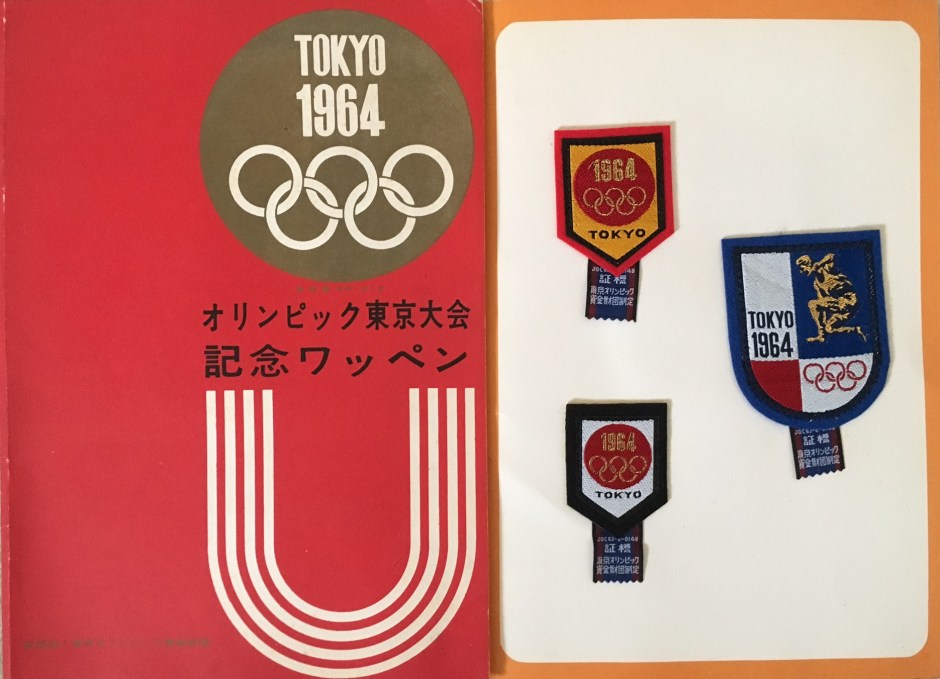
I was in Queens, New York a couple of weeks ago to clear out the home I grew up in. The house sold, we had to dump decades of stuff. One of the items that turned up and was most thankfully not thrown away was this commemorative collection of iron-on patches from the 1964 Tokyo Olympics. My father, who was on the NBC News team that helped broadcast the Tokyo Games, undoubtedly picked this up when he was there that October.

The title on the cover page called these items wappen (ワッペン), generally, iron-on patch, a word I was not familiar with. I learned that wappen is a German word that means “coat of arms”, which is why these Japanese patches have their particular shape and design.

tokyo-olympics-wappen-2

This exercise made me think of all the foreign words that have become part of everyday Japanese, many that were imported during intense foreign interactions with the Japanese: the European influence in the Meiji Period, or the American occupation in the years after World War II.

Here are a few examples below:

  • Abekku means a man and a woman who are dating, or romantically involved – a couple, in short. This word comes from the most romantic of romance languages, French. Abekku is derived from avec, which means “with”.
  • Ankēto (アンケート) is the Japanese word for a survey, what you fill out when a company wants to know what you thought of its service, for example. This word comes from the Dutch word, enquête, which means “survey” as well, but originally derived from the French word of the same spelling that means “investigate”.
  • Arubaito (アルバイト), which means part-time work in Japanese, is often abbreviated to baito (バイト). It derives from the word arbeit in German, which means “work”.
  • Gipusu or gibusu (ギプス or ギブス), which means a plaster or plastic cast, used when one breaks a bone. This word comes from the German word gipsverband.
  • Oh-rai, oh-rai, hai stoppu“, is one of my favorite Japanese phrases, which is essentially a phoneticized version of the English words, “All right, all right, OK, stop!” which you hear very often in Japan when a man is directing a large truck to continue to back up into a parking area. This was likely a phrase that Japanese heard a lot during the American occupation in the late 1940s and early 1950s.
  • Randosel (ランドセル) is the cute, leather daypack you see on the back of school children in Japan. It is derived from the Dutch word, ransel, or “backpack” in Dutch.
  • Tempura (天ぷら), that uniquely Japanese dish of deep-fried seafood or vegetables is actually an import from Portugal. The Portuguese have a similar dish called tempero or temperara, which was likely brought over to Japan by Portuguese sailors and missionaries centuries ago.

So now that you’re an expert in Japanese words borrowed from overseas vocabularies, here is your test. If you understand this, who knows, maybe you can fake your way through a Japanese conversation one day.

I left my arbaito to go to my manshon. On the way I stopped at the konbini to buy some bata and biru. I dropped my hankachi there accidentally, and was so worried because it was mother’s gift to me. My mazakon kicked into high gear, so I ran to the depaato to find another hankachi just like the one I had. Unfortunately, while I was running across the street, a basu startled me with his kurakushon, and I fell. I tore a hole in my pantsu. Even worse, I broke my arm and had to wear a gipusu for a month. “Oh, mistake!

jt-ad-cigarette-manners_throw-away
Japan Tobacco 2011 ad series, entitled “Smoking Manners for Adults”; they had been releasing similar ads since the early 1960s.

When I first moved to Japan, the first pleasant surprise was the everyday practice of taking my shoes off before entering a home. After doing that for a while, it nearly disgusted me when I came back to New York where everywhere was parading around the house in the shoes that stepped in all kinds of you-know-what outside.

I also noticed how many white cars there were on the road, and that they gleamed with newness. Then I noticed all cars on the roads looked new, nary a dent or smidge of mud to be seen. And of course, you have to look hard to find garbage on the ground, even in highly congested megalopolis of Tokyo.

So it came as no surprise to read this short article in the October 11, 1964 Japan Times.

No Litterbugs

Spectators at the opening ceremony were generally well-mannered, garbage men at the National Stadium said Saturday night. Trash collected at the stadium after the opening rites was more than 12 tons, but there were few “litterbugs”, they said.

People were given a polyethylene trash bag at the entrance. Printed on the bag was a direction in English: “Please use this etiquette bag for tidying around you.”

Three hundred waste baskets and 250 ashtrays were placed in the stadium and most people used them. In addition, a finger-sized aluminum cylinder with a cap was given to each to be used as a portable ash tray.

When I read that last line about 18 months ago, it was a bit hard for me to imagine what that cylinder looked like….until last week, when I visited four-time Olympian, Andras Toro, in California. Toro, who was an Olympian in Japan in 1964, happened to have a couple, and they looked like this.

ashtrays-from-1964_1

In the cylinder is a message from the benefactor, International Lions Club, District 302, based then in Nihonbashi Tokyo. It wasn’t a message against smoking, this despite a report the next day that four out of every ten youths started smoking before the age of 20, or the fears of cancer. No, it was a message of cleanliness, and fire prevention.

LET’S BANISH CIGARETTE BUTTS FROM ALL THE STREETS IN THE WORLD

This is a cigarette butt container. Please use it in the stand while watching games. Many of these were donated to Tokyo Olympic Games Organizing Committee by All Tokyo Lions Clubs of International Club 302 District and their members for you people coming to see the Olympic Games. We are advocating a campaign in an effort to

STOP THROWING BUTTS AWAY. SMOKE WHERE AN ASH-TRAY IS.

We are sure you may think it strange that we have to advocate such a thing now in the capital of Japan that is proud of being a civilized country. We don’t blame you at all if you do.

But, What a shame! There are not a few people as you see smoking while walking and throwing cigarette butts away in the streets in this biggest city in the world – Tokyo. Now we will present a very interesting fact to you. Take a look a t the following table indicating that FIRES CAUSED BY CIGARETTES are never, superseded by fires of other origins even in other notable cities in the world.

Well, what do you think. Surprising there are so many fires caused by cigarette, isn’t it? That is why we vote for and our sincerest and outspoken prayer…..LET’S BANISH FROM THE WORLD SMOKING AND THROWING BUTTS IN THE STREET.

Now that’s a message that still resonates today!

jt-ad-cigarette-manners-olympics


from-1964-to-2020
A sign at Haneda Airport in Tokyo, the point of arrival of most Tokyo Olympians in 1964

Bob Schul planted the seed in my brain.

At the end of a wonderfully long interview in early 2015, the 1964 gold medalist of the 5,000 meter track competition mentioned it would be nice if Olympians who participated in the 1964 Tokyo Games could return to the Tokyo for the 2020 Games. He wasn’t suggesting that the government or anyone pay for their expenses. He was just wondering, wouldn’t it be nice if they could get assistance in finding accommodations or meals, for example.

That would be nice.

But it would be nicer, frankly, incredibly inspiring actually, to find a way to bring ALL 1964 Tokyo Olympians back in 2020. I have interviewed over 70 Olympians from the 1964 Tokyo Summer Olympics. I would estimate well over 90% of them, without prompting, described their time in Japan and at the Olympics as a wonderful and special experience. Many have said they would love to come back to Japan for a visit, particularly in 2020.

Imagine the stories that these Olympians would tell about 1964, about their memories of Japanese graciousness, resiliency, efficiency, and pride. There is little doubt that bringing the 1964 Olympians would result in a mutual lovefest. There could be opportunities for fundraisers dedicated to the 1964 Olympians, educational opportunities for Olympians to share their memories at schools or museums. And it would be another opportunity for embassies and chambers of commerce to embrace their heroes from 1964, reliving their stories, and reinforcing cultural impressions.

How many Olympians would that be? Allow me to make assumptions (and use admittedly somewhat cold and clinical language about life expectancy).

logos-1964-and-2020

According to this article in The Daily Mail, British athletes were offered free admission to certain events at the 2012 London Olympics. It was estimated that around 125 Olympians were eligible (ie: still alive). Since there were 404 Brits representing their nation at the 1948 Games, one could say that 31% of that group of Olympians were alive in 2012.

But the gap between the 1964 Olympics and the 2020 Olympics is smaller – 56 years to be exact. In other words, assuming an average Olympian age of 25, most 1964 Olympians would be in their mid-70s to mid-80s. Because of that, we could assume that more than 31% of all 1964 Tokyo Olympians could be healthy and ambulatory and interested in coming to Japan in 2020. For the sake of generating an estimate, let’s say 40%. That would mean, of the 5,151 worldwide Olympians who participated in the 1964 Games, a little over 2,000 Olympians could be here in Japan in 2020!

But alas, this is still only a dream. If London organizing committee’s offer were expanded to all 4,100 Olympians from 1948, it’s possible they would have had to extend their offer to over 1,200 Olympians. I am not aware of such a program to bring all the 1948 Olympians back to the 2012 Games, but I imagine the organizing committee considered it, and I’m sure they knew the challenges. How do you contact all those Olympians? How would you finance it? At a time of peak capacity for the city, how do you accommodate so many people who deserve respectful attention and may have special needs due to their age?

Good questions all.

But it all starts with a dream.


日本語

Kousei Inoue in Rio
Japan’s Men’s Judo Team coach in Rio, Kosei Inoue

At the 2012 London Olympics, the men’s judo team from Japan did not win a single gold medal. Of the seven weight classes, the Japanese took two silver and two bronze medals in arguably their worst showing since judo premiered at the 1964 Tokyo Olympics.

At the 2016 Rio Olympics, the men’s judo team from Japan won two golds, and equally important, scored a medal in each of the 7 weight classes. The last time Japan medaled in all classes? 1964.

If this is the return to the glory years for Japan, just in time for the pressure to really build for Japanese athletes at the Tokyo2020 Games, then the men’s judo coach, Kosei Inoue, deserves top judo kudos. Inoue, gold medalist in 100kg weight class at the Sydney Games, was at those 2012 Games as an assistant coach, and he observed a judo team in chaos, according to this Gendai Business article (in Japanese).

Judoka were confused as the team of coaches were not specifically assigned to weight classes, so the judoka were uncertain whose coaching they should follow. Judoka were bullied excessively. Injured judoka were threatened with being dropped from the team. As a result of that and particularly the results in London, the coach was fired, and Inoue was asked to take over the team.

Japan's Judo Gold Medalists
Judo gold medalists Mashu Baker (left), Shohei Ono (center) and Haruka Tachimoto pose during a news conference at the Foreign Correspondents’ Club of Japan on Tuesday. | KYODO

According to various sources, Inoue brought a winning mindset to the men’s judo team, focused the coaching on technique and playing to the strengths of each judoka, improving judoka’s strength, showing them to think outside of the Japan box, and emphasizing open communication between coaches and judoka.

Inoue ensured that his training sessions were not random and chaotic, but were focused on themes, like “technique”, or “finishing strong”. He also ensured that the judoka had their own coaches, and their own development plans. As gold medalist, Mashu Baker said in this Japan Times article, “After the London Olympics, Coach Inoue took over and I have had the pleasure of training under him. I don’t know what it was like in 2012, but I can say that under Coach Inoue we have had very personalized training which really looks at making the most of the skills of each individual athlete.”

According to a story on the television news program, Bankisha! (バンキシャ!), during the Rio Olympics, Inoue realized that while technique is important, foreigners did tend to be physically stronger, particularly in the heavier weight classes. Inoue ensured that his judoka were also improving their overall strength so that they would not be wrestled out of competitions.

Inoue also thought that the way non-Japanese fought in the judo dojo was important to understand. He thought it was important that his team know that the Russians developed their techniques from Sambo, a Russian wrestling sport, and that Brazilians developed their s from jiu-jitsu.

“The world is progressing fast. You’ve got to be aware of it,” Inoue said in this Japan Times article prior to the Rio Games. “Japan’s judo has been trying to do things its own way, as if Japan was the be-all and end-all of everything.”

Inoue may have gained this insight thanks to the Japan Olympic Committee, which selected Inoue to live in the UK, learn English, see how Europeans train in judo. Perhaps the JOC saw the coaching potential in Inoue, and believed the international experience would be of benefit. Inoue spent two years in the UK, including time in Edinburgh, Scotland with George Kerr, the president of the British Judo Association, and London, teaching at the famed Budokwai.

“I felt strong pride at what I’d done,” Inoue recalled in the Japan Times article. “But once I stepped out of my country, I didn’t understand the language and the environment. Their coaching style was totally different (in Europe). I felt like I had been taken down a peg. It was tough for me, but eventually, I began to think I was immature, that I didn’t know anything. The world is so big. So when people ask me what the best experience from being abroad was, I always tell them that I realized how ignorant I was.”

Inoue even sent his judoka, Ryunosuke Haga and Masashi Ebinuma, to train overseas on their own, to build their self-reliance and mental toughness, and they both secured bronze medals for Japan.

Inoue was shaping into the ideal coach for Japan’s national team. He knew what it was to be a champion in Sydney. He knew what it was like to be humbled in Athens, when he didn’t medal. He realized that the world offered a treasure trove of lessons that would

aska cambridge in rio
Aska Cambridge

When around 98% of a nation is perceived to be of the same ethnicity, it stands to reason that nationality and ethnicity are viewed as one and the same.

But Japan has been a magnet for those seeking opportunity as well as for Japanophiles, particularly since the economy boomed in the 1980s. As the influential Japanese television entertainment industry increasingly viewed diversity as a way to get more viewers, Japanese-speaking foreigners became more popular. Children of mixed marriages, those who essentially grew up Japanese, have now become de rigeur on Japanese television.

I was one of those foreigners who came to Japan in the 1980s, but because I am of Japanese ethnicity, I have been able to blend in. I get neither fingers pointed at me, nor praise for my Japanese proficiency. But even though my cultural background is American, I can see why the attention of Japanese still, to this day, perk up when a non-Japanese is in their midst. The non-Japanese is such a tiny population that they really do stick out. Like the majority of the film, Lost in Translation, the minority experience for the “gaijin” in Japan is clichéd. And yet true.

So when the Japanese men’s 4X100 relay team very unexpectedly took silver at the Rio Olympics, losing only to the vaunted team from Jamaica, it was a very special moment for Japan. Not only did the Japanese excel in an area they are not customarily strong in – the sprint – a 23-year-old named Aska Cambridge (ケンブリッジ飛鳥), the child of a Japanese mother and a Jamaican father – was a proud member of those Japanese speedsters. He ran for the Japanese squad, he speaks fluent Japanese, and yet, he doesn’t fit the everyday look of what most Japanese perceive as Japanese.

Mashu Baker and his mother
Mashu Baker and his mom.

When a 21-year-old Japanese won judo gold in the 90kg weight class at the Rio Olympics, Japan cheered. At the 2012 London Games, no Japanese won gold in judo, the most Japanese of all the Olympic competitions. In fact, no Japanese had won the 90kg weight class since it was introduced in 1980. So who brought back the glory? A person named Mashu Baker (ベイカー茉秋), the son of a Japanese mother and an American father.

At first glance, he looks Japanese. But it’s the name that sticks out. Baker is clearly not a Japanese name, and it is written in the press in katakana, the script reserved for foreign words. Interestingly, the first name “Mashu”, while spelled out in Chinese characters, was likely chosen because of its close approximation to the name “Matthew”. I don’t know what’s written on his US passport, but it’s possible the Bakers decided they wanted their son to be identified in Japan as a “ha-fu”, a child of mixed parentage.

“Ha-fu” over the decades, perhaps centuries, have on the whole experienced more prejudicial than preferential treatment. But I do not underestimate the power of role models. I am sure that the brilliant examples of Aska Cambridge and Mashu Baker will continue to help revise how Japanese, and the rest of the world, perceive what a Japanese is.

And that’s a good thing.

Sports Fest 1

Mitsui Fudosan won the rights to be the Japan Olympic Committee’s exclusive real estate Tokyo 2020 Gold Partner. That shuts out companies like Mitsubishi Jisho (Mitsubishi Estate, in English) from marketing themselves using the Tokyo 2020 logos, or even the word, Olympics, and of course, the five-ring Olympic logo.

But there are ways companies get around the strict licensing rights dictated by the IOC. They market themselves by association.

From August 4 to 22, Mitsubishi Jisho sponsored Sports Fes Marunouchi, essentially in the middle of the Ginza, Tokyo’s established business, entertainment, shopping district, very near the famed red-bricked Tokyo Station. The Sports Fes featured over two weeks of athletic displays, Olympian appearances, and interactive sporting activities, all on the most expensive streets in Japan.

Sports Fest 2

On the Sunday afternoon I went, I saw people watching the Rio Olympics on the big screen, as well as adults and kids testing to see how high they can jump, how low they can extend their arms, how fast they can throw a basketball. And I got to see London Olympian and fencing silver medalist, Kenta Chida, in a display of fencing so close, I could have jumped into the match from my front-row seat.

Sports Fest 3

Except on the large-screen TV where NHK was broadcasting the 2016 Rio Olympics, you didn’t see the word Olympics, or the Tokyo 2020 logo, or the five-ring Olympic logo anywhere. Mitsubishi Jisho is not an official sponsor, and is forbidden from doing so. But it’s clear to everyone why Mitsubishi Jisho is sponsoring the Sports Fes Marounouchi. By holding this event during the Rio Olympics, and inviting former Japanese Olympians to talk about their experiences and display their skills, this Japanese real estate firm is basking in the golden glow of the Olympics, so hard to contain behind the curtains of IOC contracts and rules.

Sports Fest 6
Men’s individual foil silver medalist at the 2012 London Olympics, Kenta Chida.

Does this rankle the official real estate sponsor of Tokyo 2020, Mitsui Fudosan? Most likely, yes. But these are the Olympics, a premier symbol of competition. And the competition doesn’t end with the athletes. Companies in Japan will be battling for our mindshare in the coming years. And if necessity is the mother of invention, then I look forward to the creative ways non-sponsors guerilla market themselves, as we embark on the road to Tokyo 2020

Watch the video below for an up-close display of foil fighting. En garde!

Coca Cola Booth Roppongi Hills 1
Coca Cola booth at Roppongi Hills


It was August 6 and I had just watched the opening ceremonies of the Rio Olympics, which was being broadcast live in Japan that lazy Saturday morning. Quite coincidentally, my wife and I reserved a Brazilian barbecue place in Roppongi for dinner that evening.

Roppongi is a hive of activity, a center of commerce, entertainment and shopping that bustles 7 days a week. In our stroll through Roppongi that day, I came upon two examples of how official Olympic sponsors have begun marketing the Olympics, not only as a lead in to the Rio Olympics, but also as a proud reminder that Tokyo will be the host of the XXXIII Olympiad in 2020.

Coca Cola is one of 12 worldwide Olympic sponsors, part of the so-called TOP program – TOP standing for “The Olympic Partner”. Like other TOP sponsors, Coca Cola has exclusive rights in the food and beverages industry to use the word Olympics and the five-ring symbol of the Games in its global marketing and advertisements, among other exclusive rights.

And in the popular Roppongi Hills square was a Coca Cola booth, with kids and adults lining up to get in. Inside the booth was a large screen displaying a swimming competition computer game. A pair of contestants would line up in front of the screen, get a motion-sensing band attached to their wrist, and then furiously roll their arms as their watched their avatar on the screen race to the finish. At the end, they were awarded a medal with a bottle of Coca Cola attached.

After dinner, we walked to my old work haunt – Midtown Tower. This popular office complex was built by Mitsui Fudosan, a major real estate developer in Japan. Mitsui Fudosan is not a TOP partner, but is instead a Tokyo 2020 Gold Partner. In the Olympic hierarchy of sponsors, the IOC allows the local national Olympic committee to select local sponsors that have exclusive rights in Japan to market and advertise using the word “Olympics” and related logos.

Sumitomo Fudosan Midtown Tower Olympics Exhibition 1

Mitsui Fudosan used the open area in front of Midtown Tower artfully. Dotted throughout the square were sculptures of figures in athletic pose, gleaming white and geometrically fashioned. A female basketball player and a wheelchair tennis player greet us at the entrance. A sprinter climbs the glass cover of the escalator leading down to the underground shopping areas. Synchronized swimmers rise from a shallow pool of water, a paralympic runner strides, and a pair of judoka negotiate a fall.

Mitsui Fudosan wants you to “Be the Change”. In a missive at the display area, the JOC Olympic sponsor states that like athletes, whose daily efforts and countless beads of sweat and tears, have shaped them into Olympians with unique and wonderful stories, Tokyo is also being shaped on a daily basis, building by building, each with their own stories. The last line of the missive states, “Next, it’s Tokyo’s turn. The Olympics will be on our stage. What fantastic stories will be told?”

Sumitomo Fudosan Midtown Tower Olympics Exhibition 2

Rio Closing Ceremony_1

The countdown to Tokyo 2020 begins!

The Rio Olympics are over, the Olympic flame extinguished. But before the final lights of the closing ceremony dimmed, Japan sent the world an invitation. After the traditional handover of the Olympic flag from the mayor of Rio to the governor of Tokyo, Japan gave the world a sneak peek, showing why everyone should be excited about coming to Tokyo in 2020, July 24 to August 9. The closing ceremony is an opportunity for the host of the next Olympics to whet the appetite of Olympians, wannabes and sports fans alike. And Japan did not disappoint.

The show at the end of the Rio Olympics closing ceremony was hippy, cutie, techie, sexy, targeting the hippocampus of youth the world over fascinated with Japan, it’s machines, its pop music, it’s kulture of kawaii.

Rio Closing Ceremony_4

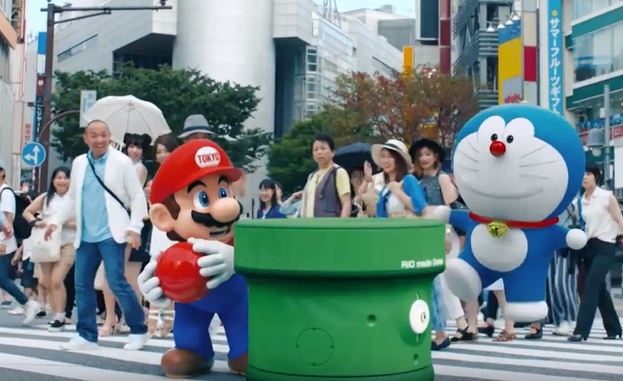
An introductory video took us on a jazzy tour of Tokyo, starting us off at the famed zebra crossing in Shibuya. We see the red Super Komachi bullet train which harkens back to the first bullet train introduced 9 days before the start of the 1964 Tokyo Olympics. We see the Sky Tree, Tokyo’s newer, bigger tower, although it can never replace the iconic Tokyo Tower, built just prior to the 64 Games. We see Pacman, Doraemon and Hello Kitty, and athletes lined up in profile, reminiscent of the famous athlete posters designed by Yusaku Kamekura for the 1964 Games.

Rio Closing Ceremony_3

And we see Japan Prime Minister, Shinzo Abe, in a car, in a hurry to get from Tokyo to Rio. He can’t get there in seconds….unless of course, he turns in to Super Mario, who ends up taking a plunge down an animated tunnel, landing on the other side of the world in Rio. Abe likely had to be heavily convinced, or plied with much alcohol, to appear in a Super Mario costume in the middle of Maracana Stadium. But he did, figuring that if the Queen of England didn’t mind being parodied for the London Olympics opening ceremonies, then maybe he shouldn’t either.

Rio Closing Ceremony_5
Yes, that’s Prime Minister Shinzo Abe, making sure he’s seen in a Super Mario costume for as little time as possible.

The video was the prelude to a display of art, dance and technology that was both precise and frenetic, ending in a Tokyo tableau, framed by, what else, that unmistakable silhouette of Mount Fuji. At show’s end, Prime Minister said, “See you in Tokyo!”

So, will we see you in Tokyo? We certainly hope so!

Watch the video here.

Silver Samurai Japan Team pose
The Japanese men strike a pose – as if pulling out swords for a fight – during the introductions to the 4×100-meter relays finals.

Upstage Usain Bolt? Hard to imagine doing that. But in Japan, the four young men of Japan’s 4×100 team, Ryota Yamagata, Shota Iizuka, Yoshihide Kiryu and Aska Cambridge, did just that.

Very unexpectedly, against such traditionally strong competition as Jamaica, America, Canada and Trinidad and Tobago, Japan sprinted to second place at an Asian record of 37.60 seconds, a fair distance behind champions Jamaica, but ahead of the United States and Canada.

No sprinters from Japan had ever done so well. Famous for long distance runners, particularly with its share of marathon Olympic champions, Japan had only one sprinting exception: a bronze medal finish in the men’s 4×100 relay at the 2008 Beijing Olympics. As Andre De Grasse, who won silver in the 200 meters and bronze in the 100 put it, “Japan probably surprised us a little bit. We didn’t expect to see them up there. But congrats to them as well.”

After all, at the beginning of the track and field competition in Rio, there was very little to indicate that Japan had the talent to medal in any sprint competition, as seen early on in the men’s individual 100 meter heats.

Cambridge Bolt and Brommel
Aska Cambridge and Usain Bolt face off in the final let of the 4×100-meter relays final.


In Heat 8, Yamagata came in second with a time of 10.20, qualifying behind South African Akani Simbine. In the semis, Yamagata finished fifth in his heat with a very solid run of 10.05 seconds, but did not qualify for the finals. Iizuka, who did not compete in the 100 meters, failed to qualify in the 200 meters with a time of 20.49 seconds.

In Heat 7 with Usain Bolt, Kiryu placed fourth, his time of 10.23 not good enough to quality for the individual finals. Cambridge qualified with the second fastest time in Heat 4 at 10.13 seconds, behind Canadian star, De Grasse. In the semis, Cambridge did even worse with a run of 10.17 and crashed out of the running for the finals, finishing last in his heat.

Fortunately for Japan, the individual sprints were one thing – the team sprints were another. In the two preliminary relay heats, Japan was not intimidated. In heat 1 of the 4X100 men’s relay, the United States team bested China, which set an Asian record time of 37.82. Japan won the second heat, not only topping the Jamaican team (sans Bolt), but also setting a new Asian record time of 37.68 seconds.

After the heats were completed, the eight teams competing in the men’s 4×100 relay were set. In order of lanes 1 to 8 were Great Britain, Brazil, The US, Jamaica, Japan, China, Canada, and Trinidad and Tobago. But in the finals, most of the teams were able to conserve the energy of their super stars in the heats, while Japan stuck to their four thoroughbreds. The Japanese were in lane 5, next to the Jamaicans, as the lead runners settled into their starting blocks.

Yamagata exploded out of the blocks, which is what you want from your lead runner. He seemed to gain ground vis-a-vis the lead runner for China in lane 6, but exchanges between runners for the Canada and Jamaica seemed to have happened a split second before Japan’s.

Yamagata passed off to Iizuka, who was Japan’s 200-meter runner. The runner of the second leg has to run in the baton exchange lanes twice, which means he runs about 125 meters. You want someone who’s speedy at longer distances, so Yamagata fit the bill. When Iizuka took off at the 100-meter mark, it appeared nearly all teams were tied.

Iizuka passed the baton to Kiryu for the third leg. The third leg is often a make or break leg. Not only does the runner in the third leg have to run 125 meters, he also has to ensure a smooth baton exchange while rounding a curve. Kiryu handled that responsibility to perfection. At the 300-meter point, Jamaica, Japan, China, Canada, as well as Trinidad and Tobago were looking equal, with a slight edge to Jamaica, Japan and Canada. Great Britain and Brazil had fallen significantly off the pace in the inside lanes, while the USA seemed to be slow on the exchange.

The fourth leg, or anchor, is often run by the swiftest on the team. Cambridge was the anchor, and his personal best was 10.1 seconds. Not only did he have the fastest time for Japan in 2016, he was seen as capable of going faster. As we all know, or could expect, Bolt was a runaway freight train and Jamaica was heading for its inevitable golden finish. But Japan’s Cambridge burst out of the exchange, and for a while appeared even to keep pace with Bolt.

silver samurai asian record
The new giants of Japan.

While gold was out of the question, Cambridge’s job was to hold onto silver. Trayvon Bromwell of the American team exploded through the anchor leg and was pushing hard for second, so desperate that he went flying to the track while crossing the finish line.

The citizens of Japan, fortunate to be able to watch this race on a lazy Sunday morning, worked themselves into a frenzy as the race came to a finish, holding their collective breath as their hearts caught up with their eyes.

And then Japan erupted. Cambridge crossed the line in front of Bromwell. Japan had taken silver.

“Nippon! Nippon!” the announcer from NHK shrieked as Cambridge flew past the finish line. The Japanese quartet instantly became the new giants of Japan. We expected the Japanese men’s gymnastics team to do well. We expected the Japanese women’s wrestlers to do well. We did not expect the Japanese men’s sprinters to beat the Americans, the Canadians and push the legendary Jamaicans and Usain Bolt.

But the Silver Samurai did. And heading into the 2020 Tokyo Olympics, pre-teens and teenagers all across the islands of Japan will be saying, “maybe, just maybe, that could be me.”

Wrestling - Women's Freestyle 53 kg Gold Medal
2016 Rio Olympics – Wrestling – Final – Women’s Freestyle 53 kg Gold Medal – Carioca Arena 2 – Rio de Janeiro, Brazil – 18/08/2016. Helen Maroulis (USA) of USA celebrates with her coach winning the gold medal after her victory against Saori Yoshida (JPN) of Japan. REUTERS/Toru Hanai .

The match started off according to the script.

In round one, Saori Yoshida of Japan takes a one point lead thanks to the passivity of her opponent, Helen Maroulis of the United States.  Yoshida is a living legend – she has won 13 straight world titles and the past 3 Olympic gold medals in freestyle wrestling. As the captain of the entire Japan Olympic team, she is expected to cap a tremendous team effort in Rio – Japanese women have already taken gold in the other three weight classes.

Going into the second half, Yoshida is still up 1-0 on Maroulis, who had never beaten Yoshida. In fact, in their first match in the past, Yoshida defeated the American in 69 seconds. Maroulis has studied Yoshida’s techniques over the past three years, in fact getting an opportunity to train with the master. But still, early in the second half, Yoshida’s victory is preordained. After all, her teammate, Kaori Icho, had already accomplished the unprecedented feat of taking gold in freestyle wrestling in four consecutive Olympics.

Wrestling - Women's Freestyle 53 kg Gold Medal
2016 Rio Olympics – Wrestling – Final – Women’s Freestyle 53 kg Gold Medal – Carioca Arena 2 – Rio de Janeiro, Brazil – 18/08/2016. Saori Yoshida (JPN) of Japan reacts after the match against Helen Maroulis (USA) of USA. REUTERS/Mariana Bazo

In the second half, Maroulis fights off an attempt by Yoshida to drag her down, and instead manages to pull Yoshida down with her right arm, and get behind Yoshida for two points and a 2-1 lead. Like Icho, who won her Rio gold medal with points in the waning seconds, Yoshida’s supporters in the stands, and in Japan were anticipating a similar spectacular comeback. But with a scant 60 seconds left, Maroulis forced Yoshida out of bounds to take 4-1 lead. That turned out to be an insurmountable lead

For Japanese fans, the impossible happened. She lost.

For Yoshida, tears of anguish streamed down her face. She had not just lost a match, as far as she was concerned – she let down her team, her country and her family. “I am sorry to finish with a silver medal despite all the cheers from so many people,” Yoshida said through tears. “As the Japanese captain, I should have gotten the gold medal. I kept thinking that I would be able to win in the end, but it got to the point where I could no longer come back. I’m sorry I couldn’t exert all my strength.”

Yoshida Saori cryingIn Japanese, Yoshida repeatedly said, “gomen nasai” (“I’m sorry”) as if she had burned down a house, or lost a company a million dollars, or lied to the press about being held up at gun point. Japanese apologize for everything, as a matter of everyday politeness, even when they haven’t done anything wrong. But in this instance, you could see the pain in her face and hear it in her voice – she believed she had failed Japan.

But as Masanori Sudoh of Nikkan Sports put it, Yoshida indeed had the weight of the world on her, far more than any mere mortal deserves.

“I’m sorry I couldn’t get the gold,” she said. Seeing Saori Yoshida cry and apologize like that pained me in my heart. At the 2004 Athens Olympics, carefree and full of smiles at the age of 22 upon winning an Olympic finals, she breezily stated “the gold medal was the only thing I didn’t have. But now I have all the medals!” Twelve years ago, the medals were her reward. But somehow, at some point, the medals became Japan’s reward. And in Rio, the burden of expectation was particularly great. Continuing to win is far more difficult than just winning once. You have to keep up with rivals who are studying your every move. You have to continually evolve. And she did, through 16 straight victories in the Olympics. To us, she was all powerful. But in truth, I believe Yoshida was always in a state of uncertainty, desperately figuring out how to stay ahead. And the more she won, the stronger she appeared…to the point where winning was a given. No one expected Saori Yoshida to lose.

And yet, lose she did. And an entire nation cried.

After the final match, Yoshida made her way to her mother, who watched from the stands. They embraced in tears as her mother said, “You lost, but you have this magnificent silver medal. I am so proud of my daughter. You gave it your very best. You are my treasure.”

Interviewed later in the day, Yoshida-san’s mother, Yukiyo Yoshida, reflected on the fact that this was the first Olympics where she was not accompanied by her husband, Eikatsu Yoshida, a former national champion and wrestling coach who passed away two years ago. Yukiyo explained to the press that her daughter told her, “Father will be angry with me.” But Yukiyo replied as all good mothers do, “No he won’t. It’s all right. You did your very best.”

Yoshida Saori and mother
Saori Yoshida comforted by her mother, Yukiyo Yoshida, and her brother Hidetoshi.