hotel-okura-under-construction-1961
Hotel Okura under construction in 1961
It was the middle of winter, and yet on January 1, 1964, Tokyo was hot! In fact, the way the foreign press described it, Japan was running a temperature!

“Japan Feverishly Prepares for the 1964 Olympic Games” – AP, January 1, 1964

“World’s Biggest City Suffering Olympic Fever” – UPI, January 2, 1964

Here’s how the major American news services – AP and UPI – explained the state of Tokyo only 10 months before the opening of the XVIII Olympiad:

A strange fever previously unknown in the Orient is gripping Japan. Symptoms include intense worry and a driving compulsion to build things. It’s called Olympic fever. Japan is lunging helter skelter toward that magic day when the 1964 Olympic games open in Tokyo. (AP)

The entire city is afflicted with “Olympic hysteria”, from the prime minister whose political future hinges on the games to the man in the street who curses the inconveniences he has to put up with for the Olympics: the high prices he has to pay, the scaffoldings he had to duck, the torn-up streets around which he has to detour. (UPI)

Again, this was 1964, less than a generation removed from the devastating effects of the Pacific War. Indeed, Tokyo was still emerging (and groaning) from the physical and emotional remains of war rubble, at least as the AP described it:

Tokyo essentially is a city just 18 years old, built on piles of ashes and rubble left by American bombers during World War II. Tokyo has grown haphazardly since 1945, with small, almost ramshackle, houses springing up in disorderly profusion along twisting, narrow streets. Trains are overcrowded. Prices are high. The city chronically has been short of housing, water – just about everything today’s tourists wants and expects. The population has grown so much (to more than 10 millions) that the city fathers have pleaded with the youth of Japan to stay on their farms in the villages and not come to the big city. But on they come, crowding in where there is no room.

national-gymnasium-under-construction
The National Gymnasium complex under construction in Tokyo on June 6, 1964, just a few months before the games were to begin. (Keystone/Hulton Archive/Getty Images)
While it might be hard to imagine today in Tokyo, where large-scale construction is on the whole, relatively and remarkably quiet and unobtrusive, it was for Tokyo denizens in the early 1960s, the bane of their existence. And safety was at times taken for granted, according to AP:

Tokyo, the largest, noisiest, most crowded city in the world, is getting a needed facelifting. The roar of new buildings and bridges going up – and occasionally falling down – fills the night and day. Bamboo scaffolding is everywhere and thousands of workmen clamber up and down, painting and plastering, putting finishing touches on new hotels, restaurants and night clubs.

At least two major Olympic construction projects have collapsed – an elevated expressway and the steel frame roof for a swimming pool. One person was killed and 25 were injured…. In an editorial titled, “no Fun and Games,” Yomiuri declared inexperienced workmen are being used on many Olympic projects and elementary safety precautions are being ignored.

We are three years away from January, 2020. Will history repeat itself? Will Tokyo be an overcrowded, noisy, chaotic city creaking its way to the Opening Ceremonies on July 24, 2020? I doubt it. Will Tokyo again be gripped in Olympic fever? Most definitely yes.

the-beatles-ascending-the-stage-at-the-budokan

My focus in this post is primarily on Japan, so get your Japanese cultural lessons here:


Usain Bolt and the Holy Redeemer

    Usain Bolt and the Holy Redeemer

The bigger picture at the Rio Olympics:

Cambridge Bolt and Brommel

monica-puigs-tears-of-joy
Monica Puig of Puerto Rico wins gold in women’s single tennis.

The 2016 Rio Olympics had some absolutely thrilling moments. Here are a few to bring back the memories:

yoshida-saori-crying
Saori Yoshida with the weight of Japan on her shoulders.

miyuki-zoku-2

The gauntlet was thrown.

“To the weak-livered denizens of Ginza – you who wear sun glasses, tight pants, and saunter down the street carrying a big paper bag as you chase the girls from the day-time – If you are men accept my challenge. I’m 56 years old but let’s see who will last the longer in the marathon…”

Apparently, those were fighting words, at least as translated by the Mainichi Daily New on September 16, 1964. The above notice was a challenge to race a marathon, for the senior Japanese to show his manly vigor in a competition of endurance. And yes, it got the attention of the teenagers, who were labeled the “Miyuki-zoku”, a mix of boys and girls who gathered on the fashionable street in the Ginza called Miyuki Street. (The suffix “zoku” means “tribe” or “club”.)

detectives-question-miyuki-zoku
Mainichi Daily News_September 17, 1964
So on the appointed time of Monday, September 14, 1964, the Mainichi Daily News reported that “hordes of onlookers, young and old, flocked to the place of challenge in front of the fountain in Hibiya Park.” Members of the Miyuki-zoku came out to meet the challenge of the 56-year old, but as it turned out, not only did the elderly challenger not appear, the police had already rushed to the scene to ensure an unauthorized marathon did not take place.

It was only a few months earlier when Heibon Punch, a new magazine focusing on fashion, started a revolution by launching the so-called “Ivy Look”. Other magazines like “Men’s Club” followed quickly, going into detail on cool Ivy. (See my previous post on this here.) When teenagers in Japan saw how young men were dressing in the United States, particularly at the Ivy League universities, with their perceived associations of class and style, they found an exciting replacement for their drab, black school uniforms, and a way to rebel.

Yes, it took the preppie look for kids in Tokyo to flip parents and authorities the bird – which is astonishing, if you look at the pictures today.

But this is Japan. And the Japanese proverb most quoted to explain social behavior here is “the nail that sticks out gets hammered down.” In other words, it’s important to conform. Those who don’t, are informed in no uncertain terms that they need to do so.

And so in the 1960s, in a time of burgeoning prosperity, with a generation that grew up with faint memories of post-war rubble and hunger, there grew a hunger to express one’s individuality, and dare to be that nail that sticks out, even if just a tad.

But the authorities were concerned about even this whiff of rebellion. After all, the Olympics were coming to town and Tokyo had to be clean, friendly and most of all orderly. These “hordes” were unsightly, the boys in their (gulp) tight, high-cut slacks with oxford-cloth or madras plaid shirts, and the girls in tight long skirts with the hemline (gasp) several inches below the knee.

miyuki-zoku-3

According to this post in the blog “Ivy Style”, the older generation co-opted a leader of the Ivy fashion movement, Kensuke Ishizu. Ishizu “discovered” this look when he visited college campuses in the United States in the 1950s, and when he returned to Japan, he created a fashion brand called “VAN”, and published Japan’s first men’s fashion magazine, “Otoko no Fukushoku”.

Neighborhood leaders desperately wanted to eradicate the Miyuki-zoku before October, so they went to Ishizu of VAN and asked him to intervene. VAN organized a “Big Ivy Style Meet-up” at Yamaha Hall, and cops helped put 200 posters across Ginza to make sure the Miyuki-zoku showed up. Anyone who came to the event got a free VAN bag — which was the bag for storing your normal clothing during loitering hours. They expected 300 kids, but 2,000 showed up. Ishizu gave the keynote address, where he told everyone to knock it off with the lounging in Ginza. Most acquiesced, but not all.

So on September 19, 1964, a huge police force stormed Ginza and hauled off 200 kids in madras plaid and penny loafers. Eighty-five were processed at nearby Tsukiji jail. The kids got the message and never came back, and that was the end of the Miyuki-zoku.

Oh those raucous and rebellious sixties…

tokyo-1964-a-diary-of-the-xviiith-olympiad-cover

In 1964, there are countless stories of people losing something, often of some value, and then getting it back. If I dropped my walled or camera in a store or a taxi in Manhattan, chances are south of 33% that I’d ever see it again.

In Japan, the odds go up significantly. Christopher Brasher recorded the events of the 1964 Games on a daily basis in his book, A Diary  of the XVIIIth Olympiad. And in the middle of the book, he told this unique, and yet oft-told tale of Japanese kindness. A jounalist lost his traveller’s cheques. One was signed, and ready for exploitation, and yet, two days later, he got all his cheques back.

What’s amazing about this story (and yet easy to believe if you’ve lived in Japan) is the extraordinary effort that went into returning the cheques to their owner:

One entirely un-Olympic story of today is of the British journalist who lost his traveller’s cheques earlier in the week. Unfortunately only one of them was signed so anyone who picked them up could have cashed them. Last night he was rung up by a Japanese woman who asked if he would like to come down and collect his cheques.

When he got to the address, he was handed his cheques by the mama-san of a night-club, who explained that she had had a little difficulty in finding out who the cheques belonged to. And when you see this particular journalist’s signature it is not surprising. It is an entirely illegible scrawl and yet it was the only clue to the ownership of the cheques. So the mama-san took a large sheet of paper and for two days she traced and retraced the signature until she could make out the first three letters of the surname.

And then she rang the hotels and, finally, the Press House, and discovered who they belonged to. When the journalist presented her with a bottle of whiskey in thanks she refused to accept it. The Japanese are truly an incredible race.

tokyo-promotional-video-heart
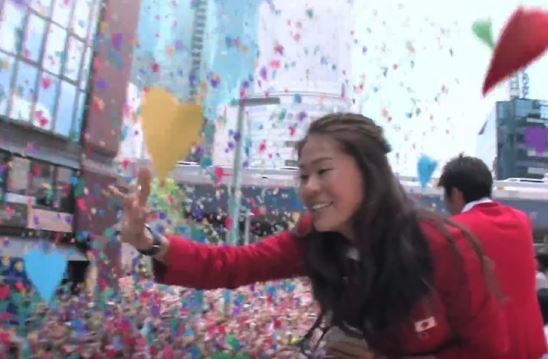
Screenshot from the 2020 Olympics Tokyo promotional video

I finally took a look at the promotional videos made by the cities vying for the 2020 Summer Games: Istanbul, Tokyo and Madrid.

In my mind, Istanbul and Madrid’s Olympic committees focused on the cities, and thus their videos felt like the tourism promotion videos you might see on CNN. My views aren’t too different from those on this Reddit thread.

The theme of the Istanbul is “Shine Bright Like a Diamond”, the lyrics from Rihanna’s song, Diamonds – the mosques in sun and shadow, the sparkling harbor waters, bustling markets, mixed in with image of infrastructure, high-end shopping, and a very occasional sports reference.

Madrid’s campaign video is more comprehensive in what it showed: high speed rail, modern cityscapes and traditional architecture, universities, greenery, music and dance, shopping and nightlife. And there was even a smattering of sports: amateurs playing golf, on bikes, skateboarding, playing basketball, runners.

Tokyo’s theme was “Discover Tomorrow”, thoroughly vague. But the images are clearly on athletes, dominated by competitors at the London Olympics, as well as amateur athletes in Japan, interspersed with iconic locales of Tokyo. You feel the intensity of the athletes and the emotions of the spectators, the animated winged-heart providing a thematic visual throughout the video.

I’m biased I know. But the Tokyo promotional video is the best of the three.

tokyo-promotional-video-parade
Screenshot from the Tokyo candidate city promotional video.
kanebo-ad_souvenir
Kanebo ad form the 1964 Tokyo Olympics Official Souvenir Book

One of the biggest cosmetics brands in Japan is Kanebo. But its corporate origins were in textiles. Established in 1887 as the Tokyo Cotton Trading Company, a few years later the name was changed to the Kanegafuchi Spinning company, or Kanebo. As you can see in the above ad, printed in the Tokyo Olympics Official Souvenir book from 1964, Kanebo was primarily a major exporter of cotton, silk, wool and non-natural textiles.

The cotton and silk spinning industry, born of the age of industrialization that hit Japan in the late 19th century and early 20th century, was a huge employer of young women, most of them teenagers. As industry was transforming the state of the family, companies wanted to reassure parents that their daughters were well cared for. The textile companies would provide educational and social opportunities for their employees, as well as in sports so that they could stay physically fit.

Helen Macnaughtan, who wrote an article called The Oriental Witches: Women, Volleyball and the 1964 Tokyo Olympics, and in it she explains how volleyball became the sport of choice for the textile factories:

Sport and recreation activities developed alongside key educational initiatives as a way not only of keeping young girls busy and occupied during non-working hours within factory residential compounds but also as a way of promoting the physical health of workers. The sport of volleyball was introduced by textile companies as it offered the chance to encourage team work amongst young female workers, required minimal equipment and could be played both indoors and outdoors. Over time the increased popularity and indeed strength of these female corporate teams from the large Japanese textile companies became notable, and developed into an investment beyond mere recreation.

nichibo-ad_souvenir
Nichibo ad from the 1964 Tokyo Olympics Official Souvenir Book


In the 1950s, women’s volleyball had become a highly popular sport in Japan, resulting in the first national volleyball tournament in 1951. According to Macnaughtan, six teams were from Kanebo, one of the earliest adopters of volleyball in textile factories, and five from Nichibo. In 1960, Japan sent a male and female volleyball teams to the world championships held in Brazil. The women’s team took second place, which was a surprise. It happened to be a team completely from the Kaizuka factory of the Nichibo Company, the logic being that instead of trying to put a team of all stars together very quickly, they should probably send one of their best teams. This team, buoyed by the success in Brazil, was then funded to compete in Europe, where they won 24 straight matches.

At the 1964 Tokyo Olympics, the first female team competition was debuting – women’s volleyball. Nichibo’s team from Kaizuka was now considered one of the best in the world, if not the best. Ten of the twelve members of the Japanese women’s Olympic team were selected from that Nichibo team, with two coming from other corporate volleyball teams.

And on the last day of competition at the 1964 Tokyo Olympics, all of Japan exploded in joy when Japan beat the Soviet Union in three straight matches. How did the Japanese achieve this monumental victory? You just need to pull the thread that leads you back 100 years ago, at the emergence of the age of industrialization in Japan.

imperial-hotel-ad-1964
An ad from the book, Tokyo Olympics Official Souvenir 1964
The Imperial Hotel in Tokyo in the 1960s was a stunning structure. Designed by the legendary architect, Frank Lloyd Wright, the Imperial Hotel’s lava rock facing, the abundance greenery and the dominant reflection pool makes me think of Angkor Wat or the Taj Mahal on a more intimate scale.

Known in Japan as the Teikoku Hotel, the Wright designed structure was built in the early 1920’s, opening up on September 1, 1923, the day of Japan’s most powerful earthquake ever, one that resulted in the flattening of Tokyo and over 140,000 deaths. Wright had already left Japan several months before, but was proud when told that the Imperial Hotel remained standing.

The ad above was published in the 1964 Tokyo Olympics Official Souvenir book, an item recently rescued from the damp and dingy garage of my old house in Queens we recently sold. The text in the ad makes the classic Japanese pitch to westerners, how their offerings are a perfect blend of East meets West.

While the ad was placed to attract guests, there was actually little need for advertising. A tremendous shortage of hotel rooms in Tokyo were expected during the 1964 Olympics. According to the official report of the Tokyo Olympic Organizing Committee post-Olympiad XVIII, the International Olympic Committee, the various national Olympic committees and international sports federations were going to send a significantly large number of foreign guests to Tokyo, and they would be in need of a dwindling number of accommodations in September and October, 1964.

frank-lloyd-wright-in-japan

Worried about meeting the needs of their important guests, the Imperial Hotel agreed, in 1962, to allocate 250 beds for the International Olympic Committee and the national Olympic committees. 750 beds were set aside by the Daiichi Hotel for the various international sports federations and their visitors. Nearly 600 additional beds were also reserved for the dignitaries by nine other hotels, including the Hotel New Otani, Fairmont Hotel and the Haneda Tokyu Hotel.

In the years and months leading up to the Games, the hotels tried hard to get the various committees and federations to provide more exact numbers of guests. The hotels were facing increasing pressures to accommodate more tourists, but they had already made commitments for the Olympic officials. Special liaison offices were created in each hotel to help confirm the exact number of guests who were planning to arrive.

In the end, many of the hotels got screwed, or perhaps a better way to say, they took one for the team. The Fairmont Hotel and Haneda Tokyu Hotel ended up filling 26% of the allocated rooms for national Olympic committee members and their guests, clearly given overly ambitious numbers. Other hotels suffered the same fate, although the Imperial Hotel, no doubt hosting the crème de la crème of the International Olympic Committee, were able to achieve 93% occupancy of rooms allocated to the Olympic and sports federation officials.

By the late 1960s, the Wright-designed structure was falling into decay, part of the building sinking into its foundation. The number of rooms was woefully short of economic viability for a downtown Tokyo hotel as well. The hotel was closed at the end of 1967, and demolished to make way for a high-rise structure.

For those nostalgic for the Wright-designed hotel, take a trip to Inuyama in Aichi prefecture, near Nagoya. There is a place called Meiji-mura, of the Meiji Village Museum, where historic buildings from Japan’s past are reconstructed, restored and preserved, including the entrance and facade of the Imperial Hotel.

meiji-mura-wright-imperial-hotel
The façade and reflection pool of the original Imperial Hotel in Meiji-mura

Twenty-six sports were recommended as new additions to the 2020 Tokyo Olympics. As many of you now know, Tokyo2020 and the IOC selected five new competitions: baseball/softball, karate, skateboarding, sports climbing and surfing.

But there were others recommended that I was either surprised about or unfamiliar with. I’ve created a list below of all the “sports” that were considered officially by Tokyo2020 for the next Summer Games. I took the liberty to make sense of them by organizing them into four categories, which you could most certainly dispute.

sports-nominated-for-tokyo2020

The Olympics are, in a way, an endorsement of the international relevance of an organized sport or gaming activity. This year, there was a conscious emphasis to increase the youth following, so skateboarding (roller sports), sports climbing and surfing were added.

Baseball and softball were actually Olympic competitions from 1992 to 2008, so it probably was not a difficult decision with the Olympics returning to Asia, where baseball is very popular. However, tug of war, which was an Olympic competition from 1900 to 1920, did not make the cut.

I was faintly familiar with Netball, which is popular in Singapore where I lived a couple of years. It is a derivative of basketball, played mainly by women. But I was not familiar with Korfball, which originated in the Netherlands and is similar to basketball, but certainly not the same. First, the teams are composed of both 4 men and 4 women. Second, you can score from all angles around the basket. Third, there is no dribbling, and fourth, you can’t shoot the ball if someone is defending you. Watch this primer for details.

Orienteering is new to me, but then again, I was never in the Boy Scouts. Orienteering is a category of events that require the use of navigational skills, primarily with the use of a map and compass. Most are on foot, but some are under water, or in cars or boats. Think The Amazing Race, without all the cameras. The video gives you an idea of what this activity is like.

DanceSport is essentially competitive ballroom dancing, which is popular in Japan. The 2004 movie “Shall We Dance” with Richard Gere and Jeffifer Lopex is a re-make of the 1996 Japanese film of the same name. A film that you may know that focuses on the competitive side of dance (with a smattering of American football) is “Silver Linings Playbook” with Jennifer Lawrence, Bradley Cooper and Robert DeNiro.

And then there’s Bridge and Chess, what most people refer to as games as opposed to sports. I used to play chess a lot, since I grew up in the days of Bobby Fischer and Boris Spassky. And while I won second place in a chess tournament when I was 13, I would never experience the mentally and physically draining levels of tension that world-class chess masters go through. Still, is it a sport?

Does it matter?

roys-chess-trophy
The second-place chess trophy I won at a competition at the Manhattan Chess Club when I was 13 years old. (If you must know, there were only three competitors.)