For the first time, Mongolia joined the Olympic community as it paraded through the National Stadium during the Opening Ceremonies of the 1964 Tokyo Games. Joining 19 other nations like Niger, Madagascar, Dominican Republic, Malaysia, Nepal, Mali and Cambodia, Mongolia sent 21 athletes to the Summer Games.
Among them walked a legend to be, a freestyle wrestler named Jigjidiin Mönkhbat. While Mönkhbat was knocked one round short of the medal round in 1964, he would go on to be Mongolia’s first Olympic silver medalist in Mexico City in 1968, placing second in middleweight freestyle wrestling.
Hakuho’s father, Jigjidiin Monkhbat (right), in Tokyo 1964.
At the age of 43, Mönkhbat had a son, one who grew up in Ulan Bator, and rode horses and herded sheep in the Mongolian steppes in the summers. At the age of 15, the son, Mönkhbatyn Davaajargal, would move to Japan to begin a life in Japan and a career in sumo. In Japan he is known as Hakuho and no sumo wrestler, Japanese or otherwise, has won more sumo championships (33) than Hakuho.
Hakuho is called Yokozuna, which is the highest rank a sumo wrestler can hold. In May, 2006, Hakuho was one rank lower, Ozeki, but was wrestling so well there was significant anticipation that he would win his first sumo tournament. According to this February 6, 2014 article in the Nikkei Asian Review, Hakuho needed the inspiration of his father to help him become champion for the first time.
In May 2006, Hakuho found himself on the cusp of his first tournament victory. All he needed to do was win his bout on the final day of the 15-day event. The night before, he was so nervous he could not eat or sleep. His father, however, led by example — though perhaps not consciously.
Jigjid had come to see his son secure title No. 1. He was staying at a hotel near the sumo hall in Tokyo. Hakuho joined him, but tossed and turned all night.
As dawn began to break, a thought occurred to Hakuho: His father had been loudly snoring away. This realization “relaxed me enough to finally get some sleep,” Hakuho said. He won his bout. A year later, he reached the pinnacle of sumo — the rank of yokozuna.
Tokyo’s train network in particular is amazing, or bewildering if you look at a train map. The train will get you almost anywhere you need to go, and if the schedule says it’s arriving at a specific time, it’s a pretty safe bet it will.
Not on that list is Sendagaya Station. But I know for a fact that it was one of the busiest stations in 1964, and will be again in 2020. Sendagaya Station is about 300 meters away from the once and future National Stadiums. Sendagaya Station itself is a relatively small station. It’s a one-platform station that accommodates trains going East and West on the Sobu Line, which cuts through the heart of Tokyo.
But if you have ever been there, you may have noticed another platform on the southern side of the station. This was a platform used in 1964, when the area was flooded with folks going to and from the various Olympic venues in that area. And a single platform was simply too narrow to handle the volume. Train authorities shuddered at the thought of waiting passengers getting shoved onto the tracks because of the crowds, so the extra platform was built two months prior to the opening of the Tokyo Games.
Since 1964, that platform has very infrequently been put back into use – the time of Emperor Hirohito’s death and funeral rites in 1989 being one of those few exceptions. But come 2020 and the crowds, the phantom platform will find employment again.
Fun Fact #17: The biggest Japanese community outside of Japan is in Brazil.
I and my direct family and relatives are among the 1.4 million Nikkei living in the USA, which is the second largest home to people of Japanese ancestry. I had assumed American was the largest home to Nikkei (or people of Japanese ethnicity). But no, Wikipedia informs me that as many as 1.6 million are in Brazil, out of 2.6~3 million people who make up the Japanese diaspora.
In the 19th and early 20th centuries, Japan had pockets of deep poverty, and like the poor in so many other countries, the Japanese emigrated to the Americas. The Japanese were attracted to the lure of sugar in Hawaii, of oranges in California, and coffee in Brazil. When it became harder for Japanese to gain entry to the United States in the 1920s, they began to pour into the coffee bean plantations of Brazil.
Early 1900s propaganda poster encouraging Japanese immigration. Image courtesy of the Brazilian government.The Japanese diaspora is not as numerous or far-reaching as the Chinese or Indian diaspora. But you will find evidence of the Japanese here and there. There are memorials dotted across Southeast Asia that note the presence of Japanese in the past two or three centuries. Surprisingly, many of them moved overseas during a period of internal conflicts and external isolationism – it was hard for Japanese to leave the country, and hard for foreigners to dock and enter Japan.
However, the Portuguese, effectively trading firearms and providing new insights into science and medicine, were allowed limited entry to Western Japan. And here is Fun Fact #2000 on Japan…something I had not known until I started looking into this so-called Japanese Diaspora: The Portuguese traders in the 16th and 17th centuries sold Japanese slaves to buyers overseas, particularly in the Portuguese colonies of India, Malaysia, Macao and Goa, India, as well as Europe.
As revealed in this research of Japanese historian, Michiko Kitahara, in his book “Naze Taiheiyo Senso ni Nattanoka (Why Did the Pacific War Break out?), “the trade between Japan and Portugal included Chinese products and, in fact, most of the products that Portuguese sold to Japanese were Chinese products, such as silk and spices. But along with the trade of this kind, there also was a different type of trade, that has been little known both in Japan and in the rest of the world even to this day—Portuguese sold Japanese slaves overseas.”
Toyotomi HideyoshiWhen de facto leader and victor of a civil war in Japan, Toyotomi Hideyoshi, heard that Japanese were being sold into slavery, he was outraged, and in the strongest diplomatic terms, insisted that the Portuguese stop trading in Japanese citizens and to return them to Japan at the expense of Japan. Hideyoshi understood that the Portuguese would not change, and so he applied real pressure to the only people he could, threatening the Japanese who were selling slaves to the Portuguese with execution.
The cold reality was that slavery was not outlawed in Japan, and that warring daimyos in Japan often converted their war prisoners into slaves. The most unfortunate of the unfortunate were shipped off to unknown shores, a lingering legacy of the modern-day Japanese diaspora.
“One of the great advantages of Army service is the opportunity for travel to far off lands. The American Service Man has a serious job to do overseas. But off duty time often finds him enjoying his stay almost as if he were a tourist.”
Sgt Stuart Queen, screenshot from The Big Picture: The Soldier in Japan
Thus begins the film, “The Big Picture: The Soldier in Japan”, one of a weekly series of television films produced by the US Army about 60 years ago. This film probably served a few purposes: as a training film for soldiers headed to Japan in the late 1950s, as a recruiting film for potential Army soldiers, and as general PR for the US Army.
The film is amazing in its coverage of Japan, commenting on almost everything you could think of: the mystique, the life of the farmer and fisherman, Shintoism, sushi and sukyaki, the coastlines and the mountains, Hakone, Hiroshima, Osaka, rush-hour traffic, tea ceremony, sumo, industry, etc. etc. etc.
There is a bit of subtle ridicule and patronization as you can imagine:
Yes, it could almost be the USA, if not for the proof to the contrary that strikes your eye. Those signs may be just a lot of chicken tracks to you, but to the Japanese, they mean a lot.
Sushi is boiled rice with a slice of raw fish on it. It tastes just like, well, boiled rice with a slice of raw fish on it.
There is also considerable praise:
Roads are the among the “best in our country”. The shoreline is comparable to the Rivera and the coastline in Florida and California coastlines.
There is almost no illiteracy in Japan.
What strikes you about the Great Buddha (in Kamakura) is the poise, the steady quiet calm of the face, the way the hands are laid in the lap, palms upward, thumbs touching. Poise and calm – you’ll see these qualities in the face and manner of Japanese everywhere.
The film begins with a description of two US Army archetype newbies to Japan, exaggerated but with elements of truth: Worrying Willy and Paradise Pete.
How Worrying Willy sees the Japanese, screenshot from The Big Picture: The Soldier in Japan
Worrying Willy: He remembers in WWII great stretches of Japan were leveled to rubble by American bombs. Willy still has the idea that Japan is like this (video of bombed out landscapes). Or maybe like this, carry overs from WWII – a hostile country , where down every dark winding alley looms the mysterious menace of the Orient. A straight shooter like Worrying Willy has to keep his wits about him, and his hand on his six-gun partner. Yes that’s Worrying Willy’s impression of Japan, as accurate as thinking that cattle graze on Fifth Avenue in New York City.
Paradise Pete: He has an idea that Japan is an Oriental Paradise where all a fellow does is lounge around in a Never Never Land – all play and no work. Well this version of Japan, to quote a phrase he hears a lot when he gets here, “nebber hoppen”. He’d be better to approach Japan with an open mind, to get rid of phony impressions and start fresh.
How Paradise Pete sees Japan, screenshot from The Big Picture: The Soldier in Japan
During the explanation of Japan’s industrial strength comes the American military’s raison d’etre in Japan: “Japanese industry ranks among the leading industrial powers in the world. Right now, Japan is the only non-communist country in Asia that can build a diesel engine. It is this giant industrial power of Japan that is a prime target of international communism. To see that this prize keeps clear of communist hands is the main reason American fighting men are in japan today.”
Ah yes, the good ol’ Cold War days. True, the film is dated. But one phrase from the film is eternal: “The way Japan affects you will depend a lot on you.”
Sazae-san’s husband, Masuo, is coming home from work and bumps into a friend. It’s an excuse for Hasegawa to comment on the massive population of the world’s most populous city at the time – Tokyo – which in turn is an excuse for Masuo and his friend to have a drink.
Drinking alcohol in Japan has always been a significant part of Japanese society, the lubricant that eases interactions between people who ordinarily behave formally with each other, the softener that allows the hair to come down, and the relaxant that turns those frowns upside down.
This is especially true in the office life of Tokyo, where most of the populace commute via train and bus and thus have little concern about having a drink or two or three after work. And for the retired generation, those who remember the industrious days of the 1960s and 1970s, drinking together at parties and at company trips to the countryside was the best way to build camaraderie across teams and functions. Drinking with clients after a routine meeting or at the year-end parties were ideal ways to relax the tensions built up between salesmen and customers. It is called “nomunication“, a cross between the word “nomu” which is Japanese for the verb “to drink”, and communication. Here is how Japan Today describes it:
Japanese salespeople frequently woo their clients over drinks, knowing that although explicit deal making is never done during this type of socializing, a deal is rarely won with- out it. Of course, drinking to build trust is not just a Japanese custom. Across East Asia, whether you are working in China, Thailand, or Korea, doing a substantial amount of drinking with customers and collaborators is a common step in the trust-building process.
Many people from task-based cultures don’t get it. “Why would I risk making a fool of myself in front of the very people I need to impress?” they wonder. But that is exactly the point. When you share a round of drinks with a business partner, you show that person you have nothing to hide. And when they “drink until they fall down” with you, they show you that they are willing to let their guard down completely. “Don’t worry about looking stupid,” Hiroki reassured our German manager, who had begun wringing his hands nervously. “The more you are willing to remove social barriers in the evening, the more they will see you as trustworthy.”
Times are changing. Alcohol consumption among men is dropping, while alcohol consumption among Japanese women is rising. Additionally, Japanese in their 20s and 30s are less likely to go drinking with company colleagues or clients at a drop of the hat as a desire for independence has grown in recent decades. I am an internal consultant in leadership development, and I remember a conversation about a Japanese leader who had strong leadership potential in sales, but was given negative feedback because he didn’t drink alcohol. “How could he shmooze the clients if he didn’t drink with them”, went the argument. Thankfully, executives in that company ignored that particular criteria, enabling that leader to climb the ranks.
2012 Vogue Japan Woman of the Year: Saori Yoshida and Kaori Icho
There are only two people, both male, who have won individual gold medals in a single event four Olympic Games in a row: Al Oerter in the discus throw from 1956~1968, and Carl Lewis in the long jump from 1984~1996.
At the Rio Olympics in August, we may bear witness to a historical achievement by a Japanese wrestler, not once, but twice.
Both Saori Yoshida (吉田 沙保里,) and Kaori Icho(伊調馨) have won consecutive gold medals in wrestling at the Olympic Summer Games in Athens (2004), Beijing (2008) and London (2012). And they won their respective weight classes at the Japan national championships in June last year to get their tickets punched to Rio. In fact, they both won their 13th straight national championship.
Yoshida of Mie Prefecture and Icho of Aomori are quite simply the two most dominant wrestlers on the planet. They are both referred to as the “legends of the unbeaten streak” (不敗神話). Ito has won 172 straight times since May, 2003, and Yoshida has lost only twice in her career, most recently in May, 2012. But they are both perfect at Olympiads.
There was a brief time when both Yoshida and Icho competed in the same weight class, but fortunately, Icho moved up to the next heavier weight class, setting up this year, a historic opportunity.
For some reason, Yoshida has become more the face of Japanese wrestling, as the front person for the Japanese security company, Alsok. But they are both supported by Alsok, as you can see in the commercial below.
But come August, we will be hearing a lot about both of these two wrestling legends.
Japan’s economy is not terrible. Nor is it robust. Generally speaking, the Japanese economy has been pushing hard against the weight of deflation with little result. GDP has dropped, and so have average wages. Prime Minister Shinzo Abe, through his mixture of fiscal stimulus, monetary easing and structural reforms, so-called Abenomics, is striving to get momentum rolling the other way, driving inflation and wages up, and getting people consuming and the economy pumping.
In the early 1960s, the economy was booming. And while inflation didn’t appear to be getting out of hand, at least according to the numbers, people like Machiko Hasegawa felt it. She wrote about it in her comic strip, Sazae-san. In the strip above, from the book, The Best of Sazae-san – The Olympic Years“, Hasegawa-san is able to reflect the average citizen’s perception that the price of everything is going up.
And in the strip below about people commuting on a bus, Hasegawa-san is showing that everybody was feeling the pinch.
And yet, it wasn’t by no means a desperate time for Japan. It was indeed a time of optimism and hope. After all, the Olympics were in Japan.
Me, several years after the closing of the New York World’s Fair in Flushing Meadows.
First things first. Novelist and futurist, Isaac Asimov had a caveat. If the world is destroyed by a thermonuclear war, his predictions would be meaningless. Got it.
Since there has been no nuclear war of significance, here are a few of the predictions Asimov made in the New York Times in August, 1964. Asimov visited the huge, big-tent event in the world that year that was not the Tokyo Olympics – the World’s Fair in New York, which happened to be in my backyard of Flushing, Queens.
By 2014, electroluminescent panels will be in common use. Ceilings and walls will glow softly, and in a variety of colors that will change at the touch of a push button. A quick search reveals that available in the marketplace is electroluminescent advertising displays (which are paper-thin flexible panels), electroluminescent paint, electroluminescent wallpaper, and something more commonly known, electroluminescent fashion.
There is an underground house at the fair which is a sign of the future. Suburban houses underground, with easily controlled temperature, free from the vicissitudes of weather, with air cleaned and light controlled, should be fairly common. The reason Asimov gives for this idea is Man’s urge to control its environment, as well as expand the amount of land to grown more food to feed a growing world population. But another reason will be the Mega-city Trend, the continued massive migration to big cities that puts tremendous pressure on the infrastructure. Singapore, where I lived for a few years, has a population of 5.5 million people on a land mass of 710 square km, a country half the size of Los Angeles. The Red Dot, as it is affectionately called, will be considerably more dense as the government predicts the population to grow to 7 million in the near future. Singapore has built upwards with its skyscrapers, and outwards with land-fill areas, but is now planning underground working facilities on a scale not commonly seen. Designs for the 300,000 square-meter Underground Science City will be 30 to 80 meters below the surface, with plans to hold a working population of over 4,000.
The planned Singapore Underground Science City
Robots will neither be common nor very good in 2014, but they will be in existence. The I.B.M. exhibit at the present fair has no robots but it is dedicated to computers, which are shown in all their amazing complexity, notably in the task of translating Russian into English. It will be such computers, much miniaturized, that will serve as the “brains” of robots. The way Asimov describes robotics, and I suppose, artificial intelligence is far less aggressive than his imagination in his novels. I haven’t read that many Asimov works, but I do know that he was one of the most significant minds behind a philosophical framework or set of rules regarding the relationship between Man and Robot: The Three Laws of Robotics. Additionally, I recall his brilliant character, Hari Seldon in Asimov’s Foundation Series, a man who developed psychohistory, a precursor, to me, of what we now call Big Data.
If you want to watch something historic, as well as geeks geeking out, here’s an incredible video of IBM’s Watson beating two humans at Jeopardy. The two humans are Jeopardy champions.
Much effort will be put into the designing of vehicles with “Robot-brains” vehicles that can be set for particular destinations and that will then proceed there without interference by the slow reflexes of a human driver. I suspect one of the major attractions of the 2014 fair will be rides on small roboticized cars which will maneuver in crowds at the two-foot level, neatly and automatically avoiding each other. Two obvious parallels to today’s technology: self-driving cars, which are all the rage, as well as maglev technology. By 2020, there are some who claim that Japan will have significant driverless transportation on the roads when the Olympians arrive.
The maglev train, which is already operational in Shanghai, will connect Tokyo to Osaka in an hour, achieving a speed of 500 kph, although it won’t be in operation until 2027.
Pictograms used at the 1964 Tokyo Olympics, from the book, “The Games of the XVIII Olympiad Tokyo 1964 – The Official Report of the Organizing Committee”If you don’t speak Japanese, travelling in Japan is a challenge. You’re in a train, you pull into a station, you peer through the window as the train decelerates desperately trying to figure out what station you’re at, scanning for English, any English at all.
The next best thing to words are symbols. The signs for men and women’s toilets come in a gazillion varieties, but they are most often a variation of a theme. Symbols, if done right, can cut to the chase.
With a continued increase in foreign tourists to Japan, and a spike in international guests in Tokyo during the 2020 Olympics expected, the Geospatial Information Authority of Japan (GSI) released a new set of map symbols which they believe will be more intuitively understood by visitors. The old map symbols included an “X”. In the West, “X” may mark the spot of treasure, but in Japan, it meant police station. The old map represented a temple with a swastika, which is too much of an emotional jolt to many with its strong association with Nazism, despite its far longer association with Hinduism and Buddhism.
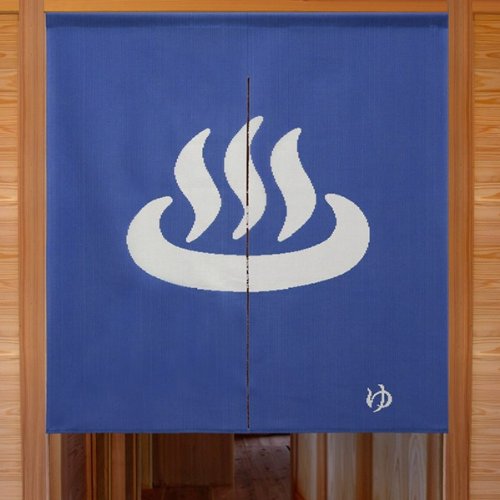
Fortunately, the GSI decided not to replace the symbol for onsen. The three wavy steamy lines bathing in an oval is a personal favorite.
The pictograms of today were born out of the pictograms of the 1964 Tokyo Olympics. These Games were the first to be held in Asia, and Japan realized they had a language problem. In addition to translation, designers figured that use of symbols would be a powerful and efficient way to get foreigners to the right place. In fact, the Tokyo Olympics proved to be filled with design opportunities for the best in the country as the ’64 Games were essentially the first time an Olympic Games systematically used pictograms to represent each of the sporting events, or direct people to places.
As this blog post states, “…for such a huge national event, needless to say the design side of things was very important too and it engaged the talents of the industry heavyweights at the time.” One of the heavyweights was Yoshiro Yamashita, who designed these event symbols.
The symbols that represented facilities were said to have been created by a team of ten designers.
From the book, “The Games of the XVIII Olympiad Tokyo 1964 – The Official Report of the Organizing Committee”
I really didn’t expect to see such a dark scene in a Sazae-san comic strip. But there it was.
Sazae-san notices a sad student walking out of the school grounds where exam results were posted. Sazae-san is so concerned that she follows the student, and is relieved to see her return safely home. What was Sazae-san worrying about? Maybe this young woman would be so distraught she would try to do harm to herself.
In Japan, these exam results determine whether you get into the school you want: Tokyo University, Kyoto University, Keio University or Waseda University, for example. Graduating from those prestigious schools will likely determine your short-term career, as well as your long-term life prospects. Parents, grandparents and the children themselves realize that a lot is riding on their chances to pass these university exams.
Japan has always had relatively high suicide rates, as you can see in the chart below. These days, Japan’s rate is about 60% higher than the global average. Back when Machiko Hasegawa was penning these Sazae-san cartoons, the suicide rate was significantly higher.
So suicides were a concern of the day. And while it is unclear whether there was a strong correlation between suicides and young people under tremendous academic pressure, it certainly was in the cultural conversation. Here are two more cartoon strips from the book The Best of Sazae-san – The Olympic Years“, illustrating the fear that one student has just trying to learn whether he passed a university exam or not, and another showing the level of deception that Sazae-san’s brother Katsuo is willing to go to in order to explain how he is doing in school to his father.




You must be logged in to post a comment.