Russians banned not banned
Source: ABC News Australia

Who’s in? Who’s out? The very political decision making process for which Russian athletes are considered eligible for the Rio Olympics or not has changed yet again.

As most of the sporting world is aware, the World Anti-Doping Agency (WADA) issued a report recommending that the entire team from Russia be banned from the upcoming Rio Olympics. The International Olympic Committee, which originally had the final thumbs-up, thumbs-down accountability on who gets to participate in the Olympics, decided to defer judgment on Russian eligibility to the international sports federations.

IOC and Russian flagsThis created chaos as, frankly, with less than two weeks to go, the various federations, some supremely under-resourced, have to make a well-researched decision on who to ban or not to ban. Many have criticized that decision. And as can be expected, decisions on Russians allowed to compete are inconsistent.

In this great summary by ABC News of Australia (as of July 27), the IAAF has banned all track and field athletes, as has the International Wrestling Federation. The World Rowing Federation has approved 6 for participation, but banned 19. The governing body for badminton (BWF), the International Judo Federation and the governing world body for volleyball, FIVB, have essentially cleared all of their eligible Russian players to compete.

As of this writing, the current estimates for Russian competitors at the Rio Olympics is more than 200, according to the Daily Mail.

However, on July 30, the IOC, likely buckling to criticism, decided to set up a three-member panel that will ultimately decide on Olympic eligibility, based on recommendations from the federations. The IOC spokesperson said that the process would be completed by August 5, which also happens to be the day of the Olympics opening ceremonies.

One person of note who will not be competing – Yuliya Stepanova. The athlete who risked her career, and perhaps even her life to help blow the whistle on the Russian state-sponsored doping and cover-up operations by talking with journalists and WADA was ironically banned.

Rusanova of Russia competes during the woman's 800 metres semi-final heat 1 at the IAAF World Championships in Daegu
Yuliya Stepanova

The IAAF, which has been hawkish in banning Russians from international competition, recognized the bravery and impact of Stepanova by approved her competition in the Rio Olympics as a “neutral athlete”. Despite that, the IOC decided to ban Stepanova from competing for her failed drug tests in the past, while conveniently dropping its accountability, casting a blind eye in all the other cases by allowing a third party to determine Olympic eligibility.

By the way, the honorary president of the International Judo Federation is Russia’s President Vladimir Putin.

  1. Have you ever exercised?
  2. Have you ever pushed yourself to exhaustion in a workout?
  3. Have you ever pushed yourself to exhaustion, want to stop, but push yourself even further?
  4. Have you ever pushed yourself to the point where your body rebels, and whatever liquids or solids are in your stomach shoot up your system and out your mouth in an acidy expulsion?

I can say yes, to the first two questions, but for Olympians, the answer to #4 is yes, on a daily basis.

exhaustion 2

Watch the above video to see how hard Team USA Olympians push themselves in the quest for gold and glory.

  • I get to the pool by about five o’clock, do about 45 minutes of prep work, and then I’m in the water at 6am. We see the sunrise in the morning when we’re already halfway through our practice. Natalie Coughlin, swimmer and 12-time Olympic medalist
  • It’s all about training when no one is watching. It’s all about training on holidays because I know most people aren’t training when they’re on holidays. Carli Lloyd, two-time gold medalist in soccer
  • Nothing is….”Oh this is fun! I enjoy the pain, the lactic acid, the burn that flows through my veins!” None of that. You don’t want any of that.Dawn Harper-Nelson, two-time 100-meter Olympic medalist
pikachu
Pikachu

Broadcaster at the Rio Olympics:

The Belgian has the lead, 30 meters on the Ethiopian struggling to stay in the race. With only a lap to go, we are clearly on the brink of….wait…my goodness! Two people have wandered onto the track, a girl and a boy…what are they doing on the track? They’re just walking, staring at their phones…and here come the leaders waving their arms, shouting. LePlante and Kidane veer to the right and pass them…they’re just standing there! Now the rest of the pack is shouting at them as they past the boy and the girl n their right and left…. OK, finally an official has come to escort them off the track. We saw this happen two days ago, when a teenage boy from Canada walked onto the mat during the semi-finals of the bantamweight wrestling competition. Could this be, yet again, another Pokémon Go attack?

On July 13, the Mayor of Rio de Janeiro, Eduardo Paes, wrote on his Facebook page on July 13 that he welcomes Nintendo to roll out the gaming phenomenon, Pokémon Go. “The whole world is coming here. Come too!”

Eduardo Paes facebook pokemon go

With everything going wrong in Brazil, the mayor knows that Pokémon Go is right now the hottest item in pop culture, so just talking about it is easy publicity for the upcoming Rio Olympics. Launched to phenomenal fanfare in Japan, the game starring such characters as Pikachu, Squirtle and Fennekin, Pokémon Go is scheduled for launches in Asia. Unfortunately, with scant few weeks left, it does not appear that Pokémon Go will be making it to Brazil any time soon.

I guess they’ll just have to settle for the Olympics.

August 4, 2016: As it turns out, Pokémon Go launched today in Rio.

There are 12 silver medals from the 1972 Munich Olympics packed away in a storage room inside the Olympic Museum in Lausanne, Switzerland. These medals have remained unclaimed for over 40 years.

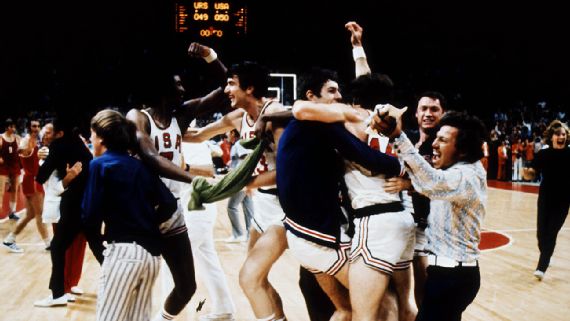
The IOC insists these medals belong to the 12 members of the US men’s basketball team, who lost to the Soviet Union 51-50. This was the Soviet Union’s “Do-you-believe-in-miracles” moment. After all, up to that finals game on September 10, 1972, the US Men’s basketball team had a record of 63-0 in Olympic competition.

But a confluence or circumstances and a last-second comedy of errors turned the men’s basketball finals in Munich into one of sports’ history’s most intriguing and controversial moments. In fact, a young Bob Costas refers to this game twenty years later at his 1992 Barcelona Olympics broadcast as “so controversial, so galling, still so difficult to accept.”

celebrating victory US Men's basketballt team 1972
US Men’s basketball team celebrating prematurely.

To be fair, the Soviet Union at the time had a strong, experienced team, and the US team were a collection of college greats, which meant they were very young and did not play extensively together until the year of the Olympics. Unfortunately for legendary coach, Hank Iba, UCLA center, Bill Walton, chose not to play on the team, which made the US team more vulnerable to the Soviet’s bulk up front.

Additionally, according to guard Tom Henderson, the coach had made a strategic error by playing a slow-down game even though the US had a team of “young deers” who “should have run them back to Russia.” So at the half they were down 26-21, and losing into the second half. But with 8 minutes left, the Americans began to run and score. With scant time left and a point behind, shooting guard Doug Collins was undercut while driving to the basket, slamming into the basket base. Woozy, Collins stepped up the free thrown line and knocked down the free throws to give the Americans a 50-49 lead with seconds left.

How many seconds left? That’s the gist of the controversy. And while I could attempt to explain it here, it really is very complicated. There are actually a large number of micro-actions that had to take place before a time-out was officially recognized according to rules at the time, and the compressed time frame and high stakes of the moment made it close to impossible to ensure clarity. And in fact, there were three separate in-bound plays. In other words, the play was re-done…twice. (Read details here).

soveit men's basketball team celebrate 1972
Soviets celebrating their “Do-you-believe-in-miracles” moment

After the initial inbound play right after the second free throw, the Soviets appeared to have one second left. In the first re-do, the Soviets were awarded three seconds, which gave them time to set up a play. They inbounded, the Soviets rushed as time slipped away, threw a meaningless pass, and suddenly, the Americans were celebrating on the court with dozens of other officials and spectators. Unfortunately, in all the chaos, the time-keeper had kept the clock at one second remaining, failing to revert the clock back to 3 seconds. Again, without

Don't want to jump in the pool

I lived in Bangkok and Singapore for over 13 years, where it is summer year round, and the temperatures are commonly in the low to mid 30’s Celsius (high 80’s Fahrenheit), and sometimes high 30’s Celsius (100+ Fahrenheit). And for every single one of those years, I had a nice big swimming pool within 10 meters of my apartment.

Jumping into the pool was an absolute delight!

But not for high-performance swimmers, athletes who have trained by jumping into water 12 degrees (20 Fahrenheit) colder than their body temperature, since they were kids. The bracing shock apparently never goes away.

“The worst part about being a swimmer? Jumping in the pool.”

“Jumping into the water when It’s 6am in the winter – it is the last thing you want to do.”

“It’s the worst part of any swimmer’s day.”

Click on the above picture or go to this link and see grown men and women revert back into little kids just thinking about it.

Stephen Colbert, like his former boss Jon Stewart and his former colleague, John Oliver, has a wit as sharp as Occam’s razor. It is often a joy to listen to him dissect an issue. In the above video clip, his dissection of the state of the Rio Olympics felt more like a vivisection. Here are a few examples:

I’m pumped for the Rio Games. They are less than two months away…or never…because yesterday Rio’s acting governor warned “the Olympics could be a big failure.”

Many of the venues are still unfinished, possibly because more than ten billion dollars in construction contracts went to just five firms, all of which are currently under investigation for price fixing and kickbacks. This has already led to top executives and politicians being jailed or charged…although the plus side for those executives – the prisons won’t be completed until 2036.

Police on strike in Brazil airport

Experts don’t expect an increase in arrests during the Olympics in part because police patrols may grind to a halt because they can’t afford to buy fuel. Though with any luck the problem will solve itself when the cars are stolen. These budget shortfalls led first responders to stage protests all over Rio yesterday, including one at the airport where police held a sign that read: Welcome to Hell. Police and firefighters don’t get paid, whoever comes to Rio de Janeiro will not be safe.

Hell. It explains why they’re changing the Olympic logo from three people holding hands to two guys mugging the other guy.

Rio 2016 logos_Steve Colbert

Say it ain’t so! I really want to see Bolt racing in the Rio Games. I hope he recovers in time.

Bolt reportedly could still be named to the Olympic team.

via Usain Bolt out of Jamaican Olympic Trials (hamstring), still hopes for Rio — OlympicTalk

Dan McLaughlin
Dan McLaughlin

Malcolm Gladwell said so in his enlightening book, Outliers, so it must be true. “The idea that excellence at performing a complex task requires a critical minimum level of practice surfaces again and again in studies of expertise. In fact, researchers have settled on what they believe is the magic number for true expertise: ten thousand hours.”

So inspired was Dan McLaughlin, a commercial photographer from Portland, Oregon, he decided to quit his profession and commit to learning how to play golf by practicing for 10,000 hours to see if he could become a professional golfer. This from a man whose golf experience up till then consisted of two visits to a driving range as a child.

So on June 27, 2009, McLaughlin began his journey, and tracked it on his site, The Dan Plan. And in 2012, when McLaughlin was the 2,500 hour mark, Golf.com writer, Alan Bastable met McLaughlin, and was impressed with his progress. McLaughlin had a 10 handicap, and according to Bastable, was energetic, enthusiastic and committed. At that stage, the plan was to hit 10,000 hours of practice in 2016, by which time he hoped to be a pro golfer.

Dan McLaughlin 2

Fast forward to November, 2015, and McLaughlin finds himself stuck on pause. Bastable caught up with McLaughlin to find the golfer recovering from back injuries with rest, as well as working hard to improve his financial situation. While the press and corporate sponsors are intrigued by this Quiotic dream, they are not showering him with as much attention as he would like. But more damaging has been the injuries to his back, which has McLaughlin contemplating surgery.

As McLaughlin said in this November post in his blog, he wrote about his frustration in dealing with his injury. “My back has been improving steadily and there was one week where I was able to play three rounds of golf with minimal pain. Then there are days where I swing a club once and it feels like I have reverted 3 or 4 weeks in my recovery. It’s not a half full – half empty situation, it’s more as if the cup has sprung a small leak and water is flowing in haphazardly.”

McLaughlin has hit the hard wall of reality. And one hopes that he is able to recover from his back ailments and resume his journey because his original reason for starting this journey resonates with me. Here’s how McLaughlin explained it in this interview with Bastable:

I’m interested in seeing whether somebody could do it, and how far they can go. In our culture, we’re kind of fascinated by the idea…not quite manifest destiny, but the ability to transform, and how far one can go, is it talent or hard work, and which trumps the other, and how much human potential we all have.

The Sports Gene Book Cover 2013I suppose McLaughlin’s premise is that in the nature vs nurture debate, nurture (or deliberate practice in this case) can “trump” nature, or the genes that assign specific physical attributes to you. Here’s what David Epstein wrote in his fascinating book, The Sports Gene: Inside the Science of Extraordinary Athletic Performance, about why that thinking appeals to so many people:

The “practice only” narrative to explain Tiger Woods has an obvious attraction: it appeals to our hope that anything is possible with the right environment, and that children are lumps of clay with infinite athletic malleability. In short, it has the strongest possible self-help angle and it preserves more free will than any alternative explanation.

And yet, Epstein explains that the 10,000-hour idea is more rule of thumb than rule.

…one man’s 3,000-hours rule was another man’s 25,000-and-counting-hours rule. The renowned 10,000-hours violin study only reports the average number of hours of practice. It does not repot the range of hours required for the attainment of expertise, so it is impossible to tell whether any individual in the study actually became an elite violinist in 10,000 hours, or whether that was just an average of disparate individual differences.

In other words, 10,000 hours is an average, and there must be other reasons to explain why some people achieve mastery faster than others, or why two people raised in similar

This is a wonderful commercial from Olympic global sponsor, VISA, featuring 15 Olympians making their way to Rio. Go to this link to confirm who the athletes are.

There was a time when Visa, the credit card company, was considered an after-thought in high-end travel and entertainment transactions compared to American Express. AMEX had the global brand cache that Visa craved, even though Visa was more readily accepted in three times more locations than AMEX.

There was a time when the IOC was barely afloat financially. The Olympics have been a powerful marketing opportunity for companies big and small from the 1950s to the 1980s, but the rights to market their products using the five rings were usually up to the local National Olympic committees (NOC) who sold the rights.

The International Olympic Committee were concerned not only regarding their financial situation, but also of the ability to control the Olympic brand if they were dependent on the local NOCs, who were perceived by the IOC to prioritize money over brand integrity. For example, the IOC did not like that a tobacco company was employing the Olympic brand in selling cigarettes during the 1964 Tokyo Olympics.

The IOC, motivated by the financial success of the 1984 Los Angeles Olympics, as well as the ability of USOC chairman, Peter Ueberroth, to sign up corporate sponsors, decided it was time to create a global Olympic sponsorship program that would make IOC the sole negotiator for marketing rights at all Olympiads. This would prove to be a challenge because NOCs, regardless of whether they had marketing chops or not, were resistant to give up power to the global authority, the IOC. On top of that, countries like the US, were concerned that the significant number of sponsors were American corporations, which would mean that American companies would inevitably end up funding athletes in countries like the Soviet Union (this at a time before the fall of the Wall, and the emergence of Glasnost).

Olympic turnaroundOver the course of countless negotiations, the IOC eventually banged out an agreement that would satisfy NOC small and large alike. Thus was born the TOP Program (The Olympic Partner), IOC’s designation for its global sponsors, who have exclusivity within their given industry to market their products and services at a given Olympics. But according to Michael Payne, who wrote the brilliant marketing book called Olympic Turnaround: How the Olympic Games Stepped Back from the Brink of Extinction to Become the World’s Best Known Brand And a Multi-Billion Dollar Global Franchise, very few corporations, initially, were willing to bite.

Coca Cola, Kodak and FedEx signed up, but for a while, those were the only corporations willing to take on the a most serious financial commitment to be the exclusive global sponsors at the 1988 Winter and Summer Olympics. Then IOC leader, Juan Antonio Samaranch appealed to the chairman of AMEX, James Robinson, to no avail. AMEX did not think they had any competitor willing to ante up, so they were willing to wait out the IOC for a better deal.

But then, circumstances colluded to bring Visa to the IOC. According to Payne, Visa had a change in marketing heads. And the new marketing head saw an opportunity to use the Olympic brand to make their customers aware of how far and wide Visa was accepted, and snatch market share from AMEX. By the time all the analysis was said and done, the line that convinced the VISA board to foot a US$14.5 million bill for TOP status was this: Visa was “going to stick the blade into the ribs of American Express”.

Was it worth the gamble? According to Payne, who was a member of the team that helped build the TOP program, the answer was yes.

For Visa, the payoff was dramatic. Global sales volume for the first three years of its Olympic partnership increased 18 percent against its own forecast of 12 per cent. Results from direct response campaigns and other promotions were 17 per cent higher when Olympic imagery was used. Card volume increased by 21 per cent during periods of Olympic promotion. Consumers who were aware of Visa’s Olympic sponsorship had dramatically better views of Visa, doubling their perception of Visa as a good corporate citizen: a 50 per cent increase in attitudes of overall best card and used for international travel.

Prime Minister David Cameron
Prime Minister David Cameron to step down.

On Thursday, June 23, we learned of the surprising affirmation by its citizens to remove the United Kingdom from the roll call of the European Union. This monumental vote, often called Brexit, has shaken economists and politicos around the world like a slow-motion punch to the gut, one much of the world watched hit in agonizing disbelief.

I’m not a political scientist or an economist, so I will leave the significantly more important impacts of Brexit on the global economy and political stability to others. I will instead focus on Brexit’s impact on sport. As a few of you may already know, the Ryder Cup, the biennial Europe-vs-US golf tournament, to be held in the US in the Fall, will go on despite the fact that six of the nine players of Team Europe are British.

As was explained in this nifty and swift Ryder Cup press release, “the criteria for being European in Ryder Cup terms is a geographical one (ie from countries who make up the continent of Europe) not a political or economic one (ie countries who make up the EU).”

Whew.

Great Britain balloon
Going it alone.

But in the long-term, there are potential negative consequences of Brexit, particularly on the state of sports in the United Kingdom.

  • Potential Loss of European Stars: Membership in the EU means citizens in member nations can work in any other member nation without a work permit. There is currently speculation that some 400 European players who currently have the automatic right to play soccer in England in the Premier League may have difficulty getting visas to continue their play. If that is the case in the coming years, fewer stars from the Continent may play in GB, thus begging the question, will the quality of play in British soccer gradually diminish?
  • Probable Loss of Funding: The EU has a funding arm to develop grassroots sports throughout the Union called Erasmus+, which splits some €265million across the 28 member nations in the period from 2014 to 2020. According to this article, “British organisations received around €1.3m in Erasmus+ sports funding, a significant amount at the grassroots level.”
  • Possible Loss of Opportunity to Host Premier Sporting Events: More than 500,000 visitors from former fellow EU member countries visited England during the 2012 London Olympics, who spent some 300 million in pounds. Brexit right now makes Great Britain a less attractive venue to host a European or global athletic event as visa requirements will make entry to Great Britain slower, likely encouraging athletes and tourists alike to opt for easier options. Organizers of super sporting events may re-think any plans for London.

With a loss of stars, funding and world-class sporting events, thanks to Brexit, the United Kingdom will likely have to work harder to maintain sporting excellence in the decades to come.