roger jackson own the podium
Roger Jackson, CEO of Own the Podium

To be the best athlete in the world often means overcoming overwhelming fatigue, excruciating pain, and suffocating fear and anxiety. As described by Olympic swimming champion Dick Roth, pain not only must be tolerated, it must be befriended.

I often thought, world-class athletes – they aren’t like you and me. Defying pain, building up super-human endurance, reaching world-class levels – is that trainable?

I posed that question to Roger Jackson, three-time Olympian, and gold medal rower in the coxless pairs at the 1964 Tokyo Olympics. Jackson was the CEO of Own the Podium, an NPO tasked with enabling Canada’s athletes to develop into Olympic champions. The only two times Canada had ever hosted the Olympics – 1976 in Montreal and 1988 in Calgary – no one from Canada won a gold medal. Own the Podium had a mission – help Canada achieve the highest medal haul in the 2010 Winter Games, to be held on home turf in Vancouver, Canada. While Team Canada did not come out on top in the medal count, Canada did win the highest number of gold medals, 14, which also happened to be the most total gold medals ever won by a country in a Winter Games.

“We had always been fifth in the world,” Jackson told me. “I was asked by the Canadian government and the Vancouver Olympic Organizing Committee to build a program to win the most medals in Vancouver. I had five years. I hired strong leadership. And I insisted on 100% commitment from our athletes. If you were willing to be disciplined and committed to the world-class training regimen we created, we would fund you. We worked with the athletes on plans, assessed the performance of the plan three times a year, identifying issues and upgrading the plans as we needed.”

Jackson emphasized that Olympians who want to be champions have to have this attitude – no compromise. “Family, school, wife – they cannot compromise your training. You need to sleep, rest and work your ass off. That’s the tone of the very best.”

Jackson said that’s why the Canadian rowing teams were traditionally strong, and why all Canadian teams had a chance, even the unknown Roger Jackson / George Hungerford coxless pair team. Canadian rowers trained hard and did not compromise.

Jackson, Roger | Hungerford, George
Canada’s Roger Jackson and George Hungerford celebrate their gold medal win in the rowing event at the 1964 Tokyo Olympics. (CP Photo/COC) Roger Jackson and George Hungerford du Canada célèbrent leur médaille d’or au deux d’aviron aux Jeux olympique de Tokyo de 1964. (Photo PC/AOC)

“In the University of British Columbia Rowing program, we were told to do something, and we had to do it,” said Jackson. “Maybe we couldn’t believe we could do it, but we’d have to try. We would row three or four miles every morning and again every evening. And because there were so few teams to compete with us as other competitive teams were so far away from us, the coach had all the different teams compete against each other. At the end of each morning workout, we would row a 2000 m race against our other crews. The slowest boats would start, being the pairs and seconds later the fours would start and later the eights would start, all converging on the finish line at about the same time. And to win, you would never give up.”

“We would get to the finish line totally exhausted, dry retching, heaving. And, on occasion, the coach would say, ‘not good enough. Do it again.’ And so we raced 2000 m again. And if it wasn’t good enough, he’d tell us to do it again. I was eating 8,000 calories a day and still losing weight, but I knew that no one else had this incredible work ethic. That was the attitude that made us do things we didn’t think we could do. So when we got to the starting line in Tokyo, I knew we had done everything we could do to prepare ourselves to win.”

Do it again. Again. Again. Again. Again. Sound familiar?

Here is a famous scene from the film, Miracle, about the 1980 USA Ice Hockey Team that won gold at the Lake Placid Olympics. Coach Herb Brooks has taken his team to play the Norwegian national team and the game ends in a tie. Brooks isn’t happy with the team’s dedication and commitment, and makes them skate sprints over and over and over….until finally, the team’s captain, exhausted beyond reason, has an epiphany.

Flushing Meadows_five
Me, several years after the closing of the New York World’s Fair in Flushing Meadows.

First things first. Novelist and futurist, Isaac Asimov had a caveat. If the world is destroyed by a thermonuclear war, his predictions would be meaningless. Got it.

isaac asimov
Isaac Asimov

Since there has been no nuclear war of significance, here are a few of the predictions Asimov made in the New York Times in August, 1964. Asimov visited the huge, big-tent event in the world that year that was not the Tokyo Olympics – the World’s Fair in New York, which happened to be in my backyard of Flushing, Queens.

By 2014, electroluminescent panels will be in common use. Ceilings and walls will glow softly, and in a variety of colors that will change at the touch of a push button. A quick search reveals that available in the marketplace is electroluminescent advertising displays (which are paper-thin flexible panels), electroluminescent paint, electroluminescent wallpaper, and something more commonly known, electroluminescent fashion.

There is an underground house at the fair which is a sign of the future. Suburban houses underground, with easily controlled temperature, free from the vicissitudes of weather, with air cleaned and light controlled, should be fairly common. The reason Asimov gives for this idea is Man’s urge to control its environment, as well as expand the amount of land to grown more food to feed a growing world population. But another reason will be the Mega-city Trend, the continued massive migration to big cities that puts tremendous pressure on the infrastructure. Singapore, where I lived for a few years, has a population of 5.5 million people on a land mass of 710 square km, a country half the size of Los Angeles. The Red Dot, as it is affectionately called, will be considerably more dense as the government predicts the population to grow to 7 million in the near future. Singapore has built upwards with its skyscrapers, and outwards with land-fill areas, but is now planning underground working facilities on a scale not commonly seen. Designs for the 300,000 square-meter Underground Science City will be 30 to 80 meters below the surface, with plans to hold a working population of over 4,000.

Singapore Underground Science City
The planned Singapore Underground Science City

Robots will neither be common nor very good in 2014, but they will be in existence. The I.B.M. exhibit at the present fair has no robots but it is dedicated to computers, which are shown in all their amazing complexity, notably in the task of translating Russian into English. It will be such computers, much miniaturized, that will serve as the “brains” of robots. The way Asimov describes robotics, and I suppose, artificial intelligence is far less aggressive than his imagination in his novels. I haven’t read that many Asimov works, but I do know that he was one of the most significant minds behind a philosophical framework or set of rules regarding the relationship between Man and Robot: The Three Laws of Robotics. Additionally, I recall his brilliant character, Hari Seldon in Asimov’s Foundation Series, a man who developed psychohistory, a precursor, to me, of what we now call Big Data.

If you want to watch something historic, as well as geeks geeking out, here’s an incredible video of IBM’s Watson beating two humans at Jeopardy. The two humans are Jeopardy champions.

Much effort will be put into the designing of vehicles with “Robot-brains” vehicles that can be set for particular destinations and that will then proceed there without interference by the slow reflexes of a human driver. I suspect one of the major attractions of the 2014 fair will be rides on small roboticized cars which will maneuver in crowds at the two-foot level, neatly and automatically avoiding each other. Two obvious parallels to today’s technology: self-driving cars, which are all the rage, as well as maglev technology. By 2020, there are some who claim that Japan will have significant driverless transportation on the roads when the Olympians arrive.

The maglev train, which is already operational in Shanghai, will connect Tokyo to Osaka in an hour, achieving a speed of 500 kph, although it won’t be in operation until 2027.

Pictograms for Women and Drinking Water
Pictograms used at the 1964 Tokyo Olympics, from the book, “The Games of the XVIII Olympiad Tokyo 1964 – The Official Report of the Organizing Committee”
If you don’t speak Japanese, travelling in Japan is a challenge. You’re in a train, you pull into a station, you peer through the window as the train decelerates desperately trying to figure out what station you’re at, scanning for English, any English at all.

The next best thing to words are symbols. The signs for men and women’s toilets come in a gazillion varieties, but they are most often a variation of a theme. Symbols, if done right, can cut to the chase.

foreign friendly pictograms

With a continued increase in foreign tourists to Japan, and a spike in international guests in Tokyo during the 2020 Olympics expected, the Geospatial Information Authority of Japan (GSI) released a new set of map symbols which they believe will be more intuitively understood by visitors. The old map symbols included an “X”. In the West, “X” may mark the spot of treasure, but in Japan, it meant police station. The old map represented a temple with a swastika, which is too much of an emotional jolt to many with its strong association with Nazism, despite its far longer association with Hinduism and Buddhism.

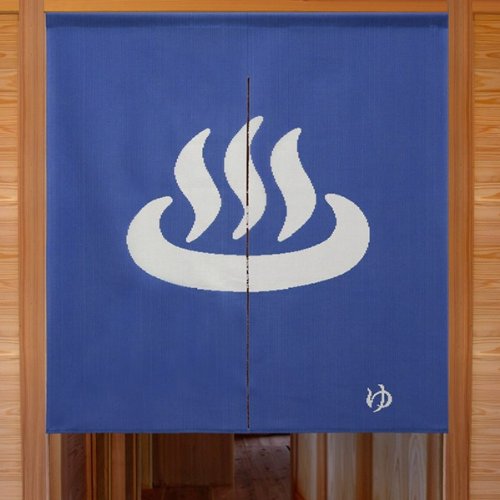
Fortunately, the GSI decided not to replace the symbol for onsen. The three wavy steamy lines bathing in an oval is a personal favorite.

onsen symbol

The pictograms of today were born out of the pictograms of the 1964 Tokyo Olympics. These Games were the first to be held in Asia, and Japan realized they had a language problem. In addition to translation, designers figured that use of symbols would be a powerful and efficient way to get foreigners to the right place. In fact, the Tokyo Olympics proved to be filled with design opportunities for the best in the country as the ’64 Games were essentially the first time an Olympic Games systematically used pictograms to represent each of the sporting events, or direct people to places.

As this blog post states, “…for such a huge national event, needless to say the design side of things was very important too and it engaged the talents of the industry heavyweights at the time.” One of the heavyweights was Yoshiro Yamashita, who designed these event symbols.

events pictograms 1964

The symbols that represented facilities were said to have been created by a team of ten designers.

pictograms at Tokyo Olympics_The Games of the XVIII Olympiad Tokyo 1964 Report
From the book, “The Games of the XVIII Olympiad Tokyo 1964 – The Official Report of the Organizing Committee”
Yukijirushi butter ad_Asahai Graf Tokyo Olympics Special Issue_November 1964
An ad for butter and cheese by the dairy company, Yuki Jirushi. From the November 1964 Asahi Graf, Tokyo Olympics Special Edition

A derogatory term in Japan for foreigners at the turn of the 20th century was “batta-kusai” (バタ臭い), literally “stinks of butter”.

In the 16th and 17th centuries in Japan, when the Portuguese and Dutch established relations and trade with the Tokugawa Shogunate, the Japanese were exposed to non-Japanese who had meat and milk in their diets. The Japanese, due to the influence of Buddhism and Shintoism, were forbidden from eating meat, and thus by extension, dairy products. On top of that, Japanese were generally lactose intolerant.

Because of the fundamental differences in diet, the Japanese thought, quite simply, that Westerners, with the residue of beef, milk and cheese in their systems, reeked.

Milking at a small farm in Japan 1933_Mainichi Photo Gallery
Milking at a small farm in Japan in 1933_Mainichi Photo Gallery

But when Emperor Meiji came to power in the late 19th Century, the emperor and his government embarked the country on a massive modernization campaign to make not only the Japanese military, science and industry equal to the levels of excellence in the Western industrialized world, but also the size and strength of Japanese people.

According to this article, the Meiji Government not only lifted the ban on meat and dairy-products consumption, they put the word out, quietly, that the Meiji Emperor also enjoyed meat, cheese and milk.

Jersey cows arrive to Japan from New Zealand 1953_Mainichi Photo Gallery
Jersey Cows arrive from New Zealand to a farm in Japan in 1953, from the Mainichi Photo Gallery

Clearly, the Meiji Government was also picking up advanced marketing techniques, such as celebrity endorsements to sell products. But when the 1960s rolled around, using data to back your claims was all the rage. The advertisement at the top of the page was published in November, 1964 in Asahi Graf’s Tokyo Olympics Special Issue. The headline text states, “These Children Will be the Strength of Japan in the Future”. The company making this statement is “Yuki-Jirushi”, one of the dairy products companies (along with Meiji) established by the Emperor Meiji.

The statistics shared in the ad show how, from 1955 to 1962, the height of the average 5-year old went from 104 to 106.1 cm tall while the average individual daily consumption of dairy products (I suppose they mean butter and cheese) went from 0.8 grams to 5.4 grams.

Distirbution of Milk Containers 1955_Mainichi Photo Gallery
Distribution of milk containers in Japan in 1955, from the Mainichi Photo Gallery

A few years later, an AP article from May, 1969 cited a government survey indicating the trend was continuing. “A ministry survey showed the average height of 11-year-old boys has increased by 4.6 inches over the past 68 years. Girls of the same age had an increase of 5.4 inches. During the 1900-1968 period, the 11-year-old boys gained 13.6 pounds and the girls 18.9 pounds in weight, the survey said.”

The article went on to explain that the Allied Occupation under the

Sazae-san_You Didn't Do Your Homework Thief

Japan is an incredibly safe city. With over 13 million strangers jampacked together, you might think that the crime and violence that plague other cities in the West might be evidenced in Tokyo. But that isn’t the case.

I won’t go into factors here. But I was surprised to see that in the world of Sazae-san in the early 1960s, crime was not an unknown quantity. In the cartoon at the top of the page from the book The Best of Sazae-san – The Olympic Years“, Sazae-san jokes about the incompetence of a con-man. In the cartoons below, the illustrator Machiko Hasegawa is able to make light of kidnapping and theft.

Sazae-san_Don't Worry I Won't Kidnap You


Sazae-san_It Was a Cheapie

The reality is, crime may very well have been on the minds of many Japanese in Tokyo at the time. As this line graph of violent crime rates from 1950 to 1996, Japan actually had higher rates of violent crime than Sweden, the United States and the UK in the late 1950s early 1960s. That was likely a product of the post-war years as Japan was crawling its way out of a decimated landscape, both economically and physically.

Total Violent Crime Rates 1950 to 1996
From the book, The Great Disruption, by Francis Fukuyama

Another popular signal of this anxiety was the powerful 1963 film, “High and Low”, by director Akira Kurosawa, starring actor Toshiro Mifune as a rich industrialist who must come to grips with the kidnapping of a child. Here is a wonderful summary and analysis of the film by New York Times film critic, A. O. Scott.

US Water Polo Team 1964
The US Olympic team in Tokyo, 1964 Olympic Games, Standing L-R: Dan Drown, Ron Crawford, Stan Cole, Bib Saari, Ralph Whitney, George Stransky, Coach Urho Saari. Bottom L-R: Tony van Dorp, Chick Mcllroy, David Ashleigh, Ned Mcllroy, Paul Mcllroy. Source: The history of USA Water Polo in the Olympic Games.

They were tied 1-1 with the Yugoslavians at the 1964 Tokyo Olympics. Along with Hungarians and the Soviet Union, Yugoslavia was part of a European domination of a sport – water polo. The United States were not on the same par as Yugoslavia at that time. They had never played any teams outside the United States until those Games. And yet, there they were, tied 1 apiece with the Yugoslavians.

“Our first game was against Yugoslavia,” said Daniel Drown, who was on that USA squad. They were supposed to be huge. When we came out of the tunnel at the pool, we didn’t think they looked that big. Then we went to shake their hands and their shortest guy was 6ft 3, and their biggest were 6ft 7. They were huge!”

The US team played even throughout the first half with the Yugoslavians. And in the second half, they caught a break – one of the Yugoslavians was ejected with four minutes remaining, which meant they would be down one man until the US scored. Despite the advantage, the US played tentatively. “We have an extra guy,” said Drown. “If we score, it will be the biggest upset. But everybody was afraid. No one would take the shot. Finally, one of their guys scored and they won 2-1.”

The US water polo team would go on to beat Brazil 7-1, but lose to the Netherlands, and thus fail to advance to the finals.

Drown remembers thinking, “we didn’t deserve to win. We were playing way over our heads.” But he knows the US team played brilliant defense. And he believes the fledgling US water polo program benefited from the coaching of Urho Saari.

“Saari believed in conditioning, absolute conditioning,” said Drown. “His philosophy was to work us so hard, so that you were sick to your stomach, and you couldn’t eat after a workout. But when it came time to play in a game, we may not have been as good as the other team, but we would be in better shape. We would think, ‘why couldn’t we win?'”

According to this article, Saari was an innovator in water polo. “Saari insisted that more emphasis should be placed on swimming, rapid ball-handling and changes in offensive and defensive tactics. He frowned on rough play and thought that teams should be less dependent on scoring done by the center-forward.”

Urho Saari at the Urho Saari Swim Stadium
Legendary El Segundo swimming coach Urho Saari. Daily Breeze file photo by Jack Wyman

“We would play 3 on 3 keep away for long periods of time, which disciplined you,” explained Drown. “One person had the ball and one would receive and he had better be open, and the third guy better be getting open. Everybody is constantly moving to get away from whomever is guarding them.”

“Saari would also run every night a scrimmage for 90 minutes four on four. He would referee it. When you did something wrong, you could see clearly when something was wrong. They threw to an open space and you

The Best of Sazae-san

Sazae-san is one of the most well-known comic characters in Japan. Created, written and illustrated by Machiko Hasegawa from the 1940s to the 1970s, Hasegawa’s characters are as much a part of the average Japanese psyche as the Yomiuri Giants, a platter of soba, or Natsume Soseki.

Hasegawa wrote about the everyday lives of an average Japanese family, the Isonos. Her genius was to illustrate normal activities as vignettes, and controversial topics in sweet and innocent frames. I found many examples of this in a recently published book of her cartoons translated into English, called “The Best of Sazae-san – The Olympic Years“. It was a delight to read about the issues the average citizen in Tokyo were dealing with in the 1960s.

Here is one comic strip that deals with an issue linked to the Olympics.

Sazae-san_I'm Against the Olympic Road


Cities all over the world were building highways and expanding roads into avenues to accommodate the explosion of automobiles on the road. Tokyo was no exception. And when Tokyo was selected as the host of the 1964 Summer Olympics in 1959, urban planners saw this as an opportunity to transform Tokyo.

One of the roads that passed through a somewhat wealthy, somewhat sleepy part of Tokyo, was called Aoyama Doori (Aoyama Road). Aoyama Doori connected Shibuya and Ginza, and was one of the noisiest and busiest thoroughfares in the city. In addition to the expectation that traffic would get worse was the general expectation that infrastructure changes related to the Olympic Games would accelerate the pace of change and pain. City planners insisted that Aoyama Doori be widened dramatically, from 22 meters to 40 meters.

Watch this video from the 2:15 minute mark to 7 minute 45 second mark to see what Aoyama Doori was like in the early 1960s.

Dealing with the tremendous change was a challenge to the citizens of Tokyo, the most populous city in the world. The change created tremendous stress for its citizens. Hasegawa recognized this stress. But in her sweet particular way, she laced her negativity with sentimentality. Why is Sazae-san’s younger brother, Katsuo against the widening or building of a road in the cartoon? Not because of the impact to people and commerce, but because of the impact on a bird’s nest.

Against the Road Expansion!
“Against the widening of the road!” Screenshot from the EdX video for the course “Visualizing Postwar Tokyo, Part 1”


George Hungerford and Roger Jackson in shell
George Hungerford and Roger Jackson after winning gold in the coxless pairs in Tokyo.
They were an afterthought, really.

Canada’s rowing eight was coached by Glen Mervyn, a protégé of the famous Frank Read, who coached the eight crew that got Canada’s only medal at the Rome Olympics – silver. George Hungerford and Roger Jackson were thrown together in the coxless pair, without a coach, in a “clunker of a boat”, only weeks before flying to Tokyo for the XVIII Olympiad.

Hungerford was supposed to row in the vaunted eight, but fell ill, and then, got kicked off the premier crew. That decision led to other decisions. A rower named Wayne Pretty assumed Hungerford’s spot on the eight. And since Pretty had been in the coxless pair boat, Jackson was left without a teammate. With the rowing roster set at 15, and the coxless pair considered a lesser priority to Team Canada, Hungerford and Jackson were asked to pair up to provide representation in this event at the Olympics, assuming Hungerford could get in good enough condition in time to compete.

“When I was selected to the eights, it was a dream come true,” Hungerford told me. But when he was diagnosed with mononucleosis in July, 1964, he was told to rest for four weeks. “It was a depressing time for me. And four weeks later my doctor told me the symptoms were gone, but my chance to join the eights was gone.”

But if they wanted to go to Tokyo, Hungerford and Jackson had to make it work. Team Canada’s expectations for coxless pairs was low. And when Hungerford and Jackson got into a shell to train, they didn’t immediately click on the water. “No, there wasn’t an instant connection,” said Hungerford. “We had to come to terms with our issues. We yelled and screamed at each other after the first few rows. But we realized that if we we’re going to Tokyo we had to put these differences aside and work together.”

Despite the bad luck that brought the two together, Hungerford observed one good bit of fortune – “As it turned out, physically we were a perfect match. We were the same height, same weight, same mental toughness and determination.” Their determination drove them to train hard, harder than anyone else in the remaining weeks to Tokyo.

And their hard work paid off in another bit of fortune. Upon arriving in Tokyo, Canada was able to borrow a boat from the Americans. And it turned out to be a George Pocock shell, a hand-crafted boat from the most reputable craftsman of his time in the US. As Hungerford explained, while everyone else was already in top condition and thus focusing on their mental preparation, Jackson and Hungerford worked hard on their rowing. “We had a full endurance training program in the last week. We were doing interval training, only 500 meter sprints. We hadn’t done a full 2000 meters and we wanted to do a time trial so we asked the eights coach to time us. We knew we had the ‘swing’. We had a sense the boat was moving, the boat was working for us. But after the 2000 meter time trial, the coach told us his watch wasn’t working properly so we didn’t know how fast we were.”

They didn’t know, until they entered the first heat, which they won. After the heat “The coach told me his watch wasn’t really broken, but he hadn’t believed it the first time he timed us,” said Hungerford. “We had the fastest time of all the heats. That put us directly in the finals – no repechages. That gave us confidence. With four or five days between the trials and finals, we kept training and we rowed our hearts out. Rowing and sleeping. Rowing and sleeping. Endurance over 2000 meters was critical.”

The Germans and the Dutch were favorites in the coxless pair competition. But once you get to the finals, you have a one in six chance, was how Hungerford and Jackson were thinking. Unfortunately, they started the race by catching a “crab” – one of the oars didn’t hit the water the right way getting the boat off to a slow and awkward start. But another boat had false started so Jackson and Hungerford got a second chance and had a good start.

At 900 meters into the 2000-meter course, they decided to go for it with a power 30 – 30 extraordinarily hard strokes up. “The boat just flew,” said Hungerford. “We were neck and neck up to 900, but then we took a length and a half on the other boats. It was a fantastic feeling. The boat was just moving, an incredible feeling, an adrenaline rush knowing we had the lead. Now we had to not let the other boats catch us. The Dutch boat was challenging. The last 200 meters was hell. Our tanks were drained at 1500 meters – I don’t know where we found that inner strength in the last 500.”

“They might have caught us if the race was longer. I was starting to fade so Roger had to adjust. We’re rowing as a pair in a sensitive boat, sensitive to one rower overpowering the other. You have to perfectly synchronize. If one loses strength the other has to match, match each other in all respects. It was challenging. As Roger told me, he had heard this burst come from the stands. They were calling out in German for the German crew, which was also coming on strong. But as Roger said, ‘there was no bloody way we were going to lose’.”

George Hungerford and Roger Jackson  on podium

In fact, they won. Canadian’s only gold medal of the 1964 Tokyo Olympics came thanks to a pair of rowers who through sickness and circumstance were thrust together in a shotgun marriage. And there they were, jelly legged, nothing left in the tank, standing at the winner’s podium with gold suspended from their necks, listening to the Canadian anthem, the only medal ceremony it was played in Tokyo.

“It was an incredible moment for us,” said Hungerford.

When it was time to leave Tokyo, to pack everything up and say goodbye to a life-changing experience, the Pocock shell, a championship shell, was returned to the American team. The boat had no name. But when they gave the boat back, it had a new decoration on the bow – a decal with the Canadian flag.

Pachinko ad_Asahi Graf Tokyo Olympics_November 1964
Poster promoting pachinko in the Olympic Village_ from the book “Asahi Graf Tokyo Olympics_November 1964”

When I first came to Japan in 1986, I was struck by the brashness of the pachinko parlor – the martial music blaring, the blast of nicotine rushing through the doors as they opened, accompanied by the high-pitched sound of ball bearings slipping, sliding and colliding with glass, metal pins, and other balls across dozens of machines.

The game known as pachinko is as much a part of 20th century pop culture in Japan as Ishihara Yujiro and Misora Hibari, Godzilla and Astro Boy (鉄腕アトム), and Western-influenced music, fashion and sports.

Like bowling and surfing in Japan, pachinko started in the West, its origins thought to be in the 18th century French game, “Bagatelle”, and then the early 20th century game American adaptation, “Corinth Game”. As further explained in this detailed History of Pachinko, the Corinth Game came to Japan in the 1920s, providing ways for children to win candy or fruit in local shops. Children would call the game “pachi-pachi” as that was the sound they heard as the ball made its way through the playing surface.

After the Second World War, pachinko served society as a means to get access to daily necessities, as well as inexpensive entertainment for adults at a time when Japan fought its way out of the rubble and desperation of a lost war. Here’s how author and Japanologist, Robert Writing described it in his book, “Tokyo Underworld“:

pachinko parlor 1960s
Pachinko Parlor in Japan_circa 1960s

“In the postwar years, the prizes became daily necessities like coffee, canned fruit, sugar, soap, and domestic cigarettes like Golden Bat. Since it cost so little to play and was the essence of simplicity itself, the popularity of pachinko skyrocketed. By 1953, there were over a million machines housed in some 50,000 pachinko parlors, all filled to capacity, day and night. Critics complained the pachinko boom was creating a nation of idiots and that it also increased the crime rate. Indeed, people were so eager to try it, they would literally steal for the money to play.”

So you can see why the picture at the top of the post surprises me – pachinko in the early 1960s was less a shining example of Japanese culture and more a vice to cover up. I wish I could read the poster’s text – I could not good enough resolution to understand what virtues of pachinko the officials were playing up – but I’m sure the allure of the bells and whistles called out to more than a few of the highly competitive Olympians…at least for a try.

National Gymnasium Annex exterior 1
The National Gymnasium Annex

I like flea markets so I found myself roaming one in Yoyogi, which happened to be right next to the beautiful National Gymnasium. The site is composed of two complementary structures, the main building where the swimming and diving events were held during the 1964 Tokyo Games, and the Annex, which is where basketball games were held.

After browsing the goods on the crisp winter day two Sundays ago, I thought I’d see up close what I had already written about. The larger structure of the Kenzo Tange-designed buildings was closed. But fortunately, the Annex was hosting an event, the 27th Annual Women’s Gymnastics Club, a free event, so I suddenly found myself in the stadium where Jerry Shipp, Mel Counts, Luke Jackson, Jeff MullinsBill Bradley and Larry Brown, to name a few, won their gold medal for the United States basketball team.

US Men's Basketball team vs Peru_Tokyo Olympics Special Issue_Kokusai Johosha
US Men’s Basketball team vs Peru_from the book “Tokyo Olympics Special Issue_Kokusai Johosha”

Inside, pre-teen and teenage girls were performing rhythm gymnastics for family and friends, who sat in the dark and intimate stadium, the floor standing in brilliant lighted relief. The Annex seats only 4,000, so I could understand how the basketball games were hot tickets. Of course, the fact that there are only 4,000 seats means there is not a bad seat in the house. You can see that in the pictures.

National Gymnasium Annex pano 1
Panoramic view of the inside of the National Gymnasium Annex

National Gymnasium Annex pano 2

Thankfully, the annex, which is a sixth the size of the national gymnasium, will be one of several sites from the 1964 Games used in the next Tokyo Games. In 2020, the annex will be the site of the handball competition. But since 1964, basketball has become an international phenomenon, and women’s basketball, also growing in popularity, has been added to the mix. With that in mind, basketball in 2020 will be played in the Saitama Super Arena, which has a maximum seating capacity of 22,500 when basketball is in the house.

National Gymnasium Annex 1
Inside the spire of the National Gymnasium Annex