Yukio Endo_Tokyo Olympiad_Kyodo News Service
Yukio Endo, from the book Tokyo Olympiad_Kyodo News Agency

By the time the 1964 Tokyo Olympics rolled around, gymnast Boris Shakhlin of the Soviet Union had won nine Olympic medals in Melbourne and Rome, including four gold medals in 1960. Until 1980, his total Olympic medal haul of 13 was the most by any male athlete until 1980.

Shakhlin certainly had an opportunity to continue his championship ways in Tokyo. Except that Yukio Endo, and perhaps all of Japan, stood in his way.

Boris Shakhlin_XVIII Olympiad Tokyo 1964_Asahi Shimbun
Boris Shakhlin, from the book XVIII Olympiad Tokyo 1964_Asahi Shimbun

Endo won the men’s individual all-around gymnastics competition, which includes compulsory and optional events in six events: the vault, floor exercise, pommel horse, rings, parallel bars and horizontal bar. After all was said and done, Endo had a total score of 115.95 out of a total 120 points, edging out three competitors who tied for second with scores of 115.40.

In other words, 0.55 separated gold from silver. The problem is, Endo had what could be described as an awful effort on the pommel horse optional. As American gymnast Dale McClements described in her diary at the time, “Endo sat on the horse 2 times and dismounted with bent legs.”

According to the Japan Times, Endo had a considerable lead over his teammate Shuji Tsurumi and Shakhlin before the pommel horse optionals. “Japanese spectators were biting their nails fearing that the last moment error would cost Endo the gold medal. The event was halted 10 minutes as Japanese team manager Takashi Kondo made a strong appeal to the judges that the faults should not be counted too much. While the Russians glowered, spectators burst into cheers when the judges finally raised their scoring flags. All four were unanimous giving Endo 9.1 scores which assured him of the gold medal.”
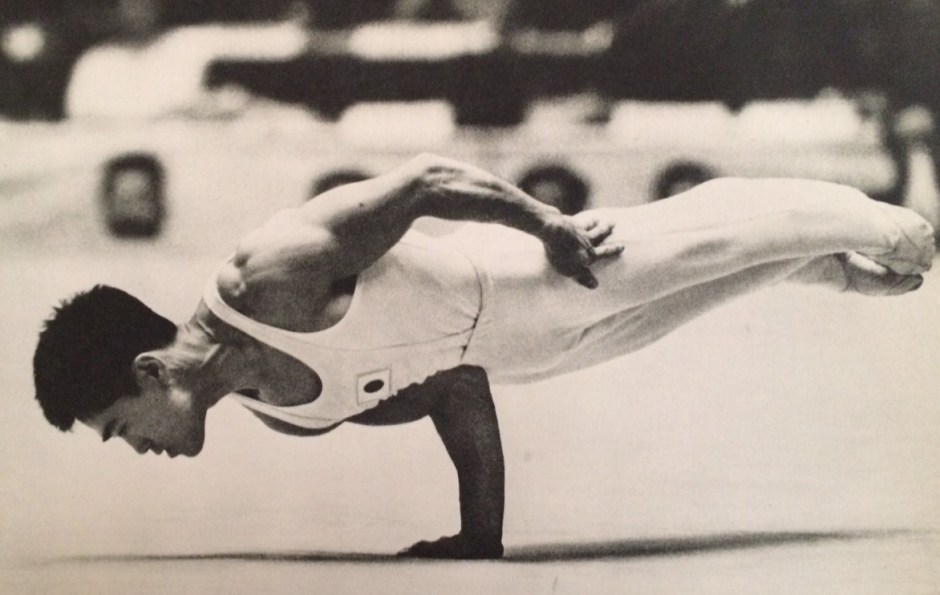
 

Yukio Endo
Yukio Endo, from the book, Tokyo Olympiad_Kyodo News Agency

Another American gymnast who witnessed Endo’s performance, Makoto Sakamoto, told me that the pommel horse is arguably the hardest of the six disciplines. “It’s the most difficult event to stay on. There are so many opportunities to fall and slip off. You can hit a slick spot, or you sit down. He missed! I remember saying, ‘Darn it, the best gymnast in the world is crumbling.’ Then he got a 9.15, and I thought, ‘what a gift!’ Anyone else would have gotten an 8.2 or 8.4. He got a 9.15.”

In other words, the 0.55 edge would have disappeared if Endo had not

1932 Olympics

President Herbert Hoover was inaugurated as the 31st President of the United States on March 4, 1929, during a period still known as the Roaring Twenties, when wealth and excess were touchstones of American culture. Nearly 8 months later, the façade came crumbling down as the stock market crashed, sparking the onset of the Great Depression.

While President Hoover, a staunch Republican, directed the government to invest in large public works programs – think Hoover Dam – he was unfortunately more well known for the shanty towns that sprung up all over America housing the dispossessed and despairing – think Hooverville.

hooverville

Hoover was naturally invited to Los Angeles, to represent the federal government at the 1932 Olympic Games hosted in Los Angeles, California. But Hoover declined, becoming only the 2nd sitting president (after Teddy Roosevelt in 1904) not to participate in an Olympic Games on US soil.

As was stated in this Time Magazine article, Hoover knew his Presidency was in trouble and that in an election year, he needed to stay close to power in Washington DC. “’For him to be away from Washington for three weeks would be a national disaster,’ White House aide Lawrence Richey said, according to Bill Watterson’s The Games Presidents Play.”

Ironically, perhaps, it was during the Olympic Games in Tokyo when President Herbert Hoover drew his last breath. He was nearly 90 years old, and like the Los Angeles Games in 1932, the 1964 Games was nary a thought.

Hoover Dies 1964
Japan Times, October 21, 1964

girl from ipanema record cover

As Olympians were prepping for the 1964 Tokyo Olympics, it’s quite possible they were training, cooling down or relaxing to the song, The Girl from Ipanema. The Brazilian Bossa Nova hit was released in the US on July 25, 1964, went to number one in the US peaking at number five for the year, and charted highly in markets all over the world.

The music from the song, often one of the first examples that come to mind when one thinks of elevator music, was composed by Antonio Carlos Jobim for a film. The lyrics were composed by Vinicius de Moraes, as he sat at a café on the beach of Ipanema, a swanky part of Rio de Janeiro. And indeed, there is a girl from Ipanama who caught the eye of Moraes as she walked by the cafe every day – Heloisa Eneida Menezes Paes Pinto.

Heloisa Pinto
Heloisa Eneida Menezes Paes Pinto, aka “The Girl from Ipanema”

Astrud Gilberto, who sang the bossa nova classic, was selected for the English-version of this song because she happened to be one of the few Brazilians who could speak English decently. And thus was born one of the shining symbols of Brazil – The Girl from Ipanema – said to be the second most recorded pop song in history, after Yesterday, by The Beatles.

And as we enter 2016, and await the start of the Olympic Summer Games in Rio de Janeiro, we hope that Rio walks in as fresh and lovely as the Girl from Ipanema:

Tall and tan and young and lovely
The girl from Ipanema goes walking
And when she passes, each one she passes goes, “Aaah…”
When she walks, she’s like a samba
That swings so cool and sways so gently
That when she passes, each one she passes goes, “Aaah…”

Roy_summer vacation_1967 maybe
Roy, sometime between the Tokyo and Mexico City Olympic Games.

On this, the last day of 2015, I’d like to thank everyone for their support of my blog – The Olympians. I have posted at least once every day since I started the blog on May 1. Out of about 300 posts, I’ve selected 25 that I personally like, in good part because I’ve had the great fortune to talk with the people mentioned in these stories.

  1. A Helicopter View of US-USSR Relations, Olympic Style
  2. American Gymnast Makoto Sakamoto and Memories of Home: Post-War Shinjuku
  3. Arnold Gordon (Part 1): Befriending Judy Garland at Manos in Shinjuku
  4. The Banning of Headgear in Boxing: The Convoluted World of Protecting Our Athletes
  5. Clumsy Handoff, Beautiful Result: A World Record Finish for the American 4X400 Relay Team in Tokyo
  6. Coach Hank Iba: The Iron Duke of Defense Who Led the Men’s Basketball Team to Gold in 1964
  7. Creativity by Committee: The 2020 Olympic Emblem and the Rio Olympic Mascots?
  8. Crowded, Noisy, Dirty, Impersonal: Tokyo in the 1960s
  9. The Dale McClements’ Diary: From Athlete to Activist
  10. Doug Rogers, Star of the Short Film “Judoka”: A Fascinating Look at Japan, and the Foreigner Studying Judo in the 1960s
  11. Escape from East Berlin in October 1964: A Love Story
  12. Escape from Manchuria: How the Father of an Olympian Left a Legacy Beyond Olympic Proportions
  13. Fame: Cover Girl and Canadian Figure Skater Sandra Bezic
  14. Frank Gorman: Harvard Star, Tokyo Olympian, and Now Inductee to the International Swimming Hall of Fame
  15. The Geesink Eclipse – The Day International Judo Grew Up
  16. India Beats Pakistan in Field Hockey: After the Partition, the Sporting Equivalent of War
  17. The Narrow Road to the Deep North
  18. On Being Grateful: Bob Schul
  19. Protesting Via Political Cartoons: Indonesia Boycotts the Tokyo Olympics
  20. The Sexist Sixties: A Sports Writers Version of “Mad Men” Would Make the Ad Men Blush
  21. “Swing” – The Danish Coxless Fours Found It, and Gold, in Tokyo
  22. Toby Gibson: Boxer, Lawyer, Convict
  23. Vesper Victorious Under Rockets Red Glare – A Dramatic Finish to One of America’s Greatest Rowing Accomplishments
  24. What it Means to Be an Olympian: Bill Cleary Remembers
  25. Who is that Bald-Headed Beauty: The Mystery of the Soviet Javelin Champion

kiddy land present dayIt’s Christmas Eve! If you’re in Tokyo and you still haven’t found time to go Christmas shopping for the kids because you’ve been drinking late into the night at all of the bounenkai parties inside and outside your company, there is a one-stop shop for childrens’ presents – Kiddy Land!

Like FAO Schwartz in New York City, Kiddy Land is a go-to place for tourists visiting Omotesando, the main strip in one of the ritziest parts of Tokyo. Celebrities and tourists of all persuasions have gone up and down its five stories, getting their fix of Japanese cuteness (kawaii) and toy innovation all in one place.

There are whole sections dedicated to Hello Kitty and Snoopy. But more significantly, Kiddy Land claims to have introduced the Valentine’s Day tradition to Japan in 1972 (although that is more likely to have happened in the 1950s), as well as the Halloween parade in 1983.

kiddyland ad in japan times
Kiddy Land ad in the Japan Times_October 19, 1964

In other words, it is a Tokyo cultural icon. I just never knew it had been around so long, as evidenced by the ad seen above in the October 19, 1964 Japan Times. In fact, Kiddy Land started in 1950 as a book store.

Many Olympians probably did visit Kiddy Land as it was only about a few football fields down the road from the Olympic Village. But toys made in Japan at the time did have a poor reputation, at a time when Made in Japan meant, cheap but poor in quality.

Even more interestingly are the other ads that populated that space. I suppose these ads reflected what was popular with visiting foreigners: swords, pearls, tailored clothes, handicrafts and “Beautiful Sweet Girls Beer” (only 280 yen!)

KiddyLand 1950


Tokyo Olympics with Rafer Johnson
Thomas Tomizawa with the NBC News team at the 1964 Tokyo Olympics. Rafer Johnson seated.

My father was a member of the NBC News Team that covered the 1964 Tokyo Olympics. He’s far left, and that’s Rafer Johnson, Rome decathlete champion, seated, also a member of the news crew. The crew are wearing protective masks, being cheeky. They probably saw a lot of Japanese wearing these masks in and around town.

In modern-day Tokyo, men and women routinely wear masks during hay fever season to avoid the pollen, or during the fall and winter months to avoid giving others their colds. But I now realize that in 1964, the reason for wearing the masks was different – the air back then was filthy. Routinely in these crisp winter days, we have perfect views of Mt Fuji. Back then you couldn’t see it for the pollution. In the 1960s, Tokyo was a year-round cloud of dust. Here’s how writer, Robert Whiting described it in the Japan Times: “Tokyoites dwelled under a constant cloud of noise, dust and pollution as the city struggled to rebuild itself from the wreckage of the American B-29 Superfortress bombings.”

The dust, the noise, the smells, the ever-changing skyline and the disorientation with unprecedented change – for many, the transformation of Tokyo was overwhelming. What took the West a couple of generations to do – moving from agriculture to manufacturing – Japan was trying to do much faster. While the pace of change was exciting to many, giving them hope after post-war desperation, the 1960s was also a period of confusion and alienation for those coping with life in the most crowded city in the world.


Documentary Tokyo
Screenshot from NHK documentary, Tokyo.


I took an EdX MOOC course called Visualizing Postwar Tokyo under Professor Shunya Yoshimi of The University of Tokyo in which he highlighted the stress people in Tokyo were under due to this change. He shared the opening minutes of this NHK documentary called “Tokyo”, by director Naoya Yoshida, which shows the crowds, the noise, the traffic and the construction through the eyes of a woman whose father was killed in the Tokyo firebombings and mother who ran away from home.

As the woman says in the documentary, “Tokyo, unplanned and full of constructions sites, is no place for a human being to live. Only a robot with no sense could live in this rough, coarse, harsh and dusty city that doesn’t have any blue skies. Many people complain like this. But I disagree. I think this city is just desperately hanging along, just like me.”

As Professor Yoshimi said, “the woman in this film is a symbol of the isolation in the big cities.”

But again, rest assured. Tokyo is one of the biggest cities in the world, and today, is arguably, the cleanest.

Mt Fuji from Roppongi
The view from my office.
Shinjuku After the War
Shinjuku right after World War II


“I was born in Shinjuku, Tokyo, 1947. It was a bombed out city, and Shinjuku was a rowdy part of the city – the black market area, an area where prostitutes walked,” recollected gymnast, Makoto Sakamoto. “I remember returnee soldiers with no legs, stumps, playing the accordion, with a jar for money.”

You can see a bit of what it was like in Tokyo in this British Pathe stock film of Tokyo in 1946 – Japanese getting on with their daily lives amidst the rubble.

Sakamoto’s father moved the family to California in 1955, but in those seven years young Makoto lived in Tokyo, his home country underwent a complete overhaul. He grew up under the Allied occupation of Japan, led by General Douglas MacArthur. He could see cottage industries, roads, houses, buildings sprout up around him. He may not have realized it, but the near-dead Japanese economy began to grow at a tremendous pace as the pulse of normalcy and optimism became the steady beat of Japanese society.

He remembers watching his brothers in foot races, encouraging him to eat cheese so that he would have the power to run with them. He remembers getting cleaned up in the public baths with his mother. And he recalls their home in Shinjuku, before they moved out to a better part of Tokyo, was very near the Musashino-kan, a movie theater in that still exists in the heart of Shinjuku. The business of movie theaters were booming in Japan, and was a reflection of a growing consumer class, as well as a need to escape the stress of re-building their homes and a nation.

Years later, Sakamoto would return to Tokyo as an American citizen to compete in the 1964 Tokyo Olympic Games. He came back to a gleaming, modern city. The American occupation had ended in 1952. The Korean War had kickstarted the Japanese post-war economy as the American military procured a lot of materials and goods from Japan for its war effort in Korea. By the time 1964 Olympics rolled around, Japan was the pleasant surprise of the East, a land of industry, modernity and quiet cool and exoticism.

Sakamoto-khun arrives in japan
17-Year-old Makoto Sakamoto returns to Japan representing the US Men’s Gymnastics team at the 1964 Tokyo Olympics

Here is more British Pathe footage of Tokyo in the 1950s. It shows a rising middle class, businessmen at a restaurant, women working at a rubber boots manufacturer, children doing their morning exercises on the school grounds, as well as men and women in suits and dresses walking along wide sidewalks.

Sakamoto attended school in Los Angeles where he would emerge as America’s top gymnast. At the Tokyo Games, he finished 20th overall, best on the US team, but in no position to muscle past the great competitors from Japan, Russia and Germany. He would continue to be America’s best gymnast through 1972, and would go on to be assistant coach to the US men’s gymnastics team that finally won gold in 1984.

But in 1964, Sakamoto was back home, competing only 2 kilometers from where he was born. “I remember walking down a cobblestone road, going to the public bath with my mother,” Sakamoto told me when reminiscing about his childhood. “My mom would look up and say, ‘there are a lot of stars tonight. It will be a beautiful day tomorrow.’”

usa-shooting

In August, American Olympic shooters, some preparing for the 2016 Rio Olympics, filed a grievance with the USOC against the national governing organization for shooting, U.S.A. Shooting. In October, U.S.A. Shooting slapped a lawsuit against the athletes, locking the two sides in a Mexican Standoff.

As stated in this New York Times article, the grievance alleges that:

  • (USA Shooting) Federation leaders are inept at raising money and promoting the sport.
  • Minutes of meetings of the board and executive committee, and meaningful financial information, are not posted on the federation website.
  • There is insufficient oversight of auditing, ethical conduct and financial compensation.
Gary Anderson_'64 Tokyo Olympic_Asahi Shimbun
1964 Tokyo Olympics gold medalist, Gary Anderson, current board member of the U.S.A. Shooting organization, from the book, ’64 Tokyo Olympics_Asahi Shimbun

It is not the first time that athletes and their governing bodies have battled in the US. Significant conflict has arisen in the worlds of gymnastics, wrestling and even at the higher levels of the AAU and NCAA. The over-riding issue is whether leaders of a governing body should stay in power indefinitely if their constituents find reason to believe that their interests as athletes are not paramount in the decisions of the governing body.

Apparently, the current U.S.A. Shooting executive director, Robert Mitchell, continued his tenure in a hotly contested board election in March.

The NY Times article sparked an emotional thread in a discussion board on a site called “Target Talk – a place to talk about Olympic style shooting, rifle or pistol, 10 meters to 50 meters, and whatever is in between.” The overall tone of the dialogue is sympathetic with the athletes.

  • “I wish I could say I was surprised, USAS seems to have no transparency at all in its leadership. I’ve no idea how they are elected…and have been a member for over five years.”
  • “Boards are meant to oversee an organization . . . why is the CEO sitting on the board? There are term limits in the by-laws, but they are not followed. Another board member has been on the board for 20 years without the required two year break. Shame on these 3 members of the executive committee – our athletes should be focused on the Olympics, not legal proceedings.”
  • “Sad. Another classic example of an organization that starts out with the best of intentions and then ultimately takes on a life of its own instead of focusing on the reason for its existence in the first place.”
  • “I also personally find it despicable that at least three of the board members/ top officials with USA shooting have decided to spend donations to USA shooting to sue their own athletes and other board members, to try and intimidate them into dropping their grievance.”
  • “I always figured that ANY organization or business like USA Shooting needs some continual change in management to get fresh ideas and keep things advancing. It also seems like the Shooting sports have been languishing or diminishing for decades now..”

The dispute continues. But at least, the two sides settled on a process – the formation of a Blue Ribbon Panel to Resolve USA Shooting’s grievances. The 7-member panel will be representatives from both U.S.A. Shooting and the athletes, including executive director Mitchell. The panel has been asked to “conduct an extensive review of USA Shooting’s Bylaws and relevant policies, ensuring the sport’s governance meets or exceeds universally agreed-upon best practices and enables USA Shooting to support its mission of preparing elite athletes for success and of growing the sport. ”

The lawsuit, apparently, still stands. And the standoff continues, but the panel is a possible step towards reconciliation.

“The optimist in me sees this as a necessary step in the right direction,” wrote a Target Talk member. “Time will tell. I think this is a de-escalation in hostilities, and a move towards USAS becoming compliant with USOC and Amateur Sports Act requirements.”


Doug Rogers_Judoka_10828_LG
Doug Rogers in the documentary, “Judoka”, by director Josef Reeve

“So far in my film career, I’ve been an SS trooper, a submarine commander, and the fastest gun in the East,” said Doug Rogers of his part-time work in Japan in the early 1960s. “But I’m getting tired of being the villain. I want to be a hero for a while.”

And so, he became the hero. Doug Rogers not only won a silver medal in the first Olympic Judo championship ever at the Tokyo Summer Games in 1964, he starred in a short black and white documentary by director Josef Reeve – “Judoka“. (This link takes you to the full-length high def version.)

Rogers moved to Tokyo at the age of 19 in 1960 after learning all he could about judo in Montreal, Canada. The birthplace of Judo, Japan, was where judoka from all over the world aspired to train. Rogers was part of a small but growing number of foreign judoka desiring to train in the Kodokan, and grapple with the university students and policemen who made up the most competitive pool of judo talent in the world.

The documentary is a wonderful look inside the mind of Rogers as he reflects on his five years in Japan, on the judo training regimen, and more broadly, on life in Tokyo in the mid-1960s. The scenes of Rogers resting in his small apartment, walking his neighborhood streets and attempting to get in a crowded train are impactful, cleanly framed on black and white film.

Judoka_Rogers Outside his Apt
Screen capture of Rogers outside his apartment, from the documentary, “Judoka”

It’s the training scenes, up close with occasional slow motion takes, that demonstrate the intensity of the judoka’s training – the opening scene when they are running barefoot shouting “ichi…ni”, when they are doing push-ups, or when they are sending each other tumbling to the mat. Rogers talks about how fortunate he was to be able to train under legendary judoka sensei, Masahiko Kimura. Kimura’s training regimen was brutal, but effective. Rogers explained that they would do 600 push ups a day, sometimes a thousand, explaining that they all knew it was unreasonable to push their bodies that far, except that, they did indeed get stronger.

As Rogers said in the film, “No one before Kimura, no one after. I’m the only Westerner he ever taught. He said I could be champion. In fact he says I must be champion. I don’t think Kimura recognizes physical limitations. He just trains beyond whatever happens to come up. For me, he says he stays up nights thinking of ways to make me stronger, better. With him I can win now.”

The humbleness of the documentary’s production is echoed by the humility of Rogers’ words, when he ruminates on life in Japan. The film is only 18 minutes long, and yet you get a quick sense from the narrative that Rogers grew from a boy to a man in Japan. In a wonderful passage where he and another judoka named Morita are filmed at an empty Budokan (the stadium built for the Olympic Judo championships in 1964), Rogers reflects on how his thinking matured.

“I went into judo trying to be tough and be strong. But I found as you get more and more skillful, the desire to act big and tough, sort of works the other way. I know I have the skill now. I don’t have to talk about it.”

Doug_Rogers,_Isao_Inokuma,_Parnaoz_Chikviladze,_Anzor_Kiknadze_1964
Doug Rogers (far left), Isao Inokuma, Parnaoz Chikviladze and Anzor Kiknadze at the 1964 Olympics

Rogers would go on to become a judo champion as a member of the Takushoku University team in the All-Japan University Championships, as well as at the World Championships in Rio de Janeiro in 1965. He

Bob Schul_Life_30October1964
Bob Schul winning the gold medal in the 5000 meters in Tokyo_Life Magazine, October 30, 1964


Bob Schul was in a room under the National Olympic Stadium, mentally preparing himself for the race of his life, the 5,000 meter competition at the 1964 Tokyo Summer Games. Schul was already filling a little uneasy. It was rainy and cold, so he spent most of his time in his dorm. Then he walked 200 meters in the rain, got on the bus and made it to the stadium, where his coaches ran up to him saying, “Where have you been?” Schul told me that his adrenalin shot up, and he thought he had gotten the time wrong. But they told Schul there was still over an hour before the race, which is exactly how much time he had intended to have. So calming himself down, Schul headed to a small room to prepare himself for his race. A member of the US track team and gold medal hope, Willie Davenport walked into the room.

“Willie Davenport, one of the world’s best hurdlers, was standing in the middle of the room dripping wet,” said Schul. “I knew he had just finished one of his trials. The first race for the US hurdlers should have been a cake walk for them. As I walked by and patted him on the back, I asked him how it went. His response was not what I had expected. He turned towards me and looked at me in the eyes and said, ‘Bob, I didn’t make it.’ Now, when somebody says that sort of thing, you don’t want to be there. I had a race to win and I didn’t want anybody saying to me ‘I didn’t make it’. But I couldn’t get away because he kept talking. I thought, ‘come on, I got to get out of here.’ Tears were coming down and he turned away. What do you say? I stood there and reached out and put my hand on his shoulder. I put my bag against the wall, and went to warm up. I tried to forget that.”

Fortunately, Schul was unaffected, winning the first ever gold for the US in the 5,000 meters. Davenport would recover after being eliminated in the 110m hurdle semis in Tokyo, going on to win gold in Mexico City, and bronze eight years later in Montreal.

The acclaimed author, Frank Herbert, once wrote, “I must not fear. Fear is the mind-killer. Fear is the little death that brings total obliteration.” Herbert’s mantra is particularly true for high performance athletes. The anonymous author who wrote the book, The Secret Olympian: The Inside Story of the Olympic Experience, also spoke of fear, its particular odor and its negative impact.

Fear-is-the-mind-killer-Dune
Kyle MacLachlan as Paul Atreides in the 1984 miniseries, Dune.

“The physiologists can’t measure our sanity. Some of us are going well in training, quick and confident. Probably an equal number are struggling, working harder than they should to make the pace, and it’s those guys (some are friends, some rivals) who are starting to crack up. I can sort of smell this creeping fear of failure, an aura or a vibe around them. It’s like an elephant in the room. No one wants to talk about it. Some have gone very quiet; others are sort of manic. I can tell my best mate has been crying in the loos after training and back in the hotel sometimes. Not good for a grown man.”

The author, Anon, writes that everybody feels the fear. But you need to