This is part two of a series on the October 1964 National geographic article called “Tokyo The Peaceful Explosion,” a fascinating portrait of Tokyo on the eve of the 1964 Tokyo Olympics. Staff writer, William Graves, and staff cameraman Winfield Parks provide a mosaic of life in the most populated city in the world at the time.
Change in Japan was fast and furious. In a conversation between Graves and an economist and editor for NHK, Hiroshi Narita (whom Graves calls “Nick”), they try to understand the secret of the emerging Japanese miracle.
I mentioned what everyone notices first about Tokyo – its fantastic prosperity. Shop windows were full, crowds on the streets were handsomely dressed, and thousands on thousands of sleek Japanese cars choked the streets. Nick nodded happily.
“Even to Americans, the figures are staggering,” he said. “In construction, Tokyo starts 800 major new buildings a year, more than two a day. The city’s – and Japan’s – economic growth rate runs about 10 percent a year, the highest in the world. In 1959 the rate rose to almost 18 percent; now people are talking about the recession.” He smiled.
“We have a stock market, too, and it’s doing just what yours is. Since 1949, for example, a share of Canon Camera Company stock has multiplied 865 times in value.”
“What’s behind it all?” I asked, trapping an elusive piece of shrimp with a chopstick.
“We are,” Nick said simply. “The Japanese people. You’ll get other answers – postwar aid, protective tariffs, new markets in Asia, and all of these things have helped. But basically the boom is built on Japanese brains, skill, and fantastic energy.”
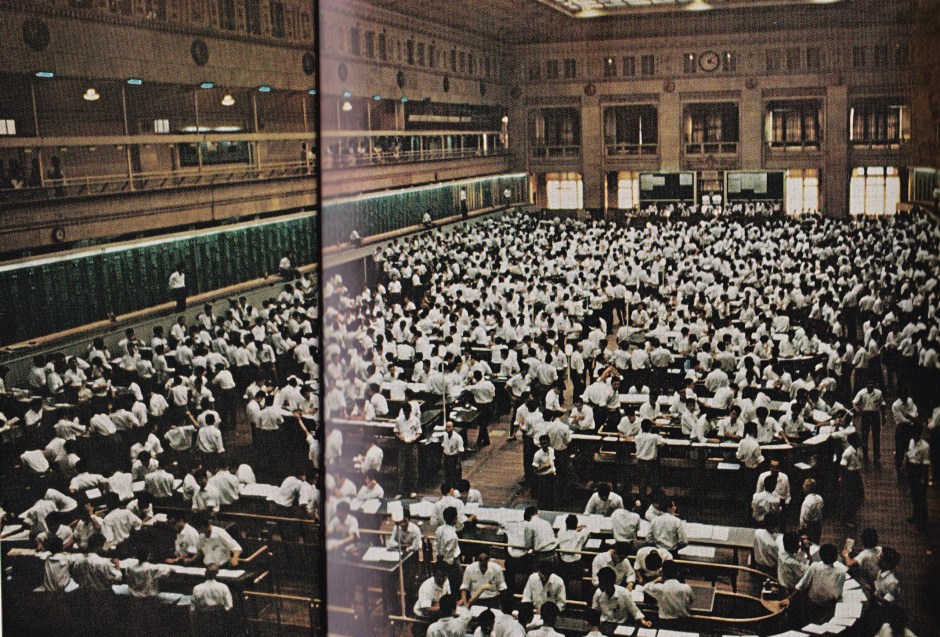
America-bound, a gleaming new truck rolls through the assembly line of the Nissan Motor Company automotive works between Tokyo and Yokohama. Of more than a million Japanese cars and trucks produced yearly, Nissan makes one in five. Bright-red paint brands this vehicle an export; japan reserves the color for its fire engines.Miniature television undergoes inspection at Sony Corporation, Tokyo’s astronomically successful postwar electronics manufacture. With 15 million sets in operation, Japan ranks second only to the United States in television ownership.Sparks from a welder’s torch shower a streetcar track. To spare daytime traffic, repair crews work from dusk to dawn.Shed-full of tuna, fresh from the sea, awaits purchasers at the dockside Central Wholesale Market in Tokyo. An immense distribution center, the market handles 1,800 tons of fish and 3,300 tons of vegetable every day. To examine fish quality in the shed’s gloom, buyers wield flashlights, their badges of office.Wall-to-wall carpet of white shirts hides the floor of Tokyo’s Stock Exchange, barometer of Japan’s explosive postwar growth. Some stocks sell for 800 times their 1950 values.Shoji Koyama headed the Tokyo Metropolitan Assembly in 1963 sharing administration of the capital with a governor, Ryotaro Azuma. Portraits of past Assembly presidents line a wall of his chamber in the Metropolitan Government Office. Mr. Koyama now serves in the Diet, Japan’s national legislature. Though it includes almost 11 percent of Japan’s population, Tokyo until recently had less than 5 percent representation in the Diet. A revision in apportionment laws has raised the percentage to 7.
“Sumimasen – very sorry….” Railway guards in a Tokyo station pack rush-hour cars to bursting with hapless commuters. Skyrocketing population threatens to cripple the Japanese capital; even now its 10,500,000 residents make it the world’s largest city. Long-suffering Tokyoites joke grimly about their city’s “crush hour.” Miraculously, scenes such as this morning jam a the Shinjuku Station produce few injuries.
Tokyo is not a city. Tokyo…is an explosion.
The crowds, the traffic, the lights, the smog, the noise, the peace, the plenty, the interplay of East and West, the exotic…. William Graves, staff writer for the monthly magazine, National Geographic, stayed in Tokyo for weeks if not months with cameraman Winfield Parks in an attempt to paint a picture of Tokyo in 1964 with words and photos.
Tokyo is not easy to love at first sight. In daylight, from the air, it resembles an enormous coffee stain, blotting the green velvet of the surrounding farm country. Seen from the ground, it lies blurred under layers of smog – a city wrapped in soiled cotton wood.
At night, however, Tokyo bursts through its somber wrapping. Then the city is aflame with neon, its low hills pulsing like great beds of coals, with crimsons, lavenders, greens, and golds of flashing electric signs announcing nightclubs, coffee bars, truck tires, television sets, cameras – everything that Tokyo owns or makes in some 57,000 factories.
Here are a few of the pictures and words from that National Geographic article, a portrait of an explosion.
Gone are wooden clogs and traditional kimono. Among Japanese young women, high heels and chic-knee-length dresses are everyday attire. Tokyo’s huge Ginza department stores tempt shoppers with top European designs. Copies in inexpensive Japanese cottons and rayons have all but driven classic styles from sight. Young Tokyo saves the conservative kimono and sashlike obi for ceremonial days or family occasions. Sign beneath American fashion magazines advertises a gift shop called “Yours.”Curtain of smog over Tokyo Harbor gives a coppery cast to the waterfront, one of many centers for the Japanese shipbuilding industry, now the world’s largest. Desperate for living space, Tokyo dumps its fresh trash into the bay and covers it with soil to create new land.Like immense cinder blocks, low-cost apartment houses rise amid factories and oil-storage tanks. Danchi, as Tokyoites call the developments, ease the crushing pressure of Tokyo’s housing shortage. Families with moderate incomes may rent a bedroom, kitchen, and living room for $20 a month.Husband enjoys his ease, just as his father did, while wife clears the dishes I their three-room apato. Tokyoites call them and their neighbors danchi zoku – “apartment-house tribe.”Grill-to-bumper flood chokes a Tokyo street. During rush hours it may take half an hour to negotiate a downtown block. Beginners’ tests are strict but, once licensed, drivers develop an individual style. A sharp horn blast signifies, “Look out! I am about to do something extraordinary.”
Evasive Action lifts a pedestrian clear of the pavement in his dash for safety. Tokyo traffic – dodging risks are high: on the city’s streets, a thousand die in a year.
The Tokyo Olympic Organizing Committee was ready for the hordes of foreigners to descend upon their shores, preparing processes, rules and documentation that made it clear to officials, workers and volunteers in the 1964 Tokyo Olympic bureaucracy who an Olympian was or wasn’t.
So when Ted (Theo) Mittet came to Japan as a rower on the US Olympic Team, he had his documents. I know this because he kept them in a box over the past five decades, and he graciously allowed me to rummage through it.
The image at the top of the article is his Identify Card. Sent about five months in advance to some 7,900 competitors and officials, blank identify cards were provided to all National Olympic Committees (NOC) or International Sports Federations (ISF). Those NOCs and ISF’s in turn filled in the cards and handed them to the athlete.
From the Official Report of the Organizing Committee – The Games of the XVIII Olympiad Tokyo 1964
These identity cards, were for all intents and purposes, a passport within Japan, and so Japanese officials took the time and effort to design a card appropriate for its level of importance. Not only was the paper manufactured with waterproof texture paper, and watermarked to prevent forgery, the card included a serial number that was fed into an IBM computer system. That serial number was also printed on a vinyl case designed to further protect the document.
The identity card allowed the athlete or official free passage on all related Olympic transportation, free admission into parks, zoos, museums, as well as free access to trains, buses and trams in Tokyo.
In the case of athletes like Mittet, their case was blue. My father was a journalist at the Tokyo Games, and his identify card case was red.
As described in this post, Mittet traveled through Japan. In as much as he could, he likely used identity card to travel, but he may have also used his railway pass, one issued to all Olympians. This pass may have been more to explain which train lines the foreigners were allowed to use, as the document kindly shows in red which lines they can board free of charge.
Inside the Olympic Village, Olympians had access to the dining halls. Each individual was provided with a book of meal coupons, which they could use breakfast, lunch and dinner in any of the dining halls they wanted. The picture below is of Mittet’s coupon book, with coupons left for only October 28, several days after the end of the Olympics.
As one can imagine, the Japanese organizers thought deeply about how the foreigners would interact with the Japanese at the countless number of touch points in Tokyo, and believed that easily recognizable documentation in English would become in certain instances the instant translation of an unspoken exchange.
“Having established procedures and protocol the Japanese organisers devised a document of reference for (almost) every forseeable contingency,” wrote Doug Ibbotson of the Evening News, in an article entitled Tokyo – Marvel of Efficiency and Goodwill. “This resulted in the distribution of mountains of paper which, I regret to say, frequently was jettisoned into the waste basket. However, once a document was in existence, the lesser officials were happy, for it became the sole arbiter in any dispute between Western Logic and the Oriental Mind.”
Paper work – one reason why the 1964 Tokyo Olympics were considered one of the smoothest operations in Olympic history.
Airbnb helped find accommodations for 85,000 people during the 2016 Rio Olympics. That is, according to Fortune Magazine, 17% of the approximate 500,000 local and foreign tourists who visited Rio during the 2016 Rio Olympics.
Handling spikes in tourist traffic during big-tent events like the Olympics, World Cup, or industry conventions is a challenge, even more so in cities like Tokyo that are already at high occupancy rates during normal weeks. Services like Airbnb have business model which connect travelers with individuals who commonly offer up their own apartments or houses and sometimes more personalized service, for fees often lower than the hotel chains.
As the “Official Alternative Accommodation Services Supplier” of the 2016 Rio Olympics, Airbnb can argue that it put cash directly in the hands of Brazilian citizens, and helped the government and organizing committee deal with room over-capacity during the Olympics. According to this Fortune article, 421,000 arrivals stayed at Airbnb rooms in Brazil in 2015. In 2016, the year of the 2016 Olympics, the number of arrivals doubled to more than 1 million.
When surfing was selected as a new Olympic sport for the 2020 Tokyo Summer Olympics, enthusiasts wondered how organizers were going to keep score.
One of the challenges when organizing surfing competitions is to create the perception that everyone has a chance at similar size and types of waves. After all we can’t control the moon and the tides they create on the vast ocean waters. And so very quickly enthusiasts wondered whether the Olympics were going to introduce wave pools to the competition, large mechanical pools that create waves. In that manner, you can pretty much guarantee that competitors will get the same level of difficulty every time.
As it turns out, surfing at the Tokyo Olympics will be held out in the wild, on the waves of Tsurigasaki Beach in Chiba, Japan. Perhaps it’s because wave pools have not yet become a part of top-flight surfing competitions, that from a technological or even a surfing culture perspective, competitors are not yet ready for wave pools. But the president of the International Surfing Association (ISA), Fernando Aquerre, gave another, economic reason in this interview with Surfer.com:
The IOC does not want to build more “white elephants” – structures that have no use after the Olympics are over. The Olympics organizers want to focus on legacy, on building things that can be used by host cities after the games. As of now, there is no commercially sustainable wave pool. You can build a wave pool like Snowdonia, but nobody knows if that will be commercially sustainable over a period of time.
Snowdonia wave pool
So how will the surfing competition be run in 2020?
First, there will be a total of 40 surfers allowed to compete, 20 men and 20 women.
Second, the event will be shortboarding only – no longboards or bodyboards.
Third, Aguerre said that they will be patient over the two-week Olympic competition to find the right two-day period to hold the surfing competition.
That last point is interesting because television will probably demand that surfing establish a set time in advance. But then again, the Olympics are also about putting “athletes first”.
“We’ll try to start it at the front end of the games, but we can wait to run it if the waves look better at the end,” Aguerre said. “We have ten years of wave history and wind conditions data to rely on. We’re very confident, and so are Tokyo and the IOC, that we’ll have reasonable waves of good quality.”
Additionally, Aguerre wants to make sure that the venue at Tsurigasaki Beach has the right vibe. “The IOC has asked us to to create a full-on beach scene at Chiba that will last the whole length of the Olympics,” he said. “It will include the surf events of course, but also organic food, yoga in the morning—it will be a place where you want to hang out. There might be a skate ramp — maybe it will be like what you see at the U.S. Open. It’s never been done before at the Olympics.”
I’m not a surfer, but when I think of places to surf in Japan, I think of Shonan Beach in Kanagawa Prefecture, or the islands of Okinawa. After all, it was the American soldiers based in those areas since the Japanese occupation of the late 1940s and early 1950s who introduced surfing to the Japanese, sparking a fascination for Hawaii, the American beach culture, and how to ride the waves with a board.
But when the Olympics return to Tokyo in 2020, all surfing eyes will turn to Chiba. Last year, surfing was voted in as a new Olympic sport for 2020, and Tsurigasaki Beach in Chiba was selected as the venue. Located about 90 minutes east from Tokyo in the city of Ichinomiya, Tsurigasaki Beach has become the go-to place to catch waves in the Kanto region.
In this survey of the best surf spots in Japan, JapanSurf.com ranked Chiba as having the best quality waves in the country. “Consistent, powerful beach breaks and thundering reefs make this area a mecca among surfers in Japan.” The Mainichi Daily News explained that surfers enjoy a “consistent flow of waves toward the shore from three different directions, namely northeast, east and southeast.”
Even more interestingly, the Mainichi article states that surfing has been responsible for a phenomenon unseen for decades in Japan – a small town that is actually growing in population.
Ever since the 1980s, people wanting to surf all year round have been moving to the town, and since the 2000s, numerous surfing shops, restaurants and new homes have emerged along prefectural Route 30, which runs parallel to the Pacific coast. As a result, the area has taken on an atmosphere of a “tropical island” bustling with youngsters, attracting what is believed to be about 600,000 visitors a year.
According to the article, the town of Ichinomiya has grown to 12,400 at the beginning of 2017, in a country where both the rapidly aging population and the desire of the youth to work in the big cities has shrunk the populations of cities and towns that are not named Tokyo or Osaka.
The Japanese love for surfing has revitalized Ichinomiya. And as planning continues to bring the biggest beach party in the world to Tsurigasaki Beach, ambitions climb. “We want to spread the name and culture of Ichinomiya across the world,” said Ichinomiya mayor, Masaya Mabuchi.
But the seed of the idea of surfing as an Olympic sport was planted, apparently, in 1912 by the Johnny Appleseed of surfing, Duke Kahanamoku.
According to the International Surfing Association (ISA), the swimming legend who won three golds and two silvers across three Olympics and 13 years, Kahanamoku “first presented his dream at the 1912 Summer Olympic Games in Stockholm, where he expressed his wish to the International Olympic Committee (IOC) to see Surfing included in the Games.”
In fact, this little historical footnote was the inspiration for the current head of the ISA, president, Fernando Aquerre. The surfer from Argentina was newly elected to the ISA in 1994, and according to Olympic.org, he had a dream to get surfing into the Olympics. In fact, Aguerre met Juan Antonio Samaranch, in 1995, part of his pitch was to give the then 75-year-old president of the IOC a surfing lesson in his office.
Unfortunately for Aguerre, what was true in 1912 was also true in 1995 – the IOC was not ready to hang ten.
“We had paddled out but there were no waves,” Aguerre said (in reference to his meeting with the IOC). “We kind of figured out that waves were going to come at some point but we didn’t really know when they were going to come because they were out of our control.”
Still president of the ISA, and still hanging on to his dream, Aguerre opened up his options by connecting with Thomas Bach in 2013, who was a candidate to become the head of the IOC. And by this time, Aguerre was more able to lay out a vision for why surfing needed to be in the Olympics – the need to attract youth to the movement with the rise of action sports. Bach, who was elected to head the IOC that year, made the attraction and retention of youth to the Olympic Games part of his platform.
Surfing has grown significantly in popularity over the recent decades. There were only 32 member countries of the ISA in 1995, but now there 100. So when surfing was submitted to the IOC in September 2015 as a part of a shortlist of new events for Tokyo 2020, primarily driven by youth-oriented action sports like skateboarding and sport climbing, surfing finally caught a wave. In August, 2016, the IOC voted surfing into the Olympics.
Come July 2020, if you want to watch the first Olympians set Olympic records with every top score in surfing, then plan to bake on the hot sands of Tsurigasaki Beach in Chiba, Japan. That is where the surfing world, Barney and pro alike, will gather.
Official Invitation to the White House for American Olympic medalists
He was invited by the Mayor to a celebration for Seattle Olympians on November 2, 1964. He was also invited to the White House by President Lyndon Johnson for a luncheon honoring American Olympic medalists on December 1, 1964.
But Ted (Theo) Mittet, in his mind, had bigger and better things to do – like travel throughout Japan: Yokohama, Kyoto, Hiroshima, Matsuyama, Beppu, Nagasaki, Niihama and Nara. The 22-year-old American rower from Seattle, Washington had helped a crew of four take the bronze medal in the rowing fours-without (which means four rowers without a coxswain). And while most of his teammates returned to the United States for parades and celebratory dinners, Mittet decided that hitchhiking and taking the train through Japan would be more fun. And based on the numerous letters exchanged between young Mittet and the Japanese he met along the way, all parties were better for that decision.
Thank you ever so much for your nice letter. It is more than you could imagine how happy I was to read your letter. I am glad to know that you stayed and travelled in Japan for two months after the Olympic Games were over. It is a wonderful and happy experience for me to have worked for the Tokyo Olympics, and we talk very often about the pleasant days during the Games. Since that time I have become much more interested in English, and I attend the English conversation classes once a week. Though I try my best it is still very hard for me to master it. Is there any idea or suggestion to learn it faster? – Hiroko Sho, a volunteer from Tokyo stationed at the offices of the US Olympic Team.
Ted Mittet surrendering his American team’s cowboy hat, gifted by President Johnson to the male Olympians
But more significantly, Mittet inspired people to dream of being a part of a bigger world.
When Mittet went to Matsuyama City in Ehime Prefecture, a place not many foreigners ventured to in the 1960s, he was invited to a high school to meet the students, three of whom screwed up the courage and effort to write to him. One was Kayoko Kurita, who wrote to Mittet of her dream.
You may be surprised to receive this letter from me but I met you in Matsuyama and spoke in English with you. Do you remember me? You gave me your name and address I was happy to receive it. You said you attend WASHINGTON UNIVERSITY in Seattle. I would like to be your pen pal, and would enjoy corresponding with you if you don’t mind. I hope we will become good pen pals.
And my dream is, ……………, but it isn’t come true, but I’ll tell you. I would like to study abroad in your country especially WASHINGTON or Indiana or Kentucky or there is no Japanese there. Your university is very good and very big excellent university, but I would like to go to High School or Junior in America, so I’m looking for a sponsor for me. But it’s very difficult to find. I wish I will.
Mittet met a university student from Osaka in Kyoto named Takanao Dojima, who volunteered to take Mittet on a tour of Kyoto’s most famous temples, Kinkakuji and Ryuanji. Dojima wrote Mittet in a letter the following year, saying “Probably nothing is more enjoyable than travelling. I want to go to America as well as you visited to Japan. But I haven’t money, I can’t to visit America.”
A Sophia University student and interpreter for the BBC during the Olympics, Masako Kajiki, possessed more advanced English skills than the average Japanese, and appeared to have the financial means to travel abroad. She wrote in mid-November, 1964 to Mittet of her role as Shylock’s daughter in an upcoming production of The Merchant of Venice, and her plans to travel to the United States.
Listening to various talks from my parents who have just come back from the States after three months’ travel in Europe and the States, I have long wanted to go to your country next summer session. I’m looking forward to visiting your country, though it’ll be only for 10 weeks. Seeing is believing.
Three months later, Kajiki was approaching her departure date for the United States. Kajiki had already sent her entire, very detailed itinerary that would take her from Haneda to Honolulu, and throughout the mainland – LA, Las Vegas, Dallas, Knoxville, DC, Pittsburgh, Cincinnati, Detroit, Chicago, New York, just to name a few in her nearly three-month cross-country adventure. In her letter, she is clearly conscious of her own accountability as teacher of things Japanese. For a young Japanese woman in the Sixties, she has a stronger and clearer point of view on America and Japan than the average Japanese. But in the end, she cannot contain the excitement of her ultimate goal – to see America for the first time, and Mr. Theodore Mittet again.
Official Invitation to a celebration for Olympians in Seattle, Washington, also turned down by Mittet.
I’m afraid, however, that after you have made the railway journey from Osaka to Tokyo, you’ll remember not only the ugliness of those cities, as seen from the train, but also the succession of advertisement billboards that so often interfered with your view of the enchanting countryside along the route. As you know Japan is surely losing our own tradition that our ancestors made unique one after they assimilated Oriental civilization and digested it. We have been, however, striving to keep up with American and European country and rebuild Japan what it is from a heap of ashes.
Without your country’s support, our country – indeed like many other countries such as Great Britain and France – would not have been able to regain the present strength in such a brief span of time. You can imagine then how anxiously I’m waiting for visiting the States. May 29th seems the longer in coming, because you are waiting for me!!
And then there was Hirokazu Okugawa, a student at the Department of Architecture at Kyoto University. Mittet was also a student of architecture at the University of Washington, and was introduced to a professor at Kyoto University named Dr. Nakamura. Okugawa was a student of Nakamura’s and they both sought a way to get Okugawa to the United States. In an initial letter to Mittet in mid-December 1964, Okugawa writes, “I would like to go to University of Washington next September, and I would like to study architecture more there. And Dr. Nakamura hopes that I study it there, and that I shall become an eminent architect. Would you introduce to your professor?”
So full of hope, Okugawa would realize that it wouldn’t be so easy to become a student in the US. Two months later, Okugawa has the name of the dean of the school of architecture at the University of Washington, and intends to state his case. But soon after, he received a letter from Mittet – now his unofficial career advisor at U of W, that dampens his spirits:
According to your letter, there is no probability of my admission for the degree to the master. My ability of English conversation is not enough to understand the lecture in the University. I am going to study hard English conversation this year.
But Okugawa has a dream. He can see himself going to the States, studying English hard, taking on any task to show he’s worthy of being a student in the United States, and continues to explore ways forward with Mittet. By the end of February, he and Mittet have decided that Okugawa should still officially apply to the University of Washington, and Mittet has sent the application form and information on all required documentation. Okugawa acts on the instructions, presumably to extreme exactitude, only to be disappointed again:
As mentioned in my previous letter, I received an application form for an admission. And I completed its form and my works in Kyoto University, and these letters were sent to the chairman Architectural Graduate Program. And also, my report in Kyoto University and three letters of recommendation were sent there.
But I received the letter from Director of Admission in which he said “It is too late for autumn 1965”.
HOW SHALL I DO? WHAT SHALL I DO?
CAN YOU HELP ME?
I BEG FAVOURITE ATTENTION.
If I can, I would like to work in architecture office, and then I would like to study in University of Washington the next year. How shall I do in order to do so? How shall I get working visa? I will be given about $1000 and the expense of transportation.
Would you please consult with the dean about my admission? I would like to know your professor, professor Nakamura’ friend. What is his name?
Looking forward your kind letter.
There is a tinge of desperation in young Okugawa’s typewritten letter. And only a week later in early May, Okugawa seems resigned to not getting into his dream school in 1965. Mittet, who has apparently responded quickly to Okugawa’s letters, when necessary by express mail, was encouraging and understanding. And indeed, hope was not lost because Okugawa informed Mittet that an official of University of Washington’s admissions stated that Okugawa could apply for enrollment in the Fall of 1966, with the condition that he take an English certification course that November.
I have received the beautiful picture of U. W. from you. The mountain covered with snows resembles Mr. Fujki in Japan. I was so glad that I showed it to many friends of mine, and I put it on the wall of my lodging house.
By the way, I took English proficiency examination on the 1st of May at A. C. C. (American Cultural Center). Fortunately I could do excellent, and the director kindly recommended me to your University. But Mr. Johnston has written to me, and said that I must not be expecting to enroll U. W. until autumn 1966, and I must take the English Examination (TEFL) on November.
When I heard these things, I was disappointed. But, I think I can study more English and architecture at Kyoto University (master courses) until autumn 1966. And I hope we discuss architecture in letters.
Did Okugawa eventually make it to Seattle, study at the University of Washington, and become an “eminent architect”? Who knows. Dreams are not goals of certitude – although they could be glowing embers of aspiration. In the case of 1964, the Olympics fanned those embers of the Japanese. In certain cases, a spark named Ted Mittet set the fire.
Mikako Kotani (front) and other former Olympians perform synchronized swimming in an Oita PrefectureOne of my most treasured memories was in the Fall of 1987, sitting in a hot spring in Hokkaido, the snow falling, the steam rising, and a beer in hand.
In addition to the great food and shopping, tourists are flocking to Japan for the country side, and in particular, enjoying onsen throughout the country. Once you (some of you) get over the embarrassment of getting naked with a whole bunch of strangers, you get yourself all clean in the shower area outside the bathing areas, and then you dip your toes into the water. And yes, it’s hot!
Some of the best onsen are in Kyuushu, a large island in the Western part of Japan. And to get Japanese and non-Japanese alike to venture beyond the cosmopolitan confines of Tokyo and Osaka, the government of Oita Prefecture started a campaign to promote their onsens….using Olympians.
In typical tongue-in-cheek Japanese fashion, the promotional videos portray Japanese synchronized swimmers performing in the onsens of Oita. The athletes include Mikako Kotani, who won two bronze medals at the 1988 Seoul Olympics, as well as Raika Fujii, silver medalist at the 2000 Sydney Olympics, and bronze medalist at the 1996 Atlanta Olympics. The campaign is called “shin-furo”, which is a word made up from “synchronized” and the Japanese word “furo”, which means bath.
“I hope viewers will enjoy the beautiful, thoroughly organized performance by former Olympians,” said Oita Prefecture spokesman Takahiro Miyazaki. “And at the same time, I hope people will also be attracted to Oita’s hot springs.”
Japan had a record 2.68 million visitors in Japan in July, well on its way to topping 2016’s record number of foreign tourists of 24 million, blowing past its original target of 20 million by 2020. The 2020 target has been re-set to 40 million visitors. For repeat visitors, the Oita onsens should certainly be a hot place to spring to.
A picture of Ted (Theo) Mittet, 2nd from left, by Takeko Honma, middle, in front of the National Gymnasium
When I first arrived in Japan in 1986, one of the most popular programs on television was “Naruhodo! The World (なるほど!ザ・ワールド),” a quiz program that showcased the beauty, excitement and uniqueness of the places around the world their reporters visited. This was entertainment, so their reporters were often loud and garish, shamelessly interacting with foreigners in goofball English, often emphasizing stereotypical or even non-representative quirks of a particular country or culture. The questions and insights of the reporters often revealed more about Japanese culture than the culture they were trying to represent.
Ted (Theo) Mittet was a 22-year-old American rower who decided to travel Japan after helping his four-without boat win the bronze medal at the 1964 Tokyo Olympics. As explained in Part 1, Mittet made many Japanese friends along the way, who exchanged letters with this young man from Seattle, Washington. Their questions to him said a lot about Japan at the time. Mittet wrote to his family describing the conversations he was having with Japanese all over the country.
I spent last evening with a very good Japanese friend’s family (his father speaks English, as does he) and was treated royally. Sukiyaki and tempura were served in unlimited quantities. After dinner we all discussed love and life and I am amazed at the similarity between East and West. My friend is anxious to learn about Christianity and I am anxious to learn about Buddhism. (He is studying Zen.) I certainly think that Buddhism makes more sense than Christianity. I plan to look into it a little further. – letter from Mittet to family in late October
While coming up the east side of the inland sea I stopped at the town of Niihama where I met three English teachers who asked me if I would speak at their school. I gladly accepted and as a result spent about three hours teaching English conversations to about 150 English students. The school offered me 3,000 badly needed yens, but being a true patriot I could not accept. You might say that it was my donation to the cultural exchange program. I was asked questions about the Beetles, the American date, President Johnson (damn!) and “What you think black man?” It was a wonderful experience and I gained much insight on Japanese life and thought. – letter from Mittet to family in late November
Religion, politics, race – all the things we were taught not to talk about in polite company. But many Japanese knew they had an exaggerated view of the world, and were eager to correct their perceptions. In the case of America, Mittet became their source.
Like the hundreds of others on the US Olympic squad, he got the training from the US State Department about how to conduct oneself properly in a foreign land as a representative of America. But one can argue, based on the letters he received from the many Japanese friends he made during his 2-month travels, Mittet was as much an American diplomat as those who sit in embassies around the world.
When travelling through Ashiya, a city near Kobe in Japan, Mittet met Mikio, a middle-aged man who saw the tall American in a crowded bus, and felt compelled to introduce himself. Like other Japanese energized by the influx of foreigners during the Olympics, and infused with a desire to warmly welcome them, Mikio went up to Mittet in the bus. “I remember first scene when I saw firstly you in the crowded bus,” he wrote in a letter to Mittet. “You are too tall, so you put your head on the bus ceiling. Then I felt too funny. (Excuse me.) But that time, I felt much friendly to you.”
Amazingly, not only did Mikio introduce himself, he invited Mittet to stay at his and his wife’s Eiko’s home overnight, where they ate and talked. But in the letter, Mikio admitted that he was still very curious, his English capability failing him in attempts to ask important questions:
It was first experience for me that I gave a lodge to a foreigner. I doubt I could make a full hospitality to you? It’s most sorry I could speak English very little. If I could speak it more fluently, I wished to ask about America things, and to tell and discuss about several problems of the war, current events and American colored man through all night. And about your life experience and philosophy.
Eiko and Mikio
Even more remarkably, Mikio found Mittet so earnest and trustworthy that he admitted to changing what he felt were prejudicial views of Americans.
I had had a prejudice for American through a few American I know, soldiers and seamen. I have thought American are a spending, war-like, uncultural and bright and cheerful nation. (Excuse me) However general Japanese people don’t think so as me.
I see and tell you, I found mistake. You are wonderful man with wit and culture. If there are many people as you in America, American will develop more and more in future. I hope you become young face of America. My dear Eiko in the room you slept, talk about memory of you.




You must be logged in to post a comment.