Jana Novotna wins Wimbledon Women Singles Championship in 1998She was on the verge of winning the 1993 Wimbledon Championship, up 6-7, 6-1, 4-1, and 40-30 in the third set, a point away from taking a commanding 5-1 lead over Steffi Graf. Jana Novotna then double faulted, and proceeded to melt down.

Ten minutes later, Graf had won the final set 7-6 and taken her fifth Wimbledon championship. Novotna, who let glory slip through her fingers, could do nothing but cry on the shoulder of the Duchess of Kent, as the tennis world cried with her.

The tennis world cried again, as three-time Olympic medalist Jana Novotna died on November 19, 2017. She was only 49, succumbing to cancer.

Novotna’s career was hardly shattered by her dramatic loss in London in 1993. Encouraged by the Duchess of Kent, she came back five years later to win the 1998 Wimbledon singles championship. But when I review her grand slam tennis record, I was amazed at how many championships she won in doubles and mixed doubles: 4 doubles and mixed doubles championships at the Australian Open, 5 doubles championships at the French Open, 5 doubles and mixed doubles championships at Wimbledon, and 4 doubles and mixed doubles championships at the US Open.

In other words, Novotna had a total of 17 grand clam championships, although 16 were in doubles. I thought, wow, that’s a lot of grand slam championships….until I saw the list of tennis players who had more grand slam titles. There were 20 people ahead of her.

What I found interesting is that of the 20 people ahead of her, most had decent balance between singles and doubles championships – people like Margaret Court, the all team leader at 64, with 24 singles championships and 40 doubles championships, or Serena Williams with 23 singles and 16 doubles championships. There were a few like Graf and Chris Evert who basically focused on winning singles championships. But the majority on the list piled up their championships in the doubles arena, like Novotna.

Is there a difference in mentality and skill sets for singles players vs doubles players? According to this blog post from the website Talk Tennis at Tennis Warehouse, there are significant differences between the two.

Successful singles players have powerful first and second serves, love to pound it back and forth from the baseline, and aim for the corners, while successful doubles players are cat-like in front of the net, are skilled at drop shots and lobs, and tend to hit to the middle of the court. The post goes on to describe what it’s like when a person who has a singles mentality plays doubles, and vica versa. Here are a few:

Singles guy playing doubles (with 3 doubles players), singles guy…

  • after his partner serves, he begins immediately retreating to the baseline (where he’s comfy)
  • after his partner returns serve, he begins immediately retreating to the baseline (where he’s comfy)
  • serves rocket first (and second) serves (rather than slowing the speed and getting the first serve in)
  • make no consideration to serve down the middle to capitalize on his netman’s poaching prowess
  • way too many low-percentage shots (when other available for typical doubles player)
  • poor volley skills make him the target of every possible ball until he gets to the baseline

Doubles guy playing singles player, doubles guy…

  • serves second serves like doubles (slower) only to find singles man has a field day crushing them for winners
  • used to covering half of 36′ doubles = 18′ but now has to cover 27′
  • that extra 9′ makes the “alleys” twice as big and he gets passed a ton by the singles player smoking them DTL or CC
  • baseline exchanges are short because singles guy is looping/spinning the ball like mad with nice pace and Doubles guy is not used to that
  • doubles guy can’t seem to get to the net because singles guy’s pinning ’em to the baseline — so who’s gonna win?


Paul Maruyama and Roy
The author and Olympian, Paul Maruyama, and me.

Paul Maruyama is an Olympian, a member of the judo team, representing the USA at the 1964 Tokyo Olympics. Paul Maruyama is also an author, and the story he has to tell is personal…and incredible.

This is the story of the approximately 1.5 million Japanese who were essentially abandoned in the northern part of China, then called Manchuria, after the Pacific War. Overrun by the military of the Soviet Union, which had just declared war on Japan, Japanese military men and civilians alike were rounded up and sent to labor camps in the Soviet Union, while women and children were left in highly insecure and unsafe circumstances, including robbery and rape.

Seiyo Uchino and Yoshino Kimura

Maruyama wrote about this time in history because his father actually played a major role in ensuring safe passage of the 1.5 million Japanese in China back to Japan. In his book, Escape from Manchuria, Maruyama tells the incredible story of how his father, Kunio Maruyama, and his friends, Hachiro Shinpo and Masamichi Musashi worked together to get to Tokyo and meet General Douglas MacArthur, and convince him to send military ships to China and repatriate their countrymen.

When producers from NHK, the giant government broadcaster, read the Japanese version of Paul Maruyama’s book, they recognized the incredible human drama amidst the geo-political churn of post-war China and Japan, and decided to produce a two-part dramatization of those events.

On consecutive Saturdays of March 24 and 31 of 2018, NHK will broadcast their dramatized version of “Escape from Manchuria.” The Japanese title of the drama is “Doko ni mo Nai Kuni,” which I suppose can be loosely translated to “A Country that is Nowhere.”

Taizo Harada and Misako Renbutsu

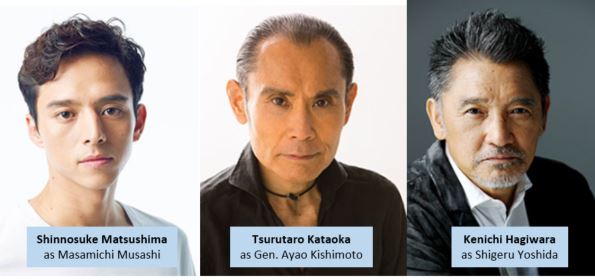
In addition to filming in China, NHK has invested in talent, recruiting some of the biggest names in Japanese television and film. Seiyo Uchino (内野聖陽) will play Paul’s father, Kunio Maruyama, while Yoshino Kimura (木村佳乃) will portray Paul’s mother, Mary Maruyama. Other well known actors like Taizo Harada (原田泰造), Misako Renbutsu (蓮佛美沙子), Shinnosukke Matsushima (満島真之介), Tsurutaro Kataoka (片岡鶴太郎), and Kenichi Hagiwara (萩原健一) fill out the all-star cast.

Prior to a recent trip to Japan, Maruyama made a sortie to Shanghai, China, where he was able to observe filming on a studio lot. A street was re-created to look like a Japanese community in Shenyang, complete with store front signs in Japanese and Chinese, filled with despairing Japanese citizens, and aggressive Russian soldiers. Maruyama, who was in Manchuria with his family at the age of six, took on the scene with wonder and pride, filled with emotion.

“When I see this set and the recreation of streets of Manchuria, the actors, all the extras, the staff, here because of a book I wrote, it’s kind of overwhelming. But I’m happy because we’re able to tell a part of Japanese history that is not well known.”

Shinnosuke Matsushima Tsurutaro Kataoka Kenichi Hagiwara

Soya Skobtsova autographs
Businesslike Zoya Skobtsova signs autographs for kids at Russian camp outside Tokyo_Sports Illustrated, October 19, 1964

It’s days before the start of the 1964 Tokyo Olympics and Olympic fever in Tokyo is rising. Athletes from all over the world were arriving days if not weeks in advance, filing off of planes and ships and filling the Olympic villages in Yoyogi, Enoshima and Lake Sagami.

For most Japanese, the Olympic villages were pop-up mini United Nations, places of such diversity to shock the mono-culture of Japan. They were drawn to the villages with the hopes of seeing the wide variety of shapes, colors and sizes of the world population, to shake hands with the foreigners, take pictures with them, and of course, get their autographs.

Certainly, to get the autograph of swimming siren Kiki Caron from France, or the amazing barefoot runner from Ethiopia Abebe Bikila, or the 218 cm giant center on the USSR basketball team, Janis Krumins would be a coup. But apparently, the Japanese would rush up to anyone who looked like a foreigner and ask for their autograph.

Hayes Jones was not just anyone – he was the 110-meter hurdles gold medalist. But when he wrote down his name “Hayes,” he would cause a ruckus beyond his expectation:

When I was going into town after the winning the gold in Tokyo, I was leaving the village to see my wife, and these Japanese kids were outside with the autograph pads and they saw me call me out, and this kid put my pen and paper in front of me. I started signing my sign, “Hayes”. …they started shouting “Bob Hayes” is here. I didn’t have the nerve to write “Hayes Jones”.

The “fanaticism” of the Japanese to get autographs was apparently wearing thin on athletes and officials alike, even before the Olympics opened, so much so that the press had words of caution for their readers. As you can read in the Yomiuri article of October 5, 1964 below, athletes were “outraged,” at risk of “writer’s cramp”! To be honest, it’s hard to tell whether the article was preaching, or teasing….

Some athletes have become so outraged that whenever they see these “fanatics” they raise their voices, yelling them to go away.

The great majority of the determined pack of autograph hounds consist of people assigned to the village. These are mostly defense force servicemen, interpreters and assorted workers who often show utter disregard for the time, place or mood of athletes in asking for autographs.

If this trend remains unchecked, many athletes will end up having writer’s cramp before they leave for home.

Autograph Hounds_Yomiuri_5Oct64
The Yomiuri, October 5, 1964

My Kamekura Yusaku original 1964 Poster

Yusaku Kamekura designed a series of four posters for the 1964 Tokyo Olympics. The first one was printed in 1961, a simple yet powerful construct of red circle on white, balanced in the bottom half of the poster with the Olympic logo and the words “Tokyo 1964” in gold.

I finally secured one of these vintage posters last week. It is striking in its simplicity. And it struck a chord with the Japanese as well.

While the “Hinomaru” flag has represented Japan on ships and in international events since the late 19th century, the red circle on white was only made the national flag by law in August 1999. Due to the powerful connection to the Japanese state in the war years, the occupying leadership group overseeing Japan’s occupation after the end of WWII – The Supreme Commander for the Allied Powers or SCAP – restricted display of the hinomaru significantly.

But in 1961, as Tokyo Olympic fever was beginning to rise, Kamekura released his red-circle-on-white poster on Japan. He claimed that his design had nothing to do with the Japanese flag. According to the article, Rebuilding the Japanese Nation at the 1964 Tokyo Olympics, Satoshi Shimizu quotes Kamekura as saying:

I drew a large red circle on top of the Olympic logo. People may have considered that this large red circle represented the hinomaru, but my actual intention was to express the sun. I wanted to create a fresh and vivid image through a balance between the large red circle and the five-ring Olympic mark. I thought that it would make the hinomaru look like a modern design.

In my view, it’s a lame explanation as the hinomaru is also a representation of the sun. To say the red circles on the poster and the flag are different is confusing. To most people, what the Kamekura’s fist ’64 Olympics poster represented was Japan’s traditional flag. In fact, as Japan continued to step out of the shadow of post-war subjugation, symbols of Japan’s past continued to make a comeback, as explained by Christian Tagsold in his article, “The Tokyo Olympics: Politics and Aftermath.”

The restoration of national pride that was staged in 1964 involved the deliberate rehabilitation of classical national symbols, especially the tennō himself (the emperor), the hinomaru (or Rising Sun) flag, the kimigayo (“His Majesty‘s Reign”) anthem, and the army. The method of their revival was to free them of their wartime associations and present them instead as symbols of peace. This was made possible by embedding them in the Olympic Games’ own narrative and by introducing new national symbols.

The power of the red-circle-on-white symbol was felt in Okinawa, a part of Japan that had been placed under American military control after the war and was still a US territory in the 1960s. The American government routinely denied requests by schools for example, to fly the hinomaru flag.

My Kamekura Yusaku original 1964 Poster 2

And yet, there was, apparently support by the Japanese public for an eventual return of the Okinawan islands to Japan. And since he Okinawa Athletic Association, was recognized as a part of the japan Athletic Association, the Torch Relay Special Committee that the torch relay should take place in all Japanese prefectures, even former ones like Okinawa., according to Shimizu. In fact, they made Okinawa the landing place for the Olympic flame after it completed its Southeast and East Asia journey.

When the Olympic flame arrived in a plane at Naha Airport in Okinawa from Taipei, the headlines claimed that the torch had arrived in Japan. Thousands of torch bearers had signed up to carry the torch for five days in Okinawa, and all of the torch bearers in Okinawa and throughout Japan would be wearing Kamekura’s design on their white tank-top shirt.

In addition, when the first runner pulled into Ounoyama Athletic Stadium after securing the flame at Naha Airport, 40,000 spectators were there to cheer him on, witness the lighting of an Olympic cauldron, the hoisting of the Hinomaru flag, and the playing of the national anthem, Kimigayo.

It would take another 8 years before Okinawa was returned to Japan by the United States, but in 1964, it appears, that thanks to the power of the Tokyo Olympics, and perhaps Kamekura’s famous first poster, the hinomaru flag and Kimigayo had been returned to Japan amidst the golden glow of the Olympics.

TOPSHOT-FSKATE-JPN-HANYU

On October 31, Evgeni Plushenko stated that Yuzuru Hanyu of Japan would likely win gold in the men’s individual figure skating competition at the 2018 PyeongChang Olympics.

On November 9, Hanyu fell awkwardly after attempting a four-revolution jump during a training session, and announced the next day that ligament damage to his ankle would prevent him from participating in the NHK Trophy competition that weekend, a tournament Hanyu had won the previous two years, as well as the Grand Prix Final, which Hanyu has won the past four years.

You can see the painful fall below at about the 30 second mark of the video below.


The question is, more significantly, will the reigning Olympic champion be able to defend his championship at the 2018 Pyeongchang Olympics? According to this analysis from The Sports Examiner, men’s figure skating has seen a revolution in the quadruple jump that will continue to put pressure on Hanyu.

Yuzuru Hanyu has prided himself on trying to keep up with the recent quadruple jump outburst in men’s figure skating, an explosion in numbers and types of quads since 2015 for which the Japanese star credits China’s Jin Boyang as having been the spark.

When Hanyu won a second world title last year, he alluded to the quad exploits of Jin, Nathan Chen of the United States and Shoma Uno of Japan – all of whom have pushed the jump revolution – when he said, “I am trying to keep up with many of the strengths of the other skaters.”

In this article of Globetrotting, Philip Hersh explains that it may not be necessary for Hanyu to keep pace with the other quadruple jumpers as his overall game has made him a champion in the past, and in fact, his desire to try new things may get in the way of an Olympic championship defense.

The trick will be convincing Hanyu to rein himself in. His desire to meet the quad standards set by rivals speaks to a fierce and admirable competitive spirit.

“Yuzu told me that what motivates and inspires him is trying new things and challenging himself,” Tracy Wilson, who helps Brian Orser in coaching Hanyu at the skater’s Toronto training base, said in a Tuesday text message. “He told me that he wants to push the sport and this approach keeps it interesting for him.

“This has been his stance since the beginning of last season when he decided to add the (quad) loop. He didn’t need the loop last year and did it on his way to record-setting performances.”

Hersh emphasized that if Hanyu is able to recover in time for the 2018 Winter Games, he may need to ignore his competition and their adoration for a particularly arduous technique called the “quad lutz.” If Hanyu recovers his time and finds the right balance of athleticism and form, he could be the first man to win consecutive gold medals in individual figure skating since Dick Button did so in 1952. If not….

Hanyu said at Autumn Classic he was bothered by knee problems that affected his quad loop.  He kept working on the lutz, and it was one of the two quads he landed cleanly last month in Russia (in what International Skating Union fact sheets said were five planned attempts; one became a triple, another a double.)

At this point, apparent risk for continuing with the quad lutz substantially outweighs the reward, which seems essentially to be personal satisfaction for Hanyu. Persisting may not only endanger him but the sport itself, for a 2018 Olympics with Hanyu in subpar condition – or without him entirely – would be diminished.

My 3 years to go Coca Cola pin

A friend of mine at Coca Cola gave me a gift that I treasure – a “3 Years to go!” pin, distributed to all Coca Cola Japan employees in anticipation of the Tokyo 2020 Games.

Coca Cola is a TOP Sponsor, which means they are one of 13 global sponsors of the Olympic Games. In fact, Coca Cola is the longest running sponsor of the Olympics, having first established its presence at the 1928 Amsterdam Olympics. They also produce Coca Cola branded Olympic pins, and sponsor pin trading centers at the Games.

The “3 years to go!” pin highlights the official Tokyo2020 logo and Olympic rings on the right, with a red Coca Cola bottle swathed in a green and gold kimono obi.

No, I won’t trade.

Aly Raisman _60 MInutes
Aly Raisman in 60 Minutes Interview

Aly Raisman is already a two-time Olympian with 6 medals from the 2012 London and 2016 Olympics, including gold medals in the team competition, while serving as captain. She is also the latest gymnast to step forward with allegations of sexual abuse against USA Gymnastics and their team doctor, Larry Nasser.

Thanks in part to the powerful coverage of the Indianapolis Star, and also in part to the recent wave of “#MeToo” revelations against men in power who prey on women, dozens of young women have come out publicly about Nasser, who has been arrested and been slapped with lawsuits.
In an interview with John LaPook of 60 Minutes, Raisman spoke about the denial, confusion and anger she went through upon realizing that she had been abused, and her advice to other girls who may be in an uncomfortable situation alone with an adult. Her words are powerful, and I want to note them:

Denial

Raisman: I was in denial. I was like, “I don’t thi– I d– I don’t even know what to think.” It– you don’t wanna let yourself believe but, you know, I am– I am– I am a victim of– of sexual abuse. Like, it’s really not an easy thing to let yourself believe that.

Raisman: I was just really innocent. I didn’t really know. You know, you don’t think that of someone. You know, so I just– I trusted him.

LaPook: You thought it was medical treatment.

Raisman: I didn’t know anything differently. We were told he is the best doctor. He’s the United States Olympic doctor and the USA Gymnastics doctor, and we were very lucky we were able to see him.

Simone Biles tweets support for Aly Raisman

Confusion

Raisman (when asked quite suddenly by an investigator to comment on Nasser): And I said, you know, “Well, he– his touching makes me uncomfortable, but he’s so nice to me. And I– I don’t think he does it on purpose because, you know, I think he cares about me.”

LaPook: So it was only after the investigator left that you began to put the pieces together.

Raisman: Yeah. I mean, I think it’s important for people to know too I’m still trying to put the pieces together today. You know it impacts you for the rest of your life.


Anger

Raisman: Why are we looking at why didn’t the girls speak up? Why not look at what about the culture? What did USA Gymnastics do, and Larry Nassar do, to manipulate these girls so much that they are so afraid to speak up?

LaPook: You’re angry.

Raisman: I am angry. I’m really upset because it’s been– I care a lot, you know, when I see these young girls that come up to me, and they ask for pictures or autographs, whatever it is, I just– I can’t– every time I look at them, every time I see them smiling, I just think– I just want to create change so that they never, ever have to go through this.


“Grooming”

Raisman (explaining the predatory practice of “grooming”): He would always bring me, you know, desserts or gifts. He would buy me little things. So I really thought he was a nice person. I really thought he was looking out for me. That’s why I want to do this interview. That’s why I wanna talk about it. I want people to know just because someone is nice to you and just because everyone is saying they’re the best person, it does not make it okay for them to ever make you uncomfortable. Ever.


Where Were the Parents?

Lynn Raisman (Aly’s mother): We were there. But if she’s not knowing that it’s wrong — never in a million years did I ever even think to say, “Hey, when you see the team doctor, is there someone with you?”

LaPook: If you could hit the rewind button, is there anything you would have done differently?

Lynn Raisman: I think the most important thing, if anyone takes anything away from this interview is sit down with your kids and explain to them that predators aren’t just strangers. They can be highly educated. They can be very well-respected in the community. It could be a family member, it could be a family friend. So, you know, that’s really, the, I mean, if I could go back in time, I would do that.


The Advice

As 60 Minutes explains, USA Gymnastics has always had a policy that an adult should “avoid being alone with a minor.” Clearly that policy was not publicized or enforced. But as far as Raisman is concerned, it’s time to publicize and enforce.

Raisman: Nobody ever educated me on, “Make sure you’re not alone with an adult.” You know, “Make sure he’s not making you uncomfortable.” I didn’t know the signs. I didn’t know what sexual abuse really was. And I think that needs to be communicated to all of these athletes, no matter the age.


Watch the 60 Minutes’ interview here.

Galen Rupp
Galen Rupp wins the 2017 Chicago Marathon

When Galen Rupp won the Chicago Marathon on October 8, 2017, he ran a personal best of 2:09:20, edging out the 2016 champion, Abel Kirui, by 28 seconds.

Congratulations Galen Rupp! A three-time Olympian, Rupp won silver in the 10K at the London Olympics, and bronze in the marathon at the Rio Olympics.

But after the Chicago Marathon, the popular runner’s publication, Let’s Run, gave Rupp a new distinction in the article celebrating his victory – “1st American-Born Winner in 35 Years.” Let’s Run’s Facebook followers picked up on the politically nuanced headline and reacted not only to the inaccuracies, but the racial and gender overtones:

  • MDW: Khalid Khannouchi may not have been born in the US, but he was, when he won, and is still American. He won in 2000 and 2002. Don’t discredit his wins as an American
  • JP: Well said. The title sounds like a trump supporter.
  • MDW: No, just a typical Letsrun or FloTrack headline. Misleading.
  • SL: Not just misleading but incorrect. First American born MALE to win in 35 years.
  • MDW: Even better!
  • JP: “First American Born God Fearing White Male Winner of Chicago Marathon Crushes Darker Skinned Heathens from Other Side of Wall!” There. I fixed it.
  • MDW: Not funny.
  • JP: Lighten up. It’s the internet.

Lets Run Galen Rupp Headline

The last American to win the Chicago Marathon, as pointed out by MDW in the Facebook post, is Khalid Khannouchi, who in fact, has won the Chicago Marathon four times, twice in 1997 and 1999 as a Moroccan, and twice in 2000 and 2002 as an American. Khannouchi became a naturalized citizen of the United States on May 2, 2000.

Like my grandfather who became a naturalized citizen in the 1950s and my mother who became a naturalized citizen in the 1960s, Khannouchi is an American citizen. The Let’sRun.com headline for Rupp’s victory could have been “1st Male American Winner in 35 Years,” but the editors made a conscious decision to politicize their headline. In the article they provide further explanation of why they think this accomplishment is significant:

While Khalid Khannouchi and Meb Keflezighi have delivered plenty of incredible performances for the U.S., a win of this magnitude by a non-African-born American has been a long time coming, and it’s never happened during the current era of Kenyan/Ethiopian dominance. Rupp’s win wasn’t just big for the U.S.; it was big for the rest of the world, as well. It had been almost nine years since a man born outside of Africa had won a World Marathon Major (Marilson Gomes dos Santos in New York in 2008). Rupp’s win today was a breakthrough, but it remains to be seen whether he is a generational talent or if his win can open the doors for other non-Africans to contend on the sport’s biggest stages. If we had to choose right now, we’d lean toward the “generational talent” explanation.

Martin Fritz Huber, who writes on running in OusideonLine.com, wrote this counter-point article entitled “We Shouldn’t Care Where a Runner is Born.”

On the one hand, this can be read as an innocuous acknowledgement of (East) African dominance in distance running; for a stark example of the latter, check out this comprehensive list of the fastest marathons ever run. More problematically, one could argue that creating an African-born vs. non-African-born binary imposes racial categories, and, needless to say, the historical precedents here are not good. To put matters in these terms also addresses distance running’s perpetual elephant in the room: whether or not, and to what degree, race and/or ethnicity signifies a “natural” competitive advantage.

Khalid Khannouchi

To me, this controversy smacks of the birther debate during Barak Obama’s tenure as president, when loud voices continued (continue) to claim that Obama was not born in the United States. The whole point about sports is that the best person wins, and the whole point about the American Dream, is that “all men are created equal” with the right to “life, liberty and the pursuit of happiness” through hard work and lack of barriers.

My grandfather emigrated from Japan to the United States in 1903, and helped build a strong community in Japan Town in San Francisco through his work as an elder in the Japanese Church of Christ and executive director of the Japanese YMCA. While he had to wait until the 1950s to become a naturalized American citizen, he helped countless others become solid American citizens. He was as American as they come, and I would hate to see an asterisk indicating that his contributions were less so because he was not born in the United States.

He, as much as Khannouchi, has made America great.

1964 Paralympics_Japan delegation opening ceremony
Japanese delegation at the 1964 Tokyo Paralympics from the book, 1964 Tokyo Olympiad, Kyodo Sports Agency

Holding the five-day Tokyo Paralympics from November 8 -12, was an amazing triumph for Japan. As previous posts have explained, Japan went from zero awareness about the rehabilitative power of sports on the disabled to hosting the first Paralympics in Asia in a matter of years.

Even more amazingly, Japan organized not one, but two competitions for the disabled, one right after the other. The first competition was the Tokyo Paralympics, an international event. The second competition is less well known, a domestic competition that was more daring than the famous first competition, for it expanded the scope of competitions.

According to Kazuo Ogoura, in his paper The “Legacy” of the 1964 Tokyo Paralympics, the British, led by Ludwig Guttmann of Stoke Mandeville Hospital, focused the competition of disabled athletes only on those who had spinal cord injuries, who got around via wheelchairs, but that “in the 1960s, there emerged a growing call for including those with vision impairment and amputees in such sporting events.

1964_Summer_Paralympics_logo
The logo for the 1964 Tokyo Paralympics; note the use of the wheelchair wheel symbols, representing Stoke and Mandeville Hospital’s influence over the criteria for participation in the Paralympics.

In fact, as D. J. Frost has written in his paper, Tokyo’s Other Games: The Origins and Impact of the 1964 Paralympics, “by the early 1960s, a handful of Japanese medical experts interested in rehabilitation had established relationships with European specialists outside of Great Britain who were actively promoting sports for those with disabilities besides spinal injuries. Japanese organisers of the 1964 Games also appear to have been in regular contact with Norman Acton, who eventually became head of the International Sports Organisation for the Disabled (ISOD). In July 1963, at Acton’s urging, Japan dispatched a team of athletes to participate in what various Japanese sources identify as the First International Sports Festival for the Disabled held in Linz, Austria.”

Awareness of the impact sports can have on the disabled beyond those with spinal cord injuries was indeed growing in Japan. Frost explained that when a group of early supporters that included members of the Health and Welfare Ministry, The Asahi Shimbun Social Welfare Organization and the International Lions Club organized a preparatory committee to consider the organization of a Paralympics in Tokyo in 1964, they initially agreed that “that the International Games held in Tokyo should be a multi-disability event, including athletes with paraplegia, blindness, hearing impairments, and other physical challenges.”

But as Ogoura explained, the officials at Stoke Mandeville, who were the patrons and coordinators at the international level, were not ready to make that shift beyond wheelchair athletes.

During the preparation stage for the Tokyo Paralympics, Yutaka Nakamura, who was one of the event’s central figures, campaigned in response to requests from German officials to include athletes with vision impairment and amputees in the 1964 Tokyo Paralympics but failed to secure consent from Stoke Mandeville officials.

Amazingly, the Japanese organizers were not deterred, and decided to split the baby by keeping the Stoke Mandeville scope for the 5-day international Tokyo Paralympic Games, but also by holding a separate domestic 2-day event soon after the first one. As Frost wrote, “it was the perfect plan. It did not threaten to alter the approach of the Stoke Mandeville Games themselves, and it addressed Japanese desires to serve a larger portion of the disabled population. Yet, the Games were clearly not equal in length or prestige, and as a result, the National Sports Meet attracted far less attention.”

The so-called “National Sports Meet” ran from November 13 – 14, 1964, and despite the fewer number of days, was larger than the highly publicized “International Sports Meet.” The international meet was three days longer than the domestic meet, but had fewer athletes (375 vs 480) and fewer sports (9 vs 34). As Frost described, this pioneering decision was both intimidating and inspiring.

With more than 34 sporting events for men and women with a wide range of disabilities, the National Meet added a layer of complexity to the planning efforts that in later years would play a role in other potential host sites’ decisions to decline the Paralympics. The structure adopted for these Tokyo Games reflects the commitment to hosting a multi-disability event that was apparent in some of the earliest organisational efforts.

Today, the Paralympics is indeed a multi-disability, multi-sport event which includes a highly complex mix of disabilities, with thousands of competitors coming from over 100 nations. The 1964 Tokyo Paralympics, both its international and domestic meets, played a significant role in the evolution and history of disabled sports.

Fujitsu 3D Gymnastic Modeling

The robots aren’t quite taking over by 2020. But they will be assisting gymnastic judges at the 2020 Olympics.

The International Gymnastics Federation (FIG) intends to employ laser technology in order to provide data and recommendations to judges instantaneously to supplement their own judgment based on what they see with their own eyes.

Fujitsu, which is a Tokyo 2020 Gold Partner, has been focusing its 3D sensory technology on the world of gymnastics in order to provide real-time feedback on techniques a gymnast is attempting and making, the elements of which can be hard to catch by the naked eye. This technology, an advance on the more familiar technology of applying motion capture balls all over the body of an athlete, does not require the subject to apply anything. Instead a device that emits lasers from a single point, one that looks like a camera, feeds data that processes, essentially, 360 degree views of the subject.

With that amount of data captured, the software is able to assess exactly how the body has moved through the air. Benchmarking against standards of excellence inputted into the software, the system is then able to provide a report to judges what techniques were attempted or made, and then assess points to those series of techniques. In essence the 3D sensory system can do the gymnastic judge’s job.

Clearly, there is an advantage a non-human system has over a human – a “robot” will not get tired or cranky at the end of the day, nor will it allow unconscious biases about nationality, race, appearance, etc to seep into its judgment. But there has been some concern, as there should be.

According to this article, whenever you place your measuring and evaluating systems in the hands of algorithms, you are subject to hacking of some sort.

“In gymnastics, you can have 10 to 100 independent moves the system is trying to score. If the algorithm were manipulated by even a small portion you could affect the overall outcome score and it would be very hard to detect,” said Betsy Cooper, the executive director for long-term cybersecurity at UC Berkeley.

Fujitsu 3D Sensing Technology for Gymnastics

Any technology that relays information from an external source – like this 3D sensor does – to a computer is at risk. Mix the technology with a scoring panel of judges, and there is room for manipulation. “You can manipulate the algorithms to change the score one out of every five times, making it hard to detect. That area is most disconcerting. Whoever has an interest in the outcome of these major sporting events will also have an interest in trying to take advantage of any such system,” Cooper said.

This is why, the plan is to have 3D sensory system only assist judges, not replace them.

Perhaps the greatest impact will be in faster development of gymnasts. Coaches and gymnasts can examine the data, understand the micro-movements that keep their points down, and apply their practices to improving their movements to get their points up.

In other words, the next generation of gymnasts will grow up on this feedback, understanding what specific things they need to do for perfection at very early stages in their career. In this new age of digital analytics and 3D modeling, athletes are able to approach perfection at a faster rate than ever before.