Madeline de Jesus
Madeline de Jesus

At the 1984 Los Angeles Olympics, the American woman’s team won the gold medal in the 4×400 relay finals, easily breaking the Olympic record by nearly a second and trouncing silver medalists Canada by nearly 3 seconds, an eternity in sprint.

The 4×400 meters event, by definition, is a race run by four people. But due to the rules of track at the time, teams were allowed to list up to six people eligible for the relays, and if there were athletes who competed in heats, but who did not run in the finals, they could still be awarded a medal for helping their team to the medal podium.

Thus, at the LA Games, six women received gold medals, including Diane Dixon and Denean Howard, who helped Team USA to an easy victory in the preliminary 4×400 competition. They not only assisted in getting their team to the finals, they rested two of the team’s stars, Valerie Brisco-Hooks and Chandra Cheeseborough, so they would be fresh for the finals.

Team Puerto Rico, on the other hand, did not have that luxury it seems.

Madeline de Jesus was representing Puerto Rico as a long jumper and sprinter at the ’84 Games. During the long jump competition on August 5, she pulled her hamstring, and she knew she would not be able to suit up for the 4×400 relay six days later.

Only six days….but enough time to plan a caper.

According to this article, Madeline consulted with her sister Margaret who was a spectator at the Olympics. And they wondered if they could get away with it. No one knew that Madeline’s injury would keep her out of the relays, so if her sister could take her place in the relays, the Puerto Rican team would have a chance. After all, Margaret was a sprinter as well. She didn’t qualify for the Olympic team, but she had a particular quality that could make this work – Margaret was the identical twin of Madeline.

Madeline and Margaret de Jesus

So Madeline suited Margaret up, presumably passing her sister all her credentials that gave her access to the village, the training facilities and the stadium. And on August 11, it was Margaret de Jesus lining up for the second leg of the 4×400 heat. Since there were ten teams competing for eight spots in the finals, Team Puerto Rico’s finishing time of 3:37.39 was enough to grab the eighth spot and qualify for the finals.

Margaret had fooled the world.

For a little less than a day.

Unfortunately for the de Jesus sisters, there was a journalist present for a Puerto Rican newspaper called

La Nación, This journalist had covered the sisters’ athletic accomplishments, and was actually able to tell the difference between Madeline and Margaret – a “beauty mark one had on her cheek.”

When the head of the Puerto Rican Olympic team heard of the deception, he immediately pulled his 4×400 team from the finals. After an investigation held by the Puerto Rican Olympic Committee, Madeline and Margaret were banned from future competition. The investigation also revealed that the relay team’s coach, Francisco Colon Alers, knew of the plan and allowed it, resulting in his lifetime ban from international competition. Sadly, the three other members of the track squad were also complicit, and they received a one-year suspension from competition.

Antigua and Barbuda finished almost two seconds behind Puerto Rico in the heats. Getting to the finals and racing one more time on the big stage would have been sweet…if not for those twins.

Long Jump in meters

Whenever I write a story on an American high jumper, long jumper or a discus thrower, I have to go through the painful back-and-forth conversion between feet and meters, inches and centimeters.

It used to be the holy grail in the United States and Britain to run a mile in fewer than four minutes, until Roger Bannister broke it, which broke the mental barrier and allowed others to blast through the four-minute wall. Today, however, no one really cares about the mile, as the standard racing distance is the 1,500 meters, which is a little less than a mile.

Now, track and field in the US has generally gone metric. For example, the USA Outdoor Track and Field Championships hold the same distance running events that other countries do: 100 meters, 800 meters, 5,000 meters, 110 meter hurdles etc. In fact, the organization, USA Track and Field, adopted distances using the metric system in 1974.

They were ahead of their time apparently, because in 1975, the US Congress passed an act that states preference for the metric system of weights and measures, which was followed by an executive order from President Gerald Ford. Essentially, the entire world had already adopted the metric system. Politicians and businessmen alike wanted the US to get with the international game plan. However, for some reason, probably related to a tremendous resistance to change, the act and the order were watered down by stating that adoption was voluntary.

What was this resistance? Listen to this fantastic podcast on design, 99 Percent Invisible, and their story on America’s implementation of the metric system, titled “Half Measures.” History professor, Stephen Mihm is quoted as saying in the podcast that interestingly, uncommon bedfellows united to resist –  astronomers, theologians and industrial engineers:

But abandoning the U.S. customary system did not sit well with a lot of people, including an influential group of “astronomers, theologians, and cranks,” Mihm explains. “And keep in mind that those categories which we consider separate and distinct today were not at this time.” This group spun together scientific arguments with other wild and nonsensical ideas, and developed a theory that to abandon the inch was to go against God’s will. Converting to metric, they argued, would be tantamount to sacrilege.

But the real core resistance to metrication came from a different group entirely: some of the most innovative industrialists of their day. Engineers who worked in the vast machine tool industry had built up enormous factories that included everything from lathes to devices for cutting screw threads — and all of these machines were designed around the inch. The manufacturers argued that retooling their machines for a new measurement system would be prohibitively expensive. They also argued there was an “intuitiveness” to the customary system that made it ideal for shop work.

Imperial Metric Conversion for cooking
Imperial – Metric Conversion for Cooking

This reluctance to fully shifting to the metric system can result in engineering miscalculations, sometimes with tragic or costly consequences:

  • In 1983, an Air Canada Flight ran out of fuel mid-flight because the ground crew and the flight crew all calculated fuel requirements in pounds instead of liters, granted this mistake happened just after the Canadian government required conversion to the metric system. Fortunately, the pilots managed an incredible “dead-stick” landing, gliding safely to a nearby airstrip.
  • In 1999, NASA lost a $125 million Mars Climate Orbiter spacecraft because engineers in Lockheed Martin calculated thruster data in pounds to NASA while NASA engineers were making their calculations in metric units called “newtons.”
  • In 2003, a car on the Space Mountain roller coaster ride at Tokyo Disneyland derailed due to a broken axle, resulting in the injury of 12. Apparently, new axle parts ordered in 2002 were measured in inches as opposed to millimeters, making the new axles off spec.

In the end, there are bigger issues than the momentary confusion of trying to know how far 5,000 meters is in feet or miles. And to be fair, American institutions have gradually adopted the metric system due to its partnerships and obligations internationally.

And yet, the fact that America still clings officially to inches, quarts and Fahrenheit can be a pain. Don’t we know that we are shooting ourselves in the 20.48 centimeter (aka foot)?

Police investigate a pickup truck used in an attack on the West Side Highway in Manhattan
Police investigate a pickup truck used in an attack on the West Side Highway in Manhattan_Reuters

On Tuesday, October 31, 2017, Sayfullo Saipov rented a truck in Passaic, New Jersey, and less than an hour later around 3pm was barreling down the scenic Hudson River Bike Path, mowing down runners, pedestrians and bikers alike. Victims and fatalities were found at different points along this 10-block killing spree, finally ending when his truck crashed into a school bus parked outside Stuyvesant High School.

Saipov was gunned down and captured by police who happened to be in that area investigating another incident. By the time the day ended, 6 people were killed on the spot, with two more dying later in the day.

This was the worst terrorist attack on New York City since September 11, 2001.

I feel pained at the loss of life and the inability to make sense of the murderous actions of this terrorist in my home town of New York, the frustration heightened by the fact that Saipov was apprehended outside my high school alma mater. Stuyvesant was only four blocks from the World Trade Towers, and thus ended up serving as a triage center for those injured and dying after the 9/11 attacks. On Tuesday, it served yet again as a backdrop to incomprehensible hatred.

A few weeks ago, the Economist Intelligence Unit (EIU) published their 2017 Safe Cities Index. In the dimension of “Personal Security”, which reflects the level of urban crime, violence or the likelihood of terrorism, New York City ranked 25th out of 60 cities surveyed. After seeing citizens run down on a bike path on a sunny afternoon, one might wonder why that ranking isn’t worse.

terror lower west side Stuyvesant

But on the whole, when EIU looks at all factors of security relevant to big cities, including digital, health and infrastructure safety, New York City ranks fourth safest in the world for cities with populations of 15 million or more.

At the top of the list, as the safest of the biggest cities, is Tokyo. In fact, Tokyo continues as the safest city in the world, maintaining its EIU reign since 2015. With the coming 2020 Tokyo Olympics, the public and private sectors in Japan are both working on measures to improve security, particularly in regards to digital security. While bombs and gun attacks are concerns, even in super safe Japan, great attention is being paid to ensuring Japan’s power grids, transportation systems, and digital platforms are not compromised now, or doing the 2020 Tokyo Olympics.

The Japanese are highly detail oriented and biased towards checking and re-checking for points of weakness and flaw, which is something I and many others can take comfort from if we dare to think about how creative and diabolical terrorist and crime organizations can be.

And yet, how do you protect against someone renting a truck and plowing into a crowd?

Predictions part 2_with checkmarks

I always avoid prophesying beforehand because it is much better to prophesy after the event has already taken place. – Winston Churchill

A good forecaster is not smarter than everyone else, he merely has his ignorance better organised. – Anonymous

In Sports Illustrated’s October 5, 1964 preview of the Tokyo Olympics, the editors stuck their necks out and picked the medalists.

As stated in Part 1, guessing US or USSR in track and field, particularly for the men, was probably not a bad bet. But here’s a few examples of why “you play the game,” as they say.


Al Oerter_Life_17July1964
Al Oerter, Life Magazine, July 1964


Discus thrower Al Oerter had already won gold at the 1956 Melbourne Olympics and 1969 Rome Olympics. There was no way he could keep that going, or so SI thought. Oerter, despite ripping his rib cage in Tokyo, he still sent his discus soaring the furthest for gold.

The sprinting heir-apparent to Wilma Rudolph in 1960, was Edith McGuire, a member of the famed Tennessee State University Tigerbelles. Clearly, SI hadn’t heard about Wyomia Tyus, who won the 100-meters championships and the crown of fastest woman in the world, but didn’t merit a listing in SI’s top three in that event.

Elvīra_Ozoliņa_1964
Elvīra_Ozoliņa 1964

SI didn’t have to stretch too much to pick Elvira Ozolina for gold in the women’s javelin. After all, the Lativan representing the USSR was the Rome Olympic champion as well as world record holder in 1964. But she did not win, and in fact finished an embarrassing (for her) fifth. However, she still got the press coverage for famously shaving her head bald after the competition.

And finally, SI can be forgiven for getting it wrong for the decathlon. After C. K. Yang’s heartbreaking loss to gold medalist, Rafer Johnson, at the 1960 Rome Olympics, the Ironman from Taiwan was expected to win gold in Tokyo and be crowned the greatest athlete in the world. But, as the great baseball manager, Casey Stengel, once said, “Never make predictions, especially about the future.”

Willi Holdorf and C. K. Yang in 1964


SI_5Oct1964 edited

Prediction is very difficult, especially if it’s about the future. – Nils Bohr, Nobel laureate in Physics


A good forecaster is not smarter than everyone else, he merely has his ignorance better organised.  – Anonymous

In Sports Illustrated’s preview of the Tokyo Olympics, the editors offered their very specific predictions for gold, silver and bronze medalists for each of the Olympic events. Not only did they provide the names and orders of victors, they offered a bit of analysis for practically each event.

If we consider that this is 1964, when the only practical way to share information real time was the telephone, and shorter term by telegram, telex and snail mail. Using their considerable global connections at the time, they put together a pretty impressive set of predictions.

Let’s take a look at the 17 track and field events shown at the top of this post. Of that 17, SI identified the actual gold medalist 11 times, as you can see the green check mark I applied to an accurate prediction. In four events (indicated by a gray check mark), they didn’t identify the eventual gold medalist, although the one they picked made it to the medal podium.

Predictions part 1_with checkmarks

In fact, on this particular page, SI got only the marathon and steeplechase gold medalist wrong. They picked Ron Clarke for gold in the 10,000 meters, who eventually took bronze. No one knew that a kid from Kansas named Billy Mills would come out of nowhere to take gold and become one of the darlings of the ’64 Games.

True, men’s athletics were dominated by the US and USSR, and the American press were very aware of the USSR stars, so maybe these selections weren’t huge gambles.

Still, I’d be happy with this success rate.

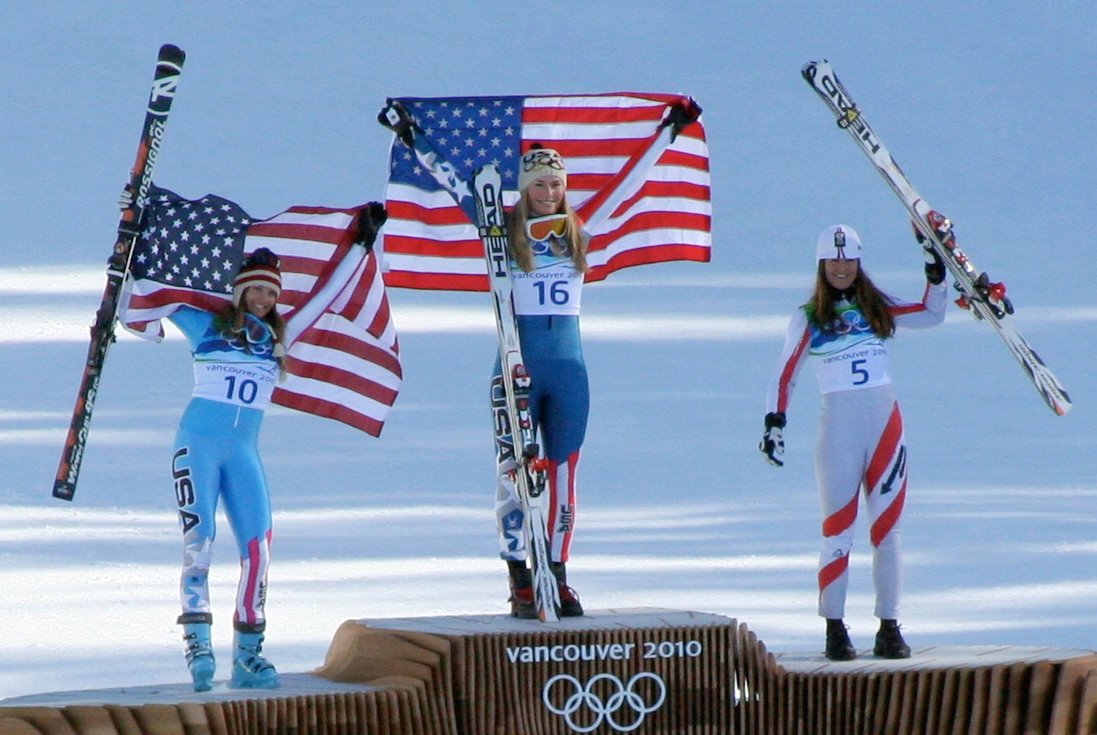
Julia Mancuso, Lindsey Vonn, Elisabeth Gorgi on the Downhill Medal Podium at the 2010 Vancouver Winter Olympics
All high performance downhill skiers experience injuries and setbacks and American Lindsey Vonn is no exception.

The three-time Olympian and 2010 gold medalist in the downhill, has had more than her share: season-ending knee surgery to repair a torn ACL and broken knee bone in early 2013, re-injury of the ACL later in 2013, which kept her off the slopes for all of 2014, including the Sochi Olympics, a broken ankle in August 2015 followed by a knee fracture three months later, ending her season, and finally a broken arm in November of 2016, which required surgery. She returned to the slopes two months later.

Forbes Magazine recently interviewed Vonn, sensing that her ability to bounce back from adversity time and again features a mindset common to successful entrepreneurs – one complete with a checklist for being resilient. And while high-performance athletes and serial entrepreneurs may appear to push this mindset to levels beyond the average person, there are powerful lessons for us all in this interview. Here is the list of Vonn’s 7 Strategies to Bounce Back From a Setback Even When It Feels Impossible. This is shortened, so go to this link for more:

  1. Prepare: The key to the comeback lies in the consistent, intentional training in advance. Develop personal training routines to keep yourself sharp, strong, and prepared for the next challenge.
  2. Internalize the lesson: If you are feeling stuck, reflect on the lessons hidden in the situation.
  3. Harness pressure to your advantage: Failure can be scary, but Vonn leverages fear to propel herself forward instead of paralyze her progress.
  4. Keep an open mind: Your brain is wired to keep you safe, which is why a setback can trigger stress and strong urge to fight or flee. If you feel stuck and blinded by your current situation, create emotional distance, gain perspective, and see if there are any creative solutions you may have missed.
  5. Define yourself: The story that we tell ourselves becomes who we are. Setbacks can be a catalyst for a new self-narrative that holds you back.
  6. Visualize: During stressful situations, the mind releases cortisol, which inhibits creativity. Practice mindfulness to quiet the mind and imagine a brighter future. Paint the mental picture with crystal clarity.
  7. Keep moving: Approach each situation as an iteration to learn from for the future.


Lindsey Vonn
Lindsey Vonn

From a personal and leadership development perspective, there are a number of nuggets of wisdom here: the importance of a development routine to maintain focus, the ability to see ways to improve when you’re doing poorly and when you’re doing well, facing fear and pressure by visualizing the joy and glory of what is possible.

I believe that great leaders, above all else, have an incredible sense of self – one’s strengths, weaknesses, likes and dislikes, and most importantly where one has come from and a clear view of where one wants to go. The more self-aware a person is, the more likely that failure, as she said, will not define you.

Samir Ait Said broken leg
Samir Ait Said

There is scary cute. And there is scary scary.

On this 31st day of October, aka Halloween, here are three legitimately scary moments in Olympic history. These images are not for the faint of heart.

Samir Ait Said, gymnast for France, broke his leg in a vault qualifier at the 2016 Rio Olympics, the snap of the bone so loud that people in the stands could hear it.


AFP_EE2G1
Andranik Karapetyan

Armenian weightlifter, Andranik Karapetyan, dislocated his left elbow attempting a lift in the clean and jerk competition at the 2016 Rio Olympics

Greg Louganis hits head on board

At the 1988 Seoul Olympics, diver Greg Louganis was performing a reverse somersault dive in the preliminaris of the 3-meter springboard competition when the back of his head slammed into the board full force. Despite the concussion and five stitches he received after that dive, he still went on to win the gold medal.

from-1964-to-2020

ボブ・シュールが私の頭に種を蒔いたのです。  

2015初旬私は1964年東京オリンピックの陸上5000メートル金メダリスト、ボブ・シュールにインタビューをしました。それは中身の濃い、長いインタビューになりましたその終わりに彼は、1964年の大会参加選手が2020年東京オリンピックで東京に来られたらすてきだろうと口にしました。彼は政府、あるいは誰かしらがその費用を負担するということを提案したのではありません。ただ、宿泊先や食事の場所などを探すための手助けがあればどんなにすばらしいことだろうと関心を寄せたのです。 

確かにそれはすばらしいことです。 

1964東京大会の参加選手全員を2020年に東京に呼び戻す方法が見つけられたら、ただ想像しているよりもすばらしいことで、実際に途方もなく感動的なことだと思います。私は、1964年東京オリンピック夏季大会の参加選手のうち、70人以上にインタビューを行いました。そのうち優に90%を超える数の人が、こちらから尋ねることなく、日本での滞在や大会について、すばらし特別な経験だったと説明しました。そして、その多くが日本にまた来たい、特に2020年に訪問したいと述べたのです。 

それらの元オリンピック選手が、1964年当時について、また、当時の日本の記憶として礼儀正しさや立ち直りの早さ勤勉さプライドついて語った内容を想像してみてください。1964年の大会参加選手を日本に呼べばお互いにとっての親愛の祭典となるのは間違いないでしょう。1964年東京オリンピック参加選手のために募金活動が資金提供をする機会もあるでしょうし、元選手らにとっては、当時の思い出を学校や博物館で紹介する教育活動の機会もあるでしょう。また、他にも、大使館や商工会議所の方々にとっては、1964年当時を追体験し、文化的な印象を深め、英雄たちをあたたかく受け入れる機会にもなるでしょう。 

選手はどのくらいの人数になるのでしょうか?推測させてください (そして平均寿命については、正直なところ幾分冷淡な医療用語を使わせてください)。

 logos-1964-and-2020

デイリー・メール紙のこの記事によれば、イギリス人の選手は、2012年のロンドンオリンピックの特定の競技について自由に観覧する機会を与えられていました。推定では、約125人の選手が該当しました ( つまり、存命だった人の人数です)1948年のロンドンオリンピックでは、イギリスの代表選手は404人だったので、そのうちの31%2012年に存命だったことになります。 

しかし、1964年と2020年は間隔がそれほど空いていません正確には56年です。言い換えると、選手の平均年齢が25歳だとして、1964年大会当時25歳だった選手のほとんどが2020年には70代半ばから80代半ばになります、そのため、1964年の大会のすべての参加選手の31%以上が健康で自分の足で歩き、2020年に日本を訪問することに関心があると予想できます。推定数を導き出すために、仮に40%としましょう。1964年の大会に参加した世界中の選手5151人のうち、2000人強が2020年にこの日本に来ることができるのです 

しかしながら、な残念ながら、これはまだ夢のままなのです。もしロンドンオリンピックの準備委員会が1948年の大会参加選手全員の4100人に申し出の対象を広げていたら、可能性としては、2012年ロンドンオリンピックへの招待者数を1200人以上に広げる必要があったでしょう。私は、1948年ロンドンオリンピック参加選手のすべてを2012年の大会に呼び戻そうという計画には目がいきませんでしたが、準備委員会は考慮に入れていたと想像していますし、彼らはそれが難題だとわかっていたと確信しています。どのようにして大会参加選手の全員に連絡をとりますか?資金はどうしますか?東京に宿泊客があふれている時期に、尊敬に値し、おそらくはその年齢 から見て特別な介助を必要とするであろう多くの人々を受け入れる方法はあるでしょう

どれも的を得た質問です

しかし、すべては夢から始まるのです。

For English Version.

Ed Caruthers with picture of silve jump

Tommie Smith was in Tokyo for the 1967 World University Games. A Japanese reporter came up to him and asked him, “Were Negroes now equal to the whites in the way they were treated?”

According to Richard Hoffer and his brilliant book about the 1968 Mexico City Games, Something in the Air, Smith said that they were not. Then Smith was asked if a boycott of the Mexico City Games was a possibility. Smith replied “you cannot rule out the possibility.” Since there was absolutely no talk of boycotts up to that point, Smith’s comment to the Japanese press spread to the international press, and by the time the 200-meter sprinter returned to American and to San Jose State College, otherwise known as “Speed City” for those on the sprint team, he was deluged with requests for interviews.

John Carlos and Tommie Smith

By the end of 1967, a sociology professor at San Jose State named Harry Edwards began building a consensus among university administrators and athlete, finding his voice on the issues of black inequality in America. He had formed an organization called the Olympic Project for Human Rights (OPHR). On Thanksgiving Day that year, the OPHR via Edwards called for a boycott of the 1968 Olympics. This was soon followed by a list of demands, including

a boycott of all New York Athletic Club events (a logical move since the club maintained indefensible admission policies), It was also demanding the exclusion of South Africa and Southern Rhodesia from the Olympics, integration of the U.S. Olympic Committee, and, as a bonus, the return of Muhammad Ali’s championship crown. Edwards let it be known that they wouldn’t mind if Avery Brundage, “a devout anti-Semitic and anti-Negro personality,” be replaced as head of the IOC.”

In 1967, Ed Caruthers was the best high jumper in the world. After having tasted a bit of what competition with the best in the world was like at the 1964 Tokyo Olympics, Caruthers was determined to return to Mexico City and win the gold medal. He told me that his track and field teammates in Tokyo, like Mel Pender and Willie Davenport, were committed and working hard to return to the Olympics and redeem themselves of the disappointment they faced in Tokyo. So when confronted with the possibility of a boycott, the initial reaction of these Black American athletes was different from others like Tommie Smith and John Carlos – they did not believe that a boycott was the right play.

“When Dr Martin Luther King was killed on April 4, 1968, there were a lot of things going on in my mind,” Caruthers told me. “What was I going to do? What is this country going to be like? There were a lot of issues that weighed on me. In the end, I was not in favor of the boycott, and I told those guys. I told them we had to run our asses off and win, which could give us more of a voice, more of an ability to throw light on these issues. You don’t get the best audience if you boycott.”

Ed Caruthers and Dick Fosbury

In the end, the desire to compete and to take advantage of the massive audience tuning into the Olympics won over those who considered a boycott. As Smith teammate, John Carlos said in this Orange County Register interview, “I strongly thought boycotting. For many of us, it as a childhood dream to compete in the Olympics. For Ed (Caruthers), it was a double-whammy because he’d been before, gotten a taste and he wanted to go and shine.

As the world saw, Smith and Carlos saw a non-violent way to protest the state of Blacks in America, by famously donning a black glove and raising their fists in the air while bowing their heads as they stood on the winners’ podium and listened to the American national anthem. They had won the gold and bronze medals respectively in the 200-meter sprint, but they were suspended from the rest of the Games for their actions.

As written in that Orange County Register article, Caruthers is still close to Smith and Carlos. A statue dedicated to the two sprinters was placed at their alma mater, San Jose State, remembering that time when they silently but powerfully spoke out for equal rights.

“If they’d boycotted the Games, nobody would remember them,” Caruthers said. “But now, here we are 40 years later, and people are still talking about it.”

IMG_5425

Oh there were a bunch of dignitaries there. A Governor. Organizing Committee Head. Olympians. Celebrities. There were proclamations. Couldn’t see it. It was rainy. And I was too late to get to a good spot.

But it was still cool, on October 28, 2017, to celebrate 1,000 Days to the Opening Ceremony of the 2020 Tokyo Olympics in the Ginza.IMG_5418


At the moment the photo above was snapped, there was 1,000 days and over 4 hours to the start of the Tokyo Olympiad – in other words, 8pm on Friday, July 24, 2020.

We got to see the 2020 logo on display, the white geometric design on traditional Japanese indigo blue, featured on the festival happi coats of supporters.

We got to see demonstrations of a few of the new events to debut in 2020, like 3-on-3 basketball and sports climbing.

IMG_5430

In the case of 3-on-3 basketball, basketball players slipped on the rain-slicked asphalt, but still put on a show. Afterwards, renown kabuki actor Ebizo Ichikawa and Olympic weightlifter Hiromi Miyake showed off their shooting prowess.

IMG_5410
Olympic weightlifter Hiromi Miyake

IMG_5406
Famed kabuki actor Ebizo Ichikawa
This event at the Ginza, still one of the world’s swankiest shopping areas, was an opportunity for Tokyo 2020 local sponsors to promote their linkage to the Olympics.


IMG_5433
Eneos does the classic tourist gimmick.

IMG_5435
A new ANA plane, with artwork designed by a junior high school student.
Here, I put my origami skills to the test to fold a paper crane. I failed…but I still put my heart into it.

IMG_5440
Kinki Nihon Tourist asking passersby to fold cranes.
On November 29, it will be 1,000 days to the 2020 Tokyo Paralympics.

The countdown continues…..