Cholera Quarantine_Yomiuri_14oct1964

It was only 13 months ago when the World Health Organization declared zika a global health emergency, particularly in Latin America. With babies born with deformed heads, men and women alike were worried about going to Brazil for the Rio Olympics last August.

And while the zika virus has not exploded into a pandemic as some had warned last year, it is still an outbreak of urgency, one that still concerns mothers-to-be in the affected regions.

In 1964, a disease that struck fear in populations throughout the world was cholera. From 1961 into the 1979s, the world was facing the seventh known outbreak of a cholera strain called El Tor. While El Tor was rarely fatal, its symptoms of severe watery diarrhea over days were enough to cause considerable fear. El Tor emerged from Indonesia, to such countries as Bangladesh, India, the USSR, Italy, North Africa and the South Pacific.

On Tuesday, October 13, 1964, the third day of the Tokyo Olympics, the newspapers explained that El Tor had made it to Japan. The October 14 Yomiuri reported that Mr. Shoji Endo, a company employee of Dai-ichi Kinzoku Company, a trading company that specialized in importing metal. Apparently, Endo had returned to Japan on Saturday, October 10, after working in Kenya for three months, and then returned to Japan through Calcutta, India and Bangkok, Thailand. Immediately after arriving in Tokyo, he boarded a train to the resort town of Shimoda to join his company colleagues on a company trip. On Tuesday, October 11, Endo fell ill with diarrhea.

early japanese cholera prevention
Early 20th century cholera-prevention notice in Tokyo

Thus commenced a mini-panic. Once they realized that Endo had recently passed through Calcutta and Bangkok, where El Tor cholera had apparently been spreading rapidly, and his diarrhea, officials acted relatively quickly:

  • People who had been in contact with Endo, colleagues and resort staff, were immediately placed in an isolation ward at a Shimoda hospital.
  • The Shizuoka Prefecture government set up a cholera precaution headquarters at the resort, and set up facilities to inoculate the 15,000 residents of Shimoda and enforce quarantine measures.
  • In Tokyo, the Welfare Ministry ordered an extensive anti-cholera campaign, and sent an official to Shimoda to ensure enforcement of the inoculations as well as the disinfection of buildings (where foreigners have stayed) and ditches and the extermination of rats, flies and cockroaches.
  • The Japanese National Railways, as well the Keisei Electric Railway Company took measures to disinfect stations on Endo’s travel route.
  • The Izumi-so Inn was effectively closed, cordoned off from the public.

Of course, this was a disaster not only for the Izumi-so Inn, but for the tourism business in Shimoda. As The Yomiuri explained, “the outbreak of cholera was having a serious effect on the town which depends on tourism for its finances. By Tuesday evening, an estimated 1,500 bookings had been canceled and the figure was rising.

The inns are normally packed with 4,000 tourists daily. The town tourist association estimated losses at JPY6,000,000 for Tuesday alone.”

As it turns out, there was no cholera outbreak in Shimoda. Perhaps it was because the officials isolated Endo in time – cholera, officials said, is contagious only after symptoms have appeared, and apparently Endo had shown no symptoms before he left Tokyo for Shimoda. Endo eventually recovered and that was that.

As for the Izumi-so Inn, it is still a thriving resort hotel, which, according to this Booking.com summary, is “a 3-mintue drive from Gero Train Station…offers Japanese-style rooms, an indoor and an open-air natural hot spring bath and Japanese cuisine.” If you’re in Japan and want to enjoy hot springs by the seaside, then look no further. The Izumi-so Inn averages an impressive 8.7 points out of 10 on the site’s review section.

Izumi-so Inn
Izumi-so Inn
1992 US women's gymnastics team Barcelona
BARCELONA – 1992: (L-R) Kim Zmeskal, Kerri Strug, Shannon Miller, Dominique Dawes, Wendy Bruce and Betty Okino of the United States stand on the podium

They are little girls. But they are as tough as nails. They have to be in order to be a top flight gymnast. And there are real costs.

The revelations last year of sexual abuse in the world of USA Gymnastics, led by reporting by The Indianapolis Star, were shocking – well over 300 cases of sexual abuse of minors over the past 20 years!

But when you listen to people in the know, former gymnasts who grew up in the seemingly cruel world of competitive gymnastics, these stories of abuse are no surprise.

Wendy Bruce Martin won a bronze medal as a part of the US women’s gymnastics team at the 1992 Barcelona Olympics. She currently runs a consultancy that helps athletes with the mental and emotional aspects of competition, and has thought deeply about what she calls the “cult culture of gymnastics.” Martin believes it is a culture that feeds an addiction, as she writes in a blog post:

Gymnastics is like being in an unfair relationship, it takes way more than it gives back to the gymnast, and whatever it needs from us gymnasts, we give it. When it does give back, it gives us feelings that reach straight into our souls. The little tastes of success are enough to keep us working, and get us addicted.

I was willing to give anything to gymnastics and I was willing to give everything. My addiction had me focused mostly on my immediate gratification. As long as I could perform my skills, I was willing to ignore the advice from my Doctor. When my Doctors told me to take time off of gymnastics to heal, I didn’t. I pushed myself and worked in pain, and when I couldn’t handle the pain, I begged the Doctor to help. I begged for something to help ease my pain and so against my Doctors advice, I made them give me Cortisone shots in my ankles and wrists.

Jennifer Sey is a US national champion gymnast, and author of the book, Chalked Up: Inside Elite Gymnastics’ Merciless Coaching, Overzealous Parents, Eating Disorders, and Elusive Olympic Dreams. She too knows first hand of this culture. This is how she described her experience for The New York Times:

When I was training, I blackened my eyes when I fell on my head on the beam after fasting for three days before a competition. “I don’t coach fat gymnasts” was a common refrain from coaches antagonizing me about my weight. I competed on an injured ankle swollen to the size of a baseball. At one point, I required monthly cortisone injections to limp through my floor routine.

After I broke my femur at the 1985 world championships, I had the cast removed early under pressure from my coaches so that I could train for the next national championships. I competed and won, but not without breaking the opposite ankle in the process.

The message I got was that if you couldn’t take it, you were weak. If you complained, you didn’t deserve to be on the team. In fact, if you perceived it as abuse, rather than just plain old tough coaching, you were delusional.

Jennifer Sey
Jennifer Sey

The problem that these two former gymnasts reveal is that it is not just the children and the coaches that perpetuate this culture of success and abuse, the parents of these children do as well. Martin explains that she had bulimia, an eating disorder. And an adult close to her was aware of this issue, and could have decided to reveal this secret, the consequences of which could have led to treatment and possibly a loss on the Olympics squad. But, she wrote, the adult was also complicit in the culture.

This adult told me that they knew about my eating disorder and they said, “Just don’t do it too much.” I was so relieved that they didn’t want to send me to treatment or therapy. I knew that I would miss out on my chance on being an Olympian. This was exactly the response I wanted. I shook my head and promised not to do it too much, and walked away in relief.

To me, Bulimia was something I was willing to sacrifice for the chance of my dreams. I was never upset at this adult for not doing more or forcing me to go into therapy. I was fine with their passive and non-confrontational advice on my disorder. I knew that they didn’t want to ruin my dream, and they didn’t want to be the one who spoke up and destroyed the 14 years of training I devoted my childhood to. They understood the Cult Culture of Gymnastics and so did I.

Sey has similar sentiments, understanding that the child gets so locked in the culture that “you learn to focus only on achievement and to disregard your own sense of right and wrong, along with your own well-being.” But she goes on to say that parents and adults do not have that excuse, particularly when it comes to sexual abuse.

Because of this, I can understand how young gymnasts might be confused about whether and how to speak up for themselves when they’ve been mistreated. But there’s no excuse for adults to turn a blind eye to sexual misconduct.

The strength and discipline of our gymnasts shouldn’t cause us to forget that most of them are children for a majority of their careers. The coaches, officials and other adults charged with harnessing their talents must also stand up for their well-being.

I wish I’d had someone to stand up for me.

Martin exclaimed the same.

The bottom line is that NOTHING is more important than the health of a child. No skills, routine, meet, medal, or trophy is more important than the child. Gymnastics will end one day, then what will the gymnast, coach, and parents be left with?

Carlo Airoldi
Carlo Airoldi

He wasn’t high born. He was a farmer from Origgio, Italy. And he could run, and run, and run – Forrest Gump-style. In the 1890’s, Carlo Airoldi was one of the best long-distance runners in Europe. In 1895, the year before the inaugural Olympics in Athens, Airoldi won the Milano-Barcelona footrace, a 12-leg competition of 1,050 kilometers!

So when Airoldi heard about the Athens Olympics, he likely thought a 42-kilometer marathon would not be a problem at all. Unfortunately, there was another problem. He was not a man of means like the majority of athletes attending the Athens Olympics. He could not afford to take trains or ships from Italy to Greece.

So he decided to walk. Two thousand kilometers. So that he could run 42.

He convinced an Italian magazine, La Bicicletta, to sponsor his expenses in exchange for his story. He figured if he walked and jogged some 70 kilometers a day, he could make it to Athens in a month. So, according to this article in Italian, he departed Milan on February 28, 1896, taking his first steps in the cold and windy winter weather. The book, The Olympics: A Very Peculiar History, explains that after making it 700 kilometers to Ragusa, Yugosloavia, Airoldi bought a ticket for a boat to Pattras in Western Greece, before walking another 200 kilometers to Athens.

It took Airoldi a little over a month, but he made it!

Carlo-Airoldi--il-librodi-manuel-sgarella
Not quite the build you’d expect of a marathon runner….

Airoldi arrived in the Greek capital in early April, just in time for the start of the Olympic Games. Unfortunately for him, these weren’t the Games of the ancient Greeks. These were the Games of Baron Pierre de Coubertin, who believed in the purity of amateur athletics, that only those who were not tainted by victory prizes were allowed to compete.

When asked by members of the organizing committee whether he have ever received money in a competition, Airoldi replied sincerely that he indeed had, the previous year, after winning the Milan-Barcelona race a year before. Perhaps, as the Italian article explains, there was also concern that this renown distance runner from Italy was a threat to the favored Greeks in the marathon. Whatever the reason, a shocked Airoldi was declined eligibility to run in the marathon.

“If only they could walk a mile in my shoes…,” he may have thought.

marathon to athens map
Marathon to Athens

Albin Lermusiaux of France, jumped out to the lead, but eventually relented to the Greek heat, and quit the footrace at the 32 kilometer mark, carried the rest of the way by horse-drawn cart. Then the Australian, Edwin Flack, jumped to the lead, only to fall at the 37 kilometer mark.

At these first modern Olympic Games in Athens, on April 10, 1896, 80,000 people sat in the Panathenaic Stadium waiting, listening to updates brought in by messengers on bicycles or horses. This was the scene of the very first marathon, an event created for the first Olympic Games. A colleague of Pierre de Coubertin, Michel Bréal, transformed a legendary story of a man named Pheidippides into an Olympic event. In 492 BC, Pheidippides ran from a place called Marathon to Athens, a distance of about 42 kilometers, to deliver new of a Greek victory over Persia, in what is called the Battle of Marathon.

So when the spectators in Panathenaic Stadium saw who was first to enter the stadium, an explosive cheer split the sky. A Greek named Spyridon Louis was to win the final event of the first modern Olympic Games in the spiritual home of the Olympics. Here is how David Goldblatt, author of the book, The Games: A Global History of the Olympics, described the significance of that moment:

It proved to be the most important event of the games, generating the kind of modern mythological hero and collective stadium spectacle that raised the 1896 Olympics above the level of a country-house games weekend or a mere historical recreation…. The man who entered the stadium first was the Greek, Spyridon Louis. The crowd went wild. The king and the crown prince descended to the track to run alongside him and, when the had finished the race, members of the royal entourage and the organizing committee embraced and kissed him.

Coubertin was also impressed, according to Goldblatt. “Egad! The excitement and the enthusiasm were simply indescribably. One of the most extraordinary sights that I can remember. Its imprint stays with me.”

Spyridon Louis

Louis was not a man of wealth. He made his wages by transporting mineral water his father mined to buyers in Athens. After his victory, Louis was showered with gifts, but continued to live a simple life of a farmer and later as a police officer.

Four years prior to his death in 1940, forty years after his momentous victory in the marathon, he could still remember that moment of glory with happiness.

That hour was something unimaginable and it still appears to me in my memory like a dream … Twigs and flowers were raining down on me. Everybody was calling out my name and throwing their hats in the air …

DSCN1264
Sakura-machi Park, Koganei_April 2004

Spring is here.

In Tokyo, you know because wherever you go, you are blessed by the blossom.

Unfortunately, the IOC does not entertain the idea of the Spring Olympics, so the image of youthful athletes running through a flurry of falling blossom petals will have to await a fictionalized Hollywood vision.


20140331_214431294_iOS
Naka-Meguro Station_March, 2014


The Summer Games are almost always held in July or August, probably because by now that is a period most other major sporting organizations would avoid for a meet or a championship. Summer Games have been held in October to avoid typhoons (Tokyo) and the heat (Mexico City), and they have been held in November and December (Melbourne) because it is summer down under in those months.

But the very first modern Olympic Games, in Athens Greece, were held in the Spring. The first re-boot of the Games were played from April 6 to 15, 1896. So today is the 121st anniversary of the start of the first Olympic Games.

Sakura Kinshicho Park
Kinshicho Park_April 2017

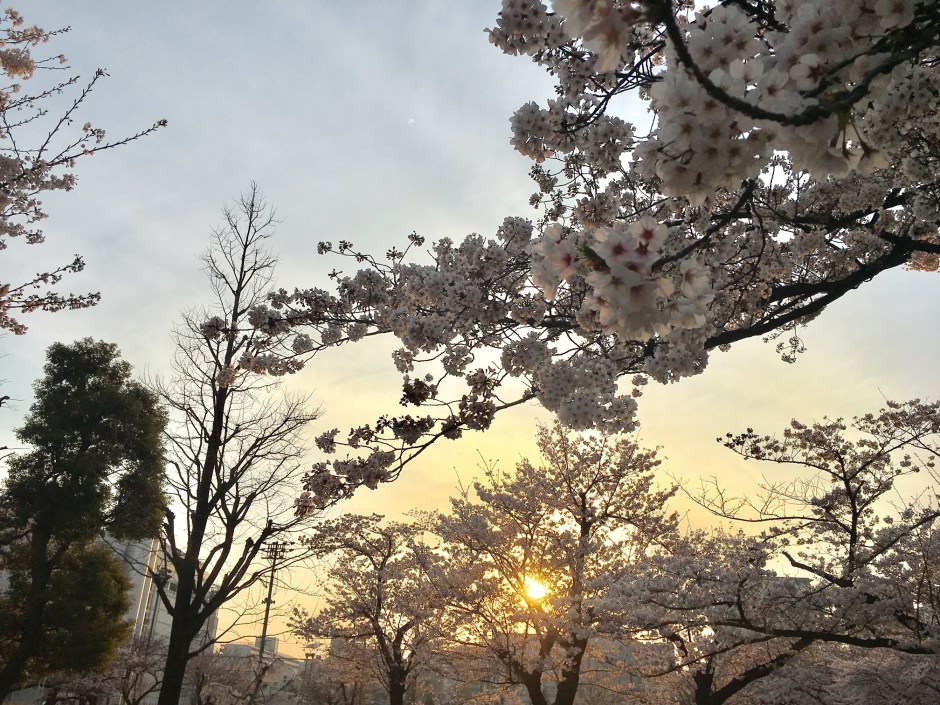
And just as Spring is the best time to visit Greece, you can say the same for Japan. Not only for the incredible food. But also for the eye candy that is the cherry blossom tree. I’ve been in Japan for over 18 years – I never get tired of staring out into a sea of pale pink, or strolling by a lone cherry tree. Even the very first budding of flower on a cool March morning brings delight and warmth.

The cherry blossom, and its representations of youth and beauty, accentuated by its relatively fleeting existence, is an icon of Japan, so much so that it was a powerful emblem in Tokyo’s bid for the 2020 Olympics.

So if you want to see Japan at its best, come during the cherry blossom season.

sakura blossom

Sakura 2017: The best places to see cherry blossoms in Japan

20 Of The Best Pictures Of 2014’s Japanese Cherry Blossoms

Japanese hanami lovers reveal the top ten things to bring on a cherry blossom viewing picnic

Pyeongchang NBC logo

We live in a 24/7 always on world. When NBC delayed broadcast of premier sporting events at the Rio Olympics, so that they could present them during prime time in the evenings, their strategy backfired for many. After all, in today’s world, people can learn of the results instantly.

NBC recently announced that for the PyeongChang Winter Olympics in early 2018, all broadcasts will be live, no matter the time in the US.

“That means social media won’t be ahead of the action in any time zone, and as a result, none of our viewers will have to wait for anything,” Jim Bell, president for NBC Olympics production and programming, said in a statement. “This is exciting news for the audience, the advertisers and our affiliates alike.”

Since South Korea will be 14 hours ahead of the East Coast of the United States, if an ice hockey match starts at 8pm in Korea, then New Yorkers can watch it real time, but they’ll have to be up at 6 am to do so. Of course, if you’re a big hockey fan, trying to avoid hearing the score for another 12 hours before watching it prime time would be a pain in the neck, if not impossible.

This may actually be ho hum news for most people.

But in 1964, the prospect of broadcasting the Tokyo Olympics live to other continents was an exciting thought.

NHK camerman 1964 Tokyo Olympics
NHK camerman at the 1964 Tokyo Olympics
Live broadcasts in 1964 were not new. The 1936 Berlin Olympics were shown live on German television. The 1960 Rome Olympics were the first to be broadcast live across Europe. But, according to John Slater of Western Carolina University, Japan wanted the 1964 Tokyo Olympics to be the first broadcast live to another continent.

Slater wrote in this abstract that members of the Tokyo Olympic organizing committee wanted the Tokyo Games to be known as the Technology Games. And so they contacted the American government in Washington D. C. if they would be willing to adapt American communication satellites designed for telephone communications to relay television signals. American officials also thought it would be very cool to be the first Games to broadcast signals literally across the globe.

NHK, the Japanese Broadcasting Corporate, built a transmitter in Japan, and the US Navy made modifications to a communications facility in California, and NASA which operated the satellite Syncom II, moved its orbiting location from the Atlantic to the Pacific. And when they tested the ability to send visual and audio television signals from Japan to North America real time, it worked! But as Slater wrote, NBC, which owned the broadcast rights in the United States, got very defensive.

The U.S. Department of State coordinated the use of the necessary radio frequencies. The system worked, and the Communication Satellite Corporation offered to make satellite time available. Both CBC and the European Broadcasting Union signed up for an hour a day, at a cost of U.S. $150 a minute.

But NBC chose to protect its investment in exclusivity. It got hung up on NASA’s policy that programs sent via experimental satellites should be made freely available to all competing media. In the end, only the opening ceremonies were televised live in the United States, and then only in the East. During the competition itself, U.S. viewers had to wait to see next-day videotapes of the Games, while viewers in Canada and Europe got the full benefit of live coverage. The Canadians had embraced the new technology, while the U.S. broadcasters tried to fend it off as a threat to their commercial interests.

NBC got an earful for promising live broadcasts, but actually providing tape-delayed shows in the evenings.

But that was 1964. Today, on the eve of the PyeongChang Winter Olympics, NBC will be giving sports fans immediate gratification.

Cartoon Charilaos Trikoupis
Prime Minister Charilaos Trikoupis and the tough economic seas he had to navigate

After all that trouble Baron Pierre de Coubertin went through to get an international congress to re-boot the Olympic Games, the Games were quickly in peril in the early days of the planning process.

From the beginning, the prime minister of Greece, Charilaos Trikoupis, was not interested in hosting the Olympic Games in Athens. In 1892, Greece’s Treasury was bankrupt due to high-priced government programs. Thus, the prime minister was not in the mood for another expensive boondoggle like the Olympics. He thought that if anything, the government should sponsor an event devoted to promoting the agro-industry of Greece.

Equally consequential, the Greeks Coubertin left behind to help organize the Games, quickly agreed that the expense of the Games would outweigh the potential glory, and disbanded.

That’s when the nemesis of the prime minister stepped in. Tripkoupis was at odds with the King of Greece and the royalty in general as the prime minister felt the King’s hand meddled too much in Greek politics. Perhaps royal intrigue was part of the reason why Trikoupis was prime minister 7 times from 1875 to 1895. But despite the prime minister’s influence in keeping the Olympics off the calendar.

Crown Prince Constantine stepped up and declared the re-establishment of the Olympics in Greece as a priority. The crown prince, who was already an honorary president of the committee, took control, establishing a new working committee, and solicited the generous funds of a rich businessman named George Averoff, had new sports facilities built, like the Panathenaic Stadium, and a velodrome.

Crown Prince Constantine

Reluctantly, Trikoupis agreed that the Olympics should be hosted in Athens. And unfortunately, the pressure on the Greek government to pay back the country’s debt as it fought its way out of bankruptcy was too immense. The prime minister recommended higher taxes to pay its debt, but that’s not a great platform for a politician to run on. With little support, Trikoupis resigned and eventually lost his seat in the general election.

With the uncooperative prime minister out of the way, the Greek Royalty and Coubertin was able to move forward in the restoration of the Athens Olympic Games in 1896.

first olympic committee 1896
Officials of the 1st Olympic Committee in 1896, Coubertin seated left

Beyond expectations, the first modern Olympic Games in Athens, Greece in 1896 was a success. It was said that 80,000 people cheered the last event – the marathon – with an enthusiasm bordering on hysteria.

Even overseas, the Athens Olympics was praised for its “triumph of sentiment, of association, of distinction, of unique splendour,” and that “the flavour of the Athenian soil, the indefinable poetic charm of knowing one’s self thus linked with the past, a successor to the great heroic figures of olden times – the splendid sportsmanship of the whole affair.”

But Baron Pierre de Coubertin, who today is seen as the father of the modern-day Olympics, did not hear the cheers. He was not given credit for the establishment of these Games by dignitaries or the press, let alone mentioned. As David Goldblatt wrote in his history, The Games: A Global History of the Olympics, “he was equally piqued by the failure of the royal house of the post-stadium crowd to acknowledge his role in inviting and animating the games, writing ‘I don’t care what the Greek newspapers say about me. When it comes to ingratitude, Greece easily wins first prize…You all got your branches…in a full stadium from the hands of the King. I am the only one whose name, if ever mentioned, was spoken only in secret.”

pierre-de-coubertin
Father of the Modern Olympics, Pierre de Frédy, baron de Coubertin

But indeed, Coubertin was the animating force behind the modern Olympics. His was a particular vision in sports. As Goldblatt describes, Coubertin was a man of the aristocracy and well connected. After visiting England and meeting Dr Penny Brookes and seeing his Much Wenlock Games, Coubertin realized that sport had a way of unifying people. From that point on, Coubertin had a vision for unifying the world, as he knew then, in a vision of sport and sportsmanship.

The late 19th century was a time of optimism. Technology was making the world smaller. And the more people knew the people of other lands, the more they traded with people of other lands, the more they visited other lands, the less likely, some thought, that they would go to war with other lands. For Coubertin, sports was a mechanism for peace.

It is clear that the telegraph, railways, the telephone, the passionate research in science, congresses and exhibitions have done more for peace than any treaty or diplomatic convention. Well, I hope that athletics will do even more…Let us export rowers, runners and fencers: there is the free trade of the future, and on the day it is introduced within the walls of old Europe the cause of peace will have received a new and might stay. This is enough to encourage your servant to dream now…to continue and complete, on a basis suited to the conditions of modern life, this grandiose and salutary task, namely the restoration of the Olympic Games.

Coubertin spoke those words in a conference he organized in November 1882. Goldblatt wrote that the audience was indifferent to his ideas. But he was not discouraged. His next goal was to arrange another conference, in May 1894. He continued to write and meet people from other lands, associates and friends, royalty and heads of states, explaining his vision of a new Olympics, one based on the principles of peace and internationalism. He got 78 delegates from sports organizations from 12 nations to attend his Paris

I’m aware that drafting is a great part of car racing strategy. I didn’t realize that even cyclists employ drafting as a part of their strategy as well.

drafting technique

The Eurosport video above takes a fascinating look at team strategy, breaking down a race showing how team support in the last kilometers of a race could make a huge difference.

drafting technique 2

Clearly, conserving the energy of your star sprinter as you head towards the finish is the key. Drafting, the act of cycling in the air wake of the cyclist in front of him, results in the cyclist being pulled by the wind eddies. So while your teammates are using up all their energy to drive a very fast pace, the sprinter at the back can conserve energy in the wind draft. As this video shows, drafting behind your competition is also a key tactic.

drafting technique 3

In other words, you almost always want to come from behind in cycling, as long as you can keep your teammates and your rivals close.

Kate Hansen wolf twitter
The famed Kate Hansen tweet

Apparently, President Trump is not the only world leader who has to deal with fake news. During the Sochi Winter Olympic Games, Russian President, Valdimir Putin also suffered such attacks.

Jimmy Kimmel, American comedian and late-nigh talk show host, pulled a fast one on the American public by playing up the problems in Sochi. He referred to stories of packs of dogs “roaming the streets, even spotted in the hotels.” He then showed a video that US Olympic luger, Kate Hansen, posted on her Twitter account the previous evening – an animal, presumably a wolf, walking through the hallway outside her Olympic Village dorm room.

As we learn in this Kimmel segment, the press went wild.

  • “A wolf in the hallway! And I’m not talking Blitzer!”
  • “You’ve heard of the Wolf of Wall Street. How about the Wolf of Olympic Village.”
  • “Oh god. It gives me chills.”
  • “I think it might have been a dog, but it’s definitely wolf size.”

But then Kimmel let us in on the prank. Kimmel produced the video on their Los Angeles set, re-creating a replica of a Sochi dorm hallway, and Hansen agreed to allow Kimmel to momentarily take over her Twitter account.

Happy April Fool’s Day everyone!

Kate Hansen on Kimmel