toros-tokyo-number_5
The competitor number for Andras Toro and his C-1 1000-meter competition at the 1964 Tokyo Olympics

When 1964 Tokyo Olympian, Andras Toro, rummaged through his decades of Olympian memorabilia with me last month, he uncovered his number. At his last Olympics representing his native Hungary as a canoeist, Toro wore the number 79, blue font on white material.

What caught my eye was that on the back of the material were the unmistakable pads of velcro. The reason it drew my attention is that I had always been bothered by the way athletes, particularly track and field athletes, have their numbers or names attached to their jerseys. They are sporting sleek, high performance jerseys, and yet their names or numbers are commonly printed on paper, and quite sloppily attached by safety pins. It’s not a big issue. It just doesn’t look cool.

alison-felix-and-name-card-fasteners

There has to be a better way.

At every Olympics, organizers are always looking for better ways to do things. Perhaps someone deep down in one of the 1964 Tokyo Olympics planning teams thought that velcro was a better way to help identify athletes.

Velcro was developed in 1941 by a Swiss electrical engineer named George de Mestral. The iconic story is that on a walk with his dog in the woods, he came home with burrs stuck to his pants, which made him wonder. When he looked at the burrs closely, he noticed that the burrs had tiny hook-like tendrils, which somehow caught themselves in the tiny openings of his pants material. Out of that insight, de Mestral patented the fasterner idea called velcro, which is a combination of the French words “velours” (velvet) and “crochet” (hook).

Velcro was seen as a light, flexible, non-metallic way to attach or seal things. In 1968, NASA used velcro in their space suits, sample collection bags and on their lunar vehicles, increasing its geeky cool cred.

So attaching name and number plates to uniforms with velcro makes sense, initially. Why are we not using that space-age technology today? My guess is that using velcro is a bit of an operational pain because it requires two to tango – you need to place the “vel” on one thing and the “cro” on another. Toro’s number plate had the “vel”. I can’t imagine the organizers at Lake Sagami requiring all canoeists to wear a special jersey that had the hook pads…but I suppose they did.

And so, the old-school pin fasteners…now they’re beginning to make sense.

olga-karasyova
Olga Karasyova

When famed Czech gymnast, Vera Caslavska, passed away last month, there was a section in a Guardian article about Caslavska that shocked me. In 1968, the Soviet Union’s women’s gymnastics team defeated the Czech team to take gold at the Mexico City Olympics. The Soviet team was said to have apparently employed a most horrifying doping technique.

To counter Caslavska and her team-mates, the Soviets took extreme measures. “In any other country it would have been called rape,” one of the Soviet coaches said a quarter of a century later, after one of the gymnasts had told a German television interviewer what happened.

Doctors had discovered that pregnant women could gain an advantage in muscle power, suppleness and lung capacity, because they produced more red blood cells. So all the gymnasts, two of whom were 15 at the time, were forced to become pregnant before the Olympics: if they did not have a husband or boyfriend, they were made to have sex with a male coach. Anyone who refused was thrown off the team.

After 10 weeks of pregnancy every gymnast had an abortion. They won the team gold medal by a fraction of a point, with Czechoslovakia second.

Wow.

This can’t be true, I thought. But it was reported in a major newspaper, I rationalized. But coaches could never get so many people to do this, I countered. But it’s been reported not only in the press, but also in documentaries, I learned.

The story first emerged in a major BBC documentary series in 1991 called “More Than a Game”. Then in 1994, a German RTL documentary featured, Olga Kovalenko, a member of that 1968 Soviet gymnastics team, who revealed the sordid details of pregnancy doping.

olga-karasyova-2But as Elizabeth Booth explains in this detailed blog post in November, 2015, it appears this sensational story of rape, pregnancy, abortion and hormones is bogus. The biggest hole in the story was the German documentary’s claim that Soviet Olga Kovalenko was revealing all. Apparently, the woman in the documentary was not Olga Kovalenko. The real gymnast, the one who competed in Mexico City on the Soviet gold-medal winning team, took a Russian sports magazine to court in proving that she was not a victim of rape doping.

Here’s how Kovalenko explained her surprise at this incredible story in a 2001 interviewa 2001 interview with a Russian journalist:

Once, German broadcaster RTL screened an interview … with my double!   A certain woman who said that she was Olympic champion in gymnastics, Olga Kovalenko.  (I actually took the surname of my second husband, but then divorced and again became Karaseva.). She gave a sensational interview, saying that the USSR coach forced the girls to get pregnant and then at the ninth or tenth week to have an abortion!  Doctors know that at these times there is a sharp increase in the levels of male hormones in the woman’s body, which in girls increases physical strength and brings new resources of life, a feeling of elation. It is meant to be a kind of doping. “That’s how we won,” – these are the words of the imaginary “Kovalenko”.

Of course, this interview was published by many news agencies, newspapers and magazines. The Moscow correspondent of the Spanish newspaper “ABC” Juan Jimenez de Partha somehow tracked down my phone and asked about the meeting. Imagine his disappointment when I told him it’s easy to prove that it is a pure fake. At the time, when my “understudy” was broadcasting live on abortion, I was on a sea cruise.  There is evidence in my passport!

Then “Paris Match” reporter Michel Peyrard, who had seen the “tremendous” interview on RTL, flew in to see me.  He was pretty surprised that I could speak perfect French, but also frustrated because he found no resemblance to the “Olga from Germany”.

In the end, as Booth explained, the suspicion of doping in the former Soviet Union was high at the time the story came out, as it is today with Russia, and thus our resistance to believing a story like this, even one as fantastical as this, has been low.

At the time the papers – quality and tabloid press alike – had little good to say about the sport.  A high profile rumour was also circulating that the female gymnasts were fed drugs to delay puberty, including one case where an ‘expert’ (we never found out exactly who) had observed photographs of a gymnast where her physical development had actually receded, rather than progressed.  The words ‘I would believe anything’ summed up the attitude of many in the press at that time.  

tokyo-olympics-wappen-1

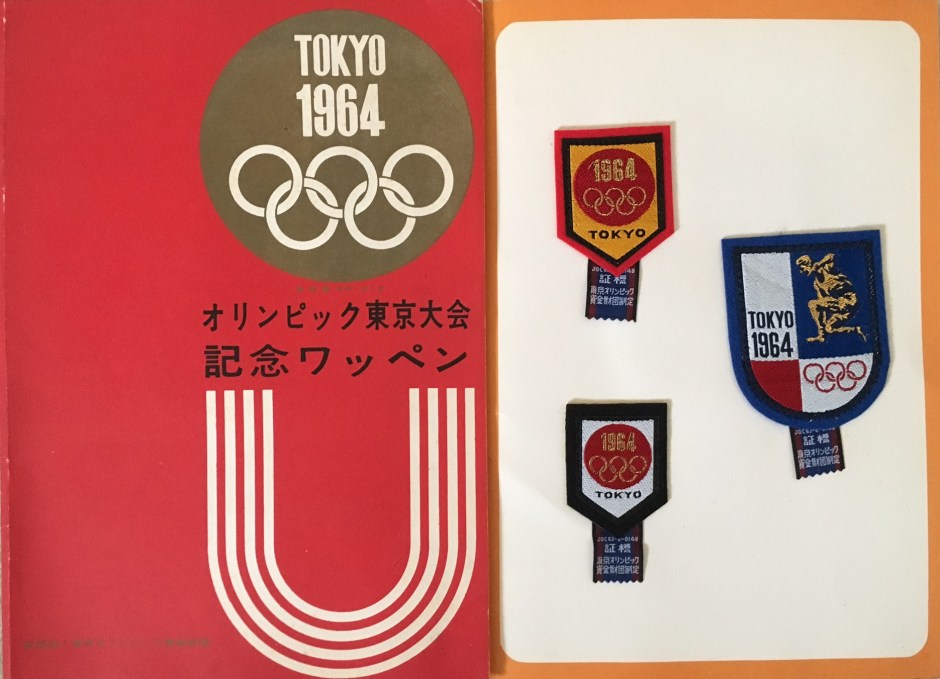
I was in Queens, New York a couple of weeks ago to clear out the home I grew up in. The house sold, we had to dump decades of stuff. One of the items that turned up and was most thankfully not thrown away was this commemorative collection of iron-on patches from the 1964 Tokyo Olympics. My father, who was on the NBC News team that helped broadcast the Tokyo Games, undoubtedly picked this up when he was there that October.

The title on the cover page called these items wappen (ワッペン), generally, iron-on patch, a word I was not familiar with. I learned that wappen is a German word that means “coat of arms”, which is why these Japanese patches have their particular shape and design.

tokyo-olympics-wappen-2

This exercise made me think of all the foreign words that have become part of everyday Japanese, many that were imported during intense foreign interactions with the Japanese: the European influence in the Meiji Period, or the American occupation in the years after World War II.

Here are a few examples below:

  • Abekku means a man and a woman who are dating, or romantically involved – a couple, in short. This word comes from the most romantic of romance languages, French. Abekku is derived from avec, which means “with”.
  • Ankēto (アンケート) is the Japanese word for a survey, what you fill out when a company wants to know what you thought of its service, for example. This word comes from the Dutch word, enquête, which means “survey” as well, but originally derived from the French word of the same spelling that means “investigate”.
  • Arubaito (アルバイト), which means part-time work in Japanese, is often abbreviated to baito (バイト). It derives from the word arbeit in German, which means “work”.
  • Gipusu or gibusu (ギプス or ギブス), which means a plaster or plastic cast, used when one breaks a bone. This word comes from the German word gipsverband.
  • Oh-rai, oh-rai, hai stoppu“, is one of my favorite Japanese phrases, which is essentially a phoneticized version of the English words, “All right, all right, OK, stop!” which you hear very often in Japan when a man is directing a large truck to continue to back up into a parking area. This was likely a phrase that Japanese heard a lot during the American occupation in the late 1940s and early 1950s.
  • Randosel (ランドセル) is the cute, leather daypack you see on the back of school children in Japan. It is derived from the Dutch word, ransel, or “backpack” in Dutch.
  • Tempura (天ぷら), that uniquely Japanese dish of deep-fried seafood or vegetables is actually an import from Portugal. The Portuguese have a similar dish called tempero or temperara, which was likely brought over to Japan by Portuguese sailors and missionaries centuries ago.

So now that you’re an expert in Japanese words borrowed from overseas vocabularies, here is your test. If you understand this, who knows, maybe you can fake your way through a Japanese conversation one day.

I left my arbaito to go to my manshon. On the way I stopped at the konbini to buy some bata and biru. I dropped my hankachi there accidentally, and was so worried because it was mother’s gift to me. My mazakon kicked into high gear, so I ran to the depaato to find another hankachi just like the one I had. Unfortunately, while I was running across the street, a basu startled me with his kurakushon, and I fell. I tore a hole in my pantsu. Even worse, I broke my arm and had to wear a gipusu for a month. “Oh, mistake!

towering-morteza-mehrzadselakjani-in-rio
Can you guess which one Mehrzad is?

At nearly 2.5 meters tall, there are very, very few people in the world taller than Mr Morteza “Mehrzad” Mehrzadselakjani of Iran. And as it turned out, this giant of a man led his Iranian volleyball team to Paralympic gold in Rio last month. In the finals against Bosnia Herzegovina, Iran outspiked their opponents 59-42, and Mehrzad, as he is popularly known , slammed home 26 of those spikes.

That is to be expected in the sport of Paralympic volleyball, where athletes are all sitting. These paralympic athletes play by normal volleyball rules, except that the net is only 1.15 meters high. Mehrzad, even when he is sitting, has a reach of over 6 meters. So it’s no wonder that this Persian paralympian can dominate a match.

One would think that being so tall would be a wonderful advantage. But in fact, Mehrzad fractured his pelvis in a bicycle accident when he was 16, which somehow stunted the growth of his right leg, which is now about 15 centimeters shorter than the left. Because of that, and the fact that he suffers from a rare condition known as acromegaly that results in abnormal growth, he has not had an easy life.

morteza-mehrzadselakjani-against-bosnia-herzegovina
Mehrzad spiking his team to victory in the Rio Paralympics sitting volleyball finals.

Relegated to a wheelchair and crutches due to his legs, and insecure due to his appearance, Mehrzad suffered from depression. But then one day, five years ago, a coach saw Mehrzad on television and believed that he could be a great paralympic athlete. “I was alone, I was depressed,” he told Iranian TV about his life growing up. “But my life has changed from playing sitting volleyball and being a Paralympian.”

See Mehrzad in action in the video below.

On October 10, 1963, I was born.

One year later, on October 10, 1964, Tokyo was reborn.

Japan was on the rise in the early 1960s and the XVIII Olympiad provided an opportunity for Japan to show the world that it was not only back on its feet, but sprinting!

To recall the energy, ingenuity and enthusiasm of Japan that October in 1964, here is a wonderful gallery of pictures from the Yomiuri Shinbum Group.

construction-of-the-national-gymnasium_yomiuri
The famed National Gymnasium, designed by Kenzo Tange, under construction

Chapter One: Tokyo Reborn: See the Olympic venues under construction.

seiko-timer-and-touch-panel-system_yomiuri
Testing the Seiko timing system that automatically captures swim finish times

Chapter Two: Made in Japan: See the emergence of Seiko and IBM, taking Japan and the Olympics to the next level of technological achievement.

traditional-happi-coats-given-to-olympians_yomiuri
Traditional happi coats were distributed to Olympians.

Chapter Three: “Omotenashi”: See the myriad ways in which Japan made visitors welcome, and gape with admiration.

japanese-athletes-training-hard_yomiuri
Japanese athletes training hard.

Chapter Four: International Sports Festival: See how the Japanese athletes trained and groomed for their big coming out party, and how overseas athletes were welcomed to Japan.

lighting-the-cauldron_yomiuri
Yoshinori Sakai lighting the Olympic cauldron on October 10.

Chapter Five: Olympic Flame: Follow the torch, and see how Japan celebrated one of its greatest. proudest days of the Showa Era.

Thanks to those Tokyo Games 52 years ago, October 10 was declared a public holiday in Japan – Sports Day – and has become a time of the year when schools all over Japan put their children through a variety of sporting activities, with their proud parents cheering them on.

It’s a day of health.

It’s a day of sport.

It’s a day of pride.

I think I’ll keep it as my birthday.

ed-temple-and-his-tigerbelles
Ed Temple with, from left, Carla Mims, Edith McGuire, Vivian Brown and Wyomia Tyus at the women’s Olympic track and field tryouts on Randalls Island in New York City in 1964. Credit Ernie Sisto/The New York Times

Ed Temple was a black man who became a track coach for a women’s team in Tennessee, who overcame, along with the women on his teams, a severe lack of resources as well as significant racial prejudice in the deep south, to become one of the most historically impactful coaches in American track.

In a career of over 40 years at Tennessee State University, Temple coached 40 Olympians who garnered 13 gold, 6 silver and 4 bronze medals, including the belle of the 1960 Rome Games, Wilma Rudolph, and her successor at the 1964 Tokyo Games, Wyomia Tyus. At the 1960 games, the four members of the American women’s 4X100 team that blazed to gold were all members of Temple’s Tennessee State University team, affectionately known as the Tigerbelles. On September 22, 2016, Temple passed away at the age of 89.

To be black and female in the southern states in America was a challenge in a good part of the 20th century. Black athletes, whose competitions would take them all over the country, had to deal with long hours in cars hoping to find a place that would serve them food or put them up for the night, thanks to legally or socially enforced segregation along racial lines. David Maraniss, who wrote about Temple in his book, Rome 1960, said this in a Nashville newspaper interview in 2008:

We’re talking about the Jim Crow era, a period when the Tigerbelles . . . traveled through the deep South and endured harsh conditions to appear at meets. You look at what he accomplished and the obstacles he faced, and it’s simply one of the great triumphs in sports and history.

muhammad-ali-and-ed-temple
Cassius Clay and Ed Temple both appeared at the 1960 Rome Olympics

Temple believed that for a black woman to persevere and win in America at that time, they had to be disciplined and smart. Temple’s standards were high, so training on the team was painful. The Tigerbelles were locked into practices three times a day, starting at 5 in the morning, resuming at 9:30 am, and then again at 2pm, often times in the searing heat of summer. Tyus, who was crowned fastest woman in the world by winning the 100-meters in both Tokyo in 1964 and in Mexico City in 1968 said that Temple practices were “just brutal. I just thought, ‘this man has got to be crazy.’” The Tigerbelles wrote and sang a song that reflected their feelings towards Temple and his practices: “It’s So Hard to be a Tigerbelle”.

And yet, the Tigerbelles won. But simply winning wasn’t enough for Temple. He was not only their coach. He was their father and mentor, one who showed a bit of tough love and expected them to keep up with their studies. Tyus was interviewed in the book, Tales of Gold: An Oral History of the Summer Olympic Games Told by America’s Gold Medal Winners, and she wrote about Temple was a father to her.

Coach Temple was an advisor as well as a coach. My father died when I was only 15, so he became a father figure as well. He was very strict, and he was very tough. He used to say, “If we’re going to run, let’s run. If we’re going to be spectators, then let’s get up in the stands where we belong.” He also insisted that we train the European way, which to him meant “No play; just hard work.” When I look back on it, I sometimes wonder how I made it, but I also know that he was very good for us as women. He was always there to lend a helping hand, but if you needed to be reprimanded, he was also very good at that. And academics always came first with him. We had to have a C average to compete, but he always pushed us to do much better than that. His whole philosophy was that we were not going to be athletes all our live, so we had to take advantage of this opportunity to get a college education. We did, and he was always so proud of the fact that of the 40 of us who competed in the Olympics, 38 have college degrees.

Temple insisted that his Tigerbelles be smart, not only intellectually, but also fashionably. There was a school of thought at that time that blacks who wanted to succeed had to hold themselves up to a higher standard of behavior and appearance in order to simply get accepted in broader swathes of society. According to Maraniss in his book Rome 1960, Temple made sure his women looked good.

As the caravan approached its destination, an order would come from the front: “Get your stuff together.” This mean rollers off, lipstick on, everything brushed and straightened. The sprinters were a free-spirited group; some chafed at Coach Temple’s rules of behavior but grudgingly obliged. “I want foxes, not oxes,” he told them. The Tigerbelles had perfected the art of emerging from the least flattering conditions looking as fresh as a gospel choir, for which they were often mistaken.

jt-ad-cigarette-manners_throw-away
Japan Tobacco 2011 ad series, entitled “Smoking Manners for Adults”; they had been releasing similar ads since the early 1960s.

When I first moved to Japan, the first pleasant surprise was the everyday practice of taking my shoes off before entering a home. After doing that for a while, it nearly disgusted me when I came back to New York where everywhere was parading around the house in the shoes that stepped in all kinds of you-know-what outside.

I also noticed how many white cars there were on the road, and that they gleamed with newness. Then I noticed all cars on the roads looked new, nary a dent or smidge of mud to be seen. And of course, you have to look hard to find garbage on the ground, even in highly congested megalopolis of Tokyo.

So it came as no surprise to read this short article in the October 11, 1964 Japan Times.

No Litterbugs

Spectators at the opening ceremony were generally well-mannered, garbage men at the National Stadium said Saturday night. Trash collected at the stadium after the opening rites was more than 12 tons, but there were few “litterbugs”, they said.

People were given a polyethylene trash bag at the entrance. Printed on the bag was a direction in English: “Please use this etiquette bag for tidying around you.”

Three hundred waste baskets and 250 ashtrays were placed in the stadium and most people used them. In addition, a finger-sized aluminum cylinder with a cap was given to each to be used as a portable ash tray.

When I read that last line about 18 months ago, it was a bit hard for me to imagine what that cylinder looked like….until last week, when I visited four-time Olympian, Andras Toro, in California. Toro, who was an Olympian in Japan in 1964, happened to have a couple, and they looked like this.

ashtrays-from-1964_1

In the cylinder is a message from the benefactor, International Lions Club, District 302, based then in Nihonbashi Tokyo. It wasn’t a message against smoking, this despite a report the next day that four out of every ten youths started smoking before the age of 20, or the fears of cancer. No, it was a message of cleanliness, and fire prevention.

LET’S BANISH CIGARETTE BUTTS FROM ALL THE STREETS IN THE WORLD

This is a cigarette butt container. Please use it in the stand while watching games. Many of these were donated to Tokyo Olympic Games Organizing Committee by All Tokyo Lions Clubs of International Club 302 District and their members for you people coming to see the Olympic Games. We are advocating a campaign in an effort to

STOP THROWING BUTTS AWAY. SMOKE WHERE AN ASH-TRAY IS.

We are sure you may think it strange that we have to advocate such a thing now in the capital of Japan that is proud of being a civilized country. We don’t blame you at all if you do.

But, What a shame! There are not a few people as you see smoking while walking and throwing cigarette butts away in the streets in this biggest city in the world – Tokyo. Now we will present a very interesting fact to you. Take a look a t the following table indicating that FIRES CAUSED BY CIGARETTES are never, superseded by fires of other origins even in other notable cities in the world.

Well, what do you think. Surprising there are so many fires caused by cigarette, isn’t it? That is why we vote for and our sincerest and outspoken prayer…..LET’S BANISH FROM THE WORLD SMOKING AND THROWING BUTTS IN THE STREET.

Now that’s a message that still resonates today!

jt-ad-cigarette-manners-olympics

peter-vidmar-silver-medal-horizontal-bars-1984
Peter Vidmar takes silver in the all arounds at the 1984 Olympics. Koji Gushiken of Japan took gold

Until 1984, the USA men’s gymnastics team had never won team gold at an Olympics. That breakthrough in Los Angeles was due to the efforts of team members Bart Conner, Timothy Daggett, Mitchell Gaylord, James Hartung, Scott Johnson and Peter Vidmar. Vidmar in particular shined, also garnering a gold in the pommel horse and a silver in the Individual all-around.

Vidmar is a popular motivational speaker and talks often about how he learned a lesson in Budapest, Hungary, about the importance of not only taking risk, but committing to taking risk. Those who do, often end up champions. But Vidmar, like many champions, learned this lesson the hard way. By falling.

It was 1983 and Vidmar was with his coach, Makoto Sakamoto, competing at the World Championships in Hungary. Vidmar was getting ready for his horizontal bar routine, a discipline of strength for Vidmar. But for some reason, he was having difficulty with his differentiating move, a risky set of maneuvers that would give him invaluable points for difficulty: As he explained in the book, Awaken the Olympian Within, “it called for me to swing around the bar, then let go, fly straight up over the bar into a half-turn, straddle my legs, come back down and catch the bar. Trust me, it’s hard.”

Concerned that he was not able to execute the moves during his warm up just prior to the finals, Vidmar allowed fear and indecision to creep in. He talked to his coach, who gave him straightforward advice on technique, but Vidmar was not feeling confident. He decided to drop the maneuver and forgo the potential 0.2 points. “Why not? I’d lose the two-tenths of a point for risk, but I could still score as high as a 9.8. That would put me on the winner’s rostrum for sure. That would mean a medal, maybe even a silver.” But he also realized just as quickly that dropping the move would mean losing the World Championship. After all, champions go for it, and someone else would.

This was the mental state of Vidmar as he stepped up to the horizontal bar and started his routine. And after his back flip with half-turn in the pike position he reached for the bar. And as Vidmar says, “the bar was not there.” He fell three meters to the floor, face down in the mat. He got back up, finished the routine, and ended up eighth of eight.

As his coach, Sakamoto tells it, Vidmar was not a happy camper.

During the medal presentation, I innocently asked,  “Pete, what happened?”  “What happened?” Peter responded, face red with abject disappointment.  “I’ll tell you what happened!” he continued angrily.  “I reached out to catch the bar, but the bar wasn’t there. That’s it!” He picked up his bag and stormed out of the arena in a fit of rage.  I had never seen Peter behave this way. 

Later at the hotel, Vidmar had cooled down. Sakamoto caught up with him and according to Vidmar, said this. “This is not the end. Everything is valuable experience, even competition. What you did tonight can be a valuable learning experience. You can benefit from this.”

Vidmar credits that moment as crystalizing an important learning moment for him in his road to becoming a champion. “I didn’t want to hear it but I knew he was right. That fall taught me something that I somehow hadn’t completely learned until that night: Never, ever take anything for granted. Especially don’t take risks for granted.”

Vidmar learned a lesson in committing to risk, to working hard to mastering the challenge so that the work and potential for failure is far outweighed by the reward. “I realized,” Vidmar says, “that I had made the decision to take the risk, but I had forgotten to really prepare myself for taking it! Knowing how important that particular skill was…that I couldn’t leave out that trick and still win the title, I should have been better prepared. I was certain to have to take the same risk at the Olympics and no matter how the skill might feel in warm-up, I had to commit now to taking it there as well.”

And the rest is history. Vidmar worked on that routine, overcoming fear and doubt, and stuck a perfect 10 in the horizontal bars en route to a silver medal in the All Arounds at the Los Angeles Games.

GYMNASTICS USA TEAM CELEBRATE
31 JUL 1984: THE UNITED STATES TEAM CELEBRATE AFTER RECEIVING THEIR GOLD MEDALS FOR THEIR VICTORY IN THE MENS TEAM GYMNASTICS COMPETITION AT THE 1984 LOS ANGELES OLYMPICS. THE USA TEAM COMPRISES PETER VIDMAR, BART CONNER, MITCHELL GAYLORD, TIMOTHY DAGGETT, JAMES HARTUNG AND SCOTT JOHNSON.
US Men's 4x400 relay team_2
Ulis WIlliams, Henry Carr, Mike Larrabee and Ollan Cassell

The first heat went well. The American 4X400 relay team at the 1964 Tokyo Olympics won handily against the Soviet Union and France, finishing a full 2 seconds ahead of the Soviets. Henry Carr led off, followed by Ollan Cassell, Mike Larrabee and Ulis Williams.

Thus, America was favored to take gold. After all, Carr was the gold medalist in the 200 meter finals. Mike Larrabee was the gold medalist in the 400 meter finals. Williams was a finalist and placed fifth in the 400-meter finals, while Cassell nearly qualified for the 400-meter finals.

And yet, Williams was worried. He wasn’t feeling right. He told me that he had run in the LA Times Indoor Track Meet in January of 1964, and had injured himself. “The track was slanted, so I ran in that leaning way you do in indoor tracks and pulled a muscle, right off the bone,” Williams told me. “I really never got back into top shape. I still ran some of my better times, but because I placed fifth in the 400-meter finals the day before, psychologically, I wasn’t sure. I had doubts.”

Williams ran the anchor leg on the team, and in fact had always run the anchor leg in his career. Even at Arizona State University, where he and Carr were teammates on the track team, he had always run anchor. But he was concerned enough to ask the US track coach, Bob Giegengack, to hold a team meeting before the 4X400 relay finals.

“I told the team I was not feeling how I would like to feel, and didn’t feel I was running my best, that I wanted to make sure that we had the best chance to win the gold medal.” In other words, he implied that he might not be the best choice as anchor for the finals and that he would run in any place the coach wanted him to run.

After Williams made that statement, Giegengack asked the others if they had any comments. Williams said that Carr stepped up and said “I don’t care where I run. I am just going to take care of business.” According to Williams, Carr made that statement with such confidence that everyone in the room thought, “With that attitude, you anchor.”

Henry Carr takes 4x400 team to gold_Tokyo Olympics Special Issue_Kokusai Johosha
Henry Carr takes 4×400 team to gold, from the book, Tokyo Olympics Special Issue_Kokusai Johosha

So with the decision to replace Carr with Williams as the anchor, 400-meter champion Larrabee spoke up and said he wanted to run second. According to Williams, it is a common tactic to place your fastest runner second, and so Larrabee thought that he could give a significant lift by building a lead in the first half of the race. With those two decisions, Williams slotted into the third leg, and Cassell took the opening leg.

And the rest is history. Although there was a slight hiccup in one of the exchanges, the Americans won gold in the world record time of 3:00.7 seconds, with Henry Carr blazing to the tape, the team finishing essentially a second faster than the teams from Great Britain and Trinidad and Tobago.

channel-4-promotional-ad-paralympics

As Japan gears up for the 2020 Olympics, they take great comfort from the success of their athletes at the 2016 Rio Olympics. Japan finished sixth in the medals table with 41 total – the country’s best showing ever. But as the country prepares for the 2020 Paralympics, they were stunned that Japan could not garner a single gold medal at the Rio Paralympics, finishing 64th out of 76 in the total medal count.

It made me wonder, what are the factors that contribute to success at the Paralympics, at least in terms of medal haul. A quick analysis indicates that a robust economy, established leadership, focused funding, and strong societal commitment to fair and reasonable accessibility for the disabled.

Robust Economy: China, Great Britain, the US, and Australia were in the top five in the Rio Paralympics, which suggests that a success factor in the Paralympics is a strong economy. However, Japan as a case in point indicates that a strong economy is not the only factor.

Established Leadership: The Ukraine is not an economy nearly as strong or stable as the others in the top five. Their success, according to this BBC report, is because Ukraine has strong leadership, in this case, a person who designed and powerfully drove a national program that focused on the development of young people with disabilities.

rio-paralympic-medal-table
2016 Rio Paralympic medal table
Ukraine were 31 places below Team USA in the Olympics medal table, but one place above them at the Rio Paralympics. They are reaping the rewards of foundations set by Valeriy Sushkevych, founder and president of the Paralympic Committee of Ukraine, who helped develop a physical education and sport programme for young people with disabilities.

Focused Funding: Strong leadership needs access to funding. When BBC compared the success of China and the US in paralympic competition, they noted that China’s paralympic development programs have access to significant funds, while the US paralympics train under constant financial constraints. The USOC runs its funding on a corporate sponsorship model, and does not receive government funds. The Chinese model is entirely government supported. The way the funds are divvied up between athletes for the Olympics and the Paralympics differs greatly as well.

With money raised through sponsorship deals with major brands such as Coca-Cola, McDonalds and Visa, USOC hands out about $50m (£39m) a year to US athletes across different sports, with the Rio Paralympics team receiving about $4m (£3m). Meanwhile, the Chinese government is aiming to develop a £647bn sports industry by 2025 and in recent years has increased its investment in sport, including football, Olympics and Paralympics. As of 2016, China has trained more than 42,100 fitness instructors for the disabled and has built 225 provincial and 34 national specialised sports training centres. The China Disability Sports Training Centre in Beijing, opened in 2007, also provides state-of-the-art facilities for disabled athletes.

Strong Societal Commitment: Also with strong leadership may come a strong, broad-based commitment, not just by governments or organizations devoted to the development of sports and athletes, but also by society. When laws are enacted to grow awareness of and increase access for the disabled, then society becomes more open and supportive.

One can conclude that hosting the Paralympics acts like an accelerant for commitment to the disabled. Before Brazil, the previous four nations to host the Paralympics were Great Britain, China, Greece and Australia. Except for Greece, Great Britain, China and Australia were in the top five of the Rio Paralympics medals table.

The investment in Paralympic success was abundant in 2012 for TeamGB. The same was true for China in 2008. The assumption is that Japanese authorities will aim not only for success for Team Nippon in the Olympics but also the Paralympics. Clearly, hosting the Olympics and Paralympics is tremendous incentive to make significant investments. And with the country’s pride on the line, the investment will flow, perceptions will shift, rules and laws may change, and Japan, by 2020, may become one of the most inclusive nations in the world. My guess is that Japan will do very well in the Tokyo Paralympics as well.