 This was my father’s identity card for the 1964 Tokyo Olympics. Through his work for NBC News, and NBC’s sustained relationship to the Olympic Games, I was a fan of the greatest sports competition in the world. I was only one years-old at the time of the Tokyo Olympic Games, and of course remember nothing of it. But come 2020, when the Summer Games return to Tokyo, I will be there.

The Race
It was 1958, and one of Nissan’s most promising engineers, Kuniyuki Tanabe was in California, testing the limits of their Datsun, more a boxy truck than a passenger car. Tanabe was one of a team of four, the first of hundreds of teams of engineers that would eventually test and modify their Japanese-made cars on the roads of America.
Scrimping and saving to ensure they could eat and sleep, they invested all their waking hours figuring out how to improve the performance of their car, maintaining the faint dream that one made in Japan could one day be sold in the USA.
As David Halberstam explained in his fascinating book, The Reckoning, [1] about the American and Japanese car industries in the 20th Century, the leader of this team, Teichi Hara, felt overwhelmed “trying to test two little Japanese vehicles, and around him was nothing but cars, thousands of them, all bigger and faster than any he had ever seen, all roaring past him on the grandest highways he had ever seen.”
Over weeks the team tinkered with the engine, the transmission and the breaks, gradually improving the car’s acceleration and drivability. Then one day, while the team was test driving on the San Diego Freeway near Bakersfield, a couple of Americans came up alongside in a Volkswagen. The Americans stared at the Japanese, and the Japanese stared at the Americans, and before Tanabe knew it, the race was on.
Back and forth they went, one car taking a little lead and then the other, until they came to the big slope, not a steep hill but steady and punishing for a small car. Tanabe decided to go to third gear and give it all the power he had. Gradually the Datsun began to pull away from the VW. At first it was a small edge and then the length of the car, and then the VW began to slip back. We can beat the Volkswagen, he kept thinking. What a good engine, what a tough little engine. Then it dawned on him: If we can beat the Volkswagen in a country where people are still lined up to buy it, we will be all right in America, we poor little Japanese.
The post-war years in Japan during the economic miracle were heady years for many Japanese. They started with so little. And as they say, necessity is the mother of invention. For the Japanese, much of that invention, much of that innovation, was fueled by long nights deciphering magazines and journals in English and other languages from the outside world. A select few had a chance to go overseas.
Like the Meiji period, the government allowed business leaders and engineers to travel to foreign nations to learn. The US government was particularly helpful. In the midst of the Cold War, the US wanted to make sure Japan became a strong symbol of freedom, an anti-communist bulwark. As Jeff Kingston explained, “Unhindered access to the US market and technology also played a key part in Japan’s growth spurt. The US market provided the crucial economies of scale while licensing of US technology on favorable terms saved Japanese companies enormous research and development expenses. US companies were inclined to license their technology because the business operating environment in Japan was not favorable for foreign firms.” [2]
Established by the Japanese government, with significant support from the US government, the Japan Productivity Center (JPC) “between 1956 and 1966 sent more than 600 inspection groups to the United States, in which more than 6,000 people took part,” wrote Martyn Smith, in his book Mass Media Consumerism Japan. [3] “The groups were made up of small business leaders who studied various aspects of American manufacturing methods. While these groups did study and import industrial technical skills and know-how to Japan, in the late 1950s marketing techniques were by far the most important productivity tool the technical group personnel brought back.”
The Wrestler
Japan had high hopes for wrestling at the 1964 Tokyo Olympics. And in fact, Japanese wrestlers won five gold medals, becoming overnight heroes for their country. Osamu Watanabe, famously known as The Animal, won an incredible 189 consecutive wrestling matches in his career, including his gold medal match in the freestyle featherweight class.
But one of the lesser known of the wrestling heroes was Yojiro Uetake, who moved to the United States in 1963 and competed for Oklahoma State University. Uetake wasn’t asked to come back to Japan to compete for the Olympic team as he was no longer on the Japan radar, so he paid his way back to Tokyo in the early summer of 1964. When he arrived at the training camp to select wrestlers to represent Japan in the Olympics, Uetake said his sudden appearance made others uncomfortable.
The selection process required him to wrestle six others competing in the bantamweight division. And the competition was strong: Hiroshi Ikeda (1963 bantamweight world champion), Tomiaki Fukuda (1965 bantamweight world champion), Masaaki Kaneko (1966 featherweight world champion), Takeo Morita (1969 featherweight world champion). But the Japanese from Oklahoma swept through the competition and finished 6-0, sealing his selection to the 1964 Olympics.
At the start of the Tokyo Olympics, the wrestler from the Soviet Union, Aydin Ibrahimov, was considered a strong favorite to win gold in the bantamweight class of the freestyle wrestling competition. As it turned out, Uetake met Ibrahimov in the semi-finals and in the heat of the battle, Uetake’s left shoulder popped out of its socket. His coach pressed hard on Uetake’s arm and popped his shoulder back in. “I didn’t feel anything,” Uetake told me, but he went on to tackle Ibrahimov twice to win 2-0. “When you are in the Olympics, tension is very high. I was simply so excited I didn’t feel any pain. Of course, after it was all done, it hurt a lot!”
Uetake had plowed through the competition to this point. But to win the gold, Uetake had to defeat Huseyin Akbas of Turkey, the reigning 1962 World Wrestling Champion. And to that day, no Japanese had ever beaten him. Uetake understood that he only needed a tie to win the gold medal, but in such cases, a wrestler can become passive, he thought, so he needed to get aggressive.
Uetake wanted to take Akbas down by grabbing his left leg but was cautious because Akbar was fast and known for turning that attack to his advantage and flipping his opponent. It seemed to Uetake that Akbas was staying away while Uetake was trying to find the right opening. In the second round, the referee briefly stopped the fight to warn Uetake to attack and gave Akbar a point. That was the only point Uetake had given up so far in his Tokyo Olympic competition, but with little time left he had now fallen behind.
Born in Japan, Made in the USA
The Japanese in the lower weight classes were feared for their speed and strength, which the press would duly note. “They are as pliable as cats and as strong as bulls. Again and again it becomes obvious that the Japanese win because of their speedy reactions and their enormous leg strength.”
American wrestler, Dave Auble faced off against Uetake in the semi-finals, but he said he was simply outplayed. “Everything I tried to do, he was a split second ahead of me. It was a blow out. It was devastating. I was totally demoralized. He won by a decision. I don’t know how he didn’t pin me. I had never had a match like that, even against world champs.”
Uetake was born in Japan. But he was also made in the USA. He was a part of that limited but growing number of Japanese who were allowed to go overseas to learn. In the case of the 20-year-old, a national high school wrestling champion in his hometown of Oura, Gunma, Uetake’s journey would take him through Stillwater, Oklahoma.
The commissioner of the Japanese Wrestling Federation and 1932 Olympian in wrestling, Ichiro Hatta, was eying Uetake as unvarnished wrestling talent. He thought that American would be a place he could learn and grow. Hatta knew that, because he had done the same.
In 1929 Hatta visited the US to educate Americans about the growing sport of judo. Since judo was not an Olympic sport, he switched his focus to wrestling and competed at the Los Angeles Olympics. He did poorly translating his judo techniques to wrestling, but knew he had to do a better job.
According to a 1958 San Francisco Chronicle article, [4] Hatta returned to the US to play baseball at Washington State University, and then trade judo expertise for wrestling expertise in freestyle and Greco-Roman wrestling. Hatta did such a good job training Japanese wrestlers that the article stated “the Japanese were the best lightweight wrestlers in the world, up to 147 pounds.”
In 1963, Hatta fulfilled a promise to Myron Roderick, American Olympian at the Melbourne Games in 1956, and in the 1960’s head coach of the Oklahoma State University (OSU) wrestling team, to send a promising Japanese wrestler to OSU. Uetake didn’t know anything about the US, but he knew he was headed to the dominant NCAA wrestling team in the United States throughout the remainder of the 20th century.
Yojiro, or Yojo, as Americans called him, moved to the U.S. reluctantly. After all, he couldn’t speak English. But at least Stillwater, Oklahoma had the small town feel he was familiar with in Gunma – people were friendly. And he liked the food, particularly hamburger steaks and gravy, fried chicken and ice cream!
Fortunately, Uetake knew how to control his weight so he could compete for the Oklahoma State University Cowboys. And compete he did, like no other Cowboy in its hallowed history. Yojiro Uetake never lost a match, winning three straight individual Big 8 and NCAA wrestling championships from 1963-1965, going an incredible 58 – 0 in collegiate competition.
What was the secret to his success?
Uetake had a great relationship with his coach. “He was a very strong wrestler,” Uetake said of Roderick. “He was passionate, strong in fundamentals and technique, and I really liked his focus on getting take downs. ‘Take ’em down and let ’em go’, he would say about how to get two points quickly.” The admiration was mutual. According to Roderick’s wife Jo Ann “Myron always said that Yojiro had natural talent and was by far the best wrestler he ever saw or coached.”[5]
Uetake also had a great relationship with the OSU football team, taking health and physical education courses with them, including future Dallas Cowboys star fullback, Walt Garrison. “He was one of the greatest athletes I ever saw,” Garrison said. And apparently Garrison and his teammates saw a lot of Uetake because the football coach not only allowed him into the practices, he allowed him to practice with them. Uetake credits football training, like running inside ropes, hitting tackling dummies in quick succession, moving side to side, and fast-paced push-ups and sit-ups, for helping him hone his technique. “Tackling from a squat is great for wrestling as we are in the same stance, where we need to be ready to attack, hit and get back, and get ready again,” Uetake told me.
Living in America had a profound effect on the young wrestler. Not only was he coached by Roderick and taken under the wing of the OSU football team, he learned how to build his own style of training. At the time, the NCAA did not allow coaches to train their wrestlers during the summer season. Instead, Uetake had to work to supplement his meager funds. “I would go to the Delta and Grand Junction in the Colorado mountains, which was like a desert. And to keep in shape, I’d come up with ways to train.” Uetake told me that he would have to lift very heavy bales of hay, but he’d do it in a way to work on specific muscles. He also maintained his feel for combat by actually tackling trees.
If he was in Japan, Uetake said, he would be wrestling all the time, and following the directions of his coach. And he would never have developed his own way of training or learned how to best take advantage of his own body and physical gifts. “I did this myself,” he said. “Roderick taught me how to focus, but I learned a lot on my own.”
All of that training, all of that innovation, finally came into play in the final 3 minutes of the gold medal match between Uetake and Akbas. Down 0-1, Uetake wanted to go for Akbas’ leg, but the Turk was matching Uetake’s moves and shifts. With only 2 minutes and 40 seconds remaining, Uetake’s instincts took over. He could not remember what happened next, except that he used his speed and guile to grab Akbas’ leg and bring him down to the mat.
Two points.
Gold medal.
Tossed into the air by his teammates, Uetake was no longer an unknown. He was an Olympic hero – on two continents.

The Marathon Sprint that Broke the Hearts of the Japanese
Abebe Bikila entered the National Stadium like he owned it. The lithe Ethiopian, a member of the Imperial Bodyguard of his nation, was about to meet expectations at the 1964 Tokyo Olympics – to become the first person to win marathons in two consecutive Olympiads.
The first time Bikila won, he was an unknown, and made headlines by running barefoot on the roads of Rome in 1960 to take the gold. When he crossed the finish line in Tokyo, amazingly over 4 minutes ahead of the second-place finisher, the audience erupted in applause, and marveled at how fresh Bikila was – so fresh in fact that he did calisthenics and jogged in place as if he were readying for the start of a second marathon.
The fact that Bikila was so far and away in a class by himself meant that the real competition in the marathon was for second. And in the race for second, Japan was ready to explode in celebration.
Like the Brits, with Brian Kilby and Basil Heatley, the Australian Ron Clarke, the other Ethiopian Demissie Wolde, as well as Americans Billy Mills and Buddy Edelen, the Japanese had a trio of strong marathoners in the competition, Toru Terasawa, Kenji Kimihara and Kokichi Tsuburaya.
At the 10K mark of the 42K race, Clarke was setting a pretty fast pace at 30:14, with Jim Hogan of Ireland and Bikila following. Around the 20K mark, Bikila took the lead and never looked back. The race for 2nd was on, with Clarke and Hogan about 5 seconds behind Bikila, and a second pack including Wolde, Tsuburaya, Jozsef Suto of Hungary and Antonio Ambu of Italy.
With about 7 kilometers to go, Bikila, Hogan, Tsuburaya and Suto were in front of the pack, with Heatley rising to fifth. Dehydrated and exhausted, Hogan dropped out of the race despite being in position for a silver medal, leaving the Japanese from the Self Defense Force, Tsuburaya, in second.
Heatley was advancing and could envision a bronze-medal finish behind the Japanese runner. “I didn’t expect to catch him,” he said, “but he was a target.”
Shortly after Bikila had finished his cooling-down exercises, Tsuburaya entered the stadium, and the crowd went wild. At their home Olympics, Japan had medaled in wrestling, judo, boxing, weightlifting, gymnastics and swimming, among others, but not in track and field. Tsuburaya was about to change that with perhaps the most significant silver medal at the Games in front of the biggest crowd he had ever experienced.
And yet, soon after Tsuburaya entered the stadium, so too did Heatley, only seconds behind. Just before the final curve of the stadium’s cinder track, Heatley turned on the jets and sprinted by his rival. For a 2nd place battle that took over 2 hours and 16 minutes, Tsuburaya lost his chance for silver by four seconds.
Writer Robert Whiting was watching the event on television, confident that Tsuburaya would make Japan proud with a silver medal only to see that expectation burst before the eyes of an entire nation, as he explained in The Japan Times[6]:
The cheering for Tsuburaya was building to a crescendo when suddenly Great Britain’s Basil Heatley came into view and proceeded to put on one of Olympic track and field’s great all-time spurts. He steadily closed the gap in the last 100 meters, passing Tsuburaya shortly before the wire, turning the wild cheering in the coffee shop, and in the stadium, and no doubt in the rest of Japan, into one huge collective groan.
Bob Schul, who three days earlier, became the first American to win gold in the 5,000-meter race, watched the end of the marathon with his wife, Sharon.
Abebe entered the stadium to great applause. He finished and went into the infield and started doing exercises. Finally the second guy, Tsuburaya came, and the crowd roared. But so did Heatley of England. Sharon asked if Tsuburaya could hold on to 2nd place. I said I didn’t think so. Heatley caught him about 150 meters before the finish. And the crowd became very quiet. The Japanese guy was going to get third. And when he did finish, the stadium did erupt.
Tsuburaya’s very public loss of the silver medal had to have been the source of pain, not only for the runner himself, but for the nation as a whole. Still and all, Tsuburaya’s run supplied one of the Games’ highlights for Japan. His bronze was Japan’s only medal in athletics, an achievement beyond the nation’s initial expectations. Writer Hitomi Yamaguchi[7] wrote of this pain and pride in a 1964 article:
Tsuburaya tried so very hard. And his efforts resulted in the raising of the Japanese flag in the National Stadium. My chest hurt. I applauded so much I didn’t take any notes. Since the start of the Olympic Games, our national flag had not risen once in the National Stadium. At this last event, we were about to have a record of no medals in track and field. Kon Ishikawa’s film cameras were rolling, and newspaper reporters were watching. People were waiting and hoping. So when Tsubaraya crossed the finish line, we felt so fortunate! When I saw the Japanese flag raised freely into the air, it felt fantastic. Tsuburaya, thank you.
When Kokichi Tsuburaya was a boy in elementary school, he participated in an event common throughout Japan – a sports day, when children compete against each other in a variety of activities, like foot races. After one such race, Koshichi Tsuburaya, the young runner’s father, chewed him out for looking behind him during the race. “Why are you looking back? Looking back is a bad thing. If you believe in yourself, you don’t need to do that.”
Many years later, with the crowd of over 70,000 on its feet and cheering, at the showcase event of the Olympics, people were yelling, “Tsuburaya, a runner is behind you! Look back! Look back! He’s close!”[8] At that moment, was Tsuburaya recalling that childhood scolding from his father? Was he letting down his father? His family? His nation?
Never Give Up!
Do your best. Persevere. Never give up.
Ganbare! Akirameru na!
These are values that resonate with the Japanese. You see it in the office worker who stays late to get things done, night after night. You see it in the high school baseball player who dives left and right after dozens if not hundreds of ground balls in the rain. You see it in the artist who tirelessly works the pottery wheel until she gets the exact curvature in the clay she sees in her head.
Kokichi Tsuburaya exemplified those values. And when he drove toward the finish line of the grueling 42-kilometer marathon, spent but on the verge of grabbing silver, urged on by the cheers of a nation, he was giving it his all.
When Heatley accelerated past the depleted Tsuburaya like a biker passing a pedestrian, the growing balloon of hope of an entire nation seemed to deflate in those seconds it took Heatley to get to the finish line.
Tsuburaya was a proud athlete. Whatever he may have been feeling on the inside, he took the loss of the silver medal stoically, determined to do better. As he said in interviews after the marathon, “I will practice hard towards Mexico City.”
Needless to say, Tsuburaya was a product of his national culture. But more relevantly, he was his father’s son.
The seven children in the Tsuburaya household had to work hard, cleaning the house, preparing the bath, cooking, planting the rice, raising the livestock when they hit the age of 10. These were not easy tasks, and the head of the household, Koshichi Tsuburaya, believed that his children needed to be disciplined to ensure they did their chores. He ordered his children around military style, shouting directions like “Attention!” “Right face!” “Forward!” He made them wear shorts in the winter. He made his children repeat chores if they weren’t done properly, and of course he would hit them to make sure they knew they had done something improperly. Training included bayonet skills, just in case.
As a child, Kokichi liked to run, and when his dog ran here and there, little Kokichi strove to keep up with it. But one day when he was 5, Kokichi felt a sharp pain in his legs and his back. The father then noticed that the boy’s left leg was shorter than his right. Knowing how little their Kokichi would complain about anything, the parents took him to the hospital, where they learned that their boy also had tuberculosis arthritis, which causes pain in the weight-bearing joints of the hips, knees and ankles. So from an early age, Kokichi felt pain whenever he ran.
And yet, Kokichi loved to run. He looked up to his older brother, Kikuzo, who ran competitively. Kokichi often joined him, and the elder sibling was surprised to see his kid brother keeping up, despite being 7 years younger. The two would often go for runs in the evenings. But their father didn’t approve of running for the sake of running. “You can’t live off of running,” he would say as a warning to his sons and repeat the refrain every time they came in late from an evening run. In order to avoid their father’s glare, the boys took to sneaking out for a run while Koshichi was in the bath.
Finally one night, Koshichi the father confronted Kokichi the son and asked him, “If you run, will you stick to it?” The boy said yes, to which the father said, in the approving way of gruff dads, “Once you decide to do this, don’t quit halfway through.”
Kokichi never quit. In fact, he took his commitment to running very seriously. In high school, he trained very hard for a national 5,000-meter competition, with the support of a high school teacher who also ran middle distance. They encouraged each other to compete in the big race, but the teacher, Hisashi Saito, was eliminated in the preliminary stages, and Kokichi decided to run and win for his teacher.
He did not win, which was to be expected for a newcomer to the national stage. And yet, Kokichi felt bad for letting his teacher down, and apologized before him with tears running down his cheeks. And like high schoolers who lose the big game, or celebrities who are caught in improprieties, he decided to show accountability in a traditional and very public way – he shaved his head.
When Kokichi graduated from high school, he did something that made his father proud – he joined the Ground Self-Defense Force and became a soldier as his father had been. Japan has a long tradition of long-distance relay races, and Kokichi was slated to join the team representing the Self-Defense Force in a national long-distance race. At the time of the race, however, he was in the hospital with a high fever. On top of that, he kept secret the fact that a slipped disk in his back was also causing him tremendous pain. Despite all that, Kokichi Tsuburaya insisted on running the longest leg of the race.
It was this commitment, this perseverance that endeared Tsuburaya to the public – and that won over his father, who had once believed that nothing would come of his son’s running. His father would often send him letters filled with encouragement, but at the same time expressing concern for his son’s well-being. And when Kokichi returned home from his bronze-medal finish at the Olympics, he discovered that his parents kept all sorts of news clippings, medals and trophies of his accomplishments. He was surprised to learn that his parents could not sleep on the eve of the Olympics, and worried deeply about his health.
The Suicide
Tsuburaya was a man of commitment, and he promised he would work hard to ensure he was ready to compete and do better at the 1968 Olympics in Mexico City. Not only did he feel the need to make up for the “loss” of silver, so too did his seniors at Japan’s Ground Self-Defense Force.
Tsuburaya did indeed train hard. And yet, somehow, he also found time for courtship. He had a met a girl named Eiko before the Tokyo Olympics, and he wanted to marry her after the Tokyo Games. His coach at the Self Defense Force athletics school, Hiro Hatano, was supportive of the proposed marriage. Tsuburaya’s parents too approved of their son’s plans.
But in 1966, coach Hatano’s reporting officer, Shigetomo Yoshiike, expressed his dissatisfaction with the union, saying that the “next Olympics was more important” (than getting married.) Yoshiike thought it was so important that Tsuburaya focus 100% on his training that he brought Hatano, Tsuburaya’s father, Eiko and Eiko’s mother together to inform them that the marriage to Tsuburaya would have to wait until after the Games. Tsuburaya was not present in that meeting.[9]
Eiko was devoted to Tsuburaya and wanted to wait until they could get married. But Eiko’s mother was no longer supportive, and did not want to wait two more years, worried that at the age of 22, Eiko could lose other opportunities to marry in that period.
In the end, the proposed marriage was broken off. Tsuburaya’s coach and manager, Hatano, was left with the unfortunate task of informing Tsuburaya. Hatano protested these decisions to his own boss to the point where he ended up being demoted and removed as Tsuburaya’s coach. The runner was thus left to train on his own, likely feeling quite alone. Very quickly, injuries began to plague him – first the return of the intense pain of the slipped disc, and then an injury to an Achilles tendon, which required surgery in 1967.
At the end of 1967, Tsuburaya returned to his hometown of Sukagawa, Fukushima for the long holiday break that bridges the old year with the new. Tsuburaya’s father was pained with news that he wasn’t sure he should share with his son. But he decided it would be best to tell him before he found out on his own – that his former fiancé, Eiko, had gotten married. Kokichi replied, “Oh, Eiko-san is married. That’s good for her.” He pretended that he was OK with the news, but his father could tell that his son was shocked and saddened.[10]
Tsuburaya returned to his Self-Defense Force base after his time with family during the New Year’s break. And on January 8th, 1968, he slit his wrists and died in his dorm room.
A Suicide Note Quintessentially Japanese
My dear Father, my dear Mother: I thank you for the three-day pickled yam. It was delicious. Thank you for the dried persimmons. And the rice cakes. They were delicious, too.
My dear Brother Toshio, and my dear Sister: I thank you for the sushi. It was delicious.
My dear Brother Katsumi, and my dear Sister: The wine and apples were delicious. I thank you.
My dear Brother Iwao, and my dear Sister: I thank you. The basil-flavored rice, and the Nanban pickles were delicious.
My dear Brother Kikuzo, and my dear Sister: The grape juice and Yomeishu were delicious. I thank you. And thank you, my dear Sister, for the laundry you always did for me.
My dear Brother Kozo and my dear Sister: I thank you for the rides you gave me in your car, to and fro. The mongo-cuttlefish was delicious. I thank you.
My dear Brother Masao, and my dear sister: I am very sorry for all the worries I caused you.
Yukio-kun, Hideo-kun, Mikio-kun, Toshiko-chan, Hideko-chan, Ryosuke-kun, Takahisa-kun, Miyoko-chan, Yukie-chan, Mitsue-chan, Akira-kun, Yoshiyuki-kun, Keiko-chan, Koei-kun, Yu-chan, Kii-chan, Shoji-kun: May you grow up to be fine people.
My dear Father and my dear Mother, Kokichi is too tired to run anymore. I beg you to forgive me. Your hearts must never have rested worrying and caring for me.
My dear Father and Mother, Kokichi would have liked to live by your side.
These were the handwritten words of Tsubaraya, one of two notes he left as explanation for why he took his life. Tsuburaya was a soldier, but he was also a Japanese icon for winning the bronze medal in the marathon at the 1964 Tokyo Olympics. As he wrote, he was simply “too tired to run anymore.”
Suicide rates, while decreasing in recent years, have been traditionally high in Japan compared to other countries. Evidence suggests there may be a certain romanticism connected with suicide in the deep recesses of the Japanese psyche. So when some of Japan’s most celebrated writers, Yukio Mishima and Nobel Laureate Yasunari Kawabata, among others, read the suicide note of Kokichi Tsuburaya, they swooned at the simple yet striking words of this athlete. Mishima viewed Tsuburaya’s notes as “beautiful, honest and sad.” And as Makoto Ueda explained in his book, Modern Japanese Writers and the Nature of Literature, [11] Kawabata was even jealous of the quality of Tsuburaya’s poetry.
Kawabata was deeply moved upon reading this suicide note. After citing it in its entirety, he offered to explain why: “in the simple, plain style and in the context of the emotion-ridden note, the stereotyped phase ‘I enjoyed’ is breathing with truly pure life. It creates a rhythm pervading the entire suicide note. It is beautiful, sincere, and sad.” Kawabata then observed that this suicide note was not inferior to similar notes written by reputable writers, despite the fact that Tsuburaya was an athlete who boasted no special talent in composition. Kawabata even felt ashamed of his own writings, he said, when he compared them with this note.
Mishima, in 1970, and Kawabata, in 1972, would also take their own lives.
The Housewife
Akiko Tachibana is a housewife in Tokyo in the late 1960s or early 1970s. Her husband works long hours, her son is a typical aloof teenage student, and she is stuck taking care of her senile father-in-law, Shigezo, when his wife passes away. The novel, The Twilight Years[12], captures a moment when the working mother in the nuclear family realizes she is part of the sandwich generation, reluctantly taking care of both dependent children and aging parents while providing a second income and doing the housework.
The author, Sawako Ariyoshi, captured the angst of the time as women had to grapple with societal norms about the proper duties of the mother and wife, and the enormous burden of having to take care of three generations of family members. Ariyoshi wrote a scene where Akiko reflects on her sister-in-law, Kyoko, who came to Tokyo to help out in the aftermath of her mother’s passing. Kyoko represents the country-side view of the ideal mother and wife, which rankles the urban working mother, Akiko, particularly regarding the use of frozen food in the family diet.
After debating whether or not to work overtime that day, Akiko decided to leave for home at the usual time, for she had not had a chance to go shopping. Her meal-planning had been considerably affected by the two additional mouths she now had to feed. She was no longer able to stock up on groceries and was often at a loss what to cook, as neither Kyoko nor Shigezo cared for easy-to-prepare foods, such as spaghetti and stir-fried dishes.
Yet if Kyoko dislikes such dishes, she ought to make her own, thought Akiko. But Kyoko did not lift a finger around the house, either because she was reluctant to intrude in another woman’s kitchen or because she was reveling in her temporary freedom from domestic duties. However, Kyoko would be leaving for home in a few days, so Akiko would not have to put up with her for much longer. Akiko had been offended when Kyoko, who felt uneasy about frozen foods, would not even agree to taste them. She was irritated by what she saw as a country woman’s prejudice. She herself firmly believed that frozen herrings and clams were far fresher than the supposedly fresh variety.
Falling Between the Cracks of a Rapidly Changing Society
Like Ariyoshi, a giant of Japanese literature and Nobel Laureate, Kenzaburo Oe, noticed the values conflict in Japanese society induced by rapid technological change.
At a series of talks Oe gave at the University of California, Berkeley in April 1999[13], he explained at length how Tsuburaya’s suicide note was a striking cultural marker of the 1960s, a reflection of Japan in a state of transition during a period of intense social, economic and political change – more specifically, from large to nuclear families, from fresh to frozen foods, from famine to feast, from obedience to rebellion.
We know from this note that Kokichi Tsuburaya was from a big family. The many names he mentions probably do not evoke any particular feeling in a non-Japanese, but to a person like myself—especially to one who belongs to an older generation of Japanese—these names reveal the naming ideology of a family in which authority centers around the paternal head-of-household. This family-ism extends to the relatives. There is probably no large family in Japan today where children are named so thoroughly in line with traditional ethical sentiments. Tsuburaya’s suicide note immediately shows the changes in the “feelings” of the families of Japanese these past thirty years.
Professor Shunya Yoshimi of The University of Tokyo conducted an online course called, Visualizing Postwar Tokyo, in which he highlighted the stress that people in Japan, particularly in Tokyo, were under due to the rapid socio-economic change taking place. He shared the opening minutes of a 1963 NHK documentary called “Tokyo,” by director Naoya Yoshida, which shows the crowds, the noise, the traffic and the construction through the eyes of a woman whose father was killed in the Tokyo fire bombings and whose mother ran away from home.
Tokyo, unplanned and full of constructions sites, is no place for a human being to live. Only a robot with no sense could live in this rough, coarse, harsh and dusty city that doesn’t have any blue skies. Many people complain like this. But I disagree. I think this city is just desperately hanging along, just like me.
Like that woman in the documentary, Oe also believed Japan in the mid-to-late 1960s was experiencing fractures in a societal veneer of optimism, harmony and perseverance that had propelled the country into its great Olympic year, as traditional relationships and ways of thinking began to break down. Tsuburaya, according to Oe, could no longer bear the rifts in society.
Domestically, 1968 saw the rage of student rebellions, most noted among which were the struggles at Tokyo University and Nihon University. Outside of Japan, there was the May Revolution in Paris, and the invasion of Soviet troops into Prague. In retrospect, we clearly see that the world was full of premonitions of great change.
Against this backdrop, a long-distance runner of the Self-Defense Forces— itself a typical phenomenon of the state of postwar Japan’s twisted polysemous society—turned his back on the currents of such a society, alone prepared to die, and wrote this suicide note.
In the note, the young man refers to specific foods and drinks, he encourages his nephews and nieces to grow up to be fine people; he is overwhelmed by the thought of his parents’ loving concern for him and writes that he knows their hearts must never have rested in their worry and care for him.
He apologizes to them because, having kept running even after the Olympics with the aim of shouldering national prestige, he became totally exhausted and could no longer run. He closed his note with the words: “My dear Father and Mother, Kokichi would have liked to live by your side.”
Tsuburaya was a man of his era, celebrated in 1964 for his accomplishments as an athlete. Today he is also remembered for his eloquence in representing the Everyman in Japan, a poet who is said to have captured the essence and the angst of those times.
[1] Halberstam, D. (1986) The Reckoning, New York, Avon Books.
[2] Kingston, J. (2014) Japan in Transformation, 1945-2010 (Seminar Studies), London and New York, Routledge Taylor and Francis.
[3] Smith, M. D. S. (2018) Mass Media, Consumerism and National Identify in Postwar Japan, New York, Bloomsbury Publishing Plc.
[4] San Francisco Chronicle, April 3, 1958
[5] Posse; 2015 Vol. 8 Spring
[6] Whiting, R. (2014) Schollander, Hayes were Spectacular at Tokyo Games, The Japan Times; October 17, 2014
[7] Yamaguchi, H (2014) Tokyo Orinpikku: Bungakusha no Mita Seiki no Saiten, Tokyo, Kodansha
[8] Aoyama, I. (2008) Kokou no Rannaa – Kokichi Tsuburaya Monogatari (The Lone Runner – The Kokichi Tsuburaya Story) Tokyo, Baseball Magazine.
[9] Ibid.
[10] Ibid
[11] Ueda, M. (1976) Modern Japanese Writers and the Nature of Literature, Redwood City, Stanford University Press
[12] Ariyoshi, S. (1984) The Twilight Years, Great Britain, Peter Owen Publishers.
[13] Townsend Center for the Humanities (1999) On Politics and Literatures: Two Lectures by Kenzaburo Oe” Available at: https://escholarship.org/uc/item/7j63t4c5
 Looking for information or insight on the Olympic Games? Try asking Olympic Oracle, a large language model chatbot based on Open AI’s ChatGPT system.
Leveraging the over 1,200 original articles I wrote for my blog “The Olympians,” the Olympic Oracle will answer any of your questions.
Give it a try!

The opening ceremony was fantastic! Spectacular! The reception was extremely good and clear. The pictures are very sharp all the way through, unbelievable! – letter from Sayoko to Thomas Tomizawa on October 10, 1964
The above reviewer, my mother, was clearly biased. Sayoko was a Japanese native of Tochigi who met a 2nd generation Japanese-American named Thomas in Tokyo in 1958, got married, and moved to the United States. Thomas was in Tokyo during the 1964 Tokyo Olympics, working for NBC News, which broadcasted the Summer Games to America.

In another letter a week later, my mother wrote to my father, “I have seen the Olympic show tonight 5~7 pm. I see your name every other day. Miura-san’s sister’s friends are watching the show every night. Yoko-san said ‘Tomizawa-san no go-shujin no namae ga deruwa yo!’ (Tomizawa-san’s name is coming up on the credits!)”
My mother, who passed away in May of this year, wrote several letters to her husband while he was working in Tokyo. She wrote about the errands she ran: buying replacement light bulbs for the refrigerator at Woolworths, setting a dentist’s appointment for her 5-year-old, Mike, picking up the daily newspaper for her husband, paying the phone bill.
She worried about an ongoing school bus strike that was inconveniencing all the parents. She complained that Mike’s teacher was giving too much candy to the kids. And she bemoaned the fact that her son, Roy, was crying so often she couldn’t take any decent pictures to send her husband.

I had turned one years old at the start of the 1964 Tokyo Olympics. And while I had no idea what the Olympics were then, I have a pretty good idea now. (See book.)
Compare and Contrast
1964 Tokyo Olympics.
2020 Tokyo Olympics.
They could have been, should have been so similar an experience: celebrations on a global scale that brought the world together and warmed the spirit. Indeed, in 2019, Tokyo2020 was gearing up to be the greatest Olympics ever.
But alas, the COVID-19 pandemic changed the course of history. The Olympics of 1964 and 2020 could not have been more different.
If 1964 were a song, it was “Joy to the World.” 2020 was “Ain’t No Sunshine.”
If 1964 were a film, it was “Rocky.” 2020 was “I, Tonya.”
If 1964 were a French dessert, it was a splendid Millefeuille with airy, flaky layers sandwiching luscious cream and fresh strawberries. 2020 was a deflated Soufflé.
Dreams Unfulfilled
It was this time 7 years ago when I started researching the 1964 Tokyo Olympics.
My vision was clear: write the definitive book in English on a defining moment in modern Japanese history, meet amazing people, be a talking head during Tokyo2020, and have total access to the Games.
My dream was vivid: sit in the stands with Olympians I interviewed, watching the 2020 Olympics and reminiscing about the 1964 Olympics.
Much of my vision was realized. My dream was not.
COVID-19 was simply a hurdle too high. With over 5 million deaths globally, and unfathomable heartbreak, the pandemic made a mockery of our pre-COVID priorities.
Had the 2020 Summer Olympics and Paralympics been scheduled for Rio or Paris or LA, I believe the Games would have been cancelled: local political will would have wilted in the tired face of surging infection and death rates.
The Games Must Go On
Japan was different.
There were no lock downs in Japan. In fact, in the months from May to June of this year, infection rates in Tokyo were decreasing as athlete training was accelerating. There were great expectations that Japan would live up to its reputation as a “safe pair of hands,” hands that would ensure the health, safety and fair competition for athletes from around the world.
And under those tremulous conditions, the Government of Japan and the organizers summoned up enough political will to continue to say, “the show must go on.”
The Olympics and Paralympics, after a year’s postponement, did take place. The greatest compromise the organizers made with the circumstances was to ban spectators from sporting events and greatly restrict the movement of foreign athletes, coaches, officials, support staff and press – a move that furthered dampened the spirits of those anticipating the Games.
In the days just prior to the start of the Olympic Games, there were protests calling for the cancelation of the Games. Only one day before the Olympics opening ceremony, Ariake, the man-made islands where much of the Tokyo2020 competition would take place, was like a ghost town.
But on the afternoon of Friday, July 23, 2021, hours before the start of the Olympics, the aerial acrobatic jet team called The Blue Impulse flew over the center of Tokyo painting the Olympic rings in the sky to the delight of growing crowds, just as they did on October 10, 1964.
People began buzzing about the stadium, fighting for photo ops in front of the Olympic rings, and setting up camp for the evening. They wouldn’t be allowed in the stadium. But they knew they could watch the ceremony fireworks and drone show from anywhere around the stadium. And despite the occasional shout of protest, no one was going to stop them from joining the fun.
Over the course of the Olympics and Paralympics, the news cycle in Japan featured more stories about Team Japan and its historic Olympic medal rush (58 total, 27 gold) than the number of infections in Tokyo (which happened to peak at the exact same time as the Olympics and Paralympics). Japanese women, in fact, shined more brightly than the men.
It’s the Journey
I did not attend any Tokyo2020 sporting events, despite holding a great number of tickets. But I met friends and acquaintances from overseas here and there. And thanks to my book, I appeared on CBS and NBC in the US, CBC in Canada, NHK in Japan, countless times on BBC radio in the UK, as well as Danish and Brazilian television.
The highlight of these Olympics for me was when I organized and hosted, on behalf of the World Olympians Association, a panel of athletes who competed at the 1964 Tokyo Summer Games, walking with them down memory lane, recalling the historic enormity of that Olympiad, the magical moments of competition, and the graciousness of their Japanese hosts. (See video below.)
When I started this journey nearly 7 years ago, I did not achieve everything I had hoped for at Tokyo2020. Nobody could under the circumstances.
But I remind myself of this age-old adage: it is not the destination. It is the journey.
Along this journey, I have met hundreds of athletes, coaches, Olympic and Paralympic committee administrators, sports marketers, journalists and academics – people who have enriched my understanding of the world, and of humanity.
I am grateful to you all.

Up on the podium Claire grins from ear to ear. She throws her arms in the air and waves her stump with pride. With a gold medal around her neck, her dreams are bigger than ever. Because whatever she can’t do today…she knows she will conquer tomorrow. – from the book, Splash.
Emerging
The little girl at the end of this children’s book is the alter ego of Claire Cashmore, the 5-time Paralympian. In real life, it took many more years for Cashmore to build a conqueror’s mindset. The native of Redditch, who has won 9 medals for Great Britain in swimming and paratriathlon, was born without a left forearm. This difference resulted in a childhood of self consciousness and self pity.
Like any kid, Cashmore wanted to fit in. But she felt her arm that ended in a stump set her apart. So she actively hid it.
“In the summer, when it was boiling hot outside, I’d always wear a jumper,” Cashmore told me. “Or I’d put a blazer over my arm. Or I’d position my bag on that side. I hid it well.”
The only place she felt comfortable in public was in the pool. “I loved the water. It felt like freedom, that feeling of being encapsulated by water, a blanket around your skin. I’d play for ages in the pool.” And as she built competence in a local swimming club, she began to win competitions.

In 2004, she made her Paralympics debut in Athens, where she had a mindset shift that changed her life. She found herself in the presence of people who were not stopping themselves.
“Athens was a real turning point,” she said. “Until then, I had no role models. I was 16 and so self conscious about how I was different. But in Athens, I was surrounded by so many people who were achieving so much despite their limitations, not feeling sorry for themselves. I made a decision then. I was not going to hide my arm.”
Cashmore won two bronze medals swimming in Athens, and medaled at subsequent Paralympics and would go on to become one of ParalympicsGB’s most recognized Paralympians. In the run up to the 2012 Paralympics, she was featured in Channel 4’s celebrated campaign marketing the London Paralympics, famously called “Meet the Superhumans.” This campaign and the success of the London Games marked a shift in public perception towards persons with disabilities.
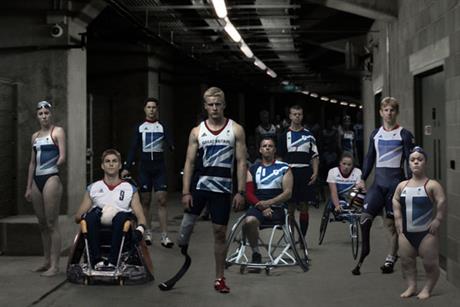
“When I first started work on the campaign, I didn’t realize how major it was,” she told me. “At that time, nothing was major with the Paralympics. I walked to the pool and saw the cameras, the trucks…and then when the campaign started, the billboards. It was awesome! That campaign really opened eyes up. Finally we were seen as elite athletes as opposed to people with disabilities. We were seen as role models.”
COVID Strikes
Like many of her peers, Cashmore was hard at work in 2019 preparing for Tokyo2020. She was making the transition from swimming to the paratriathlon, and was doing so well, she was seen as a favorite for gold in Tokyo.
And then the COVID-19 pandemic cast a murky cloud on all life’s activities around the world. Athletes were unsure about the future. They had little or no opportunity to train. Like everyone else, they had a lot of time on their hands. Time to think.
It was 2020, and Cashmore was having a conversation with her sister. London was in lockdown, and the Black Lives Matter movement was gaining global traction. Cashmore felt the Black Lives Matter movement was about representation, or the lack of it for certain members of society. She told her sister that she could relate, that people with disabilities were also lacking representation in all aspects of life.
That’s when her sister, a teacher, said, “stop moaning about it and do something about it.” And over the course of this sibling dialogue emerged the idea for a children’s book, an opportunity to change perceptions of impressionable kids towards persons with disabilities. As Cashmore writes in the foreward of her 2021 book, “my intention in Splash is not to draw attention to my limb difference, but instead to normalise it.”
How many people do you know who trained for Tokyo2020 AND wrote a book during a pandemic lockdown? I know one.
Tokyo2020
Finally, Cashmore and her teammates got their wish – the Tokyo2020 Olympics and Paralympics were given the green light. She is grateful to the host town of Miyazaki in Western Japan, where she and her teammates were able to swim, run and cycle with relative ease for two weeks, allowing them to acclimate to Japan before heading to Tokyo for the Paralympics.
Her paratriathlon team did not stay at the Athletes Village, residing instead at a hotel near the paratriathlon course, and were grateful to the hotel and their employees who met all of their needs. “They really bent over backwards to make sure our stay was perfect,” she said.
And she was grateful for the Japanese people.

“I was expecting nobody to be around because spectators weren’t allowed,” she said. “But there were so many people cheering for us, no matter what country we were from. They really backed us. When you think about what was happening in the world, the fact that there was a bit of a crowd watching us was really special.”
Cashmore won the bronze medal in her Paratriathlon competition, which she said was bittersweet because she hoped to do better. She was frustrated by incurring a penalty during the cycling phase of the race, which meant her chance of catching the leaders was essentially impossible.
But Cashmore is a veteran who has grown, progressing from a self-conscious teenager to a world-class athlete who has encountered countless high-profile challenges and taken them on with determination and professionalism.
“I was really proud that I managed to keep my cool, keep my head in the moment of craziness and hold on for that bronze medal,” said Cashmore, who has re-set her sites on Paris.
And as her alter-ego Claire said at the end of Splash, “whatever she can’t do today, she knows she will conquer tomorrow.”

It’s the 57th anniversary of the 1964 Tokyo Olympics.
That’s right, a Summer Games in Autumn. The XVIII Olympiad was held in October to avoid, presumably to avoid the heat or typhoons of August. October is certainly cooler in Tokyo. But it is also wetter. In fact, October is the month Tokyo has the most rainfall.
And it rained a lot during the 1964 Tokyo Olympics. And because it rained, the cooler temperatures seemed colder. In the case of road cyclists in Hachioji, it is said they could see their breath as they raced in the rain. The cinder tracks were a muddy mess. Umbrellas were de rigeur.
I recently purchased hard copy black and white photographs of those Games. Here are a few featuring people braving the rain, because a rainy day at the Olympics is better than a sunny day at the office.


We missed the energy of fans at the 2020 Tokyo Olympics. But 57 years ago, crowds filled the stadia, arenas and roads of the 1964 Tokyo Olympics.
I recently purchased hard copy black and white photographs of those Games.
Here are a few that show Japanese in the act of watching, as well as athletes enjoying the shopping and dining our scant visitors in 2021 could not.


 James Wong at 2018 Asian Para Games in Jakarta_@jameswong6
Like so many 14 year olds around the world, James Wong watched swimming sensation, Michael Phelps, at the 2008 Beijing Olympics with awe. Wong wanted to be Michael Phelps one day….albeit the one-armed version.
Born without a left arm, the native of Kuala Lumpur, Malaysia didn’t know anything about the Paralympics at the time. But his father found a grainy YouTube video of the men’s SB8 100m breaststroke finals at the 2008 Beijing Paralympics, and pointed out one of the swimmers – Andreas Onea of Austria.
“My dad noticed Andreas was only a few years older than me, and he had a similar build,” said Wong. “He felt relatable. I watched how he swam in that video and tried to see how he was doing it. Basically, that video kind of helped set in stone the vision of what I wanted to achieve. Prior to this, I didn’t actually know what para sport even looked like.”
Eleven years later, Wong was at the World Para Swimming Championships in London. It was a tough time. He was jetlagged. He swam poorly. His chances of making the Tokyo2020 Paralympics were diminished. But he finally got to meet Onea, who was pleasantly surprised to meet Wong. After all, five other swimmers finished better than him at the finals during that competition, so he wondered why Wong liked Onea’s swimming so much.

But Wong then told Onea the story of the YouTube video in 2008. Onea said he was touched.
The Paralympics can have an impact on my life and on the world population. I realized that in 2019, when I was at the London world championships in swimming, and James told me that the first swimming competition he ever saw was the final at the 2008 Beijing Paralympics on the 100-meter breaststroke. And this was the day, he told me, that he wanted to compete in the Paralympics, that he wanted to be a professional swimmer like Andreas Onea. I was emotionally impressed by the story when he told me. Without knowing me, because of me, just seeing me swim, he wanted to swim also.
Andreas Onea, who won a bronze medal in the 100-meter breaststroke SB8 at the 2016 Rio Paralympics, competed at the Tokyo2020 Paralympics. He did not medal this time, but Onea has developed a successful media career in television and print, as well as a motivational speaker. He understands how important it is for persons with disabilities, some 15% of the entire world population, to be given opportunities to lead fuller lives that help them approach their full potential.

“We are 15% of the world population,” said Onea. “In Austria, companies are looking for talent. They are fighting over the best talent for their workforce. This is a high potential pool that no one is tapping into. People think they will have problems with figuring out how to bring them into the workforce. These issues are things proven wrong. There are so many companies doing amazing things with people with disabilities.”
Wong told me that swimming gave him those opportunities.
In 2008, he was spotted by the national swimming head coach of Malaysia, Lewin Lim, and was told he had potential as a swimmer. Over the next 11 years, Wong was introduced to a whole new world of training, travel and competition. He competed for the first time in a tournament in Borneo, which was another part of Malaysia. But it could have been a foreign country as the people and the culture felt so different to Wong.
And when he came away with a gold and silver medal a the 2009 Asian Youth Games in Tokyo, Japan, he imagined one day winning Paralympic gold. Guangzhou in China, Berlin in Germany, Solo in Indonesia, Naypyidaw in Myanmar – Wong was going places he never could imagine.
In 2012, he moved to Australia. His parents thought it would be great if their son could get an education overseas. Because Wong’s hero, para-swimming champion, Matt Cowdrey, was from Australia, Wong looked down under and targeted the University of Adelaide, which was located relatively near the Norwood Swimming Club.

Wong worked hard to balance academic life and the rigors of training at the world-class level. At the 2014 Asian para Games in Incheon, South Korea, Wong finished 4th in the 50-meter Freestyle S8, behind the top two in the world, and another who was a finalist at the 2012 London Paralympics. And in 2016, he graduated from university.
Wong did not make the Malaysian team for the 2016 Rio Olympics. In fact, Wong has never competed in a Paralympics. But para-swimming changed his life.
The 2019 World Para Swimming Championships was his last major competition, but it gave him the credentials to apply for and receive permanent residence in Australia through a talent visa, not something that the Australian government hands out liberally.
Wong has continued his studies and is pursuing his masters in accounting and finance at the University of Adelaide, which he hopes to leverage into an opportunity at a Big Four accounting firm after he graduates in 2022. He’s happy about his future, something that he owes to swimming.
“Through swimming I met an amazing number of people I would not have met otherwise,” he said. “Without it, I’d have a completely different life.”


Tomonari Kuroda stripped the ball at mid-field, dribbled deftly between his left and right feet, shifting sharply to his left to elude two defenders and sending a sharp drive off of his left insole, the ball shooting by the French goalkeeper.
Kuroda did that with a black mask covering his eyes. He couldn’t see the ball go in, as he is visually impaired, but he could hear the reaction of his teammates. Team Japan, in its first ever match in blind soccer in the Paralympics, scored its first goal a little over three minutes into the game in amazing fashion.
Japan went on to win its first match over France 4-0 in a display of skill and teamwork. There are 22 sports categories in the 2020 Paralympics, an opportunity for athletes with disabilities to show off their athleticism, and for the very best, to win medals.
But like the world of work, where people with disabilities are employed in departments and teams, they work best when performing in synch with their colleagues. And in fact, people with disabilities can do their very best when their colleagues and technology can provide accomodations or remove barriers to performance, and create an environment where disabilities fade into the background.
In the workplace, accomodations could include the provision of doors that open automatically for people in wheelchairs, or sign language interpreters in meetings for the hearing impaired, or screen reader software for the visually impaired. These are examples of basic accomodations that can be made to create a more equitable environment for the disabled.
In the case of blind soccer, there are the accommodations of having a ball that makes a tinkling sound when rolling, allows a guide behind the opponent’s net as well as the sighted team coach to guide their players verbally, as well as a goalkeeper who is sighted and able bodied, and can also shout out guidance to his teammates.
The rules for blind soccer, or Football 5-a-side as it is called by the International Paralympic Committee, is an exercise in enhancing equity. The accomodations created by the rules allow people who are visually impaired to play a game of soccer that allows for demonstrations of extraordinary skill, teamwork and performance. In essence, the rules create the perception that the athletes are performing on an equal playing field.
To drive home the importance of the teamwork between people with disabilities and those without, the goalkeepers of the top three teams in the Paralympics take home a medal too. In fact, that is the case with able-bodied people who assist players in Boccia BC3 class, visually impaired triathletes (where the “guide” runs, cycles and helps change the uniforms of the para-athlete), as well as B Class cyclsts (where the “pilot” sits up front in a tandem bike). Here is a great Nippon Foundation article that provides the details.
The concept of equity is getting a lot of attention in the Diversity and Inclusion world, as practitioners realize that driving equity in the workplace is a more accurate approach than trying to drive equality. This difference is explained very well in this article from the Milken Institute School of Public Health:
Equality means each individual or group of people is given the same resources or opportunities. Equity recognizes that each person has different circumstances and allocates the exact resources and opportunities needed to reach an equal outcome.
The Paralympics and parasports in general are not striving, at this stage, to achieve “equality” for persons with disabilities in sport. While Kuroda’s first goal was stunning, and might make people think that he can actually see, no one is saying he should start playing on Team Japan’s Olympic squad, or any soccer squad made up of sighted players.
But given the accomodations provided by they International Blind Sports Federation (IBSA), soccer players who are visually impaired can experience the thrills and spills, aches and pains, and self-affirming achievements and victories of the team sport often called “the beautiful game.”
 Yui Wagou, as the one-winged plane in the Opening Ceremony_Yomiuri Shimbun
This was an opening ceremony of conviction.
This was an opening ceremony with a message.
And when conviction and message come together, you get goosebumps.
The opening ceremony of the Tokyo2020 Paralympics was electrifying, its Olympic counterpart paling in comparison.
The Tokyo2020 Olympics lacked conviction and a clear message, not because the officials, like IOC president Thomas Bach, lacked confidence, or the right words to say about the importance of the Games. It’s because the Japanese public lacked confidence in the organizers’ motivations – many were not prepared to listen as infection rates in Japan continued to climb.
But that may not have been the case with the Paralympics, at least with the public’s perception of the opening ceremonies. Japan’s Twitterverse reaction was positive, if not enthusiastic.
In contrast to the subtlety and vagueness of the Olympics opening ceremony, there was a consistent story told throughout the Paralympics opening ceremony, showcased by the theater of the one-winged airplane, with the theme “We Have Wings.” This show had energy!
The shifting expressions of the 13-year-old junior high school student, Yui Wagou were captivating. The wheelchair-bound first-time actress portrayed a small plane with only one wing, and her face portrayed beautifully the transformation from a sheltered, timid girl to a little plane that could.
Part of the trigger for the one-winged plane’s transformation was a legion of role models, led by Japanese rock legend, Tomoyasu Hotei, who brought explosive energy to the Stadium with his electric guitar. There was the ballet dancer with one leg, Kouichi Ohmae and the one-armed violinist, Manami Itou, who also explained through their performances that one wing is enough.
The story of the one-winged plane was in two parts, with speeches in the middle. Andrew Parsons, the president of the International Paralympic Committee had the unenviable position of speaking right after, Seiko Hashimoto, head of the Tokyo2020 organizing committee, who’s appearance created moans of disappointment across Japan. Many departed for the kitchen and restroom, hoping to be spared the words of a person who, in their minds, does not listen.
Andrew Parsons is a relative unknown to the Japanese public. He hasn’t been vilified by the press for shopping in the Ginza, as his counterpart in the IOC has. And Parsons did not shy away from his opportunity. Instead, he leaned in. He shouted with passion. He gestured powerfully. And he sent a message, above and beyond the requisite thank yous to the organizers for making Tokyo2020 happen.
Parsons launched a movement – WeThe15. He emphasized that the IPC and its partners were here “to change the entire world” by bringing attention not just to the para-athletes in front of him, but to the 1.2 billion people around the world who have disabilities, or 15% of the world population. He said that the IPC and the International Disability Alliance, along with a broad-based network of civil society, business and media organizations, will work every year to make a difference.
Over the next 10 years, WeThe15 will challenge how the world’s 15% with disabilities are perceived and treated at a global level. With the support of 20 international organizations, civil society, the business sector, and the media, we will put the world’s 1.2 billion persons with disabilities firmly at the heart of the inclusion agenda.
Parsons noted that the pandemic has been a struggle for everybody, and is particularly a time when people have to come together, indirectly referencing the flaming of fear of the other, which leads to hate and discrimination.
When humanity should be united in its fight against COVID 19, there is a destructive desire by some to break this harmony. Overlooking what brings us together, to focus on the factors that differentiate us, fuels discrimination. It weakens what we can achieve together as a human race. Difference is a strength, not a weakness and as we build back better, the post-pandemic world must feature societies where opportunities exist for all.
Parsons then brought us down from the helicopter view of WeThe15 and the need for global diversity, and honed in on the reason they are all in Tokyo – the athletes.
Paralympians, you gave your all to be here. Blood, sweat, and tears. Now is your moment to show to the world your skill, your strength, your determination. If the world has ever labelled you, now is your time to be re-labelled: champion, hero, friend, colleague, role model, or just human. You are the best of humanity and the only ones who can decide who and what you are.
The Paralympics are about celebrating diversity, and creating role models for a generation of persons with disabilities, showing them they too can fly.
In 2012, it was “Meet the Superhumans,” with images of heroic para-athletes.
In 2016, it was “We’re the Superhumans,” heroic para-athletes mixed in with images of everyday folk.
In 2021, it’s “Super. Human.” with the emphasis on Human.
Channel 4, the official broadcaster of the Paralympics in the UK, has, since the 2012 Games, captured and shaped the pop culture view of the para-athlete, and in a broader way, those with disability. Through the eyes of Channel 4, our view of the disabled has evolved.
In 2012, we needed our attention grabbed to even think of the circumstances of the disabled. For many, the para-athlete had to be portrayed as superhuman, placed on a pedestal so we could start a conversation about how inspiring the disabled are.
But the para-athlete no longer wants to be your inspiration, no longer desires to pose on your pedestal.
As disability rights activist and writer, Penny Pepper said in reaction to the 2016 Superhumans video, “the superhuman shtick is a tiresome diversion away from what is important. Let us be ordinary, let us be every day and let us at least have rights. Rights to independent living.”
People with disabilities want you to know that they are you, and you are they – just another person trying to get along in life.
A recently released video captures that tone perfectly: a man in a wheelchair responds to adoring statements of how inspiring the disabled are, with a single word of defiance.
“Bull$#!+.”
That short film is the clarion call for the “WeThe15” campaign, symbolizing the estimated 15% of the global population that are disabled. Launched on the eve of the Tokyo2020 Paralympic Games, WeThe15 “aspires to be the biggest ever human rights movement to represent the world’s 1.2 billion persons with disabilities.”
If people with disabilities had its own country, it would be the third largest in the world.
In other words, one out of every seven of your own family members, friends and colleagues have some form of disability, who may be marginalized or discriminated in some way.
It’s possible that you are treating people with disabilities in ways that are perceived as patronizing, divisive or hurtful without realizing it.
As the WeThe15 film explains, people with disabilities are not “the other.” They are the same as you.
People call us special, but there’s nothing special about us. We have mortgages. We kill houseplants. We watch reality TV. We get sunburned on holiday. We get married. We swipe right. We go on first dates, and get lucky too.
WeThe15 is a broad-based alliance of global organizations related to sports, human rights, policy, business, arts and entertainment, led primarily by the International Paralympic Committee (IPC) and the International Disability Alliance (IDA).
“WeThe15 is a decade long campaign bringing together the biggest coalition of international organizations ever to work towards a common goals: to end discrimination and transform the lives of the world’s 1.2 billion persons with disabilities who make up 15% of the global population,” said Craig Spence, IPC Chief Brand & Communications Officer.
“This could be a game changer of a campaign looking to initiate change from governments, business and the general public. By doing so we can place disability at the heart of the diversity and inclusion agenda.”

The goals of WeThe15, which are aligned to the UN 2030 Agenda for Sustainable Development and the Convention on the Rights of Persons with Disabilities, are to change attitudes and create more opportunities by:
- Putting persons with disabilities at the heart of the diversity and inclusion agenda,
- Implementing a range of activities targeting governments, businesses, and the public to drive social inclusion for persons with disabilities,
- Breaking down societal and systemic barriers that are preventing persons with disabilities from fulfilling their potential and being active members of society,
- Ensuring greater awareness, visibility, and representation of persons with disabilities, and
- Promoting the role of assistive technology as a vehicle to driving social inclusion.
During the Tokyo Paralympics, you will see many references to Wethe15, including public light ups in purple, the symbolic color of inclusivity.
It is time to stand up for the 15, not because they are special, but because they are just like you.
So while the pedestals are nice, and the pity tolerated, we are not “special.” That’s not what it’s like. That’s not our reality. And only when you see us as one of you, wonderfully ordinary, wonderfully human, only then can we all break down these barriers that keep us apart.
– from the WeThe15 campaign film

You must be logged in to post a comment.