“To the weak-livered denizens of Ginza – you who wear sun glasses, tight pants, and saunter down the street carrying a big paper bag as you chase the girls from the day-time – If you are men accept my challenge. I’m 56 years old but let’s see who will last the longer in the marathon…”
Apparently, those were fighting words, at least as translated by the Mainichi Daily New on September 16, 1964. The above notice was a challenge to race a marathon, for the senior Japanese to show his manly vigor in a competition of endurance. And yes, it got the attention of the teenagers, who were labeled the “Miyuki-zoku”, a mix of boys and girls who gathered on the fashionable street in the Ginza called Miyuki Street. (The suffix “zoku” means “tribe” or “club”.)
Mainichi Daily News_September 17, 1964So on the appointed time of Monday, September 14, 1964, the Mainichi Daily News reported that “hordes of onlookers, young and old, flocked to the place of challenge in front of the fountain in Hibiya Park.” Members of the Miyuki-zoku came out to meet the challenge of the 56-year old, but as it turned out, not only did the elderly challenger not appear, the police had already rushed to the scene to ensure an unauthorized marathon did not take place.
It was only a few months earlier when Heibon Punch, a new magazine focusing on fashion, started a revolution by launching the so-called “Ivy Look”. Other magazines like “Men’s Club” followed quickly, going into detail on cool Ivy. (See my previous post on this here.) When teenagers in Japan saw how young men were dressing in the United States, particularly at the Ivy League universities, with their perceived associations of class and style, they found an exciting replacement for their drab, black school uniforms, and a way to rebel.
Yes, it took the preppie look for kids in Tokyo to flip parents and authorities the bird – which is astonishing, if you look at the pictures today.
But this is Japan. And the Japanese proverb most quoted to explain social behavior here is “the nail that sticks out gets hammered down.” In other words, it’s important to conform. Those who don’t, are informed in no uncertain terms that they need to do so.
And so in the 1960s, in a time of burgeoning prosperity, with a generation that grew up with faint memories of post-war rubble and hunger, there grew a hunger to express one’s individuality, and dare to be that nail that sticks out, even if just a tad.
But the authorities were concerned about even this whiff of rebellion. After all, the Olympics were coming to town and Tokyo had to be clean, friendly and most of all orderly. These “hordes” were unsightly, the boys in their (gulp) tight, high-cut slacks with oxford-cloth or madras plaid shirts, and the girls in tight long skirts with the hemline (gasp) several inches below the knee.
According to this post in the blog “Ivy Style”, the older generation co-opted a leader of the Ivy fashion movement, Kensuke Ishizu. Ishizu “discovered” this look when he visited college campuses in the United States in the 1950s, and when he returned to Japan, he created a fashion brand called “VAN”, and published Japan’s first men’s fashion magazine, “Otoko no Fukushoku”.
Neighborhood leaders desperately wanted to eradicate the Miyuki-zoku before October, so they went to Ishizu of VAN and asked him to intervene. VAN organized a “Big Ivy Style Meet-up” at Yamaha Hall, and cops helped put 200 posters across Ginza to make sure the Miyuki-zoku showed up. Anyone who came to the event got a free VAN bag — which was the bag for storing your normal clothing during loitering hours. They expected 300 kids, but 2,000 showed up. Ishizu gave the keynote address, where he told everyone to knock it off with the lounging in Ginza. Most acquiesced, but not all.
So on September 19, 1964, a huge police force stormed Ginza and hauled off 200 kids in madras plaid and penny loafers. Eighty-five were processed at nearby Tsukiji jail. The kids got the message and never came back, and that was the end of the Miyuki-zoku.
Lauren Tamayo, Dotsie Bausch, Sarah Hammer, Jennie Reed
“It was a miracle,” he said.
Not only had the US not won a medal in team pursuit cycling in 20 years, USA Cycling hadn’t even bothered to organize a pursuit cycling team since 1996. So in 2012, when four American women decided to make a go of it, training desperately for the London Olympics, the collective experience in pursuit cycling in America was minimal, the team’s budget was meager, and the gap between them and the very best in the world was huge.
And yet, as 1996 Olympian, Sky Christopherson told a transfixed audience at a speaking event sponsored by the US Embassy in Tokyo in early December, a miracle indeed happened. Dotsie Bausch, Sarah Hammer, Jennie Reed and Lauren Tamayo came seemingly out of nowhere to win silver in the women’s team pursuit in London.
Hammer was already a four-time Cycling World Champion in individual pursuit, but was determined to be an Olympic champion. Bausch was a model recovering from anorexia who hadn’t started her cycling career until the age of 26. Reed was asked to come out of retirement to join the team to take a crack at the 2012 London Games.
This is the starting point for the mesmerizing documentary, Personal Gold, produced by Christopherson, who had transitioned from Olympic cyclist to entrepreneur. Not only has he become an authority on the relationship between biometrics and genomics and high performance, he also established a consultancy called Optimized Athlete.
Sky Christopherson at The American Center Japan in Tokyo
I had the pleasure of watching this documentary at this event, after which Christopherson made himself available for Q&A. His documentary told the story of a women’s cycling team that clearly lacked support in 2012. While Great Britain and Australia’s cycling organizations put tens of millions of dollars into their road and track cycling teams, USA Cycling put all their dollars in road racing, thanks to the success of Lance Armstrong and his colleagues.
Personal Gold tells the story of how the team identified Mallorca, Spain as a good place to train for its low cost and proximity to London. Other national teams would provide a whole cadre of trainers and coaches. When the American team arrived in Mallorca three months prior to the start of the London Olympics, they were shocked to learn that the only support USA Cycling would provide is a single coach.
As is shown in the documentary, the athletes’ husbands played an integral part in Team USA, keeping the bicycles in tip-top shape, shouting out times and providing water during training, cooking meals, giving massages, and being massively important keepers of morale. In addition to the cyclists’ husbands, Christopherson created a virtual team of volunteer advisors – experts on biology, genetics, sleep, a data analytics consultancy, as well as a former Navy Seal who provided guidance on teamwork.
During the course of the training camp, amazing progress was made in understanding the particular strengths and weaknesses of each of the cyclists, and what they needed to do as a team to improve. When the team began its training in Spain, they knew they had to get to world-class speeds of about 3 minutes and 16 seconds in the 3,000 meter race. But try as they could, they could not even break 3 minutes and 20 seconds. Unfortunately, by the time they broke camp, they still had not improved their times.
But Christopherson provided insight into how the body works after training hard. Like the idea of how an “a-ha” moment hits unexpectedly, after periods of great focus and concentration, the body is also readying itself for it’s own “a-ha” moment. “When we arrived in London, we began to taper (our training routine). We mostly rested. And that’s when the biggest potential comes. Of course, it’s unclear how high you will go. But athletes can get into a flow. Something happens, from their hearts, and they transcend.”
As they readied themselves for the qualification round in the velodrome in London, the team from the US tried to stay calm in a velodrome located in a country that is cycling mad. Unfortunately they were going up in the first round against Team GB, and the noise and the support for the Brits was likely intimidating.
The riders selected for this round, Bausch, Hammer and Reed, looked sloppy during the qualification race, their formation far from tight. As it turns out, they achieved their fastest time ever at 3 minutes and 19.4 seconds. But it was disappointing as it was still
A few weeks ago, I wrote about the revelations by The Indianapolis Star of sexual abuse of teenagers and pre-teens by coaches and officials within and affiliated with USA Gymnastics.
At the time, IndyStar was aware of about 50 cases. Now they report they have uncovered through police files and court case documentation that hundreds of gymnasts have been abused in the past 20 years.
“At least 368 gymnasts have alleged some form of sexual abuse at the hands of their coaches, gym owners and other adults working in gymnastics. That’s a rate of one every 20 days. And it’s likely an undercount.”
The IndyStar’s most recent article on this travesty provides a fascinating analysis of a sports organization and its affiliated officials, coaches, and gym owners in denial. Here is a good chunk of that shocking analysis in full:
USA Gymnastics focuses its efforts to stop sexual abuse on educating members instead of setting strict ground rules and enforcing them. It says it can’t take aggressive action because member gyms are independent businesses and because of restrictions in federal law pertaining to Olympic organizations. Both are contentions others dispute.
Gym owners have a conflict of interest when it comes to reporting abuse. Some fear harm to their business. When confronted with evidence of abuse, many quietly have fired the suspected abusers and failed to warn future employers. Some of those dangerous coaches continued to work with children.
Some coaches are fired at gym after gym without being tracked or flagged by USA Gymnastics, or losing their membership with the organization. USA Gymnastics often has no idea when a coach is fired by a gym and no systematic way to keep track. Ray Adams was fired or forced to resign from six gyms in four states. Yet some gym owners hired Adams, believing his record was clean.
Though the vast majority of officials put children’s well-being ahead of business and competition, some officials at every level have not. Coaches suspected of abuse kept their jobs as long as they accepted special monitoring. Others were allowed to finish their season before being fired. In 2009, Doug Boger was named a USA Gymnastics Coach of the Year and was sent to international competition while under investigation for alleged sexual abuse.
Victims’ stories have been treated with skepticism by USA Gymnastics officials, gym owners, coaches and parents. Former gymnasts Charmaine Carnes and Jennifer Sey said they felt pressured by Penny not to pursue allegations of abuse by prominent coaches Don Peters and Boger. Carnes said she thought Penny tried to keep the claims about Boger quiet for as long as possible to protect the sport’s image and win championships, a characterization that USA Gymnastics disputes.
Women’s gymnastics have made tremendous strides, winning team gold at the 2012 London Olympics as well as the 2016 Rio Olympics. But I’m curious – I’ve seen or read no reaction from the coaches and athletes at the apex of the USA Gymnastics pyramid: the Karolyis, the members of the women’s Olympic gymnastics team, and their parents. Their silence may be the result of counsel provided to them by the advisors that surround them. But at some point, they need to lead in this pivotal moment, this crisis of confidence in women’s gymnastics.
The sport of yachting is not the sport of the common man. At the 1964 Tokyo Olympics, the Crown Prince Harald of Norway competed in the 5.5 meter competition, while Prince Bhanubanda Bira of Thailand sailed in the Dragon competition.
So when Keith Musto and Tony Morgan of Great Britain decided they wanted to be on the British sailing team at the 1964 Tokyo Games, competing in the Flying Dutchmen category, they knew that their class and blood was not going to get them there. As Musto said in this video interview, “we felt if we wanted to go to the Olympics, our background probably wouldn’t allow us to be invited to the Olympics. We had to earn our place.”
The first thing they understood was that they were not supreme physical specimens, but that they could work on their strength.
We felt the only way to address that was to be fitter than our competitors. We went up to the local school one evening, and we asked the PE instructor how we could get fitter. And he said, what do you do? What are the body movements? We told him and then he put us through a process for exercises, and finished up by saying, “If you do that every day between now and the Olympics, then you’ll win a medal.” So we did it every day. Christmas Day. Boxing Day. Everyday. Basically it was the start of circuit training as we now know it today.
Musto and Morgan in Lady C
As Christopher Brasher says in his book, A Diary of the XVIIIth Olympiad, considerable strength is required in competitive sailing.
The crew member in the Star Class spends more of his time outside the boat than inside it. He hooks one leg and one arm over the gunwale and then lowers his body over the side to keep the boat as upright as possible. But he, poor lad, spends most of his time with waves breaking over him. Tony Morgan, the crew member on Lady C, does not get quite so wet because he swings out on a trapeze attached to the top of the mast. But to hold this position for half an hour at a time requires tremendous strength in his stomach muscles and hands. It is no wonder that he has had to train for three years.
What’s fascinating is that, according to Morgan, training hard was frowned upon by his colleagues in the sailing world. Perhaps it was a class attitude, that people of privilege should be effortless in their ways, without a thought of having to or needing to win. Here’s what Morgan said a student colleague said to him regarding the training Musto and Morgan were putting in as preparation for the Olympics:
Keith and I were regarded as a couple of people below the salt on the table. One day we were chastised verbally by the most senior person in the class, saying “I hear you train. We don’t do that.” I said, “I don’t know what you mean.” He said, “I heard you do a hundred press ups. I think this is a very in appropriate way to behave.”
Morgan and Musto of course ignored the naysayers. They were going to train. They were going to be selected to the Olympic team. And they were going to win, no matter what people would think. Musto reflected on that attitude, remembering the moment he entered the National Olympic Stadium that beautiful day of October 10, 1964.
At the Opening Ceremony you were waiting outside for many hours, and when you went in through the main entrance to the arena, it was s tremendous shock, the noise and the atmosphere hits you like a brick wall. It was fantastic. Up on the big notice board was the Olympic motto. I forget the exact wording but it was to the effect of “the spirit is to participate, not to win”. And I thought, “Rhubarb to that. I haven’t come here just to participate. I’ve come here to win.”
But alas, while physical prowess and tactical sailing skills are key to success in sailing, a wind shift here and a lack of wind there can change the fortunes of boats instantly. Ahead throughout the competition, Musto and Morgan thought they had the gold medal wrapped up with two races to go. But in the final of 7 seven races, a mighty wind took the sails of the New Zealand dragon class boat, and sent them flying past the British boat on to gold medal victory.
Disappointed, Musto moved on, knowing that the time in Tokyo was just one moment in a long life. Musto would go on to form a successful global fashion and sailing equipment business called Musto, and never look back.
Players who did not travel on the fatal flight paid tribute to their teammates at the club’s stadium in Chapecó. Photograph: Douglas Magno/AFP/Getty Images
“We ask for permission to approach, we have a fuel problem!”
“Nine thousand feet! “Vectors! Vectors!”
Those were, according to this article, reported to be the last words of the pilot who, on November 29, suddenly lost control of a plane carrying 77 people, including members of the Chaepecoense soccer team. The Chapecoense team was travelling from Sao Paulo, Brazil to Medellin, Colombia when their Avro RJ85 jet crashed, killing all but 6 fortunate passengers, three of them members of the team of 22.
Up to that moment, Chapecoense was living large, playing the role of lovable upstart, making the finals of the Copa Sudamericana, a major soccer tournament in South America. From a small town called Chapeco in Western Brazil, the Chapecoense Warriors were playing well against the rich teams since the end of the Rio Olympics in August, strong teams like Argentina’s Independiente and San Lorenzo. But tragedy struck unexpectedly and football fans across South America mourned, but none more so painfully than the hometown fans. Here’s how The Guardian described it:
Among townspeople, there is a sense that the loss of most of their plucky team of giantkillers wasn’t just a local tragedy, but something bigger: the loss of a tight, well-organised, and competent unit that stood out for its unexpected success in a country that has lost its way.
This is a deeply divided nation which in the past year has been roiled by a debilitating recession, a gargantuan corruption scandal and the divisive impeachment of an unpopular leftwing president. At times it has seemed that Brazil is no longer sure how to manage itself; Chapecoense was a small team that knew exactly what it was doing.
In the history of aviation disasters involving sports teams, soccer squads have had more than their fair share of tragedies. As listed in this article, there was the crash in Turin Italy in 1949 that claimed the lives of 22 members of the Tornio soccer club. Nine years later, 8 members of Manchester United were among 23 deaths in a crash outside Munich airport in Germany. And in 1987, a plane carrying members of Alianza Lima crashed in the Pacific Ocean, killing 16 players and the team coach.
Olympic teams have not been spared. The United States ice figure skating team lost its entire 18-member team when it’s plane to Prague, Czechoslovakia crashed in Belgium. And then there was the US men’s boxing team, a group of 22 boxers aspiring to a shot at the 1980 Moscow Olympics, before the American government mandated a boycott of those Games. I wrote about that tragedy here.
The video below was taken just after their draw with San Lorenzo, which sent them to the Copa Sudaamericana finals, which was cancelled. Their elation only compounds the horrific sense of loss.
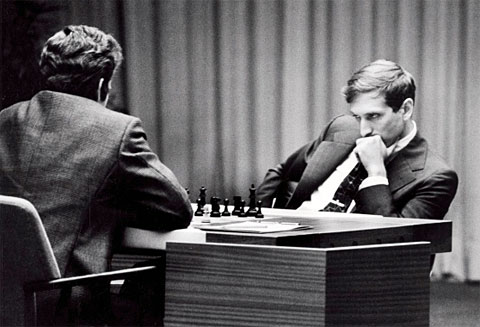
Boris Spassky and Bobby FisherI was only 8, going on 9.
My sports consciousness was not yet developed. Although the New York Mets had won the World Series in 1969, the New York Knicks had won the NBA Championships in 1970, and the New York Jets won the Super Bowl in 1970, I don’t have any memories of those amazing moments in New York sports history.
It was chess that first got my competitive juices flowing.
It was July, 1972, and before the Munich Olympics took center stage, the biggest global “sporting” event of the year was the World Chess Championship. Yes. Chess.
I owned and treasured this book as a kid.Bobby Fischer was taking on Boris Spassky for chess supremacy in Reykjavik, Iceland. But it was more than a chess match. It was the Cold War, and the 1972 championship featured an opportunity for a maverick chess savant from Brooklyn, New York, Bobby Fischer, to take down the best chess player in the Soviet Union, and thus the world, Boris Spassky.
I had learned chess from my father and I played games with friends at schools, so I was proficient enough to follow along. But chess players weren’t the only ones tuning into public television to watch two people sit at a table and not move most of the time – a good part of the American public were as well. Why? Because it was democracy vs communism, capitalism vs socialism, America vs the Soviets.
It was not just my sports consciousness that was switched on, it was a political consciousness. Like everyone around me, I wanted the American to beat the Russian. Bobby Fischer was my genius boy from New York. I had his book, Bobby Fischer Teaches Chess. I even went to chess classes at the famed Manhattan Chess Club where he had played.
I just watched the film, Pawn Sacrifice, and it brought back those memories of my youth. The film went into the quirks and paranoia of Fischer, which is today well documented and known, but for me, a kid from Queens, I had no idea. All I knew was that Fischer had to beat Spassky.
It’s an oft-told tale of Black Americans triumphing overseas – soldiers, athletes and musicians – only to come back home to a world of discrimination and second-class citizenship.
In the Rome Olympics in 1960, Rudolph won gold in the women’s 100 and 200-meter races, as well as the 4×100 relay, and arguably became the most popular athlete in the world due to her beauty and charm. (That’s saying a lot since Cassius Clay was also on the scene.)
Nearly a month after the end of the Rome Olympics, it was announced by officials of her hometown, Clarksville, Tennessee, that October 4 would be “Wilma Rudolph Day”, and that according to ESPN, Tennessee Governor Buford Ellington, was going to lead the celebration. Tennessee at the time was a segregated state, a place where authorities or owners could require the separation of races in the activities of daily life, like drinking from a water fountain, riding a bus, or eating at a restaurant. And Governor Ellington was a man elected on his support of continued racial segregation.
Rudolph understood the leverage she had at that moment, and said she would accept only if all activities related to Wilma Rudolph Day were racially integrated. It was an offer that no matter where you stood on the political and racial divide, you could not refuse. Rudolph was not to be denied, and so that day was the first time in Tennessee that blacks and whites would be allowed to mix socially.
I found this letter to the editor in the Milwaukee Journal from October 22, 1960, where one Virginia Williams of Wisconsin wrote in praise of Rudolph as the finest of role models for black Americans.
JFK and Wilma in the Oval Office
Wilma Rudolph, the Negro girl from Clarksville, Tenn., who won three gold medals at the Olympics for her running, also won praise for her good looks and charming ways. This unassuming Negro girl, coming from a large family of average income, brought honor to her race and her country. She brought credit to her country as an ambassador of good will.
County Judge William Hudson spoke in Clarksville at an integrated banquet give for Wilma. With tears in his eyes he said: “If I can overcome my emotions, I’ll make you a speech. Wilma has competed with the world and brought home three medals. If you want to get good music out of a piano, you have to play both white and black keys.”
And in order for America to maintain her leadership in the world, she has to tap all of her resources, utilize all of them. Negroes need America and America needs them.
As one can imagine, race relations in America has improved, but it has been a bumpy road. A few years later, Sports Illustrated caught up with Rudolph on the eve of the 1964 Tokyo Olympics and see how domestic life was treating her. While she was busy being a mom, she was also out on the occasional protest.
It was different in May of 1963, when Wilma took part in two demonstrations at Shoney’s, which is considered one of Clarkesville’s finest restaurants although it does not have much more to offer than hamburgers. She was turned away, together with the other Negroes. “I cannot believe it!: she said to a reporter. “Remember the reception they gave me in 1960?” A few months later Clarksville was integrated. (Sports Illustrated, September 7, 1964)




You must be logged in to post a comment.