Team Canada_Tokyo Olympic Basketball Games Guide 1964
It was a far cry from years in the future when Canada embarked on a highly financed campaign to win a bevy of gold at the Vancouver Winter Olympics with their Own the Podium program.
In 1964, the basketball players on Team Canada paid their own way to Tokyo to compete in a qualifying tournament that took place a week prior to the start of the Tokyo Olympics. If Canada played well enough to finish within the top four in the 16-team tournament to qualify for the Olympic tournament, then the 15 players would be reimbursed for the S1,044 round-trip economy airfare from Toronto to Tokyo, according to a Yomiuri article from October 5, 1964.
On October 2, Canada got by The Philippines 68-64, which set up a match against Cuba. And on October 4 in Yokohama, Canada defeated Cuba 72-63. As the article describes, “Canada’s Olympic basketball team members are in the money, and far from keeping it quiet, they’re yelling their heads off jubilantly.”
Then there’s the adage “be careful what you wish for.”
After the opening ceremonies, and the commencement of the Olympics basketball tournament in the beautiful National Gymnasium Annex in Yoyogi, Team Canada quickly realized they had entered a slaughterhouse. Team Canada proceeded to lose seven games in a row.
To the delight of the hometown fans, Canada lost handily to a much shorter Team Japan 58-37, in what was considered at that time an upset. Japan in fact won 4 games in the tournament. Team Canada’s only consolation was in the consolation round, when they somehow defeated Peru 62-61, before falling to Hungary, and landing in 14th place out of 16.
U.S. President Donald Trump (C) signs an Executive Order establishing extreme vetting of people coming to the United States after attending a swearing-in ceremony for Defense Secretary James Mattis (R). Reuters/Carlos BarriaWhen the IOC formed a team of refugee athletes to compete at the Rio Olympics, to highlight the plight of stateless people globally, it was an act for which the IOC was rightfully praised. Through its existence, the modern-day Olympics have symbolized and strived to model tolerance and inclusion.
In recent history, countries that have enforced state-sponsored discrimination have been banned from participating in the Olympic Games. South Africa was banned from the 1964 Tokyo Olympics due to its apartheid laws, and was not allowed back until apartheid ended, re-entering the Games at the 1992 Barcelona Games.
Indonesia was suspended from the IOC, prior to the 1964 Tokyo Olympics. The Asian Games were hosted in Jakarta, Indonesia in 1962, and then-president Sukarno refused entry of athletes from Israel and Taiwan. IOC president Avery Brundage insisted that the Olympics were an opportunity to bring all nations’ athletes together, not split them apart, and so suspended Indonesia from the IOC.
Sukarno responded by creating an alternative sports tournament called The Games of the New Emerging Forces (GANEFO), which of course, did not include athletes from Israel and Taiwan. The IOC then banned any athletes who competed at the GANEFO games from participating at the 1964 Tokyo Olympics. Unwilling to pull their GANEFO athletes, both Indonesia and North Korea boycotted the Games.
As we have heard recently, President Donald Trump has made entry to America off limits to citizens from seven countries: Iran, Iraq, Libya, Somalia, Sudan, Syria and Yemen – Muslim countries all. The American government is stating that protecting its borders is vitally important to its security, and inferring that anyone who is a Muslim, particularly from those seven countries, are potential terrorists.
To me, this executive order runs contrary to the spirit of the Olympics. And while this may be a low rung on the totem pole of priorities related to immigration and national security, I wonder if the Los Angeles bid for the 2024 Olympics is at risk. Will President Trump’s ban, and his rhetoric of America first put a damper on IOC members’ enthusiasm for an Olympics in a country where tolerance and inclusion become lesser values?
I wrote recently about cycling coach, Sky Christopherson, and his recommendations for a particular member of the US women’s cycling team to get more deep-sleep in order to improve the performance and recovery of her intensive training regimen. Sensors attached to her body were informing the cycling team that Jenny Reed’s body temperature was not cool enough to reach consistent levels of deep sleep, so they made efforts to ensure a cooler room and mattress in order for her to get the sleep she needed to maximize the return from the next day’s training.
I found that tidbit fascinating. I had been reading fairly consistently over the years of the importance of sleep in the workplace and the impact that sleep deprivation has on performance of employees. Here are some of the insights I gathered from a recent internet search:
Sleep experts often liken sleep-deprived people to drunk drivers: They don’t get behind the wheel thinking they’re probably going to kill someone. But as with drunkenness, one of the first things we lose in sleep deprivation is self-awareness. (The Atlantic)
One 2014 study of more than 3,000 people in Finland found that the amount of sleep that correlated with the fewest sick days was 7.63 hours a night for women and 7.76 hours for men. (The Atlantic)
On an annual basis, the US loses an equivalent of about 1.23 million working days due to insufficient sleep. This is followed by Japan, which loses on average 604 thousand working days per year. The UK and Germany have similar working time lost, with 207 thousand and 209 thousand days, respectively. Canada loses about 78 thousand working days. (Rand)
An individual that sleeps on average less than six hours per night has a ten per cent higher mortality risk than someone sleeping between seven and nine hours. An individual sleeping between six to seven hours per day still has a four per cent higher mortality risk. (Rand)
When asked what factors are keeping us awake at night, the need to use the bathroom (55%), an old, uncomfortable bed (46%) and partner snoring (42%) emerged top. Meanwhile, 23% claimed they were being kept awake by the partner using a mobile phone or tablet in the bedroom. (Huffington Post)
Sleep deprivation can impact how effectively your body metabolizes fat, as well as your neuroendocrine system, which impacts how much human growth hormone (HGH) gets released. Because HGH is important to how fresh and ready you are to take on physical and cognitive tasks during waking hours, and to how fast you recover from exercise, experts are preaching more and more how important it is for athletes (particularly young athletes) to get more sleep, especially more quality sleep. Why fiddle with illegal injections of HGH? You can get HGH naturally by simply hitting the hay.
Examples of my sleep patterns, taken from my Fitbit on two different days.
While the research on the correlation between sleep and sports performance is still light, the paper cited above provides some of the early findings:
Improved Physical Performance:Increased sleep has been shown to increase the performance of basketball players in their sprint speed and free-throw performance over a two-week period. Additionally, increased sleep led to better moods, and thus “increased vigour”. The same researchers found similar results with swimmers with improved sprint times, turn times and mood improvement. Napping for 30 minutes also has an impact, with post-nap sprint speeds increasing.
Improved Cognitive Performance:Increased sleep has shown to have an impact on attention spans, ability to concentrate, memory, and other high-level cognitive functions. This is particularly relevant to the ability to perform in team sports. If you’re feeling drunk from lack of sleep, you won’t be able to see the field of play as fully as you like, or anticipate the consequences of newly adjusted offensive or defensive alignments, or recall the rules well enough to make the split-second decisions required in the heat of play.
Diminished Levels of Pain:Athletes have all sorts of aches and pains from the beating their bodies take from competition and training. According to the research, sleep deprivation can “cause or modulate acute and chronic pain”. In other words, you can encourage a vicious cycle of pain, which causes you to lose sleep, which enhances the pain, which makes leads to continued loss of sleep. And as stated before, loss of sleep results in disruption to the release of HGH.
In other words, whether you are fighting it out in the corporate jungle or on the playing field, sleep, particularly deep sleep, may be your biggest competitive advantage in today’s always-on lifestyle. Sleep, perchance to dream….of greatness.
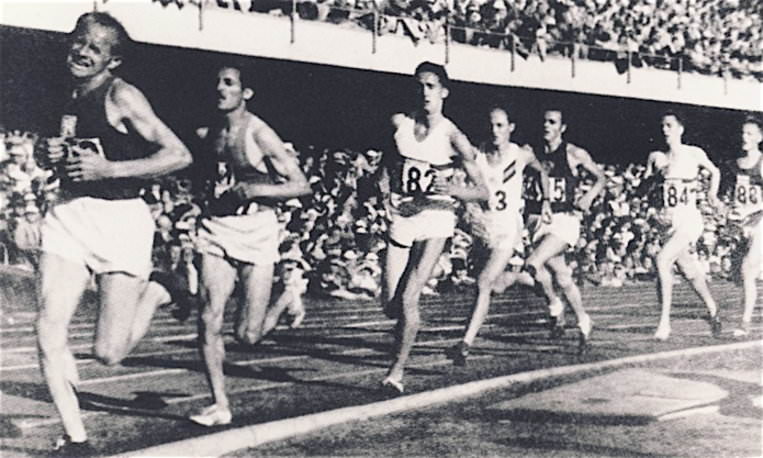
While legendary Emil Zatopek leads the pack in the 10,000 meter race at the 1952 Helsinki Olympics, Frank Sando, with only a sock on his left foot, ended up fifth.
It was 1952, at the Helsinki Olympics, there was no brighter star than Emil Zatopek of Czechoslovakia. But sharing a part of the shade under the towering figure of Zatopek was a Brit named Frank Sando. Somewhere early in the 10,000-meter race (at the end of the first or third lap depending on which report you read), Sando was spiked by a trailing runner and lost his left shoe. Sando kept running.
In fact, Sando ran nearly the entire 29-minute race, with bare left foot. And he incredibly came in fifth, running steadily in one of the more grueling of Olympic competitions, breaking the British record and coming within 3.6 seconds of a bronze medal.
It was 1960 when a man from Ethiopia topped that feat (as it were). Abebe Bikila became the first black African to win a gold medal, winning the marathon in Olympic record time….shoeless.
Abebe Bikila winning gold in the marathon in Rome in 1960.
There have been many other cases of runners losing a shoe in a race, but usually the loss of the shoe impacts the performance of the runner negatively. When someone prepares hundreds of hours for a particular running competition, it is with the understanding that the shoes will hold up. There is no training without shoes. And when an athlete is suddenly without a shoe, it will be painful. The soft skin of the bottom of the foot will peel away. The tendons and muscles that support the ankles and calfs and hamstrings will feel the effects of a suddenly altered running style, one instinctively designed to avoid pain.
But there are also people who, today, run barefoot regularly, who believe that un-shod approach is the natural way to ambulate, and better for a body that did not evolve over the millenia with Nike’s or Adidas shoes on foot. (See Barefoot Runners Society.) Barefoot runners not only enjoy barefoot running, they believe it improves their overall foot and leg condition and diminishes arthritic pain.
May strengthen the muscles, tendons and ligaments of the foot and allow one to develop a more natural gait.
By removing the heel lift in most shoes, it will help stretch and strengthen the Achilles tendon and calf muscle which may reduce injuries, such as calf strains or Achilles tendinitis.
Runners will learn to land on the forefoot rather than the heel. The heel strike during running was developed due to the excessive padding of running shoes, but research shows this isn’t the most effective natural running stride. Landing on the heel causes unnecessary braking on every stride. The most efficient runners land on the mid-foot and keep their strides smooth and fluid. Landing on the forefoot also allows your arches to act as natural shock absorbers.
It may improve balance and proprioception. Going barefoot activates the smaller muscles in the feet, ankles, legs, and hips that are responsible for better balance and coordination.
Running barefoot helps one improve balance, but it also helps them stay grounded and connected with your environment. A person can learn to spread their toes and expand the foot while it becomes a more solid and connected base that supports all movements.
And for the competitor, there is a potential benefit regarding increased speed, perhaps one of the more important factors for a competitive runner. According to this article in Runner’s World, research has shown that the simple matter of reducing the weight your feet and legs have to carry can have a significant impact on your running speed. This article quotes long-distance runner, Bruce Tulloh, who cites the research of Dr Griffith Pugh. Dr Pugh’s huge claim to fame was to be the doctor to the team that first climbed Mt Everest.
The South African long-distance runner, Zola Budd, who ran barefoot under the British flag in the 3,000-meter race at the 1984 Los Angeles Olympics.
“Dr. Pugh had me run repetition miles, to compare the effect of bare feet, shoes, and shoes with added weight. He collected breath samples. It showed a straight-line relationship between weight of shoes and oxygen cost. At sub-5:00 mile pace, the gain in efficiency with bare feet is 1 percent, which means a 100m advantage in a 10,000m. In actual racing, I found another advantage is that you can accelerate more quickly,” Tulloh said.
But if you’re not dealing with pain in your feet or legs, and you have never trained in barefoot, there is no real great advantage to start doing so. When you first run barefoot, as most of us can clearly imagine, it will hurt. The bottom of your feet will be chocked by the impact, particularly the moment you step on a pebble, a thorn, or a piece of glass. In addition to punctures and lacerations, the chance of achilles tendonitis, calf strain and plantar fasciitis are high. Then there’s the frostbite if you run in the cold….
My intent is not to pull your leg, or put my foot down on the merits of running unshod. If you have itchy feet and yearn to feel the dirt and grass as it caresses and cushions your overly protected puppies, then perhaps it’s time to stop dragging your feet. Go ahead, dig in your heels and put your best foot forward.
Expect incredible drone shots of surfing at the 2020 Tokyo Olympics.
One of my favorite toys as a kid was Verti-bird, a Mattel product from 1973 in which you operated a mini-helicopter to stop the bad guys. You had to control the helicopter’s lift and descent as well as speed, but it was connected to a wire so its flight was limited to a circular route.
But it was very cool!
Today, drones are the modern-day Verti-bird. This is a very weak comparison because drones today are in the middle of cutting-edge advancements in logistics, the military, security, news and sports coverage.
I remember talking with a photographer who covered the sailing events at the 1964 Tokyo Olympics and he mentioned that it is hard for people unfamiliar with yacht competitions to show interest because of how hard it is to capture these competitions visually. Perhaps drones will change that.
Fox Sports made a commitment last year to provide broadcasts of golf and super cross using perspectives provided by drones. This has been made possible by adjustments to Federal Aviation Administration (FAA) guidelines in the US, which now allows the use of drones for commercial use.
Because drones, when controlled by a skilled technician, can provide unique angles, particularly from above a stadium or an athlete, or close ups of athletes who are far from areas where cameramen or spectators watch.
Drones can currently move at speeds of 64 kph (40 mph). They can venture as far as 1.2 kilometers (.75 miles) away from the controller, which is a pretty wide berth. And battery life for a drone is about 20 minutes. These specs are true as of this writing, but I’m sure it’s already an outdated reality as this technology will advance rapidly.
Yes, there are fears that a drone will plop out of the sky and interfere with an athlete’s performance. People will point to the drone falling just behind a skiier at the Sochi Olympics. But the benefit, in terms of the birds-eye-view images and up-close perspectives in sports where such access was not possible, will outweigh the risk.
Expect to see incredibly creative use of drones at the 2020 Tokyo Olympics.
Kanto Matsuri at the Tokyo International Sports Week_Mainichi Daily NewsOctober 1963
Hayes Jones was in Japan for the 1964 Tokyo Olympics. He had been to Japan before, but he had not quite mastered the local language. According to Sports Illustrated, he was getting food in one of the dining areas of the Olympic Village, and said to the Japanese working behind the counter one of the few words he had mastered.
“Hai.”
Why Jones, the winner of the gold medal in the 110-meter hurdles at those ’64 Games, was saying “yes” in order to get served, is unclear. But since he wasn’t getting served, he doubled down.
“Hai! Hai!”
As SI told it, “the Japanese responded immediately to this new American game. He laughed and said, ‘Hat! Hai!’ The two stood there shouting hais at each other over the counter until Jones finally said, ‘Hey, man, come on. Give me some salad!’ Instantly he was provided with enough lettuce and tomatoes for 10 men, which occasioned another round of hais, a few bows and a perplexed look on the part of the American.”
There is no dishonesty in saying that in Japan in 1964 the number of people who could speak English was relatively low. Organizers knew that in 1963, in the aftermath of the so-called “pre-Olympics”, a week-long rehearsal in preparation of the real Olympiad to be held exactly a year later. The feedback regarding the interpreters available was harsh.
Apparently, the organizers of the officially named Tokyo International Sports Week (TISW) had recruited interpreters from local universities and overestimated their abilities. The fact that the organizers provided the students with little training also contributed to the lack of readiness. This was particularly true regarding the students understanding of specialized sports jargon. Another issue was that the organizers limited their search to students who spoke either English or French, when in fact the athletes at Sports Week needed to be understood in Russian, German, French, Spanish or Italian for example.
Middle two are official interpreters
As a result of this feedback post-Sports Week, the organizing committee made a few changes:
They recruited an additional 140 interpreters who spoke Spanish, German and Russian.
They expanded their talent pool beyond universities, openly recruiting interpreters from the general public via examination. Seven thousand five hundred people applied in the ten-day registration period.
They ensured that 750 interpreters of the now five core languages of English, French, Spanish, German and Russian would be allocated to the Olympic Village, particularly in the transportation waiting areas and reception areas.
As national olympic committees (NOC) expressed a desire to bring their own interpreters, particularly of those languages not in the five core languages, the organizers decided to create a new category called auxiliary interpreters. They allowed an NOC to bring in one local language interpreter for every 30 athletes on the team. Over 200 auxiliary interpreters from 65 countries were given credentials for the ’64 Games.
In such a multi-lingual environment as the Olympics, people who spoke three or more languages were highly valued. The organizers did not have to recruit these specialists as apparently requests to volunteer poured into the office after the end of the 1960 Rome Olympics. The organizers ended up inviting 13 foreign multi-linguist interpreters, people who did not speak Japanese, but eventually were found to be very helpful in the press center and the Olympic Village.
Were there language issues at the 1964 Tokyo Olympics? Of course. Were these issues disruptive? Absolutely not, thanks to the efforts and preparation of the organizers and the diligence of the interpreters. Here is how the organizers summarized the performance of the interpreters at the XVIII Olympiad in their report, “The Games of the XVIII Olympiad Tokyo 1964 – The Official Report of the Organizing Committee“:
The preparation of the interpreters was completed early September, one month before the commencement of the Games. Beginning on 15th September, the day of the opening of the Olympic Village, 1,230 interpreters began their activities at their designated posts, whenever they were needed. Both men and women were uniformed differently from other personnel, in distinctive black doeskin blazer with white hemming, so that they might be easily recognized. There were perhaps occasions when the original plans and the practical results did not precisely coincide. As a whole, however, the young amateur interpreters recognized well the significance of the Olympic Games as a festival of youth, and was convinced that each one of them was in fact an ‘ambassador of goodwill’. With this conviction they made up for any linguistic efficiency. They laboured long hours day and night, they performed their duties well, without any incident worthy of mention.
Theirs was a significant role in the of the Olympic Games in Tokyo. The expenses defrayed by the Organizing Committee for the recruitment, training, and management of the services of the interpreters amounted to 150 million yen (US$416,666).
One of the many interpreters at the 1964 Tokyo Olympics_Asahi Graf_Oct23_1964
National flags and anthems can be problematic at times because of the emotion they evoke.
We learned of another example recently.
One of the golfers in the world, Rory McIlroy, decided to forego with the Rio Olympics in August, stating that his concerns over the zika virus were enough to keep him home. McIlroy was not alone in that decision, but it was only recently learned that the mosquito-borne virus was not his chief issue. He stated recently in an interview with the Sunday Independent that the IOC told him that if he decided to attend the Rio Games he would have to decide under which flag he would compete: the flag of Great Britain or of Ireland.
Rory McIlroy
McIlroy is from Northern Ireland, which is part of the United Kingdom, but not part of Great Britain. I won’t go into the politics of this area, primarily because I don’t understand it well enough to try. But McIlroy felt the decision to participate in the Olympics was a decision to openly declare allegiance to a particular sovereignty, something he felt uncomfortable with.
“Not everyone is driven by nationalism and patriotism,” he told the Independent. “All of a sudden it put me in a position where I had to question who I am. Who am I? Where am I from? Where do my loyalties lie? Who am I going to play for? Who do I not want to piss off the most?” he said.
“I started to resent it and I do. I resent the Olympics Games because of the position it put me in, that’s my feelings towards it, and whether that’s right or wrong, it’s how I feel.”
Justin, if I had been on the podium (listening) to the Irish national anthem as that flag went up, or the British national anthem as that flag went up, I would have felt uncomfortable either way. I don’t know the words to either of them; I don’t feel a connection to either flag; I don’t want it to be about flags; I’ve tried to stay away from that.
Testing the new high-tech road surface August, 2016
The average temperature in Tokyo in July and August is around 30 degrees Celsius or 86 degrees Fahrenheit. But on the roads of Tokyo, after absorbing day after day of heat, can get as hot as 50 degrees Celsius, or over 120 degrees Fahrenheit.
That’s hot!
And that’s not counting the dreadful humidity that time of year in Tokyo. I hated summers in New York City, but they’re worse in Tokyo.
Now, imagine running 42 kilometers on those roads, in that heat and humidity, because the marathons for women and men are scheduled respectively on August 2 and 9 in 2020. Researchers say that on average optimal times to run a marathon are temperatures of around 6 degrees Celsius or 43 degrees Fahrenheit. Average body temperature is around 37 degrees Celsius and research also shows that running performance drops significantly if body temperature rises above 38.8 degrees celsius, according to this article.
At 38.8 C, the body can no longer effectively cool itself and it begins to divert blood to the skin to help keep it cool. This decreases the amount of blood available to carry oxygen to working muscles, which affects performance.
In intense hot weather athletic events, as the body becomes severely dehydrated, the result can be heat exhaustion, heat cramps, heat stroke, heat-induced coma and then even death.
The examples of the high-tech road surfaces: the one on the left is the water-retaining material and the one on the right is the ceramic-based sprayed material
Clearly, organizers of the Tokyo Olympics want to avoid both cramps and death. What are they going to do? They’re going to turn the roads white. On August 31, 2016, a special event was held on a 250-meter stretch of road in the middle of Tokyo that incorporated two pieces of heat-reducing technology:
a ceramic-based spray coating with insulating properties which resulted in a whitish-colored road that reflects the sun’s infra-red rays, as well as
another road material that has water-retaining properties, by which water is retained and slowly evaporated, thus cooling the roads.
These two technologies will be combined to build out a road of some 21 kilometers, according to a television broadcast I recently saw, and allows the entire 42-kilometer race to be run, presumably, on a road much cooler than what they would experience today.
Olympic marathon runner Toshihiko Seko and Paralympic wheelchair marathon runner Nobukazu Hanaoka, were on hand on August 31 to test them out the new road. Their reaction?
“The heat-insulating paving was clearly cooler,” said Seko after a test run on the road.
Hanaoka said: “The wheels did not slip when I applied the brake, even when the surface was wet.”
Other ideas being explored to keep the road and the runners cooler are:
More shade along the course
An earlier start in the day
Routing the course through more open areas with greater wind movement
Routing the course near water and presumably lower temperatures
Hotel Okura under construction in 1961It was the middle of winter, and yet on January 1, 1964, Tokyo was hot! In fact, the way the foreign press described it, Japan was running a temperature!
“Japan Feverishly Prepares for the 1964 Olympic Games” – AP, January 1, 1964
“World’s Biggest City Suffering Olympic Fever” – UPI, January 2, 1964
Here’s how the major American news services – AP and UPI – explained the state of Tokyo only 10 months before the opening of the XVIII Olympiad:
A strange fever previously unknown in the Orient is gripping Japan. Symptoms include intense worry and a driving compulsion to build things. It’s called Olympic fever. Japan is lunging helter skelter toward that magic day when the 1964 Olympic games open in Tokyo. (AP)
The entire city is afflicted with “Olympic hysteria”, from the prime minister whose political future hinges on the games to the man in the street who curses the inconveniences he has to put up with for the Olympics: the high prices he has to pay, the scaffoldings he had to duck, the torn-up streets around which he has to detour. (UPI)
Again, this was 1964, less than a generation removed from the devastating effects of the Pacific War. Indeed, Tokyo was still emerging (and groaning) from the physical and emotional remains of war rubble, at least as the AP described it:
Tokyo essentially is a city just 18 years old, built on piles of ashes and rubble left by American bombers during World War II. Tokyo has grown haphazardly since 1945, with small, almost ramshackle, houses springing up in disorderly profusion along twisting, narrow streets. Trains are overcrowded. Prices are high. The city chronically has been short of housing, water – just about everything today’s tourists wants and expects. The population has grown so much (to more than 10 millions) that the city fathers have pleaded with the youth of Japan to stay on their farms in the villages and not come to the big city. But on they come, crowding in where there is no room.
The National Gymnasium complex under construction in Tokyo on June 6, 1964, just a few months before the games were to begin. (Keystone/Hulton Archive/Getty Images)While it might be hard to imagine today in Tokyo, where large-scale construction is on the whole, relatively and remarkably quiet and unobtrusive, it was for Tokyo denizens in the early 1960s, the bane of their existence. And safety was at times taken for granted, according to AP:
Tokyo, the largest, noisiest, most crowded city in the world, is getting a needed facelifting. The roar of new buildings and bridges going up – and occasionally falling down – fills the night and day. Bamboo scaffolding is everywhere and thousands of workmen clamber up and down, painting and plastering, putting finishing touches on new hotels, restaurants and night clubs.
At least two major Olympic construction projects have collapsed – an elevated expressway and the steel frame roof for a swimming pool. One person was killed and 25 were injured…. In an editorial titled, “no Fun and Games,” Yomiuri declared inexperienced workmen are being used on many Olympic projects and elementary safety precautions are being ignored.
We are three years away from January, 2020. Will history repeat itself? Will Tokyo be an overcrowded, noisy, chaotic city creaking its way to the Opening Ceremonies on July 24, 2020? I doubt it. Will Tokyo again be gripped in Olympic fever? Most definitely yes.
“My cousin lost 10 kilos in three months! I’m going to lose 20 kilos this year.”
“My father passed away from emphysema at the age of 63. For the sake of my family, I will quit smoking this year.”
“I want to go to and win a medal at the 2020 Tokyo Olympics!”
Big goals can inspire. And we see the new year as a chance to wipe the slate of our past efforts clean, and commit to significant resolutions with vigor and determination. But even if initially inspired by them, big goals can seem overwhelming, and thus can demotivate to the point of surrender.
Very often, the key to achieving a big goal is to break it down into smaller, more concrete, more manageable goals.
You don’t develop a killer serve by just practicing your serve 100 times a day. You break down the mechanics of the serve and practice with a conscious effort to ensure the key parts of the serve are repeated accurately. That means you need to understand what the key components of a good serve are, and ideally you need to have someone observe you so you can get immediate feedback. Over time you will likely see great results.
Bob Schul didn’t become America’s first Olympic gold medal winner in the 5,000 meters by just running every day. He followed the disciplinary approach of coach Mihaly Igloi, who taught him that the interval approach. Schul’s typical day was filled with mini-goals of – for example, ten 200-meter sprints, followed by a 400-meter easy jog, followed by eight 100-meter sprints, then twelve 160-meter runs. Schul didn’t become an Olympian overnight, but he worked on his mini goals every day, and actually, during his training, every minute.
Here’s a great article from Forbes Magazine called “Why Thinking Small is The Secret to Big Success“. It focuses on this idea of chunking, and that you don’t achieve your big goals because “you’re not thinking small enough.”
Decide what you want
Proclaim your dream to your friends and family
Set a deadline
Break down the goal into smaller steps
Identify someone who’s accomplished a similar goal and model their attitude and belief system
Believe it’s possible
Take massive action
Repeat steps 6 & 7 every day
For so many of us, when we set New Year’s Resolutions, or aspire to some great goal, we do the first three steps. But we often don’t take a project management attitude to our dreams. While we may imagine what the final, wonderful end state looks like, we don’t break it down into mini-goals, identify the key actions that other actions are dependent on, and set milestone deadlines. We don’t because that level of thinking and planning is likely a muscle not often exercised. But exercise it we must. Find a friend or a coach to help you think it through.
Just remember what Al Pacino said in the locker room, when he gave his inspirational pep talk to a demoralized American football team in the 1999 Oliver Stone film, Any Given Sunday. He told the team that coming back to win would be monumental, but that they shouldn’t focus on the big goal of trying to win. They should instead stay in the moment, focus on the inches in front of them. Football, like life, he told them, is about moving forward, inch by inch.
You find out life is just a game of inches. So is football. Because in either game, life or football, the margin for error is so small. I mean, one half step too late or too early you don’t quite make it. One half second too slow or too fast and you don’t quite catch it. The inches we need are everywhere around us. They are in ever break of the game every minute, every second.
On this team, we fight for that inch. On this team, we tear ourselves, and everyone around us to pieces for that inch. We CLAW with our finger nails for that inch. Cause we know when we add up all those inches that’s going to make the fucking difference between WINNING and LOSING between LIVING and DYING.




You must be logged in to post a comment.