sam-the-eagle-spoonWho collects spoons?

Good friends in Los Angeles pleasantly surprised me recently with a couple of gifts, including a souvenir spoon from the 1984 Los Angeles Olympics. The mascot, Sam the Eagle, adorned in a loud red-white and blue had, proudly holds the Olympic torch aloft at the tip of the spoon’s handle.

After marveling at the thoughtfulness of my friends, and this artifact from my university years, my mind lept to that simple question.

Who collects spoons?

Spoon collecting, as I now know, has a long tradition. In the mid-1800’s in Europe, merchants would sell spoons, and likely other utensils, with images of famous people or local landmarks on the handles or in the bowls of the spoon. Wealthy Americans who travelled in Europe would make it a habit to collect souvenir spoons wherever they went.

In the late 19th century, souvenir spoons became a big business in the United States, triggered by two particularly popular souvenir spoon lines, One was the George and Martha Washington series, manufactured by a company called Galt & Bros initially in honor of the 100th anniversary of America’s first president.

The second hit series was the Salem Witch Spoon series, featuring, well, a witch. An American jeweler went to Germany and saw a wide variety of ornate and unusually designed spoons, and decided that America was ready for a souvenir spoon recalling the 17th century witch hunts of Salem, Massachusetts. According to this PBS article, by the mid 1890’s, there was an unprecedented boom in spoon collecting. With the advancement of mass manufacturing of the industrial age, and a collapse in the silver market, spoon collection was affordable to the growing middle class while still maintaining that hint of posh.
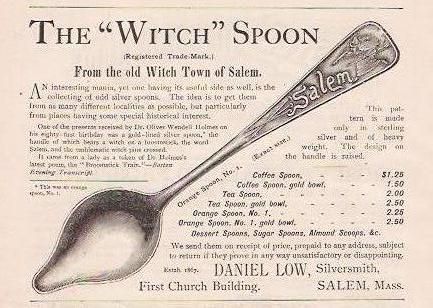
salem-witch-spoon

Here’s how the magazine Antiques and Art described the boom:

At the end of the year 1890, there were only about five souvenir spoons patented or in production in America; by May 1891, there were hundreds on the market. More patent designs were issued for souvenir spoons during this decade than for the entire period from 1790 to 1873 or after 1900. The 1890s witnessed cutting-edge innovation in the making of souvenir spoons: this decade saw the production of cast spoons (i.e. souvenir spoons made according to the lost wax process); the perfection of engraving and bright cut decoration; the introduction of embossed designs in spoon bowls and on handles; and, the production of exquisite enameled spoons which today are considered miniature works of art.

Apparently, spoon collecting is still obsession for many people today.

For a detailed display of one person’s own spoon collection, watch this unusually framed video.

imperial-hotel-ad-1964
An ad from the book, Tokyo Olympics Official Souvenir 1964
The Imperial Hotel in Tokyo in the 1960s was a stunning structure. Designed by the legendary architect, Frank Lloyd Wright, the Imperial Hotel’s lava rock facing, the abundance greenery and the dominant reflection pool makes me think of Angkor Wat or the Taj Mahal on a more intimate scale.

Known in Japan as the Teikoku Hotel, the Wright designed structure was built in the early 1920’s, opening up on September 1, 1923, the day of Japan’s most powerful earthquake ever, one that resulted in the flattening of Tokyo and over 140,000 deaths. Wright had already left Japan several months before, but was proud when told that the Imperial Hotel remained standing.

The ad above was published in the 1964 Tokyo Olympics Official Souvenir book, an item recently rescued from the damp and dingy garage of my old house in Queens we recently sold. The text in the ad makes the classic Japanese pitch to westerners, how their offerings are a perfect blend of East meets West.

While the ad was placed to attract guests, there was actually little need for advertising. A tremendous shortage of hotel rooms in Tokyo were expected during the 1964 Olympics. According to the official report of the Tokyo Olympic Organizing Committee post-Olympiad XVIII, the International Olympic Committee, the various national Olympic committees and international sports federations were going to send a significantly large number of foreign guests to Tokyo, and they would be in need of a dwindling number of accommodations in September and October, 1964.

frank-lloyd-wright-in-japan

Worried about meeting the needs of their important guests, the Imperial Hotel agreed, in 1962, to allocate 250 beds for the International Olympic Committee and the national Olympic committees. 750 beds were set aside by the Daiichi Hotel for the various international sports federations and their visitors. Nearly 600 additional beds were also reserved for the dignitaries by nine other hotels, including the Hotel New Otani, Fairmont Hotel and the Haneda Tokyu Hotel.

In the years and months leading up to the Games, the hotels tried hard to get the various committees and federations to provide more exact numbers of guests. The hotels were facing increasing pressures to accommodate more tourists, but they had already made commitments for the Olympic officials. Special liaison offices were created in each hotel to help confirm the exact number of guests who were planning to arrive.

In the end, many of the hotels got screwed, or perhaps a better way to say, they took one for the team. The Fairmont Hotel and Haneda Tokyu Hotel ended up filling 26% of the allocated rooms for national Olympic committee members and their guests, clearly given overly ambitious numbers. Other hotels suffered the same fate, although the Imperial Hotel, no doubt hosting the crème de la crème of the International Olympic Committee, were able to achieve 93% occupancy of rooms allocated to the Olympic and sports federation officials.

By the late 1960s, the Wright-designed structure was falling into decay, part of the building sinking into its foundation. The number of rooms was woefully short of economic viability for a downtown Tokyo hotel as well. The hotel was closed at the end of 1967, and demolished to make way for a high-rise structure.

For those nostalgic for the Wright-designed hotel, take a trip to Inuyama in Aichi prefecture, near Nagoya. There is a place called Meiji-mura, of the Meiji Village Museum, where historic buildings from Japan’s past are reconstructed, restored and preserved, including the entrance and facade of the Imperial Hotel.

meiji-mura-wright-imperial-hotel
The façade and reflection pool of the original Imperial Hotel in Meiji-mura
viktor-chizhikov
Viktor Chizhikov

Viktor Chizhikov is bitter, even today. His creation, Misha the Bear, emerged as the best out of 40,000 submissions for a contest to select the mascot for the 1980 Moscow Olympics.

The mascot born out of the Communist bloc’s greatest power, the Soviet Union, ironically became the first to be a globally commercial success. And Chizhikov said that he was promised the copyright, didn’t get it, and thus never saw any royalties from the stuffed toys, t-shirts and television programs related to Misha the Bear. “I hate to talk about mascots,” he told The Wall Street Journal. “This is like a thorn in my heel.”

The renowned author of over 100 children’s books in the Soviet Union, Chizhikov insists he was promised copyright ownership over Misha. He has taken various parties to court for use of Misha, particularly over television programs that feature the famous bear.

And when the Winter Olympics came to Russia in 2014, Chizhikov was indignant over one of the Sochi mascots, Mishka the Bear. According to Inside the Games, he told a radio program the following:

It’s exactly the same as mine: the eyes, the nose, the mouth, the smile, though it’s askew. They pulled around all the details of my bear. The eyes are rounded the same way, the nose is a little altered and the smile has the same characteristics.

I can’t help but wonder what property rights or IP rights law was like in the Soviet Union, a state based on the ideology that the means of production are socially owned. But Chizhikov may be tilting at windmills, or at least fighting the wrong front. According to the Wall Street Journal article, it is not the national organizing committee that owns the IP rights to such items as the design of a mascot, it is the International Olympic Committee (IOC).

In the end, Chizhikov said he received about 2,000 rubles (about USD1,600 at the time) for his original design of Misha…as well as credit for kicking off the race for commercial cash, even before the famously profitable 1984 Los Angeles Olympics.

misha-the-bear

The headlines in the United States in the late 1970s and early 1980s was of economic malaise, Three Mile Island, the Iran hostage crisis, the Soviet invasion of Afghanistan and the presidential campaign pitting incumbent Jimmy Carter against Ronald Reagan.

It was the Cold War, and the temperature was below zero. And yet, then president of stuff toy manufacturer and importer, Dakin & Co., Harold A. Nizamian, thought the planned mascot for the 1980 Moscow Olympics was charming. So he bought the license to create a stuffed bear and began producing and selling “Misha the Bear“.

Dakin began producing 240,000 Misha the Bear toys a month in early 1979, and the bear was selling. According to this Inc. article, Nizamian implies that he had global licensing rights as he claims the “the Russians were delighted and tried to buy it from us”.

But when the United States government announced that America would boycott the Moscow Olympics in protest of the Soviet invasion of Afghanistan, and forbade American companies to do business in relation to the Olympics, orders were cancelled, and Misha was suddenly a victim of a bear market.

misha-the-bear-dakin-adI actually had one of those bears. I remember getting a whole bunch of Moscow Olympic swag because NBC had the US broadcast rights for those Games, and my father was working for NBC at the time.

What’s fascinating about Misha the Bear is that ironically, this lasting symbol of the Soviet Union is one of the best known of all Olympic mascots in the world, its image gracing t-shirts, coffee mugs, pins, posters, and toys. In other words, the Soviet Union created the first commercially viable and globally popular Olympic mascot.

According to the Huffington Post, “no other mascot has done more for its country than Misha from Moscow. As the smiling tiny bear touted as Russia’s cuddly ambassador to the world, Misha served as a warm child-friendly sight as the peak of the Cold War. His image, starkly different from the traditionally gruff bear common in Russian lore, propelling Olympic merchandise sales forward while 55 nations boycotted the games.

It is said that Misha the Bear’s farewell during the Closing Ceremonies was one of the most memorable moments of the 1980 Moscow Games.

As for Dakin, Nizamian had $1 million dollar’s worth of Misha the Bear sitting in his warehouse. So what did he do?

Nizamian decided to give the bear a new nationality and a new lease on life. He removed the belt and reintroduced Misha in an assortment of T-shirts. “I Am Just A Bear,” one read; another proclaimed “U.S.A. Olympic Hockey Bear,” trading on the stunning victory by the United States at the winter Olympics. “It moved fairly well,” he explains. “We were able to dispose of about half of our stock by using that vehicle.” Dakin donated another 100,000 bears to the Special Olympics, a competition for handicapped children, and sold the final 100,000 to liquidators.

waldemar-baszanowski
Waldemar Baszanowski of Poland at the 1964 Tokyo Olympics.

It’s a game of grams. Waldemar Baszanowski of Poland and Valdimir Kaplunov of the Soviet Union battled through the three events that make up weightlifting competition: the military press, the snatch and the clean & jerk.

The world record holder at the time, Baszanowski, trailed behind two other favorites, teammate Marian Zielinski and Kaplunov, after the completion of the military press. But Baszanowski got back into a tie for the lead with the Russian after the snatch. In the final round, both Baszanowski and Kaplunov ended lifting the same weight in the clean and jerk, resulting in a world record tie, a total of 432.5 kg over the three weightlifting events.

After the final lift, the final ruling was out of their hand. Here’s how Neil Allen in his book, Olympic Diary Tokyo 1964, told the story.

The moment of victory was most unclear in the weightlifting over at Shibuya Hall where Poland’s Waldemar Baszanowski beat Russian Vladimir Kaplunov by the margin of 10.5822 oz. (300 grams) This was the difference in his body weight and that of Kaplunov and it was the only way of dividing two men who both broke the world lightweight record with a total lift of 953 1/2 lb. (432.5kg) Baszanowski held the previous record of 947 3/4 lb. (429.9kg) But it was only after an enervating tactical battle, and records beaten in all three movements, that he was able to give the mixed smile of relieve and exhilaration which is the right of the champion.

That’s right – the tiebreaker in weightlifting is the difference in body weight. The lighter of the two, in this instance was Baszanowski. Only three hundred grams separated gold from silver.

While Baszanowski would win gold convincingly four years later in Mexico City, Kaplunov in 1964 may have been wondering what he had for breakfast that fateful day.

manpower-talent-shortage-2016
From the 2016/2017 Manpower Talent Shortage Survey

Another study has revealed another issue in planning for Tokyo2020. According to a Japanese Sports Agency panel, there are concerns that Japan won’t have the necessary manpower to ensure drug testing is handled effectively and in a timely fashion.

According to a recently released report, Tokyo2020 will need approximately 200 analysts rotating in round-the-clock shifts every day during the Olympic Games, in order to complete an estimated 6,500 tests. Each test has to be completed within 24 hours of receipt of the sample.

Currently, there is only one lab in Japan that can conduct drug tests to the standards of the World Anti-Doping Agency (WADA), and they employee 15 analysts. Their turnaround time for a drug test is 10 days.

I have no doubt that Tokyo2020 will figure out how to efficiently and effectively process the required drug tests by the time the Tokyo Olympics roll around, but it will not be easy to find the talent. As a Human Resource professional working in Japan, I am fully aware of how fierce the war for talent is in this country. Manpower.com, in its most recent Talent Shortage Survey, announced that the country where employers are having the most difficulty filling roles is Japan, by far. In fact, Japan has been the most difficult country since 2010.

Japan, in comparison to other countries in Asia, has a significantly low level of English capability, which impacts all organizations in Japan that require involvement in international endeavors or global markets. The technical sales, managerial, IT, engineering or design skills may exist in Japan in abundance, but the inability to communicate efficiently in a common global language like English can often slow down the pace of cross-boundary projects. And one of the biggest cross-boundary projects to hit Japan, perhaps the biggest, will be the 2020 Olympics.

Right now, the number of people in the Tokyo Organizing Committee of the Olympic and Paralympic Games (TOCOG) who can interact with members of the IOC and individual National Organizing Committees has got to be low – in other words, so much is dependent on the few people who can speak English.

In 2020, who will be the ones who will coordinate with all of the visiting national teams, the international press, the highly technical demands of the dozens of international sports federations, the thousands of foreign athletes, and the tens of thousands of foreign tourists that arrive en masse for a few weeks in July, 2016?

More interestingly, what innovative ideas will emerge in the coming four years that will help Japan meet the demanding requirements of Tokyo 2020? What technologies will emerge as game changing? What tweaks to hiring or immigration policies will be revealed?

The Olympics can be a wonderful opportunity for change and growth in Japan.

drug-testing

2016 was the year when the entire Russian track and field team was banned from the Olympics. The evidence was so strong that the IAAF took the bold step of enacting the ban, affirming the report by the World Anti-Doping Agency. WADA accused the Russian government of a state-sponsored program to use drugs in the development of their athletes and then to cover up the drug use through illicit techniques to avoid positive drug tests.

So one would think that the Rio 2016 organizing committee and the IOC would be well prepared to ensure that officials were doing their very best to ensure a level playing field for all “clean” athletes. And yet, one could say that the state of drug testing in the run up to Rio and during the Rio Olympics was chaos.

According to this BBC article:

  • Of the 11,470 athletes, over 40% or 4,125 athletes had no record of any drug testing in 2016.
  • Of those 4,125 athletes, almost half of them were competing in so-called “higher-risk sports” (e.g.: track and field, swimming, weightlifting, cycling).

Again, those are pre-Rio Olympic numbers and a black mark on the IOC, sports governing bodies, as well as anti-doping agencies.

But during the Rio Olympics, the anti-doping processes were apparently a mess.

  • Again, there was little or no in-competition testing for athletes in “higher-risk sports”
  • Of the 11,300 athletes in Rio, only 4,800 were providing information of their whereabouts, a step required of athletes and necessary to allow drug testing officials, aka chaperones, to locate and request drug testing on demand
  • The above resulted in the failure to test about 50% of targeted athletes every day during the Olympics because athletes could not be located (Chaperones were forced to ask team officials where the athletes were, which likely allowed athletes to know in advance that a test was forthcoming)
  • Nearly 100 samples were mislabeled and therefore invalid
  • The team fell nearly 500 tests short of their minimal requirements

Nick Butler of Inside the Games had this interesting perspective:

Two key questions here concern to what extent these problems were avoidable from the IOC perspective and to what extent this fundamentally affected the efficiency of the anti-doping operation at Rio 2016. 

To some extent, there appears little the IOC and other sports officials could have changed the approach of the organisers. Brazil and chaotic preparation are just too closely entwined and, when the budget cuts and political disruption is considered, it is a miracle the Olympic and Paralympic Games happened at all.

Yet, on the other hand, the IOC had seven years to get this one right and were not exactly strapped for cash to provide more support.

Will Tokyo2020 get it right?

Twenty-six sports were recommended as new additions to the 2020 Tokyo Olympics. As many of you now know, Tokyo2020 and the IOC selected five new competitions: baseball/softball, karate, skateboarding, sports climbing and surfing.

But there were others recommended that I was either surprised about or unfamiliar with. I’ve created a list below of all the “sports” that were considered officially by Tokyo2020 for the next Summer Games. I took the liberty to make sense of them by organizing them into four categories, which you could most certainly dispute.

sports-nominated-for-tokyo2020

The Olympics are, in a way, an endorsement of the international relevance of an organized sport or gaming activity. This year, there was a conscious emphasis to increase the youth following, so skateboarding (roller sports), sports climbing and surfing were added.

Baseball and softball were actually Olympic competitions from 1992 to 2008, so it probably was not a difficult decision with the Olympics returning to Asia, where baseball is very popular. However, tug of war, which was an Olympic competition from 1900 to 1920, did not make the cut.

I was faintly familiar with Netball, which is popular in Singapore where I lived a couple of years. It is a derivative of basketball, played mainly by women. But I was not familiar with Korfball, which originated in the Netherlands and is similar to basketball, but certainly not the same. First, the teams are composed of both 4 men and 4 women. Second, you can score from all angles around the basket. Third, there is no dribbling, and fourth, you can’t shoot the ball if someone is defending you. Watch this primer for details.

Orienteering is new to me, but then again, I was never in the Boy Scouts. Orienteering is a category of events that require the use of navigational skills, primarily with the use of a map and compass. Most are on foot, but some are under water, or in cars or boats. Think The Amazing Race, without all the cameras. The video gives you an idea of what this activity is like.

DanceSport is essentially competitive ballroom dancing, which is popular in Japan. The 2004 movie “Shall We Dance” with Richard Gere and Jeffifer Lopex is a re-make of the 1996 Japanese film of the same name. A film that you may know that focuses on the competitive side of dance (with a smattering of American football) is “Silver Linings Playbook” with Jennifer Lawrence, Bradley Cooper and Robert DeNiro.

And then there’s Bridge and Chess, what most people refer to as games as opposed to sports. I used to play chess a lot, since I grew up in the days of Bobby Fischer and Boris Spassky. And while I won second place in a chess tournament when I was 13, I would never experience the mentally and physically draining levels of tension that world-class chess masters go through. Still, is it a sport?

Does it matter?

roys-chess-trophy
The second-place chess trophy I won at a competition at the Manhattan Chess Club when I was 13 years old. (If you must know, there were only three competitors.)
strasburg-fowler-cahill-arrieta
Stephen Strasburg, Dexter Fowler, Trevor Cahill and Jake Arrieta with their bronze medals at the 2008 Beijing Olympics

They are a dying breed. Since baseball was dropped from the Olympics as an official sport from the 2012 London Games, there are fewer and fewer Olympic medalists still playing in the Major Leagues.

But as it turns out, three of them are on the Chicago Cubs, the recently crowned world champions. As you can see in the picture above, very young versions of Dexter Fowler, Trevor Cahill and Jake Arrieta were on the bronze-medal winning American team that competed in the 2008 Beijing Olympics, the last time that baseball was played in an Olympics.

By my count, there are 12 major leaguers who have won a medal in baseball in the Olympics, and played in the 2016 MLB season. Baseball premiered at the 1992 Barcelona Games. Incredibly there is still one player from all medalists in the 1996 Olympics who is still playing in the majors – R. A. Dickey, a 42-year-old pitcher for the Toronto Blue Jays.

  1. RA Dickey of the Toronto Blue Jays, who won bronze for Team USA at the 1996 Atlanta Olympics
  2. Koji Uehara of the Boston Red Sox, who won bronze for Team Japan at the 2004 Athens Olympics
  3. Lee Dae-Ho of the Seattle Mariners, who won gold for Team Korea at the 2008 Beijing Olympics
  4. Oh Seung-hwan of the St Louis Cardinals, who won gold for Team Korea at the 2008 Beijing Olympics
  5. Ryu Hung-Jin of the Los Angeles Dodgers, who won gold for Team Korea at the 2008 Beijing Olympics
  6. Brett Anderson of the Los Angeles Dodgers, who won bronze for Team USA at the 2008 Beijing Olympics
  7. Jake Arrieta of the Chicago Cubs, who won bronze for Team USA at the 2008 Beijing Olympics
  8. Trevor Cahill of the Chicago Cubs, who won bronze for Team USA at the 2008 Beijing Olympics
  9. Brian Duensing of the Baltimore Orioles, who won bronze for Team USA at the 2008 Beijing Olympics
  10. Dexter Fowler of the Chicago Cubs, who won bronze for Team USA at the 2008 Beijing Olympics
  11. Kevin Jepsen of the Tampa Bay Rays, who won bronze for Team USA at the 2008 Beijing Olympics
  12. Stephen Strasburg of the Washington Nationals, who won bronze for Team USA at the 2008 Beijing Olympics

Don’t forget. Baseball is coming back to the Olympics at the 2020 Games in Tokyo. Which major league stars of today will still be Olympians in four years: Mike Trout? Bryce Harper? Noah Syndergaard? Mookie Betts? Maikel Franco? Manny Machado? Nolan Arenado? Francisco Lindor? The entire Chicago Cubs infield?

rio-handover-tokyo-3

For those of us in Japan, now thinking of how we are going to get ready for Tokyo 2020, the handover ceremony from Rio to Tokyo still resonates.

For eight minutes at the end of the Rio Olympics, Japan was given the spotlight. And the light shone brightly on Japan’s technology, fashion, arts, children and of course, Tokyo. They even made the solemn national anthem somewhat modern and uplifting with the stunning focus on the hi-no-maru, the red circle on white that symbolically represents the country.

rio-handover-tokyo-2

Tokyo2020 recently shared a video of this ceremony’s production, which is fascinating. These are the kinds of intense, complex projects that I would absolutely love to be a part of.

Global marketing and advertising powerhouse, Dentsu, was hired to create the closing handover ceremonies for Tokyo2020 for both the Rio Olympics and Rio Paralympics. Dentsu was paid JPY1.2 billion (USD12 million) to produce these segments, and of the big decisions they made was to include globally reknown cartoon characters: Doraemon and Super Mario.

Clearly, the transformation of Prime Minister Shinzo Abe into Super Mario and back again was the highlight of the handover ceremony. And interestingly, Nintendo is reported to have paid nothing to have one of its characters be front and center.

Four more years to go. So much to do, so little time.