He imagined the ghost of Plato, wandering the deplorable state of his home country of Greece, wondering where the proud, heroic Greece that he knew had gone?
Where are all your theaters and marble statues?
Where are your Olympic Games?
Panagiotis Soutsos was a journalist and editor for a newspaper in Greece, and in the afterglow of Greece’s independence from the Ottoman Empire, wrote the poem Dialogue of the Dead, in which the ghost of Plato emerges. Soutsos was a patriot, who saw the revival of the Olympic Games as a way to restore national pride. A Greek industrialist named Evangelos Zappas, who fought in the Greek war for independence, became wealthy enough to indulge Soutsos’ dream.
As David Goldblatt said in his book The Games; A Global History of the Olympics, Zappas wrote a letter to King Otto proposing to renovate the Panathenaic Stadium, a structure that had fallen into ruin, with his own funds, and re-launch the Olympic Games there.
Evangelos Zappas
Zappas would end up working with foreign minister Alexander Rangavis, who was less interested in a sports event, and more in a one-month exposition, one that focused on Greek agriculture, industry and education. Rangavis did not respond to Zappas’ idea, so Soutsos stepped up with an article publicizing Zappas’ Olympic dream, which got the ball rolling again. In the end, King Otto agreed to the organization of athletic competitions every four years to run parallel to expo. Though the Panathenaic Stadium was not ready, the first modern Olympics in Athens, Greece, commenced on November 15, 1859. Here’s how Goldblatt described it:
Held in a cobbled city square in Athens over three Sundays, there was running, horse and chariot races, discus and javelin competitions modelled on the ancient sources, as well as the climbing of a greasy pole. The games were opened by the king and queen, medals bearing the words “First Olympic Crown” were issued and prizes were plentiful. The crowds appear to have been large, and athletes came from across the Greek-speaking world to attend, but the organization was poor. Few spectators could actually see much of the events and, when the crowd pushed towards the front, the local press reported that one policeman who was supposed to keep order showed so much incompetence that his horse ran every which way and hit men and women.
Artist’s rendition of the site of the ancient Olympia Games
Today, the modern-day Olympics are held over a two-week period, or 16 days because it covers three full weekends.
But back in the day, way way back in the day – say over 2500 years ago – The Olympia Games were a five-day affair, as is explained in the book, The Games: A Global History of the Olympics, by David Goldblatt.
Opening Day: Today, an athlete a judge or official and a coach take an oath symbolically for all athletes, judges and coaches at the opening ceremonies of an Olympiad, promising to uphold the spirit of sportsmanship. Here is the athlete’s oath, for example: “In the name of all competitors, I promise that we shall take part in these Olympic Games, respecting and abiding by the rules that govern them, committing ourselves to a sport without doping and without drugs, in the true spirit of sportsmanship, for the glory of sport and the honour of our teams.”
In the 5th century BC, athletes, trainers and their families took an oath “that they would be guilty of no foul play and that they would be fair and not accept bribes.” But as we find inconsistency at times between what athletes promise to do and what they actually do, we find human behavior hasn’t changed much over the millennia. According to Goldblatt, “there was plenty of cheating and plenty of bribery.” He went on to say that the many statues of Zeus that adorned the area of the sporting grounds were paid by with fined for rule breakers.
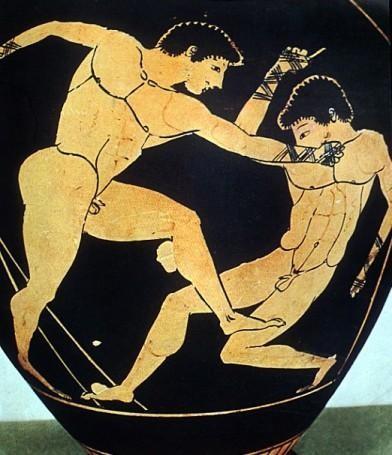
Greek boxer surrendering by raising of index finger
Day Two: According to Alan Carter’s book, The Olympic Glory That Was Greece, the second day was devoted to competitions for boys. The morning saw heats after heats of foot races as the qualifiers are shrunk down to the finalists. The victor receives a palm leaf, and his family and home town are honored by his grand accomplishment. The afternoon sees competitions in wrestling and boxing for the boys, as well as what could be considered a mixed-martial art called the pankration. Carter described it as “training for warriors who would be engaging in hand to hand confrontation with the enemy and Sparta was particularly associated with the sport.” In the pankration, you could bite or gouge eyes.
Day Three:On the third day, according to Carter, spectators enjoyed chariot races at the hippodrome. There were some six variants of chariot races – two and four-horse competitions, two mules, or foals as well – and they ran anywhere from 3,500 to 14,000 meters long. Below is a clip from the 1959 film Ben Hur, which is supposedly Rome in AD 26, over 680 years after the establishment of the four-horse chariot race. If the chariot races in Olympia were anything like this, I could see why this was a must-see event!
Day Four: Goldblatt wrote that day four was the day for generalists, when the pentathlon was held. The pentathlon then was made up of five events: the discus throw, the long jump, the javelin throw, a foot race and wrestling. According to Goldblatt, the competitors faced off in a footrace, the discus, the javelin and a jump that may have included weights. The winner was often determined after these four events. In the a winner could not be decided, wrestling was the tie breaker. The order and the way the winner was decided apparently is unclear and still debated.
Again, due to the sketchiness of the historical accounts, there is debate as to what happened on the fourth day. According to Carter, Day Four was a festive days, starting with the slaughter of 100 oxen in honor of Zeus. This was followed by the premier events, the stadion (200 yard foot race), the diaulos (400-yard foot race), followed by wrestling, boxing and pankration.
Day Five:Goldblatt wrote that day five is running, wrestling, boxing and “pankrating” (if I can turn that into a gerund). But Carter wrote that it is about pomp and circumstance, focusing on awarding the victors at the Temple of Zeus. The winners are announced with trumpets and declarations of their names and hometowns. They are given a palm leaf to hold and a wild olive branch to wear as a crown. After that, its feasting and partying into the night.
Konjiki Tsukasa was on October 10. So he thought it would be great to get married on October 10. And since the Olympics were in town, why not get married at the National Stadium on October 10, 1964, the opening day of the Tokyo Olympics.
His fiance, Masa Akimoto, agreed.
But first they had to get tickets. According to an article in The Yomiuri on October 11, 1964, the couple had 70 friends apply for opening day tickets, perhaps the hottest tickets ever to go on sale in Japan at the time. The system at the time was to apply and get your names thrown in a lottery. Fortunately, two of their friends landed them a ticket each.
But now, in addition to a ticket for the priest, they needed two witnesses. Instead of trying to find two more tickets, Konjiki called the Japan Travel Bureau (JTB) many times to try to convince them to find two people who already had tickets to the Opening Ceremonies to be their wedding witnesses. According to an October 5 Yomiuri article, JTB personnel did not initially take the requests seriously, suspecting a possible scam. But Konjiki persisted, and finally convinced JTB to find two people who happened to be seated near Konjiki and Akimoto. JTB then provided an extra ticket for the priest.
Wearing red blazers with the Olympic emblem, likely similar to what the members of the Japanese Olympic team wore, the party of five entered the stadium at 10 am, about 5 hours prior to the start of the Games, and got hitched. They then proceeded to wait patiently, got to their seats for the Opening Ceremonies, and had one of the memorable wedding days a Japanese couple could possibly have.
That was one way to get in to see the Opening Ceremonies. The Yomiuri explained on October 11 another way…which did not end well. I’ll just let you read the report about these two students:
Two youths without tickets so eager to see the opening ceremony of the Olympic Games that they hid themselves in National Stadium before the event, were arrested before the start of ceremonies by patrolling policemen.
A 19-year-old boy from Tsuabame, Niigata-ken, whose name was withheld, entered the stadium Thursday (two days before) wearing a fake press armband, after showing a business card of a Niigata Nippo newspaper reporter.
A second youth, Shuro Iino, 21, freshman a Waseda University, was discovered hiding in a toilet at 11:15 pm Friday, after climbing over a fence.
For the hottest game on ice, the players and owners have entered into a cold war of sorts. NHL commissioner Gary Bettman recently told the press that no meetings have been arranged with the International Olympic Committee regarding the possibility of NHL players competing in the PyeongChang Winter Olympics in early 2018.
The NHL schedule and the Winter Olympics schedule overlap every four years. In order to convince he NHL to release its players in the middle of the NHL hockey season, the IOC agreed to pay for the insurance, travel and accommodation of these professional hockey players. The insurance is a key component because it protects the NHL teams against an injury to a star player who could impact team success and/or team revenue for years to come. For the Sochi Olympics in 2014, the IOC sent some USD7 million to the NHL, something the IOC does not do for other sports leagues. The IOC has done so for the past five Winter Olympics since the 1998 Nagano Olympics, but this year the IOC announced they would not pay the NHL for players to come.
Bettman stated that without IOC financial support, it’s unlikely the owners would support. “We don’t make money going [to the Olympics]. I can’t imagine the NHL owners are going to pay for the privilege of shutting down for 17 days. I just don’t see that.”
However, the star players in the NHL view the Winter Olympics as a matter of prestige and pride. The very best players like Canadian Sydney Crosby of the Pittsburgh Penguins and Russian Alex Ovechkin of the Washington Capitals have said they intend to go, Ovechkin going as far to say he would go without the NHL’s permission. And as mentioned in this Ottawa Citizen article, the owners will listen to their stars.
When Alex Ovechkin said he was going to the Olympics, with or without the NHL’s blessing, it didn’t take long for Washington Capitals owner Ted Leonsis to stand behind his star. And why wouldn’t he? Ovechkin is the face of the team. He not only helps the team win games, he puts fans in seats.
Major League Baseball stands in contrast to the NHL. Currently, the World Baseball Classic, an international baseball championship series taking place in March, 2017, has the full commitment and support of MLB. And while the major league players from big-time baseball nations of Japan, Cuba, Dominican Republic and Korea are heavily involved in the World Baseball Classic, Team USA is bereft of its stars. In contrast to the NHL players, the Americans have little to no interest in participating.
Now, the World Baseball Classic is not the same at the Olympics. And when baseball returns to the Olympics in 2020 in Tokyo, MLB Commissioner Rob Manfred will likely want to ensure his league’s best players are at the Summer Games. Growing the international market for baseball will be a big priority for Manfred. But he has yet to gain consensus with team owners on how to make it work for the MLB when the Olympics will take place in the middle of the 2020 MLB season. Injuries and lost revenue to lost games will certainly be in the minds of the owners.
Rob Manfred MLB Commissioner
According to this Sports Illustrated article, there are two possible options to make it work: allow the season to continue without interruption, and just free up the players selected to their respective national teams, or shut down the MLB season for, say two-and-a-half weeks, like the NHL has done in the past.
The NBA, on the other, other hand, has had the distinct advantage of holding a primarily Fall-Winter-Spring season, while the Olympics tend to fall in the summer, the basketball off season. Traditionally, the NBA has promoted its brand and players globally, and have been a model for building a global business. Their commitment to the Olympics is thus considerable. The issue has been ensuring that the richest and greatest athletes in the world stay motivated enough to train and risk injury during their time off.
The US men’s team took bronze at the 2004 Athens Olympics, and were dubbed “The Nightmare Team”. It didn’t bode well when the superstars of the league, Kobe Bryant, Shaquille O’Neal and Kevin Garnett begged off of the team, and Ray Allen and Jason Kidd were out with injuries.
After the team’s embarrassing finish in Athens, Team USA appointed Jerry Colangelo to take charge of team selection. His job was to persuade the NBA’s best American players that it was their duty to restore pride and glory to men’s basketball in the international arena.
Colangelo convinced such stars as Kobe Bryant, LeBron James and Dwayne Wade not only to join Team USA for the 2008 Seoul Olympics, he got them to commit to playing together for three years leading up to the Olympics. Under Colangelo’s leadership and the coaching of Mike Krzyzewski, Team USA dominated at the 2008 Seoul Olympics to easily win gold. They’ve done so ever since.
Summary:
NHL: League and Owners not committed; Players committed
MLB: League committed; Owners not yet committed; American players not committed, but world players committed
NBA: League committed; Owners committed; Players committed
Orville Rogers, left, races Dixon Hemphill at the 2017 USATF Masters Indoor Track & Field Championships on February 18 in the 60-meter sprint. Dave Albo
It wasn’t quite as slow as watching water boil. But it was certainly more exciting!
Orville Rogers faced off against Dixon Hemphill in the 60-meter dash at the USATF Masters Indoor Track & Field Championships in Albuquerque, New Mexico on February 18, 2017. Rogers trailed Hemphill for most of the race, but Rogers caught Hemphill in the last 10 meters to win by 0.05 seconds in an amazing finish.
The world record in the 60-meter sprint is 6.39 seconds, held by American Maurice Greene. Roger’s winning time was 18 seconds flat. That’s right 18. But there is a good reason for this slow race. Hemphill is 99 years old. And he beat a relative whipper snapper in Hemphill, who is only 92.
Here’s how SB Nation described the above video: “What makes this video so great is the fact it’s so much slower than what we’re used to seeing. You might blink three times when Usain Bolt tears down the track, but watching a sprint unfold over 18 seconds is compelling.”
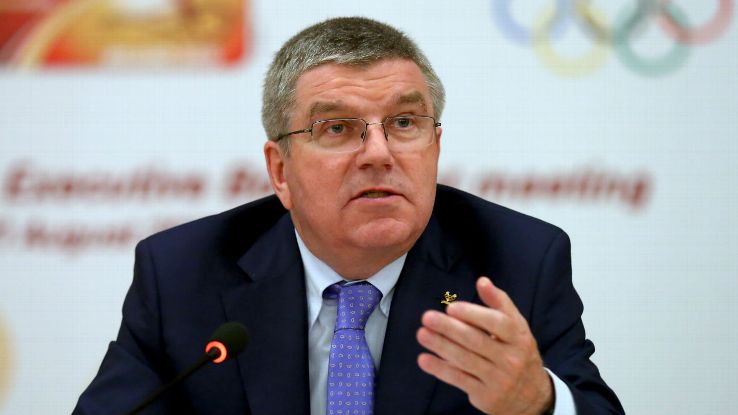
IOC President Thomas BachIn July, 2015, there were only two cities vying for the 2022 Winter Games: Almaty, Kazakhstan and Beijing, China. Just 10 months before, Oslo, Norway, the host of the 1952 Winter Olympics, pulled out of the running. Sochi a year before famously cost $50 billion, and the Norwegian government was expecting the cost for their city to be billions more than they had an appetite for.
That left Almaty, a city generally unknown, and Beijing, a well-known city that gets very little snow.
With the ugly photos coming out of Rio de Janeiro of the crumbling Olympic infrastructure after only some 7 months, more and more city denizens and governments are convinced they don’t want an Olympics in their metropolis. In fact, Budapest, Hungary, which submitted a strong bid for the 2024 Summer Games, withdrew its bid a week ago on March 1.
So like the 2022 bid, now there are only two for the 2024 Games.
This must be causing considerable heartburn for leaders of the International Olympic Committee (IOC). The bidding process has resulted not in a celebration of city pride with the hopes of bringing the biggest sports tent their way, but in opportunities for large numbers of people to publicly and loudly proclaim their disenchantment, if not diffidence with having the Olympics in their back yard.
Rio Swimming Venue Before and AfterFortunately, the 2024 has two solid prospects: Los Angeles and Paris. As Tim Crow writes in this great article, “And Then There Were Two“,
LA is the most compelling, with its vision of Californian sunshine, West Coast tech innovation and Hollywood storytelling power combining to ‘regenerate the Games’ and ‘refresh the Olympic brand around the world’.
Paris is more traditional, a classic piece of Olympic realpolitik, invoking de Coubertin in a ‘new vision of Olympism in action’ in the grand old city, linked to those time-honoured Olympic bid promises of urban regeneration and increased national sports participation.
So, as Crow extrapolates, if the president of the IOC wants to avoid further embarrassment of the citizens of the Great Cities open scorn, at least for a while, he may encourage his fellow leaders to decide the next two Olympic hosts when the IOC meet in Lima, Peru in September, 2017. As has been gossiped about for the past several months, Crow believes the IOC will select either Paris or LA for 2024, and the other one for 2028. By so doing, that would guarantee great Summer Olympic hosts throughout the 2020s, as well as avoid unwanted anti-Olympic discussion that would most certainly lead up to the 2028 process, that is currently scheduled for 2021.
Crow also speculates that the IOC may award the 2024 Summer Games to Paris, and the 2028 Summer Games to Los Angeles. Here are the three reasons why:
One, because an LA 2028 Games will give President Bach the ideal timing to play the American market for the IOC’s next US broadcast deal beyond NBC’s current contract.
Two, because it will also give Bach significant leverage in his attempts to persuade his six US-based TOP sponsors to extend their current deals, all of which end into 2020, for eight years.
But most of all, because it will buy Bach and the IOC both time and two key partners in its battle to find a new relevance and credibility for a new era and a new generation.
That last one is the tricky one. Can the Olympics be saved for the next generation?
Sen. Dianne Feinstein (D-Calif.) thinks the law that governs Olympic sports organizations in America leaves child athletes at risk of abuse. (AP Photo/Alex Brandon)
The recent revelations of decades of child sexual abuse within USA Gymnastics has created a firestorm. The spotlight has given increased awareness to the fact that “six Olympic sport governing bodies have been beset over the years by allegations of mishandled complaints of abuse,” according to the Washington Post.
In other words, cases of sexual abuse by members associated with such organizations as USA Gymnastics, USA Swimming, USA Taekwando and U.S. Speedskating have been essentially hushed up over the years.
See this link for the first part of my posts on sexual abuse in USA Gymnastics.
And now the US Government is getting involved, and their sights are on the United States Olympics Committee (USOC). On February 21, 2017, Senator Diane Feinstein of California announced that she wants her colleagues to agree on an amendment to a federal law that governs Olympic sports organizations – The Ted Stevens Olympic and Amateur Sports Act. This law was passed in 1978 in order to have a single governing body (USOC) manage the various individual national sports organizations, as well as assist in the process of selecting Olympic team members.
But what has been recently understood is that when suspicions of abuse emerge, the USOC’s policy has been one of passivity and reactivity, and that language in the Ted Stevens Act“has been interpreted by lawyers to afford coaches suspected of sexual abuse more rights than they would have if they worked in other industries.”
The Ted Stevens Act requires an Olympic governing body give fair notice, due process and a hearing to any member athlete, coach, or official it wants to ban; requirements that have sometimes prevented governing bodies from banning coaches suspected of abuse. Other youth-serving organizations, such as the Boy Scouts of America, have policies requiring swift actions when abuse is suspected, always erring in favor of protecting children from harm.
Senator Feinstein’s objective is to re-write the law so that any governing body affiliated with an Olympic governing organization must report cases of sexual abuse immediately to law enforcement authorities, as well as prevent the common practice of rotating a suspected child abuser from one club to another without any official record.
On March 2, US senators put considerably more pressure on the chief executive of the USOC, Scott Blackmun, to provide greater detail about how the USOC has handled these allegations of sexual abuse. In a letter from Senator John Thune of South Dakota and Senator Jerry Moran of Kansas to Blackmun, they say they have “serious concerns about the extent to which the United States Olympic Committee (USOC) is meeting its mandate to protect the health and safety of athletes.”
A young Ann Packer and Robbie BrightwellThere was a gravitational pull that brought Robbie Brightwell and Ann Packer together. Like two small satellites spinning around a sun called Athletics, they would meet every now and then over a four or five year period, and appear to get closer and closer…until finally, they were together, spinning in their orbit, in synch.
It was the spring of 1957 and 17-year-old Brightwell was at a six-day athletics training camp in Lilleshall Hall, a national sports center in Shropshire. He saw a girl, “dark haired, curvey and attractive.” As Brightwell wrote in his autobiography, Robbie Brightwell and His Golden Girl, “she stood out a mile.” He made an attempt to talk with her, but he got shooed away by a track judge. And then, he lost her.
In the summer of 1960, Brightwell had become an accomplished sprinter, good enough to make the Olympic Team and represent Great Britain at the Rome Olympics. He was at the English School Championships in Shrewsbury where he was asked to present medals to the 220 yards senior girls’ finalists. And there she was again.
The pretty, dark-haired girl mounting the rostrum for her silver medal had a familiar face. In a few seconds I placed her. She was the girl I’d admired at Southampton three years earlier. Her name was Ann Packer and she hailed from Berkshire.
But again, he was shooed away, this time by the administrator of the athletics course he was attending. Despite attempts to walk her back to her team section, Packer was escorted away as if he were a ne’re do well to be avoided, and not a newly-minted Olympian.
Then, in the Spring the following year, at a training camp at Loughborough Colleges organized by the International Athletics Club, their magnetic forces brought Packer and Brightwell together again.
At the outset, one particular attractive girl caught my eye. Within seconds, I realised it was Ann Packer, whose medals I’d presented at the previous year’s ESAA Championships. Having previously failed to attract her attention I determined to make up for lost time. Waiting until after lunch, I wandered over to her group. Apart from a perfunctory smile, she ignored me.
Packer had many potential suitors and Brightwell’s shyness left him at the outskirts of Packer’s orbit. But as fate would have it, their gravitational pull would send them careening together, coincidentally in the street, on their way to a dance party.
From Brightwell’s autobiographyShe laughed off my apologies, and I escorted her to the dance hall. When we arrived, the evening’s entertainment was in full swing, and anxious to maintain the initiative, I asked for the first dance. Leaving the floor and anxious to keep her to myself, I steered her to join Barry Jackson and his Melton Mowbray girlfriend, Pat Parker. From time to time, our conversation would be interrupted by others whisking her off, but I held a trump card; guaranteeing her return, I kept a firm grip on her handbag. Encouragingly, she stayed by my side. I felt more and more confident in her presence.
And that, as Bogey said at the end of Casablanca, was the beginning of a beautiful friendship.
Fast forward to October 1964. Ann Packer had won a silver in the 400 meters and a gold in the 800 meters. Robbie Brightwell had come from behind to snag silver for his 4×400 relay team. They left Tokyo as heroes of the 1964 Summer Olympics, and were headed home to England where the Olympic heroes would take center stage in one of the biggest weddings of the year.
You can’t even see her – Kon Ichikawa‘s camera is tightly focused on the two lead runners of the women’s 800 meter race,Maryvonne Dupurer of France and Zsuzsa Szabo of Hungary. Occasionally, the angle lengthens and you can see the rest of the pack bleed into the frame. Towards the end of the race Dupurer is safely in the lead, with about 6 others in a pack a few yards behind. Until, Billy Mills-like, #55 of Great Britain splits wide and sprints past the pack, blasts pasts Duprerer and wins the 800-meters with, apparently, ease.
#55 was Ann Packer. At that time, she wasn’t experienced at the 800 – her specialty was the 400 meters. And while her hopes for gold in the 400 meters were very high, she had to settle for silver, losing to a powerful Betty Cuthbert of Australia. At that stage, with her best event done, she wasn’t motivated to do worse in a 800-meter field packed with superstars. After all, her 800-meter career was really only a few months old.
Just prior to the Tokyo Olympiad, members of the Great Britain track and field team were in France for a meet. Packer’s hamstring was barking somewhat so she was reluctant to run in events unnecessarily. However, there were open slots for the 800-meter competition, and as her then fiancé and fellow 400-meter specialist, Robbie Brightwell, explained to her, the 800 would be less punishing on her hamstring than the 400 and it would also still be a good tune up. Additionally, Brightwell reasoned, there would be no pressure as everyone recognized Packer as a 400-meter runner.
And as all great sports stories play out, she ran and she nearly won in an event she rarely gave a second thought to. The Olympic authorities for GB agreed that Packer should get one of the open 800 meter slots. Packer protested, saying that she would be taking another worthy runner’s spot to Tokyo, but the fact of the matter is that Packer had smashed the qualifying time required.
But when she got to Tokyo, after taking second in the 400 meters, Packer no longer had visions of glory. She could already see herself back home in England. In fact, her plan was to forgo a potentially disastrous 800 and catch up on her shopping in downtown Tokyo. As far as she was concerned, her Olympiad was over. Here’s how Brightwell described her state of mind, in his autobiography, Robbie Brightwell and His Golden Girl:
“Do you think I should run in the 800 meter heats tomorrow?” she asked. “Maybe I should call it a day and go shopping.” I gaped in astonishment. “Shopping? You must be mad! Shopping? This is the Olympic games, not the Moulsford Village sports!”
“I know, but I’m hardly likely to bed or a silver medal, am I? And I need to buy some presents for the folks back home.”
“Come off it!” I exploded. “Think about the British girls back home who would have given their eyeteeth to be here in your place!”
She smiled sheepishly. “OK I’ll run. Not that it’ll make much difference. I’m bound to get eliminated in the heats, and then I can go shopping.”
As it turns out, Packer and perhaps even her fiancé Brightwell were missing the telltale signs of potential success. While Packer hoped just to remain respectable, others saw a form and ease that would translate easily to victory. As Packer prepared for the finals, after essentially just making the cuts in the heats, two people of considerable experience and respect came up to Packer with powerfully motivating words. Again, here is how Brightwell explains it in his autobiography:
Milkha Singh jogged past with his 1600 meters relay squad. Espying her, he dashed over, taking both hands and staring stern-faced into her eyes. “Ann Packer, listen to me. You will win!” She giggled self conscientiously, flashing me an amused smile. Shaking her hands emphatically, he repeated his message.
“You’re not listening, Ann Packer! Yesterday, I watched your semi-final. You were coasting! After the race, you come and show me your gold medal.”
She nodded respectfully. No sooner he departed than Percy Cerutty,Betty Cuthbert’s coach, rushed up. Even though they had never been introduced, Percy wasn’t a man for social ceremonies. “This,” he said, wagging a finger in front of her face, “is the finger of experience. And it’s standing to attention. Listen! Better and I’ve been talking. Stay with them until the end, and you will hammer them. Understand?”
Mission completed, Percy disappeared as quickly as he’d appeared.
When Packer won her race, right away she steered to the stands and into the arms of Brightwell. Milkha Singh was there as well, smiling with the satisfaction of clairvoyance proved correct. “Did I not say your woman would win? You didn’t believe me! I was right! Hee, hee, hee! Brightwell, you never listen to me!”
Syngman Rhee Line: a boundary established by South Korean President Syngman Rhee to demarcate the South Korean maritime border, a line disputed by the Japanese government and one that Japanese fishing boats would persistently cross.
Korea and Japan has history. Over 1500 years of cultural exchange, trade and military conflict has shaped an affinity and a rivalry that goes from love to hate and back.
In the days before the start of the 1964 Tokyo Olympics, before they would face off in men’s and women’s volleyball, the two nations were facing off in the high seas. On Monday, October 7, 1964, according to The Japan Times, a Japanese fishing boat was stopped by a South Korean patrol ship. The Korean authorities were attempting to stop the Japanese boat from fishing in what South Korea claimed were their territorial waters.
The seven Japanese fishermen were escorted onto (taken prisoner by?) the South Korean patrol boat. Apparently the seas were rough, and the two boats collided, creating damage to the fishing boat. Eventually, the 77.5 ton fishing boat, named No. 58 Hoyo Maru, sank.
Japan Times, October 6, 1964
The Korean boat also suffered some damage and apparently a Korean coast guard was sent to do repair work, according to The Yomiuri. The man fell into the water, but was fortunately picked up by another Japanese fishing boat close by. A second Korean coast guard was in a boat looking for the first one and found him being cared for (captured?) on the Japanese boat, and boarded (was taken prisoner by?) the Japanese boat.
Which set up the “prisoner exchange”.
When the Japanese realized that the Koreans were holding 7 Japanese fishermen at the same time the Koreans realized that the Japanese were holding 2 Korean coast guard personnel, they probably thought they had spent enough time in the tense choppy waters of the Pacific Ocean. A trade was made and all parties went to their respective homes.
But this maritime battle would continue for another year, until the approval of the Japan-Korea Fishery Agreement in 1965. Until that time, nearly 4,000 Japanese had been arrested and over 300 Japanese boats by South Korean authorities. Additionally 44 people had died in these fishing conflicts.
The Japanese men’s and women’s volleyball teams handily defeated their South Korean opponents, but you can bet the fans and the teams in those matches were a tad more pumped up to sink the players on the other side of the net.






You must be logged in to post a comment.