This is part two of a series on the October 1964 National geographic article called “Tokyo The Peaceful Explosion,” a fascinating portrait of Tokyo on the eve of the 1964 Tokyo Olympics. Staff writer, William Graves, and staff cameraman Winfield Parks provide a mosaic of life in the most populated city in the world at the time.
Change in Japan was fast and furious. In a conversation between Graves and an economist and editor for NHK, Hiroshi Narita (whom Graves calls “Nick”), they try to understand the secret of the emerging Japanese miracle.
I mentioned what everyone notices first about Tokyo – its fantastic prosperity. Shop windows were full, crowds on the streets were handsomely dressed, and thousands on thousands of sleek Japanese cars choked the streets. Nick nodded happily.
“Even to Americans, the figures are staggering,” he said. “In construction, Tokyo starts 800 major new buildings a year, more than two a day. The city’s – and Japan’s – economic growth rate runs about 10 percent a year, the highest in the world. In 1959 the rate rose to almost 18 percent; now people are talking about the recession.” He smiled.
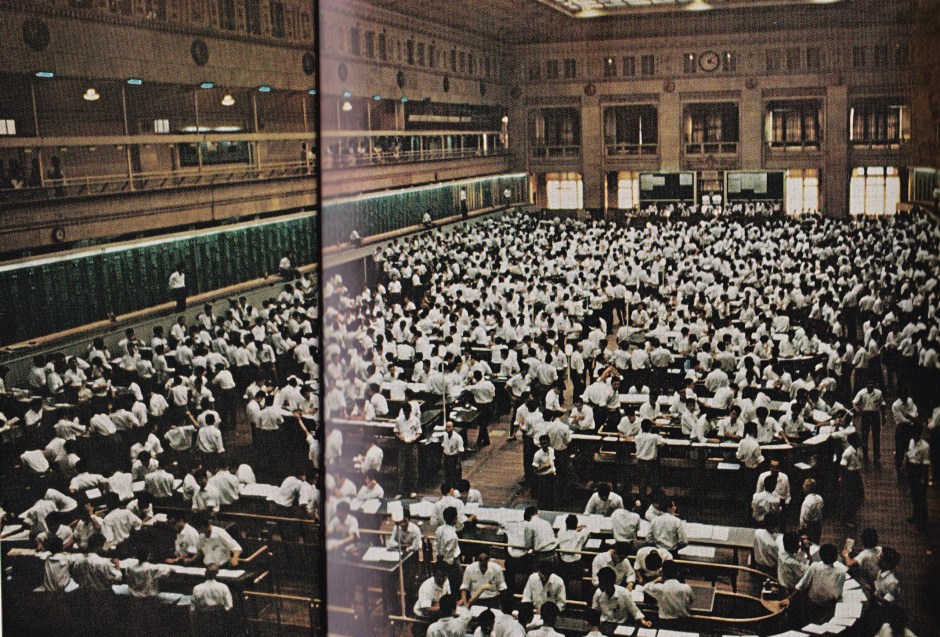
“We have a stock market, too, and it’s doing just what yours is. Since 1949, for example, a share of Canon Camera Company stock has multiplied 865 times in value.”
“What’s behind it all?” I asked, trapping an elusive piece of shrimp with a chopstick.
“We are,” Nick said simply. “The Japanese people. You’ll get other answers – postwar aid, protective tariffs, new markets in Asia, and all of these things have helped. But basically the boom is built on Japanese brains, skill, and fantastic energy.”
America-bound, a gleaming new truck rolls through the assembly line of the Nissan Motor Company automotive works between Tokyo and Yokohama. Of more than a million Japanese cars and trucks produced yearly, Nissan makes one in five. Bright-red paint brands this vehicle an export; japan reserves the color for its fire engines.Miniature television undergoes inspection at Sony Corporation, Tokyo’s astronomically successful postwar electronics manufacture. With 15 million sets in operation, Japan ranks second only to the United States in television ownership.Sparks from a welder’s torch shower a streetcar track. To spare daytime traffic, repair crews work from dusk to dawn.Shed-full of tuna, fresh from the sea, awaits purchasers at the dockside Central Wholesale Market in Tokyo. An immense distribution center, the market handles 1,800 tons of fish and 3,300 tons of vegetable every day. To examine fish quality in the shed’s gloom, buyers wield flashlights, their badges of office.Wall-to-wall carpet of white shirts hides the floor of Tokyo’s Stock Exchange, barometer of Japan’s explosive postwar growth. Some stocks sell for 800 times their 1950 values.Shoji Koyama headed the Tokyo Metropolitan Assembly in 1963 sharing administration of the capital with a governor, Ryotaro Azuma. Portraits of past Assembly presidents line a wall of his chamber in the Metropolitan Government Office. Mr. Koyama now serves in the Diet, Japan’s national legislature. Though it includes almost 11 percent of Japan’s population, Tokyo until recently had less than 5 percent representation in the Diet. A revision in apportionment laws has raised the percentage to 7.
“Sumimasen – very sorry….” Railway guards in a Tokyo station pack rush-hour cars to bursting with hapless commuters. Skyrocketing population threatens to cripple the Japanese capital; even now its 10,500,000 residents make it the world’s largest city. Long-suffering Tokyoites joke grimly about their city’s “crush hour.” Miraculously, scenes such as this morning jam a the Shinjuku Station produce few injuries.
Tokyo is not a city. Tokyo…is an explosion.
The crowds, the traffic, the lights, the smog, the noise, the peace, the plenty, the interplay of East and West, the exotic…. William Graves, staff writer for the monthly magazine, National Geographic, stayed in Tokyo for weeks if not months with cameraman Winfield Parks in an attempt to paint a picture of Tokyo in 1964 with words and photos.
Tokyo is not easy to love at first sight. In daylight, from the air, it resembles an enormous coffee stain, blotting the green velvet of the surrounding farm country. Seen from the ground, it lies blurred under layers of smog – a city wrapped in soiled cotton wood.
At night, however, Tokyo bursts through its somber wrapping. Then the city is aflame with neon, its low hills pulsing like great beds of coals, with crimsons, lavenders, greens, and golds of flashing electric signs announcing nightclubs, coffee bars, truck tires, television sets, cameras – everything that Tokyo owns or makes in some 57,000 factories.
Here are a few of the pictures and words from that National Geographic article, a portrait of an explosion.
Gone are wooden clogs and traditional kimono. Among Japanese young women, high heels and chic-knee-length dresses are everyday attire. Tokyo’s huge Ginza department stores tempt shoppers with top European designs. Copies in inexpensive Japanese cottons and rayons have all but driven classic styles from sight. Young Tokyo saves the conservative kimono and sashlike obi for ceremonial days or family occasions. Sign beneath American fashion magazines advertises a gift shop called “Yours.”Curtain of smog over Tokyo Harbor gives a coppery cast to the waterfront, one of many centers for the Japanese shipbuilding industry, now the world’s largest. Desperate for living space, Tokyo dumps its fresh trash into the bay and covers it with soil to create new land.Like immense cinder blocks, low-cost apartment houses rise amid factories and oil-storage tanks. Danchi, as Tokyoites call the developments, ease the crushing pressure of Tokyo’s housing shortage. Families with moderate incomes may rent a bedroom, kitchen, and living room for $20 a month.Husband enjoys his ease, just as his father did, while wife clears the dishes I their three-room apato. Tokyoites call them and their neighbors danchi zoku – “apartment-house tribe.”Grill-to-bumper flood chokes a Tokyo street. During rush hours it may take half an hour to negotiate a downtown block. Beginners’ tests are strict but, once licensed, drivers develop an individual style. A sharp horn blast signifies, “Look out! I am about to do something extraordinary.”
Evasive Action lifts a pedestrian clear of the pavement in his dash for safety. Tokyo traffic – dodging risks are high: on the city’s streets, a thousand die in a year.
It was 1999 and the two premier national teams in women’s soccer were facing off in the Rose Bowl in Pasadena California to determine the champions of the second FIFA World Cup Championship.
The United States and China were locked in a scoreless draw through regular and extra time, with victory coming down to a penalty shootout. After goaltender Briana Scurry stopped a shot in the third round, victory rested in the left foot of Brandi Chastain. And when she rocketed the ball into the upper right hand corner of the net, Chastain immediately ripped off her jersey, fell to her knees, her arms extended in ecstatic triumph, and her black Nike sports bra exposed for the entire world to see.
Lisa Lindahl was at home in Vermont when her phone rang and her friend told her to switch on the TV. Lindahl was an entrepreneur who established the market for sports bras in the late 1970s, so when she saw Chastain raise her arms in victory, she said was astonished, and proud. “It was her confidence, her preparation and her long journey that came to fruition in that moment,” said Lindahl in this 99% invisible podcast. “And that is perfect because I could say that about my journey of the jog bra.”
One of my favorite podcasts, 99% Invisible, is not about sports, but about design. And strange as it may seem today, the sports bra was non-existent before 1977. No sportswear or sports equipment manufacturer ever imagined why women would ever need a sports bra.
Dr. LaJean Lawson, who is the Sports Bra Science and Marketing Consultant to Champion Athleticwear, and has been shaping the design of the sports bra for three decades, said that the environment for women in sports when she was growing up was very different.
When I started high school we weren’t allowed to run full court because there was the assumption that girls were too weak, and we couldn’t run any races longer than 400 meters. So women participating in sports having/needing a sports bra is so recent.
The more Lawson promoted the sports bra and the idea of better fitness for women, she even got hate mail.
This letter said “If God had intended women to run he would not have put breasts on them.” There was a whole socio-cultural stereotype of how women should behave, and it wasn’t vigorously and badly. It was more calm and sweet, and how to comport yourself with more steadiness, and not the sort of enthusiasm and passion you see with sport.
But in the 1970s, circumstances were conspiring in the United States to make it easier for women to participate and compete in sports.
In the United States, a section of the United States Education Amendments of 1972, famously called “Title IX,” was created, and subsequently had a huge impact on American society. While the overall goal was to ban gender discrimination within federally funded schools and universities, encouraging greater access for women to higher education, protecting pregnant women and parenting students from being expelled, and challenging gender stereotypes about whether boys or girls were strong in a particular academic category like math and science, Title IX has had a tremendous impact on women in sports.
According to this article, “the impact of Title IX on women’s sports cannot be overstated: the NCAA says the number of female college athletes is at an all-time high, and the numbers of girls playing high school sports has swelled from fewer than 300,000 in 1974 to more than 3.1 million in 2012.”
Additionally, getting into shape and staying fit became a huge part of the American pop culture in the 1970s and 1980s. With bestselling books like The Complete Book of Running by Jim Fixx, which came out in 1977, and Jane Fonda’s Workout, published in 1981, women were running and working out more.
And the more women ran, the more obvious it became that they had a problem men did not. Here’s what Lindahl had to say about that:
My whole generation started exercising, and I had a friend introduce me to what was then called “jogging”. When you have at-shirt over bouncing nipples, you get chafing. So the answer to that is to put a bra on. Because I did try running without any bra. And then of course I got a lot of comments from passing motorists, and certain male runners. So you wear a bra and that poses problems of different sorts, like the straps that fall off your shoulders so you’re always jigging them back up, hardware can dig into your back, and they’re hot and sweaty.
One day, Lindahl’s sister, who also ran, called to ask this obvious, painfully obvious, question: “‘What do you do about your boobs? I am so uncomfortable when I’m running! Why isn’t there a jock strap for women?’ That’s when we really laughed. We thought that was hilarious.”
But Lindahl couldn’t get the idea out of her head, and started to think about the ideal bra for female runners – a bra with straps that wouldn’t fall off the shoulders and wide enough so they wouldn’t dig in. Lindahl recruited a friend, Polly Smith, who was a seamstress and costume designer. And they worked through multiple prototypes for this bra, but could not hit upon the design that made it easier for her to run. Then one day, Lindahl’s husband came down the steps with a jock strap not where it was supposed to be – over his head and across his chest – and said playfully, “Hey ladies, here’s your new jock bra!”
The three of them had a great laugh, and Lindahl thought to continue the joke by pulling the jock strap off her husband and putting it on herself….except that when Lindahl put the jock strap over her breast, she had an epiphany. “Oh!”
The next day, Lindahl went running in a contraption that featured two jock straps sewn together, and realized she had a design that would work. Lindahl, Smith and Smith’s assistant, Hinda Schreiber decided to build a business. Schreiber’s father lent them $5000, the team built a relationship with an apparel manufacturer in South Carolina, and by 1978, they were distributing the “Jog Bra.”
Despite the initial reaction of sports retailers, who thought that the jog bra should go in a lingerie department and not in a sporting goods store, sales of the $16 bra took off. Jog Bra had annual sale increases of 25%, and created an entirely new market. More importantly, it enabled women to enjoy their sporting activities more fully and freely, whether it was taking part in a Jane Fonda workout, playing point guard on a high school basketball team, or running a marathon. The sports bra that Lindahl, Smith and Schreiber created liberated a whole generation of women athletes.
That feeling of liberation came to fruition that moment Brandi Chastain ripper off her jersey in 1999. But that vision was in Lindahl’s head in 1977.
It should be modest enough I could take off my t-shirt on really hot summer days because I had a running partner who would do that. He would take off his shirt in the middle of his run, pull it over his head and tuck it in the back of his shorts. I was so jealous because I couldn’t do that.
Today, millions of women can and do, thanks to the Jog Bra. Happy 40th!
This is part two highlighting the powerful black and white photos of the opening day ceremonies of the 1964 Tokyo Olympics, 53 years ago yesterday. The photo above, from this series compiled by Fuji Film, captured one of the most dramatic moments of the Tokyo Games.
The sacred flame that lit the Olympic cauldron, which burned for the 16 days of the Tokyo Olympics, was initially lit 51 days earlier on August 21 in Olympia, Greece. The flame then travelled through 12 countries in Eurasia, including Turkey, Lebanon, Iran Thailand, Malaysia and Taiwan, before landing in Japan. The flame was distributed to four torches, which then made their way through all prefectures in Japan. The four flames came together in Tokyo and the final torch bearer was Yoshinori Sakai, a university runner selected because he happened to be born on August 6, 1945 in Hiroshima, the day the world entered the nuclear war age.
After the Olympic cauldron was lit, the flag bearers of the 93 nations formed a semi-circle around the lectern, where Japanese gymnast Takashi Ono, stood. Ono, a veteran participating in his fourth Olympics, who accumulated 5 golds and 13 total medals since the 1952 Helsinki Games, delivered the athlete’s oath.
In the name of all competitors, I promise that we shall take part in these Olympic Games, respecting and abiding by the rules that govern them, in the true spirit of sportsmanship, for the glory of sport and the honor of our teams.
After the oath, 8,000 pigeons were released. I’m sure it was a spectacular image on television and in the newspapers and magazines, but it was a bit of an annoyance to athletes and spectator alike who tried and failed to dodge the guano bombs of the birds who were probably less than thrilled with being cooped up in cages and then suddenly released into the air above the stadium. One athlete told me that the water pressure in the Olympic Village dropped drastically as everyone showered at the same time to rid themselves of their unwanted opening day souvenir.
October 10, 1964. In the annals of 20th century Japanese history, it was truly a day to remember.
It was minutes before the commencement of the 1964 Tokyo Olympics, the flags of 93 nations rising into a clear blue sky. The above photo was snapped and compiled into a set of photos by Fuji Film commemorating the XVIII Olympiad’s opening ceremony, which began at 2pm on Saturday, October 10, 1964, 53 years ago today.
The athletes would have to deal with cold and wet conditions for much of the Tokyo Olympics, but that day, the 5,500 athletes marched into the National Stadium under perfect conditions. As tradition has it, the host nation’s team marches into the Stadium last. Expectations were high for Team Japan, with a goal set of 15 gold medals. They actually achieved 16, third best after the US and USSR.
The President of the Organizing Committee for the Games, Daigoro Yasukawa, can be seen above introducing the International Olympic Committee President, Avery Brundage. In the official report which offered a post mortem of the Games from an operational perspective, Yasukawa expresses gratitude to the people of Japan.
…it was because Japanese in all walks and interests of life worked together in close and harmonious cooperation—all with one basic goal—that these Games might be an unqualified success. This spirit permeated into the Organizing Committee, and was to be found also in the sports associations and the many cooperating organizations involved. This surely is the only factor that enabled success in our organization efforts.
At the end of the Second World War, in the aftermath of the Hiroshima and Nagasaki bombings, the Emperor’s voice was heard over the radio for the first time by his Japanese subjects. The Emperor asked his people to surrender, to “bear the unbearable, and endure the unendurable.” Nineteen years later, the Emperor is presiding over the Olympics, an event symbolizing peace and unity, in a city that was unrecognizable from its bombed-out shell in 1945. As noticed in this Japan Times article, the scene depicted in this photo may have been striking to many Japanese as the only person standing in the stadium was the Emperor – a role reversal of sorts in a very different time.
After the Emperor declared the XVIII Olympiad open, the Olympic Flag was brought into the stadium by Japanese self-defense forces, the embroidered satin flag initially brought in by the Mayor of Rome, the site of the XVII Olympiad. The flag was raised exactly 15.21 meters into the air. That was the distance Mikio Oda hopped, skipped and jumped to win the gold medal in the triple jump at the 1928 Amsterdam Olympics, Japan’s first ever gold medal.
Imagine it’s October 9, 1964 and you have this ticket to the Opening Ceremonies of the 1964 Tokyo Olympics on the next day.
This is the day over 5,000 athletes and the entire population of Japan has been waiting for – the start of a new Japan.
And by the looks of it, your ticket is in a prime location – Q-57, 5 UPP. I’m not 100% sure where that seat is on the map provided on the back of the ticket, but my guess is the area I highlighted in blue.
If it is indeed that section, you are in an honored section. Since the design of this ticket is different from the tickets generally sold, these may be for special guests, as indicated by the word “SPECIAL” written on the ticket’s map.
Special perhaps because in 5 UPP, Q-57, you will be seated very near the center of the stadium, almost directly opposite the Olympic cauldron, where a teenager from Hiroshima, born on the day an atomic bomb was dropped on his city, would climb the steps and light the Olympic flame.
Less than 50 meters in front and below you will be seated Emperor Hirohito, who will launch the Games.
And thousands of the world’s best athletes will march into the stadium by your seat, as if they are marching for you.
Don’t lose that ticket. It’s going to be quite a show.
The gold medalAt 586 grams (nearly 1.3 pounds), the gold medal to be awarded at the 2018 PyeongChang Olympics will be the heaviest medal ever created for an Olympic Games.
The previous heavyweight champion of Olympic medals was the Vancouver medal of 2010 that tipped the scales at 576 grams, according to this article.
But more importantly, at least to me, the simplicity of the Korean medal design is striking. There is very little to disturb the surface, much of the text blends inconspicuously in the design, including use of native Korean alphabet letters that in its entirety spell out the words “PyeongChang Winter Olympics.”
Textured like the bark of a tree, the surface of the medal complements the actual weight to give the athlete a sense of solidity. This may be top of mind for Olympians who have heard about the flimsiness of the medals awarded at the 2016 Rio Olympics. The intent, of course, is to make the association of the medal design with Korean society, according to the Korea Herald.
“Hangeul is the foundation and the soul of Korean culture,” PyeongChang’s organizing committee said. “Hangeul is considered the seed that eventually blossoms and bears fruit, which symbolize Korean culture. The trunk is the process of that development.”
Additionally, the ribbon that will allow the medal to hang from the neck of an Olympian will be made from a traditional Korean textile called “gapsa,” and the round wooden case for the medal is said to be inspired by traditional Korean architecture.
“I tried some new techniques and went through a lot of trials and errors,” medal designer Lee Suk-woo said. “I wanted the medals to represent the hard work and dedication of the athletes. And the finished products came out a lot better than I’d expected.”
Top Ten All Time American Universities for Olympians
High school students and their parents in the United States, frankly all over the world, look at the multiple annual top university lists, from US News to Forbes.
A new list is out – American universities or colleges with the most Olympians. The site, Olympstats, published this list a few days ago, after the editors went through the onerous task of figuring out the collegiate affiliations of all American Olympians since 1896.
Question: Which American university is in the top ten for producing the most Summer Olympians, and the most Winter Olympians?
Above is Olympstats list of top ten American universities for producing Olympians since the first modern Olympics in 1896. I’m proud to say that my alma mater placed 9th, although I imagine a bulk of those Olympians were in the early 20th century when Ivy League institutions were the only ones that had students who could afford to go to Europe from the United States.
Top Ten States for Olympians
The first four universities are from California. It had always been my running assumption that year-round warm-weather states like California would produce a large chunk of Olympians. But as we can see below, Florida and Hawaii don’t merit top ten mention.
Top Ten American Universities for Summer Olympians
Predictably, the top four American universities to produce Olympians also dominate the list of top ten American universities to produce Summer Olympians.
Top Ten American Universities for Winter Olympians
When we look at Winter Olympians, the Midwest and Northeast dominate. One to note is #11 on the list below – Westminster College, a college in Salt Lake City, Utah. Since Westminster partnered with the U. S. Ski and Snowboard Association (USSA), this liberal arts school has become a hotbed for winter sports. In fact, Westminster students made up 10% of the US Olympic Team at the 2014 Sochi Olympics.
So, what’s the answer to the question posed at the beginning of this blog post?
The Tokyo Olympic Organizing Committee was ready for the hordes of foreigners to descend upon their shores, preparing processes, rules and documentation that made it clear to officials, workers and volunteers in the 1964 Tokyo Olympic bureaucracy who an Olympian was or wasn’t.
So when Ted (Theo) Mittet came to Japan as a rower on the US Olympic Team, he had his documents. I know this because he kept them in a box over the past five decades, and he graciously allowed me to rummage through it.
The image at the top of the article is his Identify Card. Sent about five months in advance to some 7,900 competitors and officials, blank identify cards were provided to all National Olympic Committees (NOC) or International Sports Federations (ISF). Those NOCs and ISF’s in turn filled in the cards and handed them to the athlete.
From the Official Report of the Organizing Committee – The Games of the XVIII Olympiad Tokyo 1964
These identity cards, were for all intents and purposes, a passport within Japan, and so Japanese officials took the time and effort to design a card appropriate for its level of importance. Not only was the paper manufactured with waterproof texture paper, and watermarked to prevent forgery, the card included a serial number that was fed into an IBM computer system. That serial number was also printed on a vinyl case designed to further protect the document.
The identity card allowed the athlete or official free passage on all related Olympic transportation, free admission into parks, zoos, museums, as well as free access to trains, buses and trams in Tokyo.
In the case of athletes like Mittet, their case was blue. My father was a journalist at the Tokyo Games, and his identify card case was red.
As described in this post, Mittet traveled through Japan. In as much as he could, he likely used identity card to travel, but he may have also used his railway pass, one issued to all Olympians. This pass may have been more to explain which train lines the foreigners were allowed to use, as the document kindly shows in red which lines they can board free of charge.
Inside the Olympic Village, Olympians had access to the dining halls. Each individual was provided with a book of meal coupons, which they could use breakfast, lunch and dinner in any of the dining halls they wanted. The picture below is of Mittet’s coupon book, with coupons left for only October 28, several days after the end of the Olympics.
As one can imagine, the Japanese organizers thought deeply about how the foreigners would interact with the Japanese at the countless number of touch points in Tokyo, and believed that easily recognizable documentation in English would become in certain instances the instant translation of an unspoken exchange.
“Having established procedures and protocol the Japanese organisers devised a document of reference for (almost) every forseeable contingency,” wrote Doug Ibbotson of the Evening News, in an article entitled Tokyo – Marvel of Efficiency and Goodwill. “This resulted in the distribution of mountains of paper which, I regret to say, frequently was jettisoned into the waste basket. However, once a document was in existence, the lesser officials were happy, for it became the sole arbiter in any dispute between Western Logic and the Oriental Mind.”
Paper work – one reason why the 1964 Tokyo Olympics were considered one of the smoothest operations in Olympic history.
Lourdes University, a small mid-western school in Sylvania, Ohio, announced in January 2017 that the “Gray Wolves” of Lourdes intends to field three teams to compete in two eSports leagues – the National Association of Collegiate eSports and the Collegiate StarLeague, and that scholarships are available for game gamers.
Lourdes’ President Mary Ann Gawalek explained that “Competitive video gaming requires students to possess excellent critical thinking, problem-solving and teamwork skills – which are transferrable to their academic pursuits. In addition, these individuals must follow a strong fitness regimen and have a healthy mind and spirit.”
It’s also possible that institutions are picking up on what gamers already know – eSports is becoming big business. Estimates stated in Business Insider and Newzoo indicate that advertising and sponsorship monies dedicated to eSports ranges from USD440 million to USD700 million, with expectations of growth to anywhere from USD800 million to USD1.5 billion by 2020.
The IOC has seen this trend, and eSports aligns with the committee’s desire to continuously draw in the youth market. Recent additions like surfing, skateboarding, sports climbing and three-on-three basketball to the 2020 Games are a direct result of that strategy. And so, the organizers of the 2024 Paris Olympics are studying the possibility of including eSports. However, when IOC president, Thomas Bach, was asked for his views on eSports, he provided a point of view that was a shot across the bow of the gaming industry.
“We want to promote non-discrimination, non-violence, and peace among people,” Bach said to the SCMP, an Alibaba-owned paper. “This doesn’t match with video games, which are about violence, explosions and killing. And there we have to draw a clear line.”
Fans of eSports pointed out the hypocrisy, in their view, of the IOC saying no to eSports while awarding medals in boxing, shooting, fencing, judo and wrestling, for example.
While eSports includes games of explicit violence, like Counter-Strike or Overwatch, Bach and the IOC may be open to non-violent eSports that actually mimic sports in the more traditional sense, like soccer or basketball.
But when I first heard this story, my personal skepticism sensor didn’t tick up because of the violence. I simply couldn’t see eSports as an Olympic event because it doesn’t feel like a sport. To me sports are acts of intense physicality. I love chess, but I don’t view it in the same way as running, jumping, swimming throwing or a whole host of similar actions.
I could be biased. I had an original Atari game counsel, and an early Nintendo Fami-con way back when. But I would never consider myself a gamer. Watching people play electronic games is impressive, but beyond incredible hand-eye coordination, I haven’t yet reached the conclusion that eSports are more sport than game.
eSports enthusiasts may counter that Dressage or prone rifle shooting are more game than sport, and I’d have to agree that there is a range of physicality in such tournaments as the Olympics. But I still can’t shake the feeling that eSports are not truly sports.
In the end, my opinion doesn’t matter.
As Around The Rings notes, the 2022 Asian Games in Hangzhou will award medals in eSports. And if the organizers of the 2024 Paris make a more specific recommendation for non-violent games for the eSports category, the IOC may have to consider its inclusion.




You must be logged in to post a comment.