The majority of Japanese have considered themselves middle class for decades, speaking to the highly meritocratic nature of Japan’s society. This is part three of Faces of Tokyo, a series of posts on how Dentsu explained the Japanese to the rest of the world, in a book called “Tokyo Olympics Official Souvenir 1964.” They did so with a collection of profiles of people, who represented a wide variety of professions.
These profiles represented the average person in Japan, who served the growing Japanese population during Japan’s greatest economic expansion – the 1960s.
Taxi Driver:Taxi drivers had a reputation for reckless driving habits – often labeled kamikaze drivers by the foreign press. But it was a living, and not such an easy one. As the profile explained, “the traffic jams of Toyo are among the world’s worst. Day and night 930,000 taxi drivers suffer from bad roads, long labor hours and other inconveniences. But if you’re lucky, maybe you get in the back of the cab of Mr Tadashi Yamamoto, who was recognized as an “Excellent” driver.
Stewardess:As Dentsu wrote, becoming an actress, stewardess or a fashion model “form the triumverate of the modern Japanese teenager’s dream.” Hisako Miki, a 24-year-old stewardess for Japan Airlines, was living that dream. Taking care of passengers on the international routes, conversing politely in English with foreigners, bringing back gifts to her family and friends from the world over, Miki was enjoying a life of relative glamour, that likely would lead to the right marriage – a pilot perhaps.
Traffic Guard: Tokyo in the 1960s was crowded, dusty and noisy. But someone had to stand in the middle of the roads so that children could cross the roads safely and get to and from school. Teruko Yokote was a 45-year old traffic guard, whose whistle, hand gestures and stern looks kept impatient drivers at bay. Traffic guards, as the profile explains, were a recent addition to the work force, an attempt to diminish the problem of car accidents involving children.
Student: Dentsu tells us that all those young boys walking around in black slacks, jackets and hats looking like military men are actually students. Student uniforms for both girls and boys, for some reason, are based on 19th century Western European naval designs. The interesting political commentary regarding the Waseda University student aside, the Japanese student is the shining example of middle class meritocracy in the country. Students take tests, and the better the scores, the better the school, the better the job, and hopefully the better the life.
The American government, yet again is trying to sell American cars in Japan. But a reputation of poor quality and poor mileage (unfounded perhaps) result in poor re-sale value. No matter what the government does, Japanese citizens do not want to buy American cars.
In fact, the people who used to buy the long, sleek American cars were the Yakuza, or at least that was the perception.
Chevrolet Impala
But when I look at the ads for cars in the weeks of the 1964 Tokyo Olympics, me – a non-driver without a license – I do admit, I lust.
Above and below are the ads from October 10 and 17 editions of The Saturday Evening Post, the weeks of the 1964 Tokyo Olympics. George Lucas’ film, American Graffiti, portrayed the youthful car culture of 1962 Modesto California, which showcases automobiles primarily from the 1950s and 1960s. And again, I’m no car expert, but you get a sense that in 1964 cars were getting longer and sleeker – rounded edges giving way to sharper angles.
Take a gander at the American cars of ’64, as seen through the eyes of the readers of The Saturday Evening Post. Which one gets your motor running, makes you wanna head out on the highway, lookin’ for adventure, and whatever comes your way…..
Buick Electra 225Pontiac Grand Prix
Ford Galaxie 500, Fairlane 500 Sports Coupe and Mustang Hardtop
This is part two of Faces of Tokyo, a series of posts on how Dentsu wanted to portray the Japanese to foreign visitors of Japan, as explained in a set of pictures and profiles of Japanese and the work they do. The profiles below, from the book, “Tokyo Olympics Official Souvenir 1964,” are intended to leave the foreign reader the impression that the Japanese, in 1964, are indeed savvy internationalists.
Ballerina:She’s been to Europe twice to study dance and performed with a visiting opera company from Italy in 1963. On top of that, ballerina, Yukiko Tomoi, was given the task of organizing a special performance of La Turandot during the Tokyo Olympics, not only for the Japanese who grew up loving classical European music and dance, but for the Westerner who needed assurances that the Japanese were not all shamisen and kabuki.
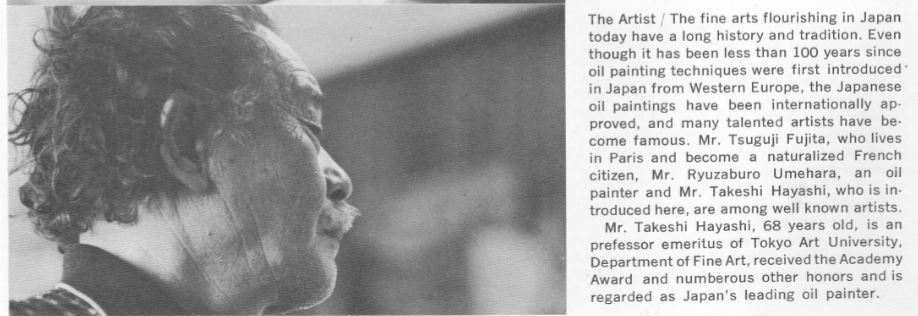
The Artist:Not only do the Japanese know ballet in 1964, they know how to paint using techniques introduced to Japan from Western Europe in the Meiji Period. Featured here is Takeshi Hayashi, an established painter and professor of the Tokyo Art Museum. Dentsu even mentioned artist Tsuguji Fujita, a Japanese artist who moved to Paris, and even traded in his Japanese passport for a French passport.
Fashion Model:Dentsu selected Reiko Kawasaki as the face of the young model, likely because she evokes a young Audrey Hepburn. There’s very little detail in this profile, except that she has been a model for three years “who has not attempted to get ahead faster than her shadow.” More interestingly, the profile refers to Akiko Kojima, who was crowned Miss Universe in 1959, the first ever from Asia. A triumph over the beauties from Norway, the US, England and Brazil, Kojima’s victory was yet another milestone in Japan’s march to international acceptance.
Fashion Designer: She was one of the biggest names in fashion in Japan. Hanae Mori in 1964 was particularly well regarded for her costume designs in film. A year later, she debuted internationally with a show in New York City, and 12 years later opened up shop in Paris.
In 1964, the world came to Japan for the 1964 Tokyo Olympics, and to most foreigners, particularly from the West, the Japanese were not familiar, foreign perceptions ranging from warlike to exotic to friendly.
The Japanese were intent in facilitating the positive image of the Japanese. In the book, “Tokyo Olympics Official Souvenir 1964”, the publisher Dentsu produced a section called “Faces of Tokyo”, to encourage specific perceptions of the Japanese:
That the Japanese are indeed uniquely Japanese
That the Japanese are international
That the Japanese are middle class.
Uniquely Japanese
The Housewife: Apparently the modern-day housewife of Japan in 1964 is beautiful, loves weekend outings with the family, and wears kimono designed by her husband. Somehow, Dentsu is trying to portray the typical Japanese housewife as beautiful, modern and well to do.
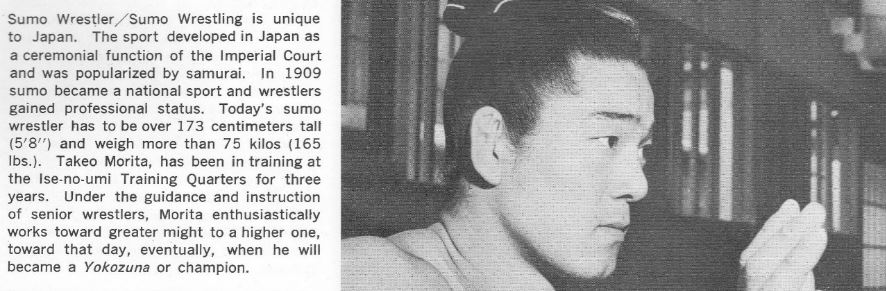
The Sumo Wrestler: The profiled wrestler was still a relative unknown, but Takeo Morita, who later became known as Fujinokawa Takeo, made it to the heights of sekiwake in the very Japanese sport of sumo. Dentsu explains that sumo emerged out of imperial court functions to become a national sport in the early 20th century. (Real)
The Geisha: The profile here is undecipherable in English – I’m sure this is from a vague description of what it means to be a geisha by a translator who likely gave up and just threw a bunch of English words together….
The Buddhist Priest:This profile introduces the resident priest of Zojoji, Buddhist temple in Tokyo Shiba Koen, very near Tokyo Tower. Not only is he a priest, but he is a Doctor of Philosophy, honorary president of a Japanese university, and through his many books, a go-to guy in Japan to understand Buddhism.
The Flower Arrangement Sensei:Although true less and less today, the expertise and techniques of specific skills and trades were handed down from one generation to another very deliberately, often from parent to child, as was the case with flower arranger, Kasumi Teshigawara, featured here. My guess is that the reference to her brother is famed film director, Hiroshi Teshigawara.
Chinese Cultural Minister Luo Shugang Education, Culture, Sports, Science and Technology Minister Yoshimasa Hayashi and South Korean Culture, Sports, and Tourism Minister Do Jong-hwan
Think about it. The next three Olympic Games will be held in Asia:
2018 Winter Olympics: PyeongChang, South Korea
2020 Summer Olympics: Tokyo, Japan
2022 Winter Olympics: Beijing, China
In the history of the modern Olympiad, the majority of host cities selected for both Summer and Olympic Games have been in Europe. In the period of 1896 to 1952, only three of the first 20 Olympiads were held outside Europe, the others in the USA. From 1956 to 2016, the diversity of host cities improved, with only 50% of the Olympiads held in Europe.
But for the first time, three Olympiads in a row will be held in Asia. In the world of diplomacy, that smells like opportunity. So when the culture ministers of Japan, China and South Korea met in Kyoto for their annual meeting of minds in August, 2017, they announced that they will organize joint events to spread the depth and beauty of East Asian culture within the three countries in connection to the upcoming Olympiads in Asia.
While the specifics of the plan are to be determined by an “experts’ body” to be set up, it was agreed that five cities in each of the three countries would be identified as locales for these cultural exhibitions and exchanges. In fact, according to this Japan Today article, this is an expansion of an initiative called the Culture Cities of East Asia Program, that had started in 2014. China’s Changsha and South Korea’s Daegu are already hosting such events. Next year, Japan’s Kanazawa will be host.
Efforts to strengthen copyright protections for cultural products
Continued trilateral dialogue on preserving the intangible cultural heritage of all three countries.
Support of UNESCO’s International Research Center for Intangible Cultural Heritage in the Asia-Pacific Region, which works to protect, preserve and promote intangible culture such as traditional music, dance, performing arts and craftsmanship.
Examples of “intangible cultural heritage” in Japan would be noh, washoku (traditional Japanese food), and washi (traditional hand-made paper).
With so much geo-political tension in the region, exacerbated by the sabre-rattling of North Korea, there is a belief that diplomacy, through the promotion of the respective nations’ cultural heritage, can promote the cause of peace, according to Kyoto mayor, Daisaku Kadokawa.
The East Asian region shares a long history of exchanges. Here in Kyoto, you can see and feel the cultural elements of the region. The power of culture can help bring the region together, and lead to peace.
When surfing was selected as a new Olympic sport for the 2020 Tokyo Summer Olympics, enthusiasts wondered how organizers were going to keep score.
One of the challenges when organizing surfing competitions is to create the perception that everyone has a chance at similar size and types of waves. After all we can’t control the moon and the tides they create on the vast ocean waters. And so very quickly enthusiasts wondered whether the Olympics were going to introduce wave pools to the competition, large mechanical pools that create waves. In that manner, you can pretty much guarantee that competitors will get the same level of difficulty every time.
As it turns out, surfing at the Tokyo Olympics will be held out in the wild, on the waves of Tsurigasaki Beach in Chiba, Japan. Perhaps it’s because wave pools have not yet become a part of top-flight surfing competitions, that from a technological or even a surfing culture perspective, competitors are not yet ready for wave pools. But the president of the International Surfing Association (ISA), Fernando Aquerre, gave another, economic reason in this interview with Surfer.com:
The IOC does not want to build more “white elephants” – structures that have no use after the Olympics are over. The Olympics organizers want to focus on legacy, on building things that can be used by host cities after the games. As of now, there is no commercially sustainable wave pool. You can build a wave pool like Snowdonia, but nobody knows if that will be commercially sustainable over a period of time.
Snowdonia wave pool
So how will the surfing competition be run in 2020?
First, there will be a total of 40 surfers allowed to compete, 20 men and 20 women.
Second, the event will be shortboarding only – no longboards or bodyboards.
Third, Aguerre said that they will be patient over the two-week Olympic competition to find the right two-day period to hold the surfing competition.
That last point is interesting because television will probably demand that surfing establish a set time in advance. But then again, the Olympics are also about putting “athletes first”.
“We’ll try to start it at the front end of the games, but we can wait to run it if the waves look better at the end,” Aguerre said. “We have ten years of wave history and wind conditions data to rely on. We’re very confident, and so are Tokyo and the IOC, that we’ll have reasonable waves of good quality.”
Additionally, Aguerre wants to make sure that the venue at Tsurigasaki Beach has the right vibe. “The IOC has asked us to to create a full-on beach scene at Chiba that will last the whole length of the Olympics,” he said. “It will include the surf events of course, but also organic food, yoga in the morning—it will be a place where you want to hang out. There might be a skate ramp — maybe it will be like what you see at the U.S. Open. It’s never been done before at the Olympics.”
I’m not a surfer, but when I think of places to surf in Japan, I think of Shonan Beach in Kanagawa Prefecture, or the islands of Okinawa. After all, it was the American soldiers based in those areas since the Japanese occupation of the late 1940s and early 1950s who introduced surfing to the Japanese, sparking a fascination for Hawaii, the American beach culture, and how to ride the waves with a board.
But when the Olympics return to Tokyo in 2020, all surfing eyes will turn to Chiba. Last year, surfing was voted in as a new Olympic sport for 2020, and Tsurigasaki Beach in Chiba was selected as the venue. Located about 90 minutes east from Tokyo in the city of Ichinomiya, Tsurigasaki Beach has become the go-to place to catch waves in the Kanto region.
In this survey of the best surf spots in Japan, JapanSurf.com ranked Chiba as having the best quality waves in the country. “Consistent, powerful beach breaks and thundering reefs make this area a mecca among surfers in Japan.” The Mainichi Daily News explained that surfers enjoy a “consistent flow of waves toward the shore from three different directions, namely northeast, east and southeast.”
Even more interestingly, the Mainichi article states that surfing has been responsible for a phenomenon unseen for decades in Japan – a small town that is actually growing in population.
Ever since the 1980s, people wanting to surf all year round have been moving to the town, and since the 2000s, numerous surfing shops, restaurants and new homes have emerged along prefectural Route 30, which runs parallel to the Pacific coast. As a result, the area has taken on an atmosphere of a “tropical island” bustling with youngsters, attracting what is believed to be about 600,000 visitors a year.
According to the article, the town of Ichinomiya has grown to 12,400 at the beginning of 2017, in a country where both the rapidly aging population and the desire of the youth to work in the big cities has shrunk the populations of cities and towns that are not named Tokyo or Osaka.
The Japanese love for surfing has revitalized Ichinomiya. And as planning continues to bring the biggest beach party in the world to Tsurigasaki Beach, ambitions climb. “We want to spread the name and culture of Ichinomiya across the world,” said Ichinomiya mayor, Masaya Mabuchi.
But the seed of the idea of surfing as an Olympic sport was planted, apparently, in 1912 by the Johnny Appleseed of surfing, Duke Kahanamoku.
According to the International Surfing Association (ISA), the swimming legend who won three golds and two silvers across three Olympics and 13 years, Kahanamoku “first presented his dream at the 1912 Summer Olympic Games in Stockholm, where he expressed his wish to the International Olympic Committee (IOC) to see Surfing included in the Games.”
In fact, this little historical footnote was the inspiration for the current head of the ISA, president, Fernando Aquerre. The surfer from Argentina was newly elected to the ISA in 1994, and according to Olympic.org, he had a dream to get surfing into the Olympics. In fact, Aguerre met Juan Antonio Samaranch, in 1995, part of his pitch was to give the then 75-year-old president of the IOC a surfing lesson in his office.
Unfortunately for Aguerre, what was true in 1912 was also true in 1995 – the IOC was not ready to hang ten.
“We had paddled out but there were no waves,” Aguerre said (in reference to his meeting with the IOC). “We kind of figured out that waves were going to come at some point but we didn’t really know when they were going to come because they were out of our control.”
Still president of the ISA, and still hanging on to his dream, Aguerre opened up his options by connecting with Thomas Bach in 2013, who was a candidate to become the head of the IOC. And by this time, Aguerre was more able to lay out a vision for why surfing needed to be in the Olympics – the need to attract youth to the movement with the rise of action sports. Bach, who was elected to head the IOC that year, made the attraction and retention of youth to the Olympic Games part of his platform.
Surfing has grown significantly in popularity over the recent decades. There were only 32 member countries of the ISA in 1995, but now there 100. So when surfing was submitted to the IOC in September 2015 as a part of a shortlist of new events for Tokyo 2020, primarily driven by youth-oriented action sports like skateboarding and sport climbing, surfing finally caught a wave. In August, 2016, the IOC voted surfing into the Olympics.
Come July 2020, if you want to watch the first Olympians set Olympic records with every top score in surfing, then plan to bake on the hot sands of Tsurigasaki Beach in Chiba, Japan. That is where the surfing world, Barney and pro alike, will gather.
It’s estimated that to make all of the gold, silver and bronze medals to provide to all the expected top three winners of all Olympic events, the manufacturer would need 9.6 kilograms of gold, 1,210 kilograms of silver, and another 700 kilograms of copper, which is the main component of bronze.
it is the goal of the Tokyo 2020 organizers to award athletes at the 2020 Games with medals created from 100% recycled materials. Instead of resource-poor Japan buying from the reserves and mines of other countries, the nation will mine its own growing stash of hidden resources – its urban mines.
An urban mine is a metaphor for all of the electronic goods a rich society buys, consumes and throws away, which also house a collectively massive amount of precious or rare elements. By that definition, Japan is loaded, according to this research from 2009:
A considerable amount of metal was estimated to be accumulated in Japan. The accumulation amount of gold and silver is 6,800 tons and 60,000 tons respectively. They are greater than the reserves of richest resource-possessing country, South Africa for gold and Poland for silver.
To uncover the riches stored in our electronic waste, Tokyo 2020, the Japanese Government and wireless provider NTT-DoCoMo, among a variety of public-private partners, kicked off a campaign in April to collect used and unneeded smartphones, PCs, displays, digital cameras, PC displays, MP3 players, handheld video game players, or calculators.
Olympic swimmer Takeshi Matsuda donating phone for recycling at an NTT-DoCoMo outlet
According to Tokyo 2020 CEO Toshiro Muto, about 500,000 mobile phones have already been collected, which is a good start. “This is not enough to make all the medals,” he admitted, “but we still have a lot of leeway because some people outside Tokyo still are not aware of the program. There is a lack of recognition, so we have much more work to do in creating excitement and being even more creative to have wise ways to collect these metals.”
Japan can do this now because they had set up the process four years before, when the government passed The Act on Promotion of Recycling Small Waste Electrical and Electronic Equipment. The government was then able to certify 45 recycling operators nationally to receive small electric and electronic devices collected by local governments and then to sort, dismantle and send them to smelters to recover metals. According to this report from Japan for Sustainability, in the first year of this project,
a total of 13,236 tons of small electric and electronic devices were sent to certified operators. Some had been collected by municipalities across the nation (9,772 tons) and others had been brought directly to the operators by citizens and companies. They broke the devices down into their parts and sorted them, sending 8,582 tons to the smelters. Among the metals extracted from them, iron accounted for the largest portion in weight (6,599 tons), followed by aluminum (505 tons) and copper (381 tons). Extracted precious metals including gold and silver amounted to 494 kilograms.
Amazing.
If you are interested in contributing to the production of the first Olympic medals molded from metals recycled from Japan’s massive urban mines, then gather those unneeded phones and small electronic devices and donate them to the cause. Take your mobile phones and tablets to your local NTT-DoCoMo store, or follow these instructions if you want to send your PC and other larger items for recycling. (Yes, this applies to people living in Japan only, and unfortunately the instructions are in Japanese only.)
It was the end of June, 1999, and my New York Knicks had come off a stunning run to make it to the NBA Finals against the San Antonio Spurs. They lost in five games, but the energy and excitement that Latrell Sprewell, Patrick Ewing, Allan Houston, Larry Johnson and Marcus Camby brought to New York City was electric!
It was a great time to be a Knick fan!
But a week later, still basking in the glory of my team’s incredible season-ending run, the powers that be in the Knickerbocker management team made a decision in the NBA draft that puzzled, if not deflated the fan base. With the fifteenth pick in the first round of the draft, the Knicks selected Frédéric Weis.
Qui?
Weis was from France, a seven footer, perhaps someone to clog up the middle. Who was pick number 16? One of the most talented players to come out of my favorite university college team, Ron Artest, who would go on to become a volatile but brilliant All-Star in his career. (Yes, Artest of St. John’s University, would change his name to Metta World Peace.)
But what of Weis?
For starters, the Knicks’ coach, Jeff van Gundy did not appear to be supportive of the selection. Weis, overjoyed to be drafted, soon felt the cold shoulder once he arrived in the United States for the Knicks’ summer league camps where rookies and others are worked out. Weis was not considered inspired material, but he was a first round draft pick, which afforded him the right to sign a contract that would have made him a Knick. But thanks to his agent, he declined so that he could play another year with his professional team in France. Weis personally believes that was a mistake.
Then came the 2000 Sydney Olympics, and perhaps the most famous dunk in Olympic history, perhaps in basketball history. The American team were facing the French national team, and pretty much handling the French, up by 15 with 16 minutes to play in the game. The French rebounded the ball at their end of the court, one player bounced pass a ball that went a bit too high for his teammate. That’s when Vince Carter, one of the NBA’s most dynamic players at that time, came charging in, snatching that high pass, dribble twice and then leaping for a thunderous dunk. In his path was Weis, who Carter simply lept over, all 2.18 meters of him.
That play has been dubbed “Le dunk de la morte,” or the Dunk of Death.
Vinsanity went into overdrive. Weis, if he were a stock, nosedived – a symbol of all the terrible talent decisions Knick management had made in the past (and in the future).
And that was despite the fact that Weis played well on a French team that won the silver medal at the 2000 Sydney Olympics.
Weis never played a game as a New York Knick. After the Olympics and his return to France, no efforts were made by Knick management to make him a part of the team. In other words, to Knicks fans, Weis was a total waste of a good draft pick.
The New York Times followed up on Weis in September, 2015, with this wonderful but sad story of a man whose basketball career, so full of promise, never took off, and a life that appeared to deteriorate year on year.
A couple of years after winning silver at the Olympics, Weis and his wife Celia had a boy named Enzo. A year later, the boy was diagnosed to be autistic, which was hard for Weis to handle, so much so that the couple separated, Celia taking Enzo away. Bouts of depression became deeper, until finally Weis decided he had had enough of himself. Here’s how the New York Times told that story:
On the morning when Frédéric Weis tried to kill himself, he dreamed about owning a beach house. A beach house had been Weis’s dream for a long time. In France, in Spain, in Greece — wherever his career as a 7-foot-2 professional basketball player took him. He liked the sand, he liked the surf. A beach house was a good dream.
But on that day, in January 2008, the dream did not make him smile. Weis got into his car in Bilbao, Spain, around 10 a.m. and began the drive here, to this small city in west-central France best known for its production of fine china. He was on his way to see his wife and son. About 90 minutes into the drive, Weis suddenly pulled over at a rest area near Biarritz, a French town not far from the border.
He stopped the car, leaned back in his seat and, at 30 years old, considered all that had happened to him during his career… Weis thought about all this for a while. Then he thought about the beach house. Then he thought about his son, Enzo. Then he reached over, took out the box of sleeping pills he had brought with him and swallowed every single one.
But, as the article explained, Weis did not pass on. He instead fell into a deep sleep, waking up 10 hours later realizing he was still alive. “He had failed, and for once, this made him happy. ‘It was the luckiest I’ve been in my life,’ he said.”
Frederic Weiss at his tobacco shop
Weiss returned to basketball in Spain and France before retiring in 2011. When the New York Times caught up with him in Limoges, France, where he was running a tobacco store and a bar, battling bouts of depression, but back with his wife Celia and son Enzo.
Life goes on for the man made famous by the Dunk of Death.






You must be logged in to post a comment.