Fanny Blankers Koen in Tokyo_Asahi Graf 2

She was 46 years old, and she walked around Tokyo with an air of confidence and style. Fanny Blankers-Koen was in Tokyo for the 1964 Summer Olympics, and the Japanese press followed her around – after all, she was one of the most accomplished Olympians in town. At the age of 30 at the 1948 London Olympics, she became the first woman to win four gold medals in a single Games, replicating the 1936 accomplishments of her hero, Jesse Owens.

Fanny Blankers Koen in Tokyo_Asahi Graf 1

In the October 23, 1964 edition of the Japanese magazine, Asahi Graf, Blankers-Koen was featured in a photo spread, looking relaxed and glamourous. The article shows her walking about town, relaxing in the Olympic Village, describing her as a tall woman with golden hair and light blue eyes.

Fanny Blankers Koen in Tokyo_Asahi Graf 3

The article states she is the “chaperone” to the Netherland’s women’s athletics steam, but as fellow Dutch and Olympian, Ada Kok, wrote to me, she was actually one of several coaches on the Dutch Olympic squad.

The article quotes a Japanese swimmer, Hiroshi Furubashi, who knew Blankers-Koen, saying that she was a hero to the Dutch after her dramatic accomplishments in London in 1948. But as I wrote in previous posts, despite her historic accomplishments, she was never embraced in her home country as she was outside it. Kok said that the Dutch team at the 1964 Olympics treated Blankers-Koen as they did everyone else, quite neutrally, as just another member of the team.

Fanny Blankers Koen in Tokyo_Asahi Graf 5

“It may be a very bad Dutch habit, but our well known sportspeople were more recognised and honoured abroad then in the Netherlands,” said Kok. “The Dutch are more like, ‘act normal and keep both feet on the ground’, no matter how famous you become in your sport.”

And as I wrote in this post, Blankers-Koen was a very complex person, who was driven by a need to win at everything, and to be recognized as an achiever. It is unlikely she got that sense of fulfillment in her home culture. But when she came to Japan, she was a star.

Paul Mccartney one on one

It was 50 years ago, when Sgt. Pepper taught his band to play. (It’s the album’s 50th anniversary!)

It was 51 years ago, when the Beatles came to Japan to play.

It was 53 years ago, in the year of the Tokyo Olympics, when the Beatles had the top five on the Billboard Hot 100, the only act ever to hold the top five spots:

  • No. 1, “Can’t Buy Me Love”
  • No. 2, “Twist and Shout”
  • No. 3, “She Loves You”
  • No. 4, “I Want to Hold Your Hand”
  • No. 5, “Please Please Me”

I have written about The Beatles impact on the time surrounding the 1964 Olympics, not only on Japan but on people around the world. In 1964, Olympians coming to Tokyo, particularly from Europe and the United States, knew of Beatlemania, sang their songs, and saw on TV the screaming hordes of girls chasing the four lads from Liverpool wherever they went. There was even a group called The Tokyo Beatles!

On April 27, I got a tiny taste .

In 1966, the Beatles played the more intimate Budokan, built to showcase judo in the Tokyo Olympiad. However, I saw Paul McCartney perform in the Tokyo Dome, a baseball stadium not built for concert acoustics. But that was OK! We were in the presence of the Walrus!

The concert began with the most iconic of pop music sounds – the jarring clanging opening chord of “A Hard Day’s Night.”

And then Sir Paul played for over two hours, ending in the communal “lah lah lah, lah lah lah lah” of Hey Jude.

When he left the stage, we knew he’d be back for an encore. When McCartney re-emerged, he played the most covered single of all time, his very own “Yesterday.” He could have easily walked off the stage and ended the night on a high. But he then barked out the reprise to “Sgt Peppers Lonely Hearts Club Band”. He could have ended the night with the lyrics, “We hope you have enjoyed the show….we’re sorry but it’s time to go,” but he didn’t.

Next up was a song from his Wings days, “Hi Hi Hi”. You knew he couldn’t end on a Wings song, but he took an interesting turn by celebrating the birthday of a band member with, of course, the Beatles upbeat song, “Birthday”.

I’ve never been to a Beatles concert, but there must be an appropriate way to end one, and that would be with the “Medley” from side 2 of my favorite Beatles’ album – Abbey Road. I was ecstatic! The perfect finish! After the pulsating drum solo, McCartney brought it all to an end with these lyrics:

And in the end

The love you take

Is equal to the love you make

McCartney is 74. And yet, he played for a solid 2 hours and 40 minutes. There were times when his voice cracked, and some of the faster songs felt slower than normal….which is OK because this is Japan where people stay seated….after all, the average age in the Dome must have been about 64.

As my wife screamed “Paul!”, and McCartney soaked in the applause, he told the crowd he loved us all – “Minna-san daisuki!” And maybe he says that to all the crowds. But his encore went on and on, lingering as if he had little desire to depart. Even after his final song, he stayed on stage to say good bye before walking off, stage left.

I experienced only a tingling of Beatlemania that the Olympians of 1964 did, but maybe, I’m amazed…at the way you pulled me out of time.


Paul McCartney One on One Tour T-Shirt
My T-shirt!

A Visit with a Japanese Family_13

Here is part 4 of a series on how the Organizing Committee of the Tokyo Olympics in 1964 presented the typical Japanese family to the world. In these series of pictures, the writers again show how similar the typical Japanese and Western families actually are. Moms shout out to kids that dinner is ready, and they settle together at the dinner table to a wide variety of cuisine.

13 Amid the cackling and shouting of the kid on the lawn we hear Mother’ s voice. It’s supper time. Japan adopted daylight-saving-time shortly after the war, but the problem of getting the children inside while it was still light out proved too great, and daylight-saving-time was abandoned.

14 All the family members gather in the kitchen area for supper. For dinner you can expect any variety of Western, Chinese, Indian or Japanese food. No other nation offers such an array of homecooking. The availability of fresh meats and an abundant supply   of   fish give the homemaker scores of menu ideas. Rice, the all­ time favorite in Japan is losing some of its popularity to bread, especially at breakfast time. The main food seasoning is soy sauce, which was first introduced. to Japan from China centuries ago.   Try a little on your fish.

A Visit with a Japanese Family_14

When I read that Japanese typically eat Indian food, I had to pause for a moment. Indian food? Then I realized that one of the most popular dishes in the Japanese diet is indeed curry rice, a thick yellow curry that has been popular since the late 19th century when the British introduced it to the Japanese.

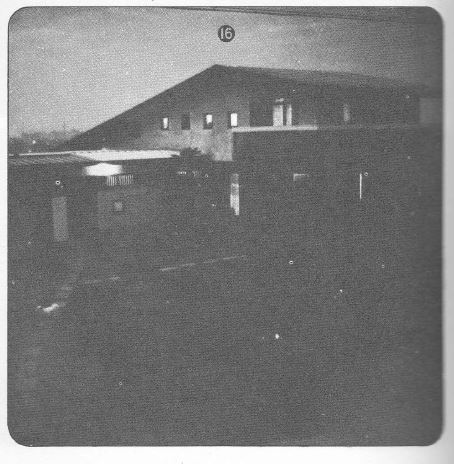
The article ends as does the day of the typical Japanese family – with everyone fast asleep, except the eldest son burning the midnight oil studying for university exams.

16   The   family   has retired for the night.   What a long time we’ve been here!   Only   one   light is burning.   It’s in the room of the oldest boy who is studying for the university entrance examinations .   He is   preparing   for the fiercest competition he may ever face. Taro, the family dog, is keeping the vigil outside. Well, good night now, have a good rest.

A Visit with a Japanese Family_16

It’s the 1960s! The Japanese economy is booming! This was the time of The Three Sacred Treasures of Post-War Japan, when every family had to have a television, a refrigerator and a washing machine.

This is part 3 about how the Olympic Organizing Committee sought to educate the visiting foreigners about the typical Japanese household. Their message – yes, we’re Japanese, but we’re Western and Modern as well! In an article written in “Tokyo Olympics Official Souvenir 1964”, the writers explained how up to the times the typical Japanese family was. Having said that, the Kato girls are stuck cooking in the kitchen and doing the laundry, albeit with the latest white goods on the market.

A Visit with a Japanese Family_5

5 Kitchen Area. This functional modern design is gaining in popularity as fewer girls are willing to be house­ maids. The housewife’s aids today are electric appliances. Mrs. Kato and her daughter-in-law are clearing the breakfast table.

A Visit with a Japanese Family_6

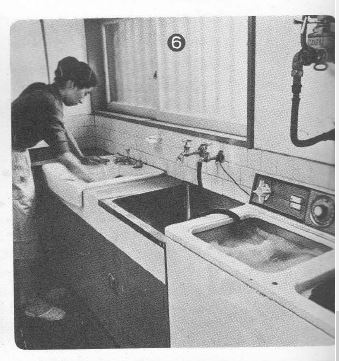
6 Laundry   and   Bath.   The latest model washing ma­chine and spin dryer. Look at the bathtub-in a Japanese style bath you wash and rinse outside the tub, and in this case, in a Western style shower. The water is not replaced for every bather so it’s important that you be clean before   you   get into the hot water of the tub to relax.

A Visit with a Japanese Family_7

7 The handy folding clothesdryer can be moved to the sunniest areas as the sun moves across the sky.

A Visit with a Japanese Family_10

10 With the washing in the fresh air, Mother turns to sewing. New electric sewing machines have made it possible for women to make their own kimonos at home. Once kimonos had to be made by professional dress­ makers. Japan currently produces sewing machines, at an annual rate of 3.5 million, many of which are ex ported.

Through the eyes of mother Kato, the writers show how Japan has modernized. First, mom drives! How else can she attend PTA meetings and buy her groceries at the increasingly popular supermarket!

A Visit with a Japanese Family_11

11 Faced with increasing duties at home and outside, Mother has learned to drive. Alas, she had the new car two months before she could pass the driving test!

12 After attending a PTA meeting at the school of her youngest child, Mother stops at a supermarket on her way home. Supermarkets came into   vogue in Japan about three years ago and have proved so popular with house­ wives that there are some 2,000 supermarkets in Tokyo alone.

A Visit with a Japanese Family_12

This is part 2 about an article written in “Tokyo Olympics Official Souvenir 1964”, a book designed to make sense of Japan to visiting foreigners during the 1964 Tokyo Olympics. While the article was interesting, the pictures were fascinating.

As stated in part 1, the Olympic Organizers wanted to put foreign visitors at ease, that Japan wasn’t so different. The article shows a picture of the family Kato. Kato is a typical Japanese name, but the house they live in – definitely not typical!

A Visit with a Japanese Family_1

1 Here we are-this is the Kato   home.   Nice, isn’t it? Kato-san is a company manager and he, with his wife and eldest son’s family live in a nine-room, upper middle class home. The house, constructed recently at a cost of ¥9 million (S25,000), is of hinoki (Japanese cypress), considered the best home building material.

Hmmm, I don’t know about you, but 9 rooms, even for an upper middle-class home seems insanely spacious. And then there is the space around the house itself. If you’ve lived in a typical neighborhood, even in an upper-middle class abode, you rarely see such space around the house. More likely is that you could open your window and practically touch the house next door.

A Visit with a Japanese Family_2.JPG

2 This is the front entrance. As we slip out of our shoes and into house slippers, we meet- Kato-san’s eldest son who is making the opposite change. He’s on his way to the office.

Clearly the eldest son is Westernized. He’s not in kimono – rather, he’s in the modern-day office wear of white shirt, trousers and necktie. And another familiar cultural cue of the 1960s: the wife stays at home to do the housework while the husband is working hard for the family.

3 With her husband off to work, the wife is in the living room, guiding the   vacuum   cleaner   over   the   rug and under the Western-style furniture. You’ll notice the display shelves, a genuine Japanese touch.   Resting   on them are some of the family’s art treasures.

A Visit with a Japanese Family_3

Not only are the Japanese Westernized, they’re civilized!

8   The clock has ticked by a few hours and Mother is in the garden hanging out the wash. She smiles as she hears her daughter practicing scales upstairs. Musical education at home was a rarity in prewar   Japan, but is extremely popular now, especially for young people. Japan is proud to be the producer of some of the world’s finest pianos.

A Visit with a Japanese Family_8

9 Kato-san’s three grandchildren are on late summer vacation now, from late July to early September. The oldest girl, home from college, is spending her leisure time playing the piano, while her brother, who is a high school student, and the youngest boy, who is in junior high school, are making plastic models and assembling a radio.

A Visit with a Japanese Family_9

But not everything is Westernized. The Japanese actually do enjoy their green tea. And thanks to this article, foreigners can avoid the embarrassing faux pas of adding sugar to their green tea.

4 Upstairs, Kato-san is sipping hot green tea (without cream or sugar) which his wife has just brought him. He doesn’t have to go to the office until later. This sunny spot is a typical all-purpose Japanese room-a simple airy living room during the day, a dining area when you bring the low table to the center of the room, and at night, when the bedding is taken from the closets, and placed on the tatami presto, It’s a bedroom!

A Visit with a Japanese Family_4

A Visit with a Japanese Family_15

Organizers of the Tokyo Olympic Games in 1964 were worried about how they were going to accommodate all of the expected 30,000 visitors during the peak. In addition to hotels, youth hostels and even large passenger liners, owners of private homes were asked to make rooms available for foreign visitors. Over 580 private homes alone added an additional 1,445 beds to capacity.

Those who stayed at a Japanese private home likely had a unique and wonderful experience. But there must have been some initial concern by foreigners in crashing at a stranger’s place, particular in the land of the rising sun, where the people were inscrutable and the food moved on its own.

Perhaps the Organizing Committee felt a need to explain the Japanese family to the Westerner. Towards the end of the book, “Tokyo Olympics Official Souvenir 1964”, the publisher, Dentsu, dedicated a few pages to demystifying the Japanese family.

Dentsu’s approach was to apply the tried but true formula of the harmonious meeting of East and West. In this article, we visit the Kato family – a symbol of this pleasing integration:

We’ re on our way to Mr. Kato’s or “Kato-san’s” home. Let me give you some tips before we get there. You’ll find “dual” living arrangements there-Western modes and time-honored Japanese tradition peacefully co-existing under one roof. The Japanese have not dispensed with tatami rooms (straw mat floors), but one room is usually Western style with a rug and furniture. Kimono at home is the rule and Western dress outside, for the office, school and business.  

It’s not just the house and the rooms, but also how the typical Japanese family eats and sleeps.

At mealtime you’ll see the family is as dexterous with fork and knife as with chopsticks (called hashi), but on the other hand they may favor chopsticks even for Western food. Each family member will have his own set of hashi, and guests are provided with disposable ones which are discarded after use. With the same relish, Kato-san and his son drink hot Japanese sake (rice wine) or whiskey on ice. At night some of the family may sleep on futons (feather bedding) and others will sleep in beds. The people of this country are “sensitive pragmatists”­ – there is beauty, versatility and comfort in their homes and lives.

Now Dentsu figured that the visiting Westerner has been programmed by WWII propaganda of how Japanese children and mothers were under the total subjugation of the man of the household, and how entire families were under the total subjugation of the Emperor of Japan. In this article, Westerners were reassured that times have changed, and so have the Japanese, but not entirely:

The Japanese home is no longer ruled by a huffing-puffing patriarch. Husband, “wife and children are a close group. While the chief decision-maker is the bread-winner, wives these days usually hold the purse strings and the women’s voice in domestic affairs is to be with. The Japanese Civil Code attempts to regulate inheritance so that one third of a man’s estate goes to his wife and two­ thirds to his children. It is still common,   however, for an estate, settled in terms of a will, to award the lion’s share of the inheritance to the eldest son, reflecting the traditional value placed upon family line, rather than upon individuals.

Christo and Jean Claude The Gates._Plaza Hoteljpg
The Gates by Christo and Jean Claude, in front of thePlaza Hotel

It was February, 2005. The International Olympic Committee’s evaluation commission was in New York City, checked in at the prestigious Plaza Hotel, overlooking a picturesque Central Park draped in snow. The once-in-a-lifetime Christo and Jean-Claude exhibition known simply as The Gates – massive saffron-colored banners dotting the walkways of the park.

To this IOC commission, the one that would decide whether New York City, Paris, London, Madrid or Moscow would win the right to host the 2012 Olympics, the messaging was consistent. There’s no place like New York City. And there’s no better place to host the Summer Olympics than the Big Apple.

New_York_City_2012_Olympic_bid_logo.svg

Picture this, they likely said to the commission members:

  • See the iconic Batman symbol of Gotham City, see the Olympic Rings shining in the New York night.
  • Imagine athletes of the world floating down the Hudson River in an armada, their procession leading them to the Olympic Stadium on the newly revitalized West Side.
  • Know that the world’s best athletes would compete in iconic, world-renown venues: basketball at Madison Square Garden, baseball at Yankees Stadium, tennis at Arthur Ashe Stadium (where the US Open is held), soccer at Giants Stadium, the triathlon in Central Park!
  • How about a closing ceremonies that includes a massive ticker tape parade down Broadway and the Canyon of Heroes.

And don’t forget that New York City is a microcosm of the world. The Statue of Liberty has welcomed the world for over a century. As the NYC2012 slogans stated, “Every Country Gets Home Field Advantage” and “Every Flag Will Wave”.

At this time, I had just moved from Bangkok, Thailand to Tokyo, Japan. My mind was filled with the tsunami that had just hit Thailand and other parts of Southeast Asia, and my relocation to Japan. I had no idea what was going on in my hometown of New York City. But if I had been aware, I’m sure I would have been on the bandwagon.

I could see that vision. I can still see that vision. It is worthy of New York City.


stamps 2

A friend of mine in Denmark recently sent me a wonderful gift – a commemorative souvenir stamp sheet that went on sale on October 10, 1964, the opening day of XVIII Olympiad in Tokyo.

It is a beautiful set that show off some of the iconic venues of the Tokyo Games, including the 30-yen stamp featuring the Nippon Budokan Hall. The popular Japanese martial art of judo was debuting at the 1964 Games, and the Japanese government decided to build  a structure just for judo at the Olympics.

Not only was the stamp publicizing the Budokan, it was helping to pay for it.

From the first Olympic Games in 1896 in Athens, governments have raised funds for Olympiads through the issuance of stamps. According to the IOC, more than 50 million Olympic stamp series have been issued since 1896, generating revenue for Olympic operating committees through surcharges on stamps.

Receipts of Olympic Fund Raising Association
From the final report of the Olympic Games

An organization called the Olympic Fund Raising Association was created in December, 1960, mandated with raising funds primarily from private sources. The Association was responsible for raising funds for the Olympic Organizing Committee, the Japan Amateur Sports Associations to help raise the performance level of athletes in Japan, as well as for the construction of the Budokan.

And according to the final report of the Olympic Games published by the Tokyo Olympic Organizing Committee, stamps were the Association’s best money maker, as you can see in the table below. What’s also interesting is the number of fund raising projects the Association oversaw: advertising in telephone books and trains. And not only did they make money off of selling cigarettes, but also thanks to legalized gambling in motorboat, bicycle and motorcycle racing, among many other things.

The Olympic Fund Raising Association raised a total of around JPY6 billion (USD16 million), and 16% or JPY963 million was due to stamps.


Stamps 1
The inside of the commemorative stamp booklet.
Paea Wolfgramm defeats Duncan Dokiwari

Pita Nikolas Taufatofua put Tonga on the map during the opening ceremonies of the 2016 Rio Olympics. Carrying his nation’s flag, his torso bare, muscles rippling and golden skin gleaming, Taufatofua had tongues hanging and wagging.

But Taufatofua didn’t last the entire bout of even his first match, eliminated from the Olympics due to mercy rules, losing 16-1 to Sajjad Mardani. To be fair, Tonga is so small, the Pacific archipelago’s population is a bit above 100,000, which is probably about the population of my neighborhood in Tokyo. So the numbers alone make it unlikely for a world champion to emerge from Tonga.

But the tiny kingdom of Tonga, participating in the Olympics since 1984, beat the odds and claimed a silver medal in 1996. Paea Wolfgramm was a student at the university of Auckland in New Zealand where he played rugby when a schoolmate suggested that Wolfgramm give boxing a try in 1990. After 24 bouts in and around the Pacific islands circuit, Wolfgramm found himself the super heavyweight representative of Tonga, and was going to the 1996 Atlanta Olympics.

Wolfgramm was a big man, 185 cm tall and 140 kgs in weight, but as he had no international track record, he was a total unknown among the American, Cuban and European boxers expected to medal.

Pita Nikolas Taufatofua

First up for Wolfgramm was a boxer from Belarus, Sergei Dahovich, whom Wolfgramm snuck by on points, 10-9. This set up a match with the Cuban, Alexis Rubalcaba. The Cuban boxers were always considered a threat. But Wolfgramm, a devout Morman, surprised essentially everyone, taking the fight to Rubalcaba, pummeling him at the ropes, and sending the Cuban to two standing eight counts. Wolfgramm won on points 17-12, and in that moment, to the chants of “Ton-ga! Ton-ga!” from the Atlanta crowd, went from unknown to unbelievable.

The entire island nation of Tonga was already celebrating its greatest Olympic moment as Wolfgramm had secured the nation’s first medal, guaranteed a bronze medal with the Cuban’s defeat. While the match between Wolfgramm and the Nigerian boxer Duncan Dokiwari was not televised in Tonga, the entire populace was on pins and needles when Wolfgramm took to the ring for semi-final bout.

The fight between Wolfgramm and the 1994 Victoria Commonwealth Games champion was a tight affair, tied 6-6 going into the third and final round. And the match stayed tied at 6 until the very final seconds, when Wolfgramm landed a punch to Dokiwari’s face to get the decisive point. Wolfgramm was going to the gold-medal round!

But there was a cost. Not only did Wolfgramm have a broken nose, he had broken his wrist in his desperate match against Dokiwari. And he was up against Vladimir Klitschko. The brainy PhD from the Ukraine, Klitschko would also go on to become a world heavyweight champion, in fact, the second longest reigning heavyweight champion of all time. (Joe Louis reigned for nearly 12 years, while Klitschko was champion for nearly 10.)

Wolfgramm had said that if this had not been a championship bout, he probably would have not gotten into the ring. But this was for gold, and he was reported to have said, “If I won a gold medal, I could not even imagine. I would die first, coach would die next and the king would give me half of Tonga.”

The Tongan did not win, although he made the fight a fight. After the second round, Wolfgramm was down only 3-2. But the third round was the Ukrainian’s. Klitschko pummelled away, and won the gold-medal match 7-3. Despite the lack of resources and support, the broken nose and wrist, Wolfgramm battled for himself and for an entire nation. Of his wrist, Wolfgramm was quoted as saying, “I was willing for it to break into 2,000 pieces if necessary.

Wolfgramm would turn professional soon after the Atlanta Games, and go onto a successful career, winning his first 14 bouts, and retiring with a career record of 20-4.

Vladimir Klitschko defeats Paea Wolfgramm

Jesse Owens

What is an amateur today?

Decades ago, the Olympics represented the very best of the so-called “amateur” athlete, those who excelled at a sporting discipline and did not receive financial gain from it. The Sullivan Award has had a storied history of recognizing the very best athletes in the United States who happened to be amateurs, including such greats as golfer Bobby Jones, basketball player Bill Bradley, swimmer Mark Spitz and American football quarterback Peyton Manning.

Today, athletes in a much wider variety of sports have ways to make an income in their sport, via competition prize money, professional leagues, and sponsorship deals, which render the pool for Sullivan Award recipients shallower than decades past.

And yet, when the obvious choice for the Sullivan Award winner of 1936 was Jesse Owens, arguably the athlete with the most significant accomplishments of the Berlin Olympics, the powers that be selected Glenn Morris, the winner of the Olympic decathlon. Winning the gold in the decathlon, perhaps in another year, should have been enough to win the Sullivan. But Owens, who was a black American, took four gold medals under the glare of Adolph Hitler in a clearly bigoted regime. Morris was white, and that may have been the overriding criteria for the judges.

“We have overlooked people,” Roger J. Goudy, president of the Amateur Athletic Union (AAU) acknowledged in this New York Times article. “Jesse Owens went to Berlin and won four Olympic gold medals in 1936. He did not win the Sullivan, which went to his white teammate Glenn Morris in a close vote, 1,106 to 1,013. Owens had been the overwhelming winner of The Associated Press poll for the best athlete of the year, amateur or professional.”

But yesterday, on April 11, 2017, a wrong was righted. Jesse Owens was awarded the inaugural Gussie Crawford Lifetime Achievement Award. The award was presented to Owen’s granddaughter, Gina Hemphill-Strachan. She had this to say about her grandfather:

I would say the thing that makes me most proud of his legacy is the fact that he does have a legacy. At 80 years after his accomplishments in Berlin, that he’s still relevant. People still speak about him with such passion and compassion and reverence. He certainly left a mark with so many young people because he was an unofficial ambassador, traveled all over the world, speaking to so many young people, encouraging young people, training and all that.

Carl Lewis, no slouch himself in track and field, reflected on the amazing athletic accomplishments of Owens:

“I tell you something, it is tough to win the long jump and something else, period,” he added. “I think we kind of overstate how easy it (winning four events at one meet) is. And for him to do it back then with all he had to deal with…I looked at him as someone to aspire to, someone to emulate, not just athletically.”

Jesse Owens in Tokyo_Tokyo Olympics Special Issue_Kokusai Johosha

According to Ron Perelmen of the Sports Examiner, this belated recognition of Owens was due to Peter Cava, a former communications director for the AAU.

“Soon after I went to work for AAU in 1974, the ’73 Sullivan Award winner was announced,” said Cava. “Looking over the list of previous winners, it was shocking to see that Jesse Owens’ name wasn’t on the list.” When Cava noted at the Rio Olympics that it was the 80th anniversary of Owens’ historical accomplishments, he thought it was about time to recognize him. “The Sullivan Award has been called ‘An Oscar for Amateurs,’ said Cava. “The Academy of Motion Picture Arts and Sciences presents Oscar Awards for lifetime accomplishments.”  

So here we are, 80 years later, finally recognizing Jess Owens as we should – as one of the greatest athletes of all time.