I was a very geeky Star Wars fan. On May 25, 1977, 40 years ago today, I cut school with a couple of other junior high school buddies to see the highly anticipated opening of George Lucas‘ magnus opus at the Astor Plaza Theater in Manhattan.
I own original Star Wars posters, buttons, trading cards and various promotional items from that period. I even created a quiz that tested the Star Wars acumen of my friends, to very nerdy depths.
One thing I didn’t know at the time was that the iconic baddie in black, Darth Vader, was represented by more than two people. We all knew that David Prowse was the body inside, and that James Earl Jones intoned Vader’s menace with his breathy baritone. But we didn’t know that the swordbuckling Vader was animated by a 1952 Helsinki Olympian from England named Bob Anderson.
Anderson of Alverstoke, Hampshire served in World War II with the Royal Marines, where, according to The Independent, he learned how to fence. After the war, Anderson found success in competition, succeeding in the 1950 British Empire Games before joining TeamGB at the World Championships and the Helsinki Games. While his team finished fifth, Anderson went on to coach Great Britain’s fencing teams for the next five Olympics. His teams took silver at both the 1960 Rome Olympics and 1964 Tokyo Olympics.
Mark Hamill with Olympian and Darth Vader stand-in Bob Anderson
He was also brought in to choreograph the lightsaber fight between Obi-wan Kenobi and Darth Vader in Star Wars. When Lucas began work for the sequel, The Empire Strikes Back, it was likely determined that Prowse could not execute the lightsaber duels to the precision desired. That’s when Anderson the choreographer became Anderson the dark lord. It is Anderson who duels with Mark Hamill in The Empire Strikes Back, and it is Anderson’s Vader who cuts Luke Skywalker’s right hand off.
Anderson went on to reprise Vader’s lightsaber scenes in The Return of the Jedi. At the time, however, Anderson’s screen presence was never officially acknowledged. Upon the release of The Return of the Jedi, which I also saw on opening day, May 25, 1983, Hamill felt he needed to let the world know the truth about his on-screen dad in an interview with Starlog Magazine. “Bob Anderson was the man who actually did Vader’s fighting. It was always supposed to be a secret, but I finally told (director) George (Lucas) I didn’t think it was fair any more. Bob worked so bloody hard that he deserves some recognition. It’s ridiculous to preserve the myth that it’s all done by one man.”
I didn’t know this until recently. I will have to add this to my quiz.
Bob Anderson training with Mark Hamill in Return of the Jedi
For example, the front page of the Riverside Daily Press on July 24, 1935 blared across the full length of the front page, “Gay Cocktail Parties Result in Dismissal of Eleanor Holm Jarrett”.
Under the word “Ousted”, was a lithe Eleanor Holm in a skin-tight swimsuit posing like a Hollywood starlet. The caption read “Eleanor Holm Jarrett, attractive night club queen-swimmer who was dropped from the American Olympic team for indulging in liquor and parties contrary to training rules.” The article started with a provocative lead – “The one member of the American Olympic swimming team who appeared the most certain to win a title, Mrs. Eleanor Holm Jarrett, prepared to return home today.”
Holm was the Olympic champion in the 100-meter backstroke, having won gold convincingly at the 1932 Los Angeles Games. Married to a jazz band leader, Art Jarrett, and very much used to the life as a celebrity, Holm did not take to the third-class accommodations on the SS Manhattan, which was transporting the US Olympic team to Europe and the Berlin Olympics.
According to The Book of Olympic Lists, by David Wallechinsky and Jaime Loucky, Holm – a veteran of two Olympiads – she wanted to be where the officials and the press were: first class. When an executive of the company that owned the SS Manhattan invited Holm up to first class for a party, the only Olympian invited, she of course said yes.
Quick to accept, she stayed up until six a.m., matching drinks with the sportswriters. She had to be helped back to her cabin. The next day there was much joking and wisecracking among the non-Olympic first-class passengers about the “training techniques” of the US team. Embarrassed US Olympic officials issued Holm a warning, but she was defiant and continued to drink in public off and on for the next few days. When advised by friends to moderate her behavior, she reminded them that she was “free, white, and 22”.
Wallenchinsky and Loucky described further examples of Holm’s drunken adventures on the SS Manhattan. On the evening of July 23, shortly before reaching Europe, the ship’s doctor found Holm “in a deep slumber which approached a state of coma”, which he diagnosed as acute alcoholism. The next morning, the American Olympic team manager woke Holm up and informed her that American Olympic Committee had voted to remove her from the team.
The next day, the press included the official announcement from Avery Brundage, the US Olympic Committee chairman. “Mrs. Eleanor Holm Jarrett has been dropped from the Olympic team and her entry has been withdrawn on account of violation of training rules. I wish to emphasize that there is no reflection in any way upon the entire team.” According to the press, Holm was requested to return to the United States.
Unfortunately for Brundage, Holm was immediately hired by news gatherer, the Associated Press to write a column, presumably about anything she wanted (presumably since she felt her Olympic career was over and her amateur status no longer a requirement). With press credentials, Holm was in Berlin to stay, and with her star power, she was at all of the biggest social gatherings. According to Holm in the book, Tales of Gold, Brundage didn’t like playing second fiddle to her.
A funny sidelight to Brundage kicking me off the team was that I was invited to everything in Berlin, and he would be there, too. He would be so miserable because I was at all these important functions. I would ignore him – like he wasn’t even alive. I really think he hated the poor athletes. How dare I be there and taking away his thunder? You see, they all wanted to talk to me.
Eleanor Holm at the press gallery at the 1936 Berlin OlympicsHolm said she hung out with Herman Goering, and regularly got autographs from Adolph Hitler. She claimed that famed documentarian, Leni Riefenstahl, filmed her in the pool, although that footage was apparently left on the cutting floor. Despite the socializing, Holm wrote that she trained every day just in case she was reinstated to the team. In the end, however, Brundage would not budge and the world watched a Dutch woman named Nida Senff win gold in the backstroke.
Holm would go on to divorce Jarrett and marry a man named Billy Rose, who produced a hugely popular music, dance and swim show called Billy Rose’s Aquacade, where she would become an even brighter star, swimming with fellow Olympic champions Johnny Weissmuller and Buster Crabbe.
Holm passed away in 2004 at the age of 90, her star dimmed by the passage of time. But in the mid-20th century, during the Depression and War years, there were few brighter stars than Eleanor Holm.
Eleanor Holm is number 6; from The Daily Herald Biloxi Mississippi, August 5, 1932
The daughter of a fireman, perhaps it’s no wonder that little Eleanor loved the water from an early age.
“I had no fear of the water, and I used to go way out in the ocean, and a lifeguard had to come out and keep getting me,” explained Eleanor Holm in the book, Tales of Gold, of her childhood at her family’s summer cottage in Long Beach, New York.
Winning competitions from the age of 13, Eleanor Holm was selected at the age of 14 to the national swim team to represent the United States at the 1928 Amsterdam Olympics. Holm placed fifth in her specialty – the 100-meter backstroke.
At the age of 17, the beauty from Brooklyn was offered a chance to travel with the Ziegfeld Follies, one of the dominant entertainment machines of American pop culture of the time, but Holm declined. She was determined to participate and win at the 1932 Los Angeles Olympics. Holm as an adult had a reputation as the life of the party. But in 1932, as she got herself ready for the Olympics, she insists she was very serious, to the point of being a party pooper.
In 1932, when nothing was going to stop me, I used to snitch on the girls if they kept me awake. I’d say to the coaches, “Did you know she was out last night? She didn’t get in until 10 o’clock.” Nobody believes this now.
Holm’s focus paid off. On August 9, the backstroker set a blistering pace to set the world record in the 100 meters. Two days later, with a comfortable, lead, Holm took the gold medal with seconds to spare over Philomena Meaning of Australia.
As The New York Times reported on August 12, 1932, “not once did Miss Holm pay any attention to the guiding line of red flags strung overhead. She stroked rhythmically and perfectly, but her black-capped head was ever turned toward Miss Mealing’s lane. It was not until she was ten meters from the end and well ahead that the Brooklyn girl paid strict attention to her own race. Then she flailed away at the water in a sprint finish that insured her triumph beyond any doubt.”
After her Olympic triumph, not far from the Hollywood hills, a star was born. As she told David Anderson of The New York Times in 1984, ”I was hardly dry at those Olympics when I was whisked from one studio to another – Warner Brothers, MGM, Paramount – to take movie tests. In the years before the next Olympics, I took diction lessons and drama lessons but as it turned out, I was only in one movie. I was Jane in a Tarzan movie. Glen Morris was Tarzan.”
In a 1992 interview with Sports Illustrated, Holm said that she signed a contract with Warner Brothers only eleven days after her gold medal victory. “They sent me to school to learn how to act,” said Holm. “I started out at $500 a week, and I was supposed to go to the studio or take an acting lesson from Josephine Dillon, Clark Gable’s first wife, every day. There was a great director at Warner then named Mervyn LeRoy, and I did bit parts in a few of his movies. Douglas Fairbanks Jr. was there then, and Carole Lombard and Edward G. Robinson. The studio would make me go to their sets to learn how to act. And I was impressed, seeing the stars and the celebrities. So I’d ask them for their autographs!”
But after only nine months, Holm was given a difficult choice. Because the studio wanted her to swim in the movies, she felt that would jeopardize her amateur status and prevent her from possibly competing in the 1936 Berlin Olympics. She would later go on to star in movies about herself, as well as in the 1938 film, Tarzan’s Revenge, but in 1933, she got out of her contract with Warner Brothers.
“It’s funny, but I never really had any ambition to be an actress. God knows the studio tried, but I still have my Brooklyn accent, don’t I? And they spent a lot of money for me to lose it! They tried to groom me for light comedy, but the only thing I ever wanted was to win the Olympics.”
Fortunately, in Los Angeles in 1932, she did. Holm did not get a second chance in 1936.
The Players Tribune is a internet forum devoted to the athlete’s perspective. Hounded and misquoted by the press, Derek Jeter believed athletes needed a place for them to tell their story in their own words.
One of the features of The Players Tribune is Letter to My Younger Self, an opportunity for athletes to reflect on their youth, and what their current self would have told their younger self.
Kobe Bryant‘s advice to the high school prodigy that he was is interestingly of a financial nature, and somewhat insightful. He explains that giving your friends and loved ones things, nice things, expensive things, is not doing your friends and family a favor. In fact, two-time Olympic gold medalist, and five-time NBA champion, Bryant would tell his younger self that giving things away is an act of selfishness, and not a responsible way to take care of those you care for.
You love them, and they were always there for you growing up, so it’s only right that they should share in your success and all that comes with it. So you buy them a car, a big house, pay all of their bills. You want them to live a beautiful, comfortable life, right? But the day will come when you realize that as much as you believed you were doing the right thing, you were actually holding them back. You will come to understand that you were taking care of them because it made YOU feel good, it made YOU happy to see them smiling and without a care in the world — and that was extremely selfish of you. While you were feeling satisfied with yourself, you were slowly eating away at their own dreams and ambitions. You were adding material things to their lives, but subtracting the most precious gifts of all: independence and growth. Understand that you are about to be the leader of the family, and this involves making tough choices, even if your siblings and friends do not understand them at the time.
When you’re young, you’re care free and often pain free. But the aches and pains of the full-time athlete can take its toll. To world-class athletes, it’s often the mental stress that is the bigger test.
According to three-time Olympic medalist between 1996-2004, Brandi Chastain of the US women’s soccer team, and four-time Olympian, Jackie Joyner-Kersee, managing pain and injury is a key to maturing as an athlete.
Brandi Chastain
The mental and physical challenges of rehabbing your body will test your patience. Have faith in those moments — they will define your future perseverance. No athlete knows what’s on the other side of significant injuries. Live all of your questions and trust the process. You’ll return a better player, a better teammate, a better person. – Brandi Chastain in The Player’s Tribune
Yes, your leg will be black and blue, and the torn muscle will bring pain unlike anything you’ve ever felt before. Yes, you’ve never been seriously injured before. However, it will be essential that you listen to your physical therapist when they tell you that you’ll be OK. The only thing that will hold you back is a lack of mental toughness at the time. – Jackie Joner-Kersee in The Player’s Tribune
And finally, if these athletes were to tell their younger selves to give pause, it would be for their parents, who unconditionally and thanklessly chauffeured them to practice and back, practice and back, practice and back.
2012 London Olympic semi-finalist, Caroline Wozniacki, wrote about the early morning drives to tennis practice, and how she wished she were more in the moment, more appreciative of those moments in the car.
He’ll wake up early to drive you to the tennis club at 6 a.m. so you can practice before all the matches start. Then, at eleven at night, he’ll jump back in the car with you and take you back to the club so you can practice after the day’s matches have ended. Appreciate everything your family does for you during your childhood. They will sacrifice so much for you. Do yourself a favor and make the most of those car rides. Soak in all the lessons and guidance that Dad provides you — and not just the stuff about tennis. Pay attention to what he is trying to instill in you about life. He and Mom will always stress the importance being a good person, of treating people right, of being respectful and kind. Let that sink in. Allow it to shape who you become. – Caroline Wozniacki in The Player’s Tribune
My favorite player on my home team ice hockey team, the New York Rangers, is goalie Henrik Lundquist. The two-time Olympian and gold medalist from the 2006 Turin Winter Games, Lundquist also remembers the long hours his parents drove him through all kinds of weather so he and his brother could play hockey.
Starting tomorrow, your parents will begin their journey, too. They will drive you and your brother hours and hours across Sweden to play hockey. They’ll drive through huge snowstorms. They’ll drive after long days at work. And their reward at the end of those drives will be to sit in cold rinks for hours — helping you get dressed, then watching you play, then helping you get undressed. Years later, when you think back on this time in your life as a grown man with a child of your own, you will finally appreciate what an incredible sacrifice your parents made for you and Joel. – Henrik Lundquist in The Player’s Tribune
The first ever winner of the marathon, Spyridon Louis, was said to have made a pit stop at his uncle’s tavern for a glass of wine before winning gold at the 1896 Athens Olympics.
But discus thrower, Jules Noël, was a beneficiary of the US government’s decision to suspend the importation and imbibing of alcohol.
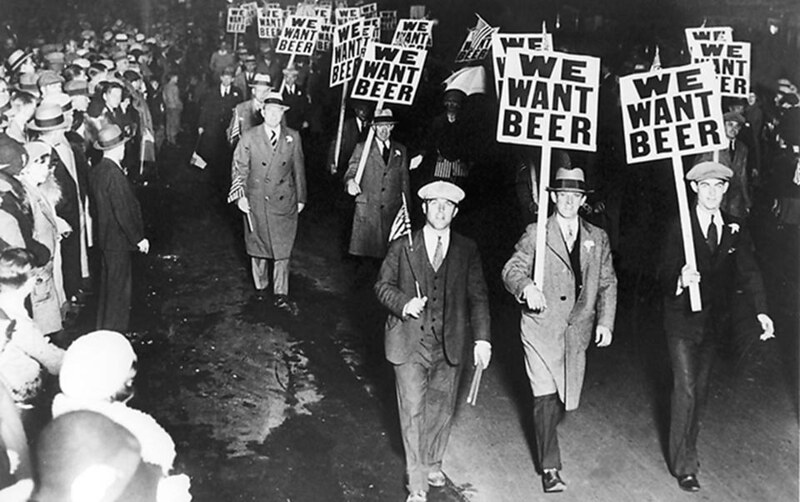
From 1920 to 1933, it was illegal to produce, import, transport and sell alcoholic beverages. This teetotaler era in the United States, known as Prohibition, happened to be in force during the 1932 Olympics hosted in Los Angeles, California. But according to David Wallechinsky and Jaime Loucky in their book, The Book of Olympic Lists, “in the interests of international goodwill the US government suspended its prohibition against alcoholic beverages to allow French, Italian and other athletes to import and drink wine.”
Anti Prohibition Protest in New York City in 1932.
Frenchman, Noël, believed that “wine was an essential part of his diet,” according to sports-reference.com. Apparently, the world record holder and eventual gold medalist in the discus throw, John Anderson, led nearly the entire competition. But in the fourth and final round, after Anderson’s leading throw of 49.49 meters, Noël was reported to send a discus way past Andersen’s best throw at the time. But apparently, “the officials were watching the pole vault and did not see it land. Noël was given an extra throw but could not produce his top throw again and he would eventually place fourth.”
Before his mighty but unofficial throw, Noël was said to be “swigging champagne with his compatriots in the locker room between rounds at the discus event.”
The high school girl in Japan is as iconic an image of Japanese popular culture as the ninja, Mt Fuji and Hello Kitty.
For whatever pop psychology reason you want to imagine, the teenage girl in a uniform, particularly those that echo the naval uniforms of Europe in the 19th century, is a constant in Japan’s mainstream (and not so mainstream) culture. More interestingly, the fighting high school girl is a uniquely popular phenomenon in Japan – case in point, the iconic characters of Sukeban Deka and Sailor Moon.
1989 High School Sumo Kanazawa Tournament
In promotion of the 101st High School Sumo Kanazawa Tournament, to be held on Sunday, May 21, 2017, a video called “Sumo Girls Eighty Two Techniques” was released. The Japan pop culture site, SoraNews24, provides details on these 82 techniques.
Most people, however, are likely more interested in the visuals.
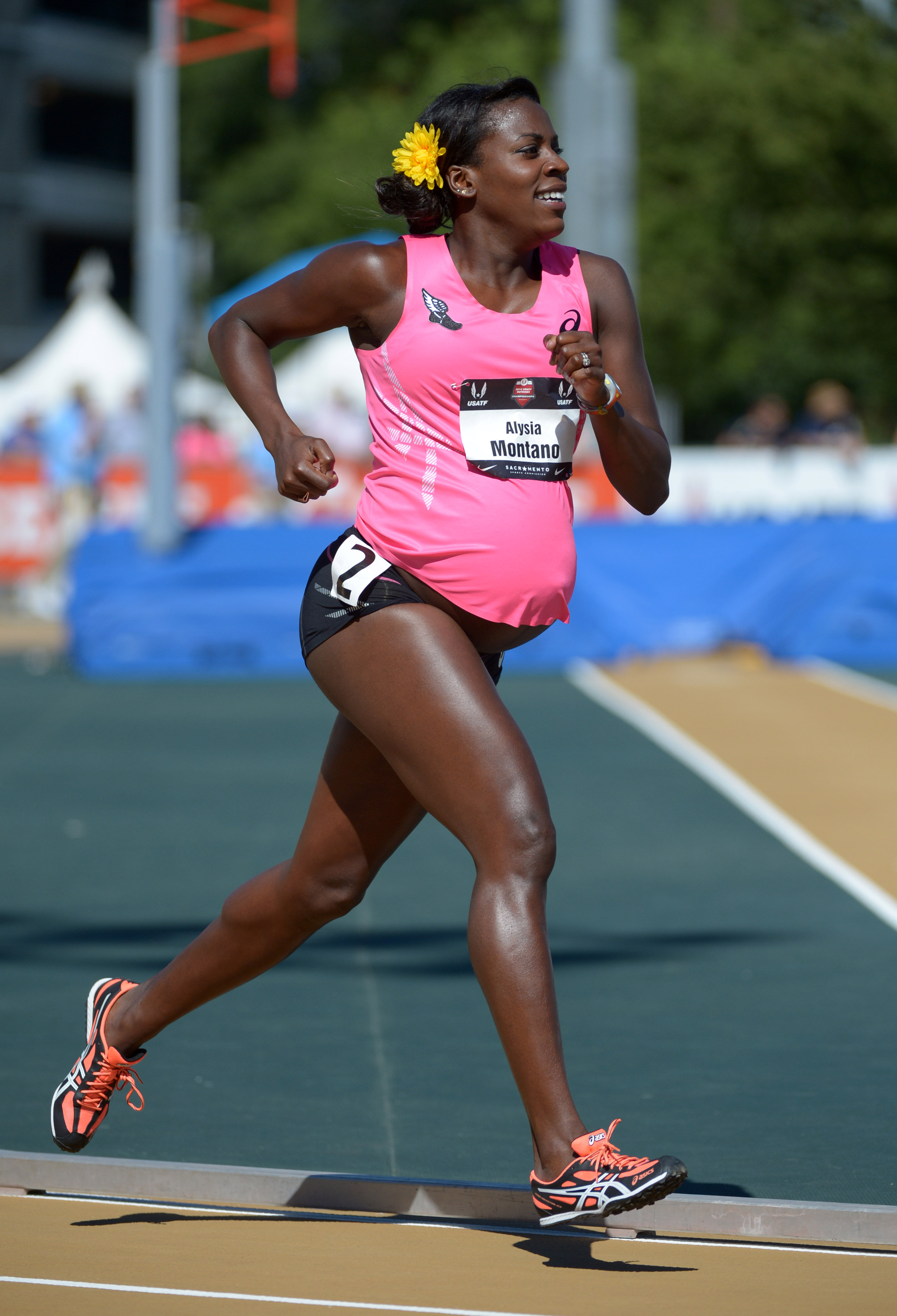
Alysia Montaño competing at the 2014 USA Outdoor Championships
Athletes are always pushing the boundaries – doing and accomplishing things that most others would not try or even think of doing.
When Alysia Montaño was considering whether to compete in her fourth straight USA Outdoor championship in 2014, she made a decision to do so – a daring decision considering she was 8 months pregnant!
This link, which shows a list of athletes who competed in the Olympics while pregnant, is filled with names of people who were 5-months pregnant or less. I wrote about the famed Flying Dutchwoman, Fanny Blankers-Koen, who was three-months pregnant when she won four gold medals at the 1948 London Olympics. Today, it is more and more common to hear about athletes competing while pregnant.
But Montaño race at 8 months was eyepopping. She was not out to win the 800 meter competition at the USA Outdoor Championship. In fact, she completed her race 35 seconds off her personal best. Her objective, as she related in this CNN interview, was to show the world what it looks like for a pregnant woman to be working, even as late as 8 months.
I recognized it was unlikely for people to see a pregnant woman running, in general. I wanted people to recognize that fitness and pregnancy is a really good thing, and this is what it looks like being a professional woman, whether my profession happens to be a professional athlete, or a businesswoman who has to go in an office and work 9 to 5. This is what it looks like for me as a professional athlete and wanted people to see that.
Of course, everyone wonders, is it safe? And Montaño has explained in many interviews that she did consult with her doctors, who not only said it was safe, it is a very good idea for women who are pregnant to exercise. Montaño explained that the immediate concern in running is not to fall. But like walking down the street, when a pregnant woman’s center of gravity is different from when she is not pregnant, she has to always remember to keep the posture upright. Montaño concentrated on doing so during the race.
In Montaño’s interview with ABC News, Senior Medical Contributor Dr. Jennifer Ashton explained that “pregnancy is not a disease,” and “we have to remember, pregnancy, labor and delivery – we have to train for them.”
As explained in this article, only one out five pregnant women exercise according to a study commissioned by the International Olympic Committee, and that “The American Congress of Obstetricians and Gynecologists (ACOG) recommends at least 150 minutes per week of moderate-intensity aerobic activity for women with uncomplicated pregnancies (although contact sports, scuba diving, sky diving, hot yoga or activities with risk of falling should be avoided, reads the organization’s opinion).”
Said Dr. Raul Artal, who co-authored the report, “pregnancy should not be a state of confinement but rather an opportunity for women to continue an active lifestyle or to adopt an active lifestyle if they were not active before.”
Amber Miller competing at the 2011 Chicago Marathon
Amber Miller certainly didn’t confine herself. At the age of 27, while 39 weeks pregnant, Miller ran in the 2011 Chicago Marathon. It was not publicized, but when people realized she was pregnant, she got a lot of double takes and words of encouragement, as noted in this New York Times Well blog post.
Miller finished the race three hours off her personal best, in 6 hours and 25 minutes, mixing in walking with running. But then after the marathon, she embarked on a second one. While running she experienced contractions. Eight hours after completing the marathon, she gave birth to a baby girl. Which of the two was more difficult? “I don’t feel anything from the marathon, but I do feel what you’d expect after giving birth,” she said the day after.
So for all the mothers who have toughed it out, by just having children, Happy Mother’s Day!
My dear Father, my dear Mother, I enjoyed the delicious three-day tororo soup, the dried persimmons, and the rice cakes. My dear Brother Toshio, and my dear Sister, I enjoyed the delicious sushi. My dear Brother Katsumi, and my dear Sister, I enjoyed the delicious wine and apples. My dear Brother Iwao, and my dear Sister, I enjoyed the delicious shiso herbal rice, and the nanban zuke pickles. My dear Brother Kikuzo, and my dear Sister, I enjoyed the delilcious grape juice and Yomeishu wine. I enjoyed them. And thank you, my dear Sister, for the laundry you always did for me. My dear Brother Kozo and my dear Sister, I thank you for the rides you gave me in your car, to and fro. I enjoyed the delicioius mongo-cuttlefish. My dear Brother Masao, and my dear sister, I am very sorry for all the worries I caused you. Sachio-kun, Hideo-kun, Mikio-kun, Toshiko-chan, Hideko-chan, Ryosuke-kun, Takahisa-kun, Miyoko-chan, Yukie-chan, Mitsue-chan, Akira-kun, Yoshiyuki-kun, Keiko-chan, Koei-kun, Yu-chan, Kii-chan, Shoji-kun: May you grow up to be fine people. My dear Father and my dear Mother, your Kokichi is too tired to run anymore. Please forgive him. He is sorry to have worried you all the time. My dear Father and Mother, Kokichi would have liked to have lived by your side.
These were the handwritten words of Kokichi Tsubaraya, one of two notes he left as explanation for why he took his life in his dormitory room of the Ground Self Defense Forces. Tsuburaya was a soldier, but he was also a Japanese icon, winning the bronze medal in the marathon at the 1964 Tokyo Olympics. As he wrote, he was simply “too tired to run anymore”. As described in a previous post, injuries and heartbreak may have led to Tsuburaya’s demise.
Suicide rates, while decreasing in recent years, thankfully, have been traditionally high in Japan compared to other countries. Perhaps there is a romanticism connected with suicide in the deep recesses of Japanese culture. So when some of Japan’s most celebrated writers, Nobel Prize winners Yukio Mishima and Yasunari Kawabata, read the suicide note of Kokichi Tsuburaya, they swooned at the simple yet striking words of the athlete. Mishima viewed Tsuburaya’s notes as “beautiful, honest and sad.” And as Makoto Ueda explained in his book, Modern Japanese Writers and the Nature of Literature, Kawabata was even jealous of the quality of Tsuburaya’s poetry.
Kawabata was deeply moved upon reading this suicide note. After citing it in its entirety, he offered to explain why: “in the simple, plain style and in the context of the emotion-ridden note, the stereotyped phase “I enjoyed” is breathing with truly pure life. It creates a rhythm pervading the entire suicide note. I tis beautiful, sincere, and sad.” Kawabata then observed that this suicide note was not inferior to similar notes written by reputable writers, despite the fact that Tsuburaya was an athlete who boasted no special talent in composition. Kawabata even felt ashamed of his own writings, he said, when he compared them with this note.
Another giant of Japanese literature, Kenzaburo Oe, was also impressed by the suicide note of Tsuburaya. At a series of talks Oe gave at the University of California, Berkeley in April 1999, he talked about how Tsuburaya’s suicide note was a wonderful cultural marker of the 1960s, a reflection of Japan in a state of transition during a period of intense social, economic and political change. Let me quote Oe at length here:
We know from this note that Kokichi Tsuburaya was from a big family. The many names he mentions probably do not evoke any particular feeling in a non- Japanese, but to a person like myself—especially to one who belongs to an older generation of Japanese—these names reveal a naming ideology of a family in which authority centers around the paternal head-of-household. This family-ism extends to the relatives. There is probably no large family in Japan today where children are named so thoroughly in line with traditional ethical sentiments. Tsuburaya’s suicide note immediately shows the changes in the “feelings” of the families of Japanese these past thirty years.
The many foods and drinks he refers to also tell of the times. Twenty years had passed since Japan’s defeat, and it was not a society of food shortages. But neither was it the age of satiation and Epicurean feasting that began ten years later. The year Tsuburaya died was the year that Nikkeiren, the Japan Federation of Employers’ Association, tried to counter the spring offensives—the annual demand by labor unions for wage hikes and improved working conditions—by arguing that the sharp increase in prawn imports was evidence of a sufficient rise in the standard of living. More consumers were eating imported frozen prawns. Business administrators keep an eye on such trends. And I think that honestly expresses the eating habits of Japanese people at this time.
Domestically, 1968 saw the rage of student rebellions, most noted among which were the struggles at Tokyo University and Nihon University. Outside of Japan, there was the May Revolution in Paris, and the invasion of Soviet troops into Prague. In retrospect, we clearly see that the world was full of premonitions of great change.
Against this backdrop, a long distance runner of the Self-Defense Forces— itself a typical phenomenon of the state of postwar Japan’s twisted polysemous society—turned his back on the currents of such a society, alone prepared to die, and wrote this suicide note. In the note, the young man refers to specific foods and drinks, he encourages his nephews and nieces to grow up to be fine people; he is overwhelmed by the thought of his parents’ loving concern for him and writes that he knows their hearts must never have rested in their worry and care for him. He apologizes to them because, having kept running even after the Olympics with the aim of shouldering national prestige, he became totally exhausted and could no longer run. He closed his note with the words: “My dear Father and Mother, Kokichi would have liked to live by your side.”
Tsuburaya was a man of his times, celebrated in 1964 for his accomplishments as an athlete. Today he is also remembered for his eloquence in representing the Every Man in Japan, a poet who is said to have captured the essence and the angst of those times.
Roy with 1964 Tokyo Olympic TorchThe Olympians has been a labor of love for exactly two years. It is my sketchbook as I prepare for the mural masterpiece, a book on the 1964 Tokyo Olympics.
While my book’s focus is on the XVIII Tokyo Olympiad, I use my blog as an excuse to write about anything even remotely related to these areas: the Tokyo Olympics, the Olympics overall, Japan, and sports in general. In other words, I think of my blog as therapy for a restlessly curious mind.
How else could I go 730 straight days without missing a post?
Roy’s 2nd BirthdayIt’s been exactly two years since I started my journey to understand the context, the organization and the stories of the 1964 Tokyo Olympics. My father was at those games as a news producer for NBC, and I turned one years old on Opening Day.
I moved to Tokyo for a third time in January, 2014, excited by Tokyo’s selection as the host city for the 2020 Summer Games. Surprised to find not a single book on the 1964 Tokyo Olympics in English, I endeavored to write the definitive record. On May 1, 2015, I started my blog, The Olympians is in many ways, the first draft of my book.
All, thank you for your wonderful comments and support!






You must be logged in to post a comment.