He wasn’t high born. He was a farmer from Origgio, Italy. And he could run, and run, and run – Forrest Gump-style. In the 1890’s, Carlo Airoldi was one of the best long-distance runners in Europe. In 1895, the year before the inaugural Olympics in Athens, Airoldi won the Milano-Barcelona footrace, a 12-leg competition of 1,050 kilometers!
So when Airoldi heard about the Athens Olympics, he likely thought a 42-kilometer marathon would not be a problem at all. Unfortunately, there was another problem. He was not a man of means like the majority of athletes attending the Athens Olympics. He could not afford to take trains or ships from Italy to Greece.
So he decided to walk. Two thousand kilometers. So that he could run 42.
He convinced an Italian magazine, La Bicicletta, to sponsor his expenses in exchange for his story. He figured if he walked and jogged some 70 kilometers a day, he could make it to Athens in a month. So, according to this article in Italian, he departed Milan on February 28, 1896, taking his first steps in the cold and windy winter weather. The book, The Olympics: A Very Peculiar History, explains that after making it 700 kilometers to Ragusa, Yugosloavia, Airoldi bought a ticket for a boat to Pattras in Western Greece, before walking another 200 kilometers to Athens.
It took Airoldi a little over a month, but he made it!
Not quite the build you’d expect of a marathon runner….
Airoldi arrived in the Greek capital in early April, just in time for the start of the Olympic Games. Unfortunately for him, these weren’t the Games of the ancient Greeks. These were the Games of Baron Pierre de Coubertin, who believed in the purity of amateur athletics, that only those who were not tainted by victory prizes were allowed to compete.
When asked by members of the organizing committee whether he have ever received money in a competition, Airoldi replied sincerely that he indeed had, the previous year, after winning the Milan-Barcelona race a year before. Perhaps, as the Italian article explains, there was also concern that this renown distance runner from Italy was a threat to the favored Greeks in the marathon. Whatever the reason, a shocked Airoldi was declined eligibility to run in the marathon.
“If only they could walk a mile in my shoes…,” he may have thought.
Albin Lermusiaux of France, jumped out to the lead, but eventually relented to the Greek heat, and quit the footrace at the 32 kilometer mark, carried the rest of the way by horse-drawn cart. Then the Australian, Edwin Flack, jumped to the lead, only to fall at the 37 kilometer mark.
At these first modern Olympic Games in Athens, on April 10, 1896, 80,000 people sat in the Panathenaic Stadium waiting, listening to updates brought in by messengers on bicycles or horses. This was the scene of the very first marathon, an event created for the first Olympic Games. A colleague of Pierre de Coubertin, Michel Bréal, transformed a legendary story of a man named Pheidippides into an Olympic event. In 492 BC, Pheidippides ran from a place called Marathon to Athens, a distance of about 42 kilometers, to deliver new of a Greek victory over Persia, in what is called the Battle of Marathon.
So when the spectators in Panathenaic Stadium saw who was first to enter the stadium, an explosive cheer split the sky. A Greek named Spyridon Louis was to win the final event of the first modern Olympic Games in the spiritual home of the Olympics. Here is how David Goldblatt, author of the book, The Games: A Global History of the Olympics, described the significance of that moment:
It proved to be the most important event of the games, generating the kind of modern mythological hero and collective stadium spectacle that raised the 1896 Olympics above the level of a country-house games weekend or a mere historical recreation…. The man who entered the stadium first was the Greek, Spyridon Louis. The crowd went wild. The king and the crown prince descended to the track to run alongside him and, when the had finished the race, members of the royal entourage and the organizing committee embraced and kissed him.
Coubertin was also impressed, according to Goldblatt. “Egad! The excitement and the enthusiasm were simply indescribably. One of the most extraordinary sights that I can remember. Its imprint stays with me.”
Louis was not a man of wealth. He made his wages by transporting mineral water his father mined to buyers in Athens. After his victory, Louis was showered with gifts, but continued to live a simple life of a farmer and later as a police officer.
Four years prior to his death in 1940, forty years after his momentous victory in the marathon, he could still remember that moment of glory with happiness.
That hour was something unimaginable and it still appears to me in my memory like a dream … Twigs and flowers were raining down on me. Everybody was calling out my name and throwing their hats in the air …
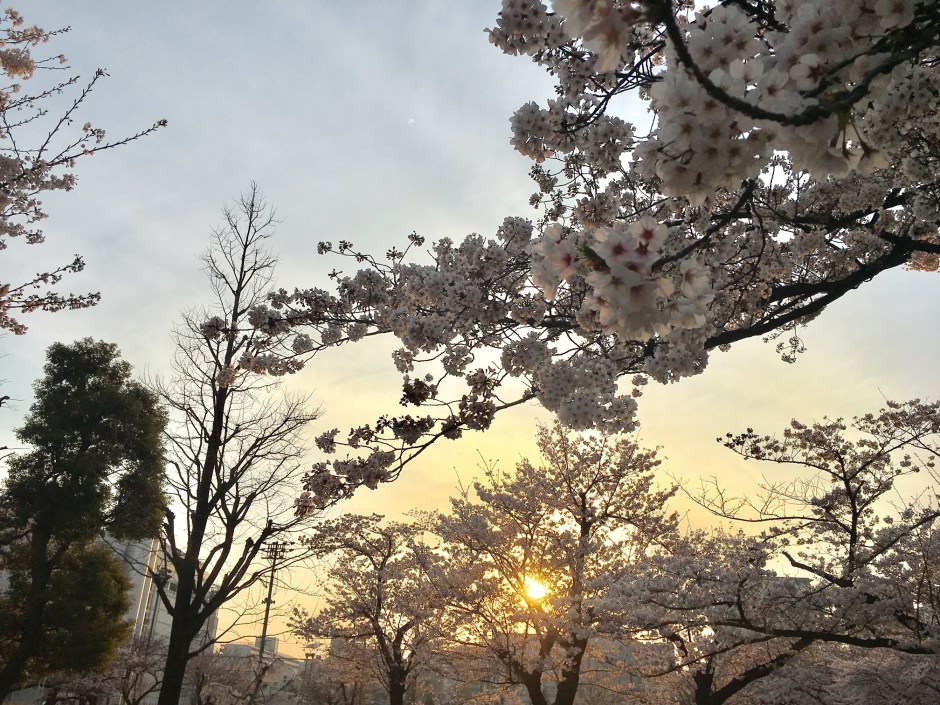
In Tokyo, you know because wherever you go, you are blessed by the blossom.
Unfortunately, the IOC does not entertain the idea of the Spring Olympics, so the image of youthful athletes running through a flurry of falling blossom petals will have to await a fictionalized Hollywood vision.
Naka-Meguro Station_March, 2014
The Summer Games are almost always held in July or August, probably because by now that is a period most other major sporting organizations would avoid for a meet or a championship. Summer Games have been held in October to avoid typhoons (Tokyo) and the heat (Mexico City), and they have been held in November and December (Melbourne) because it is summer down under in those months.
But the very first modern Olympic Games, in Athens Greece, were held in the Spring. The first re-boot of the Games were played from April 6 to 15, 1896. So today is the 121st anniversary of the start of the first Olympic Games.
Kinshicho Park_April 2017
And just as Spring is the best time to visit Greece, you can say the same for Japan. Not only for the incredible food. But also for the eye candy that is the cherry blossom tree. I’ve been in Japan for over 18 years – I never get tired of staring out into a sea of pale pink, or strolling by a lone cherry tree. Even the very first budding of flower on a cool March morning brings delight and warmth.
The cherry blossom, and its representations of youth and beauty, accentuated by its relatively fleeting existence, is an icon of Japan, so much so that it was a powerful emblem in Tokyo’s bid for the 2020 Olympics.
So if you want to see Japan at its best, come during the cherry blossom season.
We live in a 24/7 always on world. When NBC delayed broadcast of premier sporting events at the Rio Olympics, so that they could present them during prime time in the evenings, their strategy backfired for many. After all, in today’s world, people can learn of the results instantly.
NBC recently announced that for the PyeongChang Winter Olympics in early 2018, all broadcasts will be live, no matter the time in the US.
“That means social media won’t be ahead of the action in any time zone, and as a result, none of our viewers will have to wait for anything,” Jim Bell, president for NBC Olympics production and programming, said in a statement. “This is exciting news for the audience, the advertisers and our affiliates alike.”
Since South Korea will be 14 hours ahead of the East Coast of the United States, if an ice hockey match starts at 8pm in Korea, then New Yorkers can watch it real time, but they’ll have to be up at 6 am to do so. Of course, if you’re a big hockey fan, trying to avoid hearing the score for another 12 hours before watching it prime time would be a pain in the neck, if not impossible.
This may actually be ho hum news for most people.
But in 1964, the prospect of broadcasting the Tokyo Olympics live to other continents was an exciting thought.
NHK camerman at the 1964 Tokyo OlympicsLive broadcasts in 1964 were not new. The 1936 Berlin Olympics were shown live on German television. The 1960 Rome Olympics were the first to be broadcast live across Europe. But, according to John Slater of Western Carolina University, Japan wanted the 1964 Tokyo Olympics to be the first broadcast live to another continent.
Slater wrote in this abstract that members of the Tokyo Olympic organizing committee wanted the Tokyo Games to be known as the Technology Games. And so they contacted the American government in Washington D. C. if they would be willing to adapt American communication satellites designed for telephone communications to relay television signals. American officials also thought it would be very cool to be the first Games to broadcast signals literally across the globe.
NHK, the Japanese Broadcasting Corporate, built a transmitter in Japan, and the US Navy made modifications to a communications facility in California, and NASA which operated the satellite Syncom II, moved its orbiting location from the Atlantic to the Pacific. And when they tested the ability to send visual and audio television signals from Japan to North America real time, it worked! But as Slater wrote, NBC, which owned the broadcast rights in the United States, got very defensive.
The U.S. Department of State coordinated the use of the necessary radio frequencies. The system worked, and the Communication Satellite Corporation offered to make satellite time available. Both CBC and the European Broadcasting Union signed up for an hour a day, at a cost of U.S. $150 a minute.
But NBC chose to protect its investment in exclusivity. It got hung up on NASA’s policy that programs sent via experimental satellites should be made freely available to all competing media. In the end, only the opening ceremonies were televised live in the United States, and then only in the East. During the competition itself, U.S. viewers had to wait to see next-day videotapes of the Games, while viewers in Canada and Europe got the full benefit of live coverage. The Canadians had embraced the new technology, while the U.S. broadcasters tried to fend it off as a threat to their commercial interests.
NBC got an earful for promising live broadcasts, but actually providing tape-delayed shows in the evenings.
But that was 1964. Today, on the eve of the PyeongChang Winter Olympics, NBC will be giving sports fans immediate gratification.
Apparently, President Trump is not the only world leader who has to deal with fake news. During the Sochi Winter Olympic Games, Russian President, Valdimir Putin also suffered such attacks.
Jimmy Kimmel, American comedian and late-nigh talk show host, pulled a fast one on the American public by playing up the problems in Sochi. He referred to stories of packs of dogs “roaming the streets, even spotted in the hotels.” He then showed a video that US Olympic luger, Kate Hansen, posted on her Twitter account the previous evening – an animal, presumably a wolf, walking through the hallway outside her Olympic Village dorm room.
As we learn in this Kimmel segment, the press went wild.
“A wolf in the hallway! And I’m not talking Blitzer!”
“You’ve heard of the Wolf of Wall Street. How about the Wolf of Olympic Village.”
“Oh god. It gives me chills.”
“I think it might have been a dog, but it’s definitely wolf size.”
But then Kimmel let us in on the prank. Kimmel produced the video on their Los Angeles set, re-creating a replica of a Sochi dorm hallway, and Hansen agreed to allow Kimmel to momentarily take over her Twitter account.
Robbie Brightwell was a 16-year old student in Shropshire, England, and was straining to keep his eyes open while doing research in his local library when he came upon an old magazine and was struck by a picture of runners in a competition sometime in the late 19th century. As he related in his autobiography, Robbie Brightwell and His Golden Girl, he was surprised to see that in an area called Much Wenlock, not far from his own, there was a sporting event called “The Olympics”.
Intrigued, Brightwell, who went on to captain Britain’s track and field team at the 1964 Tokyo Olympics, began impromptu research into the Much Wenlock Games, and learned that Baron de Coubertin, at the age of 27, came to Much Wenlock and met an 81-year-old English physician, who planted the idea for what we now recognize as the Modern Olympics.
But as is true with any great endeavor, new ideas and initiatives are often built on earlier iterations. According to The Games: A Global History of the Olympics by David Goldblatt, events held in both England and France could be considered precursors to Coubertin’s Olympics.
The Cotswold Games: In the early part of the 17th century, fairs and festivals were a common part of the English country lifestyle. One of the biggest in England was the Cotswold Games in Chipping Camden, a mixture of fun and sports, contests and gambling. As can be seen in the poster for the Cotswold Games, also known as the “Cotswold Olimpicks”, there was a mock castle created on a hill, in front of which was the main theater for the events. Developed by Robert Dover, a “charismatic and charming man”, the Cotswold Games featured “hare coursing and horse racing, wrestling and shin kicking, stick fighting and hammer throwing.” Dover established this country fair in 1612 and was able to organize the Cotswold Games for about 30 years. Unfortunately for Dover, and perhaps the community of Chipping Camden, the 1630s saw a shift from the hedonistic reign of King James I to a more conservative, puritanical approach of Oliver Cromwell, who overthrew the King in 1645. That put an end to the Cotswold Games.
The Republican Olympiad:When the French monarchy was overthrown in the French Revolution of 1789, leaders of the new republic were excited about change to come. One of the leaders of the revolution, Charles Gilbert Romme, devised a way to update the calendar for a new, enlightened France. With five days added to the year, with the inclusion of another day added to a Leap Year, which would take place every four years. According to Goldblatt, “Romme thought that the lead day might be a good occasion for staging public festivities and games: ‘we suggest calling it the French Olympiad and the final year the Olympics Year.” In 1796, the first Republican Olympiad was held in Paris, where hundreds of thousands came out for games, music, dancing, running and wrestling. Winners of competitions won wreaths of laurels, pistols, sabres, vases and watches. The Republican Olympiad continued for two more cycles, but died out before the start of the 19th century.
John Lennon in front of poster that inspired “Being for the Benefit of Mr. Kite”
Pablo Fanque’s Travelling Circus Royal: As Goldblatt noted, the Olympics were often more often associated with circuses in the 18th and 19th centuries in England. One of the most popular traveling circuses was called Pablo Fanque’s travelling Circus Royal, which offered an “unrivalled equestrian troupe” and ” new and novel features in the Olympian Games.” Pablo Fanque was said to be the most popular circus proprietor in a golden age of circuses in Victorian England, and was quite accomplished not only as an equestrian, but also as a master of the corde volante. But as you may be able to tell, Fanque’s association to the Olympics is peripheral at best. His association to The Beatles may be stronger. The album, Sergeant Pepper’s Lonely Hearts Club Band” featured a song called “Being for the Benefit of Mr. Kite“, the lyrics of which are primarily lifted from an 1843 poster marketing Fanque’s Circus Royal.
The Much Wenlock Olympian Games: Dr Penny Brookes of Shropshire, England, agreed with the thinking of the time, that it was important to promote “the moral, physical and intellectual improvement of the inhabitants of the town…by the encouragement of outdoor recreations and by the award of prizes annually at public meetings for skill in athletic exercises and industrial attainments.” The first Much Wenlock Olympic Games were held in 1850. While these Olympic Games were a rural fair, they also had a firm sporting focus. In addition to fun events like wheelbarrow and sack races, both amateurs and professionals competed in cricket, football, archery, hurdling, running, shooting, cycling and a pentathlon. Large cash prizes were awarded.
When Baron de Coubertin, was told about the Much Wenlock Olympic Games, he made it a point to visit and meet Dr Brookes, a seminal act in the origin story of the modern Olympic Games.
William Penny Brookes in 1876 Photo WENLOCK OLYMPIAN SOCIETY
Konjiki Tsukasa was on October 10. So he thought it would be great to get married on October 10. And since the Olympics were in town, why not get married at the National Stadium on October 10, 1964, the opening day of the Tokyo Olympics.
His fiance, Masa Akimoto, agreed.
But first they had to get tickets. According to an article in The Yomiuri on October 11, 1964, the couple had 70 friends apply for opening day tickets, perhaps the hottest tickets ever to go on sale in Japan at the time. The system at the time was to apply and get your names thrown in a lottery. Fortunately, two of their friends landed them a ticket each.
But now, in addition to a ticket for the priest, they needed two witnesses. Instead of trying to find two more tickets, Konjiki called the Japan Travel Bureau (JTB) many times to try to convince them to find two people who already had tickets to the Opening Ceremonies to be their wedding witnesses. According to an October 5 Yomiuri article, JTB personnel did not initially take the requests seriously, suspecting a possible scam. But Konjiki persisted, and finally convinced JTB to find two people who happened to be seated near Konjiki and Akimoto. JTB then provided an extra ticket for the priest.
Wearing red blazers with the Olympic emblem, likely similar to what the members of the Japanese Olympic team wore, the party of five entered the stadium at 10 am, about 5 hours prior to the start of the Games, and got hitched. They then proceeded to wait patiently, got to their seats for the Opening Ceremonies, and had one of the memorable wedding days a Japanese couple could possibly have.
That was one way to get in to see the Opening Ceremonies. The Yomiuri explained on October 11 another way…which did not end well. I’ll just let you read the report about these two students:
Two youths without tickets so eager to see the opening ceremony of the Olympic Games that they hid themselves in National Stadium before the event, were arrested before the start of ceremonies by patrolling policemen.
A 19-year-old boy from Tsuabame, Niigata-ken, whose name was withheld, entered the stadium Thursday (two days before) wearing a fake press armband, after showing a business card of a Niigata Nippo newspaper reporter.
A second youth, Shuro Iino, 21, freshman a Waseda University, was discovered hiding in a toilet at 11:15 pm Friday, after climbing over a fence.
My friends know this: I’m addicted to Nissin Cup Ramen.
There’s something about the aroma after I’ve waited that obligatory 3-minutes for the hot water to soften the noodles and bind the various spices and ingredients in a flavor that instantly gratifies me. This is not a universal addiction to Cup Noodle. It has to be made in Japan – the ones manufactured elsewhere are probably catering to local tastes, and to my palate, pale in comparison.
I don’t believe they manufacture the King Size version anymore, but if they did, I’d buy.
Nissin Cup Ramen also tends to have the coolest commercials. One released in November, 2016 is not only super fun, it is appealing to the same demographic the Tokyo 2020 Olympics are trying to appeal to. In a somewhat tenuous take on The Seven Samurai, Nissin created a commercial that features athletes decked out in traditional armour that the West now associate with the warrior class known as the samurai.
And the seven featured in this commercial are magnificent! They surf, they skateboard, they pogo-stick over street vendors, they spin on their bikes, do acrobatic twists on skis to the amazement of the bewildered crows around them.
Over the decades, the IOC has worked with host countries to appeal to the youth, and ensure a market for their product for years to come. The X-Games, an ESPN-sponsored event featuring extreme sports, drove up the popularity of skateboarding and freestyle motocross. Thanks to growing popularity of these youth-driven activities, snowboarding became an Olympic sport in 1998, while BMX cycling debuted at the 2008 Olympics.
Tokyo 2020 will feature a bevy of new competitions that the organizers hope will build a new generation of Olympic fans, including surfing, skateboarding, and sports climbing.
The oldest golf club in the world, Muirfield Golf Club, located in Scotland, the birthplace of golf, recently decided to provide women the opportunity to have equal membership with male members. It took 273 years, but as Virginia Slims once proclaimed, “You’ve come a long way, baby.”
This change in policy came after the famed golf club was denied the chance to host the British Open golf championship because of its membership rules. Other clubs like R&A, The Royal St George’s and Royal Troon in Scotland, Augusta National in the USA, and most recently the Royal Adelaide Golf Club in Australia have changed their membership policies to allow for full membership to women.
But the Kasumigaseki Country Club in Saitama, not far from Tokyo, has stuck to its guns despite significant pressure to offer equal membership rights to women. Currently, female members of the Kasumigaseki C. C. are not considered full members, and are not allowed to play on Sundays. Ordinarily, this particular policy would go unnoticed if not for the fact that Kasumigaseki C. C. was selected to be the Olympic venue for golf during the 2020 Tokyo Olympics.
More recently, International Olympic Committee Vice President, John Coates, said that “Image-wise, our position is clear. We will only go to a club that has non-discrimination.”
Coates went on to reveal that discussions with the Kasumigaseki Country Club have been positive, and that “It’s heading in the right direction for them to have a nondiscriminatory membership procedure. It would appear that we should be able to have this result by the end of June.”
So will Kasumigaseki Country Club end up par for the course, or will they shank their last drive and lose out on this golden opportunity at the 2020 Tokyo Olympics?
Mel Pender receiving his Medal of Honor_from the collection of Mel Pender.
Ella Fitzgerald and Louis Armstrong had to overcome the challenge of being Black in America, and discovered in their trips to Europe that their talent was far more significant than their color. Over 100,000 African Americans were sent to Europe to fight during World War I. After the war, a large number stayed, feeding the fascination for jazz music that began to fill the most popular clubs in Paris. In Europe, blacks were viewed not as inferiors, but as individuals. And jazz artists were revered.
Two-time Olympian, Mel Pender, is African American, has been subject to subtle and overt discrimination throughout his life in Georgia and in the US military. His autobiography, Expression of Hope – The Mel Pender Story, is peppered with such anecdotes. He joined the US military which had just begun de-segregation, in advance of the Supreme Court ruling for schools to end de-segregation between whites and blacks. So Pender had expected an even higher respect for meritocracy and equality in the Army. And yet, he remembers his first trip on the bus en route to basic training. The bus stopped for lunch. The whites went in the restaurant through the front door, and the blacks through a side door. Pender silently fumed.
I would not get off the bus to use the bathroom, I guess in protest, so needless to say I suffered the remainder of my ride to Fort Jackson. Naively perhaps, I thought that when I joined the army, despite the color of my skin, I would be treated the same as any other soldier. Again, I would ask the question why? I thought I could do the same as whites and be given respect as a soldier, ready and willing to fight and die for this country.
Pender recalled another time in America , just before shipping out to Okinawa, when he was a part of an integrated, racially mixed troop of soldiers who were taking leave for different parts of the country. He and his colleagues, all of whom were white, decided it would be faster to hitchhike to Atlanta than wait for a bus. When they got to the highway, they suddenly waved good bye to Pender saying “we’ll see you later!”
The soldiers walked off down the road, leaving me behind. I guess they felt that they would not get picked up being with a black person. Well, I wasn’t sure what to do next. It was pitch dark out, raining, and frankly I was scared.
When Pender arrived in Okinawa, Japan, in 1960, he had no reason to expect any different treatment from the Japanese. But as it turned out, Pender had, quite unexpectedly, a “Black American in Paris” experience. He couldn’t believe how wonderful the people were.
It was a completely different world to any previous experience I had gone through. The people were hard-working, intelligent, and very polite. This was the first time a group of people had shown me so much respect. It was new to me, and I loved it. For the first time I felt free as I interacted with them. The shackles of stereotypes and expectations of prejudice melted away, and I felt really good about myself. I quickly realized that the absence of racial barriers with these people was the reason for my feeling of well-being, acceptance, and almost happy self-abandonment.
As mentioned in Part 1, Pender discovered that he had a talent for sprinting. When he emerged victorious in a track meet between US military athletes and Japanese athletes training for the 1964 Tokyo Olympics, he was asked to compete in the inner-service competitions, where he was crowned champion in 100- and 200-yards. His commanding officer rewarded Pender with seven days of “R and R” (rest and relaxation) in Yokohama – the so-called mainland!
From the collection of Mel Pender
That’s where Pender found his muse. He was enjoying his time in Yokohama immensely where “the people on the mainland were even nicer.” And on his last day, he and his friends went to the NCO Club where he met a Japanese lady named Monako Yamamoto. Pender was bewitched, telling me “I was in love. She was beautiful.” He said that Yamamoto said the Olympics would be in Tokyo in 1964, so Pender promised that he would then make the team and be back to see her for the Olympics. In fact, as he wrote in his book, Pender knew very little of the Olympics at that time.
She smiled and said, we will see. Well I did not know much about the Olympics or the track team, and I had no idea how to even go out about getting onto the team. I just knew that I wanted to come back to Japan, one way or the other. Overseas was great because we were not black or white, just Americans.
Japan gave Pender a vision of what a life of equality and mutual respect would feel like. But Pender also knew that the potential was always there in America. Back to Pender’s story, about being abandoned by his fellow white soldiers at the highway, in the dark, in the rain. Eventually, a black driver picked Pender up and drove him to a nearby gas station where he hoped to catch a bus. Still alone, he sat there wondering how he was going to get home, when a car pulled up.
Well, I sat down to wait, and to my surprise, a car pulled up full of white guys: “You need a ride?” the driver yelled out?
“I’m going to Atlanta,” I told him.
“Hop in!” he said, and they took me all the way to Peachtree Street in downtown Atlanta. Now these guys also were in the military, and they did not know me, yet they were kind enough to look out for me. But the same guys I had spent every day with, that I would have to fight side by side with, face life-and-death situations with, deserted me as soon as civilian streets beckoned.
What happened was ironic, but at the same time, the end result of the incident was inspiring. There is always reason to hope, to believe that change for the better is possible. You see, I believe that as long as there are some good people in this world, then good decent principles will win out over the bad ones, even if it takes time. Patience is a virtue, and hope for progress in human relations is a necessary first ingredient for anyone who dreams of a better future in a better society.




You must be logged in to post a comment.