miyuki-zoku-2

The gauntlet was thrown.

“To the weak-livered denizens of Ginza – you who wear sun glasses, tight pants, and saunter down the street carrying a big paper bag as you chase the girls from the day-time – If you are men accept my challenge. I’m 56 years old but let’s see who will last the longer in the marathon…”

Apparently, those were fighting words, at least as translated by the Mainichi Daily New on September 16, 1964. The above notice was a challenge to race a marathon, for the senior Japanese to show his manly vigor in a competition of endurance. And yes, it got the attention of the teenagers, who were labeled the “Miyuki-zoku”, a mix of boys and girls who gathered on the fashionable street in the Ginza called Miyuki Street. (The suffix “zoku” means “tribe” or “club”.)

detectives-question-miyuki-zoku
Mainichi Daily News_September 17, 1964
So on the appointed time of Monday, September 14, 1964, the Mainichi Daily News reported that “hordes of onlookers, young and old, flocked to the place of challenge in front of the fountain in Hibiya Park.” Members of the Miyuki-zoku came out to meet the challenge of the 56-year old, but as it turned out, not only did the elderly challenger not appear, the police had already rushed to the scene to ensure an unauthorized marathon did not take place.

It was only a few months earlier when Heibon Punch, a new magazine focusing on fashion, started a revolution by launching the so-called “Ivy Look”. Other magazines like “Men’s Club” followed quickly, going into detail on cool Ivy. (See my previous post on this here.) When teenagers in Japan saw how young men were dressing in the United States, particularly at the Ivy League universities, with their perceived associations of class and style, they found an exciting replacement for their drab, black school uniforms, and a way to rebel.

Yes, it took the preppie look for kids in Tokyo to flip parents and authorities the bird – which is astonishing, if you look at the pictures today.

But this is Japan. And the Japanese proverb most quoted to explain social behavior here is “the nail that sticks out gets hammered down.” In other words, it’s important to conform. Those who don’t, are informed in no uncertain terms that they need to do so.

And so in the 1960s, in a time of burgeoning prosperity, with a generation that grew up with faint memories of post-war rubble and hunger, there grew a hunger to express one’s individuality, and dare to be that nail that sticks out, even if just a tad.

But the authorities were concerned about even this whiff of rebellion. After all, the Olympics were coming to town and Tokyo had to be clean, friendly and most of all orderly. These “hordes” were unsightly, the boys in their (gulp) tight, high-cut slacks with oxford-cloth or madras plaid shirts, and the girls in tight long skirts with the hemline (gasp) several inches below the knee.

miyuki-zoku-3

According to this post in the blog “Ivy Style”, the older generation co-opted a leader of the Ivy fashion movement, Kensuke Ishizu. Ishizu “discovered” this look when he visited college campuses in the United States in the 1950s, and when he returned to Japan, he created a fashion brand called “VAN”, and published Japan’s first men’s fashion magazine, “Otoko no Fukushoku”.

Neighborhood leaders desperately wanted to eradicate the Miyuki-zoku before October, so they went to Ishizu of VAN and asked him to intervene. VAN organized a “Big Ivy Style Meet-up” at Yamaha Hall, and cops helped put 200 posters across Ginza to make sure the Miyuki-zoku showed up. Anyone who came to the event got a free VAN bag — which was the bag for storing your normal clothing during loitering hours. They expected 300 kids, but 2,000 showed up. Ishizu gave the keynote address, where he told everyone to knock it off with the lounging in Ginza. Most acquiesced, but not all.

So on September 19, 1964, a huge police force stormed Ginza and hauled off 200 kids in madras plaid and penny loafers. Eighty-five were processed at nearby Tsukiji jail. The kids got the message and never came back, and that was the end of the Miyuki-zoku.

Oh those raucous and rebellious sixties…

personal-gold-2

Four women, Dotsie Bausch, Sarah Hammer, Jennie Reed and Lauren Tamayo, did something no American women had done in 20 years – win a medal in track cycling at the Olympics.

Their incredible story of training and triumph are told impactfully in the documentary, Personal Gold. You can find a summary of their story at this link here. This post is about the amazing transformation sports performance sciences is undergoing, and how biometric data is making an impact on the training and performance of athletes today.

With incredibly little resources available to them, Reed called her former USA Cycling teammate, Sky Christopherson, who was well on the way of making a marked transition from athlete to entrepreneur. Christopherson had become convinced that digital medicine would become a vital tool for high performance athletes. Understanding how to uncover insight from big data is hugely important in marketing, financial services, economics, and is now a big part of health and human performance sciences.

Due to the relatively low support of the women’s cycling track team by USA Cycling, Christopherson recruited volunteers to help him gather individualized biological and genetic data on each of the four cyclists, data that was being generated by sensors attached to the athletes bodies 24 hours a day, 7 days a week, and then to analyze it.

According to Christopherson, who was also the producer of the documentary, Personal Gold, the amount of information available to them was overwhelming, not only for Sky and his team, but for his computers, which in the early days crashed in trying to cope with the number crunching.

But once Christopherson recruited a big data analysis firm to volunteer their time and expertise, they began to take note of insight they could use. And all the data told them that each cyclist had unique characteristics and individual needs, and thus training them all the same way could at times be detrimental to the individual’s performance and growth. Here are a few examples pointed out by Christopherson at a recent speaking engagement in Tokyo, sponsored by the US Embassy:

  • In Hammer’s case, blood tests showed she had Vitamin D deficiencies, made worse by training indoors most of the time. Having normal levels of Vitamin D is key to getting the most out of one’s training, so Hammer was working harder than she needed to due to her deficiency.
  • Bausch, whose experience was greater as a distance cyclist and was struggling at sprinting speeds, was found to have what is known as the “sprinter’s gene”, which according to this Wired article, boosted her confidence.
  • Sensors noted that Reed was not getting enough deep sleep. More and more research is revealing the importance of deep sleep. In the case of athletes, the longer and deeper you sleep, the more HGH (human growth hormones) like cortisol or testosterone, is released naturally into their systems. These hormones are essential to faster recovery, and thus the ability to train longer at peak performance.

The data can also tell an athlete when an athlete can train hard, when the body is ready for it, or when to rest. This is key because as Christopherson advised, this knowledge can prevent injuries from occurring.

personal-gold-screenshot
Trailer screenshot

I asked Christopherson if this was a case of “Moneyball“, where the women’s team had access to insight that other teams didn’t have, using that information arbitrage to their advantage unbeknownst to the heavily-resourced cycling giants.

“We were grassroots and so we were very nimble and could innovate and change very quickly,” Christopherson told me. Being a small, low-budget operation forced them to be innovative, using whatever resources were available to them in the world. In fact, he felt that the well-financed teams, whose funds came from sponsors, often limited their flexibility. While teams are obligated to using the products of sponsors, the American team had no such limitations, and Christopher told the audience that they had the flexibility to change sensors and equipment as they saw fit.

The proverb, “necessity is the mother of invention”, was never truer.

personal-gold-1
Lauren Tamayo, Dotsie Bausch, Sarah Hammer, Jennie Reed

“It was a miracle,” he said.

Not only had the US not won a medal in team pursuit cycling in 20 years, USA Cycling hadn’t even bothered to organize a pursuit cycling team since 1996. So in 2012, when four American women decided to make a go of it, training desperately for the London Olympics, the collective experience in pursuit cycling in America was minimal, the team’s budget was meager, and the gap between them and the very best in the world was huge.

And yet, as 1996 Olympian, Sky Christopherson told a transfixed audience at a speaking event sponsored by the US Embassy in Tokyo in early December, a miracle indeed happened. Dotsie Bausch, Sarah Hammer, Jennie Reed and Lauren Tamayo came seemingly out of nowhere to win silver in the women’s team pursuit in London.

Hammer was already a four-time Cycling World Champion in individual pursuit, but was determined to be an Olympic champion. Bausch was a model recovering from anorexia who hadn’t started her cycling career until the age of 26. Reed was asked to come out of retirement to join the team to take a crack at the 2012 London Games.

This is the starting point for the mesmerizing documentary, Personal Gold, produced by Christopherson, who had transitioned from Olympic cyclist to entrepreneur. Not only has he become an authority on the relationship between biometrics and genomics and high performance, he also established a consultancy called Optimized Athlete.

sky-christopherson-at-american-center-japan
Sky Christopherson at The American Center Japan in Tokyo

I had the pleasure of watching this documentary at this event, after which Christopherson made himself available for Q&A. His documentary told the story of a women’s cycling team that clearly lacked support in 2012. While Great Britain and Australia’s cycling organizations put tens of millions of dollars into their road and track cycling teams, USA Cycling put all their dollars in road racing, thanks to the success of Lance Armstrong and his colleagues.

Personal Gold tells the story of how the team identified Mallorca, Spain as a good place to train for its low cost and proximity to London. Other national teams would provide a whole cadre of trainers and coaches. When the American team arrived in Mallorca three months prior to the start of the London Olympics, they were shocked to learn that the only support USA Cycling would provide is a single coach.

As is shown in the documentary, the athletes’ husbands played an integral part in Team USA, keeping the bicycles in tip-top shape, shouting out times and providing water during training, cooking meals, giving massages, and being massively important keepers of morale. In addition to the cyclists’ husbands, Christopherson created a virtual team of volunteer advisors – experts on biology, genetics, sleep, a data analytics consultancy, as well as a former Navy Seal who provided guidance on teamwork.

During the course of the training camp, amazing progress was made in understanding the particular strengths and weaknesses of each of the cyclists, and what they needed to do as a team to improve. When the team began its training in Spain, they knew they had to get to world-class speeds of about 3 minutes and 16 seconds in the 3,000 meter race. But try as they could, they could not even break 3 minutes and 20 seconds. Unfortunately, by the time they broke camp, they still had not improved their times.

But Christopherson provided insight into how the body works after training hard. Like the idea of how an “a-ha” moment hits unexpectedly, after periods of great focus and concentration, the body is also readying itself for it’s own “a-ha” moment. “When we arrived in London, we began to taper (our training routine). We mostly rested. And that’s when the biggest potential comes. Of course, it’s unclear how high you will go. But athletes can get into a flow. Something happens, from their hearts, and they transcend.”

As they readied themselves for the qualification round in the velodrome in London, the team from the US tried to stay calm in a velodrome located in a country that is cycling mad. Unfortunately they were going up in the first round against Team GB, and the noise and the support for the Brits was likely intimidating.

The riders selected for this round, Bausch, Hammer and Reed, looked sloppy during the qualification race, their formation far from tight. As it turns out, they achieved their fastest time ever at 3 minutes and 19.4 seconds. But it was disappointing as it was still

tokyo-promotional-video-heart
Screenshot from the 2020 Olympics Tokyo promotional video

I finally took a look at the promotional videos made by the cities vying for the 2020 Summer Games: Istanbul, Tokyo and Madrid.

In my mind, Istanbul and Madrid’s Olympic committees focused on the cities, and thus their videos felt like the tourism promotion videos you might see on CNN. My views aren’t too different from those on this Reddit thread.

The theme of the Istanbul is “Shine Bright Like a Diamond”, the lyrics from Rihanna’s song, Diamonds – the mosques in sun and shadow, the sparkling harbor waters, bustling markets, mixed in with image of infrastructure, high-end shopping, and a very occasional sports reference.

Madrid’s campaign video is more comprehensive in what it showed: high speed rail, modern cityscapes and traditional architecture, universities, greenery, music and dance, shopping and nightlife. And there was even a smattering of sports: amateurs playing golf, on bikes, skateboarding, playing basketball, runners.

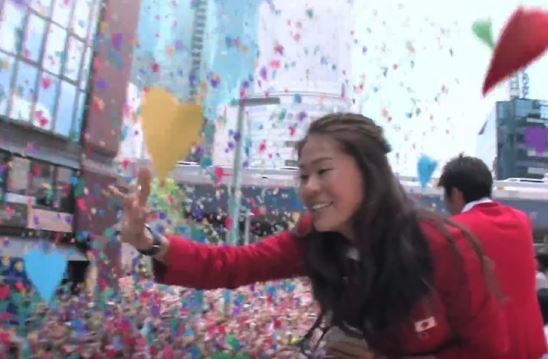
Tokyo’s theme was “Discover Tomorrow”, thoroughly vague. But the images are clearly on athletes, dominated by competitors at the London Olympics, as well as amateur athletes in Japan, interspersed with iconic locales of Tokyo. You feel the intensity of the athletes and the emotions of the spectators, the animated winged-heart providing a thematic visual throughout the video.

I’m biased I know. But the Tokyo promotional video is the best of the three.

tokyo-promotional-video-parade
Screenshot from the Tokyo candidate city promotional video.

Babe Didrikson Zaharias

On July 31, 1932, Babe Didrikson won a gold medal in the javelin throw. On August 3rd and 4th, she ran in the 80-meter hurdles heats and then finals, winning her second gold medal. And on August 7, she battled Jean Shiley to the very end, losing the gold to Shiley on a rule violation.

Somewhere in that week, between July 31 and August 7, Didrikson found time to join three sportswriters for a game of golf at the Brentwood country Club. Famed writer, Grantland Rice, was one of the party of four that played the links with Didrikson, who had never played golf before. According to Rice, Didrikson carded a 91, and hit drives of 250 yards.

After the Olympics, Didrikson’s star shining brightly, Babe showed off her various skills in the vaudeville circuit, barnstormed with a basketball team, and generally played to adoring crowds. In 1935, she began to play golf more seriously, even competing in the all-male Los Angeles Open in 1938. It was at a golf tournament that year when Didrikson met a wrestler named George Zaharias, whom she married later that year.

In the 1940s, Babe Didrikson dominated women’s golf. In one stretch in 1946 and 1947, Didrikson won 14 golf tournaments in a row, including the first time an American had ever won the British Women’s Amateur Championship. To this day, Babe’s streak stands as the greatest in golf history.

In 1950, at the peak of her career, there were only about six tournaments a year for women. Using her influence to round up corporate sponsors, Didrikson formed a new pro tour called the Ladies Professional Golf Association, or the LGPA.

george-zaharias-and-babe-didrikson
George Zaharias and Babe Didrikson

In 1953, Didrikson was diagnosed with cancer and had surgery, which had a positive effect. She would go on to win the 1954 Women’s United States Open by twelve strokes, and became an inspiration to millions. But the cancer would return, as would operations and more golf, until finally, on September 27, 1956, the world’s greatest female athlete passed away.

As mentioned by her fellow Olympic teammate, Jean Shiley, Babe was the boyish, brash, I’m-number-one-preaching-Muhammad-Ali of her time. The New York Times noted in her obituary that as her golf career took off, she began to dress in more feminine wear, embraced her marriage with Zaharias, and even became accustomed to mentoring younger golfers.

But as a top player and drawing power in golf, her attitude and demeanor changed. The once lonely tomboy became a social success. She developed into a graceful ballroom dancer and became the life of many a social gathering. She was too skillful at gin rummy for most and at times, to change the pace at a party, she would take out a harmonica and give a rendition of hillbilly tunes she had learned as a youngster.

This change was the cause of a more convivial feeling toward her by rivals. In her younger days her desire to win had served to toughen her as far as any opponent was concerned. But in her later days, instead of goading her rivals with, “Yep, I’m gonna beat you,” she began encouraging the younger girls on the golf circuit.

fidel-castro-in-1964
Fidel Castro, southpaw, throwing a pitch in 1964

Fidel Castro has passed away. But his legacy for the love of sport continues.

Cuba has the 65th largest GDP in the world today. It has the 78th largest population in the world at 11.2 million people. And yet, in the Americas, only America and Canada have garnered more total Olympic medals than the small island nation of Cuba. Incredibly, in the period from the 1976 Olympics in Montreal to the 2004 Olympics in Athens, Cuba finished in the top 11 medal count. At the Barcelona Olympics in 1992, only the United Team (the former Soviet bloc), the United States, Germany and China got more than Cuba’s 31 total medals.

Clearly, this Caribbean nation has punched way above its weight class, and not just in boxing where Cuba is most famous. In 20 Olympic Games, Cuba has won 79 gold medals, 67 silver medals and 70 bronze medals in judo, athletics, wrestling and of course baseball. By comparison, India, which has a population over a hundred times larger, and the fifth largest GDP in the world, has competed in four more Olympics than Cuba, and yet has totaled only 28 medals.

And according to articles after President Castro passed away on November 25, 2016, Castro had a hand in turning Cuba into a sports power – and it doesn’t appear to be via state-sponsored doping systems. According to this article, sports became a social phenomenon due to state-sponsored institutions.

After Castro entered Havana on Jan. 1, 1959, the revolutionary government approved and implemented a nationwide plan to improve the nation’s sports practice, resulting in free and universal access to sports schools for every citizen.

In 1961, Cuba created the National Institute of Sports, Physical Education and Recreation which was placed in charge of promoting sports for children, adults and even the elderly on the island. The state-run program was also charged with improving the quality of service in its sports facilities, manufacturing its own equipment and conducting research in sports science.

fidel-castro-at-basketball-clinic

But Cuba’s biggest sports cheerleader was, according to the New York Times, was el presidente himself.

“I think Fidel Castro legitimately liked sports,” said David Wallechinsky, the president of the International Society of Olympic Historians. “One got the sense with East Germany, for example, that it really was a question of propaganda and that government officials didn’t have that obsession with sport itself that Fidel Castro did.” Whatever hardships they endured, Cubans could take pride in their sports stars.

But of course, during Cuba’s hey day in the 1970s and 1980s, in the heat of the cold war, Castro could not help but use Cuba’s great sporting achievements as a tool in the battle for geo-political mindshare. Of course, as the Times points out, propaganda is often just propaganda, a smokescreen behind which you hide the uglier shades of truth.

Yet it was primarily baseball, along with boxing and other Olympic sports, that came to symbolize both the strength and vulnerability of Cuban socialism. Successes in those sports allowed Mr. Castro to taunt and defy the United States on the diamond and in the ring and to infuse Cuban citizens with a sense of national pride. At the same time, international isolation and difficult financial realities led to the rampant defection of top baseball stars, the decrepit condition of stadiums and a shortage of equipment.

fidel-castro-and-teofilo-stevenson-in-1984
Fidel Castro boxing great, Teofilo Stevenson in 1984

So for every great sporting star who remained in Cuba, like three-time Olympic heavyweight champion,Teófilo Stevenson, or Javier Sotomayor, still the world record holder in the high jump, there have been many who defected, often to their neighbor to the north, the United States.

What does the future bring? Will the recent thawing of relations initiated by presidents Raul Castro and Barack Obama continue to allow greater travel and expanded opportunities for cross-border business and cultural exchange? Or will President-elect Donald Trump reverse the thaw? Will that have any impact on sports in Cuba?

participation-medal-1

She was a teenager marching into the National Olympic Stadium during the pomp and circumstance of the Opening Ceremony of the 1964 Tokyo Olympics. And she was in awe. This athlete, who wishes to stay anonymous, was from a country that was participating in the Olympics for the first time. She held no aspirations of taking home a medal, and at times, she felt overwhelmed.

But when she saw the following words on the stadium screen, she felt they were meant for her.

The most important thing in the Olympic Games is not to win but to take part. Just as the most important thing in life is not the triumph but the struggle.

The founder of the modern Olympic movement, Baron Pierre de Coubertin, had an idealistic view of the Games, that people and nations were not gathering to win, but to do their best. In fact, from the very first Modern Games in Athens in 1896, the International Olympic Committee (IOC) requires that each hosting organizing committee provide Participation Medals to all athletes attending the Olympics.

I have one, the participation medal from the 1964 Tokyo Olympics. Designed by Taro Okamoto and Kazumitsu Tanaka, the medal was manufactured from copper, with an image of three runners and a swimmer on one side, with the five Olympic rings and the words “XVIII Olympiad Tokyo 1964” in both English and Japanese on the flip side. Only about 5,600 of these medals were created, and as mandated by the IOC, the medal’s dies and molds are returned to the IOC. So in theory, I have one of a limited collection.

participation-medal-2

To be honest, most Olympians are likely not satisfied with going home with just a participation medal. But high jumper, John Thomas, would have been. At both the 1960 Rome Olympics and the 1964 Tokyo Olympics, he was expected by the press and perhaps the USOC to win gold. But he won bronze in Rome and silver in Tokyo, results that should be a matter of pride and joy for Thomas. But as he explained to the AP in 1964, “they have no use for losers. They don’t give credit to a man for trying.”

Over 5,100 athletes attended the 1964 Tokyo Olympics, and over 500 medals were distributed to people who were in first, second or third. In other words, some 90% of all athletes, or about 4,500 Olympians went home without a gold, silver or bronze medal. But they did take home a Participation Medal. And because of that, someone in Bulgaria thought it was OK to sell it to some guy in Tokyo.

wilma_rudolph

When you see a champion, there is almost always a role model.

For Olympic champions like Florence Griffith Joyner, Jackie Joyner-Kersee and Evelyn Ashford, the role model is Wilma Rudolph, the first American woman to win three gold medals in a single Olympic Games. Crowned the fastest women in the world at the 1960 Rome Olympics, Rudolph easily won the gold in the 100-meter and 200-meter sprints, and anchored the American 4×100 team to victory.

Due to her modest grace and her apparent beauty, as well as a life story of overcoming difficult odds to become the best in the world, Rudolph was in the early 1960s the most famous female athlete in the United States, if not the world.

And while she is well known for helping to integrate her hometown of Clarksville, Tennessee when she insisted on the relaxation of segregation laws during her Clarksville Welcome Home celebrations, she has perhaps had a more lasting impact on the success of women, particularly black women, in sport.

wilma-rudolph-1960

At the banquet in her honor during “Wilma Rudolph Day” on October 4, 1960, she made this statement: “In every effort I have been motivated by one thing: to do justice to those who believe in me and to use my physical talents to the glory of God and the honor of womanhood.” David Maraniss, in his book Rome 1960, pointed out that phrase as a symbol of Rudolph’s true lasting influence.

…it was the last phrase of her banquet speech – the honor of womanhood – that resonated deepest and longest. She was by no means the first great woman Olympian, but a unique combination of personal and cultural forces – her style and attractiveness, her candor and pride in who she was and where she was from, the leg braces of her childhood, the fact that she flashed onto the scene so brilliantly at the first commercially televised Olympics, her international esteem – made her a powerful symbol of the rise of women in sports. If there were a Mount Rushmore of women athletes, her profile would be one of the four chiseled faces. “For every woman athlete who came after, she was the person who opened the door,” Ed Temple said later. “Wilma opened that door, and for all women, not just in track and field. She had that smile. She had that charisma.”

Maureen M. Smith wrote the book, Wilma Rudolph: A Biography, and proclaimed, “Wilma Rudolph’s story is more than the races she won and world records she established. It is the story of a young woman who overcame tremendous obstacles that should have kept her from ever experiencing athletic success, and yet she is the epitome of triumph.”

Here was a woman that women, particularly black women, could look up to with pride, and set as the bar for achievement. When Rudolph passed away in November, 1994, here’s what Joyner-Kersee had to say about her idol.

She was someone I could always talk to. She was very inspirational. She was always in my corner. If I had a problem, I could pick up the phone and call her at home. It was like talking to your sister or your mother, someone you knew for a lifetime. I always thought of her as being the greatest, and not only athletically. You respected her as a woman.

jackie-joyner-kersee-with-medals
Jackie Joyner-Kersee with medals

None other than 1960 Olympics teammate and USA team captain, Rafer Johnson, wrote in his autobiography, The Best That I Can Be, that Rudolph’s contribution cannot be overlooked.

One of the most important changes has been the advancement of female athletes. In my day, the public suffered under the assumption that women could not compete in the same sports as men, or had to be protected if they did. I remember women’s basketball, for instance, when each team had an offensive and defensive unit so the players did not have to run full court. Most of the male athletes I knew had great respect for their female counterparts; we were not surprised to see the strides women have made since Wilma Rudolph dazzled the world in Rome.

wilma-rudolph-and-richard-nixon-in-nashville_1960
Wilma Rudolph and Richard Nixon in Nashville_1960

It’s an oft-told tale of Black Americans triumphing overseas – soldiers, athletes and musicians – only to come back home to a world of discrimination and second-class citizenship.

Wilma Rudolph broke the mold.

In the Rome Olympics in 1960, Rudolph won gold in the women’s 100 and 200-meter races, as well as the 4×100 relay, and arguably became the most popular athlete in the world due to her beauty and charm. (That’s saying a lot since Cassius Clay was also on the scene.)

Nearly a month after the end of the Rome Olympics, it was announced by officials of her hometown, Clarksville, Tennessee, that October 4 would be “Wilma Rudolph Day”, and that according to ESPN, Tennessee Governor Buford Ellington, was going to lead the celebration. Tennessee at the time was a segregated state, a place where authorities or owners could require the separation of races in the activities of daily life, like drinking from a water fountain, riding a bus, or eating at a restaurant. And Governor Ellington was a man elected on his support of continued racial segregation.

Rudolph understood the leverage she had at that moment, and said she would accept only if all activities related to Wilma Rudolph Day were racially integrated. It was an offer that no matter where you stood on the political and racial divide, you could not refuse. Rudolph was not to be denied, and so that day was the first time in Tennessee that blacks and whites would be allowed to mix socially.

I found this letter to the editor in the Milwaukee Journal from October 22, 1960, where one Virginia Williams of Wisconsin wrote in praise of Rudolph as the finest of role models for black Americans.

kennedy-and-wilma-rudolph
JFK and Wilma in the Oval Office

Wilma Rudolph, the Negro girl from Clarksville, Tenn., who won three gold medals at the Olympics for her running, also won praise for her good looks and charming ways. This unassuming Negro girl, coming from a large family of average income, brought honor to her race and her country. She brought credit to her country as an ambassador of good will.

County Judge William Hudson spoke in Clarksville at an integrated banquet give for Wilma. With tears in his eyes he said: “If I can overcome my emotions, I’ll make you a speech. Wilma has competed with the world and brought home three medals. If you want to get good music out of a piano, you have to play both white and black keys.”

And in order for America to maintain her leadership in the world, she has to tap all of her resources, utilize all of them. Negroes need America and America needs them.

As one can imagine, race relations in America has improved, but it has been a bumpy road. A few years later, Sports Illustrated caught up with Rudolph on the eve of the 1964 Tokyo Olympics and see how domestic life was treating her. While she was busy being a mom, she was also out on the occasional protest.

It was different in May of 1963, when Wilma took part in two demonstrations at Shoney’s, which is considered one of Clarkesville’s finest restaurants although it does not have much more to offer than hamburgers. She was turned away, together with the other Negroes. “I cannot believe it!: she said to a reporter. “Remember the reception they gave me in 1960?” A few months later Clarksville was integrated.  (Sports Illustrated, September 7, 1964)

XXIII Olympic Summer Games

In the 1970s, after the tragic Munich Olympics in 1972, and the financially disastrous Montreal Olympics in 1976, there were not many cities that had an appetite for the 1984 Olympics. In fact, Los Angeles may have been the only real bid, and thus were able to extract significant financial concessions from the IOC. LA Olympic Committee head, Peter Ueberroth then kept costs low by getting corporate sponsors to contribute massively. In fact Corporate America played a huge role in bringing financial accountability and world-class production values to the Olympics.

In the case of the Olympic mascot, Ueberroth was able to rely on a trusted member of corporate America, Disney. While Disney was a bidder for the mascot design project, it was true that one of the member of the Los Angeles Olympic Organizing Committee’s executive committee was Card Walker, then chairman of the board of the Disney Corporation. Thus it was no surprise that Disney won the bid.

The design of the Olympic mascot was handed to legendary artist and publicity art director, Bob Moore, whose work has been seen in such films as Fantasia, Bambi and Dumbo. In the early stages of the design process, Moore and his team worked on ideas that would emphasize the sunny Pacific Coast environment and weather, or symbols of the state, California. As a matter of fact, they thought they could use the Golden Bear, which is California’s state animal…until they realized that following on the popular Moscow Games mascot, Misha the Bear, would be more than a small cold war embarrassment.

bob-moore
Bob Moore

According to this detailed explanation of the development of the 1984 Olympic mascot from Mouse Planet, Moore’s team of 30 artists drew up animated versions of orange and palm trees, cactuses, bisons, snakes and turtles. Apparently, a beefed-up bison standing on two legs looked awkward and was abandoned. I suppose that was true for the humanoid cactus….

In the end, the bald eagle became the symbol of choice, with its associations to freedom, independence and fighting spirit. In fact, Sam the Eagle, as the mascot was eventually called, represented the very motto of the Olympic Games “Citius, Altius, Fortius”, which is Latin for faster, higher, stronger. How a “short, stubby, cuddly little eagle” as Mouse Planet describes Sam represents faster, higher, stronger is debatable, the idea that the stuffed toy would sell millions was not. As Mouse Planet explains, 43 companies ended up licensing to sell Olympic branded products. Sam the Eagle was featured on t-shirts, cups, pins, keychains, watches, picture frames, even Frisbees and spoons.

Sam the Eagle soared, as did the American Olympic Team, at the 1984 Los Angeles Games. Although Misha the Bear may have had a word or two for Sam the Eagle….