February 9, 2018 was the first day of the PyeongChang Winter Olympics, and I have so many memories of my 10 days in Korea.
I remember….
.…how cold it was – minus 10 degrees centigrade with a wind chill of “can’t-feel-my-face” degrees. And yet, as if cooperating with the Gods of Olympia, no snow fell, no winds blew, and no need for all the heat packs I brought with me to the stadium.
…how astounded I was when Pita Taufatofua the shirtless Tongan and his oil-slick torso came striding in with his nation’s flag…apparently too hot to notice the cold.
Pita Taufatofua, shirtless in Rio and in PyeongChang, the taekwando-cum-cross country skiier.
…how Trump made an appearance and the Olympics great again.
Fake Kim Jong Un and Fake Trump walk right by my seat.
…how confusing it was, in those early days when the bus operators were moving the bus stops and changing the times, making me 100 minutes late for a ski jump competition despite leaving 90 minutes early.
Getting directions from electronic and human volunteers alike was often confusing.
…how nice it was to grab a burger at USA House and McDonalds, which was taking a bow at its last Olympics as a sponsor.
…how surprised I was to note that Korea had to import zamboni drivers.
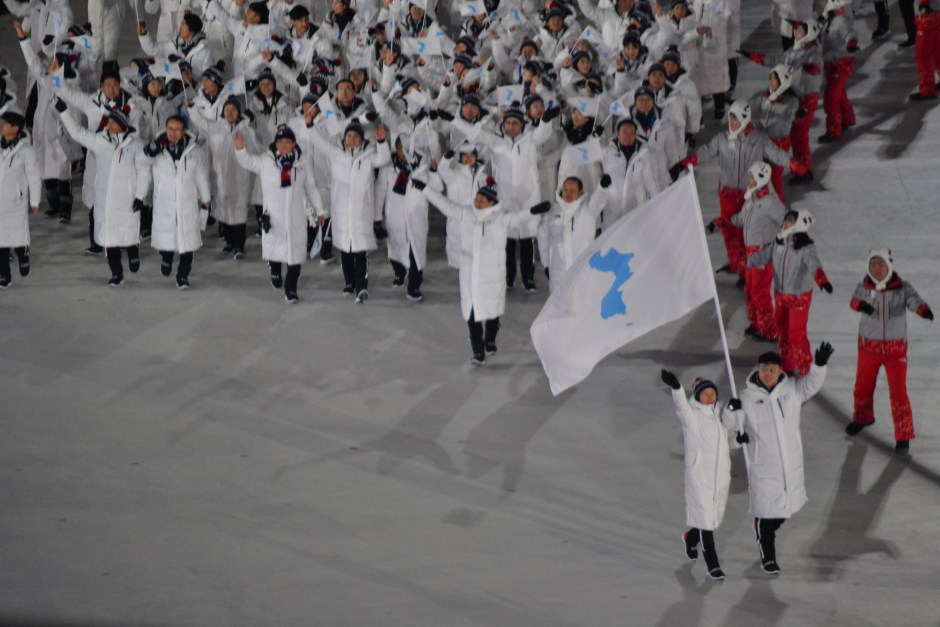
…how enthusiastic the North Korea cheering squad were – their synchronized movements, the sameness of their uniforms and faces, their enthusiastic cheers and singing – they were the must-take photo op of the event.
Photo taken by author on January 6, 2019, from the fifth floor of a building.
It’s rising!
The New National Stadium, which will be the focal point for the 2020 Tokyo Olympics, is about twice as high as it was a year since I last took pictures.
Current view of inside the stadium, from Nippon Terebi.
The architect of this stadium, Kengo Kuma, is famous for working with wood, and you can now see long slats of light brown cedar wood lining the upper part of the stadium. While criticized heavily for dropping plans for a thoroughly different design by world-renown architect Zaha Hadid, the organizing committee did well in selecting Kuma. His design will certainly merge more harmoniously with the surroundings, particularly the wooded confines of Meiji Shrine. In fact, the New National Stadium is called The Mori no Stadium (杜のスタジアム), or the Shrine Forest Stadium.
The cedar slats that line the stadium eaves.
As Kuma explained in this interview, he was anxious about whether the color of the wood, which was tinged a light white color, would blend well with the green of Meiji Shrine’s trees. “But when I saw the texture of the trees (as a backdrop to the stadium), I was relieved that it was okay.”
An Oedo Line train station – Kokuritsu-kyogijo Eki – is right underneath the stadium.
November 30, 2019 is the targeted completion date for the New National Stadium.
Tokai University anchor Akihiro Gunji breaks the tape to give his school the victory in the Tokyo-Hakone ekiden on Wednesday in Otemachi. | KYODO
It’s a New Year’s tradition in Japan – settling into lazy days of eating and laying about in front of the TV with family on January 2nd and 3rd, watching a running competition that spans over 200 kilometers – the Hakone Ekiden.
Since 1920, the annual Hakone Ekiden has transfixed the nation as teams of ten long-distance runners from universities in the Kanto region compete to complete ten legs of about 20 kilometers each. They run the roads of Japan from downtown Otemachi to Hakone on day one, and then back to Otemachi on day two.
Thousands line the streets to cheer runners from their alma mater while tens of millions more watch on TV from 8 in the morning to about 1:30 in the afternoon. It’s Super Bowl Sunday in America – without the glitzy half-time show.
And when 2020 rolls around, its feasible that some of the Japanese distance runners with medal hopes for the Tokyo Olympics will be competing in the 100th anniversary of the Hakone Ekiden that January. In fact, that was the raison d’etre of the Hakone Ekiden – “to bring up runners to compete in the world.”
With expanded knowledge of what international competition was like, Kanakuri grasped an opportunity to raise greater awareness of long-distance running, and thus develop Japan’s next generation of international competitors.
It started with a celebration – an event to highlight the 50th anniversary of Tokyo becoming the nation’s capitol. In 1917, Yomiuri Shimbun organized a massive road race that spanned over 500 kilometers and ran from Kyoto (the former capitol) to Tokyo. The idea of creating long-distance relay exchanges along the way came from the Edo-period practice of transmitting messages from Kyoto to Tokyo and back via humans who ran from station to station with their important missives.
Zensaku Mogi
So impressed was Kanakuri with the idea of a long-distant relay race, he had a vision of America – that the same could be done traversing the United States from sea to shining sea. While that vision was, as it turned out, an impossible dream at the time, it inspired Kanakuri and his partners from Tokyo Koshi and Waseda universities to create an organization that would invite university students to participate in a local ekiden. In the end, four major universities in Tokyo – Waseda, Keio, Meiji and Tokyo Koshi – elected to compete in the first Hakone Ekiden.
On February 15, 1920, when Zensaku Mogi of Tokyo Koshi University broke the tape on his arrival in front of the Hochi Shimbun office of Yomiuri Group, helping his team to a total 2-day time of 15 hours, five minutes and 16 seconds, he ignited a tradition of hope in the youth and future of Japan that continues to this day.
573 days to Opening Day of the 2020 Tokyo Olympics. On July 24, 2020, all the questions, all the angst, all the planning will end, and all that will matter are the athletes. For now, we can only speculate about what will be, and recall what has been.
Max Muncy after his walk-off homer in the 18th inning of Game 3 of the 2018 World Series.
It was 30 minutes past midnight Friday night in Los Angeles. The game had been going for well over 7 hours. Up stepped tired veteran infielder, Max Muncy, who sent an opposite field home run to left center that won it for the Los Angeles Dodgers over the Boston Red Sox in game 3 of the 2018 World Series.
In Tokyo, Japanese fans watched Kenta Maeda play a pivotal role pitching shut out ball in the 15th and 16th innings, helping the Dodgers to victory in the 18th inning. It was after 4pm Saturday afternoon in Japan, which gave die-hard fans a chance to catch their breath, have an early dinner, and settle in to watch game 1 of Japan’s baseball championship series – The Japan Series.
And as the baseball fates would have it, the Hiroshima Carp battled the SoftBank Hawks of Fukuoka into extra innings as well. With a runner on second in the bottom of the 12th, Kosuke Tanaka of the Carp was up with Tomohiro Abe on 2nd with the potential winning run. Alas, Cuban southpaw Livan Moinelo of the Hawks struck out Tanaka, ending the inning…and to the surprise of the casual foreign fan, the game.
Game 1 of the Japan Series ended in a 2-2 tie!
Different from Major League Baseball, Nippon Professional Baseball (NPB) has a rule that a game cannot continue beyond 12 innings, even if the two teams are tied. This is true during both the regular season and the post season. However, it is possible for the best-of-seven championship Japan series to go more than seven games.
For example, if both the Carp and the Hawks win three games each over the next six games, an eighth game will be scheduled, and the teams would play as long as it takes to determine the winner of the decisive fourth victory.
Of course, if there happens to be two ties, a ninth game could be needed, and so on.
Explanations as to why baseball in Japan has this particular rule are vague, and yet the ones bandied about have a whiff of cultural relevance.
Bob Whiting, long-time writer on Japanese baseball, said that “the explanation usually given is that the trains shut down around 11-12 each night so calling game a tie is so fans can go home. But that doesn’t explain the time limit on afternoon games.”
Another explanation of limiting the length of games is related to energy conservation. It’s possible league officials and owners did not like the optics of keeping the bright lights of the stadium on into the late hours of the evening while the average worker had been asked to make efforts to save energy, particularly during the oil shock years of the 1970s.
These optics were worsened again after the March 2011 triple disaster of the earthquake, tsunami and nuclear power plant crisis in northern Japan. As a result, the NPB ruled that games would not be allowed to go into extra innings at all if the game had already passed 3 hours and 30 minutes. Conserving power after the loss of the Dai-Ichi Nuclear Power Plant, and subsequent suspension of almost all nuclear power plants across the country, was the call to action.
There is no energy crunch today in Japan. Most people watch baseball games on TV, not in person. And yet a championship baseball game in Japan can end in a tie.
But as the Hawks manager said after the game, I hope with a straight face, “It was a big tie for us. We’ll be able to take advantage of it.”
End of the 12th inning and Game 1 of the 2018 Japan Series
The Toyosu fish market is pictured in this photo taken from a Mainichi helicopter on July 30, 2016. (Mainichi)
The Tsukiji era is over. The Toyosu era has begun today, October 11.
After decades in the planning, the government has finally moved the fishmongers of Tsukiji to a former gas storage facility in Toyosu, about a few kilometers southeast of the famed fish market.
One of the most popular tourist attractions in Japan, tens of thousands visited Tsukji daily to enjoy the fresh seafood, and if they arrived before 5 am, as hundreds did every weekday, to watch the auction of frozen tuna laid out like lumber on the slick fishmonger floor.
Tsukiji was also a significantly large market, as over 1,540 tons of seafood valued at USD14 million or JPY1.6 billion traded hands every day. Around 650 businesses operated in Tsukiji, including 100 vegetable traders that sold 985 tons of fruits and vegetables daily, creating a vibrant community with over 14,000 workers and 28,000 buyers doing in the crammed confines of the Tsukiji market.
This coziness of Tsukiji, while part of the charm, was also part of the problem. Working within facilities originally constructed prior to World War II, Tsukiji businesses were not air conditioned, and kept their fish and vegetables fresh with crushed ice. Since storage space was limited, fish could be found stored outside, even in the summer months. The hustle bustle of Tsukji was made greater with the countless number of trucks that transported goods in and out of Tsukiji on its narrow roads.
The cramped quarters were an issue, and the move to Toyosu nearly doubles the available space for the market from 23.1 hectares in Tsukiji to 40.7 hectares in Toyosu. There were other reasons to move – the steel beams that kept the buildings up were rusting, the building standards were not up to date in terms of eartquake resistance, asbestos was said to be in the walls, and rats filled the nooks and crannies.
The Loop Line 2 plan, Nikkei Asian Review
And then there is the coming 2020 Tokyo Olympics, providing an extra incentive to accelerate the move. Plans for 2020 included:
a transportation hub of 3,000 vehicles, called Bus Rapid Transport (BRT), that would be used to move athletes, officials, and volunteers around to the various Olympic venues,
an extension of a major road artery, called Loop Line 2, from downtown Toranomon to Toyosu, that would allow vehicles to move unimpeded via a tunnel dug underneath Tsukiji, and
The Olympic Village, to be built between the Tsukiji market and Toyosu market.
When Yuriko Koike came to power as governor of Tokyo in the summer of 2016, she put a halt to the planned November 7, 2016 move of the fish market to Toyosu when high levels of a poisonous chemical, benzene, were detected in the soil and in the air of the former gas storage facility.
Tsukiji Fish Market Aerial View
Two years later, after measures to diminish the impact of the contaminents in the soil were taken, Governor Koike officially gave the go ahead to open Toyosu on October 11.
That decision has brought closure to many of the Tuskiji businesses that eventually moved to Toyosu. But the delay has left considerable uncertainty for others, according to the Nikkei Asian Review.
One party is the Tokyo Olympic Organizing committee, which gives the committee much less time to convert the Tsukiji fish market into a transportation hub. Dealing with the tens of thousands of people on the move for two weeks during the Games, in addiiton to the already congested roads and trains of Tokyo, will be a tremendous challenge, and the readiness and effectiveness of the BRT will be critical to the success of the 2020 Olympics.
Another concerned party is a group, including Mitsui Fudosan Residential, Mitsubishi Jisho Residence, Sumitomo Realty & Development and Nomura Real Estate Development, which are creating different parts of the Olympic Village. The rooms for athletes will be converted and sold as condos after the Olympics, according to Nikkei Asian Review. They write that the 24 blocks of 5,600 condominums will help drive the population of the Harumi bayside area from 12,000 today to about 29,000 in ten years.
Unfortunately, the development of the tunnel part of the Loop Line 2, planned to transport people and vehicles underneath Tsukiji, was postponed after the move of the fish market to Toyosu was postponed.
As the area of the Olympic Village is not close to any train station (the closest station being a 25-minute walk to Kachidoki Station on the Oedo Line), the developers of the condos were depending on the development of high-speed connections from the Olympic Village Harumi waterfront area to Shimbashi train station in about 10 minutes, but that possibility appears to be in jeopardy with uncertainty over the development of the tunnel.
Uncertainty doesn’t sell.
Developers are hoping to start selling the condo units before the games, aiming to sell more than 4,000 of 5,600 units. But the uncertainty over whether the BRT will be fully operational by the autumn of 2022, when new owners are scheduled to take possession, is causing worries about how this will work out.
Toyosu has opened, and the era of early morning jaunts to the fish market, standing meters from the valuable frozen tuna being hawked in auction is over. As this site explains, you will find a more antiseptic version of the Tsukiji experience.
Expect the experience at Toyosu to be different from the lively, messy but also charming and authentic Tsukiji. It seems like a very organized and sterile atmosphere—and only certain clearly-marked areas will be accessible to visitors. The times of tourists touching the price tags of tuna are over—your experience is all behind glass windows now.
The author at Tsukiji one early May morning in 1989, with an ugly moustache.
Shimazaki hiding from the police on Dream Island, in the Asahi Television produced film, Olympic Ransom
The phone rings. It’s Kunio Shimazaki, and he’s asking for police inspector Masao Ochiai, to inform him where to deliver the ransom money. If the police do not comply with his demand for 80 million yen, then he will set off another bomb in Tokyo, one that will certainly derail the good-feel bandwagon of the 1964 Tokyo Olympics. (See part 1.)
Shimazaki hangs up, but the police notice in the recording of the call that seagulls could be heard in the background. The Tokyo University student, Shinozaki, as created by Hideo Okuda, in his 1984 novel “Olympic Ransom” (Orinpikku no Minoshirokin), is keeping out of sight.
Yumenoshima today. The area behind the white fence will be the archery venue for Tokyo 2020. You can see the chimney for the incinerator that get rids of waste and provides heat for the greenhouse.
The police, of the possible hundreds of seaside spots along Tokyo Bay, wonder where Shinozaki, and his partner in crime, Tomekichi Murata, could be.
As it turns out, they are hiding on Dream Island, a landfill in Tokyo Bay off of the mouth of the Arakawa River. First planned in the 1930s as the possible site to replace Haneda Airport, it was opened to the public as a beach called Yumenoshima, the island of dreams. Alas, dreams don’t last forever. The beach was closed, re-opening as a garbage dump in 1957, an out-of-the way destination for the increasing amount of waste generated by a fast-growing economy.
The map of Yumenoshima, the white box in the middle is where the archery venue will be.
Unfortunately, the ten million tons of garbage accumulated over a ten-year period, was left to fester. And only 8 months after the end of the 1964 Tokyo Olympics, it was reported that massive number of flies, that literally blackened the sky, made their way from Yumenoshima across the Sumida River into the heart of Tokyo. As famed translator, Edward Seidensticker wrote in his book, Tokyo Rising, the Japan Self-Defense forces were brought into the fight off the plague of flies.
Initial efforts of the Self-Defense Force (the Japanese army by another name) to exterminate the flies seem initially to have had only the effect of spreading them. Finally a scorched-earth policy worked. Dream Island was for a time a cinder on which not even flies could live.
Today, Yumenoshima is a nice weekend outing, where you can hold a barbecue, sail away from the Marina, walk through a tropical greenhouse, visit the museum of the famed Daigo Fukuryu Maru, a symbol of the horrors of the nuclear age in the 1950s, or play baseball by the seaside on one of 12 fields.
An illustration of the planned archery venue for Tokyo 2020.
It will also be the site for the archery competition during the 2020 Tokyo Olympics. A grassy field across the street from the greenhouse, the area is fenced off as construction continues.
From an idea to a dream to a nightmare, Yumenoshima has settled into middle age as a family outing. And in 2020, the world of archery will descend on the man-made island, dreaming of gold.
If you look closely, you can see Tokyo Skytree in the distance.
Tiger Woodswon the TOUR Championship, his first victory in five years. He slogged his way to the finish with two bogies in the final four holes, but he enjoyed the stroll towards the green of East Lake Golf Course in Atlanta, Georgia, leading a Tiger swarm not seen in years.
“I had a hard time not crying coming up the last hole,” he said. “I had to suck it up and hit some shots.”
And when he hit his final putt on 18, the NBC announcer said what so many thought, that after so much injury, so many surgeries, and a very long championship drought, Tiger was back. “We thought we’d never see it. Probably he didn’t either. Tiger Woods – a winner again. Number 80.”
Up by three holes at 14 in the final round, his closest competitors fading, Woods two putts a birdie chance away, bogies away two shots on 15 and 16, and then hangs on for a 2-shot victory over fellow American Billy Horschel. “It was a just grind,” said Woods on NBC. “I loved every bit of it – the fight and the grind and the tough conditions. I loved every bit of it.
TWITTER: Congratulations to our boss on winning the Tour Championship today, marking it his 80th PGA Tour victory and a comeback for the ages. – TGR #TW80
Justin Rose, who won gold at the re-boot of Olympic golf in Rio, finished tied for fourth but with enough points to win the FedEx Cup. Woods is not thinking of Tokyo 2020 right now, but you can bet organizers and members of the Kasumigaseki Country Club are catching Tiger Fever. The Kasumigaseki C. C. in particular does not want the gender controversy to get attention every time their club is mentioned, so a little Tiger magic will distract.
Will Tiger make it to Tokyo, and be one of the incandescent stars of Tokyo2020?
Right now, Tiger doesn’t make the cut.
According to the International Golf Federation (IGF), the Olympics limit the number of players to 60 each for the men’s and women’s competitions. The IGF will look to the official world golf rankings as a basis of their own Olympic World Golf Rankings (OWGR). The top 15 men in the world, ranked over the period of July 1, 2018 to June 22, 2020, will be eligible to compete in the 2020 Tokyo Olympics. There is a caveat – with countries rich in golf talent, there is a limit of four players.
Unless, Tiger really gets his game into high gear in the coming 22 months, he could get left behind. According to gold prognosticator, Nosferatu, Americans -Dustin Johnson, Brooks Koepka, Justin Thomas, Bryson DeChambreau, Rickie Fowler, and Jordan Spieth – already occupy the first six slots in the OWGR rank list as of today. The PGA Tour official world gold ranking has Woods at 21, with 11 Americans ahead of him.
But that was before Woods’ final putt on 18 today. And he had already climbed from 80th in April to 13th in September in the OWGR. What do the coming weeks months have in store? Hopefully, we can follow those tiger tracks all the way to Tokyo in 2020.
Some of the famous people in the world have tattoos. The US tattoo industry alone is a $1.5 billion business. And many of the 20 million plus foreigners visiting Japan every year are sporting tattoos. But as some visitors are surprised to learn, their tattoos are sometimes frowned upon, and result in being turned away from the hot springs and beaches of Japan.
Rugby World Cup Organizers are excited about the 2019 Rugby World Cup tournament coming to Japan, and have been eager to show respect to their hosts next year. At the one-year-to-go milestone, tournament director Alan Gilpin stated in a press conference that rugby players with tattoos need to cover up their body ink.
“We will make (Japanese) people aware around the facilities that players will use in the country that people with tattoos in a Rugby World Cup context are not part of the yakuza, the Japanese mafia,” added Gilpin.
It’s a socially sensitive statement as there is generally a negative attitude of Japanese towards tattoos – a common rationale being that Yakuza were commonly associated with tattoos. In fact, there is a law against tattoo artists without a medical license, which has been enforced. And signs at pools, hot springs and public beaches commonly explain in multiple languages that people with tattoos are prohibited from entry, or at least asked to cover them up.
The Japan Travel Association (JTA), eager to avoid private establishments from kicking surprised foreign guests out of their establishments, have encouraged hot spring proprietors to relax their rules against people with tattoos. But the reality is, with the Rugby World Cup in 2019 and the Olympics in 2020, Japanese will see a lot of foreign athletes with tattoos – on the beach, in the pools, all round town.
Here are a few of the Olympic hopefuls who sport tattoos.
Joseph Schooling – swimmer, Singapore, gold medalist in 100 meter butterfly at the 2016 Rio OlympicsShaun White – three-time gold medalist in showboarding halfpipe, American, and potential Olympian in skateboarding at Tokyo 2020 Olympics
I received several compliments when mine were visible, and one of my favourite moments on our most recent trip was when I had a summer dress on in the subway and my forearm tattoos were showing. One particularly cool young man seemed quietly fascinated, and rolled up his shirt sleeves silently to reveal the very lower edges of his arm tattoos. We were part of some similar ‘tribe’. No words were exchanged, only a nod that my husband could take his picture as he posed nonchalantly against the train door.
If you have tattoos and plan a visit to Japan, Moss writes that you should take the following under advisement:
Expect to completely cover tattoos at any pool, gym and most water parks and beaches.
Tattoos are banned at onsens (bath houses).
Many ryokans (Japanese inns) will not accept tattooed guests.
You should consider covering your tattoos at any temple or sacred site.
And what does Moss suggest are the best ways to avoid Japanese seeing your tattoo?
Use a rashie at the pool
Book a private onsen instead of attending a public one.
Naomi Osaka is the 2018 US Open champion, the first Japanese to win a grand slam tennis championship, let alone make it to the semi-finals of one.
And as most sports fans know today, her victory was most bittersweet. Osaka defeated her idol, Serena Williams, who had a monumental emotional meltdown in the second set of the Open finals. Engaging in a battle of wills, Williams and umpire, Carlos Ramos, turned the last 30 minutes of the match into an emotionally charged, penalty-filled drama which helped determine the final outcome.
What should have been the happiest moment in the 20-year-old’s career was instead rendered unexpectedly painful.
Naomi Osaka was crowned champion, after a display of dominant tennis, but thanks to the rain of boos from the New York crowd who sided with Williams, Osaka could only weep for playing a role in the humiliation of her hero. She initially believed the crowd was booing her, which is heartbreaking to think about.
In answer to the question about her dream to play in a finals match against Serena, she replied “I’m going to sort of differ from your question. I’m sorry. I know everyone was cheering for her. I’m sorry it had to end like this.” As soon as Osaka said that, you could hear the crowd groaning in regret for their boos. As the groans turned to cheers, she did something so very Japanese, simply thanking the audience for being there. “I just want to say thank you for watching the match. Thank you.”
With those last two words, she nodded her head in a bow, like so many Japanese do unconsciously every day.
Naomi Osaka, the daughter of a Japanese mother and a Haitian father, does not at first glance appear Japanese. And it is not uncommon for children of mixed race to stick out uncomfortably in Japanese society, sometimes bullied for appearing different.
But in that moment, I suspect many Japanese who watched Osaka’s body language closely, recognized her as their own. Yomiuri, which owns the largest newspaper in Japan, called Osaka a “new heroine that Japan is proud of.”
Terebi Asahi Live, September 13, 2018
In the days after Osaka’s US Open championship victory, the Japanese media was thoroughly won over. On the September 13 broadcast of Terebi Asahi Live, the commentators highlighted the reasons why the Japanese of all ages have fallen in love with Naomi Osaka. Among several reasons, they cited qualities that exemplify Japanese values:
The gap between her cool on the court and her awkwardness in front of the press
Her caring comments about other players
Her shy smile and even her broken Japanese.
Awkward Cool: In her appearance on the highly popular talk show Ellen, she answered the first question about becoming the US Open champion by saying, “I’m sorry but it’s so weird…like you’re a real person?” To which, Ellen Degeneres replied that she was indeed real. As many have noted, she puts on no airs in front of the cameras. What you see is what you get.
Caring Comments: In the awards ceremony of the US Open, Osaka was asked what it felt to be the first Japanese, male or female, to win a grand slam final. Again, deflecting the focus off her, she replied that was her dream to play Serena Williams in a US Open Finals. “I’m really glad I was able to do that,” she said looking at Williams. “I am really grateful I was able to play with you. Thank you.”
And again, the head bow to Serena, something so out of place in New York, and so overtly Japanese in its humility.
Naomi Osaka has charmed the world. And Japan has quite unexpectedly made her their own. Even the Japanese government, one run by the fairly conservative Liberal Democratic Party, has slowly eased into the idea that Japan needs to allow greater inflows of foreign immigrants. The Foreign Minister, Taro Kono, explained on September 13 to the World Economic Forum that Japan has to accept more foreigners due to its aging population and low birth rate, citing Naomi Osaka as a symbol for how Japan can benefit from increased immigration.
It’s good to have diversity,” Kono said. “It’s good to have an open policy.”
Before the US Open, there was some hope that a Japanese would win gold at the 2020 Olympics in front of the home crowd. As Naomi Osaka is the newly crowned Queen of tennis, that hope has blossomed into full-blown expectation.


You must be logged in to post a comment.