Tsuburaya and Suto 2
Kokichi Tsuburaya and Jozsef Suto

When József Sütő lined up for the marathon at the 1964 Tokyo Olympics, the Hungarian didn’t know any of the other 67 competitors in the race, except for the then-world record holder, American Buddy Edelen, and the reigning Olympic champion from Ethiopia, Abebe Bikila.

When Sütő hit the halfway point in the marathon, Bikila was indeed firmly in the lead. Slightly behind him was Jim Hogan of Ireland. Ron Clarke of Australia was third, but pressing hard on Clarke were Sütő, Kokichi Tsuburaya of Japan, and Demissie Wolde of Ethiopia.

“Mr. Tsuburaya was in this group, but I did not know at the time who he was,” Sütő explained in an interview with me. “I saw of course that he is Japanese but I did not know more.”

József Sütő (77), Kenji Kimihara (73)
József Sütő (77), Kenji Kimihara (73) on the day of the memorial run, photo by Rajzó-Kontor Kornélia

And yet, it was that race that established a life-long tie between those two runners, who never met except in that single competition on October 21, 1964. Fifty years later, Sütő would return to Japan and pay respects to the Japanese marathoner who won the bronze medal at the Tokyo Olympics, and then subsequently and sadly took his own life four years later.

At this own expense, Sütő flew out to Japan to attend the 32nd Tsuburaya Memorial Meet, an annual series of running events held in the city of Sukagawa, Fukushima, the hometown of Kokichi Tsuburaya. This was October, 2014, which meant that he would be running in the memorial only two days before the 50th anniversary of the marathon of the Tokyo Olympics.

As explained in this article, Sütő ran in the 5k race, and at the age of 78, ran it in a respectable 27 minutes and 8 seconds. More importantly, he ran it in the race with teenage boys, aged 13 to 15. Sütő understands symbolism, the importance of being a role model, which is why he ran with the boys. When Sütő was growing up in Hungary, his hero was Sándor Iharos, one of the best distance runners in the world in the mid-1950s, a world record holder in the 1500-, 2,000- and 5,000-meter distances.

But Sütő also understands how he represents history, and his linkage to Japan and the 1964 Olympics, one of the defining moments of its history in the 20th century, as well as to the marathon itself. He had arrived in Tokyo on October 18th and was immediately whisked north to Sukagawa. He ran the race on October 19th. On October 20th, he attended a tour of the museum dedicated to the memory of Kokichi Tsuburaya, and then returned to Tokyo for a meeting with representatives of Japan’s National Olympic Committee on October 21st.

The meeting began at 3pm, and exactly 17 minutes into the meeting, Sütő interrupted the conversation by saying “Gentlemen, 50 years ago on this date and at this moment I was taking the turn into the Olympic stadium….and I’ll cross the finish line in a moment!”

I’ve only had the opportunity to exchange emails through an intermediary/translator named Rajzó-Kontor Kornélia, who kindly offered to assist me in communicating with Sütő . Through Rajzó-Kontor’s help, as well as the brilliant articles she wrote on Sütő’s visit to Japan in 2014, I can see that Sütő appreciates the enormity of Japan’s moment in 1964, and as he learned after leaving the Tokyo Olympics, the physical and mental trials Tsuburaya endured after the Tokyo Games. Sütő never met Tsuburaya, but he knows him, and likely wishes he could embrace him.

After completing his race at the Tsuburaya Memorial Meet that beautiful October day, he revealed his thoughts to reporters, as explained by Rajzó-Kontor:

Sütő told the local television viewers the same thing he had said in the cemetery the day before; that he had been thinking of Tsuburaya and thanking him as he ran. Sütő said he believed he would have run the distance “hand in hand” with Tsuburaya, were he still alive.


NOTE: Many, many thanks to Rajzó-Kontor Kornélia for the time she took to translate my questions from English to Hungarian, personally meet with József Sütő, and then translate his responses from Hungarian back to English.

Bethany Woodward

Bethany Woodward is a silver medalist in the 200 Meters (T37) sprint at the 2012 London Paralympics. She continued her career as a para-athlete, but has become disillusioned about the state of para-athletic competition. The Ringwood, England native made news recently for returning a silver medal won in a competition several years ago, not because she cheated, but because a person on her relay team was not disabled enough.

In this fascinating audio report from the BBC, entitled Paralympic Sport – Fair Play?, Woodward was interviewed regarding the growing issue of “classification cheating.”

The reporter explained that Woodward is classified as a T-37 sprinter. “T” stands for “track,” while 37 is a degree of disability. The lower the number, the greater the impairment. The purpose of the classification system is to create an equal playing field for the competitors. But either because of the challenge of classifying disabilities or purposely interpreting the criteria for a certain classification broadly, athletes can see inequities.

Reporter: Volunteers classify athletes based on how their disability impacts their performance, not on the disability itself. They look at the medical paperwork and the doctor or the physiotherapist does tests. Then a technical classifier, a sports scientist or a coach, for example, will assess the athlete. They’re also watched in competition before their classification is confirmed. Bethany Woodward said after the 2012 Paralympics, the make-up of her class seemed to change.

Woodward: In London there was no one in my classification I thought shouldn’t be there. But then suddenly classes were seemed to be opening up. I have hardly any dorsiflexion in it, or none. And within the criteria for cerebral palsy it said that you shouldn’t have any dorsiflexion . And then there was people coming who had dorsiflexion and I could see that when they were warming up.

Reporter: In other words, they could bend their foot.

Woodward: Yeah, they could bend their foot. So there were physical elements you could see that they were definitely a lot stronger in different areas than you. My cerebral palsy isn’t something that will fluctuate at all. And then you have people coming in who have a medical condition that really fluctuates. One day they could be absolutely fine and one day they are not OK. And we can’t ask for medical evidence because that is something deemed confidential.

When asked why she returned her medal, Woodward explained that nothing has changed since she first raised the issues. “Nothing has changed in a year. There was nothing I could do to fix it, but I can make I can step away with a clear conscience, a voice. In handing that medal back really closes the book for me – I did everything I could for this sport.”

Olivia Breen
Olivia Breen

Olivia Breen is a long jumping champion who has cerebral palsy and learning difficulties, and who went to Rio and made it to the finals of the T-38 100-meter finals. According to her father, Michael Breen, one of Olivia’s competitors had relapsing MS, which he felt was unfair when compared to athletes with cerebral palsy like his daughter, because their condition could be in remission at the time of the race, or controlled by drugs. He also claimed that another finalist objected to being classified at all.

What followed in the report was an insightful exchange that speak to the challenges of differentiating subtle differences in conditions.

Reporter: I’ve read interviews with athletes whose impairments have been questioned before an d they say, frankly it’s insulting for people to say that about me. They don’t know my medical history so you don’t know for sure what is or isn’t affection that particular athlete’s performance.

Michael Breen: That’s a really good point. I’m not going to try to justify every person who’s queried someone’s disability because it’s not possible. What I’m saying is, there is something fundamentally wrong with classification. It’s not fit for purpose and it’s broken.

Szewińska and her Tokyo medals

In 1964, one of the more powerful track and field teams at the Tokyo Olympics was the team from Poland. Jozef Szmidt won his second straight gold in the triple jump. Andrzej Badenski took bronze in a tough men’s 400-meter competition, and the Polish men from the 100-meters relay team took silver behind the Americans.

The 4×100 women’s relay team did even better, streaking to gold and an (apparent) world record in Tokyo. The women who ran the second leg was Irena Kirszenstein Szewinska. The then-20-year-old from Warsaw was starting a career that would carry her through five consecutive Olympiads. In that period, she captured an amazing total of seven Olympic track and field medals.

In addition to her gold medal in the 100-meter relays and a silver in the 200 meters, she was a silver medalist in the long jump as well. But she was indeed a sprinter at heart, and set 10 world records in the 100 meters, 200 meters and the 400 meter sprints.

At the 1968 Mexico City Olympics, she won her first individual sprinting gold medal in the 200-meter sprint finals in come-from-behind style. Seemingly behind 4 or 5 other runners, when she hit the straightaway, she accelerated and pulled away with ease, as you can see in the video below.

After winning a bronze medal in the 200 meters at the Munich Olympics in 1972, Kirszenstein Szewinska reinvented herself. In 1973, she began competing in the longer 400 meters, and as her IAAF Hall of Fame profile page states, “she quickly proved very adept at the new distance. The following year she became the first woman to break 50 seconds over one lap of the track.”

“My favorite event was the 200 meters because deep down I felt like a sprinter,” she said in this short video on the Polish Olympian. “My heart always belonged to sprint. Nevertheless, I always treated the 400 meters as a long spring, and that’s why I was successful at that distance as well.”

Szewińska 400 meter finals Montreal
Szewińska pulling away in the 400 meter finals at Montreal

In Montreal, at the age of 30, she punished the competition, set a world record, and won her most satisfying gold medal.

“I had been running for 20 years. During that time, there were many important moments. But I suppose the most important moment of all of them was the last gold medal I won at the Montreal Games for the 400 meters.”

One of the greatest women track and field stars of the 20th century, Kirszenstein Szewinska has continued her career in sports as an administrator, including Vice-President (1995-1999) then Executive Board Member (1999-2003) of the World Olympians’ Association (WOA), member of the International Association of Athletics Federation (IAAF) Women’s Committee (1984-2007).

Vera Caslavska and Josef Odlozil married

The pace set by the Kenyans was relentless. The thin air of Mexico was punishing. Favorite Jim Ryun, weakened by a bout with mononucleosis, was whipped by 3 seconds, as Kip Keino dashed to a gold-medal finish in the 1,500 meters at the Mexico City Olympics.

Thirteen seconds after Keino crossed the finish line, Josef Odlozil of Czechoslovakia, finished in twelfth place. It was a poor finish compared to his silver medal at the 1964 Tokyo Olympics, but in the end, Odlozil won the bigger prize.

At the end of the 1968 Olympics, Odlozil married compatriot, and one of the darlings of the Mexico City Games, Vera Caslasvska. The Czech gymnast who won three gold medals in Tokyo, did even better in Mexico City with four more golds. Thousands of people came out to the Mexico City Cathedral to wish the Olympic couple well.

Their marriage was to last not quite 20 years, ending in divorce in 1987. Those 20 years must have been filled with mini dramas, as Odlozil apparently worked for the Czech Army, while Caslavska struggled to establish a productive career after returning from Mexico City. She had supported anti-government movements, and protested against the Soviet invasion after the so-called Prague Spring. Caslavska was not allowed to leave the country or get coaching work.

Odlozil and Caslavska had two children, a boy named Martin and girl named Radka. It appears that relations between father and son were poor, possibly leading to a tragic conclusion.

On August 7, 1993, Odlozil was in a placed called “U Cimbury”, described as a “disco-restaurant” in this post from Once Up a Time in the Vest. As it turned out, Odlozil’s estranged son Martin was also present. Words were exchanged. Punches were thrown. Odlovil fell to the ground, hitting his head, and subsequently fell into a prolonged coma. A little over a month later on September 10, 1993, Odlovil died.

vera caslavska and josef odlozil prague castle_ALAMY
Vera Caslavska and Josef Odlozil Prague Castle_ALAMY

His son Martin was sentenced to four years in prison for murder.

His wife, Vera, fell into depression and was rarely seen in public.

Was Josef looking for his son Martin? Was it true that Martin, upon seeing his father, went to the DJ and request a song called “Green Brains” that was considered offensive to members of the Czech Army? Did Martin, in a fit of rage, go to his father’s car and vandalize it?

All the eyewitnesses were said to be drunk. The only thing that was clear – father and son were in the same place where a fight took place, and Odlovil fell to the floor unconscious.

From the Fall of 1968 to the Fall of 1993, a 25-year drama came to a horrific close.

Being an Olympic champion shields us not from the slings and arrows of outrageous fortune.

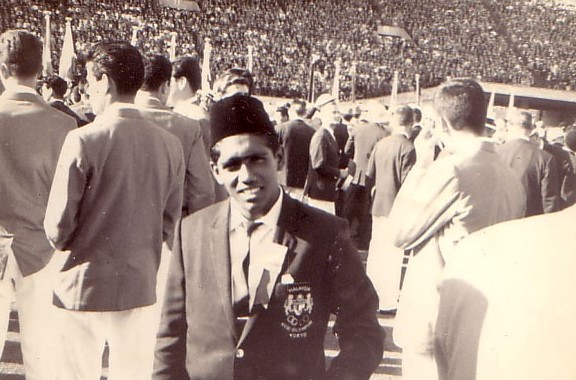
C Kunalan in Tokyo_2
Kunalan at the 1964 Tokyo Olympics Opening Ceremonies

It was the summer of 1964 and Singapore was in crisis.

Singapore’s leader, Lee Kuan Yew, had brokered a deal with the British Government and the leadership of Malaya to be included in a nation called Malaysia, established in 1963. This was not a match made in heaven. Racial tensions were part and parcel of the daily lives in the region between Singapore, which was a mixture of Indian, Malay and Chinese, but had a predominant population of ethnic Chinese, and the rest of the Malaya Federation, which was primarily Bumiputra and Islamic.

In July and September, Singapore felt the political tension born of the delicate balancing act that brought Singapore and Malaya together, and at times, the tension boiled over. Race riots broke out where shophouses were burned down, police and military were called out to restore order and enforce curfews, and people were beaten and killed.

This is the atmosphere in which athletes in Malaysia and Singapore were preparing for the 1964 Tokyo Olympics. Canagsabai Kunalan was a promising 21-year-old sprinter, talent spotted only a year before by the Malaysia track coach, Tan Eng Yoon. After a successful sprinting debut in 1963, Tan believed Kunalan was ready for the Tokyo Olympics, and recommended him for the 4X100 relay team, along with Mazland Hamzah, John Daukom, and Mani Jegathesan.

Tan Eng Yoon and Stan Wright with Malaysia team
3 weeks prior to Tokyo – standing: Tan Eng Yoon and Stan Wright; sitting (L to R): Kunalan, Wong Fey Wan, Kuda Ditta, M Jegathesan, and Dilbagh Singh

But the make-up of the 4X100 relay team did not sit well with Wong Fey Wan. Another talented sprinter, Wong defended his record, and called out Kunalan publicly in the press:

I beat Kunalan in the 100 m finals in the national championships in which I finished second to Jegathesan, and I beat him again in the Government Services Meet in the 100 m final on Saturday in which I finished third…. I am willing to race against Kunalan again to prove I am the better man over 100 m. If I am wrong I will quit athletics.

Coach Tan did favor Kunalan, perhaps for his work ethic, perhaps for the belief that Kunalan was stronger around the curves and a better choice as back up for the relays. Maybe Wong did not have the political support as he was self-taught and did not have the benefit of a coach lobbying his case as Tan did for Kunalan. Maybe race was influential. As explained through Kunalan’s state of mind at the time in the biography, “C. Kunalan – Singapore’s Greatest Track and Field Athlete”, Kunalan was unhappy.

Whatever the true reason for Wong’s exclusion – be it sporting or political, this incident affected Kunalan, who regarded this as “one of the saddest moments” of his running career. He never knew for sure whether he had been chosen on the basis of merit, but he wished that Wong had been chosen instead, knowing how much Wong had been looking forward to competing at the Olympic Games.

It was Kunalan instead who went to Tokyo. Just three days before his 22nd birthday, the Malaysian 4×100 team finished last in their round one heat, and that was that.

While Kunalan had no control over the make-up of the 4×100 Malaysian relay team, during a period of racial and political strife in his country, he did indeed have control over more important, personal decisions – with whom he would marry.

Kunalan and Roy 2
Kunalan and me

Teammates in track, Kunalan first met Chong Yoong Yin, captain of the Raffles Girls School track team, and a member of the Malaysia national track team. They had track in common, but to their parents, little else. Kunalan was ethnic Indian and was brought up in the Hindu religion. When Kunalan had returned from the Tokyo Olympics and his parents realized that his relationship with the ethnic Chinese woman, Yoong Yin, was still intact, they gave their son an ultimatum: “leave that Chinese girl or never return home again.”

Kunalan walked out.

Yoong Yin received the same ultimatum from her father and her uncle. And she too left home, joining her mother, who was estranged from her father.

Distraught after being shunned by their own families, they struggled momentarily, wondering what would happen. But Kunalan in the end was resolved. “We’ll have our own friends who will accept us.”

Wedding Day

Engaged in October 1965, with a wedding date set for October 1966, the parents of Kunalan and Yoong Yin eventually saw that there was no fighting the bond between the two. Kunalan’s father surprised his son with a visit, and said he would bless the union, but only if Yoong Yin would take on an Indian name and convert to Hinduism. Fortunately, that was not a problem for Yoong Yin, and the two sprinters were married in a Hindi ceremony. Subsequently a Chinese wedding dinner was held by Yoong Yin’s mother.

Fifty-two years later, Kunalan and Yoong Yin are still happily married. And Kunalan proudly proclaims that diversity and the need to be inclusive of all races and nationalities is vital to world peace. “I am not nationalistic,” he told a Singaporean magazine. “I am more of an internationalist.”

His children, a blend of Indian and Chinese DNA and heritage, have lived their parents’ creed, marrying members of other nationalities. Kunalan is proud of to be an inter-racial grandparent.

He remembers 1964. He recalls seeing the worst in the race riots of Singapore, and the best in the gathering of the world’s best athletes in Tokyo. And he believes that we are capable, through sports, to co-exist in peace and love.

Canagasabai Kunalan is living proof.

The International Family

Canagasabai Kunalan Singapore’s Fastest Man Part 1: Defying the Odds in Mexico City

A Teaching Moment at the Singapore Sports Museum

Canagasabai Kunalan strolled through the Singapore Sports Museum, walking his guest through Singapore’s greatest sporting achievements, explaining the history with enthusiasm, with the skills honed over decades as a teacher.

But C. Kunalan was more than just a teacher. As we walked through the corridors, passers-by would recognize the fit, elderly gentleman as the man who held the title, Singapore’s fastest, for decades. In fact, Kunalan had held at different points the fastest marks in the 100 meters, 200 meters and 400 meters in Singapore track history.

It was 1968 at the Mexico City Olympics, when Kunalan set the Singapore record for 100 meters, a mark that stood for 33 years.

Jim Hines set the world record in the 100-meters in Mexico City with a time of 9.95, considerably faster than Kunalan’s 10.38. But when you think about it purely from a statistical perspective, Singapore had a tiny talent pool. The population of Singapore in 1968 was 2 million, only 1% of the entire US population, and roughly the same population of Hines’ state of Arkansas that year.

C Kunalan in Mexico City_2
Kunalan finishing third (719) in a 100-meter heat to advance. Eventual gold winner Jim Hines strolls into the finish.

Kunalan defied the odds, advancing beyond the first round at the Mexico City Games to be recognized as one of the top 32 fastest men in the world. And if you know the history of Southeast Asia in the 1960s, you know that in 1968, Singapore was only in its third year as a sovereign nation. It wasn’t clear until the last days before departing Singapore whether Kunalan had the funds to even travel to Mexico.

In the end, Kunalan made it to Mexico City, and he was there to compete. But he knew, as a sprinter, he and his teammates were significantly behind those in the advanced industrial economies, or in the nations under the flag or influence of the Soviet Union. In his biography, C. Kunalan – Singapore’s Greatest Track and Field Athlete, written by Steven Quek, a one-time colleague of his in the National Institute of Education, Quek explains how support and role modeling by others contributed to his development.

At the Mexico City Olympics Kunalan recalled simple but powerful gestures: USA Assistant Track Coach Stan Wright offering Kunalan the use of Team USA’s masseurs for a pre-competition rub down, or Bahaman sprinter Tom Robinson coming up to Kunalan to suggest that the Singaporean be aware that he was exerting too much effort into the first 20 meters of his sprint, when he should in fact be conscious of staying relaxed. “Tom, a world-class athlete, was willingly sharing advice with an unknown from Asia. Kunalan never forgot this.”

After Kunalan’s competitions ended, he was then able to watch the very best athletes in the world demonstrate the highest levels of physical achievement:

Ever the teacher, Kunalan understood that for Singapore athletes to succeed internationally, to reach the world-class levels on display at the Olympics, their training must improve, as he explained in a letter to his wife:

We must get very serious about training. There are about 6 short men all doing 10 or 10.1. Why? Arms and legs big!! Mine only 1/2. You know darling! If I can get their strength, I will be doing 10 sec too.

C Kunalan in Mexico City_1
C, Kunalan in Mexico City

Kunalan would retire from track in 1970, but would go on to become one of Singapore’s most successful primary and secondary school teachers, twice being recognized as “Teacher of the Year”. He currently works for the Singapore Sports Council, in offices near the Singapore Sports Museum.

Maybe you’ll be lucky to see him there, get a tour like I did, and learn from a man who has literally lived the history of Singapore sports.

Canagasabai Kunalan Singapore’s Fastest Man Part 2: Out of the Frying Pan of the Race Riots and Into the Fire of the Olympics

Abdul Khaliq and Milkha Singh
Milkha Singh (right) barely edging out Abdul Khaliq in the 200-meter finals of the 1958 Asian Games in Tokyo.

He arrived at Haneda Airport in May of 1958, camera bulbs popping and microphones thrust towards him. He was driven to The Dai-ichi Hotel escorted by police on motorcycles, greeted by fans asking for autographs.

Having recently broken the Asian speed records in both the 400 meters and 200 meters, Milkha Singh was a sports hero throughout Asia, and was in Tokyo to compete in the 1958 Asian Games.

Eyes bleary and bloodshot from a long flight from Calcutta, India, Singh still was amazed when he arrived in Japan, as he described in his autobiography, The Race of My LIfe. “I was thrilled to have been given a chance to visit Japan, a country I admired for the tenacious way they had rehabilitated themselves after the devastation wrought by the Second World War. When we landed at Tokyo Airport, our eyes were dazzled by the brightness of the multicolored lights. The puddles of water that had collected after a recent shower glowed with the reflection of the lights as well.”

It was at these Asian Games where Singh established his famous rivalry with Pakistani, Abdul Khaliq, the fastest 100-meter sprinter in Asia at the time. According to Singh, when Singh was first introduced to Khaliq at the hotel, with a friendly warning to watch out for Singh in the 200 meters, “Khaliq shot back, ‘I have met and run races with many a Tom, Dick and Harry like him. They are no match for me.”

On Day 2 of the Asian Games, Singh was favored to win the 400-meter race, which he did fairly handily. His time of 46.6 seconds was an Asian record, which the Japanese crowd greeted with an eruption of cheers. “I felt my hair stand on end and a shiver of delight ran through me,” he wrote. And when he saw the Indian flag rise high, he wrote that “it was the most stirring moment in my life and I was filled with great patriotic fervour seeing the Tricolor fluttering in the open blue sky.”

But his defining moment of truth was still to come.

The 200-meter competition was held the next day. Khaliq of Pakistan had won the 100-meter finals. Singh of India had won the 400-meter finals. Thus, bragging rights for fastest man in Asia would be determined in Asian Games 200-meter finals.

After the starting gun was fired, and the six sprinters made their way up the straightaway, Khaliq and Singh were essentially neck and neck at the 100-meter mark. With Singh on the innermost lane and Khaliq a couple of lanes to Singh’s right, they both knew it was going to be a fight to the finish.

Despite focusing on our running, we were each aware of the other’s progress and were pushing ourselves and our utmost limits. It was fast, it was furious, it was neck-to-neck. There was high drama. About three or four yards from the finishing line, I pulled a muscle on my right leg. Then my legs got entangled and I tripped and tumbled over the finishing line. At that very moment, Khaliq breasted the tape too.

Milkha Singh tumbling over finish line at Tokyo Asian Games from The Race of My Life
From Singh’s autobiography, The Race of My Life.

It took about 30 minutes for the judges to analyze the photographs taken at the finish line from multiple angles. In the end, the judges determined Singh the victor. “I was now Asia’s best athlete!”

Japan leveraged these 1958 Games, showing off its new National Stadium and its ability to run a major international sports competition. The next year, Tokyo was selected to host the 1964 Summer Olympics. Singh would go on to take gold at the 400 meters at the Commonweatlh Games in London, and earn the moniker, The Flying Sikh, and become a favorite to be the first Asian to win a gold in track at the 1960 Rome Olympics.

In the early 1960s, Milkha Singh, along with C. K. Yang emerged as the great Asian hopes in athletics.

Milkha Singh heros welcome from The Race of My Life
Milkha Singh returns from Tokyo to India, from The Race of My Life

running in heat

Imagine it’s Sunday, August 9, 2020, the final day of the Tokyo Olympics. The marathon has started, tens of thousands of people are lining the route, and the morning sun is radiating a furnace room of heat.

On August 9 this year (2017), the temperature hit a high of 37 degrees Celsius, or 98.6 degrees Fahrenheit. That’s hot man! And potentially dangerous for runners, as well as spectators. According to Makoto Yokohari, a professor of city planning at the University of Tokyo, in August the temperature at the location of the national stadium in Tokyo gets to 30 degrees at 7:30 am, and rises to the mid 30s in Asakusa, the mid-way point of the 2020 marathon. Yokohara adds in this article that much of the route, especially around the Imperial Palace, is not under shade.

Runner’s WorldFor runners, the fastest times often come in cool weather, in a range of 4.5 °C (40 °F) to about 13 °C (55°F), according to this analysis from Runner’s World. But when you run a marathon in hot weather, your body will rebel. According to this article from Scientific America, marathoners need blood to go in two directions at the same time – to your muscles to deliver oxygen and keep your muscles pumping, and to your skin so that your body can cool down. When it’s really hot, unfortunately, the blood that goes to the muscles that are getting a work out, gets even hotter, and the blood that gets to the surface doesn’t cool down. You sweat more, you dehydrate, and your body reacts with heat cramps, heat exhaustion, or even heatstroke.

The mother of all heat related illnesses. Your body temperature rises above 105 degrees F and it becomes a life-threatening situation. Most often, heatstroke results from untreated heat exhaustion, although it’s very possible for heatstroke to come about with no signs of heat exhaustion. Heatstroke is characterized by extreme fatigue and weakness, confusion and odd behavior, disorientation and finally unconsciousness. Your body’s regulatory system completely shuts down at this point, sweating ceases, and your skin becomes hot and dry. Unfortunately, it doesn’t end there. Convulsions and seizures can occur as your brain begins to shut down; coma and death are possible in the worst situations. GET OUT OF THE HEAT IMMEDIATELY! Seek medical attention, get in the shade, drink water, etc anything to get cooled down! You do NOT want to get to this point.

running in heat 2

For us pedestrians, succumbing to the heat is commonplace in August, according to Akio Hoshi, a professor of health science at Toin University of Yokohama. “The number of people transported by ambulance due to heatstroke or heat exhaustion has peaked in early August in recent years. So the Tokyo Olympics fall in the period with the highest risk,” Hoshi said.

The 1964 Tokyo Olympics were held in October, and the weather was primarily wet and cold….preferable conditions to the marathoners of 2020.

I don’t enjoy running. My preference is to read my kindle while exercising on an elliptical machine. But on the weekends, I will head out into the neighborhood, often climbing the stairs of road overpasses, and running through the residential area I live in.

But now I run with an Apple Watch, and even more conveniently with Apple Airpods.

I bought the Nike Apple Watch opportunistically in a recent visit to Portland where the lack of a sales tax makes big purchases attractive. My main objective was to upgrade on my Fitbit.

airpodsWhile the Apple Watch is cool, as all Apple products tend to be, the jury is still out regarding its utility as an exercise measurement tool. I’ve recently realized that not only does the Apple Watch lack the measurement tool that the Fitbit has to measure stairs climbed, it also does not automatically measure sleep time and patterns.

That’s a disappointment.

The revelation has been the Airpods! First, how does a one-size-fit-all headset stay in any person’s ears, I have no idea. But I can run and jump and the Airpods stay in place (although I sometimes feel better pushing them in on occasion).

Running without wires has been a revelation. With the Air Buds connecting to the Apple Watch via bluetooth, I can run relatively unencumbered without wires. For me, it was one of those nagging issues that, once removed, feels liberating.

Aska Cambridge Keeping Up with Usain Bolt in 4x100 Relay
Aska Cambridge Keeping Up with Usain Bolt in 4×100 Relay – click on image to see Olympic Channel’s “Games to Remember”

The Olympic Channel features a video that recalls images and moments from the 2016 Rio Olympics. Entitled “Games to Remember – Re-Experience Rio 2016: The Official Summary of the Rio2016 Olympic Games,” the video runs over 37 minutes long.

I started it, but was only going to watch it for a few minutes. I ended up watching the entire video, a collection of short clips of the events of each of the 16 days. And they are all stunning!

Slow mo, normal speed, tracking shots, overhead shots, long shots, all edited to highlight the aesthetics of epic poetry in motion, to accentuate the limits to which the athletes will stretch themselves, to remind us of the chills we experienced when viewing the very best in the world achieve the highest levels of physical achievement.

Go to this link. If you can, put it up on your big flatscreen TV. And revisit the joy of the 2016 Rio Olympics.

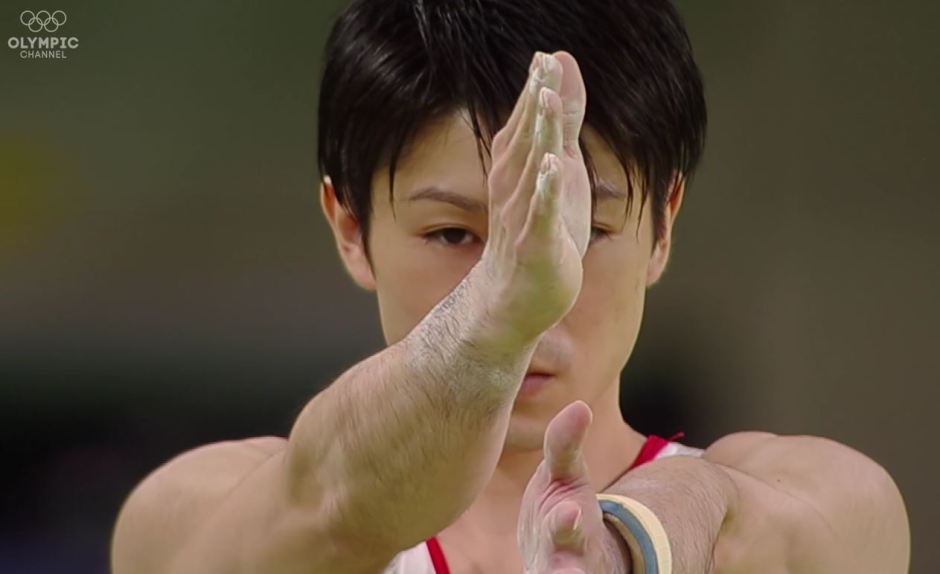
Kohei Uchimura from Games to Remember
Kohei Uchimura – click on image to see Olympic Channel’s “Games to Remember”