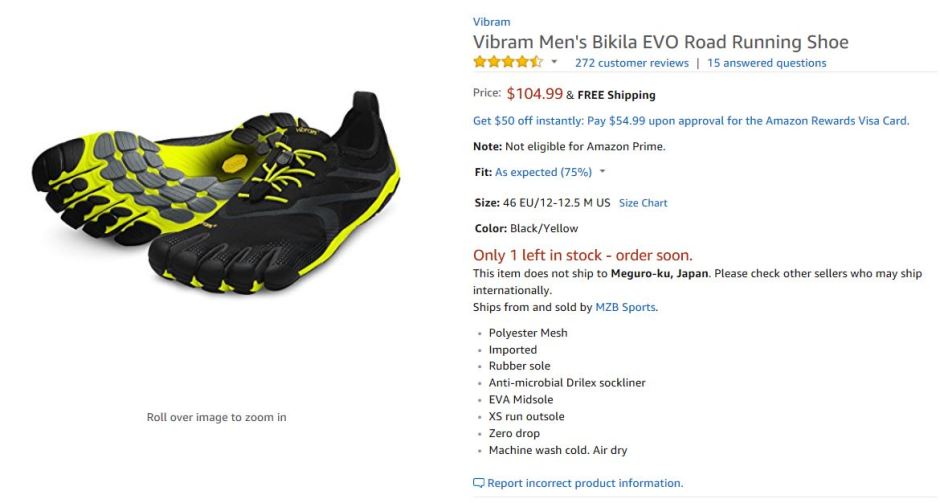
Running in Vibram FiveFingers Bikila EVO Shoes is like running barefoot. And running barefoot can, it is said, return you to a better, injury-free way of running.
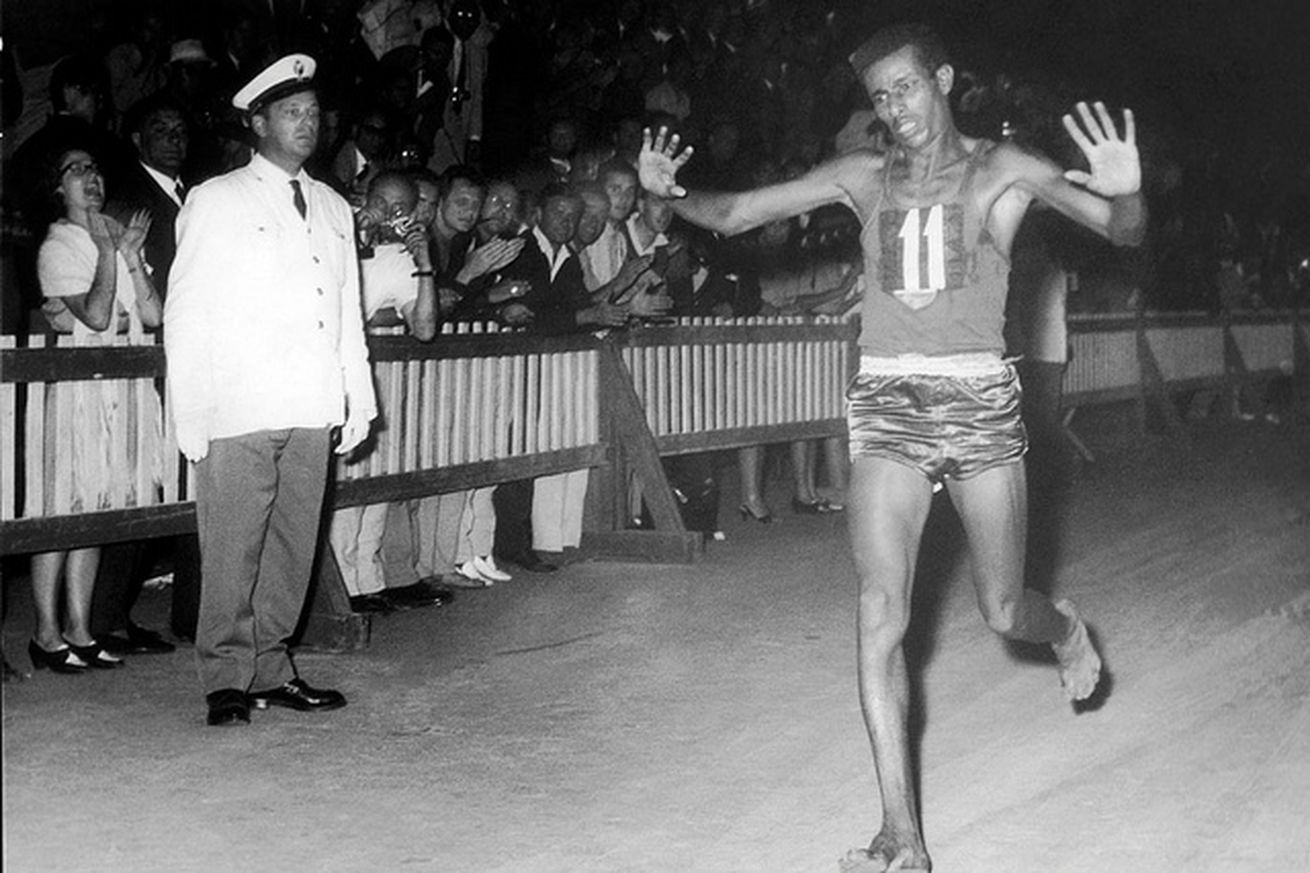
That’s the whole point of the Vibram experience – to reproduce what it is like to walk or run barefoot. And who better to name a running shoe that replicates the barefoot experience than Abebe Bikila, the famed two-time gold medalist who famously came out of nowhere to win the 1960 Rome Olympics marathon…sans socks and shoes.
The shoe manufacturer, Vibram, has marketed shoes called the Vibram Bikila, trademarking the name of the famous Ethiopian athlete in 2010. In February, 2015, Teferi Bikila, the son of Abebe, filed a lawsuit against Vibram to cease using the Bikila name as the family never granted permission.
“He won the Rome marathon with bare feet, and nobody did it before then or since then,” Bikila, 45, said in this AP article. “It’s important that his legacy be respected.”
Unfortunately for the Bikilas, there is apparently a time limit on respect. A judge of the U. S. District Court in Tacoma, Washington dismissed the lawsuit in November, 2016, citing that the Bikila’s were aware of the Bikila shoe brand in 2011 but did not act until 2015, and thus “it would have been unfair to Vibram to allow the lawsuit to go forward after such a delay, when Vibram had been investing in and marketing the products for years.”
“The Bikilas unreasonably delayed in seeking to enforce their rights, and this unreasonable delay prejudiced Vibram,” wrote Judge Ronald Leighton.
Musashino Forest Sports Plaza on the left, and Ajinomoto Stadium on the right
It was a cold and desolate Sunday when I walked around the grounds of the new Musashino Forest Sports Plaza. Located a short walk away from Tobitakyu Station on the Keio Line, the Musashino Forest Sports Plaza is right next to Ajinomoto Stadium, the home of the J-League Division 1 soccer team, F. C. Tokyo.
There were no events scheduled at either the Sports Plaza of Ajinomoto Stadium on the January afternoon I visited, but come July 2020, this quiet area of Chofu, very near the American School in Japan where my son went to high school, will be filled with thousands of noisy fans. The Musashino Forest Sports Plaza opened on November 27, 2017, the first of eight new permanent Tokyo 2020 venues to be completed. The Plaza will host badminton and pentathlon fencing in the 2020 Olympics, as well as wheelchair basketball during the 2020 Paralympics.
View of the Main Arena on the left background, the sub-arena with its pool and gym on the right background, with a track and field in the foreground.
According to this article, the Musashino Forest Sports Plaza is built to serve the community long after the Olympics end. The facilities include a swimming pool, a gym, a multi-use sports area and two fitness studios which are available to the public. The roof of the facilities are made up of solar panels, to help provide a more sustainable energy source.
Main Arena and its solar panel roof
And in line with Tokyo2020 Accessibility Guidelines, “the facility designed to be accessible to all, including the elderly, people with impairments, parents with infant strollers and those with guide dogs. The main arena has space for wheelchairs, and the space is designed with enough height difference between the rows of seating to ensure that those in wheelchairs can see clearly, even if spectators in front of them stand up.”
Ajinomoto Stadium will also host matches in the soccer competition during Tokyo 2020, and will be called Tokyo Stadium during the Olympics in accordance with its non-commercialization policy.
American Justin Gatlin is the fastest man in the world today, but can he beat the speed of a ball in freefall that accelerates at 9.81 meters per second squared in the Shotgun Touch competition?
Russian Denis Ablyazin won the silver medal in the men’s vault at the 2016 Rio Summer Olympics, but can he win the “Monster Box” competition, hurdling a vault over 3 meters high?
New Zealander Tomas Walsh won the bronze medal in the men’s shot put at the Rio Games, but can he defeat All Blacks rugby player and fellow New Zealander, Nepo Laulala, in the excruciating “Power Wall” contest?
If you’re a big fan of Ninja Warrior, you know the incredible obstacle course is based on a Japanese television program called Sasuke, produced by Tokyo Broadcasting System (TBS). The same network, TBS, also produces a program called Sports Grand Prix Top Athletes which puts athletes to the test in creative competition.
And being an Olympian does not put you to the front of the class. Ablyazin made it look easy vaulting a horse built up some 2.5 meters high. But near the 3-meter mark, he faltered and lost to a Japanese trampoline competitor. Walsh also made it look easy pushing a movable wall against other competitors who sought to push the wall back, an event that is akin to a reverse tug of war.
But one would have thought that racing a falling ball to a spot requires pure speed, and that the fastest man in the world should win hands down. The “Shotgun Touch” competition requires a runner to touch a button which releases a ball from the ceiling (an unknown number of meters above the ground). The object is for the runner to get any part of their body, usually hands and fingers, on the ball before it touches the ground.
For competitors like track stars Kenji Fujimitsu and Gatlin, as well as Kansas City Royal Whit Merrifield, or J-League soccer star, Kensuke Nagai, getting to the ball 12 meters away was not so difficult, but another 50 to 100 centimeters, and the ball can seem to be accelerating faster than the law of physics. In some of the early attempts around 12 meters, Gatlin made it look easy with the ball hitting him in the back or his arms.
And yet, he actually missed at 12.60 meters and twice at 13 meters, disqualifying him from the rest of the competition. As he learned, diving technique is as important as speed. There’s no way Merrifield would beat Gatlin in a 100-meter sprint, and yet he was able to succeed at 13 meters. In the end, it was J-League soccer star Nagai who triumphed the shotgun touch competition.
Kinda silly, kinda fun…that’s how I spent my New Year’s evening.
Horace Ashenfelter ahead of Vladimir Kazantsev in 3000meter steeplechase
It was 1952 at the Helsinki Olympics, and the Cold War was heating up.
Making their first appearance at the Olympics were the Soviet Union. And in the 3,000-meter steeplechase, the favorites were Russians Vladimir Kazantsev, and Mikhail Saltykov, both world record holders with times under 9 minutes. Horace Ashenfelter, an American whose best at the time was nearly 18 seconds slower than Kazantsev’s best, was not given a chance to win the steeplechase competition.
And yet the American press played up the geo-political theme, particularly since Ashenfelter was an FBI agent in the US government. As Red Smith wrote in his column on July 26, 1952,
It was evident at Wednesday’s steeplechase heats that the final would bring about the carnival’s first head-on, man to man clash between an American and a Russian. A lot of people had been waiting for such a match ever since it became apparent, long before the games opened, that the 15th Olympics would be chiefly a Russian-American struggle. Before the heats, however, nobody had dreamt that the match might come about in the steeplechase. All the tall tales about a generation of supermen rehearsing behind the iron curtain had made special mention of Vladimir Kazantsev of Kiev, who had been charging over the obstacles at speeds the outside world had never seen.
With such a foe looming, Ashenfelter was given little chance. In the book, The Heart of a Champion, he was teased about his likely fate at the hand of the Russians:
“Horace, how is it going to feel to be out there running on the track when Kazantsev is in taking a shower and on his way home?” Another team-mate said, “I’ll bet Horace will have only three laps to go when Kazantsev is getting his gold medal.”
And yet, Ashenfelter was never fazed by the challenge. As stated in this interview, Ashenfelter was in prime shape and had nothing to lose.
I’m a pretty confident guy, actually and – put it this way – he had to beat me. It was the first time and only time where I had about three weeks of controlled training and rest. I had fine tuned my weight and weighed 128 pounds which I carried on five feet nine frame as compared to my normal weight of 140. I was in outstanding shape and had no bad luck occur. I was just going to stay with the pace as long as I could and to make the pace if I had to – I didn’t mind that.
He got suckered by his coaches as his plan they had was for him to stay with me. That meant that he was running on my right shoulder the whole race and adding three or four yards to each lap. I ran him a little bit wide on the corners and we bumped several times as he was running that close to me. That didn’t bother me but it may have bothered him – I don’t know. I knew I had a lot left at the end.
The American press lapped up the victory. As Smith wrote in his column, “The G man, reluctant to keep his back turned on a Commie, trotted back and slapped Kazantsev on the blouse of his britches.”
It was not known at that time that Kazantsev was also a KGB Agent, but one could imagine that Red Smith’s rhetoric would have been even more provocative.
As for Ashenfelter, he could care less about the Cold War drama on the track. “He was just an opponent. The media writes what they think and what they believe will attract readers.”
The Gregory Brothers are an amazing group of musicians who have used pitch-correction software to turn verbatim into joyous song. The video below is of a song they call “Speechless,” stitched together with the words of joy of 2016 Rio Olympians. See Olympic stars Monica Puig, Mo Farah, Andre deGrasse, Kevin Durant and Simone Manuel in their singing debut.
Yasuhiro Yamashita at the 1984 Los Angeles Olympics
The Modern Olympics have been going strong since 1896, so there is no shortage of stories about Olympians or Olympics past. Here are a few I wrote about in 2017.
Businesslike Zoya Skobtsova signs autographs for kids at Russian camp outside Tokyo_Sports Illustrated, October 19, 1964
It’s days before the start of the 1964 Tokyo Olympics and Olympic fever in Tokyo is rising. Athletes from all over the world were arriving days if not weeks in advance, filing off of planes and ships and filling the Olympic villages in Yoyogi, Enoshima and Lake Sagami.
For most Japanese, the Olympic villages were pop-up mini United Nations, places of such diversity to shock the mono-culture of Japan. They were drawn to the villages with the hopes of seeing the wide variety of shapes, colors and sizes of the world population, to shake hands with the foreigners, take pictures with them, and of course, get their autographs.
Certainly, to get the autograph of swimming siren Kiki Caron from France, or the amazing barefoot runner from Ethiopia Abebe Bikila, or the 218 cm giant center on the USSR basketball team, Janis Krumins would be a coup. But apparently, the Japanese would rush up to anyone who looked like a foreigner and ask for their autograph.
Hayes Jones was not just anyone – he was the 110-meter hurdles gold medalist. But when he wrote down his name “Hayes,” he would cause a ruckus beyond his expectation:
When I was going into town after the winning the gold in Tokyo, I was leaving the village to see my wife, and these Japanese kids were outside with the autograph pads and they saw me call me out, and this kid put my pen and paper in front of me. I started signing my sign, “Hayes”. …they started shouting “Bob Hayes” is here. I didn’t have the nerve to write “Hayes Jones”.
The “fanaticism” of the Japanese to get autographs was apparently wearing thin on athletes and officials alike, even before the Olympics opened, so much so that the press had words of caution for their readers. As you can read in the Yomiuri article of October 5, 1964 below, athletes were “outraged,” at risk of “writer’s cramp”! To be honest, it’s hard to tell whether the article was preaching, or teasing….
Some athletes have become so outraged that whenever they see these “fanatics” they raise their voices, yelling them to go away.
The great majority of the determined pack of autograph hounds consist of people assigned to the village. These are mostly defense force servicemen, interpreters and assorted workers who often show utter disregard for the time, place or mood of athletes in asking for autographs.
If this trend remains unchecked, many athletes will end up having writer’s cramp before they leave for home.
When Galen Rupp won the Chicago Marathon on October 8, 2017, he ran a personal best of 2:09:20, edging out the 2016 champion, Abel Kirui, by 28 seconds.
Congratulations Galen Rupp! A three-time Olympian, Rupp won silver in the 10K at the London Olympics, and bronze in the marathon at the Rio Olympics.
But after the Chicago Marathon, the popular runner’s publication, Let’s Run, gave Rupp a new distinction in the article celebrating his victory – “1st American-Born Winner in 35 Years.” Let’s Run’s Facebook followers picked up on the politically nuanced headline and reacted not only to the inaccuracies, but the racial and gender overtones:
MDW: Khalid Khannouchi may not have been born in the US, but he was, when he won, and is still American. He won in 2000 and 2002. Don’t discredit his wins as an American
JP: Well said. The title sounds like a trump supporter.
MDW: No, just a typical Letsrun or FloTrack headline. Misleading.
SL: Not just misleading but incorrect. First American born MALE to win in 35 years.
MDW: Even better!
JP: “First American Born God Fearing White Male Winner of Chicago Marathon Crushes Darker Skinned Heathens from Other Side of Wall!” There. I fixed it.
MDW: Not funny.
JP: Lighten up. It’s the internet.
The last American to win the Chicago Marathon, as pointed out by MDW in the Facebook post, is Khalid Khannouchi, who in fact, has won the Chicago Marathon four times, twice in 1997 and 1999 as a Moroccan, and twice in 2000 and 2002 as an American. Khannouchi became a naturalized citizen of the United States on May 2, 2000.
Like my grandfather who became a naturalized citizen in the 1950s and my mother who became a naturalized citizen in the 1960s, Khannouchi is an American citizen. The Let’sRun.com headline for Rupp’s victory could have been “1st Male American Winner in 35 Years,” but the editors made a conscious decision to politicize their headline. In the article they provide further explanation of why they think this accomplishment is significant:
While Khalid Khannouchi and Meb Keflezighi have delivered plenty of incredible performances for the U.S., a win of this magnitude by a non-African-born American has been a long time coming, and it’s never happened during the current era of Kenyan/Ethiopian dominance. Rupp’s win wasn’t just big for the U.S.; it was big for the rest of the world, as well. It had been almost nine years since a man born outside of Africa had won a World Marathon Major (Marilson Gomes dos Santos in New York in 2008). Rupp’s win today was a breakthrough, but it remains to be seen whether he is a generational talent or if his win can open the doors for other non-Africans to contend on the sport’s biggest stages. If we had to choose right now, we’d lean toward the “generational talent” explanation.
On the one hand, this can be read as an innocuous acknowledgement of (East) African dominance in distance running; for a stark example of the latter, check out this comprehensive list of the fastest marathons ever run. More problematically, one could argue that creating an African-born vs. non-African-born binary imposes racial categories, and, needless to say, the historical precedents here are not good. To put matters in these terms also addresses distance running’s perpetual elephant in the room: whether or not, and to what degree, race and/or ethnicity signifies a “natural” competitive advantage.
To me, this controversy smacks of the birther debate during Barak Obama’s tenure as president, when loud voices continued (continue) to claim that Obama was not born in the United States. The whole point about sports is that the best person wins, and the whole point about the American Dream, is that “all men are created equal” with the right to “life, liberty and the pursuit of happiness” through hard work and lack of barriers.
My grandfather emigrated from Japan to the United States in 1903, and helped build a strong community in Japan Town in San Francisco through his work as an elder in the Japanese Church of Christ and executive director of the Japanese YMCA. While he had to wait until the 1950s to become a naturalized American citizen, he helped countless others become solid American citizens. He was as American as they come, and I would hate to see an asterisk indicating that his contributions were less so because he was not born in the United States.
He, as much as Khannouchi, has made America great.
On Sunday, November 8, 1964, 53 years ago today, commenced the 1964 Summer Paralympics in Tokyo. Held over a five-day period, the competition was dominated by the team from the United States, with 123 medals, including 50 gold. The team from Great Britain was a distant second with 61 medals, including 18 gold.
Ron Stein of O’Fallon, Illinois won 8 gold medals. Rosalie Hixson of Crystal Spring, Pennsylvania won six gold medals and a silver. And Tim Harris of Rockford, Illinois took home 11 medals, including 3 gold medals. The total of those three Americans alone would have placed them in sixth place if they were their own country.
Harris contracted polio when he was only 18 months old, but learned how to get around on a wheelchair and crutches so competently that he was competing in wheelchair athletics by the time he entered the University of Illinois. Competing in football, basketball, track and field, swimming, ping pong and archery, clearly Harris was a natural athlete.
But at the 1964 Tokyo Paralympics, Harris was repeatedly in the shadow of his University of Illinois teammate, Stein. Harris finished second to Stein in the men’s wheelchair dash, the shot put, the discus throw, the pentathlon, and third to Stein in the javelin and club throw. “Ron earned eight gold medals,” said Harris in a Morning Star article from November 20, 1964. “This was his meet. I certainly never expected to earn 11 medals. I would have been real happy to win just one.”
Harris competed internationally for eight years since his first at the Stoke Mandeville Games in in London in 1963, collecting over 30 gold medals and setting seven world records in his career. He would go on to marry Judy Webb, who won two medals at the third Paralympics held in 1968 in Israel.
The 1960s saw the blossoming of the international competition for disabled athletes. The success of the Tokyo Paralympics helped the general public and organizers alike understand that the disabled were not a helpless class to hide away. “Someone told me before I left (the United States for Japan) that the Japanese left handicapped people out in the cold, but that sure wasn’t the case this year,” said Harris in the Morning Star article. “They went all out for you. The hospitality was simply overwhelming.”
Of Hixson’s accomplishments in Tokyo, Governor Scranton said in this AP article of December 13, 1964, “she is a shining example of the fact that in our state today a handicapped person is not a person without opportunity. Her accomplishment in the Paralympics is a marvelous tribute to her stamina and determination, and it gives me great pride to take this opportunity to salute her as well as her teammates and classmates from the Johnstown Rehabilitation Center on behalf of all my fellow Pennsylvanians.”


 But at the 1964 Tokyo Paralympics, Harris was repeatedly in the shadow of his University of Illinois teammate, Stein. Harris finished second to Stein in the men’s wheelchair dash, the shot put, the discus throw, the pentathlon, and third to Stein in the javelin and club throw. “Ron earned eight gold medals,” said Harris in a Morning Star article from November 20, 1964. “This was his meet. I certainly never expected to earn 11 medals. I would have been real happy to win just one.”
You must be logged in to post a comment.