Erin Hamlin
Erin Hamlin, women’s luge

I enjoy talking to Olympians, people who have dedicated a good chunk of their lives to unlocking the secrets to even higher performance. The TeamUSA site published this article that shares the insight of American Olympians who have competed in multiple Winter Olympics or Paralympics. The way I would summarize their advice:

  • Learn from Experience and Your Mistakes
  • Sometimes Ignorance is Bliss
  • Don’t Let the Moment Define You


Learn from Experience and Your Mistakes

Successful athletes will often view failures and mistakes as positives. Thomas Edison famously responded that he never failed when developing the light bulb. “I didn’t fail 1,000 times. The light bulb was an invention with 1,000 steps.”

Erin Hamlin is a three-time Olympian in the women’s luge at the 2006 Torino Olympics, 2010 Vancouver Olympics and, finally stepping up to the medal podium with a bronze medal at the Sochi Olympics had this to say about failure. “The more bad runs you have, the more ways you know how it didn’t work,” she said. “You can take that and figure out how to do it right.”

Ted Ligety_alpine skier
Ted Ligety, alpine skier

Sometimes Ignorance is Bliss

At some point, you can get too much advice on how to succeed at the Olympics, or in any high-pressure moment. Two-time gold medalist in alpine skiing, Ted Ligety, thinks that it’s important for people to not think too much, and trust in yourself and abilities may be the best advice for athletes stepping on the big stage for the first time.

“I wouldn’t have that much advice for myself,” said Ligety when asked what he would say to himself if he could go back to 2006. “Being a little naïve back then was a good thing.”

Don’t Let the Moment Define You

Oksana Masters
Oksana Masters


Oksana Masters is a summer and winter Paralympian in nordic skiing, rowing and cycling, and felt the pressure early in her career. “Oh my gosh, everyone single person is watching, and it’s the biggest race, and if you mess up, it’s over.” But her advice to others would be to just treat the big race as just another training session.

Kelly Clark is a four-time Olympian, who has won gold and two bronze medals in the halfpipe since the 2002 Salt Lake City Games, said that the competition in the Olympics is merely one moment in your long life. “We can get wrapped up in four years of intensity for 30 seconds [of performing on the Olympic stage], and we make it into something that defines us, we make it into a destination,” she said. “You don’t need to make it a destination or something where you need a T-shirt that says, ‘I survived the Olympic Games,’” she said. “Instead, think, ‘I got to do this wonderful sport.’”

Perhaps the most practical advice came from Masters about packing so much clothes for the Olympics. “You’ll never use them.”

Kelly Clark snowboarder

Spiderman vs Hulk at the Winter Olympics_1

I grew up on comic books, thrilled by the Marvel world of super heroes fighting evil in the universe while dealing with their own complications of making a living, family strife, and acne. The reason that Hollywood is enamored with the Marvel and DC universes is because of the powerful character development of superheroes who were learning as they went, uncovering personal flaws, while wisecracking and cracking heads.

But perhaps in my youth, I was overly forgiving.

I picked up a 1980 comic book because it was related to the Olympics – Marvel Treasury Edition #25, Spider-Man vs. The Hulk at the Winter Olympics.

Spiderman vs Hulk at the Winter Olympics_3

And boy, it is bad. The illustrations are fine. The story is ridiculous. The writing is awful – way too much explanation.

According to this article, there was a time in the late 1970s and early 1980s when Marvel and DC were locked in a Cold War – Détente relationship. When DC put out a large-sized comic book called DC’s Limited Collector’s Edition, Marvel did the same with Marvel Treasury Edition. Measuring 10 inches by 14 inches, the Marvel Treasury Edition was significantly bigger than the standard 6.5 by 10 inch mag.

But Marvel featured primarily reprints. Inspired by the coming Winter Games in 1980, Marvel decided to use the Marvel Treasury format in issue #25, creating original content in commemoration of the 1980 Lake Placid Winter Olympics, complete with appearances by Spider-Man and the Incredible Hulk. Despite the writing, and storyline, the art is still pretty cool.

I wonder if they were thinking to do one on the 1980 Moscow Summer Olympics. I guess we’ll never know.

Spiderman vs Hulk at the Winter Olympics_2

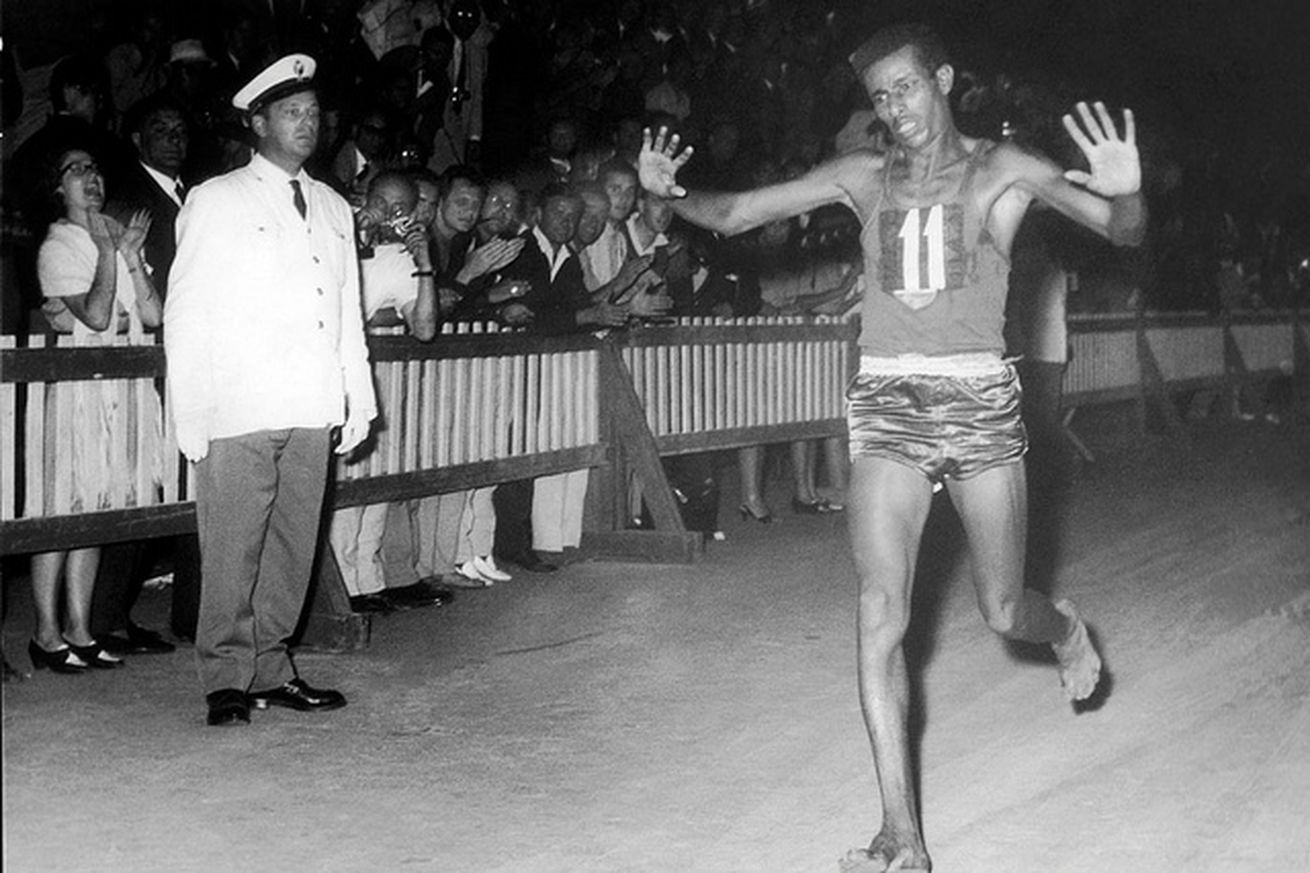
Abebe Bikila in Rome
Abebe Bikila running barefoot in Rome.

Running in Vibram FiveFingers Bikila EVO Shoes is like running barefoot. And running barefoot can, it is said, return you to a better, injury-free way of running.

That’s the whole point of the Vibram experience – to reproduce what it is like to walk or run barefoot. And who better to name a running shoe that replicates the barefoot experience than Abebe Bikila, the famed two-time gold medalist who famously came out of nowhere to win the 1960 Rome Olympics marathon…sans socks and shoes.

The shoe manufacturer, Vibram, has marketed shoes called the Vibram Bikila, trademarking the name of the famous Ethiopian athlete in 2010. In February, 2015, Teferi Bikila, the son of Abebe, filed a lawsuit against Vibram to cease using the Bikila name as the family never granted permission.

Vibram Bikila shoes

“He won the Rome marathon with bare feet, and nobody did it before then or since then,” Bikila, 45, said in this AP article. “It’s important that his legacy be respected.”

Unfortunately for the Bikilas, there is apparently a time limit on respect. A judge of the U. S. District Court in Tacoma, Washington dismissed the lawsuit in November, 2016, citing that the Bikila’s were aware of the Bikila shoe brand in 2011 but did not act until 2015, and thus “it would have been unfair to Vibram to allow the lawsuit to go forward after such a delay, when Vibram had been investing in and marketing the products for years.”

“The Bikilas unreasonably delayed in seeking to enforce their rights, and this unreasonable delay prejudiced Vibram,” wrote Judge Ronald Leighton.

In other words, the other shoe dropped.

Musashino Forest Sports Plaza 1
Musashino Forest Sports Plaza on the left, and Ajinomoto Stadium on the right

It was a cold and desolate Sunday when I walked around the grounds of the new Musashino Forest Sports Plaza. Located a short walk away from Tobitakyu Station on the Keio Line, the Musashino Forest Sports Plaza is right next to Ajinomoto Stadium, the home of the J-League Division 1 soccer team, F. C. Tokyo.

Musashino Forest Sports Plaza google maps

There were no events scheduled at either the Sports Plaza of Ajinomoto Stadium on the January afternoon I visited, but come July 2020, this quiet area of Chofu, very near the American School in Japan where my son went to high school, will be filled with thousands of noisy fans. The Musashino Forest Sports Plaza opened on November 27, 2017, the first of eight new permanent Tokyo 2020 venues to be completed. The Plaza will host badminton and pentathlon fencing in the 2020 Olympics, as well as wheelchair basketball during the 2020 Paralympics.

Musashino Forest Sports Plaza 3
View of the Main Arena on the left background, the sub-arena with its pool and gym on the right background, with a track and field in the foreground.

According to this article, the Musashino Forest Sports Plaza is built to serve the community long after the Olympics end. The facilities include a swimming pool, a gym, a multi-use sports area and two fitness studios which are available to the public. The roof of the facilities are made up of solar panels, to help provide a more sustainable energy source.

Musashino Forest Sports Plaza 2
Main Arena and its solar panel roof

And in line with Tokyo2020 Accessibility Guidelines, “the facility designed to be accessible to all, including the elderly, people with impairments, parents with infant strollers and those with guide dogs. The main arena has space for wheelchairs, and the space is designed with enough height difference between the rows of seating to ensure that those in wheelchairs can see clearly, even if spectators in front of them stand up.”

Ajinomoto Stadium will also host matches in the soccer competition during Tokyo 2020, and will be called Tokyo Stadium during the Olympics in accordance with its non-commercialization policy.

Musashino Forest Sports Plaza 4

Sports Grand Prix Top AthletesAmerican Justin Gatlin is the fastest man in the world today, but can he beat the speed of a ball in freefall that accelerates at 9.81 meters per second squared in the Shotgun Touch competition?

Russian Denis Ablyazin won the silver medal in the men’s vault at the 2016 Rio Summer Olympics, but can he win the “Monster Box” competition, hurdling a vault over 3 meters high?

New Zealander Tomas Walsh won the bronze medal in the men’s shot put at the Rio Games, but can he defeat All Blacks rugby player and fellow New Zealander, Nepo Laulala, in the excruciating “Power Wall” contest?

If you’re a big fan of Ninja Warrior, you know the incredible obstacle course is based on a Japanese television program called Sasuke, produced by Tokyo Broadcasting System (TBS). The same network, TBS, also produces a program called Sports Grand Prix Top Athletes which puts athletes to the test in creative competition.

And being an Olympian does not put you to the front of the class. Ablyazin made it look easy vaulting a horse built up some 2.5 meters high. But near the 3-meter mark, he faltered and lost to a Japanese trampoline competitor. Walsh also made it look easy pushing a movable wall against other competitors who sought to push the wall back, an event that is akin to a reverse tug of war.

But one would have thought that racing a falling ball to a spot requires pure speed, and that the fastest man in the world should win hands down. The “Shotgun Touch” competition requires a runner to touch a button which releases a ball from the ceiling (an unknown number of meters above the ground). The object is for the runner to get any part of their body, usually hands and fingers, on the ball before it touches the ground.

For competitors like track stars Kenji Fujimitsu and Gatlin, as well as Kansas City Royal Whit Merrifield, or J-League soccer star, Kensuke Nagai, getting to the ball 12 meters away was not so difficult, but another 50 to 100 centimeters, and the ball can seem to be accelerating faster than the law of physics. In some of the early attempts around 12 meters, Gatlin made it look easy with the ball hitting him in the back or his arms.

And yet, he actually missed at 12.60 meters and twice at 13 meters, disqualifying him from the rest of the competition. As he learned, diving technique is as important as speed. There’s no way Merrifield would beat Gatlin in a 100-meter sprint, and yet he was able to succeed at 13 meters. In the end, it was J-League soccer star Nagai who triumphed the shotgun touch competition.

Kinda silly, kinda fun…that’s how I spent my New Year’s evening.

Horace Ashenfelter ahead of Vladimir Kazantsev in 3000meter steeplechase

It was 1952 at the Helsinki Olympics, and the Cold War was heating up.

Making their first appearance at the Olympics were the Soviet Union. And in the 3,000-meter steeplechase, the favorites were Russians Vladimir Kazantsev, and Mikhail Saltykov, both world record holders with times under 9 minutes. Horace Ashenfelter, an American whose best at the time was nearly 18 seconds slower than Kazantsev’s best, was not given a chance to win the steeplechase competition.

And yet the American press played up the geo-political theme, particularly since Ashenfelter was an FBI agent in the US government. As Red Smith wrote in his column on July 26, 1952,

It was evident at Wednesday’s steeplechase heats that the final would bring about the carnival’s first head-on, man to man clash between an American and a Russian. A lot of people had been waiting for such a match ever since it became apparent, long before the games opened, that the 15th Olympics would be chiefly a Russian-American struggle. Before the heats, however, nobody had dreamt that the match might come about in the steeplechase. All the tall tales about a generation of supermen rehearsing behind the iron curtain had made special mention of Vladimir Kazantsev of Kiev, who had been charging over the obstacles at speeds the outside world had never seen.

With such a foe looming, Ashenfelter was given little chance. In the book, The Heart of a Champion, he was teased about his likely fate at the hand of the Russians:

“Horace, how is it going to feel to be out there running on the track when Kazantsev is in taking a shower and on his way home?” Another team-mate said, “I’ll bet Horace will have only three laps to go when Kazantsev is getting his gold medal.”

And yet, Ashenfelter was never fazed by the challenge. As stated in this interview, Ashenfelter was in prime shape and had nothing to lose.

I’m a pretty confident guy, actually and – put it this way – he had to beat me. It was the first time and only time where I had about three weeks of controlled training and rest. I had fine tuned my weight and weighed 128 pounds which I carried on five feet nine frame as compared to my normal weight of 140. I was in outstanding shape and had no bad luck occur. I was just going to stay with the pace as long as I could and to make the pace if I had to – I didn’t mind that.

He got suckered by his coaches as his plan they had was for him to stay with me. That meant that he was running on my right shoulder the whole race and adding three or four yards to each lap. I ran him a little bit wide on the corners and we bumped several times as he was running that close to me. That didn’t bother me but it may have bothered him – I don’t know. I knew I had a lot left at the end.

The American press lapped up the victory. As Smith wrote in his column, “The G man, reluctant to keep his back turned on a Commie, trotted back and slapped Kazantsev on the blouse of his britches.”

It was not known at that time that Kazantsev was also a KGB Agent, but one could imagine that Red Smith’s rhetoric would have been even more provocative.

As for Ashenfelter, he could care less about the Cold War drama on the track. “He was just an opponent. The media writes what they think and what they believe will attract readers.”

On January 6, 2018, Horace Ashenfelter passed away at the age of 94.

If you’re following the 2018 PyeongChang Olympics on Twitter, you can’t avoid the tweets on calls to boycott the 2018 Winter Games in support of a ban on the eating of dog meat in Korea. Certainly, as 2018 just happens to be The Year of the Dog in the Asian zodiac timeframe, and the Winter Olympics are in South Korea this year, this is an opportune time to protest the consumption of dog meat.

Over the past two millenia, gaegogi, or dog meat, has been consumed in Korea, as well as China and Vietnam. Wikipedia cites an article that states 25 million dogs are eaten each year by humans. I have never tried dog meat, or cat meat for that matter, which is also consumed by humans to lesser degrees, primarily in Asia.

But I have had horse meat, a popular delicacy in Japan. It’s called basashi, served raw like sashimi, and it is delicious. But friends who had never in their life had the thought of eating horse would probably outwardly protest, or inwardly recoil upon hearing that horse was a highlight of Japanese cuisine.

basashi
Basashi, or raw horse meat, a popular dish in Japan.

There are quite a few commentaries on the internet on this topic – the idea that eating animals viewed first as pets and friends is abhorrent, while eating animals viewed first as food is not even a passing thought for most people (vegans and animal activists excluded).

Why is that? Jared Piazza, a lecturer in moral psychology from Lancaster University commented about the terrible ways dogs are slaughtered for human consumption, and the ambivalence it creates in many:

I too find myself heartbroken by these images. But as a vegan I find myself wondering why isn’t there more outrage in the world over the slaughter of other animals. For instance, each year in the US roughly 110m pigs are killed for meat. Where is the same public outcry over bacon?

The simple answer is emotional prejudice. We just don’t care enough about pigs for their needless suffering to pull at our heartstrings. As Melanie Joy, social psychologist and expert on “carnism” points out, we love dogs, yet we eat pigs, and there are simply no good moral reasons for such hypocrisy.

However this belief really just reflects the fact that people spend more time getting to know dogs than pigs. Many people have dogs as pets and through this relationship with dogs we’ve come to learn about them and care deeply for them. But are dogs really that different from other animals we eat?

Dr. Marc Bekoff wrote in Psychology Today explained that our feelings towards animals slaughtered so they can become pork chops or hamburger or chicken soup are muted since these animals are “out of sight, out of mind” for many of us.

In my essay concerning eating pigs I wrote, “When some people learn that I go to China to work with Animals Asia in their moon bear rescue program (link is external) (see also) they ask, ‘How can you go there, that’s where they eat dogs and cats?’ I simply say that I just left the United States where people routinely eat pigs, cows, chickens, and millions of other sentient beings.” Why is eating dogs different from eating cows and pigs at a barbecue or in a restaurant? For one, we don’t see the actual painful process of how pigs and cows become meals. 

In the end, is the debate about whether people eat dog or cat meat? Or is it about whether we care how we treat animals raised for human consumption? Do many of us prefer to keep such images out of sight, out of mind? (Yes, I struggle with the non-committal nature of this post’s conclusion.)

Jean Claude Killy_Sports Illustrated cover

As soon as Jean-Claude Killy ended his run in the Alpine downhill competition at the 1968 Grenoble Winter Olympics, the first person to greet him was his mentor and friend, Michel Arpin. Arpin, who worked for ski manufacturer, Dynamic, adroitly hugged his friend, showing photographers his back pouch with the Dynamics logo.

A policeman, as instructed to do for all skiers, took Killy’s skis away in order to avoid the “unseemly” display of ski brands adorning an amateur Olympic champion. Arpin then, according to The Complete Book of the Winter Olympics, took one of his skis off and planted it in the snow so that photographers could capture Killy with the ski and the two yellow bars of the Dynamic brand.

Killy retired from competitive skiing not long after Grenoble, because he knew that it would be hard to sustain his World Cup skiing dominance and triple-gold medal Olympic achievement. He also knew that he had other worlds to conquer. He signed with sports management firm, International Management Group, and started his career representing such brands as American Express, Schwinn bicycles, United Airlines, Chevrolet, as well as Head, the ski equipment manufacturer which put Killy’s vaunted name on their newest fiberglass skis.

Jean-Claude Killy, from the tiny village of Val-d’Isere in the French Alps, was a super star, and was now getting paid enough to live the life of the jet set and do what he pleased. He married an actress, Danielle Gaubert. He competed as a race car driver. He acted in movies, and produced television programs. Eventually he moved into sports administration, joining the executive board of the Alpine Skiing Committee of the International Federating of Skiing (FIS), serving as co-president of the 1992 Albertville Winter Olympics, president of the Tour de France organization, as well as a member of the International Olympic Committee.

Jean Claude Killy in the 1972 film Snow Job

Famed gonzo journalist, Hunter S. Thompson, spent some time with Killy in the midst of his transformation from world-class skier to world-class pitchman, catching Killy in a burst of unsolicited honesty. “Before, I could only dream about these things,” said Killy. “When I was young I had nothing, I was poor. . . Now I can have anything I want!”

Killy indeed started from humble beginnings. But he felt he had earned his way to the top, focusing on all aspects of how to be the greatest skier of his time, and making the same effort to be the best in his part of the world of business. Thompson recognized that drive in Killy in his profile called “The Temptations of Jean-Claude Killy.” Thompson was following Killy during a marketing tour for Chevrolet, noting that Killy’s ability to draw you in was Gatsby-like, and was an ability that made him rich. But Thompson also admitted that Killy worked at his new profession, as much as he did in his previous one.

The Temptations of Jean Claude Killy

Jean-Claude, like Jay Gatsby, has “one of those rare smiles with a quality of eternal reassurance in it, that you may come across four or five times in life. It faced — or seemed to face — the whole external world for an instant, and then concentrated on you with an irresistible prejudice in your favor. It understood you just as far as you would like to believe in yourself, and assured you that it had precisely the impression of you that, at your best, you hoped to convey.”

That description of Gatsby by Nick Carraway — of Scott, by Fitzgerald — might just as well be of J.-C. Killy, who also fits the rest of it: “Precisely at that point [Gatsby’s smile] vanished — and I was looking at an elegant young roughneck, whose elaborate formality of speech just missed being absurd. . .”

The point is not to knock Killy’s English, which is far better than my French, but to emphasize his careful, finely coached choice of words. “He’s an amazing boy,” I was told later by Len Roller. “He works at this [selling Chevrolets] just as hard as he used to work at winning races. He attacks it with the same concentration you remember from watching him ski.”

The Gregory Brothers

The Gregory Brothers are an amazing group of musicians who have used pitch-correction software to turn verbatim into joyous song. The video below is of a song they call “Speechless,” stitched together with the words of joy of 2016 Rio Olympians. See Olympic stars Monica Puig, Mo Farah, Andre deGrasse, Kevin Durant and Simone Manuel in their singing debut.

Jean-Claude Killy, Guy Perillat
Jean-Claude Killy, Guy Perillat 1 and 2 in the downhill at Grenoble

Jean-Claude Killy edged out his fellow Frenchman, Guy Perillat, by only 8 one hundreth of a second in the men’s downhill. In the second alpine event, the giant slalom, King Killy, as he had been called, won easily for his second gold event.

The big question remaining – could Killy match the accomplishments of the great Austrian, Toni Sailer, who won all three alpine events at the 1956 Cortina d’Ampezzo Winter Olympics. The answer was touch and go.

A few days after Killy won the giant slalom, the weather in the French Alps deteriorated. Visibility on the slopes was horrible due to shadows, fog and mist, which made it hard to see the gates that formed the route down the mountain. The visibility was so poor, some of the skiers pleaded with officials to postpone the slalom competition, to no avail.

There are two rounds of skiing in the slalom and Killy found favor with the Gods as the skies cleared during his first run, helping him secure a small lead with a time of 49.37 seconds. In the second round, Killy made it down the course without fault, with a slighly slower time of 50.36 seconds.

A threat to Killy’s gold medal trifecta, Norwegian, Hakon Mjoen, seemingly overtook Killy in his second run, only to be disqualified for missing two gates down the slope. There was only one more man who had a chance to beat Killy – the Austrian Karl Schranz. Silver medalist in the giant slalom at the 1964 Innsbruck Olympics, and World Cup Champion in 1969 and 1970, Schranz unfortunately found greater fame in this 1968 slalom event.Karl Schranz

Sailer Schranz and Killy
Austrian skier Karl Schranz being congratulated by teammate Toni Sailer (left) and Frenchman Jean-Claude Killy after winning the Olympic slalom event here. Later came the sensational disqualification of Schranz by the judges for missing a gate.

As Schranz made his way down the slalom course, at the 21st gate, he had to stop, according to sports-reference.com. Schranz told officials that a man in black walked onto the course in his path, forcing him to stop. Upon hearing that explanation, officials allowed Schranz a do-over. Taking advantage, Shranz skied the course to perfection, generating the fastest combined times of the two rounds, and entered the post-race press conference as the proud winner of his first Olympic gold medal. Killy was the reluctant winner of the silver medal.

Two hours later, Schranz’s world was turned topsy turvy. It was announced that Schranz had missed gate #19 in the second round, two gates earlier than when the mystery man in black impeded Schranz’s progress. Since the infraction occurred prior to the distraction, officials declared Shranz disqualified, and Jean-Claude Killy the gold medalist.

Schranz and the Austrian team, according to The Complete Book of the Winter Olympics 2014 Edition, were outraged.

Schranz claimed that if he did miss a gate or two it was because he had already been distracted by the sight of someone on the course. His supporters contended that the mystery man had been a French policeman or soldier who had purposely interfered with Schranz in order to insure Killy’s victory. The French, on the other hand, hinted that Schranz had made up the whole story after he had missed a gate.

In the end, a Jury of Appeal ruled against Schranz. The Austrian lost his gold, and Killy won his third gold of the Grenoble Winter Games, matching Sailer in 1956. As he was quoted in The Complete Book, Killy celebrated with the sustained intensity he brought to the slopes: “The party went on for two-and-a-half days, and the whole time I never saw the sun once.”