1964 Paralympics_poster

The 1964 Tokyo Olympics ended on October 24, 1964 to universal praise. On November 12, 1964, the Thirteenth International Stoke Mandeville Games for the Paralysed, otherwise known as the 1964 Summer Paralympics, also ended in success, and arguably with greater impact.

The Tokyo Paralympics helped maintain momentum, as the number of nations grew from 17 to 21, events from 57 to 144, and participants from about 180 to 375. As D. J. Frost wrote in his excellent paper entitled, Tokyo’s Other Games: The Origins and Impact of the 1964 Paralympics, “they were widely hailed as a success and credited with giving ‘hope, courage, and self-confidence to Japan’s physically disabled’.” The 1964 Paralympics raised awareness significantly for people around the world, particularly in Japan, and added to the tremendous global goodwill developed via the organization of the Olympic Games a few weeks before.

Incredibly, in contrast to the five years of planning and organizing devoted to the Tokyo Olympics, the Tokyo Paralympics came together quite suddenly, with an official organization to plan and execute the games coming together only in mid-1963. While the Paralympics and Olympics are a joint deal for host cities today, that was not the case in the 1960s. When the first Paralympics were held after the Rome Olympics in 1960, Frost wrote that “a mere handful of people in Japan were aware of their existence.” In other words, the idea of organizing an international competition for disabled athletes prior to 1962 was essentially non-existent. Frost tells the incredible story of how very quickly, how a small group of people established new organizations, created public awareness, built consensus among local and national leaders, raise funds and then actually run the event.

Again, citing a good chunk of Frost’s research, here is the timeline of disabled sports in Japan, which demonstrates the sudden alacrity with which Japan made the 1964 Paralympics a reality.

September 1960 – A Lone Japanese Meets the Father of the Paralympics: At the 1960 Rome Olympics, there were over 160 athletes, and likely dozens if not hundreds other Japanese scouting out the Rome Games in search of information and ideas to prepare them for their own Games in 1964. But there were zero representatives from Japan at the 1960 Paralympics in Rome, which was held in mid-September. The closest there was to a Japanese representative was Hanako Watanabe, the wife of the head of the Rome bureau for the Kyodo News Agency. Watanabe did have an academic background in labor and welfare policy, but more importantly, she had access to the father of the Paralympic movement, Ludwig Guttmann. It is said the two met and talked about the possibility of holding a similar event in Japan after the Tokyo Olympics.

1964 Paralympics_dartchery
From the book, Tokyo Olympiad 1964_Kyodo News Agency

February 1961 – The First Major Document in Japanese on Disabled Sports: Matao Okino, the director of the Japanese branch of the World Veterans Federation (WVF), received materials about disability sports from the head office in Paris. Interested in bringing greater attention to the topic in Japan, Okino joined with Masatora Hieda, the head of the National Disability Rehabilitation Training Centre, to translate the materials and prepare a 157-page booklet, titled ‘Sports for the Disabled’.

April 13, 1961 – An Influential Workshop: Two emerging experts appeared at a workshop on disability rehabilitation training, where Okino gave a talk entitled “Elevating Sports for the Disabled in Japan,” while Watanabe shared her experiences in Rome during the Paralympics. According to Frost, Watanabe’s influence was not insignificant. Hieda acknowledged that Watanabe’s introductions to Guttmann, to labor and welfare experts, and to media via her husband, were key to building this ragtag network of disability sports community.

May, 1961 – The First Official Organization Devoted to Disabled Sports: Okino meets Guttmann at an international congress for the WVF in Paris. This leads to an agreement to form an official organization to promote disability sports in Japan. This group, the Association for the Promotion of Sports for the Disabled, was formed in August, and was made up of representatives of 24 groups related to disabled people. However, Okino and his colleagues were still not quite confident they could organize a Paralympics in Japan, and few concrete actions resulted.

October 22, 1961 – The First Disabled Sports Competition in Japan: All movements need a spark. Arguably, the spark happened away from the ivory towers of Tokyo, in the fields of Oita, Kyushu in Western Japan. Dr. Yutaka Nakamura, and a local government official, Atsushi Hirata, organized Japan’s first competition for disabled athletes. Their success, while not highly publicized, became the model for a practical application for the thinkers in Tokyo.

March, 1962 – The Lions Club and Asahi Shimbun Offer Their Weighty Support: Now that people in Japan could see what a Tokyo Paralympics might look like, supporters began to emerge. Susumu Iimuro, a leader of a large volunteer service organization called Lions Club International, joined hands with Muneyoshi Terada, an official of the Asahi Shimbun Social Welfare Organization to announce that they would be very supportive if Japan hosted the Stoke Mandeville Games, which was then the official name of the Paralympics. They announced “across-the-board support.” Terada then led the creation of a concrete plan to bring the Paralympics to Japan, the decision to establish a preparatory committee, and then consensus-building meetings with relevant officials in the Health and Welfare Ministry.

May 10, 1962 – A Committee is Finally Formed: The Preparatory Committee is formed, made up of 21 individuals, who go on to make one of the more important decisions they will make: selected Yoshisuke Kasai, the then chairman of the Association for the Promotion of Social Welfare, to lead this committee. Kasai is generally recognized as a powerful driving force in realizing the 1964 Paralympics.

May 30, 1962 – Lions Club Leads the Fundraising: The Preparatory Committee asks the Lions Club to help them raise funds, and resolves to send Japanese disabled athletes to the annual Stoke Mandeville Games in London.

1964 Paralympics_prepping for the Games
Preparatory work for the 1964 Tokyo Paralympics

July 1962 – The First Japanese Disabled Athletes in International Competition: Two men from Oita prefecture are sent to England to participate in the International Stoke Mandeville Games, the first Japanese to do so.

August, 1962 – The Crown Prince Supports: Of all the acts and decisions made towards building awareness about the disabled in society and the impact sports can have on the health of disabled athletes, one of the strategically important ones was involving the Crown Prince of Japan, Akihito, and his wife the Crown Princess, Michiko. The fairy story of a commoner meeting the Crown Prince on a tennis court, leading to a royal wedding covered feverishly by the media, was still strong in the hearts of the Japanese. So when the Crown Prince met with members of the preparatory committee, and stated afterwards that he hoped that the Paralympics would become a reality in Tokyo in 1964, media coverage and subsequently favorability by the public towards the Paralympics grew. Riding the wave of support, Prime Minister Hayato Ikeda pledged government assistance.

May 13, 1963 – It’s Official: The Health and Welfare Ministry approved the incorporation of a newly formed committee, the Organising Committee for the Paralympic Games in April, and a few weeks later, on May 13, Kasai sent a letter to Guttmann and his fellow committee members of the Stoke Mandeville Games of their intent to host the 1964 Stoke Mandeville Games in Tokyo, after the Tokyo Olympics.

At that stage, once the plan was in place, superior Japanese skills in execution took over, ensuring that the five-day event from November 8 to November 12, 1964 took place flawlessly.

SI_5Oct1964 edited

Prediction is very difficult, especially if it’s about the future. – Nils Bohr, Nobel laureate in Physics


A good forecaster is not smarter than everyone else, he merely has his ignorance better organised.  – Anonymous

In Sports Illustrated’s preview of the Tokyo Olympics, the editors offered their very specific predictions for gold, silver and bronze medalists for each of the Olympic events. Not only did they provide the names and orders of victors, they offered a bit of analysis for practically each event.

If we consider that this is 1964, when the only practical way to share information real time was the telephone, and shorter term by telegram, telex and snail mail. Using their considerable global connections at the time, they put together a pretty impressive set of predictions.

Let’s take a look at the 17 track and field events shown at the top of this post. Of that 17, SI identified the actual gold medalist 11 times, as you can see the green check mark I applied to an accurate prediction. In four events (indicated by a gray check mark), they didn’t identify the eventual gold medalist, although the one they picked made it to the medal podium.

Predictions part 1_with checkmarks

In fact, on this particular page, SI got only the marathon and steeplechase gold medalist wrong. They picked Ron Clarke for gold in the 10,000 meters, who eventually took bronze. No one knew that a kid from Kansas named Billy Mills would come out of nowhere to take gold and become one of the darlings of the ’64 Games.

True, men’s athletics were dominated by the US and USSR, and the American press were very aware of the USSR stars, so maybe these selections weren’t huge gambles.

Still, I’d be happy with this success rate.

Ed Caruthers at Santa Ana
Ed Caruthers at Santa Ana College

Still a freshman at Santa Ana College, high jumper Ed Caruthers was headed to the Tokyo Olympics in 1964. Caruthers had always been a football player, and as a pretty good wide receiver/defensive back, he hoped one day to get drafted by an NFL team. Out of football season, Caruthers dabbled in track and field. Strangely, with little effort, Caruthers would win most high jump competitions. In 1964, he told me, he “went to the AAU championships, and lo and behold, I jumped 7 ft 1 inch, and beat John Thomas, which then qualified me for the Olympic trials.”

Even more strangely, Caruthers wasn’t even aware that the Olympics were that year – 1964. He was simply more interested in preparing for the football season that Fall. But when he won the finals in the high jump at the Olympic trials in September, he realized that he wasn’t going to play football for Santa Ana in the coming months, and so did not register for school. As he told me, his track coach was “happy as a lark,” while his football coach had a hole in his team.

So Caruthers the football player, who was an accidental Olympian, took off for Japan in early October, about a week in advance of the Tokyo Olympics opening ceremonies. Caruthers was in good shape when he arrived, but with so much time before his competition, he needed to train. Unfortunately, it was hit or miss if a particular US team had dedicated coaches or not. The high jumpers, according to Caruthers, did not. And for a kid like Caruthers, who a month before wasn’t even aware the Olympics were taking place, a naïve kid who wondered why his teammates would not train with him, was suddenly thrust wide-eyed into the world of super mega-sports spectacle, complete with all the food you can eat.

The high jump competition was in the last two or three days so I was in Tokyo three weeks without competition. I didn’t have any coaching, and I didn’t go up to any coach and ask them either. I’m jumping by myself so I didn’t have that extra thing to push me higher. If John Rambo or John Thomas were out there training with me, I might have had the adrenaline going, wanting to show them. But (even though we were teammates) I was a competitor to them, so we didn’t.

Caruthers was not born of wealth, and was barely eating a bowl of cereal a day when he was a student in junior college. But when he came to Tokyo, and was privy to the bounty of the Olympic Village, he ended up eating eggs, waffles, bacon, cookies, ice cream, and lots of it. “I weighed 190 pounds when I arrived. After two weeks, I weighed 198 pounds. I thought maybe when you go to the other side of the world you gain weight, but no.” He just ate too much.

So prior to the high jump competition, Caruthers stopped eating. For three days, all he consumed was cornflakes, milk and salad. So, no, Caruthers was not feeling as strong as he wanted to at the start of the competition, nor feeling right or ready. As a consequence, Caruthers did not perform as well as he had expected, as he explained to me in detail:

I was getting up really good but I couldn’t tell what I wasn’t doing wrong. People in the stands who saw me jump said “we can’t believe you missed that… all you had to do is step one foot back”. I was about 3 – 4 inches over the bar. My plant wasn’t in the right place but I couldn’t tell. I’m 19 years old. The first jump was easy. But you have to make adjustments in your 2nd or 3rd jumps. At 7 feet everything has to be really refined and precise – there’s less room for error. I needed to make adjustments. After my second attempt I really needed someone to tell me but all I’m doing is I’m trying to run faster because I think I need more effort. I ended up jumping only 6-10 and a quarter.

Caruthers finished in eighth place. He sat on the bench and watched the others compete to the finish. Valeriy Brumel of the Soviet Union and John Thomas both jumped 2.16 meters, but could not go beyond that. Brumel took gold on fewer misses, Thomas silver and Rambo bronze. Caruthers thought, “damn, there are two guys on the medal stand I’ve beaten this year. There’s no reason I shouldn’t be on that stand.” He thought about the opening ceremonies, being together with thousands of athletes, all the flags of the world flapping around him, and “I’m right there in the middle of it. I am with the best athletes in the world.” He realized at his darkest moment that finishing eighth was not good enough, that his attitude and focus were inadequate, and that he wanted, needed to redeem himself in Mexico City four years later.

When Caruthers returned home to California, he was determined to focus more on track than on football. He was offered scholarships to play at USC or UCLA, but he picked the University of Arizona because it was 500 miles away from home, and from all the distractions of his friends and neighborhood. And he also wanted to make sure that he got his degree, and sought help from the university to ensure that he did well with his grades and graduated.

That’s what Tokyo did for me. Prior to that I only cared about two weeks from now. After Tokyo, my attitude was the difference between night and day. Training. Confidence. Everything. I knew what I was in school for. I had a schedule. I built up my strength. I refined my technique. I worked it so that I knew exactly what I should be doing to jump my best height.

In 1967, there was no better high jumper in the world than Ed Caruthers. He was primed for gold in Mexico City. He was determined. Nothing was to get in the way of his goal – to erase the memory of his poor performance in Tokyo. Nothing.

Nothing….except the Flop.

Sacred Flame in Kagoshima 1
Sacred Flame during torch relay in Kagoshima in September, 1964

It was called the Flame of Hope – a flickering flame kept alive in a boat lantern in the city of Kagoshima. Until it wasn’t.

The sacred flame came to Japan after being ignited in Olympia, Greece, and traversing South, Southeast and East Asia. When the flame arrived in Kagoshima on September 9, 1964, one of the many torch relay runners, a sports store owner, took his torch back home with the flame still alive. When the principal of the local elementary school saw the flame, he said he wanted his students to see it.

The Lantern that Held the Olympic Flame

And thus was born the idea to keep the Olympic flame alive, where it finally settled in a city youth training center. It was called the Flame of Hope. And for decades, residents of Kagoshima would over the years request the honor of using the Olympic flame to ignite fires for weddings, festivals and camp outings. For all intents and purposes, the Flame of Hope became an Eternal Flame, at least that is what the people of the youth training center dedicated to protecting.

Then one day in November, 2013, the flame went out, although no one really knew that until recently. In reports that came out only last week in October 2017, the head of the youth training center admitted this: “I saw with my eyes that the flame went out on November 21,” he added. “We re-lit the fire and kept it going for about two weeks, but I thought that was not good.”

According to that AFP report, the head of the center was feeling considerable pressure at that time as the news of Tokyo’s selection for the 2020 Olympics was bringing considerable attention to Kagoshima and the legacy of the eternal flame from 1964. “At that time, I could not say something that could destroy (people’s) dreams,” added the official, who declined to be named.

With so many people requesting use of the Flame of Hope, the guilt over deceiving the public had reached its breaking point, so he recently decided to come clean. In the past four years, the Flame of Hope had actually been re-lit by a magnifying glass and sunlight in December, 2013.

To be fair, the Olympic flame has a history of being extinguished, particularly those held by runners during torch relays, most recently when striking teachers disrupted the torch relay prior to the 2016 Rio Olympics.

But you have to feel for the employees of the Kagoshima youth training center – to see hope flicker out before their very eyes. Fortunately, hope takes on many forms, and still fuels expectations for greatness in 2020.

Closing Ceremonies_Mixing_Games of the XVIII Olympiad_IOC
From the book, Games of the XVIII Olympiad_IOC

On Saturday, October 24, a national effort to restore pride to a defeated nation and demonstrate to the world that Japan was indeed back, ended at the Closing Ceremonies on the final day of the Tokyo Olympiad.

The ceremonies began with Emperor Hirohito entering the National Stadium. And then began the march of the athletes – perhaps less march, more flood. Here’s how it was reported in The Official Report of the XVIII Olympiad:

The flags of all participating nations were marched into the Stadium by standard bearers at 5 o’clock with the names of the nations held high. The athletes followed into the field behind them without distinction of nationality and like a flood water released from its gates. All lined up together in an orderly manner in the area behind the flags. There was a feeling of deep emotion with the completion of the Games, and a peaceful hush descended on the Stadium.

Closing ceremony 6
From The Official Report of the XVIII Olympiad

When the athletes had all entered the stadium, the national anthem of Greece was played as that nation’s flag was raised, followed by the flags of Japan and Mexico, accompanied to the playing of the Mexican national anthem. The president of the IOC, Avery Brundage, then officially closed the Tokyo Summer Games, and proclaimed hope for a successful Games in Mexico City four years later:

I call upon the youths of all countries to assemble four years from now at Mexico City and there to celebrate with us the Games of the XIX Olympiad. May they display cheerfulness and concord so that the Olympic torch will be carried on with ever greater eagerness, courage and honor for the good of humanity throughout the ages.

Closing Ceremonies_IOC Flag_Games of the XVIII Olympiad_IOC
Fromthe book, Games of the XVIII Olympiad_IOC

As The Tokyo Olympic Hymm B played, the Olympic flame dissipated into the blackness of the night. In the dark and the quiet, the Olympic flag was lowered and carried off the field by members of the Self-Defense Forces, their solemn march highlighted by a single spotlight.

And suddenly, blossoming from the dark canvas of the field, red-orange flames ignited from hand torches held by hundreds of female college students who formed an oval around the stadium track. As Auld Lang Syne wafted through the Autumn air, the students rotated and waved tehir torches that “made a most impressive and magnificant spectacle as their flames…rotated like a gigantic undulating wave,” according to the Official Report.

Closing ceremony 5_Tokyo Olympiad_Kyodo News Agency
From the book, Tokyo Olympiad_Kyodo News Agency

It was finally time to leave. As the athletes marched out of the stadium, the electronic signboard lit up with the words “Sayonara! We Meet Again in Mexico City in 1968!” The Emperor left the stadium, and then the evening sky exploded in a blaze of fireworks.

Closing Ceremonies_Sayonara_Games of the XVIII Olympiad_IOC
From the book, Games of the XVIII Olympiad_IOC

Thus ended one of the most significant milestones in Japan’s march to recovery and prosperity in the 20th Century.

Closing Ceremonies Ticket_front

If you had this ticket to the Closing Ceremonies of the XVIII Olympiad on Saturday, October 24, 1964, 53 years ago today, you would have had honored seats. Like this ticket to the Opening Day Ceremonies, you would likely have been watching the pageantry from this area marked in red on the ticket’s stadium layout. That would have placed you directly across from the Olympic Cauldron, and some distance behind Emperor Hirohito of Japan.

You would have seen a different march of the athletes from that on Day One. On October 10, in the daylight of a beautiful Autumn afternoon, the athletes of 93 nations marched in order and in an orderly fashion. On October 24, after the tension of months of intense training and two weeks of pressure-cooker competition, the athletes were ready to party. They did not march in order of their country or even in an orderly fashion. Athletes of different nations mixed as they strolled, ran, and lollygagged their way into and around the stadium.

Closing Ceremonies Ticket_back_marked

And as the November 2, 1964 issue of Sports Illustrated described it, the team from New Zealand likely drew the attention of the Emperor with their antics.

The butane Olympic flame had been turned off and a blazing “SAYONARA” flashed on the scoreboard in capital letters. At that moment of opportunity, a maverick group of nine New Zealand athletes had a second thought. Grinning preposterously, they broke ranks and began loping around the track in one last ceremonious romp, pausing in their progress to dance impromptu jigs and to sing sudden songs.

In front of the imperial box, they repeated their comic opera for Emperor Hirohito himself, bowing from the waist in an exaggerated series of jerks. Distance Runner Bill Baillie threw the Emperor a record-breaking kiss (of the numbers who had stood in his imperial presence, no one had ever done that before). Remarkably, nobody hurried to intervene. The Emperor smiled in spite of himself, and doffed his Western hat.

That doesn’t happen every day. And you would have had a fine seat to witness it!

NZ team bowing
Members of New Zealand team bowing to the Emperor, from the book, XVIII Olympiad Tokyo 1964_Asahi Shimbun
Geesink vs Kaminaga 2_Tokyo Olympics Special Issue_Kokusai Johosha
Geesink and Kaminaga, from the book, “Tokyo Olympics Special Issue_Kokusai Johosha”

It was Friday, October 23, 1964.

The Nippon Budokan was packed. But perhaps there was a sense of resignation at this, the penultimate day of the 1964 Tokyo Olympics.

Despite the fact that three Japanese judoka, Takehide Nakatani, Isao Okano and Isao Inokuma had already taken gold in the first three weightclasses over the previous three days, there was considerable doubt that Akio Kaminaga could defeat Dutchman, Anton Geesink, in the open category.

After all, Geesink shocked the judo world by becoming the first non-Japanese to win the World Championships in 1961. More relevantly, Geesink had already defeated Kaminaga in a preliminary bout. So while the Japanese, including Crown Prince Akihito and Princess Michiko who were in the Budokan, were hoping Kaminaga would exceed expectations, all they had to do was see the two judoka stand next to each other to be concerned – the 2-meter tall, 120 kg foreign giant vs the 1.8-meter tall, 102 kg Japanese.

Even though judo purists know that skill, balance and coordination are more important to winning than size, deep down many likely felt that the bigger, stronger foreigner was going to win. After all, the bigger, stronger US soldiers and their allies had defeated the Imperial forces of Japan in the Pacific War.

And so Geesink did, defeating Kaminaga handily, sending the Japanese nation into a funk.

That was late in the afternoon on October 23. About 13 kilometers southwest of the Nippon Budokan and the site of Kaminaga’s defeat, the Japanese women’s volleyball team was preparing for their finals at the Komazawa Indoor Stadium. They too were going up against bigger, stronger adversaries, from the USSR.

In this case, however, there was a lingering sense that their magical women of volleyball would defeat the Soviets. They had in fact already done so at the World Championships in 1962, walking into the lioness’ den in Moscow and winning the finals. So when nearly every citizen in Japan had settled in front of their televisions that Friday evening, having the choice of four channels to choose from to watch the match, they were gearing up to explode in celebration.

And yet, Geesink had just sunk Kaminaga, as well as Japan’s hopes of sweeping gold in the only sport at the Olympics native to Japan. Maybe we just aren’t big enough, or strong enough, some may have thought.

Hirobumi Daimatsu, coach of the women’s volleyball team, accepted the challenge and worked over the years to train his players to compensate for relative weaknesses in size and strength, with speed, technique and guts. And much to the relief and joy of the nation, the Japanese defeated the Soviet Union in straight sets: 15-11, 15-8 and a tantalizingly close final set, 15-13.

Japan's Women's Volleyball team victorious 1964_Bi to Chikara
Japan’s Women’s Volleyball team victorious from the book, Bi to Chikara

And on that Friday evening, the day before the final day of Japan’s two-week Olympic journey to show the world that they were a nation to be recognized and respected, a team of diminutive Japanese women took down the larger Soviet women.

Whatever lingering sting from Kaminaga’s loss remained, whatever bad feelings of boycotts by the Indonesians or the North Koreans may have left, even perhaps, whatever shame that came from “enduring the unendurable” after the nation’s defeat in the Second World War, may have washed away in that moment the ball fell to the ground for the final point of the match.

On that day, Japan was a nation re-born – young, confident, world-beaters.

Nat Geo_shipbuilder

This is part two of a series on the October 1964 National geographic article called “Tokyo The Peaceful Explosion,” a fascinating portrait of Tokyo on the eve of the 1964 Tokyo Olympics. Staff writer, William Graves, and staff cameraman Winfield Parks provide a mosaic of life in the most populated city in the world at the time.

Change in Japan was fast and furious. In a conversation between Graves and an economist and editor for NHK, Hiroshi Narita (whom Graves calls “Nick”), they try to understand the secret of the emerging Japanese miracle.

I mentioned what everyone notices first about Tokyo – its fantastic prosperity. Shop windows were full, crowds on the streets were handsomely dressed, and thousands on thousands of sleek Japanese cars choked the streets. Nick nodded happily.

“Even to Americans, the figures are staggering,” he said. “In construction, Tokyo starts 800 major new buildings a year, more than two a day. The city’s – and Japan’s – economic growth rate runs about 10 percent a year, the highest in the world. In 1959 the rate rose to almost 18 percent; now people are talking about the recession.” He smiled.

“We have a stock market, too, and it’s doing just what yours is. Since 1949, for example, a share of Canon Camera Company stock has multiplied 865 times in value.”

“What’s behind it all?” I asked, trapping an elusive piece of shrimp with a chopstick.

“We are,” Nick said simply. “The Japanese people. You’ll get other answers – postwar aid, protective tariffs, new markets in Asia, and all of these things have helped. But basically the boom is built on Japanese brains, skill, and fantastic energy.”

Nat Geo_car factory
America-bound, a gleaming new truck rolls through the assembly line of the Nissan Motor Company automotive works between Tokyo and Yokohama. Of more than a million Japanese cars and trucks produced yearly, Nissan makes one in five. Bright-red paint brands this vehicle an export; japan reserves the color for its fire engines.
Nat Geo_electronics factory
Miniature television undergoes inspection at Sony Corporation, Tokyo’s astronomically successful postwar electronics manufacture. With 15 million sets in operation, Japan ranks second only to the United States in television ownership.
Nat Geo_railway construction
Sparks from a welder’s torch shower a streetcar track. To spare daytime traffic, repair crews work from dusk to dawn.
Nat Geo_fish market
Shed-full of tuna, fresh from the sea, awaits purchasers at the dockside Central Wholesale Market in Tokyo. An immense distribution center, the market handles 1,800 tons of fish and 3,300 tons of vegetable every day. To examine fish quality in the shed’s gloom, buyers wield flashlights, their badges of office.
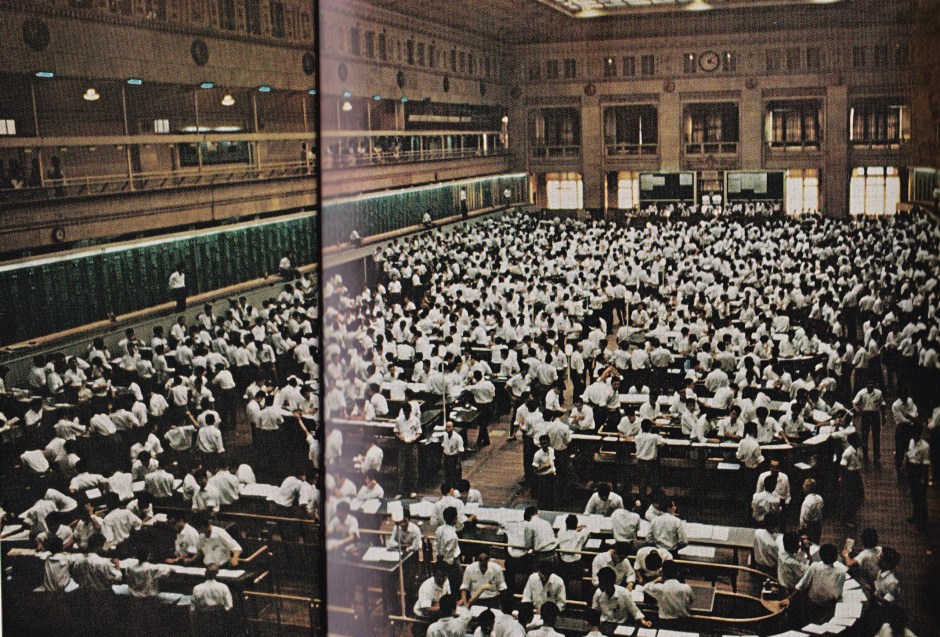
Nat Geo_Tokyo Stock Exhcange
Wall-to-wall carpet of white shirts hides the floor of Tokyo’s Stock Exchange, barometer of Japan’s explosive postwar growth. Some stocks sell for 800 times their 1950 values.
Nat Geo_city official
Shoji Koyama headed the Tokyo Metropolitan Assembly in 1963 sharing administration of the capital with a governor, Ryotaro Azuma. Portraits of past Assembly presidents line a wall of his chamber in the Metropolitan Government Office. Mr. Koyama now serves in the Diet, Japan’s national legislature. Though it includes almost 11 percent of Japan’s population, Tokyo until recently had less than 5 percent representation in the Diet. A revision in apportionment laws has raised the percentage to 7.
Syd Hoare_A Slow Boat to Yokohama
Syd Hoare, from his book, “A Slow Boat to Yokohama”

Syd Hoare, a member of Team Great Britain’s judo team in 1964, the year judo debuted as an Olympic sport in Tokyo, died on September 12, 2017. While I never had the honor to interview him, I did read his wonderful book, “A Slow Boat to Yokohama – A Judo Odyssey.”

Based on his life story as a young judoka, “A Slow Boat to Yokohama” tells well his journey to Japan to learn at the mecca of Judo in the early 1960s, and then competing at the 1964 Tokyo Olympics. I have borrowed those stories for a few of my blog posts:

For a wonderful look at Hoare’s past, here is an obituary penned by his daughter, Sasha Hoare, in The Guardian.

My father, Syd Hoare, who has died aged 78, was an Olympic judo competitor, author and commentator.

The son of Alfred Hoare, an executive officer at the Ministry of Defence, and Petrone (nee Gerveliute), a waitress, Syd enjoyed a wild childhood in postwar London: scrumping, climbing trees, jumping out of bombed-out houses on to piles of sand and being chased by park keepers. At 14, while a pupil at Alperton secondary modern school, Wembley, he wandered into WH Smith and found a book on jujitsu, which led to judo lessons at the Budokwai club in Kensington and sparked a lifelong passion for the sport.

Syd quickly became obsessed with judo and underwent intense training, often running the seven miles back to his home in Wembley to lift weights after a two-hour session at the Budokwai. In 1955, at 16 he was the youngest Briton to obtain a black belt and two years later won a place in the British judo team. He respected not only judo’s physical and mental aspects but its link to eastern philosophy.

For more, click here.

Syd Hoare from The A to Z of Judo
Syd Hoare portrait from back cover of his book, The A to Z of Judo
Nuzman under arrest
A grim-faced Carlos Nuzman left his home wearing a dark business suit in the Rio heat as he was escorted by police. (Source: AP)

He was a member of the Brazilian men’s volleyball team at the 1964 Tokyo Olympics.

After serving as the head of the Brazilian Volleyball Confederation, he was selected as the president of the Brazilian Olympic Committee and a member of the International Olympic Committee (IOC).

And in his role as head of the Rio de Janeiro Organizing Committee, he led the bid process that resulted in the selection of Rio de Janeiro for the XXXI Olympics in 2016.

But today, Carlos Nuzman is a man under arrest on bribery and fraud charges. A French investigation into the activities of former IAAF head and IOC member, Lamine Diack, who is under detention in France, have uncovered evidence that indicates vote buying during the bid process for the 2016 Games.

The Daily Mail cites the Brazilian press stating “Nuzman is accused of being the link between Brazilian businessman Arthur Cesar de Menezes Soares Fiho, nicknamed ‘King Arthur’, and Diack for bribes to African IOC members ahead of the 2009 vote which awarded the Games to the South American city.”

In early September, it was reported by AP that Brazilian authorities searched Nuzman’s house, uncovering $150,000 in cash in five different currencies, as well as three passports: a Brazilian, Russian and a diplomatic passport. According to this more recent AP report, Nuzman “amended his tax declaration to add about $600,000 in income, according to the arrest order,” and that “in Nuzman’s last 10 years as Brazilian Olympic Committee president, his net worth increased 457 percent, according to invLamine Diackestigators.”

Following Nuzman’s arrest, the IOC suspended him from his honorary membership in the IOC, and has been released from duties in the IOC coordination commission overseeing preparations for the 2020 Tokyo Olympics, according to the Daily Mail. Not only has Nuzman been impacted, the IOC has suspended the Brazilian Olympic Committee, frozen that organization’s funds, and will not allow it to vote on Olympic matters.