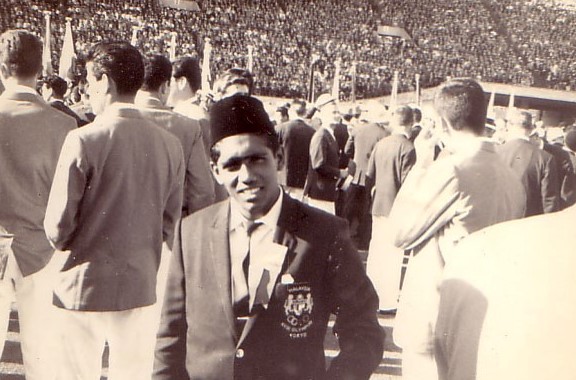
C Kunalan in Tokyo_2
Kunalan at the 1964 Tokyo Olympics Opening Ceremonies

It was the summer of 1964 and Singapore was in crisis.

Singapore’s leader, Lee Kuan Yew, had brokered a deal with the British Government and the leadership of Malaya to be included in a nation called Malaysia, established in 1963. This was not a match made in heaven. Racial tensions were part and parcel of the daily lives in the region between Singapore, which was a mixture of Indian, Malay and Chinese, but had a predominant population of ethnic Chinese, and the rest of the Malaya Federation, which was primarily Bumiputra and Islamic.

In July and September, Singapore felt the political tension born of the delicate balancing act that brought Singapore and Malaya together, and at times, the tension boiled over. Race riots broke out where shophouses were burned down, police and military were called out to restore order and enforce curfews, and people were beaten and killed.

This is the atmosphere in which athletes in Malaysia and Singapore were preparing for the 1964 Tokyo Olympics. Canagsabai Kunalan was a promising 21-year-old sprinter, talent spotted only a year before by the Malaysia track coach, Tan Eng Yoon. After a successful sprinting debut in 1963, Tan believed Kunalan was ready for the Tokyo Olympics, and recommended him for the 4X100 relay team, along with Mazland Hamzah, John Daukom, and Mani Jegathesan.

Tan Eng Yoon and Stan Wright with Malaysia team
3 weeks prior to Tokyo – standing: Tan Eng Yoon and Stan Wright; sitting (L to R): Kunalan, Wong Fey Wan, Kuda Ditta, M Jegathesan, and Dilbagh Singh

But the make-up of the 4X100 relay team did not sit well with Wong Fey Wan. Another talented sprinter, Wong defended his record, and called out Kunalan publicly in the press:

I beat Kunalan in the 100 m finals in the national championships in which I finished second to Jegathesan, and I beat him again in the Government Services Meet in the 100 m final on Saturday in which I finished third…. I am willing to race against Kunalan again to prove I am the better man over 100 m. If I am wrong I will quit athletics.

Coach Tan did favor Kunalan, perhaps for his work ethic, perhaps for the belief that Kunalan was stronger around the curves and a better choice as back up for the relays. Maybe Wong did not have the political support as he was self-taught and did not have the benefit of a coach lobbying his case as Tan did for Kunalan. Maybe race was influential. As explained through Kunalan’s state of mind at the time in the biography, “C. Kunalan – Singapore’s Greatest Track and Field Athlete”, Kunalan was unhappy.

Whatever the true reason for Wong’s exclusion – be it sporting or political, this incident affected Kunalan, who regarded this as “one of the saddest moments” of his running career. He never knew for sure whether he had been chosen on the basis of merit, but he wished that Wong had been chosen instead, knowing how much Wong had been looking forward to competing at the Olympic Games.

It was Kunalan instead who went to Tokyo. Just three days before his 22nd birthday, the Malaysian 4×100 team finished last in their round one heat, and that was that.

While Kunalan had no control over the make-up of the 4×100 Malaysian relay team, during a period of racial and political strife in his country, he did indeed have control over more important, personal decisions – with whom he would marry.

Kunalan and Roy 2
Kunalan and me

Teammates in track, Kunalan first met Chong Yoong Yin, captain of the Raffles Girls School track team, and a member of the Malaysia national track team. They had track in common, but to their parents, little else. Kunalan was ethnic Indian and was brought up in the Hindu religion. When Kunalan had returned from the Tokyo Olympics and his parents realized that his relationship with the ethnic Chinese woman, Yoong Yin, was still intact, they gave their son an ultimatum: “leave that Chinese girl or never return home again.”

Kunalan walked out.

Yoong Yin received the same ultimatum from her father and her uncle. And she too left home, joining her mother, who was estranged from her father.

Distraught after being shunned by their own families, they struggled momentarily, wondering what would happen. But Kunalan in the end was resolved. “We’ll have our own friends who will accept us.”

Wedding Day

Engaged in October 1965, with a wedding date set for October 1966, the parents of Kunalan and Yoong Yin eventually saw that there was no fighting the bond between the two. Kunalan’s father surprised his son with a visit, and said he would bless the union, but only if Yoong Yin would take on an Indian name and convert to Hinduism. Fortunately, that was not a problem for Yoong Yin, and the two sprinters were married in a Hindi ceremony. Subsequently a Chinese wedding dinner was held by Yoong Yin’s mother.

Fifty-two years later, Kunalan and Yoong Yin are still happily married. And Kunalan proudly proclaims that diversity and the need to be inclusive of all races and nationalities is vital to world peace. “I am not nationalistic,” he told a Singaporean magazine. “I am more of an internationalist.”

His children, a blend of Indian and Chinese DNA and heritage, have lived their parents’ creed, marrying members of other nationalities. Kunalan is proud of to be an inter-racial grandparent.

He remembers 1964. He recalls seeing the worst in the race riots of Singapore, and the best in the gathering of the world’s best athletes in Tokyo. And he believes that we are capable, through sports, to co-exist in peace and love.

Canagasabai Kunalan is living proof.

The International Family

Canagasabai Kunalan Singapore’s Fastest Man Part 1: Defying the Odds in Mexico City

A Teaching Moment at the Singapore Sports Museum

Canagasabai Kunalan strolled through the Singapore Sports Museum, walking his guest through Singapore’s greatest sporting achievements, explaining the history with enthusiasm, with the skills honed over decades as a teacher.

But C. Kunalan was more than just a teacher. As we walked through the corridors, passers-by would recognize the fit, elderly gentleman as the man who held the title, Singapore’s fastest, for decades. In fact, Kunalan had held at different points the fastest marks in the 100 meters, 200 meters and 400 meters in Singapore track history.

It was 1968 at the Mexico City Olympics, when Kunalan set the Singapore record for 100 meters, a mark that stood for 33 years.

Jim Hines set the world record in the 100-meters in Mexico City with a time of 9.95, considerably faster than Kunalan’s 10.38. But when you think about it purely from a statistical perspective, Singapore had a tiny talent pool. The population of Singapore in 1968 was 2 million, only 1% of the entire US population, and roughly the same population of Hines’ state of Arkansas that year.

C Kunalan in Mexico City_2
Kunalan finishing third (719) in a 100-meter heat to advance. Eventual gold winner Jim Hines strolls into the finish.

Kunalan defied the odds, advancing beyond the first round at the Mexico City Games to be recognized as one of the top 32 fastest men in the world. And if you know the history of Southeast Asia in the 1960s, you know that in 1968, Singapore was only in its third year as a sovereign nation. It wasn’t clear until the last days before departing Singapore whether Kunalan had the funds to even travel to Mexico.

In the end, Kunalan made it to Mexico City, and he was there to compete. But he knew, as a sprinter, he and his teammates were significantly behind those in the advanced industrial economies, or in the nations under the flag or influence of the Soviet Union. In his biography, C. Kunalan – Singapore’s Greatest Track and Field Athlete, written by Steven Quek, a one-time colleague of his in the National Institute of Education, Quek explains how support and role modeling by others contributed to his development.

At the Mexico City Olympics Kunalan recalled simple but powerful gestures: USA Assistant Track Coach Stan Wright offering Kunalan the use of Team USA’s masseurs for a pre-competition rub down, or Bahaman sprinter Tom Robinson coming up to Kunalan to suggest that the Singaporean be aware that he was exerting too much effort into the first 20 meters of his sprint, when he should in fact be conscious of staying relaxed. “Tom, a world-class athlete, was willingly sharing advice with an unknown from Asia. Kunalan never forgot this.”

After Kunalan’s competitions ended, he was then able to watch the very best athletes in the world demonstrate the highest levels of physical achievement:

Ever the teacher, Kunalan understood that for Singapore athletes to succeed internationally, to reach the world-class levels on display at the Olympics, their training must improve, as he explained in a letter to his wife:

We must get very serious about training. There are about 6 short men all doing 10 or 10.1. Why? Arms and legs big!! Mine only 1/2. You know darling! If I can get their strength, I will be doing 10 sec too.

C Kunalan in Mexico City_1
C, Kunalan in Mexico City

Kunalan would retire from track in 1970, but would go on to become one of Singapore’s most successful primary and secondary school teachers, twice being recognized as “Teacher of the Year”. He currently works for the Singapore Sports Council, in offices near the Singapore Sports Museum.

Maybe you’ll be lucky to see him there, get a tour like I did, and learn from a man who has literally lived the history of Singapore sports.

Canagasabai Kunalan Singapore’s Fastest Man Part 2: Out of the Frying Pan of the Race Riots and Into the Fire of the Olympics

Ichinomiya Chiba Open

When surfing was selected as a new Olympic sport for the 2020 Tokyo Summer Olympics, enthusiasts wondered how organizers were going to keep score.

One of the challenges when organizing surfing competitions is to create the perception that everyone has a chance at similar size and types of waves. After all we can’t control the moon and the tides they create on the vast ocean waters. And so very quickly enthusiasts wondered whether the Olympics were going to introduce wave pools to the competition, large mechanical pools that create waves. In that manner, you can pretty much guarantee that competitors will get the same level of difficulty every time.

As it turns out, surfing at the Tokyo Olympics will be held out in the wild, on the waves of Tsurigasaki Beach in Chiba, Japan. Perhaps it’s because wave pools have not yet become a part of top-flight surfing competitions, that from a technological or even a surfing culture perspective, competitors are not yet ready for wave pools. But the president of the International Surfing Association (ISA), Fernando Aquerre, gave another, economic reason in this interview with Surfer.com:

The IOC does not want to build more “white elephants” – structures that have no use after the Olympics are over. The Olympics organizers want to focus on legacy, on building things that can be used by host cities after the games. As of now, there is no commercially sustainable wave pool. You can build a wave pool like Snowdonia, but nobody knows if that will be commercially sustainable over a period of time.

Snowdonia wave pool
Snowdonia wave pool

So how will the surfing competition be run in 2020?

  • First, there will be a total of 40 surfers allowed to compete, 20 men and 20 women.
  • Second, the event will be shortboarding only – no longboards or bodyboards.
  • Third, Aguerre said that they will be patient over the two-week Olympic competition to find the right two-day period to hold the surfing competition.

That last point is interesting because television will probably demand that surfing establish a set time in advance. But then again, the Olympics are also about putting “athletes first”.

“We’ll try to start it at the front end of the games, but we can wait to run it if the waves look better at the end,” Aguerre said. “We have ten years of wave history and wind conditions data to rely on. We’re very confident, and so are Tokyo and the IOC, that we’ll have reasonable waves of good quality.”

Additionally, Aguerre wants to make sure that the venue at Tsurigasaki Beach has the right vibe. “The IOC has asked us to to create a full-on beach scene at Chiba that will last the whole length of the Olympics,” he said. “It will include the surf events of course, but also organic food, yoga in the morning—it will be a place where you want to hang out. There might be a skate ramp — maybe it will be like what you see at the U.S. Open. It’s never been done before at the Olympics.”

morteza-mehrzadselakjani-against-bosnia-herzegovina
Mehrzad spiking his team to victory in the Rio Paralympics sitting volleyball finals.

The athletes who participate in the Paralympics challenge our perceptions about what a “normal” person looks like or is capable of. When people like me – someone who does not interact frequently with people who have so-called disabilities – watch the para-athletes in action, we are amazed. The British broadcaster of the 2012 Paralympics in London, Channel 4, emphasized that point by creating the fantastic promotional video called “Meet the Superhumans.”

By the time Rio rolled around in 2016, running from September 7 to 16, the mindset towards the Paralympics was shifting – that athletes were not superhuman, but they were people like the rest of us who could develop their talents, sometimes up to world-class levels. Channel 4 captured that sentiment in a promotional video called “Yes, I can!”

If you watched the Rio Paralympics, you were likely amazed by people who appear relatively disabled because they can’t see or hear, are missing a limb or two, or are paralyzed in parts of their bodies, for example. But amazing is becoming the new normal. By the time Tokyo 2020 rolls around, perhaps we won’t be amazed at the overcoming of disability – we will be amazed at the athleticism and competitiveness.

For now, here are stories from the 2016 Rio Paralympics, which frankly, amazed me.

jefinho-scoring-against-china
Jefinho celebrates his equalising goal against China (Photo: Marcio Rodrigues/MPIX/CPB)
Roy with Fiji 7 dollar bill
Me with a Fijian 7-dollar bill

Just got this in the mail from a friend – a 7-dollar note!

When the rugby team from Fiji won their nation’s first gold medal in the Olympics’ first rugby seven’s final at the 2016 Rio Olympics last August, it seemed as if all 900 thousand citizens jumped up and rejoiced.

Eight months later, the Fiji government commemorated the Olympian accomplishment not just with a 50-cent coin, but also a 7-dollar bill! A million of these bills, with the very uncommon denomination of 7, were printed, and of course, they are legal tender. (Seven Fiji dollars is about USD3.40.)

Fiji Seven Dollar Bill_Front

The front of the bill is a striking vertical layout, featuring the team captain Osea Kolinisau with the ball, and the team coach, Ben Ryan, looking contemplative. The back of the bill shows the entire team. A watermark shows team member Svenaca Rawaca running with the ball as well.

Thanks Victor Warren!

(Victor was a member of the Canadian field hockey team at the 1964 Tokyo Olympics.)

Fiji Seven Dollar Bill_Back

Tsurigasaki Beach Aerial View
Aerial View of Tsurigasaki Beach

I’m not a surfer, but when I think of places to surf in Japan, I think of Shonan Beach in Kanagawa Prefecture, or the islands of Okinawa. After all, it was the American soldiers based in those areas since the Japanese occupation of the late 1940s and early 1950s who introduced surfing to the Japanese, sparking a fascination for Hawaii, the American beach culture, and how to ride the waves with a board.

But when the Olympics return to Tokyo in 2020, all surfing eyes will turn to Chiba. Last year, surfing was voted in as a new Olympic sport for 2020, and Tsurigasaki Beach in Chiba was selected as the venue. Located about 90 minutes east from Tokyo in the city of Ichinomiya, Tsurigasaki Beach has become the go-to place to catch waves in the Kanto region.

In this survey of the best surf spots in Japan, JapanSurf.com ranked Chiba as having the best quality waves in the country. “Consistent, powerful beach breaks and thundering reefs make this area a mecca among surfers in Japan.” The Mainichi Daily News explained that surfers enjoy a “consistent flow of waves toward the shore from three different directions, namely northeast, east and southeast.”

Ichinomiya surfing alamy

Even more interestingly, the Mainichi article states that surfing has been responsible for a phenomenon unseen for decades in Japan – a small town that is actually growing in population.

Ever since the 1980s, people wanting to surf all year round have been moving to the town, and since the 2000s, numerous surfing shops, restaurants and new homes have emerged along prefectural Route 30, which runs parallel to the Pacific coast. As a result, the area has taken on an atmosphere of a “tropical island” bustling with youngsters, attracting what is believed to be about 600,000 visitors a year.

According to the article, the town of Ichinomiya has grown to 12,400 at the beginning of 2017, in a country where both the rapidly aging population and the desire of the youth to work in the big cities has shrunk the populations of cities and towns that are not named Tokyo or Osaka.

The Japanese love for surfing has revitalized Ichinomiya. And as planning continues to bring the biggest beach party in the world to Tsurigasaki Beach, ambitions climb. “We want to spread the name and culture of Ichinomiya across the world,” said Ichinomiya mayor, Masaya Mabuchi.

Map to Ichinomiya Tsurigasaki Beach
Duke Kahanamoku
Duke Kahanamoku

Surfing is coming to the Olympics in 2020.

But the seed of the idea of surfing as an Olympic sport was planted, apparently, in 1912 by the Johnny Appleseed of surfing, Duke Kahanamoku.

According to the International Surfing Association (ISA), the swimming legend who won three golds and two silvers across three Olympics and 13 years, Kahanamoku “first presented his dream at the 1912 Summer Olympic Games in Stockholm, where he expressed his wish to the International Olympic Committee (IOC) to see Surfing included in the Games.”

Fernando Aguerre

In fact, this little historical footnote was the inspiration for the current head of the ISA, president, Fernando Aquerre. The surfer from Argentina was newly elected to the ISA in 1994, and according to Olympic.org, he had a dream to get surfing into the Olympics. In fact, Aguerre met Juan Antonio Samaranch, in 1995, part of his pitch was to give the then 75-year-old president of the IOC a surfing lesson in his office.

Unfortunately for Aguerre, what was true in 1912 was also true in 1995 – the IOC was not ready to hang ten.

“We had paddled out but there were no waves,” Aguerre said (in reference to his meeting with the IOC). “We kind of figured out that waves were going to come at some point but we didn’t really know when they were going to come because they were out of our control.”

Still president of the ISA, and still hanging on to his dream, Aguerre opened up his options by connecting with Thomas Bach in 2013, who was a candidate to become the head of the IOC. And by this time, Aguerre was more able to lay out a vision for why surfing needed to be in the Olympics – the need to attract youth to the movement with the rise of action sports. Bach, who was elected to head the IOC that year, made the attraction and retention of youth to the Olympic Games part of his platform.

Surfing has grown significantly in popularity over the recent decades. There were only 32 member countries of the ISA in 1995, but now there 100. So when surfing was submitted to the IOC in September 2015 as a part of a shortlist of new events for Tokyo 2020, primarily driven by youth-oriented action sports like skateboarding and sport climbing, surfing finally caught a wave. In August, 2016, the IOC voted surfing into the Olympics.

Come July 2020, if you want to watch the first Olympians set Olympic records with every top score in surfing, then plan to bake on the hot sands of Tsurigasaki Beach in Chiba, Japan. That is where the surfing world, Barney and pro alike, will gather.

Surfing Hokusai waves olympic rings

japan ewaste
Japan’s Urban Mines – it’s electronic waste

It’s estimated that to make all of the gold, silver and bronze medals to provide to all the expected top three winners of all Olympic events, the manufacturer would need 9.6 kilograms of gold, 1,210 kilograms of silver, and another 700 kilograms of copper, which is the main component of bronze.

it is the goal of the Tokyo 2020 organizers to award athletes at the 2020 Games with medals created from 100% recycled materials. Instead of resource-poor Japan buying from the reserves and mines of other countries, the nation will mine its own growing stash of hidden resources – its urban mines.

An urban mine is a metaphor for all of the electronic goods a rich society buys, consumes and throws away, which also house a collectively massive amount of precious or rare elements. By that definition, Japan is loaded, according to this research from 2009:

A considerable amount of metal was estimated to be accumulated in Japan. The accumulation amount of gold and silver is 6,800 tons and 60,000 tons respectively. They are greater than the reserves of richest resource-possessing country, South Africa for gold and Poland for silver.

To uncover the riches stored in our electronic waste, Tokyo 2020, the Japanese Government and wireless provider NTT-DoCoMo, among a variety of public-private partners, kicked off a campaign in April to collect used and unneeded smartphones, PCs, displays, digital cameras, PC displays, MP3 players, handheld video game players, or calculators.

Takeshi Matsuda donating phone for recycling at an NTT-DoCoMo outlet
Olympic swimmer Takeshi Matsuda donating phone for recycling at an NTT-DoCoMo outlet

According to Tokyo 2020 CEO Toshiro Muto, about 500,000 mobile phones have already been collected, which is a good start. “This is not enough to make all the medals,” he admitted, “but we still have a lot of leeway because some people outside Tokyo still are not aware of the program. There is a lack of recognition, so we have much more work to do in creating excitement and being even more creative to have wise ways to collect these metals.”

Japan can do this now because they had set up the process four years before, when the government passed The Act on Promotion of Recycling Small Waste Electrical and Electronic Equipment. The government was then able to certify 45 recycling operators nationally to receive small electric and electronic devices collected by local governments and then to sort, dismantle and send them to smelters to recover metals. According to this report from Japan for Sustainability, in the first year of this project,

a total of 13,236 tons of small electric and electronic devices were sent to certified operators. Some had been collected by municipalities across the nation (9,772 tons) and others had been brought directly to the operators by citizens and companies. They broke the devices down into their parts and sorted them, sending 8,582 tons to the smelters. Among the metals extracted from them, iron accounted for the largest portion in weight (6,599 tons), followed by aluminum (505 tons) and copper (381 tons). Extracted precious metals including gold and silver amounted to 494 kilograms.

Amazing.

If you are interested in contributing to the production of the first Olympic medals molded from metals recycled from Japan’s massive urban mines, then gather those unneeded phones and small electronic devices and donate them to the cause. Take your mobile phones and tablets to your local NTT-DoCoMo store, or follow these instructions if you want to send your PC and other larger items for recycling. (Yes, this applies to people living in Japan only, and unfortunately the instructions are in Japanese only.)

Frederic Weiss at a Knicks camp

It was the end of June, 1999, and my New York Knicks had come off a stunning run to make it to the NBA Finals against the San Antonio Spurs. They lost in five games, but the energy and excitement that Latrell Sprewell, Patrick Ewing, Allan Houston, Larry Johnson and Marcus Camby brought to New York City was electric!

It was a great time to be a Knick fan!

But a week later, still basking in the glory of my team’s incredible season-ending run, the powers that be in the Knickerbocker management team made a decision in the NBA draft that puzzled, if not deflated the fan base. With the fifteenth pick in the first round of the draft, the Knicks selected Frédéric Weis.

Qui?

Weis was from France, a seven footer, perhaps someone to clog up the middle. Who was pick number 16? One of the most talented players to come out of my favorite university college team, Ron Artest, who would go on to become a volatile but brilliant All-Star in his career. (Yes, Artest of St. John’s University, would change his name to Metta World Peace.)

But what of Weis?

For starters, the Knicks’ coach, Jeff van Gundy did not appear to be supportive of the selection. Weis, overjoyed to be drafted, soon felt the cold shoulder once he arrived in the United States for the Knicks’ summer league camps where rookies and others are worked out. Weis was not considered inspired material, but he was a first round draft pick, which afforded him the right to sign a contract that would have made him a Knick. But thanks to his agent, he declined so that he could play another year with his professional team in France. Weis personally believes that was a mistake.

Then came the 2000 Sydney Olympics, and perhaps the most famous dunk in Olympic history, perhaps in basketball history. The American team were facing the French national team, and pretty much handling the French, up by 15 with 16 minutes to play in the game. The French rebounded the ball at their end of the court, one player bounced pass a ball that went a bit too high for his teammate. That’s when Vince Carter, one of the NBA’s most dynamic players at that time, came charging in, snatching that high pass, dribble twice and then leaping for a thunderous dunk. In his path was Weis, who Carter simply lept over, all 2.18 meters of him.

That play has been dubbed “Le dunk de la morte,” or the Dunk of Death.

Vinsanity went into overdrive. Weis, if he were a stock, nosedived – a symbol of all the terrible talent decisions Knick management had made in the past (and in the future).

And that was despite the fact that Weis played well on a French team that won the silver medal at the 2000 Sydney Olympics.

Weis never played a game as a New York Knick. After the Olympics and his return to France, no efforts were made by Knick management to make him a part of the team. In other words, to Knicks fans, Weis was a total waste of a good draft pick.

The New York Times followed up on Weis in September, 2015, with this wonderful but sad story of a man whose basketball career, so full of promise, never took off, and a life that appeared to deteriorate year on year.

Vince Carter Frederic Weiss in Le Duck du Mort

A couple of years after winning silver at the Olympics, Weis and his wife Celia had a boy named Enzo. A year later, the boy was diagnosed to be autistic, which was hard for Weis to handle, so much so that the couple separated, Celia taking Enzo away. Bouts of depression became deeper, until finally Weis decided he had had enough of himself. Here’s how the New York Times told that story:

On the morning when Frédéric Weis tried to kill himself, he dreamed about owning a beach house. A beach house had been Weis’s dream for a long time. In France, in Spain, in Greece — wherever his career as a 7-foot-2 professional basketball player took him. He liked the sand, he liked the surf. A beach house was a good dream.

But on that day, in January 2008, the dream did not make him smile. Weis got into his car in Bilbao, Spain, around 10 a.m. and began the drive here, to this small city in west-central France best known for its production of fine china. He was on his way to see his wife and son. About 90 minutes into the drive, Weis suddenly pulled over at a rest area near Biarritz, a French town not far from the border.

He stopped the car, leaned back in his seat and, at 30 years old, considered all that had happened to him during his career… Weis thought about all this for a while. Then he thought about the beach house. Then he thought about his son, Enzo. Then he reached over, took out the box of sleeping pills he had brought with him and swallowed every single one.

But, as the article explained, Weis did not pass on. He instead fell into a deep sleep, waking up 10 hours later realizing he was still alive. “He had failed, and for once, this made him happy. ‘It was the luckiest I’ve been in my life,’ he said.”

Frederic Weiss tobacco shop
Frederic Weiss at his tobacco shop

Weiss returned to basketball in Spain and France before retiring in 2011. When the New York Times caught up with him in Limoges, France, where he was running a tobacco store and a bar, battling bouts of depression, but back with his wife Celia and son Enzo.

Life goes on for the man made famous by the Dunk of Death.

Benjamin Spock with children
Dr. Benjamin Spock

One of the most famous names in America in pediatric health, at least in the 20th Century, was a man named Dr. Benjamin Spock. His book, Baby and Child Care, was a perennial best seller and the bible on child care. The only other book to outsell his in America – the actual Bible.

What I didn’t know was that Spock was a gold medalist, a member of the American eight-man crew that was so dominant at the 1924 Paris Olympics that their time of 6 minutes and 33 seconds was almost 16 seconds faster than the second-placed Canadian crew.

A renown expert in the medical field, an Olympic champion, Spock was a name in America few did not know. And yet, despite a relatively wealthy upbringing, he was not born with confidence and expectations of greatness. As he explains in the book, Tales of Gold: An Oral History of the Summer Olympic Games Told by America’s Gold Medal Winners, Spock explained that his mother was a very devoted tyrant, and his father was a self-made man who was obsessed with status, proud to have been a member of the finest and exclusive social clubs at Yale University.

When Spock entered Yale, I believe around 1921, he wrote:

I felt very unsure of myself. I felt unpopular and unable to compete with other boys. I felt like a sissy, a mother’s boy, and I was timid. I was afraid they might bully me and that I would not be able to do the things they were able to do.

Sports was an acceptable avenue of exploration, and he continued his focus on the high jump, which he trained in at his high school. But try as he could, he could not improve beyond mediocrity. One day in his freshman year, he walked by the rowers in the Yale gym. In rowing, height can be an advantage. Despite his skinny frame, Spock was tall, six feet four inches (1.9 meters), and so caught the eye of the captain of Yale’s rowing team.

“What sport do you go out for?”, said the captain.

“High jumping,” said Spock.

“Why don’t you go out for a man’s sport?” said the captain.

To Spock, who yearned to be seen as a man’s man, these were the words that struck his soul. To be seen as having potential in one of the most respected and manly of sports at the time – rowing – was a revelation. “I was elated. The captain of the crew thought that I might be crew material! That had never occurred to me.”

Benjamin Spock
From the book, Tales of Gold

Granted, the Yale squad was one of the worst crew teams in the United States. As Spock described, their technique was outdated. “You’d lie way, way back to get the length of the stroke and pull the oar up almost to your chin and shove it away.” But during Spock’s freshman year, the rowing committee at Yale decided it was time to change things up, so they hired a coach out of Washington named Ed Leader, who transformed the stroke and the team.

In two years under Leader’s leadership, Yale’s rowing team went from worst to first, and Spock’s eight-man crew defeated a crew made up of US Navy officers fairly handily, earning the right to compete at the Paris Summer Olympic Games. In Paris, the American eight from Yale were considered favorites with perennial favorites, The Thames Rowing Club of Great Britain. Fortunately for the US, the Thames Rowing Club had in Paris only four members of the crew which won the prestigious Grand Challenge Cup at the Henley Royal Regatta the previous year, perhaps paving a golden path for Spock and his team.

Baby and Child Care coverAs Spock wrote about his team’s gold-medal-winning finals, “the race itself was an anticlimax. We won by, I think, 3-and-a-half boat lengths. You’re not meant to win a race that short by as much as a boat length.”

Spock graduated from Yale, and then got his doctor of medicine at Columbia University, launching a career to become America’s most famous pediatrician. Interestingly, Spock became very critical of putting children or young adults into “excessive competition”, worrying that parents were putting too much pressure on their children. “The problem is,” he wrote in 1985 in Tales of Gold, “that Americans are meant to be the best in everything.” He even had thoughts about parenting in Japan, arguably an early hotbed for prototypical Tiger Moms.

I was visiting Japan, and if any country is worse than the U.S. for competitive youngsters, it is Japan. Their educators told me that a shocking number of elementary school children commit suicide and that the number is going up every year. They commit suicide because they don’t think they’re getting grades high enough to satisfy their parents. What kind of society is that in which children have to kill themselves because they can’t compete?