Pavel Datsyuk and Ilya Kovalchuk of SKA Saint Petersburg

They all play for the National Hockey League (NHL) and in April, 2017, NHL Commissioner, Gary Bettman ended any sliver of hope by stating unequivocally:

 …in an effort to create clarity among conflicting reports and erroneous speculation, this will confirm our intention to proceed with finalizing our 2017-18 regular season schedule without any break to accommodate the Olympic Winter Games. We now consider the matter officially closed.

The NHL, in the end, did not want to take the 17-day break required in the NHL schedule, during a period when the American football and baseball leagues have no games on the schedule. Thus, the break would take revenue out of the franchise owners’ pockets. Despite the passionate player interest in playing for their nations, as they had done since the 1998 Nagano Olympics, and despite the IOC funding the travel and insurance costs of NHL players, we will not be seeing the very best ice hockey players from the NHL in PyeongChang in February, 2018.

So who will play, and who will win? National teams will look to universities, retired NHL players and members of their own ice hockey leagues, which are not going to suspend play for the Olympics. Chief among them is the Kontinental Hockey League, or the KHL.

Formed in 2008, the KHL is made up of teams from Belarus, China, Finland, Kazakhstan, Latvia, Russia and Slovakia, and is currently the second biggest professional ice hockey league after the NHL. So of all the national teams, Russia, via players in the KHL, will likely have the most NHL experience at the PyeongChang Winter Games. Based on this article from NBC Sports, here are some of the celebrated names who are in the KHL, and thus will likely play in the coming Olympic Games:

  • Pavel Datsyuk: two-time Stanley Cup champion, four-time Olympian, Russia’s team captain at the 2014 Sochi Olympics, 15-yer veteran of the NHL’s Detroit Red Wings, and currently member of the SKA Saint Petersburg club of the KHL, age 39
  • Ilya Kovalchuk: four-time Olympian for Russia, last played for the NHL’s New Jersey Devils, and currently member of the SKA Saint Petersburg club of the KHL, age 34
  • Andrei Markov: three-time Olympian for Russia, and two-time all-star with the Montreal Canadiens, now playing for Akk Bars Kazan of the KHL, age 38
  • Slava Voynov: a two-time NHL All-Star from Russia, Stanley Cup Champion with the Los Angeles Kings and Sochi Olympian, now playing for the SKA Saint Petersburg in the KHL after pleading no contest to a charge of domestic violence, age 27
  • Max Talbot: a Canadian who played on the Stanley Cup Champion Pittsburg Penguins and three other NHL teams for 12 years before moving to the Lokomotiv Yaroslavi club in the KHL, age 33
  • Ben Scrivens: a Canadian goalie who has over 140 games of NHL experience, and currently plays for the Salavat Yulaev Ufa of the KHL, age 31

Does an edge go to the Russian ice hockey team in PyeongChang? Does age and experience go before youth and enthusiasm? Will we re-visit those days of yesteryear when college students in the West went up against professionals in Russia?

Without the NHL players, ice hockey at the Olympic Games could prove very exciting.

Andrei Markov

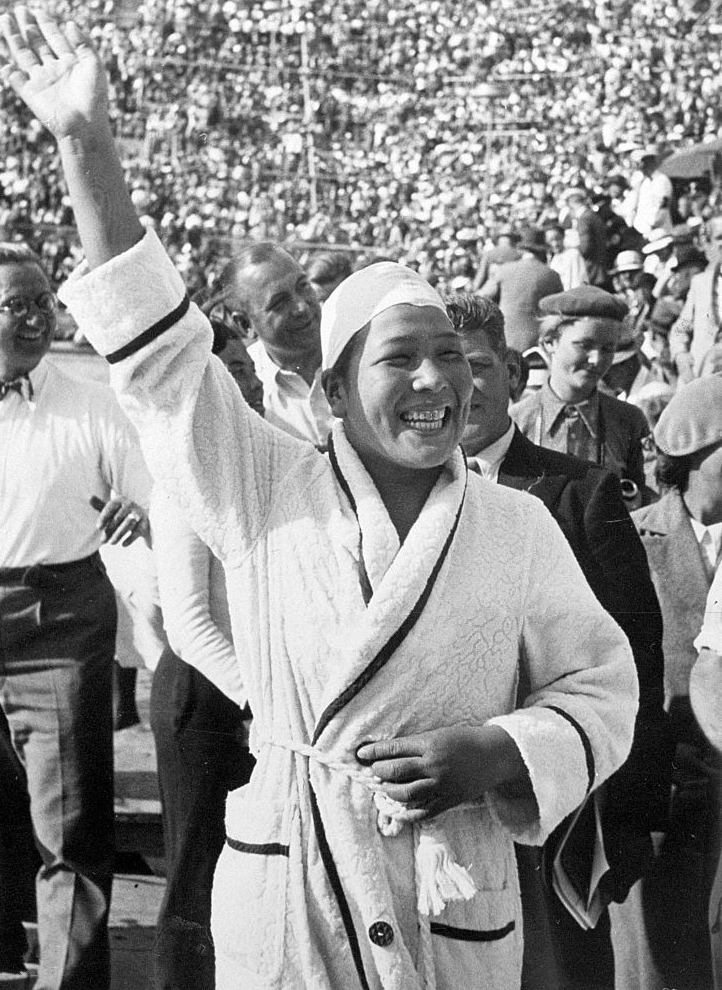
Hideko Maehata after winning gold in Berlin
Hideko Maehata waving to the crowd after winning gold in Berlin

It was a slight, perhaps. The first and most famous of films about the Olympics – Leni Riefenstahl’s documentary about the 1936 Berlin Olympics, entitled Olympia, did not include the winner of the women’s 200-meter breast stroke. That’s because the winner was a Japanese, Hideko Maehata, who beat out a German named Martha Genenger.

But that’s OK. When Maehata returned to Japan after her gold-medal winning performance in Berlin, she was a national celebrity. Eight other Japanese won gold medals at the Berlin Games, but they may not have gotten the media attention that Maehata did. As Robin Kietlinski explains in her seminal book, Japanese Women and Sport, national radio was bringing the world to all of Japan, led by Nihon Hoso Kyokai, or NHK. Established in 1924, Maehata’s race was one of the first events to be covered live, broadcasted to Japan via satellite.

And according to Kietlinski, they had the man who brought the excitement of the moment alive for Japanese listeners – Kasai Sansei – whose shrieks of excitement and shouts of “Maehata ganbare” brought the swimming stadium of the Imperial Sports Field in Berlin to the homes of people all across Japan. In this NHK documentary, Maehata’s cousin, Tomizo Hase, was asked about his recollections of listening to that famous radio broadcast:

We were all nervous, out palms sweating. We said to each other, we really hope she wins. There were about 10 people inside and many more outside. What a heavenly feeling it was. Some of us cried in joy, saying she’s done great.

In her book, Kietlinski provides a transcript in English of that broadcast. To listen in Japanese and get the sense of excitement Japanese felt in 1936, go to the 25 second mark of the video below.

Maehata and Genenger are side by side. Ah, Maehata pulls ahead! She’s in the lead! She’s a little bit ahead. Fifty meters down. 100 meters down. Fifty meters left to go. Maehata is a little bit ahead! Ah, Genenger is coming. Come on, come on! Maehata is in danger, she’s in danger! Go for it! Maehata go for it!

They turned, the swimmers just now turned and Maehata holds onto a slight lead. C’mon Maehata. Go for it! (Repeated four more times) Forty meters left to go. (Repeated four times) Maehata is ahead! Maehata is ahead! Genenger is coming. It’s just a very small lead by Maehata. Go for it Maehata! (Repeated four times) Twenty-five meters left to go! Maehata’s lead is small, it’s very small! Maehata! Go for it Maehata! (Repeated eleven times)

Maehata is in the lead! (Repeated six times) Five meters left to go! Four meters left! Three meters, two meters. Maehata is ahead! Maehata has won! (Repeated eighteen times) By a small margin Maehata is the champion! Thank you Ms Maehata, the Japanese flag will fly today. Thank you! For the first time in the history of women’s swimming the Japanese flag will fly.

Hideko Maehata on the Podium with Martha Genenger
Hideko Maehata (center) on the Podium with Martha Genenger (right) and Inge Sorensen of Denmark (left)

Hideko Maehata swam 10,000 meters a day. So taking the two-week boat trip from Japan to the West Coast of the United States was a piece of cake for the native of Wakayama, Japan. It was the last 200 meters, in the pool, that were going to be painful.

After winning her heat in the 200-meter breaststroke by nearly 3 seconds, she lined up for the finals. And in a tough-fought nail biter, a 16-year old Australian named Clare Dennis set an Olympic record and edged out Maehata by a tenth of a second.

According to Robin Japanese Women and Sport, in her book Japanese Women and Sport, Maehata was welcomed back home in Japan as a hero, but the 18-year-old, while proud was disappointed. Was it worth training so hard again, and trying again for gold in 1936, or should she put an end to the long hours in the water and get married as society at the time required. Kietlinski explained that Maehata received letters from her fans making both sides of the argument.

According to this NHK mini-documentary of Maehata’s life, it was the Mayor of Tokyo at that time, Hidejiro Nagata. Nagata, proud of Japan’s incredible accomplishments at the 1932 Los Angeles Olympics, was putting together his plan for Tokyo to host the 1940 Olympics, met the returning Maehata and insisted that she go for it again in Berlin.

If only you had won that gold medal. It’s so frustrating. Don’t forget the bitter taste of defeat. Let it drive you to do better four years from now at the Berlin Olympics.

And so, Maehata decided to aim for gold and glory at the 1936 Berlin Olympics. She doubled her regimen, swimming 20 kilometers a day, the water hiding the tears of pain. She noted that her victory in LA was denied by such a tiny margin that perfecting her start was essential. She worked on her launch from the starting block by practicing 100 starts a day, her toes bleeding from the wear and tear.

The training was so grueling I cried as I swam. But at those times, I reminded myself that if I failed to overcome the pain, and fall short in Berlin, I would be the laughing stock of Japan.

And so, despite being cheered on by thousands as she boarded the ship for Europe and ultimately Berlin in 1936, she did so with considerable anxiety. In fact, as the NHK video explains, based I believe on what she described in her own autobiography, she found herself alone on the deck of the ship, looking over the waves, thinking that if she did not win, she would jump into the ocean on the return trip and kill herself.

This was the first Olympics in Berlin, otherwise known as the Nazi Olympics as it was presided over by der Führer, Adolph Hitler. The home field advantage for the German athletes was significant, and Maehata’s biggest competitor in the 200-meter breast stroke was a 20-year-old from Krefeld, Germany, Martha Genenger.

Genenger sent the first warning shot, winning her first round heat in 3:02.9 seconds, setting an Olympic record. Maehata fired back in her first round heat with a time one second better, re-setting the Olympic record. In the semi-finals, no records were set, but no other competitor came anywhere close to Genenger’s or Maehata’s times. The finals were to be a showdown between the German and the Japanese.

Hideko Maehata in high schoolIt was 4pm on August 11, 1936. Maehata was in lane 6. Genenger was in lane 7. Even in the early part of the race, Maehata pulled ahead. And for the remainder of the 150 meters, Maehata clung to the lead. When her hand touched the wall, she was not sure who had won.

When I reached the finish line I l gasped for breath and looked across at the next lane and saw that Genenger was already there. And I thought I had lost.

In fact, Maehata had persevered by a mere sixth tenths of a second. She had fulfilled the command of the Mayor of Tokyo. She had realized the dreams of an entire nation.

And she could get on with her life. In 1937, Maehata married a doctor, retiring from swimming. She raised two children, and when she greater flexibility after her children grew up, she started a swimming school in 1967. She saw that after the war, the Japanese were weak in swimming. She felt that she could contribute by focusing on mothers, teaching them the joys of swimming. If mothers understand and enjoy swimming, she believed, so will their children.

Maehata suffered a stroke while teaching, at 68. She was told she would never walk again, which was fuel for her competitive fire. So she pushed herself. “I still have the drive inside,” she said in the NHK documentary. “When I have a tough day, I recall my days as a competitive swimmer, and it’s like someone is yelling at me that I have to be stronger. The fact that I am still alive and active today is thanks to that inner strength.” Amazingly, a year later, Maehata returned to the pool and resumed her coaching duties.

In 1995, at the age of 80, Maehata, one of the most famous sports figures of the early 20th century in Japan, passed away.

Hideko Maehata getting married

Bethany Woodward

Bethany Woodward is a silver medalist in the 200 Meters (T37) sprint at the 2012 London Paralympics. She continued her career as a para-athlete, but has become disillusioned about the state of para-athletic competition. The Ringwood, England native made news recently for returning a silver medal won in a competition several years ago, not because she cheated, but because a person on her relay team was not disabled enough.

In this fascinating audio report from the BBC, entitled Paralympic Sport – Fair Play?, Woodward was interviewed regarding the growing issue of “classification cheating.”

The reporter explained that Woodward is classified as a T-37 sprinter. “T” stands for “track,” while 37 is a degree of disability. The lower the number, the greater the impairment. The purpose of the classification system is to create an equal playing field for the competitors. But either because of the challenge of classifying disabilities or purposely interpreting the criteria for a certain classification broadly, athletes can see inequities.

Reporter: Volunteers classify athletes based on how their disability impacts their performance, not on the disability itself. They look at the medical paperwork and the doctor or the physiotherapist does tests. Then a technical classifier, a sports scientist or a coach, for example, will assess the athlete. They’re also watched in competition before their classification is confirmed. Bethany Woodward said after the 2012 Paralympics, the make-up of her class seemed to change.

Woodward: In London there was no one in my classification I thought shouldn’t be there. But then suddenly classes were seemed to be opening up. I have hardly any dorsiflexion in it, or none. And within the criteria for cerebral palsy it said that you shouldn’t have any dorsiflexion . And then there was people coming who had dorsiflexion and I could see that when they were warming up.

Reporter: In other words, they could bend their foot.

Woodward: Yeah, they could bend their foot. So there were physical elements you could see that they were definitely a lot stronger in different areas than you. My cerebral palsy isn’t something that will fluctuate at all. And then you have people coming in who have a medical condition that really fluctuates. One day they could be absolutely fine and one day they are not OK. And we can’t ask for medical evidence because that is something deemed confidential.

When asked why she returned her medal, Woodward explained that nothing has changed since she first raised the issues. “Nothing has changed in a year. There was nothing I could do to fix it, but I can make I can step away with a clear conscience, a voice. In handing that medal back really closes the book for me – I did everything I could for this sport.”

Olivia Breen
Olivia Breen

Olivia Breen is a long jumping champion who has cerebral palsy and learning difficulties, and who went to Rio and made it to the finals of the T-38 100-meter finals. According to her father, Michael Breen, one of Olivia’s competitors had relapsing MS, which he felt was unfair when compared to athletes with cerebral palsy like his daughter, because their condition could be in remission at the time of the race, or controlled by drugs. He also claimed that another finalist objected to being classified at all.

What followed in the report was an insightful exchange that speak to the challenges of differentiating subtle differences in conditions.

Reporter: I’ve read interviews with athletes whose impairments have been questioned before an d they say, frankly it’s insulting for people to say that about me. They don’t know my medical history so you don’t know for sure what is or isn’t affection that particular athlete’s performance.

Michael Breen: That’s a really good point. I’m not going to try to justify every person who’s queried someone’s disability because it’s not possible. What I’m saying is, there is something fundamentally wrong with classification. It’s not fit for purpose and it’s broken.

Szewińska and her Tokyo medals

In 1964, one of the more powerful track and field teams at the Tokyo Olympics was the team from Poland. Jozef Szmidt won his second straight gold in the triple jump. Andrzej Badenski took bronze in a tough men’s 400-meter competition, and the Polish men from the 100-meters relay team took silver behind the Americans.

The 4×100 women’s relay team did even better, streaking to gold and an (apparent) world record in Tokyo. The women who ran the second leg was Irena Kirszenstein Szewinska. The then-20-year-old from Warsaw was starting a career that would carry her through five consecutive Olympiads. In that period, she captured an amazing total of seven Olympic track and field medals.

In addition to her gold medal in the 100-meter relays and a silver in the 200 meters, she was a silver medalist in the long jump as well. But she was indeed a sprinter at heart, and set 10 world records in the 100 meters, 200 meters and the 400 meter sprints.

At the 1968 Mexico City Olympics, she won her first individual sprinting gold medal in the 200-meter sprint finals in come-from-behind style. Seemingly behind 4 or 5 other runners, when she hit the straightaway, she accelerated and pulled away with ease, as you can see in the video below.

After winning a bronze medal in the 200 meters at the Munich Olympics in 1972, Kirszenstein Szewinska reinvented herself. In 1973, she began competing in the longer 400 meters, and as her IAAF Hall of Fame profile page states, “she quickly proved very adept at the new distance. The following year she became the first woman to break 50 seconds over one lap of the track.”

“My favorite event was the 200 meters because deep down I felt like a sprinter,” she said in this short video on the Polish Olympian. “My heart always belonged to sprint. Nevertheless, I always treated the 400 meters as a long spring, and that’s why I was successful at that distance as well.”

Szewińska 400 meter finals Montreal
Szewińska pulling away in the 400 meter finals at Montreal

In Montreal, at the age of 30, she punished the competition, set a world record, and won her most satisfying gold medal.

“I had been running for 20 years. During that time, there were many important moments. But I suppose the most important moment of all of them was the last gold medal I won at the Montreal Games for the 400 meters.”

One of the greatest women track and field stars of the 20th century, Kirszenstein Szewinska has continued her career in sports as an administrator, including Vice-President (1995-1999) then Executive Board Member (1999-2003) of the World Olympians’ Association (WOA), member of the International Association of Athletics Federation (IAAF) Women’s Committee (1984-2007).

Lourdes University eSports scholarship.jpg

You can get a scholarship in e-Sports.

Lourdes University, a small mid-western school in Sylvania, Ohio, announced in January 2017 that the “Gray Wolves” of Lourdes intends to field three teams to compete in two eSports leagues – the National Association of Collegiate eSports and the Collegiate StarLeague, and that scholarships are available for game gamers.

Lourdes’ President Mary Ann Gawalek explained that “Competitive video gaming requires students to possess excellent critical thinking, problem-solving and teamwork skills – which are transferrable to their academic pursuits. In addition, these individuals must follow a strong fitness regimen and have a healthy mind and spirit.”

It’s also possible that institutions are picking up on what gamers already know – eSports is becoming big business. Estimates stated in Business Insider and Newzoo indicate that advertising and sponsorship monies dedicated to eSports ranges from USD440 million to USD700 million, with expectations of growth to anywhere from USD800 million to USD1.5 billion by 2020.

The IOC has seen this trend, and eSports aligns with the committee’s desire to continuously draw in the youth market. Recent additions like surfing, skateboarding, sports climbing and three-on-three basketball to the 2020 Games are a direct result of that strategy. And so, the organizers of the 2024 Paris Olympics are studying the possibility of including eSports. However, when IOC president, Thomas Bach, was asked for his views on eSports, he provided a point of view that was a shot across the bow of the gaming industry.

esports The_International_2014.jpg

“We want to promote non-discrimination, non-violence, and peace among people,” Bach said to the SCMP, an Alibaba-owned paper. “This doesn’t match with video games, which are about violence, explosions and killing. And there we have to draw a clear line.”

Fans of eSports pointed out the hypocrisy, in their view, of the IOC saying no to eSports while awarding medals in boxing, shooting, fencing, judo and wrestling, for example.

While eSports includes games of explicit violence, like Counter-Strike or Overwatch, Bach and the IOC may be open to non-violent eSports that actually mimic sports in the more traditional sense, like soccer or basketball.

But when I first heard this story, my personal skepticism sensor didn’t tick up because of the violence. I simply couldn’t see eSports as an Olympic event because it doesn’t feel like a sport. To me sports are acts of intense physicality. I love chess, but I don’t view it in the same way as running, jumping, swimming throwing or a whole host of similar actions.

I could be biased. I had an original Atari game counsel, and an early Nintendo Fami-con way back when. But I would never consider myself a gamer. Watching people play electronic games is impressive, but beyond incredible hand-eye coordination, I haven’t yet reached the conclusion that eSports are more sport than game.

eSports enthusiasts may counter that Dressage or prone rifle shooting are more game than sport, and I’d have to agree that there is a range of physicality in such tournaments as the Olympics. But I still can’t shake the feeling that eSports are not truly sports.

In the end, my opinion doesn’t matter.

As Around The Rings notes, the 2022 Asian Games in Hangzhou will award medals in eSports. And if the organizers of the 2024 Paris make a more specific recommendation for non-violent games for the eSports category, the IOC may have to consider its inclusion.

Vera Caslavska and Josef Odlozil married

The pace set by the Kenyans was relentless. The thin air of Mexico was punishing. Favorite Jim Ryun, weakened by a bout with mononucleosis, was whipped by 3 seconds, as Kip Keino dashed to a gold-medal finish in the 1,500 meters at the Mexico City Olympics.

Thirteen seconds after Keino crossed the finish line, Josef Odlozil of Czechoslovakia, finished in twelfth place. It was a poor finish compared to his silver medal at the 1964 Tokyo Olympics, but in the end, Odlozil won the bigger prize.

At the end of the 1968 Olympics, Odlozil married compatriot, and one of the darlings of the Mexico City Games, Vera Caslasvska. The Czech gymnast who won three gold medals in Tokyo, did even better in Mexico City with four more golds. Thousands of people came out to the Mexico City Cathedral to wish the Olympic couple well.

Their marriage was to last not quite 20 years, ending in divorce in 1987. Those 20 years must have been filled with mini dramas, as Odlozil apparently worked for the Czech Army, while Caslavska struggled to establish a productive career after returning from Mexico City. She had supported anti-government movements, and protested against the Soviet invasion after the so-called Prague Spring. Caslavska was not allowed to leave the country or get coaching work.

Odlozil and Caslavska had two children, a boy named Martin and girl named Radka. It appears that relations between father and son were poor, possibly leading to a tragic conclusion.

On August 7, 1993, Odlozil was in a placed called “U Cimbury”, described as a “disco-restaurant” in this post from Once Up a Time in the Vest. As it turned out, Odlozil’s estranged son Martin was also present. Words were exchanged. Punches were thrown. Odlovil fell to the ground, hitting his head, and subsequently fell into a prolonged coma. A little over a month later on September 10, 1993, Odlovil died.

vera caslavska and josef odlozil prague castle_ALAMY
Vera Caslavska and Josef Odlozil Prague Castle_ALAMY

His son Martin was sentenced to four years in prison for murder.

His wife, Vera, fell into depression and was rarely seen in public.

Was Josef looking for his son Martin? Was it true that Martin, upon seeing his father, went to the DJ and request a song called “Green Brains” that was considered offensive to members of the Czech Army? Did Martin, in a fit of rage, go to his father’s car and vandalize it?

All the eyewitnesses were said to be drunk. The only thing that was clear – father and son were in the same place where a fight took place, and Odlovil fell to the floor unconscious.

From the Fall of 1968 to the Fall of 1993, a 25-year drama came to a horrific close.

Being an Olympic champion shields us not from the slings and arrows of outrageous fortune.

An Airbnb hosted accomodation in Brazil
An Airbnb hosted accommodation in Brazil

Airbnb helped find accommodations for 85,000 people during the 2016 Rio Olympics. That is, according to Fortune Magazine, 17% of the approximate 500,000 local and foreign tourists who visited Rio during the 2016 Rio Olympics.

Handling spikes in tourist traffic during big-tent events like the Olympics, World Cup, or industry conventions is a challenge, even more so in cities like Tokyo that are already at high occupancy rates during normal weeks. Services like Airbnb have business model which connect travelers with individuals who commonly offer up their own apartments or houses and sometimes more personalized service, for fees often lower than the hotel chains.

The Japanese government has been, contrary to trends in other countries and cities, rather welcoming to Airbnb, as this kind of service potentially opens up the less populated countryside of Japan to repeat travelers who want to see the “real” Japan. Through Airbnb hosts, travelers can stay in rice-field-side houses run by elderly folks whose children have long skipped town and are in need of additional spending cash.

As the “Official Alternative Accommodation Services Supplier” of the 2016 Rio Olympics, Airbnb can argue that it put cash directly in the hands of Brazilian citizens, and helped the government and organizing committee deal with room over-capacity during the Olympics. According to this Fortune article, 421,000 arrivals stayed at Airbnb rooms in Brazil in 2015. In 2016, the year of the 2016 Olympics, the number of arrivals doubled to more than 1 million.

Construction of the National Gymnasium_AP

It’s already a year behind schedule.

When the Tokyo Olympic Organizing Committee decided to renege on its agreement to Zaha Hadid to build the National Stadium for the 2020 Olympics, the decision resulted in a second search for an architect, and a plan that had a year lopped off the timeline.

So while many people have faith in the Japanese construction industry to make heroic efforts to get the stadium ready in time for the 2020 Tokyo Olympics, it comes with an extra challenge – the fact that unemployment is at its lowest unemployment rate since 1995 – 2.8%. While politicians in America and Europe are looking for easy ways to produce thousands if not millions of new blue-collar jobs, Japan cannot find enough people to keep up.

The aftermath of the 2011 tsunami, aka 3.11, is still impacting Japanese society today, as construction work in the Tohoku region of Japan sucks up a large percentage of the construction worker pool. So construction companies are rushing ahead with the talent they have. In the productivity equation, that should mean longer hours for the workers.

But Japanese corporations have been warned by the government that they cannot work their people to death. Compensation claims for cases of “karoshi” (worked to death) have been steadily increasing over the years as the public realizes there are limits to the loyalty one can show one’s company or one’s leaders.

Recently, Olympic Minister Shunichi Suzuki was at the construction site of the National Stadium and said that while the work is continuing as scheduled thanks to the workflow efficiency, he warned that “working conditions must meet legal standards.”

He cited the case of a 23-year old worker who had been working on the construction site of the National Stadium, and who had committed suicide in July. According to the Mainichi, he was working well over the limit of 80 hours of overtime per month, although the records showed that he was under the limit. According to this article, the worker’s mother said that her son would routinely wake up at 4:30 am and get home at 1 am. The Japan Times stated that the suicide note of the worker stated he was “physically and mentally pushed to the limit.”

The rock of the 2020 deadline. The hard place of the worker shortage. Is there a way out of this squeeze?

Zoe Ann Olsen, Vicki Draves and Patsy Elsener
American silver, gold and bronze medalists in the springboard finals, Zoe Ann Olsen, Vicki Draves and Patsy Elsener, at the 1948 London Olympics

Vicki Manalo Draves was the most successful member of the US swimming and diving team at the 1948 London Olympics, the only American to win two individual gold medals. She was also the first Asian American woman to be an Olympic champion.

And yet for decades after her amazing achievements in London, Manalo Draves drifted into relative obscurity. Granted, she was inducted into the International Swimming Hall of Fame in 1969. But in her hometown of San Francisco, she had gone virtually unrecognized and unknown for much of her life. In the first half of the 20th century, when Manalo Draves was growing up, she had to deal with the conscious and unconscious bias of the times, as she was the child of a English mother and a Filipino father.

For example, in order to get access to diving facilities at a swimming club in San Francisco, Vicki Manalo was told by her coach to assume her mother’s maiden name, Taylor, which would make the members of the club more comfortable, presumably.

As Rodel Rodis wrote in this article for the Inquirer.net, “if she had represented the Philippines when she won her two gold medals, there would have been parks and schools named after her, and monuments of her erected all over the Philippines to celebrate her inspiring victory.”

Manalo Draves actually got a taste of that kind of adulation when she and her husband/coach, Lyle Draves, visited the Philippines after her gold-medal victories in London, according to this Central City article. They spent a month in both the capitol of Manila and her father’s hometown of Orani, Bataan, where she held diving exhibitions in the day time, and partied in the evenings.

“It was a wonderful experience. And I dived for the president at the palace swimming pool,” said Vicki Draves.

“But they kept us up every night nighclubbing until 3 or 4 in the morning,” said Lyle Draves.

Victoria Manalo Draves Park Plaque

Today, the Bay Area Sports Hall of Fame (BASHOF) has not included their double gold medalist from South of Market district (SoMa). But fortunately, before Manalo Draves passed away in 2010, she was honored by the San Francisco Recreation and Park Commission, which approved the naming of a park after the Olympic champion. On October 27, 2006, a 2-acre park in the 1000 block of Folsom was dubbed the Victoria Manalo Draves Park.

“I got some breaks, very much so,” said Manalo Draves in this article. “And I’d say to any young people, if they have dreams to follow them, see them all the way through no matter what it takes. And always be fair and kind.”

My grandfather migrated to San Francisco in 1903 to run the Japanese-American YMCA for many years. My father was born in J-Town in 1929, five years after Vicki Manalo was born. I’d like to think they knew of Vicki Manalo and cheered the exploits of a fellow Asian American from San Francisco, after the trauma the West Coast Japanese Americans faced during World War II.

We all need role models.