Sammy Lee and Vicki Manalo Draves

Before there was Pat McCormick, Ingrid Engel-Kramer or Fu Mingxia, there was Vicki Manalo Draves.

At the 1948 London Olympics, the first summer games held since 1936, an abeyance caused by the Second World War, Manalo Draves became the first American woman to win two gold medals in an Olympic Games, as well as the first American woman to win both the springboard and platform diving finals at the Olympics.

Manalo Draves was also the first Asian American woman to win a medal in the Olympics. Born to a mother from England and a father from the Philippines, Manalo Draves grew up in the South-of-Market district of San Francisco. Her mother was a maid at a hotel and he father was a chef and musician on ships and a houseboy for an army colonel in the Presidio, doing all they could just to make ends meet. Certainly there was no money left over for swimming or diving lessons.

But somehow, Manalo Draves was spotted, and asked if she wanted to learn how to dive. And fortunately, she was in California, rich in swimming and diving coaches at the time. So learn she did, from one coach after another. Although not her coach, one of America’s best divers in 1944, Sammy Lee, saw Manalo Draves’ form, and introduced himself. Lee then introduced the young diver to a friend and diving coach, Lyle Draves. Not only did Lyle become Vicki’s coach, he became her life partner, married for over 60 years.

But wife or not, the husband worked the wife hard in training. As explained in this Central City article, she worked during the day as a secretary in San Francisco, and took a train across the bay to the Athens Athletic Club in Oakland where she trained every evening from 7pm to 10pm, making 50 to 100 dives a night. With victories at the US National Championships from 1946 – 48 in platform, as well as a championship in 1948 in springboard, Manalo Draves was building up to be a favorite for a medal in the 1948 London Olympics.

In 1948, Manalo Draves was battling teammate, Zoe Ann Olsen, in the springboard. Going into her last dive, having fallen behind Olsen, Manalo Draves could not talk to her coach, as coaches were forbidden to enter the competition space. Feeling she was unable to perform to her best, and worried that she was not going to nail her last dive – a back one-and-a-half layout – she went up to the only friendly face on the deck – teammate, Sammy Lee. As she wrote in the book, “Tales of Gold,” Lee told her what she needed to hear:

Newlyweds Victoria and Lyle Draves_1946
Newlyweds Victoria and Lyle Draves, 1946, from the book Tales of Gold

I was very worried about the last dive, which was a back one-and-a-half layout, because I had not been hitting it at all in practice. I said to him, “Oh Sam, what am I going to do? This is the dive I have to get.” He told me, “Come on. You didn’t come all this way just to say, “I can’t do it.’ You’ve got to get up there and hit it.”

Hit it she did. And as Manalo Draves won the platform competition going away, she earned two gold medals in London. As for Sammy Lee, he won gold in the platform and bronze in the springboard competition. The first Asian Americans to medal in the Olympics dominated the diving competition at the 1948 London Games. Lee, who would become Dr Sammy Lee, serving in the US Army Medical Corps in South Korea during the Korean War, would be a coach and a friend to some of the greatest divers of the 20th century.

In the case of Manalo Draves, Lee not only introduced Manalo Draves to her husband, he was the one who gave Manalo Draves away at her wedding, as her father had already passed away.

Manalo Draves went on to a career as a swimming entertainer, performing with Buster Crabbe and Esther Williams. And then she stopped, disappearing from the American consciousness for decades.

The majority of Japanese have considered themselves middle class for decades, speaking to the highly meritocratic nature of Japan’s society. This is part three of Faces of Tokyo, a series of posts on how Dentsu explained the Japanese to the rest of the world, in a book called “Tokyo Olympics Official Souvenir 1964.” They did so with a collection of profiles of people, who represented a wide variety of professions.

These profiles represented the average person in Japan, who served the growing Japanese population during Japan’s greatest economic expansion – the 1960s.

Taxi Driver

Taxi Driver: Taxi drivers had a reputation for reckless driving habits – often labeled kamikaze drivers by the foreign press. But it was a living, and not such an easy one. As the profile explained, “the traffic jams of Toyo are among the world’s worst. Day and night 930,000 taxi drivers suffer from bad roads, long labor hours and other inconveniences. But if you’re lucky, maybe you get in the back of the cab of Mr Tadashi Yamamoto, who was recognized as an “Excellent” driver.

Stewardess

Stewardess: As Dentsu wrote, becoming an actress, stewardess or a fashion model “form the triumverate of the modern Japanese teenager’s dream.” Hisako Miki, a 24-year-old stewardess for Japan Airlines, was living that dream. Taking care of passengers on the international routes, conversing politely in English with foreigners, bringing back gifts to her family and friends from the world over, Miki was enjoying a life of relative glamour, that likely would lead to the right marriage – a pilot perhaps.

Traffic Guard

Traffic Guard: Tokyo in the 1960s was crowded, dusty and noisy. But someone had to stand in the middle of the roads so that children could cross the roads safely and get to and from school. Teruko Yokote was a 45-year old traffic guard, whose whistle, hand gestures and stern looks kept impatient drivers at bay. Traffic guards, as the profile explains, were a recent addition to the work force, an attempt to diminish the problem of car accidents involving children.

Student

Student: Dentsu tells us that all those young boys walking around in black slacks, jackets and hats looking like military men are actually students. Student uniforms for both girls and boys, for some reason, are based on 19th century Western European naval designs. The interesting political commentary regarding the Waseda University student aside, the Japanese student is the shining example of middle class meritocracy in the country. Students take tests, and the better the scores, the better the school, the better the job, and hopefully the better the life.

Oldsmobile Dynamic 88 The Delta

The American government, yet again is trying to sell American cars in Japan. But a reputation of poor quality and poor mileage (unfounded perhaps) result in poor re-sale value. No matter what the government does, Japanese citizens do not want to buy American cars.

In fact, the people who used to buy the long, sleek American cars were the Yakuza, or at least that was the perception.

Chevrolet Impala
Chevrolet Impala

But when I look at the ads for cars in the weeks of the 1964 Tokyo Olympics, me – a non-driver without a license – I do admit, I lust.

Above and below are the ads from October 10 and 17 editions of The Saturday Evening Post, the weeks of the 1964 Tokyo Olympics. George Lucas’ film, American Graffiti, portrayed the youthful car culture of 1962 Modesto California, which showcases automobiles primarily from the 1950s and 1960s. And again, I’m no car expert, but you get a sense that in 1964 cars were getting longer and sleeker – rounded edges giving way to sharper angles.

Take a gander at the American cars of ’64, as seen through the eyes of the readers of The Saturday Evening Post. Which one gets your motor running, makes you wanna head out on the highway, lookin’ for adventure, and whatever comes your way…..

Buick Electra 225
Buick Electra 225
Pontiac Grand Prix
Pontiac Grand Prix


Ford Galaxie 500, Fairlane 500 Sports Coupe and Mustang Hardtop


Rambler Classic
AMC Rambler Classic

This is part two of Faces of Tokyo, a series of posts on how Dentsu wanted to portray the Japanese to foreign visitors of Japan, as explained in a set of pictures and profiles of Japanese and the work they do. The profiles below, from the book, “Tokyo Olympics Official Souvenir 1964,” are intended to leave the foreign reader the impression that the Japanese, in 1964, are indeed savvy internationalists.

Ballerina

Ballerina: She’s been to Europe twice to study dance and performed with a visiting opera company from Italy in 1963. On top of that, ballerina, Yukiko Tomoi, was given the task of organizing a special performance of La Turandot during the Tokyo Olympics, not only for the Japanese who grew up loving classical European music and dance, but for the Westerner who needed assurances that the Japanese were not all shamisen and kabuki.

Artist

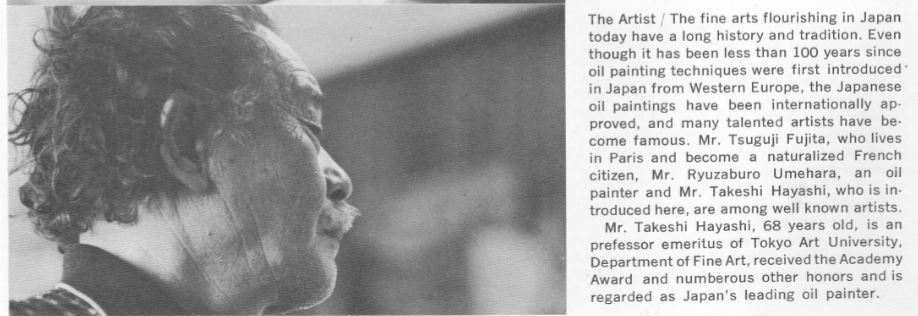
The Artist: Not only do the Japanese know ballet in 1964, they know how to paint using techniques introduced to Japan from Western Europe in the Meiji Period. Featured here is Takeshi Hayashi, an established painter and professor of the Tokyo Art Museum. Dentsu even mentioned artist Tsuguji Fujita, a Japanese artist who moved to Paris, and even traded in his Japanese passport for a French passport.

Fashion Model

Fashion Model: Dentsu selected Reiko Kawasaki as the face of the young model, likely because she evokes a young Audrey Hepburn. There’s very little detail in this profile, except that she has been a model for three years “who has not attempted to get ahead faster than her shadow.” More interestingly, the profile refers to Akiko Kojima, who was crowned Miss Universe in 1959, the first ever from Asia. A triumph over the beauties from Norway, the US, England and Brazil, Kojima’s victory was yet another milestone in Japan’s march to international acceptance.

Fashion Designer

Fashion Designer: She was one of the biggest names in fashion in Japan. Hanae Mori in 1964 was particularly well regarded for her costume designs in film. A year later, she debuted internationally with a show in New York City, and 12 years later opened up shop in Paris.

In 1964, the world came to Japan for the 1964 Tokyo Olympics, and to most foreigners, particularly from the West, the Japanese were not familiar, foreign perceptions ranging from warlike to exotic to friendly.

The Japanese were intent in facilitating the positive image of the Japanese. In the book, “Tokyo Olympics Official Souvenir 1964”, the publisher Dentsu produced a section called “Faces of Tokyo”, to encourage specific perceptions of the Japanese:

  • That the Japanese are indeed uniquely Japanese
  • That the Japanese are international
  • That the Japanese are middle class.

Uniquely Japanese

Housewife

The Housewife: Apparently the modern-day housewife of Japan in 1964 is beautiful, loves weekend outings with the family, and wears kimono designed by her husband. Somehow, Dentsu is trying to portray the typical Japanese housewife as beautiful, modern and well to do.

Sumo Wrestler

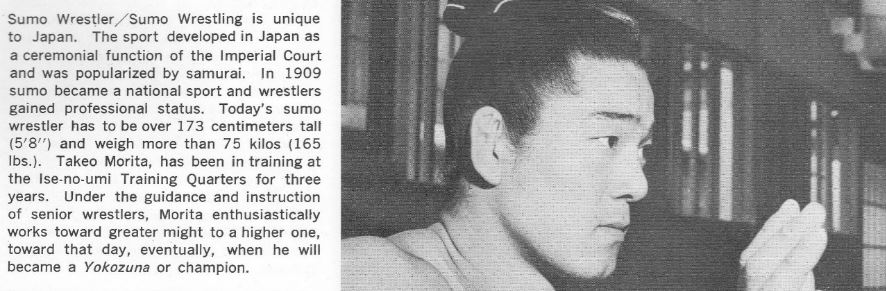
The Sumo Wrestler: The profiled wrestler was still a relative unknown, but Takeo Morita, who later became known as Fujinokawa Takeo, made it to the heights of sekiwake in the very Japanese sport of sumo. Dentsu explains that sumo emerged out of imperial court functions to become a national sport in the early 20th century. (Real)

Geisha

The Geisha: The profile here is undecipherable in English – I’m sure this is from a vague description of what it means to be a geisha by a translator who likely gave up and just threw a bunch of English words together….

Buddhist Priest

The Buddhist Priest: This profile introduces the resident priest of Zojoji, Buddhist temple in Tokyo Shiba Koen, very near Tokyo Tower. Not only is he a priest, but he is a Doctor of Philosophy, honorary president of a Japanese university, and through his many books, a go-to guy in Japan to understand Buddhism.

Flower Arranger

The Flower Arrangement Sensei: Although true less and less today, the expertise and techniques of specific skills and trades were handed down from one generation to another very deliberately, often from parent to child, as was the case with flower arranger, Kasumi Teshigawara, featured here. My guess is that the reference to her brother is famed film director, Hiroshi Teshigawara.

Chinese Cultural Minister Luo Shugang Education, Culture, Sports, Science and Technology Minister Yoshimasa Hayashi and South Korean Culture, Sports, and Tourism Minister Do Jong-hwan

Think about it. The next three Olympic Games will be held in Asia:

  • 2018 Winter Olympics: PyeongChang, South Korea
  • 2020 Summer Olympics: Tokyo, Japan
  • 2022 Winter Olympics: Beijing, China

In the history of the modern Olympiad, the majority of host cities selected for both Summer and Olympic Games have been in Europe. In the period of 1896 to 1952, only three of the first 20 Olympiads were held outside Europe, the others in the USA. From 1956 to 2016, the diversity of host cities improved, with only 50% of the Olympiads held in Europe.

But for the first time, three Olympiads in a row will be held in Asia. In the world of diplomacy, that smells like opportunity. So when the culture ministers of Japan, China and South Korea met in Kyoto for their annual meeting of minds in August, 2017, they announced that they will organize joint events to spread the depth and beauty of East Asian culture within the three countries in connection to the upcoming Olympiads in Asia.

While the specifics of the plan are to be determined by an “experts’ body” to be set up, it was agreed that five cities in each of the three countries would be identified as locales for these cultural exhibitions and exchanges. In fact, according to this Japan Today article, this is an expansion of an initiative called the Culture Cities of East Asia Program, that had started in 2014. China’s Changsha and South Korea’s Daegu are already hosting such events. Next year, Japan’s Kanazawa will be host.

Other areas of partnership cited in The Japan Times include:

  • Efforts to strengthen copyright protections for cultural products
  • Continued trilateral dialogue on preserving the intangible cultural heritage of all three countries.
  • Support of UNESCO’s International Research Center for Intangible Cultural Heritage in the Asia-Pacific Region, which works to protect, preserve and promote intangible culture such as traditional music, dance, performing arts and craftsmanship.

Examples of “intangible cultural heritage” in Japan would be noh, washoku (traditional Japanese food), and washi (traditional hand-made paper).

With so much geo-political tension in the region, exacerbated by the sabre-rattling of North Korea, there is a belief that diplomacy, through the promotion of the respective nations’ cultural heritage, can promote the cause of peace, according to Kyoto mayor, Daisaku Kadokawa.

The East Asian region shares a long history of exchanges. Here in Kyoto, you can see and feel the cultural elements of the region. The power of culture can help bring the region together, and lead to peace.

Isn’t it pretty to think so?

Opening Ceremony Rio 2016 Olympic Games
Carlos Nuzman and Thomas Bach (back) at the Rio Olympics Opening Ceremony

They raided the home of the president of the Brazilian National Olympic Committee, Carlos Nuzman, and took away his passport.

Two investigations, one in France and the other in Brazil, have come together to uncover evidence which indicate attempts to influence the candidate city bidding process for the 2016 Summer Olympics and the 2020 Summer Olympics, and led to the investigation of Nuzman, who was a member of the Brazilian volleyball team at the 1964 Tokyo Olympics and presided over the 2016 Rio Olympics last August as head of the Brazilian NOC.

Operation Car Wash (Operação Lava Jato) is an ever-expanding investigation within the Brazilian government that has uncovered a massive system of bribes to government officials in exchange for decisions favorable to contractors, particularly in the construction business. Brazilian authorities also saw similar patterns of corruption in Brazil’s bid to make Rio de Janeiro the host city for the 2016 Summer Olympics, and worked closely with French authorities, who are holding former IAAF president and influential IOC member, Lamine Diack, who may be providing detailed information on the hidden, somewhat unseemly world of bribes to influence candidate city selection.

According to Inside The Games, “Nuzman, President of both the Bid and Organising Committee for Rio 2016, is accused of involvement in a scheme in which $1.5 million (£1.2 million/€1.4 million) was used as an attempt to solicit the votes of International Olympic Committee (IOC) members in return for supporting the Brazilian bid which was awarded the Games in 2009 in Copenhagen.”

Lamine Diack
Lamine Diack

Sports Intern editor, Rich Perelman, quoted Brazilian prosecutors as stating, “Nuzman was the agent responsible for bringing together interested parties, making contacts and oiling relationships to organise the mechanisms for transferring Cabral’s bribes directly to African members of the International Olympic Committee, which was effectively done by way of Arthur Soares.”

Perelman went on to note that Soares “paid as much as $10 million in bribes to Sergio Cabral, governor of Rio de Janeiro from 2007-14, and that in 2009, some $2 million of that money was funneled to Lamine Diack just three days before the Host City selection in Copenhagen.”

Still, somewhat under the radar is an investigation into the bidding process for the 2020 Summer Olympic Games. The UK newspaper, The Guardian, has reported on a USD1.5 million payment made to a Singapore-based company called Black Tidings, which appears to have contacts to Papa Massata Diack, the son of Lamine Diack. The bank transfer payment was labeled, perhaps naively, “Tokyo 2020 Olympic Game Bid,” and was made only weeks before Tokyo won the host city bid.

Nooses are tightening as the Brazilian and French investigations dig deeper. As Perelman wrote, “These are nervous, unhappy times for people who have been in the spotlight of the Olympic Movement over the past decade.”

Kiryu
Yoshihide Kiryu breaking the 100-meter speed record for Japan, on Saturday, September 9, 2017
A Japanese finally did it! Yoshihide Kiryu, a senior at Toyo University, ran a 9.98 100 meters in an inter-collegiate track meet in Fukui, Japan on Saturday, September 9, 2017. No Japanese had ever run a sub-10-second 100 meters until that day.

No doubt, this will be a big boost to sprinters in Japan looking to find glory on home turf at the 2020 Tokyo Olympics. Without a single top individual sprinter in the finals of the 100-meter sprints at the 2016 Rio Olympics, the Japanese men’s team still came away with silver in the 100-meter relays. Kiryu ran the third leg, before handing off to Asuka Cambridge, who clung to Usain Bolt‘s shoulder for the dramatic finish.

In the history of the men’s 100 meter sprint, 10 seconds was a barrier which seemed more psychological than physical, much like the 4-minute mile was before Roger Bannister showed that it was possible.

The first person said to break the 10-second barrier was Bob Hayes, who a year before the Tokyo Olympics ran the 100-meters in 9.9. At the 1964 Tokyo Olympics, he did it again in the semi-finals, although both sub-10-second finishes were run during illegal tailwinds.

Four years later, a few months prior to the 1968 Mexico City Olympics, American sprinters Jim Hines, Ronnie Ray Smith and Charlie Greene were all credited with times of 9.9 seconds at the USA Outdoor Track and Field Championships. Hines would record 9.9 seconds at the 100-meter finals in Mexico City that year, the first non-wind assisted electronic sub-10 second 100-meter spring. And yet, Mexico City was a high-altitude location, a quality that is said to have been advantageous to speedsters (as opposed to distance runners.)

In 1977, the way official times for sprinting was measured changed, from hand timing to fully automatic timing (FAT). After the rule change, only Hines’ times in 1968 were held up as the only ones to be considered under 10 seconds. It finally took American Carl Lewis at the 1984 World Championships in Modesto, California to record a time of 9.97, the first sub-10 second finish at low altitude and with fully automated timing.

Of course, a lot has happened since 1977, and Lewis’ time in 1984 doesn’t even merit a top 25 all-time fastest 100-meters. In fact, the slowest of the top 25 fastest 100-meter sprints is 9.88 seconds, a full second better than Kiryu’s Japan record. Additionally, it’s still way off Christian Coleman’s time of 9.81 seconds in June, 2017, and way, way off of the incredible 9.56 seconds posted by all-time great, Usain Bolt, way back in 2009.

And yet, when Kiryu realized he broke the 10-second barrier, he had broken a psychological dam in Japan. I would not be surprised to see Japanese sprinters break 10 seconds many times in the coming three years leading up to the 2020 Tokyo Olympics.

Yoshihide Kiryu breaking Japan record

C Kunalan in Tokyo_2
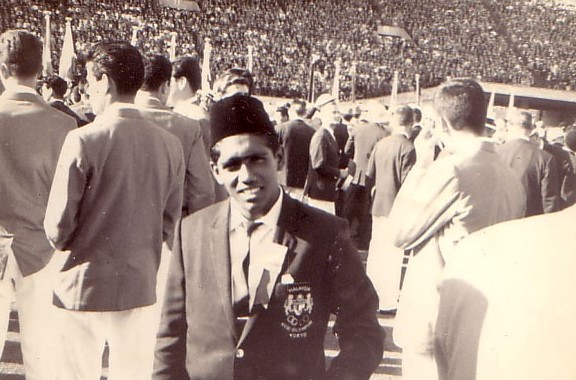
Kunalan at the 1964 Tokyo Olympics Opening Ceremonies

It was the summer of 1964 and Singapore was in crisis.

Singapore’s leader, Lee Kuan Yew, had brokered a deal with the British Government and the leadership of Malaya to be included in a nation called Malaysia, established in 1963. This was not a match made in heaven. Racial tensions were part and parcel of the daily lives in the region between Singapore, which was a mixture of Indian, Malay and Chinese, but had a predominant population of ethnic Chinese, and the rest of the Malaya Federation, which was primarily Bumiputra and Islamic.

In July and September, Singapore felt the political tension born of the delicate balancing act that brought Singapore and Malaya together, and at times, the tension boiled over. Race riots broke out where shophouses were burned down, police and military were called out to restore order and enforce curfews, and people were beaten and killed.

This is the atmosphere in which athletes in Malaysia and Singapore were preparing for the 1964 Tokyo Olympics. Canagsabai Kunalan was a promising 21-year-old sprinter, talent spotted only a year before by the Malaysia track coach, Tan Eng Yoon. After a successful sprinting debut in 1963, Tan believed Kunalan was ready for the Tokyo Olympics, and recommended him for the 4X100 relay team, along with Mazland Hamzah, John Daukom, and Mani Jegathesan.

Tan Eng Yoon and Stan Wright with Malaysia team
3 weeks prior to Tokyo – standing: Tan Eng Yoon and Stan Wright; sitting (L to R): Kunalan, Wong Fey Wan, Kuda Ditta, M Jegathesan, and Dilbagh Singh

But the make-up of the 4X100 relay team did not sit well with Wong Fey Wan. Another talented sprinter, Wong defended his record, and called out Kunalan publicly in the press:

I beat Kunalan in the 100 m finals in the national championships in which I finished second to Jegathesan, and I beat him again in the Government Services Meet in the 100 m final on Saturday in which I finished third…. I am willing to race against Kunalan again to prove I am the better man over 100 m. If I am wrong I will quit athletics.

Coach Tan did favor Kunalan, perhaps for his work ethic, perhaps for the belief that Kunalan was stronger around the curves and a better choice as back up for the relays. Maybe Wong did not have the political support as he was self-taught and did not have the benefit of a coach lobbying his case as Tan did for Kunalan. Maybe race was influential. As explained through Kunalan’s state of mind at the time in the biography, “C. Kunalan – Singapore’s Greatest Track and Field Athlete”, Kunalan was unhappy.

Whatever the true reason for Wong’s exclusion – be it sporting or political, this incident affected Kunalan, who regarded this as “one of the saddest moments” of his running career. He never knew for sure whether he had been chosen on the basis of merit, but he wished that Wong had been chosen instead, knowing how much Wong had been looking forward to competing at the Olympic Games.

It was Kunalan instead who went to Tokyo. Just three days before his 22nd birthday, the Malaysian 4×100 team finished last in their round one heat, and that was that.

While Kunalan had no control over the make-up of the 4×100 Malaysian relay team, during a period of racial and political strife in his country, he did indeed have control over more important, personal decisions – with whom he would marry.

Kunalan and Roy 2
Kunalan and me

Teammates in track, Kunalan first met Chong Yoong Yin, captain of the Raffles Girls School track team, and a member of the Malaysia national track team. They had track in common, but to their parents, little else. Kunalan was ethnic Indian and was brought up in the Hindu religion. When Kunalan had returned from the Tokyo Olympics and his parents realized that his relationship with the ethnic Chinese woman, Yoong Yin, was still intact, they gave their son an ultimatum: “leave that Chinese girl or never return home again.”

Kunalan walked out.

Yoong Yin received the same ultimatum from her father and her uncle. And she too left home, joining her mother, who was estranged from her father.

Distraught after being shunned by their own families, they struggled momentarily, wondering what would happen. But Kunalan in the end was resolved. “We’ll have our own friends who will accept us.”

Wedding Day

Engaged in October 1965, with a wedding date set for October 1966, the parents of Kunalan and Yoong Yin eventually saw that there was no fighting the bond between the two. Kunalan’s father surprised his son with a visit, and said he would bless the union, but only if Yoong Yin would take on an Indian name and convert to Hinduism. Fortunately, that was not a problem for Yoong Yin, and the two sprinters were married in a Hindi ceremony. Subsequently a Chinese wedding dinner was held by Yoong Yin’s mother.

Fifty-two years later, Kunalan and Yoong Yin are still happily married. And Kunalan proudly proclaims that diversity and the need to be inclusive of all races and nationalities is vital to world peace. “I am not nationalistic,” he told a Singaporean magazine. “I am more of an internationalist.”

His children, a blend of Indian and Chinese DNA and heritage, have lived their parents’ creed, marrying members of other nationalities. Kunalan is proud of to be an inter-racial grandparent.

He remembers 1964. He recalls seeing the worst in the race riots of Singapore, and the best in the gathering of the world’s best athletes in Tokyo. And he believes that we are capable, through sports, to co-exist in peace and love.

Canagasabai Kunalan is living proof.

The International Family

Canagasabai Kunalan Singapore’s Fastest Man Part 1: Defying the Odds in Mexico City

A Teaching Moment at the Singapore Sports Museum

Canagasabai Kunalan strolled through the Singapore Sports Museum, walking his guest through Singapore’s greatest sporting achievements, explaining the history with enthusiasm, with the skills honed over decades as a teacher.

But C. Kunalan was more than just a teacher. As we walked through the corridors, passers-by would recognize the fit, elderly gentleman as the man who held the title, Singapore’s fastest, for decades. In fact, Kunalan had held at different points the fastest marks in the 100 meters, 200 meters and 400 meters in Singapore track history.

It was 1968 at the Mexico City Olympics, when Kunalan set the Singapore record for 100 meters, a mark that stood for 33 years.

Jim Hines set the world record in the 100-meters in Mexico City with a time of 9.95, considerably faster than Kunalan’s 10.38. But when you think about it purely from a statistical perspective, Singapore had a tiny talent pool. The population of Singapore in 1968 was 2 million, only 1% of the entire US population, and roughly the same population of Hines’ state of Arkansas that year.

C Kunalan in Mexico City_2
Kunalan finishing third (719) in a 100-meter heat to advance. Eventual gold winner Jim Hines strolls into the finish.

Kunalan defied the odds, advancing beyond the first round at the Mexico City Games to be recognized as one of the top 32 fastest men in the world. And if you know the history of Southeast Asia in the 1960s, you know that in 1968, Singapore was only in its third year as a sovereign nation. It wasn’t clear until the last days before departing Singapore whether Kunalan had the funds to even travel to Mexico.

In the end, Kunalan made it to Mexico City, and he was there to compete. But he knew, as a sprinter, he and his teammates were significantly behind those in the advanced industrial economies, or in the nations under the flag or influence of the Soviet Union. In his biography, C. Kunalan – Singapore’s Greatest Track and Field Athlete, written by Steven Quek, a one-time colleague of his in the National Institute of Education, Quek explains how support and role modeling by others contributed to his development.

At the Mexico City Olympics Kunalan recalled simple but powerful gestures: USA Assistant Track Coach Stan Wright offering Kunalan the use of Team USA’s masseurs for a pre-competition rub down, or Bahaman sprinter Tom Robinson coming up to Kunalan to suggest that the Singaporean be aware that he was exerting too much effort into the first 20 meters of his sprint, when he should in fact be conscious of staying relaxed. “Tom, a world-class athlete, was willingly sharing advice with an unknown from Asia. Kunalan never forgot this.”

After Kunalan’s competitions ended, he was then able to watch the very best athletes in the world demonstrate the highest levels of physical achievement:

Ever the teacher, Kunalan understood that for Singapore athletes to succeed internationally, to reach the world-class levels on display at the Olympics, their training must improve, as he explained in a letter to his wife:

We must get very serious about training. There are about 6 short men all doing 10 or 10.1. Why? Arms and legs big!! Mine only 1/2. You know darling! If I can get their strength, I will be doing 10 sec too.

C Kunalan in Mexico City_1
C, Kunalan in Mexico City

Kunalan would retire from track in 1970, but would go on to become one of Singapore’s most successful primary and secondary school teachers, twice being recognized as “Teacher of the Year”. He currently works for the Singapore Sports Council, in offices near the Singapore Sports Museum.

Maybe you’ll be lucky to see him there, get a tour like I did, and learn from a man who has literally lived the history of Singapore sports.

Canagasabai Kunalan Singapore’s Fastest Man Part 2: Out of the Frying Pan of the Race Riots and Into the Fire of the Olympics