Next Big Pivot 2_Yuko Mitsuya
Yuko Mitsuya at The Next Big Pivot Charity Dinner 2017


“I’m tall, so I played volleyball. It was never a dream or a passion.”

It’s not what you’d expect to hear from an Olympian. But that’s how Yuko Mitsuya, member of the Japan woman’s volleyball team that took bronze at the 1984 Los Angeles Olympics, started off her speech at a charity event on February 23, 2016.

“I didn’t really like how tall I was. Volleyball was the only way to deal with this.”

One imagines someone who succeeds at the highest levels would be filled with passion for their accomplishment. But the 177 cm tall woman from Katsuyama, Fukui, was ever humble in a talk that was inspirational. Mitsuya was speaking at an event called “The Next Big Pivot Charity Dinner 2017” in Tokyo, raising funds to provide young Japanese women with an opportunity to learn about leadership in the sports industry. Last year, five women went to New York City to participate in a program called Future Frontwomen, which gave them in-depth exposure to how the NBA is run and how sports can be managed as business.

Those five women were present to hear Mitsuya explain that the path to success is not just fueled by passion, it is one of hard work, persistence and learning. Mitsuya, currently the chairperson of the Japan Basketball Association and the former CEO of a lingerie manufacturer, explained that she made the team because she was tall, but in her early junior high school days, she wasn’t very good. She worked at it, got better, and was able to contribute.


Next Big Pivot 1
Mie Kajikawa and the Future Frontwomen


I wasn’t that good. I was really a problem to the team. I hated it, but this was all I could do. Over time I got better, and more confident. I realized that becoming good at something was not a matter of whether I liked it or not. It mattered whether I practiced. And I practiced every day, and learned. I tried very hard and eventually got recognized as the best junior high school women’s volleyball player in Fukui.

Her one big lesson for young women in Japan (and perhaps for anybody who desires to achieve) is that no matter how good you are, there’s always another level up. She succeeded as a volleyball player in junior high school in Fukui, but when she moved to Tokyo for high school, she realized that she still had a lot to learn.

I thought I was good, until I got to this next level. And I lost confidence. But my friends supported me and helped me recover my confidence as I improved. And that’s what’s important – always stepping up, going another level up. There is always an opportunity to rise up further. You do well and you get to the top, and you realize, there’s another level to climb. As I got used to achieving and stepping up, I could always improve. For women, young women, I believe there are lots of chances to step up. You shouldn’t let your pride get in the way, worrying whether you will achieve or not. You need to understand that getting to a certain level means re-setting your mindset and your goals, so that you climb to the next level.

Prior to Mitsuya’s retirement, the only life she had known was volleyball. But she took it to the next level by transitioning to teaching at the high school and university level. Three years after participating in CSR activities with the leadership of a lingerie company called Ten Arrows, she was named CEO of that company. That was a big step up.


Mitsuya Yuko 1
Yuko Mitsuya in 1984

When I became a company CEO, a lot of people said I was hired just because I’m a well-known person. But I want young women to realize that specialization in one area does not mean that you cannot do something else. You need to challenge yourself and try different things because there are common skills you can use in other types of work. Based on my experience in volleyball, I learned how to motivate people (which is important for company leaders). I learned another important lesson from sports, which is also important in companies: resilience. I encourage people to challenge themselves because you need the experience of overcoming issues. And if you fail, well, through failure you grow. More importantly, if you do not challenge yourself, you may regret not making the attempt.


Mie Kajikawa understands this. Kajikawa was first a basketball player at Nagoya University. She worked in sales for the Japan Travel Bureau in Nagoya, studied French in France for a month, spent a few years doing secretarial work for executives in foreign financial services firms in Tokyo until she realized what she wanted to do – study sports management in the United States. During her master’s program at Ohio University, she had a career-defining experience – an internship with the Detroit Pistons.

From that point on, the doors to NBA officials or relevant sports industry players, as well as sports associations in Japan opened up. Kajikawa went on to participate in Tokyo’s bid for the 2016 Summer Olympics (which eventually went to Rio), and founded the company, Cheer Blossom, Inc., which provides consultation in CSR to Japan’s professional basketball league – B. League. And when she established the non-profit organization, Next Big Pivot, she became a significant player not only in promoting the empowerment of women in sports business, but also advocating for the development of basketball in Japan.

If you are interested in learning more about Next Big Pivot and Kajikawa’s plans, click here.

Muhammad Ali Jr.
Muhammad Ali Jr., a son of Muhammad Ali, spoke during a forum on the consequences of President Trump’s immigration policies at the Capitol on Thursday. He was stopped at the airport the next day. Credit Mandel Ngan/Agence France-Presse — Getty Images

There is little doubt the politics of fear – fear of different, fear of crime, fear of Muslims – have infected the tinier crannies of our lives these days.

At times, it appears that fear trumps common sense.

Being the son of perhaps the most famous sports icon in the world does not inoculate one from the human conditions triggered by this fear. Muhammad Ali Jr., son of the eponymous boxer whose name very few adults would not know, was detained on March 10 before boarding a flight from Reagan National Airport in Washington D. C. to Fort Lauderdale, Florida.

Ali was asked for his date of birth, his social security number, and where he was born despite handing a JetBlue agent his Illinois identity card. The agent then called Homeland Security. When Ali presented his passport, he was allowed onto the flight.

This was the second time in a month that Ali was detained at an airport, and only a day after Ali had testified at a forum in D. C. regarding President Donald Trump’s immigration policies.

Of course, African Americans have been subject to this fear for centuries. And while race relations have improved visibly and measurably over the decades, one could argue there is still room for improvement. Ali’s story reminded me of the fastest man in the world in 1964, Bob Hayes, who won two gold medals at the Tokyo Olympics. He then came home and signed with the Dallas Cowboys to become a Hall of Fame wide receiver, and one of only two NFL Super Bowl champions who also brought home the gold in an Olympics.

Bob Hayes Dallas Cowboys
Bob Hayes #22 Dallas Cowboys

Only a few weeks after Bob Hayes won gold in the 100-meter dash and won national bragging rights to one of the biggest events of the biggest global sports competition, Hayes signed a contract with the Dallas Cowboys on December 8, 1964. This included a six-thousand -dollar Buick Rivera as part of Hayes’ signing bonus. Unfortunately, in the South in the Sixties, a black man driving an expensive car drew the suspicion of the police, regularly. In this account in his autobiography, Run, Bullet, Run, is how Hayes, arguably one of the most famous athletes in America at the time, was treated like a “boy” by local authorities.

That car caused me a little trouble when I got back to school. You see, there weren’t many black kids my age (I turned twenty two less than two weeks after I signed with the Cowboys) driving cars like that in good old Tallahassee. About once a week or so, some of Tallahassee’s finest would stop me and ask, “Boy, whose car is that?” I would tell them it was my car, and they would give me a ticket for anything they felt like – speeding, running a stop sign, driving on white folks’ streets – you name it.

I finally got smart. I went downtown and bought a chauffeur’s black cap and put it in the back seat. Every time the police pulled me over after that asked me whose car I was driving, I would say, “It’s my boss man’s car,” and they would let me go. This was the era when, while driving from Dallas back to Florida, I would pass restaurants all over Louisiana, Mississippi, and Alabama with signs that read, “No colored” or “Colored around back.” I was good enough to represent their country in the Olympics, but not good enough to eat with them.

1964 Buick Rivera


Individual Men's Road Race
From the book, Tokyo Olympiad 1964_Kyodo News Service

It was the morning of October 8, two days before the start of the 1964 Tokyo Olympics. Top Swiss cyclists Hans Lüthi and Heinz Heinemann were on the Koshu Highway in western Tokyo getting some training in when a truck, entering from a side road, hit them.

Lüthi had contusions on his left arm and his chest, waist and thighs, while Heinemann, a veteran of the 1960 Rome Olympics, had contusions on his waist, legs and hands. Doctors at the Jinwakai Hospital in Hachioji, according to The Yomiuri of October 9, 1964, were quoted as saying “Heinemann’s injuries would require one week’s medical treatment and Luthi’s three weeks’ treatment.” The article also said that they “might be unable to participate in the Olympic events.”

As it turned out, the men’s individual road race took place on October 22, two weeks after the accident, and both Lüthi and Heinemann were able to compete. While the records of who was in what place and when they finished in this 194-kilomter race is unclear for this particular event, according to this site, Lüthi appears to have finished in 16th in a field of 107, not far off from legend-to-be Eddy Merckx . Heinemann finished 63rd.

If one believes what one reads in the press at the time, every single Japanese in Tokyo took it upon themselves to be the perfect ambassador to any foreigner they came upon. Thus the truck driver, one Katsu Wada, might have been mortified that he was the one who may have ended the Olympic dreams of these cyclists.

Cyclist Hans Luthi and driver Katsu Wada
Cyclist Hans Luthi and driver Katsu Wada.

As you can see in the above photo, Wada publicly showed his contrition.

But as The Yomiuri article goes on to say, it may have been the Swiss who were in the wrong. According to the Metropolitan Police Department, “the Tokyo Olympic Organizing Committee (TOOC) had approved an advance schedule for practice by Olympic cyclists to enable police to impose restrictions to protect cyclists from vehicles. According to the schedule, Olympic cyclists were to practice on the road race course on eight days, October 2, 4, 5, 6, 12, 14, 19 and 22 under police protection, said the MPD.”

wilson-kipsang-tokyo-marathon
Wilson Kipsang wins the Tokyo Marathon

Wilson Kipsang won the Tokyo Marathon on March 1 with the time of 2 hours, 3 minutes and 58 seconds. The Kenyan broke the Japan record for the race, but did not beat his personal best of 2:03:23, which was a world record he set at the 2013 Berlin Marathon. Nor did he best the current world record of 2:02:57, currently held by fellow Kenyan Dennis Kimetto.

Kipsang, enjoying the cool temperatures of Tokyo, thought he could take back the world record. But he likely did not believe he had a chance at running under 2 hours. Getting to 1:59:59 is the holy grail of long-distance running. According to this in-depth look from the New York Times at “Sub2”, as this quest is called, a researcher from the Mayo Clinic thinks that breaking the 2-hour barrier won’t happen for another 10 to 25 years, and a three-time Olympian from Ethiopia, Bekele, says “I can’t say it’s possible.” As the article explains, “Could the body have enough carbohydrate fuel to run that far, that fast? Would the brain slow the legs for self-preservation?”

A 1:59:59 marathon would require a searing pace of 4 minutes 34 seconds per mile, seven seconds faster than the pace of the current world record. It would require 85 to 90 percent of a runner’s maximum aerobic capacity — twice the capacity of an average man — and a sustained heart rate of about 160 to 170 beats per minute. (The typical resting rate is 60 to 100 beats per minute.)

It is beginning to feel a bit like Zeno’s Paradox, that no matter how close you get to your target, you may never reach it. Could the 2-hour marathon be a bridge too far? Sports scientist and anti-doping expert in the IOC, Yannis Pitsiladis, believes that a Sub2 marathon is possible. “What excites me is understanding the limits of human performance. What can man do?”

yannis-pitsiladis

Pitsiladis believes we’ve only just scratched the surface in understanding the science of endurance running. Incremental gains in the disciplines of nutrition, biomechanics, genetics, running efficiency, training, race strategy, sports medicine, as well as data analytics could get runners to the tipping point of dramatic advances in long-distance running. “We know nothing about the science of training,” Pitsiladis said. “I really mean nothing. When I say that, people get really upset.”

Here are a few of the non-conventional ideas of Pitsiladis from that New York Times article:

  • How Many Miles: Many elite marathoners, for instance, run about 120 miles a week in training. But there was little science to support that regimen, Pitsiladis said. Perhaps 75 miles a week would work just as well for many runners — or maybe any reasonable training program would.
  • Live High Train High? A popular training method is known as “live high, train low.” By living at a higher altitude, athletes stimulate the production of red blood cells to compensate for the lower level of oxygen in the air. By training at or near sea level, they are able to maintain the intensity of their workouts because more oxygen is available. Live high, train low is supported by some evidence. But Pitsiladis is not fully convinced of its efficacy, saying, “I would bet you it’s wrong and that what’s better is live high and train higher,” as perhaps the two greatest distance runners in history — Haile Gebrselassie and Kenenisa Bekele of Ethiopia — often did.
  • Be a Glutton for Glucose: Pitsiladis had come to believe that a two-hour marathon might be best achieved by bombarding the system with glucose.For instance, Owen Anderson, a consultant to the Sub2 Project who coached elite Kenyan road runners in Michigan, gave his athletes eight to 10 ounces of a sports drink about 10 minutes before a race to get accustomed to a bloated feeling. (They drank more during competition.)
  • Run the Second Half Faster: Against convention, Pitsiladis theorized that the second half of a two-hour marathon would be run faster, not slower, than the first half. As runners burn fuel and become lighter during a race, he said, they should become more economical, needing less oxygen to maintain a certain speed.
  • Squeeze Don’t Twist: When runners drank, Pitsiladis believed, they could shave precious seconds by squeezing fluid from a bag instead of opening a bottle, as elite runners do on the course.
  • Rinse Don’t Drink: And perhaps, he said, they needed to drink little or nothing in the second half of a two-hour marathon. Instead, they might rinse their mouths with a carbohydrate solution and spit it out. Research showed the brain could be tricked into believing that more carbs were on the way, thus inducing the muscles to work harder.

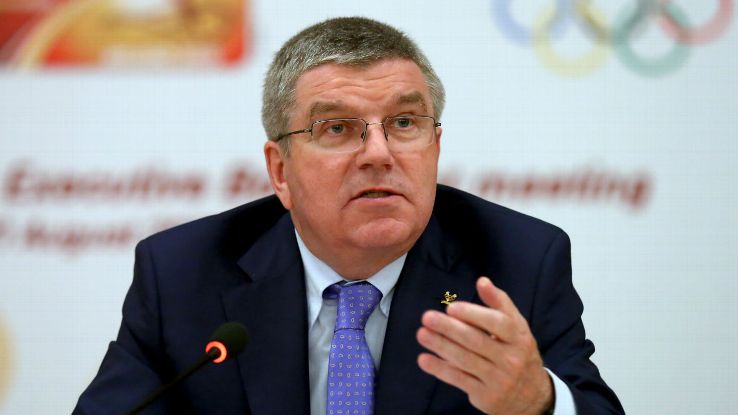
President Thomas Bach
IOC President Thomas Bach
In July, 2015, there were only two cities vying for the 2022 Winter Games: Almaty, Kazakhstan and Beijing, China. Just 10 months before, Oslo, Norway, the host of the 1952 Winter Olympics, pulled out of the running. Sochi a year before famously cost $50 billion, and the Norwegian government was expecting the cost for their city to be billions more than they had an appetite for.

That left Almaty, a city generally unknown, and Beijing, a well-known city that gets very little snow.

With the ugly photos coming out of Rio de Janeiro of the crumbling Olympic infrastructure after only some 7 months, more and more city denizens and governments are convinced they don’t want an Olympics in their metropolis. In fact, Budapest, Hungary, which submitted a strong bid for the 2024 Summer Games, withdrew its bid a week ago on March 1.

So like the 2022 bid, now there are only two for the 2024 Games.

This must be causing considerable heartburn for leaders of the International Olympic Committee (IOC). The bidding process has resulted not in a celebration of city pride with the hopes of bringing the biggest sports tent their way, but in opportunities for large numbers of people to publicly and loudly proclaim their disenchantment, if not diffidence with having the Olympics in their back yard.

Rio Swimming Venue Before and After
Fortunately, the 2024 has two solid prospects: Los Angeles and Paris. As Tim Crow writes in this great article, “And Then There Were Two“,

LA is the most compelling, with its vision of Californian sunshine, West Coast tech innovation and Hollywood storytelling power combining to ‘regenerate the Games’ and ‘refresh the Olympic brand around the world’.

Paris is more traditional, a classic piece of Olympic realpolitik, invoking de Coubertin in a ‘new vision of Olympism in action’ in the grand old city, linked to those time-honoured Olympic bid promises of urban regeneration and increased national sports participation.

So, as Crow extrapolates, if the president of the IOC wants to avoid further embarrassment of the citizens of the Great Cities open scorn, at least for a while, he may encourage his fellow leaders to decide the next two Olympic hosts when the IOC meet in Lima, Peru in September, 2017. As has been gossiped about for the past several months, Crow believes the IOC will select either Paris or LA for 2024, and the other one for 2028. By so doing, that would guarantee great Summer Olympic hosts throughout the 2020s, as well as avoid unwanted anti-Olympic discussion that would most certainly lead up to the 2028 process, that is currently scheduled for 2021.

Crow also speculates that the IOC may award the 2024 Summer Games to Paris, and the 2028 Summer Games to Los Angeles. Here are the three reasons why:

  • One, because an LA 2028 Games will give President Bach the ideal timing to play the American market for the IOC’s next US broadcast deal beyond NBC’s current contract.
  • Two, because it will also give Bach significant leverage in his attempts to persuade his six US-based TOP sponsors to extend their current deals, all of which end into 2020, for eight years.
  • But most of all, because it will buy Bach and the IOC both time and two key partners in its battle to find a new relevance and credibility for a new era and a new generation.

That last one is the tricky one. Can the Olympics be saved for the next generation?

Janine the Machine. All Janine Shepherd knew was athletic success, winning national titles before she turned 10. She was such a promising skiier that she trained to be a cross-country competitor at the 1988 Calgary Olympics.

But one crisp cool day in 1986, cycling on the roads of the Blue Mountains in New South Wales, Australia, her life and her dreams changed in an instant. A truck smashed into her, resulting in injuries in almost every part of her body possible: broken neck and spine, broken ribs and arm, broken collarbones and feet, head injury, internal injury, massive loss of blood.

As she deadpans in this very popular TedTalk presentation, “I was having a really bad day.”

But of course, TedTalks are often about inspiration, and Shepherd’s story is nothing but.

She talks of her out of body experience, seeing her body from above, torn apart, and the verbal battle she had with herself, whether to stay or go:

Come on. Stay with me.

No, it’s too hard!

Come on. This is our opportunity.

No, that body is broken! It can no longer serve me.

Come on, stay with me. We can do it together.

After ten days on the razor’s edge of life and death, she chose to “return to her body”, and begin the process of recovery. As she was counselled, she would go through depression, asking herself the inevitable question, “why me?” She was told she would never return to the life she had before, let alone walk again.

janine-shepherd-piolot

“I was an athlete. That was all I knew. That’s all I had done. If I couldn’t do that, then who was I?”

There was a point, at rock bottom, she realized she really did have a choice. That she could embark on the greatest creative act of her life – reinventing herself. Shepherd’s talk is spellbinding, as you hear of her deciding that since she can’t walk, she can fly. She took flying lessons. She began to will herself to walk. She continued to advance her flying skills, learning how to fly bigger planes, and then how to fly planes acrobatically, and then teaching others to fly.

As Shepherd explains at the end of the presentation, “I knew for certain although my body might be limited it was my spirit that was unstoppable.”

EPSON scanner Image
L to R: Kim Ui-Tae, James Bregman, Isao Okano, Wolfgang Hofmann

Isao Okano had all the pressure in the world on him, as did all Japanese representatives of the judo team. They simply could not lose on their home turf, in the Budokan. But Okano, competing in the 80kg weightclass, made it all look easy. The 3rd dan form Chuo University swept through the competition. And in his semi-final bout against Frenchman Lionel Grossain, Okano wasn’t feeling the pressure – he was applying it.

Watch the above video. The chilling action starts from the 35 second mark and ends very quickly after that. Okano sends Grossain down with a right leg kick. As they hit the mat, Okano spins around and gets on top of Grossain, who is kneeling, with his head facing the mat. Grossain pushes upwards, sending Okano off, his body twisting so that his body is awkwardly facing upwards, and it appears the Frenchman has an advantage, his right arm pushing down on Okano’s chest.

But while Okano’s body is spinning, his right hand has solidly gripped the back collar of Grossain’s judogi. As the two middleweight judoka twist and turn on the mat, Okano has turned Grossain’s collar into a vise. As Okano twists away from Grossain to lift himself off the mat, Grossain’s collar puts tremendous pressure on the left side of his neck. In an instant, the pressure to Grossain’s cartoid artery restricts blood and thus oxygen to his brain, rendering him unconscious.

American Jim Bregman, who won bronze in that middle-weight competition, witnessed this match. “Grossain was very tough,” he told me. “Grossain was on top of Okano trying to hold him down, and Okano reached his hand across grabbed his gi, and put Grossain out. He’s stone cold out. With Okano’s skill and mat work, he choked him out.”

Okano had just advanced to the gold medal round, but the more immediate need was to get Grossain conscious again. Fortunately, Grossain was quickly revived by Okano, likely relieving every in the Budokan.

Okano executed a judo technique called okuri eri jime, which is the employment of the judogi in placing pressure on the neck. You can see Okano in this training video, showing very clearly how to execute this powerful technique.

Okano would go on to win the World Judo Championships in his division in 1965. More amazingly, he won the All-Japan Judo Championships in 1967 and 1969, while coming in second in 1968, a tournament that does differentiate by weight. In other words, he had to beat much larger judoka. At 80 kg, Okano (and Shinobu Sekine) is the lightest ever to win the All-Japan Judo Championships.

li-na-laura-wilkinson-anne-montminy
Li Na Laura Wilkinson Anne Montminy
It was looking bleak for the divers from the USA at the 2000 Sydney Olympics. The traditionally strong men’s team had not medaled in the 10-meter platform or the inaugural synchronized platform diving event. The American women were also shut out of the inaugural synchronized 3-meter springboard competition.

Laura Wilkinson of Houston Texas was on that synchronized swim team that finished fifth, adding to Team USA’s diving woes. But some felt that there was a chance as the Chinese, the powerhouse over the past four Olympics, had entered two very young divers, Sang Xue (15) and Li Na (16). It was thought that they could break under the pressure.

They didn’t. In fact, Sang and Li were 1-2 going into the final round. Wilkinson was fifth, and considered way behind. When asked after the semi-finals what it would take to beat the Chinese? “My best,” said Wilkinson (in an AP article). “I need to hit all my dives.”

It was only six months before Olympics that Wilkinson broke three bones in her right foot. And while she was able to recover in time to win a spot on the Olympic team by winning the US diving trials, she had to wear a big rubber kayaking boot to protect her foot as she climbed the 10-meter platform. She told reporters that the broken bones would rub against each other in a way that made it feel like she was walking on a rock.

So imagine, you’re way behind in fifth, an entire country is pinning its hopes on you. And you have to block out the foot as well as the expectations.

Which is what Wilkinson did.

In the final round, her third dive – a reverse two-and-a-half somersault – the 22-year-old split the water with nary a splash. Even with a perfect dive, Wilkinson needed help. And she got that. Li and Sang both had poor third dives, and Wilkinson suddenly was in the lead, which she clung to, to the very end.

Wilkinson unexpectedly won the 10-meter platform gold medal, ending a 36-year drought for US women’s platform diving.

Wilkinson would go on to win the 10-meter platform competition at the 2005 World Championships, and compete in the 2004 and 2008 Olympics, but she will forever be remembered for her gutsy come-from-behind victory in Sydney.

In honor of her accomplishments, the International Swimming Hall of Fame (ISOH) announced on March 2, 2017, that Wilkinson will be entered into their Class of 2017.

dianne-feinstein
Sen. Dianne Feinstein (D-Calif.) thinks the law that governs Olympic sports organizations in America leaves child athletes at risk of abuse. (AP Photo/Alex Brandon)

The recent revelations of decades of child sexual abuse within USA Gymnastics has created a firestorm. The spotlight has given increased awareness to the fact that “six Olympic sport governing bodies have been beset over the years by allegations of mishandled complaints of abuse,” according to the Washington Post.

In other words, cases of sexual abuse by members associated with such organizations as USA Gymnastics, USA Swimming, USA Taekwando and U.S. Speedskating have been essentially hushed up over the years.

See this link for the first part of my posts on sexual abuse in USA Gymnastics.

And now the US Government is getting involved, and their sights are on the United States Olympics Committee (USOC). On February 21, 2017, Senator Diane Feinstein of California announced that she wants her colleagues to agree on an amendment to a federal law that governs Olympic sports organizations – The Ted Stevens Olympic and Amateur Sports Act. This law was passed in 1978 in order to have a single governing body (USOC) manage the various individual national sports organizations, as well as assist in the process of selecting Olympic team members.

But what has been recently understood is that when suspicions of abuse emerge, the USOC’s policy has been one of passivity and reactivity, and that language in the Ted Stevens Act“has been interpreted by lawyers to afford coaches suspected of sexual abuse more rights than they would have if they worked in other industries.”

The Ted Stevens Act requires an Olympic governing body give fair notice, due process and a hearing to any member athlete, coach, or official it wants to ban; requirements that have sometimes prevented governing bodies from banning coaches suspected of abuse. Other youth-serving organizations, such as the Boy Scouts of America, have policies requiring swift actions when abuse is suspected, always erring in favor of protecting children from harm.

Senator Feinstein’s objective is to re-write the law so that any governing body affiliated with an Olympic governing organization must report cases of sexual abuse immediately to law enforcement authorities, as well as prevent the common practice of rotating a suspected child abuser from one club to another without any official record.

On March 2, US senators put considerably more pressure on the chief executive of the USOC, Scott Blackmun, to provide greater detail about how the USOC has handled these allegations of sexual abuse. In a letter from Senator John Thune of South Dakota and Senator Jerry Moran of Kansas to Blackmun, they say they have “serious concerns about the extent to which the United States Olympic Committee (USOC) is meeting its mandate to protect the health and safety of athletes.”

Robbie Brightwell, captain of Team GB’s track and field team, was about to board his flight for Tokyo and the XVIII Olympiad when he got a telegram. It was from his mentor, Harold Fletcher, the headmaster of his school when he was a young teenager, as he explained in his autobiography, Robbie Brightwell and His Golden Girl.

“Best of luck to you & team. Stop. Do your best. Stop. Hold true to T&D. Stop.”

Brightwell, the 400-meter sprinter from Shropshire, was likely pleased to receive such encouragement, but he was puzzled about what he had to hold true to. What did “T&D” mean?

This was the 1960s and long flights had long stopovers – the one Brightwell boarded landed in Tehran, Iran to refuel. The Persian air hung hot and heavy despite the early morning, and the nagging flies made the new environment somewhat unbearable. Brightwell’s teammate and eventual double silver medalist in Tokyo, hurdler John Cooper, remarked, “This place is a bloody disaster.”

And that last word unlocked the puzzle that had been rattling around Brightwell’s brain since he left London. Fletcher was referring to Rudyard Kipling’s famous poem, “If”.

If you can dream—and not make dreams your master;

If you can think—and not make thoughts your aim;

If you can meet with Triumph and Disaster

And treat those two impostors just the same;

Brightwell was a young 21, and was asked to captain a group of talented athletes who were looking to be the most successful athletics team Great Britain had ever sent to an Olympics. But he was feeling the pressure. This was a time when athletes in the US and the UK were bristling at the hierarchal and top-down nature of sports associations – how they selected athletes for meets and competitions, what support they provided, and in general whether they treated them as people or pawns.

robbie-brightwell-ann-packer-tokyo-1964

Brightwell had strong views that sports associations and officials needed to be more transparent and give athletes greater voice, but also knew that transparency and voice would not come without a fight. Brightwell clearly was popular among other athletes for his positivity, evenhandedness, and clarity of values. And when the powers that be, notably the British Amateur Athletic Board (BAAB), noticed that the track and field team was enjoying success and had a great esprit de corps, many believed Brightwell was a major influence.

When Jack Crump, the secretary to the BAAB, offered the captaincy to Brightwell, the runner was overjoyed. But perhaps he heard Kipling whisper in his ear to treat “Triumph” as an imposter. Brightwell took a mental step back and asked Crump questions: Would there be any duties? Could the captaincy be rolled over into the following season to ensure consistency? Brightwell was involved in reform activities in athletics – could he still continue with that? In other words, was this just a title, placed on someone who’s most important role was to avoid controversy?

If you can wait and not be tired by waiting,

Or being lied about, don’t deal in lies,

Or being hated, don’t give way to hating,

And yet don’t look too good, nor talk too wise:

Brightwell eventually accepted. But he did not stay quiet. The captain asked to be present when the BAAB made its selections for Great Britain’s track and field team, but he was turned down. “Surely I should have sight of the team before it’s splashed over the newspapers? I don’t believe it’s an unreasonable request, if only as a matter of courtesy.”

And yet Brightwell was left in the dark. The reaction to the selection was emotional, according to Brightwell.

A chorus of omitted athletes raised merry hell, providing the press with a wealth of “protest” stories. In my opinion, many had cause for complaint. Athletes who were still injured had been picked, while alternative candidates reaching top form had been ignored. Similarly, world-class athletes recovering from illness (and almost certain to achieve full fitness before Tokyo), were disregarded. Also, complaints abounded that regional bias within the selection panel had influenced decisions.

Brightwell did not believe his captaincy was just in name only. He decided to write an open letter to the press to voice his disappointment in the lack of transparency. Brightwell was