The majority of Japanese have considered themselves middle class for decades, speaking to the highly meritocratic nature of Japan’s society. This is part three of Faces of Tokyo, a series of posts on how Dentsu explained the Japanese to the rest of the world, in a book called “Tokyo Olympics Official Souvenir 1964.” They did so with a collection of profiles of people, who represented a wide variety of professions.

These profiles represented the average person in Japan, who served the growing Japanese population during Japan’s greatest economic expansion – the 1960s.

Taxi Driver

Taxi Driver: Taxi drivers had a reputation for reckless driving habits – often labeled kamikaze drivers by the foreign press. But it was a living, and not such an easy one. As the profile explained, “the traffic jams of Toyo are among the world’s worst. Day and night 930,000 taxi drivers suffer from bad roads, long labor hours and other inconveniences. But if you’re lucky, maybe you get in the back of the cab of Mr Tadashi Yamamoto, who was recognized as an “Excellent” driver.

Stewardess

Stewardess: As Dentsu wrote, becoming an actress, stewardess or a fashion model “form the triumverate of the modern Japanese teenager’s dream.” Hisako Miki, a 24-year-old stewardess for Japan Airlines, was living that dream. Taking care of passengers on the international routes, conversing politely in English with foreigners, bringing back gifts to her family and friends from the world over, Miki was enjoying a life of relative glamour, that likely would lead to the right marriage – a pilot perhaps.

Traffic Guard

Traffic Guard: Tokyo in the 1960s was crowded, dusty and noisy. But someone had to stand in the middle of the roads so that children could cross the roads safely and get to and from school. Teruko Yokote was a 45-year old traffic guard, whose whistle, hand gestures and stern looks kept impatient drivers at bay. Traffic guards, as the profile explains, were a recent addition to the work force, an attempt to diminish the problem of car accidents involving children.

Student

Student: Dentsu tells us that all those young boys walking around in black slacks, jackets and hats looking like military men are actually students. Student uniforms for both girls and boys, for some reason, are based on 19th century Western European naval designs. The interesting political commentary regarding the Waseda University student aside, the Japanese student is the shining example of middle class meritocracy in the country. Students take tests, and the better the scores, the better the school, the better the job, and hopefully the better the life.

This is part two of Faces of Tokyo, a series of posts on how Dentsu wanted to portray the Japanese to foreign visitors of Japan, as explained in a set of pictures and profiles of Japanese and the work they do. The profiles below, from the book, “Tokyo Olympics Official Souvenir 1964,” are intended to leave the foreign reader the impression that the Japanese, in 1964, are indeed savvy internationalists.

Ballerina

Ballerina: She’s been to Europe twice to study dance and performed with a visiting opera company from Italy in 1963. On top of that, ballerina, Yukiko Tomoi, was given the task of organizing a special performance of La Turandot during the Tokyo Olympics, not only for the Japanese who grew up loving classical European music and dance, but for the Westerner who needed assurances that the Japanese were not all shamisen and kabuki.

Artist

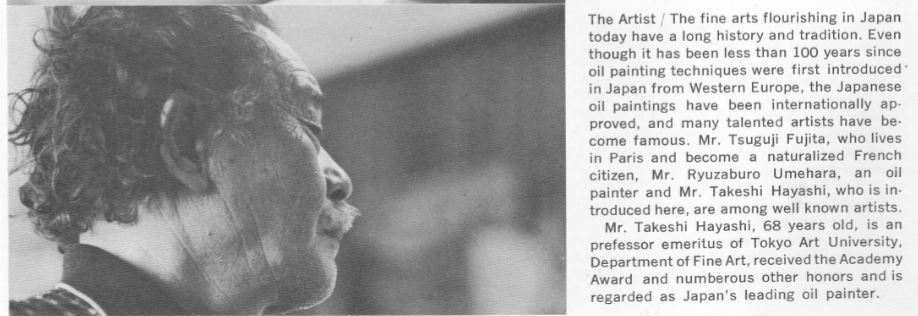
The Artist: Not only do the Japanese know ballet in 1964, they know how to paint using techniques introduced to Japan from Western Europe in the Meiji Period. Featured here is Takeshi Hayashi, an established painter and professor of the Tokyo Art Museum. Dentsu even mentioned artist Tsuguji Fujita, a Japanese artist who moved to Paris, and even traded in his Japanese passport for a French passport.

Fashion Model

Fashion Model: Dentsu selected Reiko Kawasaki as the face of the young model, likely because she evokes a young Audrey Hepburn. There’s very little detail in this profile, except that she has been a model for three years “who has not attempted to get ahead faster than her shadow.” More interestingly, the profile refers to Akiko Kojima, who was crowned Miss Universe in 1959, the first ever from Asia. A triumph over the beauties from Norway, the US, England and Brazil, Kojima’s victory was yet another milestone in Japan’s march to international acceptance.

Fashion Designer

Fashion Designer: She was one of the biggest names in fashion in Japan. Hanae Mori in 1964 was particularly well regarded for her costume designs in film. A year later, she debuted internationally with a show in New York City, and 12 years later opened up shop in Paris.

In 1964, the world came to Japan for the 1964 Tokyo Olympics, and to most foreigners, particularly from the West, the Japanese were not familiar, foreign perceptions ranging from warlike to exotic to friendly.

The Japanese were intent in facilitating the positive image of the Japanese. In the book, “Tokyo Olympics Official Souvenir 1964”, the publisher Dentsu produced a section called “Faces of Tokyo”, to encourage specific perceptions of the Japanese:

  • That the Japanese are indeed uniquely Japanese
  • That the Japanese are international
  • That the Japanese are middle class.

Uniquely Japanese

Housewife

The Housewife: Apparently the modern-day housewife of Japan in 1964 is beautiful, loves weekend outings with the family, and wears kimono designed by her husband. Somehow, Dentsu is trying to portray the typical Japanese housewife as beautiful, modern and well to do.

Sumo Wrestler

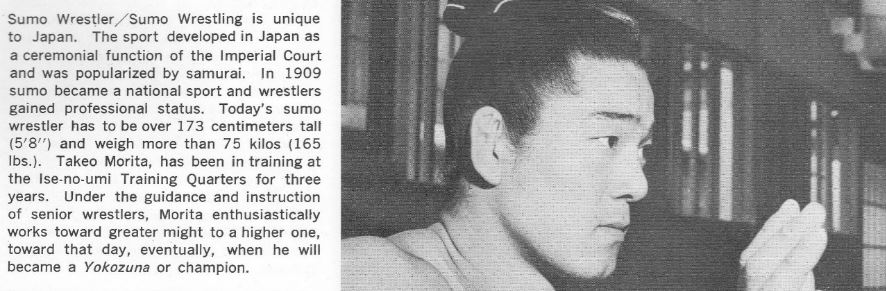
The Sumo Wrestler: The profiled wrestler was still a relative unknown, but Takeo Morita, who later became known as Fujinokawa Takeo, made it to the heights of sekiwake in the very Japanese sport of sumo. Dentsu explains that sumo emerged out of imperial court functions to become a national sport in the early 20th century. (Real)

Geisha

The Geisha: The profile here is undecipherable in English – I’m sure this is from a vague description of what it means to be a geisha by a translator who likely gave up and just threw a bunch of English words together….

Buddhist Priest

The Buddhist Priest: This profile introduces the resident priest of Zojoji, Buddhist temple in Tokyo Shiba Koen, very near Tokyo Tower. Not only is he a priest, but he is a Doctor of Philosophy, honorary president of a Japanese university, and through his many books, a go-to guy in Japan to understand Buddhism.

Flower Arranger

The Flower Arrangement Sensei: Although true less and less today, the expertise and techniques of specific skills and trades were handed down from one generation to another very deliberately, often from parent to child, as was the case with flower arranger, Kasumi Teshigawara, featured here. My guess is that the reference to her brother is famed film director, Hiroshi Teshigawara.

Bob Hayes_Tokyo Olympiad 1964_Kyodo News Service
Bob Hayes, from the book Tokyo Olympiad 1964_Kyodo News Service

He was born on Third Street on the east side of Jacksonville, Florida. People called it Hell’s Hole.

The youngest of four, Bob Hayes remembers growing up chopping firewood to keep the house warm, his mother working as a maid to keep the children fed and clothed, and a father that made little effort to recognize his son.

In his, at times, brutally honest autobiography, Run, Bullet, Run, Hayes writes of his father George Sanders, who had an affair with Mary Hayes, while her husband, Joseph Hayes, was fighting in World War II in the US Navy. When Joseph returned, he accepted the situation. But when Sanders, who also went off to fight in World War II, came back, he rarely recognized Bob Hayes as his son. When Sanders was asked if Bob was his son, he would reply, “That’s what his mother says.”

And yet, his father needed his son. Sanders ran a shoe shine parlor in Hell Hole, but that was not his main source of revenue. In fact, as Hayes explained in his book, the shoe shine shop was a front for a numbers racket, and a lucrative one at that. Bob was helping out by manning the shoeshine parlor in the afternoons.

When Bob Hayes was in high school, the football coaches all thought Hayes was a potential talent and wanted the young man to be groomed into a star. But Sanders refused, putting his business ahead of Hayes’ potential. In the end, the assistant football coach, Earl Kitchings, and Jimmy Thompson, the head coach of the football team, visited Sanders to plead their case. When told no, a prominent alumni in Hayes’ high school, Josh Baker, stepped in and said he would fill in at the store while Hayes attended afternoon practice. At that stage, Sanders relented, and Hayes started practicing with the high school football team. Baker went to work…but for only two days. By then, Sanders couldn’t be bothered, and Hayes began a hall of fame football career.

And yet, Hayes yearned for his father’s support. And in his first year as a football player in high school, Hayes did not get that many touches, carrying the ball only 9 times as the team’s backup halfback. But there was that one play, when he took the hand off in his own end zone and scrambled for a 99-yard touchdown. “That’s when my father finally claimed me as his son.”

As Hayes grew up, one could say, like father, like son.

His first sexual experience, at the age of twelve, as he describes in his autobiography, was with his father’s girlfriend, a woman named Edith who was fifteen years older. At the age of sixteen, Hayes got a girlfriend pregnant, who had an abortion as they both felt they were not ready to take that next step as a parent.

During and after his days as an NFL star, Hayes would provide Quaaludes to women in order to have his way. “You give a female a lude, and all she knows how to say to you is yes.”

By the time he got to college, Hayes had two daughters, whom he did not raise. In fact, he was surprised one time after his football career had ended to have a woman in her early twenties come up to him and say, “You’re my dad.”

Hayes wasn’t a great father, which he readily admitted. When he and his then wife, Janice, had his first legitimate son, Bob Jr., he flew to Jacksonville to see his father George Sanders. Sanders had been in poor health since returning from the War in the Pacific. But a few hours before Hayes made it to Jacksonville, his father passed away.

Hayes won two gold medals and a super bowl championship, one of only two people to do that. He had the right coaches at the right time which helped him develop into a tremendous athlete. And yet, he never had the right coach in the game of relationships.

Synchronized Swimmers Bill May and Christina Jones

The Tokyo2020 Olympics will be the closest the Olympics have ever come to gender equality, with female:male participation reaching an amazing 48.8 to 52.2 percent ratio. This list from the IOC shows an amazing level of equality in the 321 events currently planned for Tokyo.

In part two of this look at the remaining holdouts of gender-specific events, let’s take a look at the women-only events.

No Men Allowed

  • Synchronized Swimming: Bill May is a relative rarity in sports – a male synchronized swimmer. When people wonder if men compete in a sport heavily represented by women, May is the poster child. Essentially, he’s the only one. There are discussions of adding male synchronized swimming as an Olympic event, but that would not happen until 2024 at the earliest. Synchronized swimming emerged from a sport called “water ballet” in Europe in the late 19th century. What’s interesting, according to this article, is that synchronized swimming as a show or a sporting event at that time was male only. But as people understood that women actually had body make ups that made them more effective as synchronized swimmers, women began to play bigger roles in events and competitions. The association of women to this discipline became stronger in America in the 1930s, when a swimming coach named Kay Curtis developed a form of “water pageantry” which we today call synchronized swimming, and publicized it through a swimming act known as the Modern Mermaids, a show that became very popular across America.
  • Rhythmic Gymnastics: Rhythmic Gymnastics, which involves elements of ballet, gymnastics and dance while manipulating a rope, hoop, ball and/or ribbon, has been an Olympic sport since the 1984 Los Angeles Olympics. However, this discipline was born from the work of men in France “who all believed in movement expression, where one used dance to express oneself and exercise various body parts,” according to Wikipedia. So why the gender split? The New York Times essentially concluded in this article that real men don’t do rhythmic gymnastics. “There are male rhythmic gymnasts, but not at the Olympics. And their numbers are small. The stigma of the term rhythmic gymnastics poses “a huge marketing challenge,” said Mario Lam, a martial arts and gymnastics instructor in Canada. Lam uses the term “martialgym” to help avoid the connotation that it is a female-only sport, he said.”
  • Balance Beam: As this site explains, the gymnastics discipline of the balance beam is an event that requires “an obscene amount of strength, flexibility, and balance” on a long and narrow piece of wood, 10cm wide and 500cm long. The reason why men don’t compete? “Basically, the decision to keep men off of the balance beam most likely borrows from centuries-old gender norms. …the balance beam requires a particular amount of grace and flexibility — traits that are designated to the women of gymnastics, whereas the men’s sport keeps a more specific focus on displays of strength.”
Man on balance beam
Man on balance beam
Zach Railey in a Finn

Outside of Title IX in America, one of the most powerful levers for gender equality in sports have been the IOC. As I mentioned in this post, the IOC has added new sports categories and re-shuffled events so that Tokyo 2020 will have a female-male participation rate of 48.8 to 52.2%. That’s up from a 44.2% female participation rate at the 2012 London Olympics.in this post

Take a look at this list of planned Tokyo 2020 events and you’ll see that there is equality in almost every sports category. Can’t say that for much of the work world!

Interestingly, there are a handful of events that are gender-specific. In other words, there are still events that only men can compete in, and some that only women can compete in. In part one of this series, I will look at the men-only events, and part two will feature the women-only events.

No Women Allowed

  • Greco-Roman Wrestling: There has never been an Olympic competition in Greco-Roman wrestling at the Olympics, and there are currently no international tournaments devoted to women in that sport. It is unclear to me why Greco-Roman wrestling, which disallows grabbing of legs and kicking of legs compared to freestlye wrestling, is not encouraged for women. One of most significant physical differences between men and women is muscle mass, particularly in the upper body, but no one is saying that men and women should compete against each other in Greco-Roman wrestling. While the IOC has pressured the United World Wrestling Federation to improve gender representation in their tournaments, Greco-Roman, for whatever reason, has not had a high female participation rate historically. The biggest challenge for the wrestling federation, as I understand it, is to increase the popularity of Greco-Roman wrestling for women so that they can put together a competitive enough field. This may take until after Tokyo 2020 to hit critical mass and allow for gender equality in Olympic wrestling.
  • Finn – One Person Dinghy: This sailing discipline is apparently the greatest sailing test for an individual. According to sailor Zach Railey in this article, “It is well documented that overall people throughout the world are getting bigger, stronger and fitter, and the Finn is really a true test of power, endurance, and mental strength. Anyone who has sailed a Finn in steep chop and 20 knots can tell you just how physically hard the boat is to sail.” So strength again emerges as a differentiator. And perhaps as a result, the number or women who compete in Finn has not reached critical mass. The question is, with the strength requirements for the Finn, is it too dangerous for the fairer sex? Who knows.
  • 50km Race-Walking: I can’t find any decent explanation for why the 50-km race walk is male only in the Olympics. Both men and women can compete in the 20-km race walk as Olympians. And women appear to have raced competitively in the 50k race walk in IAAF competitions through much of the 21st century. Who knows?
  • Rings: Again, men have the advantage in upper body strength vis-a-vis women. So perhaps the number of women competing in this gymnastics discipline never reached critical mass. And yet, according to this site, women competed in the rings (or as they used to be called, “the flying rings”, at the 1948 London Olympics as a part of the Women’s Team All Around competition. Women never competed in the rings again after the ’48 Games, and I don’t know why.
  • Pommel Horse: Hmmm….the pommel horse discipline in gymnastics appears to be a less popular discipline for men than say, the floor exercise, the rings or the parallel bar for example. This article explains that the pommel horse “caters to a different body type. Having long arms helps, giving the gymnast greater separation from the horse, and in turn, room for his hips and legs to swivel underneath him. And the basic motion – going around and around on a horizontal plane – is the opposite from the up-and-down motion of the bars, rings and vaults.” And yet, I can’t find any explanation as to why women have not traditionally competed except for the reason it’s true for the rings – greater requirements for upper body strength have discouraged women from training on the horse, and so a critical mass of women fit for competition may have never emerged. Again, who knows?


Woman on Rings

Sam Querrey at Wimbledon

When I played a lot of tennis in the 1970s and early 1980s, Americans like Jimmy Connors and John McEnroe were giants who battled the likes of Bjorn Borg, Guillermo Vilas, Mats Wilander, Stefan Edberg, and Ivan Lendl. Connors and McEnroe passed the American torch to Jim Courier, Andre Agassi and Pete Sampras, who went on to greater championship glory. But those days of American dominance are long gone.

As this interesting article from Five Thirty Eight points out, an American named Sam Querrey became the first American since Andy Roddick in 2009 to reach a semi-final of a Grand Slam tournament, by beating Andy Murray at Wimbledon on July 13, 2017. (Querrey lost to Marin Cilic, thus continuing men’s futility in Grand Slams.)

Five Thirty Eight is a blog written by data analytic junkies, and they provide powerful data on the virtual disappearance of the American male in the semifinals of any of the four grand slam tournaments: the Australian Open, the French Open, Wimbledon and The US Open. In fact, the last American to win a grand slam was Andre Agassi, at the 2003 Australian Open.

That is an amazing drought for the world’s biggest economy that happens to have a huge tennis fandom.

Five Thirty Eight provides the rationale:

The globalization of tennis has slowed down America year after year. In the early Open era, beginning in 1968, into the 1970s and ’80s, America led the world in tennis training, practice and equipment. American men won loads of Grand Slam titles from 1968 through the 1990s, when John McEnroe, Jimmy Connors, Agassi, Pete Sampras and Jim Courier ruled. From 1990 to 1999, American men reached the semifinals or better 62 times at Grand Slams. All the while, though, foreign tennis training improved. By the time 2000 came along, diversity had climbed. American men reached the semifinals or better only 26 times from 2000 to 2009.

OK. That kind of makes sense.

Except that the globalization argument should include data on women. Since the year 2000, there have been only 3 years when an American woman did not win a grand slam finals: 2004, 2006 and 2011. Every other year, an American has won: Lindsay Davenport, Jennifer Capriati, and two others who happen to have the same last names: Williams.

Serena and Venus Williams have captured 29 of the past 70 grand slams since the year 2000, or 41% of them. If we add Jennifer Capriati’s three grand slam championships and one of Davenport’s, the total increases to 33 of 70 to nearly 47%, or nearly half of all grand slam championships in the 21st century.

It doesn’t appear globalization has slowed down American women.

Venus Williams makes it to her ninth Wimbledon Finals in 2017
@
Tokyo Olympic volleyball gold medalist Masae Kasai’s wedding in May 1965 attracted national attention, and Prime Minister Eisaku Sato (left) and his wife were on hand for the ceremony. | KYODO

The year 1962 was a fateful year for Masae Kasai and her teammates on the national women’s volleyball team.

The Japanese team won the world volleyball championships by defeating then champions, the Soviet Union, in the finals match in Moscow. The team was at the top of their game, but the practices were punishing (as related in this post), and some of the team members were getting older – in fact, the captain, Kasai, was 29 years old when the team captured the world championship crown.

In the 1960s, it was considered unfortunate if a woman did not marry by their mid-20s. In fact, it used to be a bit of a slur to a woman if she were considered a “Christmas Cake” – in demand until the 25th (of December), but no longer of value after the 25th. Thus family and society constantly reminded the women of Japan’s undefeated and champion volleyball team that true success in life for them would come with marriage. The coach, Hirobumi Daimatsu, believed that part of his responsibility included to help arrange marriages for his team members after retirement from the game.

And in 1962, after the world championships, Daimatsu, Kasai and other members of the team intended to retire so they could go on with their lives and leave behind a life of harsh training nearly 7 days a week, 51 weeks a year.

However, in 1962, it was announced that volleyball would debut at the Olympics in 1964, the year that Tokyo would host the Olympics. After their victory in Moscow, the public and the media strongly called for the coach, Kasai and the entire team to fight on through 1964, with the goal of winning gold at the 1964 Olympiad, as Helen Mcnaughtan explains in her article, The Oriental Witches: Women Volleyball and the 1964 Tokyo Olympics.

…the public expectation was immense, and the team received some 5,000 letters from fans urging the ‘Oriental Witches’ to continue. In early 1963, the team members got together after the New Year holiday, and most of the players decided to stay until the Olympics. Kasai decided to give up her ambitions to marry for the time being and to aim for the gold medal at the Tokyo Olympics. In interview, Kasai recollected that she decided to continue because she felt that the public at that time would ‘not allow her to retire’, and that the only way to respond to the public’s expectation that the national team could win the gold medal was to try to give them that victory.

Fortunately, as related in this blog post, the Oriental Witches swept through the round-robin matches and dominated the Soviet Union in the finals to win gold for Japan. So finally, it was time for the women to get married. Kasai, as the captain and star of the team, was given extraordinary help in finding a mate. Coach Daimatsu asked Japan’s newly minted prime minister, Eisaku Sato, to help. After meetings with three other men, when Kasai failed to experience that spark of possibility, the prime minister’s wife introduced Kasai to an officer in the Japan Self Defense Forces named Kazuo Nakamura.


okaasan no kin medaru_Kasai Masae cover
Cover of Kasai’s autobiography.


In Kasai’s autobiography, Okaasan no Kin Medaru (Mom’s Gold Medal), she wrote how her first meeting with Nakamura involved a considerable number of other people, including the prime minister, and thus there was practically no conversation between Nakamura and Kasai during that first meeting. But Kasai felt something in Nakamura’s voice that seemed to speak to her heart. And so she told the prime minister that she would like to meet Nakamura again. Nakamura agreed to meet again. According to Kasai, Nakamura was nervous about the idea of marrying Kasai, and she appreciated his willingness to explain himself in a straight manner.

Nakamura: Does Kasai-san intend to get married?

Kasai: Why?

Nakamura: Well, you said you would give up volleyball at the age of 29. However the world didn’t let you to do it. So you decided to live until 31 as a volleyball player and give up on marriage. So now that you won the gold medal, I think people are just making noise about your marriage.

Kasai: No, this is not true. I quit volleyball after the Olympics, and I strongly wish to get married.

Nakamura: I am sorry, I was rude. However, I think I am unsuitable for Kasai-san as a husband. Even though I hate war, if anything happens, I will need to fight on the frontlines. In that time, if I have children or a wife, I will unfortunately be drawn back home. So I think being single is more convenient for me. The Self-defense forces, different from our domestic troops, cannot settle down to domestic lives. And I would have no inconveniences in the military, and thus have no need for help with cooking or laundry.

Kasai: ….

Nakamura: Of course, there are some senior officers who are married, but I don’t think that it is a happy life. This is why, even though I am 33 years old, I believe, in principle, that military men like me should not marry.”

My assistant regimental commander said that I should stop thinking this way and just go see you. In fact, the day we had our first omiai meeting, I did not even know where I was going, since he just took me there. Once we arrived, I found myself in the prime minister’s private residence, I was so scared my legs froze up, ha ha ha…,” Nakamura laughed. “In fact, they still are! My parents were surprised when I got home and told them that I was in the prime minister’s home and that my matchmaking pair was that volleyball player Kasai, hahaha….

Kasai was hooked. She wrote that she had never a man who would speak so frankly with her, which made him even more attractive to him. Once she realized that Nakamura may be the man for her, she attempted to explain that she was a simple person, that the gold medal did not go to her head. “Even though I won a gold medal, I am still just a very ordinary woman from a farmer family in Yamanashi. I did not become rich because of the gold medal, and without volleyball I am just a woman, although admittedly, a very tall woman.”

Nakamura replied that for people of their age, a person of her height is beautiful. It was a sign to Kasai that Nakamura was interested, that he would speak to his admiration for a quality – her height – that Kasai has spent a lifetime being embarrassed about.

About 5 weeks after their initial meeting, Kazuo Nakamura and Masae Kasai were married on May 31 at Ichigaya Kaikan in Tokyo.


Note: Special thanks to Marija Linartaite, for her help in the research for this article.

The film, over 54 years later, can indeed make one cringe.

The male coach, throwing a volleyball to the right and to the left of a young woman whose sole mission is to get a hand on the ball, do a somersault on the hard court over her shoulder or across her back, land on her feet in order to begin running the other way so she can desperately get her hand on the ball, back and forth, down and up, over and over again….until she’s so tired she does not realize her body is simply moving on its own.

This technique is called “kaiten reshibu” (receive and rotate), and was one of the secret weapons that made Japan’s women’s volleyball team so effective in the sixties. When they marched into Moscow to take on the mighty Soviet Union in the 1962 world championships, where the Soviet team was not only on their home court, but had a distinct height and strength advantage, the Japanese entered the arena as underdogs, and left the arena as world champions.

It is said that the Soviet press were so amazed by the Japanese that they called them “The Oriental Witches”, a moniker that the international press took up with relish. Interestingly, the Japanese press and the team itself took to that title with pride.

“In Japan, ‘witch’ (majo) is a scary thing,” said team captain, Masae Kasai in an interview with Helen Macnaughtan of SOAS, University of London. “But the nickname wasn’t meant to reflect this. It was a word to describe our volleyball play, which had never been seen before: techniques such as ‘receive and rotate’ (kaiten reshibu).”

The domineering head coach of the women’s national team of Japan, Hirobumi Daimatsu, knew that the Japanese had to find a way to compensate for their weaknesses. The Japanese women were smaller, so they had to be quicker, more efficient, more willing to sacrifice their bodies.

And while the end seemed to justify the means – the women’s volleyball team under Daimatsu had never lost – some wondered whether the coach was crossing the line, and abusing his players. In a Japanese documentary cited by Iwona Mewrklejn in her article, “The Taming of the Witch: Daimatsu Hirobumi and Coaching Discourses of Women’s Vollevball in Japan”, the labor union of the company that employed the members of the women’s volleyball team criticized Daimatsu for his training regimen. But “the union’s objections did not seem to matter, either to the coach or to the management.”

Overseas journalists also thought that the women were being abused, as you can tell in the title of a Sports Illustrated article, “Driven Beyond Dignity.” In this March 16, 1964 article, the writer, Eric Whitehead, described the punishing practices that Daimatsu put his players through. When a player looked so exhausted that she wanted to quit, Whitehead quoted Daimatsu as saying:

If you’d rather be home with your mother, then go. We don’t want you here.

There’s a South Korean team in town. If this is too tough for you, maybe you should go and play with them.

Driven Beyond Dignity SI photo 1
From the March 16, 1964 Sports Illustrated

Whitehead goes on to describe the evening meal break from practice as terse, something that more or less interrupts the coach’s training timeline.

It is 7 o’clock now and the girls’ supper is wheeled in in metal urns: rice, meat and fish. Daimatsu ignores it and quickens the pace. His grim, wild-eyed intensity is frightening. His face is still a mask, but it is strained and beaded with sweat. Now many of the girls are openly sobbing, their faces distorted with the agony of effort and the physical punishment. But they keep staggering in, and the food sits for half an hour before Daimatsu gives a curt signal and the first-team girls- always the first to eat – go to the urns. The others shift to a brisk scrimmage as Daimatsu goes to the sidelines for his own meal, which is served to him by a ball girl. As he dines he is even more chilling to observe, for now one seems to see in him the cool arrogance of a despot.

One could also say there is a bit of “arrogance” in Whitehead’s writing. In response to a comment by Daimatsu about the importance of this kind of training, Whitehead editorialized directly in his article with a single, dismissive line.

Except for a one-week break around Eastertime, this is the routing, year in and year out. Says Coach Daimatsu: “There is time for nothing else. The players know absolutely no other life. They do it because they choose to. The preparation for winning is a personal, individual challenge. It is accepted without question.

Ah, but then, I said to myself, it’s only volleyball, played by girls.

If this were high school football in Texas, where football has been religion for decades, my guess is that Whitehead would never write “Ah, but then, it’s only high school football, played by boys.” Never mind that many of the women on Daimatsu’s team were in their mid to late 20s, he may not have fully understood the expectations that the entire nation of Japan had of this women’s team, although he gives a nod to the notion, albeit in a somewhat patronizing way:

The team’s captain, tall, graceful Masae Kasai, smiles shyly from her desk. Little stories like hers tell the big one. Two years ago, at age 28, Masae was in love and engaged to a young man from Osaka. She had a choice: marriage and a home, or a continuation of the daily torture under Hirofumi (sic) Daimatsu. She chose the latter, for at the 1964 Olympics the glory of Japan will flicker again and glory is everything.

Perhaps Masae had said it all the previous night when I asked her about the team’s chances at the Olympics. “You must understand,” she said gravely. “We have never experienced defeat. We must win.”

Oriental Witches_2_Driven Beyond Dignity SI photo 3
Captain Masae Kasai and Coach Hirobumi Daimatsu during a practice in early 1964, from Sports Illustrated

Whether they were chasing glory or just trying to meet the heavy expectations of their country, Kasai and her teammates bought into Daimatsu’s approach, as explained by Macnaughtan. After all, they tried his methods and won, and never believed that he was treating them with disrespect. In fact, they trusted Daimatsu explicitly.

I had a lot of trust and respect for Coach Daimatsu. The team was happy to take direction from him because we trusted him. He was a volleyball player himself when he was a university student. He joined Nichibo (the name of the team’s company) after being a soldier in the war. The team and I followed his hard training because of his great human nature. He was a man we could trust and respect as a human being. Whenever our team won, we were convinced that his hard training was the right way to go, and so we would practice and train hard again, and then we would win again. There was a very close bond between him and the team.


They say it is the highest rated television program in Japan’s history. It was 7pm on Friday, October 23, 1964, and it may not be an exaggeration to say that almost anyone near a television was watching the gold-medal match of the women’s volleyball championship at the Komazawa Indoor Sports Arena.

It was a day before the ending of the 1964 Tokyo Olympics, a fortnight during which all of Japan was collectively holding their breath, simultaneously hoping that their young men and women would exceed expectations, and that nothing horribly embarrassing would happen during Japan’s debut on the global stage.

In this particular case, the Japanese women’s team were expected to win. They had already steamrolled through the US, Romania, Korea and Poland, conceding only a single set during the entire two-weeks of round-robin play. Their opponents in the final round, the Soviet Union, had done the same, winning every set against the same teams.

Oriental Witches_8_ Bi to Chikara
Olympic champions at last, from the book Bi to Chikara

Despite the fact that volleyball was making its debut at the Olympics at the 1964 Tokyo Olympiad, Japan had a rivalry. In 1960, Japan lost its debut in international competition to the Soviet Union in the championship match in Brazil, thus igniting volleyball fever in Japan. Two years later in 1962, Japan again made it to the finals of the world championships against the Soviet Union, in Moscow. Somehow, the women from Japan won.

When it was also announced that volleyball would become an Olympic event at the ’64 Olympics, the Japanese public wildly agreed that their women’s team had the best chance at gold in the 1964 Games to be held in Tokyo.

The pressure on the team was immense. One of the players was quoted in the Sankei News a day before the finals as saying, “if we lose, we might have to leave the country.”

To say the weight of an entire nation was on the shoulders of these women would be an understatement. To make matters worse, the finals match didn’t start anywhere close to the scheduled time of 7pm, so the players had to wait around and stew in their tension for an extra 30 minutes. And yet, when the game finally began, the women of Japan simply went about their business, taking the first two sets 15-11 and 15-8.

As team captain, Masae Kasai, recalled in her autobiography, Okaasan no Kin Medaru, (Mom’s Gold Medal), she reminded herself to stay calm, but couldn’t help but wonder, “What the heck is wrong with the Soviets?”

Oriental Witches_9_ Bi to Chikara
The Soviet Team after their loss to the Japanese, from the book Bi to Chikara

In the third set, Japan raced to an 11-3 lead, and Kasai thought in that instant, “It’s possible, victory is possible.” But then in the next instant, Kasai got mixed up with a teammate when attempting to receive, and according to the team captain, the Soviets seemed to catch a second wind. Still Japan battled to a 13-6 lead, and got to match and championship point at 14-8. But then momentum switched suddenly to the Soviets, as they clawed their way back to within a point – 14-13.

The team’s coach, Hirobumi Daimatsu called time out. “What are you doing? Calm down. All you need is one point to win, right. Take it easy.”

It was Kasai’s turn to serve, and she hoped to decide the match then and there, but the Soviets got the serve back. (This was a time when you could only win points on your serve.) And back and forth it went, both teams failing to capitalize on their own serve five times in a row.

Oriental Witches_7_ Bi to Chikara
Coach Hirobumi Daimatsu lifted in the air in celebration, from the book, Bi to Chikara

Emiko Miyamoto, whipped her super slim left arm through the air, rocketing the ball across the net to the Soviet back court with such velocity that the Soviet receiver’s return, which should have been a pass to a teammate in the frontcourt, ended up flying across the net. The Soviet player in the front court saw it heading towards her and hoped to change the ball’s direction, but when she tapped it, the ball had already passed over the net. A Japanese player reacted and sent the ball back to the Soviets, but the referee ruled a stoppage of play.

And in that moment, 9:01 pm, the players realized that they had finally reached the peak of a very tall mountain, coming together with jubilant hugs and tears, as a nation erupted in celebration.


Note: Special thanks to Marija Linartaite, for her help in the research for this article.