Going au natural was considered not only natural, but beautiful, in ancient Greece. The nude athlete is a powerful image in Greece. It is said that when a runner named Orsippus of Megara lost his loincloth in the midst of a sprint, he was said to run even faster, gaining him victory and fame. Running naked became a competitive advantage.
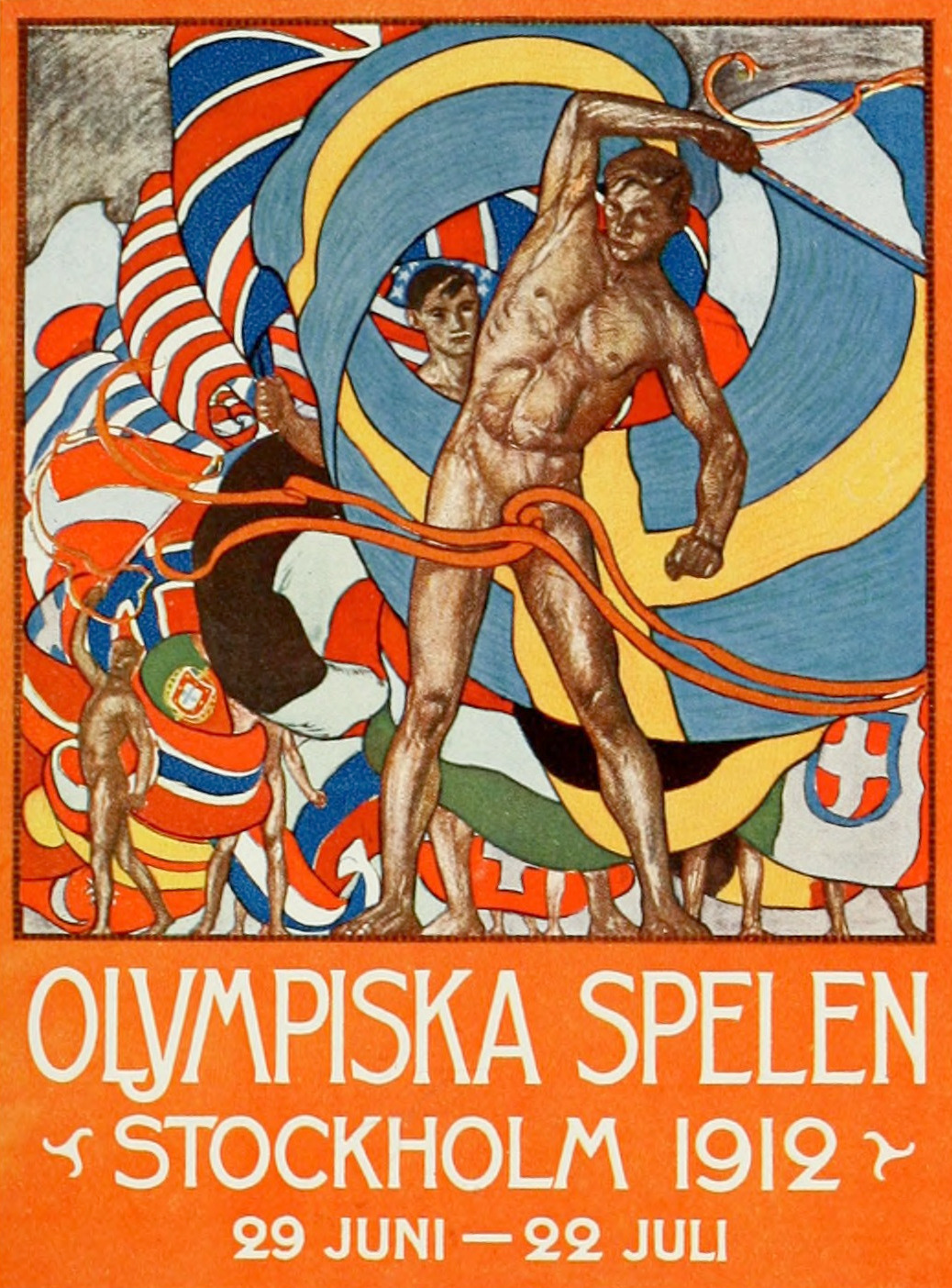
As archaeologists like Heinrich Schliemann, who uncovered the site of ancient Troy in the late 19th century, captured the imagination of people the world over, the thinking and customs of the ancient Greece became idealized. The nude athlete in particular was de rigeur in posters advertising the early Olympic Games.
In fact, from 1912 to 1936, the male body was the main feature of the Olympic poster, with the 1912 Stockholm Olympic poster being the most, how shall we say, intriguing, showing that there’s a lot you can do with a ribbon. And after World War I ravaged Europe, the Olympics came to Antwerp, Belgium in 1920, where the poster also employed a fully nude man, private parts covered this time by a swirling towel.
The French were not so revealing, but the poster for the 1924 Paris Olympics did emphasize the bare chests and midriffs of virile young men ready to go into athletic battle. The poster for the 1928 Amsterdam Olympics was less suggestive, but still featured a yearning half-nude man.
Then, there are the prudish Americans, who featured a man of chiseled musculature, but whose torso was covered by a white t-shirt.
The Germans in 1936, the Brits in 1948 and the Finns in 1952 all did variations on a theme with the male body, until the Aussies came along and changed the look and feel dramatically. They removed the human, and replaced it with, what looks like a card, or invitation to the Olympic Games.
I recently bought a copy of Life Magazine’s October 30, 1964 edition, featuring a young Don Schollander staring off into the distance, his four gleaming gold medals draped around his neck. (Read about that here.) But equally interesting to me were the ads in the magazine, a time capsule containing artifacts of a consumer goods era long gone.
Polaroid: Polaroid saw the future was in instant images. Why wait days to get your print photos when Polaroid could do it in 60 seconds? Polaroid is still around, albeit more as a novelty. Although you can’t tell in this ad, this Polaroid Color Pack Camera expanded like an accordion, and appears very popular amidst the biggest names in rock and roll according to this site. Polaroid’s brand and IP is now owned by “The Impossible Project,” an organization dedicated to keeping Polaroid’s instant film legacy and business alive, a decade after Polaroid gave up on instant film cameras.
Encyclopaedia Britannica: Did you own a set of that massive collection of Western-centric knowledge? My family did. I remember chucking it into a dumpster as we cleared out the detritus of 20th century knowledge management, replaced ruthlessly by the Internet. The last paper version of this massive set of tomes – all 32,640 pages – was published in 2010.
Yellow Pages: This was a directory of telephone numbers and addresses amassed by AT&T, a tome published every year to help find the contact information of a business in your area. This tome too is now a relic of the past – see Encyclopaedia Britannica.
Admiral: In the early 1960s, Admiral was one of the leading names in electronics, famous for their televisions, radios and record players among a vast lineup of products. In their heyday, Admiral helped lead the transition from vacuum tube technology to transistors. Today, Admiral is still around as a television brand marketed by a company based in Taiwan. More interestingly, vacuum tube amplifiers today are all the rage.
Winston: I had thought that you couldn’t advertise cigarettes or tobacco products in American magazines, so I thought I’d highlight this antiquated ad for Winston Filter Cigarettes, with its iconic slogan, “Winston tastes good…like a cigarette should!” That ad made Winston the best-selling cigarette in the world in 1966, two years after this ad. While advertising tobacco products on the television and radio was banned in America in 1971, apparently, companies can still advertise tobacco products in magazines and newspapers. However, tobacco companies can get significant blow back if they try.
At the 1984 Los Angeles Olympics, the American woman’s team won the gold medal in the 4×400 relay finals, easily breaking the Olympic record by nearly a second and trouncing silver medalists Canada by nearly 3 seconds, an eternity in sprint.
The 4×400 meters event, by definition, is a race run by four people. But due to the rules of track at the time, teams were allowed to list up to six people eligible for the relays, and if there were athletes who competed in heats, but who did not run in the finals, they could still be awarded a medal for helping their team to the medal podium.
Thus, at the LA Games, six women received gold medals, including Diane Dixon and Denean Howard, who helped Team USA to an easy victory in the preliminary 4×400 competition. They not only assisted in getting their team to the finals, they rested two of the team’s stars, Valerie Brisco-Hooks and Chandra Cheeseborough, so they would be fresh for the finals.
Team Puerto Rico, on the other hand, did not have that luxury it seems.
Madeline de Jesus was representing Puerto Rico as a long jumper and sprinter at the ’84 Games. During the long jump competition on August 5, she pulled her hamstring, and she knew she would not be able to suit up for the 4×400 relay six days later.
Only six days….but enough time to plan a caper.
According to this article, Madeline consulted with her sister Margaret who was a spectator at the Olympics. And they wondered if they could get away with it. No one knew that Madeline’s injury would keep her out of the relays, so if her sister could take her place in the relays, the Puerto Rican team would have a chance. After all, Margaret was a sprinter as well. She didn’t qualify for the Olympic team, but she had a particular quality that could make this work – Margaret was the identical twin of Madeline.
Madeline and Margaret de Jesus
So Madeline suited Margaret up, presumably passing her sister all her credentials that gave her access to the village, the training facilities and the stadium. And on August 11, it was Margaret de Jesus lining up for the second leg of the 4×400 heat. Since there were ten teams competing for eight spots in the finals, Team Puerto Rico’s finishing time of 3:37.39 was enough to grab the eighth spot and qualify for the finals.
Margaret had fooled the world.
For a little less than a day.
Unfortunately for the de Jesus sisters, there was a journalist present for a Puerto Rican newspaper called
La Nación, This journalist had covered the sisters’ athletic accomplishments, and was actually able to tell the difference between Madeline and Margaret – a “beauty mark one had on her cheek.”
When the head of the Puerto Rican Olympic team heard of the deception, he immediately pulled his 4×400 team from the finals. After an investigation held by the Puerto Rican Olympic Committee, Madeline and Margaret were banned from future competition. The investigation also revealed that the relay team’s coach, Francisco Colon Alers, knew of the plan and allowed it, resulting in his lifetime ban from international competition. Sadly, the three other members of the track squad were also complicit, and they received a one-year suspension from competition.
Antigua and Barbuda finished almost two seconds behind Puerto Rico in the heats. Getting to the finals and racing one more time on the big stage would have been sweet…if not for those twins.
Whenever I write a story on an American high jumper, long jumper or a discus thrower, I have to go through the painful back-and-forth conversion between feet and meters, inches and centimeters.
It used to be the holy grail in the United States and Britain to run a mile in fewer than four minutes, until Roger Bannister broke it, which broke the mental barrier and allowed others to blast through the four-minute wall. Today, however, no one really cares about the mile, as the standard racing distance is the 1,500 meters, which is a little less than a mile.
Now, track and field in the US has generally gone metric. For example, the USA Outdoor Track and Field Championships hold the same distance running events that other countries do: 100 meters, 800 meters, 5,000 meters, 110 meter hurdles etc. In fact, the organization, USA Track and Field, adopted distances using the metric system in 1974.
They were ahead of their time apparently, because in 1975, the US Congress passed an act that states preference for the metric system of weights and measures, which was followed by an executive order from President Gerald Ford. Essentially, the entire world had already adopted the metric system. Politicians and businessmen alike wanted the US to get with the international game plan. However, for some reason, probably related to a tremendous resistance to change, the act and the order were watered down by stating that adoption was voluntary.
What was this resistance? Listen to this fantastic podcast on design, 99 Percent Invisible, and their story on America’s implementation of the metric system, titled “Half Measures.” History professor, Stephen Mihm is quoted as saying in the podcast that interestingly, uncommon bedfellows united to resist – astronomers, theologians and industrial engineers:
But abandoning the U.S. customary system did not sit well with a lot of people, including an influential group of “astronomers, theologians, and cranks,” Mihm explains. “And keep in mind that those categories which we consider separate and distinct today were not at this time.” This group spun together scientific arguments with other wild and nonsensical ideas, and developed a theory that to abandon the inch was to go against God’s will. Converting to metric, they argued, would be tantamount to sacrilege.
But the real core resistance to metrication came from a different group entirely: some of the most innovative industrialists of their day. Engineers who worked in the vast machine tool industry had built up enormous factories that included everything from lathes to devices for cutting screw threads — and all of these machines were designed around the inch. The manufacturers argued that retooling their machines for a new measurement system would be prohibitively expensive. They also argued there was an “intuitiveness” to the customary system that made it ideal for shop work.
Imperial – Metric Conversion for Cooking
This reluctance to fully shifting to the metric system can result in engineering miscalculations, sometimes with tragic or costly consequences:
In 1983, an Air Canada Flight ran out of fuel mid-flight because the ground crew and the flight crew all calculated fuel requirements in pounds instead of liters, granted this mistake happened just after the Canadian government required conversion to the metric system. Fortunately, the pilots managed an incredible “dead-stick” landing, gliding safely to a nearby airstrip.
In 1999, NASA lost a $125 million Mars Climate Orbiter spacecraft because engineers in Lockheed Martin calculated thruster data in pounds to NASA while NASA engineers were making their calculations in metric units called “newtons.”
In 2003, a car on the Space Mountain roller coaster ride at Tokyo Disneyland derailed due to a broken axle, resulting in the injury of 12. Apparently, new axle parts ordered in 2002 were measured in inches as opposed to millimeters, making the new axles off spec.
In the end, there are bigger issues than the momentary confusion of trying to know how far 5,000 meters is in feet or miles. And to be fair, American institutions have gradually adopted the metric system due to its partnerships and obligations internationally.
And yet, the fact that America still clings officially to inches, quarts and Fahrenheit can be a pain. Don’t we know that we are shooting ourselves in the 20.48 centimeter (aka foot)?
Oh there were a bunch of dignitaries there. A Governor. Organizing Committee Head. Olympians. Celebrities. There were proclamations. Couldn’t see it. It was rainy. And I was too late to get to a good spot.
But it was still cool, on October 28, 2017, to celebrate 1,000 Days to the Opening Ceremony of the 2020 Tokyo Olympics in the Ginza.
At the moment the photo above was snapped, there was 1,000 days and over 4 hours to the start of the Tokyo Olympiad – in other words, 8pm on Friday, July 24, 2020.
We got to see demonstrations of a few of the new events to debut in 2020, like 3-on-3 basketball and sports climbing.
In the case of 3-on-3 basketball, basketball players slipped on the rain-slicked asphalt, but still put on a show. Afterwards, renown kabuki actor Ebizo Ichikawa and Olympic weightlifter Hiromi Miyake showed off their shooting prowess.
Olympic weightlifter Hiromi Miyake Famed kabuki actor Ebizo IchikawaThis event at the Ginza, still one of the world’s swankiest shopping areas, was an opportunity for Tokyo 2020 local sponsors to promote their linkage to the Olympics.
Eneos does the classic tourist gimmick.
A new ANA plane, with artwork designed by a junior high school student.Here, I put my origami skills to the test to fold a paper crane. I failed…but I still put my heart into it.
Kinki Nihon Tourist asking passersby to fold cranes.On November 29, it will be 1,000 days to the 2020 Tokyo Paralympics.
It was 1999 and the two premier national teams in women’s soccer were facing off in the Rose Bowl in Pasadena California to determine the champions of the second FIFA World Cup Championship.
The United States and China were locked in a scoreless draw through regular and extra time, with victory coming down to a penalty shootout. After goaltender Briana Scurry stopped a shot in the third round, victory rested in the left foot of Brandi Chastain. And when she rocketed the ball into the upper right hand corner of the net, Chastain immediately ripped off her jersey, fell to her knees, her arms extended in ecstatic triumph, and her black Nike sports bra exposed for the entire world to see.
Lisa Lindahl was at home in Vermont when her phone rang and her friend told her to switch on the TV. Lindahl was an entrepreneur who established the market for sports bras in the late 1970s, so when she saw Chastain raise her arms in victory, she said was astonished, and proud. “It was her confidence, her preparation and her long journey that came to fruition in that moment,” said Lindahl in this 99% invisible podcast. “And that is perfect because I could say that about my journey of the jog bra.”
One of my favorite podcasts, 99% Invisible, is not about sports, but about design. And strange as it may seem today, the sports bra was non-existent before 1977. No sportswear or sports equipment manufacturer ever imagined why women would ever need a sports bra.
Dr. LaJean Lawson, who is the Sports Bra Science and Marketing Consultant to Champion Athleticwear, and has been shaping the design of the sports bra for three decades, said that the environment for women in sports when she was growing up was very different.
When I started high school we weren’t allowed to run full court because there was the assumption that girls were too weak, and we couldn’t run any races longer than 400 meters. So women participating in sports having/needing a sports bra is so recent.
The more Lawson promoted the sports bra and the idea of better fitness for women, she even got hate mail.
This letter said “If God had intended women to run he would not have put breasts on them.” There was a whole socio-cultural stereotype of how women should behave, and it wasn’t vigorously and badly. It was more calm and sweet, and how to comport yourself with more steadiness, and not the sort of enthusiasm and passion you see with sport.
But in the 1970s, circumstances were conspiring in the United States to make it easier for women to participate and compete in sports.
In the United States, a section of the United States Education Amendments of 1972, famously called “Title IX,” was created, and subsequently had a huge impact on American society. While the overall goal was to ban gender discrimination within federally funded schools and universities, encouraging greater access for women to higher education, protecting pregnant women and parenting students from being expelled, and challenging gender stereotypes about whether boys or girls were strong in a particular academic category like math and science, Title IX has had a tremendous impact on women in sports.
According to this article, “the impact of Title IX on women’s sports cannot be overstated: the NCAA says the number of female college athletes is at an all-time high, and the numbers of girls playing high school sports has swelled from fewer than 300,000 in 1974 to more than 3.1 million in 2012.”
Additionally, getting into shape and staying fit became a huge part of the American pop culture in the 1970s and 1980s. With bestselling books like The Complete Book of Running by Jim Fixx, which came out in 1977, and Jane Fonda’s Workout, published in 1981, women were running and working out more.
And the more women ran, the more obvious it became that they had a problem men did not. Here’s what Lindahl had to say about that:
My whole generation started exercising, and I had a friend introduce me to what was then called “jogging”. When you have at-shirt over bouncing nipples, you get chafing. So the answer to that is to put a bra on. Because I did try running without any bra. And then of course I got a lot of comments from passing motorists, and certain male runners. So you wear a bra and that poses problems of different sorts, like the straps that fall off your shoulders so you’re always jigging them back up, hardware can dig into your back, and they’re hot and sweaty.
One day, Lindahl’s sister, who also ran, called to ask this obvious, painfully obvious, question: “‘What do you do about your boobs? I am so uncomfortable when I’m running! Why isn’t there a jock strap for women?’ That’s when we really laughed. We thought that was hilarious.”
But Lindahl couldn’t get the idea out of her head, and started to think about the ideal bra for female runners – a bra with straps that wouldn’t fall off the shoulders and wide enough so they wouldn’t dig in. Lindahl recruited a friend, Polly Smith, who was a seamstress and costume designer. And they worked through multiple prototypes for this bra, but could not hit upon the design that made it easier for her to run. Then one day, Lindahl’s husband came down the steps with a jock strap not where it was supposed to be – over his head and across his chest – and said playfully, “Hey ladies, here’s your new jock bra!”
The three of them had a great laugh, and Lindahl thought to continue the joke by pulling the jock strap off her husband and putting it on herself….except that when Lindahl put the jock strap over her breast, she had an epiphany. “Oh!”
The next day, Lindahl went running in a contraption that featured two jock straps sewn together, and realized she had a design that would work. Lindahl, Smith and Smith’s assistant, Hinda Schreiber decided to build a business. Schreiber’s father lent them $5000, the team built a relationship with an apparel manufacturer in South Carolina, and by 1978, they were distributing the “Jog Bra.”
Despite the initial reaction of sports retailers, who thought that the jog bra should go in a lingerie department and not in a sporting goods store, sales of the $16 bra took off. Jog Bra had annual sale increases of 25%, and created an entirely new market. More importantly, it enabled women to enjoy their sporting activities more fully and freely, whether it was taking part in a Jane Fonda workout, playing point guard on a high school basketball team, or running a marathon. The sports bra that Lindahl, Smith and Schreiber created liberated a whole generation of women athletes.
That feeling of liberation came to fruition that moment Brandi Chastain ripper off her jersey in 1999. But that vision was in Lindahl’s head in 1977.
It should be modest enough I could take off my t-shirt on really hot summer days because I had a running partner who would do that. He would take off his shirt in the middle of his run, pull it over his head and tuck it in the back of his shorts. I was so jealous because I couldn’t do that.
Today, millions of women can and do, thanks to the Jog Bra. Happy 40th!
The gold medalAt 586 grams (nearly 1.3 pounds), the gold medal to be awarded at the 2018 PyeongChang Olympics will be the heaviest medal ever created for an Olympic Games.
The previous heavyweight champion of Olympic medals was the Vancouver medal of 2010 that tipped the scales at 576 grams, according to this article.
But more importantly, at least to me, the simplicity of the Korean medal design is striking. There is very little to disturb the surface, much of the text blends inconspicuously in the design, including use of native Korean alphabet letters that in its entirety spell out the words “PyeongChang Winter Olympics.”
Textured like the bark of a tree, the surface of the medal complements the actual weight to give the athlete a sense of solidity. This may be top of mind for Olympians who have heard about the flimsiness of the medals awarded at the 2016 Rio Olympics. The intent, of course, is to make the association of the medal design with Korean society, according to the Korea Herald.
“Hangeul is the foundation and the soul of Korean culture,” PyeongChang’s organizing committee said. “Hangeul is considered the seed that eventually blossoms and bears fruit, which symbolize Korean culture. The trunk is the process of that development.”
Additionally, the ribbon that will allow the medal to hang from the neck of an Olympian will be made from a traditional Korean textile called “gapsa,” and the round wooden case for the medal is said to be inspired by traditional Korean architecture.
“I tried some new techniques and went through a lot of trials and errors,” medal designer Lee Suk-woo said. “I wanted the medals to represent the hard work and dedication of the athletes. And the finished products came out a lot better than I’d expected.”
Top Ten All Time American Universities for Olympians
High school students and their parents in the United States, frankly all over the world, look at the multiple annual top university lists, from US News to Forbes.
A new list is out – American universities or colleges with the most Olympians. The site, Olympstats, published this list a few days ago, after the editors went through the onerous task of figuring out the collegiate affiliations of all American Olympians since 1896.
Question: Which American university is in the top ten for producing the most Summer Olympians, and the most Winter Olympians?
Above is Olympstats list of top ten American universities for producing Olympians since the first modern Olympics in 1896. I’m proud to say that my alma mater placed 9th, although I imagine a bulk of those Olympians were in the early 20th century when Ivy League institutions were the only ones that had students who could afford to go to Europe from the United States.
Top Ten States for Olympians
The first four universities are from California. It had always been my running assumption that year-round warm-weather states like California would produce a large chunk of Olympians. But as we can see below, Florida and Hawaii don’t merit top ten mention.
Top Ten American Universities for Summer Olympians
Predictably, the top four American universities to produce Olympians also dominate the list of top ten American universities to produce Summer Olympians.
Top Ten American Universities for Winter Olympians
When we look at Winter Olympians, the Midwest and Northeast dominate. One to note is #11 on the list below – Westminster College, a college in Salt Lake City, Utah. Since Westminster partnered with the U. S. Ski and Snowboard Association (USSA), this liberal arts school has become a hotbed for winter sports. In fact, Westminster students made up 10% of the US Olympic Team at the 2014 Sochi Olympics.
So, what’s the answer to the question posed at the beginning of this blog post?
The American government, yet again is trying to sell American cars in Japan. But a reputation of poor quality and poor mileage (unfounded perhaps) result in poor re-sale value. No matter what the government does, Japanese citizens do not want to buy American cars.
In fact, the people who used to buy the long, sleek American cars were the Yakuza, or at least that was the perception.
Chevrolet Impala
But when I look at the ads for cars in the weeks of the 1964 Tokyo Olympics, me – a non-driver without a license – I do admit, I lust.
Above and below are the ads from October 10 and 17 editions of The Saturday Evening Post, the weeks of the 1964 Tokyo Olympics. George Lucas’ film, American Graffiti, portrayed the youthful car culture of 1962 Modesto California, which showcases automobiles primarily from the 1950s and 1960s. And again, I’m no car expert, but you get a sense that in 1964 cars were getting longer and sleeker – rounded edges giving way to sharper angles.
Take a gander at the American cars of ’64, as seen through the eyes of the readers of The Saturday Evening Post. Which one gets your motor running, makes you wanna head out on the highway, lookin’ for adventure, and whatever comes your way…..
Buick Electra 225Pontiac Grand Prix
Ford Galaxie 500, Fairlane 500 Sports Coupe and Mustang Hardtop
Ted (Theo) Mittet in Tokyo, from the collection of Dick Lyon
It was as if 1964 was Year 1, and Japan was re-born.
Japan was young, energetic and full of hope. One of the biggest hits of 1964 in Japan was “Konnichi wa Akachan,” – “Hello, my sweet baby!” – a bouncy, happy tune of fresh starts.
Ted (Theo) Mittet was a 22-year old from Seattle, Washington, who qualified for the Tokyo Olympics as a rower on the US Olympic team, and came to Japan with eyes wide open. And he loved it from the start. “Japan is all that I expected and more,” he wrote to his parents a week before the start of the Olympics. “Its people are very friendly to say the least.”
Mittet was on a powerful rowing crew that took the bronze medal in the fours-without competition at the Tokyo Olympics. But while many of his teammates on Team USA went home, Mittet sold his air ticket to the States and travelled Japan. More importantly (to me), he wrote and received many letters. This was a time when people sent telegrams, when long-distance phone calls were expensive, and letters took days if not weeks to traverse the seven seas, pens were our keyboards, while boats, planes and people were our internet.
It was a time when getting a letter from the postman was sometimes a thrill.
I was very glad to see you letter beside my Mother’s Mirror and I cried my father “Received, Received”. My father was glad, too. My mother and brother were glad, too. I cried your letter’s news all over.my friends. I’m afraid you did not write to me soon. But I got your letter. I think happily.
The above was the opening of a letter from a high school student in Matsuyama City, Ehime Prefecture name Katsuhiro Matsuo, overjoyed to get another letter from the young American rower.
Katsuhiro Matsuo, high school student in Matsuyama, Ehime
Mittet travelled from Tokyo to Yokohama, then on to Kyoto. He passed through Hiroshima, Matsuyama, Beppu, Nagasaki, Niihama and Nara, before heading back to Yokohama and Tokyo. During his 2 months of travel in Japan, he wrote constantly and voluminously to family and friends in the US, as well as new acquaintances he met during the Olympics and his travels. The letters from the Japanese in particular reflect Japan’s excitement and curiosity about foreigners and their desire to welcome them to their country and their home.
In some cases, the Olympics may have given some Japanese the courage to break out of their normal shy shells and reach out to the world. Mittet was the closest to the outside world for these letter writers, and so they made what was likely an extraordinary effort to write letters in English.
Dear Theodore, I know how surprised you are to receive this letter from unknown friend in Japan. You visited Silk Center in Yokohama. Where I was working during Olympic season. You gave me your card. Oh, no. I required you to give it to me. Do you recollect me? If you could, I am glad. Ha Ha. It is difficult for you to recollect me because you met many people, did not you? – Junko Aoki, a student at Kanagawa University in Yokohama
Dear Theodore, You may be surprised to receive this letter from a complete stranger, but I met you at the Toda Rowing Course and talked with you for a few minutes. I gave you a little badge, do you remember me? I’m taking this liberty of writing to you with the sincere hope that you’ll accept me as your new Japanese friend. – Emiko Kobayashi, a high school student from Toda-machi, Saitama
The Tokyo Olympics were a rush of adrenaline for the Japanese, so many of them amazed and happy to be surrounded by so many foreigners from so many different countries. Mittet met a volunteer interpreter named Teruyo Wakui at Enoshima Station, not far from where she worked translating for the sailors competing in the nearby yachting events. Despite her fatigue, meeting Mittet proved to be another rush for this volunteer just after the end of the Tokyo Olympics.
When I happened to meet you at Enoshima station, I was rather tired after twenty days’ work. But I was so glad to meet you and to speak with you. In yachting game, there was no competition as you. Most of all the competitors of yachting were rather gentle and kind, and even the younger men were not as young as you. You are so young and full of dream and curiosity to many things of Japan.
After twenty days in yacht harbor, I suddenly remembered that youth is more wonderful than any other thing in this world. We can do anything without money, as we are young. And I think you have enough courage to do anything that you want, though you say you don’t have courage, but pleasure.


You must be logged in to post a comment.