At the 1964 Tokyo Olympics, the Olympic Village was more than serviceable. It was an actual neighborhood.

The neighborhood was called Washington Heights, an American military compound designed to make American soldiers and their families feel like they never left America, as you can see in the video above. If you watch until the 1:18 minute mark, you’ll see Washington Heights before it was transferred from the US Government to the Japanese government for the purpose of being re-fashioned into an Olympic Village.

I got my hands on a booklet that was published by the Organizing Committee of the 1964 Olympics, called “XVIII Olympiad Official Bulletin No. 12”. This booklet, published in November 1963 to update officials on the progress of the organizing committee, featured pictures and blueprints of the dorm rooms in the Olympic Village.

Here are the descriptions from that bulletin with the images. If you’re an Olympian from 1964, let me know your memories of living in those former military family quarters.

There are two types of housing facilities: one is a ferro-concrete four-storied building of a dormitory type, and the other, an independent wooden house of one or two stories. The men’s quarters will consist of these two kinds of housing, while the quarters for women will be of the dormitory type especially prepared for the fair sex.

Ferro concrete four story dorm_XVIII Olympiad Bulletin No12
Ferro concrete four story dorm

Each floor of the dormitory is of the same plan and has 18 bedrooms and a common bath and toilet facilities. There will be a total of 69 bedrooms per building. A central heating system is provided, but the temperatures in October in Japan will not require its operation. The staircases and corridors are covered with asphalt tile, the walls with plaster, and the ceilings with sound-absorbing materials.

Each bedroom, 25.5 square meters in area, faces the corridor on one side and has windows on the other. Lockers will be prepared along one of the two blank walls, in addition to beds (three beds in a room on the average), desks chairs and boxes for small articles will be provided, in each bedroom. For comfortable living conditions, bedside lamps have been installed, and insect nets and curtains are attached to the windows.

There are nine types of independent housing units. One frame house is composed of one to four housing units of one or two types. The combination of such unites varies 50 different ways. A house may be of one to four unites of the same types and another house may be of two to four unites of two different types. Building may be of one storied, while the others may be two storied. Although the types of houses are quite varied, the interior décor is limited to only nine types.

One-story wooden house dorm_XVIII Olympiad Bulletin No12
One-story wooden house dorm

The outside of those houses is covered with cement mortar, and the roofs are tiled. A-1 Type house is the simplest; it is one-storied and has four bedrooms and a utility room. One of the two doors leads to the entrance hall and the other to the utility room. Eight persons will be accommodated in each house of this type.

In the larger two-storied B-1a Type house are four bedrooms, the rest being almost the same as in the A-1 Type. Nine athletes are to be provided with lodgings in this type of house. The wood floor is covered with a carpet, and the (board) walls are painted. The ceiling is covered with fibre board. These houses will be furnished in the same way as the dormitory rooms and wardrobe closets will be added, if necessary.

Each house has a gas hot furnace for heating, and the room for the chef de mission is equipped with a telephone. The utility room contains a gas heater and a sink.

Two-story wooden house dorm_XVIII Olympiad Bulletin No12
Two-story wooden house dorm

Kunalan, Tomizawa, Haque and Hamid
Canagasabai Kunalan, the writer, Anwarul Haque and Hamid Supaat at the Singapore Cricket Club
We gathered at the prestigious Singapore Cricket Club on May Day, and enjoyed fish and chips and beef Guinness pie reminiscing about 1964. I had the honor of having lunch with three Singaporean Olympians who went to the Tokyo Olympiad:

  • Canagasabai Kunalan, who held the fastest 100-meter time in Singapore for over 30 years, and competed under the Malaysian flag at the 1964 Olympics, as well as under the Singaporean flag in 1968,
  • Hamid Supaat, who competed in the grueling individual cycling road race in the chilly hills of Hachioji at the 1964 Tokyo Olympics, as written about here, and
  • Anwarul Haque, who was a goalie on the 1964 Malaysian field hockey team, went on to become a lawyer, as well as serving eight years as president of the Singapore Cricket Club, where we ate and reminisced.

In 1964, Singapore was undergoing political upheaval, having gained independence from Britain in 1963, and joining a federation of states that became Malaysia. Previous to that, Singapore had been a colony since Stamford Raffles arrived on the tiny island in 1819 to claim it as a trading post for the East Indies Company and the British empire.

Before independence, Singapore was a bustling harbor town, its population growing quickly, but still relatively small at 1.5 to 1.8 million in the first half of the 1960s. So it’s quite understandable that in the sports history of Singapore, only 5 medals have been won by Singaporeans in the history of the Olympics, the first one – Singapore’s first silver – in 1960 and the last one – Singapore’s first gold – in 2016.

Tan Howe Liang wins silver at Rome
Tan Howe Liang migrated with his family from southern China to Singapore and at an amusement park saw an exhibition of weightlifters and was hooked. He joined a weightlifting club, and soon became internationally competitive, finishing ninth in the lightweight category at the 1956 Melbourne Olympics, and then gaining confidence by winning gold at the 1958 Commonwealth Games, the 1958 Asian Games and the 1959 SEAP Games. In Rome, Howe Liang brought glory to Singapore with a silver medal in the lightweight category.

Lloyd Oscar Valberg

Even earlier, at the 1948 London Olympics, Singapore had a representative as a part of British crown colonies. His name was Lloyd Oscar Valberg, and he competed in the high jump as Singapore’s sole athlete in the first Olympics after the Second World War. Valberg came in 14th. But he set the Singapore record for the high jump at the age of 17, and is a symbol of how far Singapore has come. Valberg’s nephew was Colin Schooling, and his son saw his famous relative as a role model.

Inspired by his grand uncle, Joseph Schooling went on to take gold in the 100-meter butterfly in one of the most dramatic races at the 2016 Rio Olympics. Schooling beat a very strong field, including his childhood idol, Michael Phelps to win Singapore’s first gold medal.

Kokichi Tsuburaya afer the marathon
After the grueling marathon

Do your best. Persevere. Never give up.

Ganbatte! Akirameru na!

These are values that resonate with the Japanese. You see it in the office worker who stays late to get things done, night after night. You see it in the high school baseball player who dives left and right after dozens if not hundreds of ground balls in the rain. You see it in the artist who tirelessly works the pottery wheel until she gets the exact curvature in the clay she sees in her head.

Kokichi Tsuburaya exemplified those values. And when he drove toward the finish line of a grueling 42-kilometer marathon race at the 1964 Tokyo Olympics, on the verge of grabbing a silver medal in track and field, where Japan had found no success, 70,000 Japanese shouted and screamed their encouragement, attempting to will Tsuburaya on to a strong finish. And yet the drama laid out before the spectators had the sickly feeling of inevitability. Just as Tsuburaya emerged from the shadows of the tunnel entrance, a few meters behind so too did Basil Heatley, a Brit hot on the Japanese’s heels.

When Heatley accelerated past a depleted Tsuburaya like a biker passing a pedestrian, the growing balloon of hopes an entire nation held for Tsuburaya seemed to deflate in those seconds it took Heatley to get to the finish line. It must have been a tremendous disappointment.

But then again, that’s OK. To the Japanese, Tsuburaya was not a loser. He was one of them, a man who tried so very hard, who did his very best, who never gave up. As he said in interviews after the marathon, “I will practice hard towards Mexico City.”

Of course, Tsuburaya was a product of his national cultural traits. But more impactfully, he was his father’s son, as described in Ichiro Aoyama’s book, The Lone Runner – The Kokichi Tsuburaya Story.

.

Kokichi Tsuburaya 7 years old
Little Kokichi at 7 years old, smiling front and center.

The seven children in the Tsuburaya household had to work hard, cleaning the house, preparing the bath, cooking, planting the rice, raising the livestock when they hit the age of 10. These were not easy tasks, and the head of the household, Koshichi Tsuburaya, believed that his children needed to be disciplined to ensure they did their chores. He ordered his children around military style, shouting directions like “Attention!” “Right face!” “Go Forward!” He made them wear shorts in the winter. He made his children repeat chores if they weren’t done properly, and of course he would hit them to make sure they knew they had done something improperly. Training included bayonet skills, just in case.

As a child Kokichi liked to run, and when his dog ran, little Kokichi liked to try to keep up with the dog. But one day, when he was 5, Kokichi felt a sharp pain in his legs and his back. The father (named Koshichi) then noticed that their boy’s left leg was shorter than his right. Knowing how little their little Kokichi would complain about anything, the parents took him to the hospital, where they learned that their boy also had tuberculosis arthritis, which causes pain in the weight-bearing joints of the hips, knees and ankles. So from an early age, Kokichi felt pain whenever he ran.

And yet, Kokichi loved to run. He looked up to his older brother, Kikuzo, who ran competitively. Kokichi often joined his older brother, and the elder brother saw the kid brother keep up, despite being 7 years younger. The brothers would often go for runs in the evenings. But their father didn’t approve of running for the sake of running. “You can’t live off of running,” he would say as a warning to his sons.

One time the brothers came home a little later than usual, and the entire family was seated at the dinner table quietly, waiting to start eating until the two boys sat down. The father kept quiet until the boys returned late again from running, and again told his boys angrily, “You can’t live off of running.” In order to avoid the glare of their father, the boys would sneak out for a run while their father was taking a bath.

Finally, one night, Koshichi the father confronted Kokichi the son and asked him, “If you run, will you stick to it?” The son said yes, to which Koshichi said, in the approving way of gruff dads, “Once you decide to do this, don’t quit halfway through.”

Kokichi never quit. In fact, he took his commitment to running very seriously. In high school, he trained very hard for a national 5,000 meter competition. He did not win, and without anyone’s urging, shaved his head to account publicly for his loss.

When Kokichi graduated from high school, he did something that made his father proud – he joined the Ground Self-Defense Force and became a soldier like his father had been. Japan has a long tradition of long-distance relay races, and Kokichi was slated to join the team representing the Self-Defense Forces in a national long-distance race. At the time of the race, Kokichi was in the hospital with a high fever. On top of that, Kokichi kept the fact that a slipped disk in his back was also causing him tremendous pain. Despite all that, Kokichi Tsuburaya insisted on running the longest leg of the race.

It was this commitment, this perseverance that eventually endeared Tsuburaya to the public. And through it all, even his father, who thought nothing would ever come of his running, was quietly very proud of his son.  His father would often send Kokichi letters of encouragement, saying how worried he was for his son. And when Kokichi returned home from his bronze-medal finish at the Tokyo Olympics, he was surprised to find that his parents kept all sorts of newsclippings, medals and trophies of his accomplishments , or could not sleep on the eve of the Olympics, and worried deeply about his health.

They were deeply proud of their little Kokichi. And likely, so was an entire nation.


Note: Special thanks to my researcher, Shiina Ishige, for her in-depth research that contributed heavily to the writing of this post.

Heatley Bikila Tsuburaya on medal stand 1964
Basil Heately, Abebe Bikila and Kokichi Tsuburaya on the medal stand

Abebe Bikila strolled into the National Stadium like he owned it. And he did. The lithe Ethiopian, a member of the Imperial Bodyguard of his nation, was about to meet expectations at the 1964 Tokyo Olympics – to become the first person to win marathons in two consecutive Olympics.

The first time Bikila did so, he was an unknown, and made headlines by running barefoot on the roads of Rome in 1960 to win marathon gold. When he crossed the finish line in Tokyo, amazingly over 4 minutes earlier than the second place finisher, the audience marveled at how fresh Bikila was – so fresh that he did calisthenics and jogged in place as if he were readying for the start of a marathon.

In other words, the actual competition in the marathon was for second. And in the race for second, Japan was ready to explode in celebration.

Like the Brits, with Brian Kilby and Basil Heatley, the Australian Ron Clarke, the other Ethiopian Demissie Wolde, as well as Americans Billy Mills and Buddy Edelen, the Japanese had a trio of strong marathoners in the competition, Toru Terasawa, Kenji Kimihara and Kokichi Tsuburaya.

As explained in this detailed article, at the 10K mark of the 42K race, Clarke was setting a pretty fast pace at 30:14, with Jim Hogan of Ireland and Bikila following. Around the 20k mark, Bikila took the lead and never looked back. The race for 2nd was on, with Clarke and Hogan about 5 seconds behind Bikila, and a second pack including Wolde, Tsuburaya, Jozsef Suto of Hungary and Antonio Ambu of Italy.

Kokichi_Tsuburaya 1964_adoring fans

With about 7 kilometers to go, Bikila, Hogan, Tsuburaya and Suto were in the lead, with Heatley rising to fifth. Amazingly, Hogan dropped out of the marathon despite being in position for a silver medal, leaving the Japanese from the self defense forces, Tsuburaya in second. Heatley and Kilby were coming on, passing Suto with only 2 kilometers to go.

Heatley was advancing and could envision a bronze-medal finish, but didn’t think he could pass Tsuburaya. “I didn’t expect to catch him,” Heatley recalls, “but he was a target.”

Bikila entered the National Stadium triumphantly, winning with an ease that both shocked and surprised the crowd. But the crowd went wild a few minutes later when Tsuburaya entered the stadium. At their home Olympics, Japan had medaled in wrestling, judo, boxing, weightlifting, gymnastics and swimming among others, but not in track and field. Tsuburaya was about to change that, in front of the biggest crowd possible.

And yet, soon after Tusburaya entered the stadium, so too did Heatley, only about 10 meters behind. Just before the final curve of the stadium’s cinder track, Heatley turned on the jets and sprinted by Tsuburaya. For a 2nd place battle that took over 2 hours and 16 minutes, Tsuburaya lost his chance for silver by four seconds.

Writer, Robert Whiting, was watching this match on the television, confident that Tsuburaya would make Japan proud with a silver medal only to see that expectation burst before the eyes of an entire nation, as he explained in this article.

The cheering for Tsuburaya was building to a crescendo when suddenly Great Britain’s Basil Heatley came into view and proceeded to put on one of Olympic track and field’s great all-time spurts. He steadily closed the gap in the last 100 meters, passing Tsuburaya shortly before the wire, turning the wild cheering in the coffee shop, and in the stadium, and no doubt in the rest of Japan, into one huge collective groan.

Bob Schul, who three days earlier, became the first American to win gold in the 5,000 meter race, watched the end of the marathon with some dismay.

Abebe entered the stadium to great applause. He finished and went into the infield and started doing exercises. Finally the second guy, Tsuburaya came, and the crowd roared. But so did Heathley of England. Sharon asked if Tsuburaya could hold on to 2nd place. I said I didn’t think so. Heatley caught him about 150 meters before the finish. And the crowd became very quiet. The Japanese guy was going to get third. And when he did finish, the stadium did erupt. And that was the only medal they won in track and field.


Heatley on the heels of Tsuburaya
Heatley hot on the heels of Tsuburaya


When Kokichi Tsuburaya was a boy in elementary school, he competed in an event common throughout Japan – a sports day, when children compete against each other in a variety of activities, like foot races. After one such race, Koshichi Tsuburaya, the young runner’s father, chewed him out for looking behind him during the race. “Why are you looking back during the race. Looking back is a bad thing. If you believe in yourself, you don’t need to do so.”

Many years later, with over 70,000 people screaming in the showcase event of the Olympics, people were yelling, “Tsuburaya, a runner is behind you! Look back! Look back! He’s close!” Was Tsuburaya recalling that childhood scolding from his father? Would it have made a difference if he did?

While Tsuburaya’s very public loss of the silver medal must have been the source of pain, not only for Tsuburaya, but also of the nation. But in the end, there were no hard feelings. After all, Tsuburaya won Japan’s only medal in Athletics, a bronze in the marathon, an achievement beyond the nation’s initial expectations. Writer Hitomi Yamaguchi wrote of this pain and pride in a 1964 article.

Tsuburaya tried so very hard. And his efforts resulted in the raising of the Japanese flag in the National Stadium. My chest hurt. I applauded so much I didn’t take any notes. Since the start of the Olympic Games, our national flag had not risen once in the National Stadium. At this last event, we were about to have a record of no medals in track and field. Kon Ishikawa’s film cameras were rolling, and newspaper reporters were watching. People were waiting and hoping. So when Tsubaraya crossed the finish line, we felt so fortunate! When I saw the Japanese flag raised freely into the air, it felt fantastic. Tsuburaya, thank you.

You can watch the dramatic second-place finish to the Tokyo Olympics marathon at the 5:38 mark of this video:

Note: Special thanks to my researcher, Marija Linartaite, for finding and translating the last quote.

Roy with 1964 Tokyo Olympic Torch
The Olympians has been a labor of love for exactly two years. It is my sketchbook as I prepare for the mural masterpiece, a book on the 1964 Tokyo Olympics.

While my book’s focus is on the XVIII Tokyo Olympiad, I use my blog as an excuse to write about anything even remotely related to these areas: the Tokyo Olympics, the Olympics overall, Japan, and sports in general. In other words, I think of my blog as therapy for a restlessly curious mind.

How else could I go 730 straight days without missing a post?

Enjoy!

Japan 1964


Tokyo 2020


Random Rambles

Roy's 2nd Birthday
Roy’s 2nd Birthday
It’s been exactly two years since I started my journey to understand the context, the organization and the stories of the 1964 Tokyo Olympics. My father was at those games as a news producer for NBC, and I turned one years old on Opening Day.

I moved to Tokyo for a third time in January, 2014, excited by Tokyo’s selection as the host city for the 2020 Summer Games. Surprised to find not a single book on the 1964 Tokyo Olympics in English, I endeavored to write the definitive record. On May 1, 2015, I started my blog, The Olympians is in many ways, the first draft of my book.

All, thank you for your wonderful comments and support!


Olympians 1964


Amazing Olympians

Fanny Blankers Koen in Tokyo_Asahi Graf 2

She was 46 years old, and she walked around Tokyo with an air of confidence and style. Fanny Blankers-Koen was in Tokyo for the 1964 Summer Olympics, and the Japanese press followed her around – after all, she was one of the most accomplished Olympians in town. At the age of 30 at the 1948 London Olympics, she became the first woman to win four gold medals in a single Games, replicating the 1936 accomplishments of her hero, Jesse Owens.

Fanny Blankers Koen in Tokyo_Asahi Graf 1

In the October 23, 1964 edition of the Japanese magazine, Asahi Graf, Blankers-Koen was featured in a photo spread, looking relaxed and glamourous. The article shows her walking about town, relaxing in the Olympic Village, describing her as a tall woman with golden hair and light blue eyes.

Fanny Blankers Koen in Tokyo_Asahi Graf 3

The article states she is the “chaperone” to the Netherland’s women’s athletics steam, but as fellow Dutch and Olympian, Ada Kok, wrote to me, she was actually one of several coaches on the Dutch Olympic squad.

The article quotes a Japanese swimmer, Hiroshi Furubashi, who knew Blankers-Koen, saying that she was a hero to the Dutch after her dramatic accomplishments in London in 1948. But as I wrote in previous posts, despite her historic accomplishments, she was never embraced in her home country as she was outside it. Kok said that the Dutch team at the 1964 Olympics treated Blankers-Koen as they did everyone else, quite neutrally, as just another member of the team.

Fanny Blankers Koen in Tokyo_Asahi Graf 5

“It may be a very bad Dutch habit, but our well known sportspeople were more recognised and honoured abroad then in the Netherlands,” said Kok. “The Dutch are more like, ‘act normal and keep both feet on the ground’, no matter how famous you become in your sport.”

And as I wrote in this post, Blankers-Koen was a very complex person, who was driven by a need to win at everything, and to be recognized as an achiever. It is unlikely she got that sense of fulfillment in her home culture. But when she came to Japan, she was a star.

Paul Mccartney one on one

It was 50 years ago, when Sgt. Pepper taught his band to play. (It’s the album’s 50th anniversary!)

It was 51 years ago, when the Beatles came to Japan to play.

It was 53 years ago, in the year of the Tokyo Olympics, when the Beatles had the top five on the Billboard Hot 100, the only act ever to hold the top five spots:

  • No. 1, “Can’t Buy Me Love”
  • No. 2, “Twist and Shout”
  • No. 3, “She Loves You”
  • No. 4, “I Want to Hold Your Hand”
  • No. 5, “Please Please Me”

I have written about The Beatles impact on the time surrounding the 1964 Olympics, not only on Japan but on people around the world. In 1964, Olympians coming to Tokyo, particularly from Europe and the United States, knew of Beatlemania, sang their songs, and saw on TV the screaming hordes of girls chasing the four lads from Liverpool wherever they went. There was even a group called The Tokyo Beatles!

On April 27, I got a tiny taste .

In 1966, the Beatles played the more intimate Budokan, built to showcase judo in the Tokyo Olympiad. However, I saw Paul McCartney perform in the Tokyo Dome, a baseball stadium not built for concert acoustics. But that was OK! We were in the presence of the Walrus!

The concert began with the most iconic of pop music sounds – the jarring clanging opening chord of “A Hard Day’s Night.”

And then Sir Paul played for over two hours, ending in the communal “lah lah lah, lah lah lah lah” of Hey Jude.

When he left the stage, we knew he’d be back for an encore. When McCartney re-emerged, he played the most covered single of all time, his very own “Yesterday.” He could have easily walked off the stage and ended the night on a high. But he then barked out the reprise to “Sgt Peppers Lonely Hearts Club Band”. He could have ended the night with the lyrics, “We hope you have enjoyed the show….we’re sorry but it’s time to go,” but he didn’t.

Next up was a song from his Wings days, “Hi Hi Hi”. You knew he couldn’t end on a Wings song, but he took an interesting turn by celebrating the birthday of a band member with, of course, the Beatles upbeat song, “Birthday”.

I’ve never been to a Beatles concert, but there must be an appropriate way to end one, and that would be with the “Medley” from side 2 of my favorite Beatles’ album – Abbey Road. I was ecstatic! The perfect finish! After the pulsating drum solo, McCartney brought it all to an end with these lyrics:

And in the end

The love you take

Is equal to the love you make

McCartney is 74. And yet, he played for a solid 2 hours and 40 minutes. There were times when his voice cracked, and some of the faster songs felt slower than normal….which is OK because this is Japan where people stay seated….after all, the average age in the Dome must have been about 64.

As my wife screamed “Paul!”, and McCartney soaked in the applause, he told the crowd he loved us all – “Minna-san daisuki!” And maybe he says that to all the crowds. But his encore went on and on, lingering as if he had little desire to depart. Even after his final song, he stayed on stage to say good bye before walking off, stage left.

I experienced only a tingling of Beatlemania that the Olympians of 1964 did, but maybe, I’m amazed…at the way you pulled me out of time.


Paul McCartney One on One Tour T-Shirt
My T-shirt!

A Visit with a Japanese Family_13

Here is part 4 of a series on how the Organizing Committee of the Tokyo Olympics in 1964 presented the typical Japanese family to the world. In these series of pictures, the writers again show how similar the typical Japanese and Western families actually are. Moms shout out to kids that dinner is ready, and they settle together at the dinner table to a wide variety of cuisine.

13 Amid the cackling and shouting of the kid on the lawn we hear Mother’ s voice. It’s supper time. Japan adopted daylight-saving-time shortly after the war, but the problem of getting the children inside while it was still light out proved too great, and daylight-saving-time was abandoned.

14 All the family members gather in the kitchen area for supper. For dinner you can expect any variety of Western, Chinese, Indian or Japanese food. No other nation offers such an array of homecooking. The availability of fresh meats and an abundant supply   of   fish give the homemaker scores of menu ideas. Rice, the all­ time favorite in Japan is losing some of its popularity to bread, especially at breakfast time. The main food seasoning is soy sauce, which was first introduced. to Japan from China centuries ago.   Try a little on your fish.

A Visit with a Japanese Family_14

When I read that Japanese typically eat Indian food, I had to pause for a moment. Indian food? Then I realized that one of the most popular dishes in the Japanese diet is indeed curry rice, a thick yellow curry that has been popular since the late 19th century when the British introduced it to the Japanese.

The article ends as does the day of the typical Japanese family – with everyone fast asleep, except the eldest son burning the midnight oil studying for university exams.

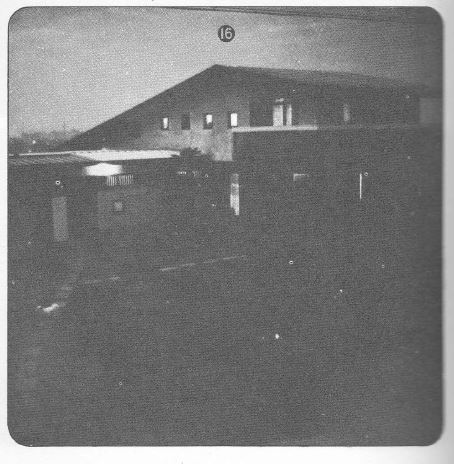
16   The   family   has retired for the night.   What a long time we’ve been here!   Only   one   light is burning.   It’s in the room of the oldest boy who is studying for the university entrance examinations .   He is   preparing   for the fiercest competition he may ever face. Taro, the family dog, is keeping the vigil outside. Well, good night now, have a good rest.

A Visit with a Japanese Family_16

It’s the 1960s! The Japanese economy is booming! This was the time of The Three Sacred Treasures of Post-War Japan, when every family had to have a television, a refrigerator and a washing machine.

This is part 3 about how the Olympic Organizing Committee sought to educate the visiting foreigners about the typical Japanese household. Their message – yes, we’re Japanese, but we’re Western and Modern as well! In an article written in “Tokyo Olympics Official Souvenir 1964”, the writers explained how up to the times the typical Japanese family was. Having said that, the Kato girls are stuck cooking in the kitchen and doing the laundry, albeit with the latest white goods on the market.

A Visit with a Japanese Family_5

5 Kitchen Area. This functional modern design is gaining in popularity as fewer girls are willing to be house­ maids. The housewife’s aids today are electric appliances. Mrs. Kato and her daughter-in-law are clearing the breakfast table.

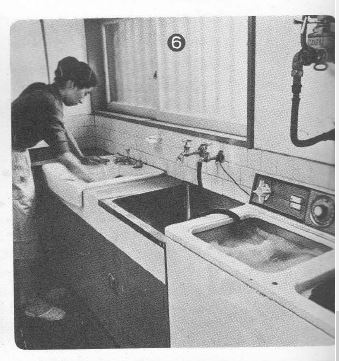
A Visit with a Japanese Family_6

6 Laundry   and   Bath.   The latest model washing ma­chine and spin dryer. Look at the bathtub-in a Japanese style bath you wash and rinse outside the tub, and in this case, in a Western style shower. The water is not replaced for every bather so it’s important that you be clean before   you   get into the hot water of the tub to relax.

A Visit with a Japanese Family_7

7 The handy folding clothesdryer can be moved to the sunniest areas as the sun moves across the sky.

A Visit with a Japanese Family_10

10 With the washing in the fresh air, Mother turns to sewing. New electric sewing machines have made it possible for women to make their own kimonos at home. Once kimonos had to be made by professional dress­ makers. Japan currently produces sewing machines, at an annual rate of 3.5 million, many of which are ex ported.

Through the eyes of mother Kato, the writers show how Japan has modernized. First, mom drives! How else can she attend PTA meetings and buy her groceries at the increasingly popular supermarket!

A Visit with a Japanese Family_11

11 Faced with increasing duties at home and outside, Mother has learned to drive. Alas, she had the new car two months before she could pass the driving test!

12 After attending a PTA meeting at the school of her youngest child, Mother stops at a supermarket on her way home. Supermarkets came into   vogue in Japan about three years ago and have proved so popular with house­ wives that there are some 2,000 supermarkets in Tokyo alone.

A Visit with a Japanese Family_12