On August 5, 2016, all eyes were on Rio de Janeiro.
Despite all the doomsayers’ diatribes about political corruption, the fears of the zika virus, the filth of Guanabara Bay, and the anemia of the Brazilian economy, the Games went on. And the Games were great!
In the moving opening ceremony, the famed Brazilian love for music and dance were on display. Super model Gisele Bundchen strolled across the field to the tune of The Girl from Ipanema. The honor of lighting the Olympic cauldron was given unexpectedly to Athens marathoner Vanderlei Cordeiro de Lima, whose 2004 Olympic marathon was bizarrely interrupted by a defrocked Irish priest. And the cauldron de Lima lit was stunning, the fire’s light reflected magnificently in a shining, swirling structure of metal places and balls, creating a spectacular golden vision of the sun.
A bright spot for the IOC was highlighting the plight of the global refugee issue by forming an all-refugee team, an excellent idea!
And to be honest, from a sports perspective, if you bring the very best athletes in the world together, the drama of the competition will subsume almost all else (for good and for bad.)
For Brazilians, here were a few of their nation’s most inspirational stories, starting with Neymar’s winning penalty shot that sealed Brazil’s first even Olympic gold in soccer.
Nigel Talton likely imagined himself breaking the tape at a championship track meet, or even the Rio Olympics, but he probably didn’t imagine himself winning a sprint at SunTrust Park…between innings at Atlanta Braves games…in a teal-colored spandex suit with big blue goggles.
But when you’re an aspiring track star, you do what you must to pay the bills.
Working two jobs in order to afford to keep training in track, the 26-year-old from Fort Valley, Georgia had a moment on Friday, June 9, 2017 that most people or companies can only dream of – a video that goes viral.
Talton’s job is to play a superhero-like character called The Freeze, who races from the left field pole at SunTrust Park, around the warning track in front of the outfield fence to a finish line in right center field, against a fan who has a 200-foot head start. The Freeze almost always wins, but in this particular case, the fan celebrated just before reaching the finish line, only to be passed by The Freeze. The fan’s shock and subsequent face plant made the video must-see viewing, and made The Freeze a star.
According to track blog, FloTrack, while Talton is employed part-time by the Atlanta Braves as a ground keeper and The Freeze, he is a legitimate sprinter, with solid personal bests, including 10.47 in the 100 meters and 21.66 in the 200. But as FloTrack explained, world-class track is a highly competitive world. “Talton came out of college as an accomplished athlete, but in the cutthroat world of track and field, his times were not good enough to secure a sponsorship.”
And yet, Talton loves to run and does not want to give up on his dreams. In fact, he aims to make the 2018 World Indoors. “I just want to make a team before I’m done,” said Talton. “My route to that path was detoured, and this came upon me, so right now I’m just continuing to train… just training and saving up for next year.”
Nigel Talton and his alter ego The FreezeExcept for the elite, most of those who have finished with college and the support it provides for track and field athletes have to enter the rat race. People like Talton have to scrape by to continue the dream.
“I just want to have the opportunity to train as a professional track runner,” Talton said in FloTrack. “I wish there was a program for us athletes. It’s so hard for us athletes that don’t have sponsors that have potential. It’s very hard, that’s why I work two jobs. I’m going to continue to keep my faith and continue working for the indoor season… It’s not about me, I’m just doing it to inspire others and to entertain.”
There’s no doubt that RaceTrac, the company that operates convenience stores throughout the southern part of the US, and sponsors this between-inning activity for the Atlanta Braves, has lucked into a marketing bonanza in promoting a frozen drink called “Numbskull.” The question is, can Talton leverage his 15-minutes of fame into sponsorship, and make it a little easier for this world-class sprinter to take his game to the next level.
“I never know what’ll happen out of this ‘Beat The Freeze’ contest,” Talton said in this Washington Post article. “I’m just blessed and waiting, waiting for whatever opportunity come across my way.”
This photo provided by Kevin Snyder show Kyle Snyder’s damaged gold metal from the 2016 Rio Olympics on Tuesday, May 23, 2017, in Maryland.
The candidate team that submitted Rio’s bid for the 2016 Olympics were praised for their emphasis on sustainability – how they would revitalize their down-and-out urban areas, clean up their polluted waters, and build needed public transportation systems. They even promised to use recycled metals to build the gold, silver and bronze Olympic and Paralympic medals.
Unfortunately, many of those promises to make 2016 the Sustainability Olympics have not been kept. And as for the medals from the Rio Olympics, well, they are proving to be not so sustainable.
As I wrote in an August 2016 post, the medals were formed with mercury-free gold, and recycled silver and bronze. Even the ribbons were produced from recycled plastic bottles. According to this article, the medal manufacturer employed 80 people to handcraft the medals, who spent 48 hours making each one.
Unfortunately, recipients of the medals have begun to understand that all that gold does not glitter. You can see American wrestler Kevin Snyder‘s gold medal in the picture, which has a commonly reported issue – flaking and discoloring of the medal’s varnish. Apparently when a medal is dropped or rubbed up against other objects, the surface has been known to flake, particularly the silver medals. It has also been reported that the cover of medals have fallen off, but I am yet to see photographic evidence of that.
A spokesman for Rio2016 has explained that, perhaps, the medals were built for Brazilian heat. “We’re seeing problems with the covering on between six or seven percent of the medals, and it seems to be to do with the difference in temperatures,” Rio 2016 spokesman Mario Andrada said, according to this NBC Sports report.
The good thing is that the medal factory is back in business as the Rio2016 organizers are promising to replace the medals. But American Kerri Walsh-Jennings, who won bronze in beach volleyball to complement her three golds from previous Olympics, has grown attached to her flaking bronze medal.
“They’ve offered to replace them. I’m not sure if I want to swap it out,” Walsh-Jennings told The Associated Press, adding the reason was “100 per cent sentimental.”
Feyisa Lilesa with his wife Iftu, son Sora and daughter Soko, after winning the 2017 United Airlines NYC Half (photo by Jane Monti for Race Results Weekly)
Since the time he left Rio de Janeiro, with a silver medal in the marathon from the Summer Olympic Games, Feyisa Lilesa has not been able to enjoy the triumphant return home to an adoring populace like most other Olympian medalists.
Instead, he lives a life a self-exile.
When he crossed the line to finish his marathon achievement in Rio, he crossed another line by extending his arms and crossing them in the shape of an X, with fists clenched. It was a clear sign to his country men and women in Ethiopia that Lilesa was outraged with his government, his arms raised in protest against his country’s leaders for the treatment of the country’s largest ethnic group which he belongs to – the Oromo. According to reports, hundreds of Oromo have been killed by Ethiopian troops, and thousands of others have been injured, arrested or disappeared, according to a report by Human Rights Watch.
While the Ethiopian government has said Lilesa would be welcome back with arms wide open, he does not believe that. And in his new home in the arid desert of Arizona in the United States, in his lonely jogs, he is constantly reminded that a government agent of Ethiopia might be lurking to do him harm.
“There is nothing I could do to stop it if someone wanted to do something to me out there,” he says through an interpreter in a May 1 Sports Illustrated article. “I am alone, just like I am alone in this country. All I can do is stay strong and keep going.”
The time I first wrote about Lilesa in December, 2016, he truly was all alone, as he left his family behind when he defected to the United States. And according to the Sports Illustrated article, a remarkable interview, his wife, Iftu, let him know what a painful decision he had made when he first talked with her on the phone.
When Iftu called, he could not pick up the phone. He didn’t know what to say. It took him two days to call her back. There was fear and anger in her voice. “Why didn’t you tell us what you were doing?” she demanded. “You gave us this good life, and now our lives aren’t as good. What plan did you have? You’ve risked everything. Why did you make this decision?” She knew her husband had been pained for years. She knew that he felt stifled, that he’d kept quiet for fear of reprisal. She knew he had visited imprisoned protesters and had given clothing and training shoes to needy Oromo. Deep inside, she knew the answers to her questions.
She knew what is in his heart. And according to this fascinating article, Lilesa was thinking that he could make a difference if he was able to get a medal in Rio. This act of defiance was not a spontaneous act of a tired athlete who had just run hard for over two hours. It was premeditated.
Preparing for Rio, Lilesa felt desperate to call attention to a crisis largely ignored by the international community. He needed a medal. Only gold, silver and bronze finishers would get significant media coverage. He had won big races in Europe, the United States and Asia, including the Tokyo Marathon at the start of 2016. But he wasn’t a heavy favorite in Rio. His time in Tokyo had been 2:06:56, only the 31st-fastest marathon of the year. Rio would be the race of his life — a race for his people. He kept his plan a secret, even from his wife and children. If he’d told them, he would have been swallowed by emotion. If he had felt Iftu’s sorrow, he might have lost his nerve.
Feyisa Lelisa reunited with his familyafter six months of self exile
But he did not lose his nerve. And when given other opportunities – the Honolulu Marathon in December, 2016, or the London Marathon in April, 2017, Lilesa will cross his arms to show he is still thinking of his family members and friends who have suffered and perished. But now, he no longer is running this political marathon alone. On Valentine’s Day of 2016, Lilesa was re-united with his wife and children.
On Feb. 14 — six months after Feyisa said goodbye to them in Africa — his children leap into his arms in the Miami International Airport. Soko, a girl sharp and willful, seems beyond her years. Sora stands close. Near the baggage claim in the bright airport, they laugh and tease, and Feyisa picks them up and cuddles them. Moments later, he holds Iftu in a tight embrace. Tears stream from her brown eyes. With both hands, he wipes them away. Tears well in his own eyes, but he does his best to stand straight and keep them from falling.
Lelisa feels that tears will demonstrate weakness, for he does not want the government to believe that he is succumbing to the pressure.
Lelisa is not weak. He is stronger. But he is not happy.
“It is much better now, with my wife and children,” Lilesa says. “But if you put this on a scale of 1 to 100, I am only at 15 percent happiness. I am in exile, not for myself first and foremost but for my people. And my people are suffering. Going through hell. The situation has gotten worse. I have told you that right now I do not want to cry. The day I will cry is when my people win justice and freedom. That day, I cry nonstop, out of joy.”
It was only 13 months ago when the World Health Organization declared zika a global health emergency, particularly in Latin America. With babies born with deformed heads, men and women alike were worried about going to Brazil for the Rio Olympics last August.
In 1964, a disease that struck fear in populations throughout the world was cholera. From 1961 into the 1979s, the world was facing the seventh known outbreak of a cholera strain called El Tor. While El Tor was rarely fatal, its symptoms of severe watery diarrhea over days were enough to cause considerable fear. El Tor emerged from Indonesia, to such countries as Bangladesh, India, the USSR, Italy, North Africa and the South Pacific.
On Tuesday, October 13, 1964, the third day of the Tokyo Olympics, the newspapers explained that El Tor had made it to Japan. The October 14 Yomiuri reported that Mr. Shoji Endo, a company employee of Dai-ichi Kinzoku Company, a trading company that specialized in importing metal. Apparently, Endo had returned to Japan on Saturday, October 10, after working in Kenya for three months, and then returned to Japan through Calcutta, India and Bangkok, Thailand. Immediately after arriving in Tokyo, he boarded a train to the resort town of Shimoda to join his company colleagues on a company trip. On Tuesday, October 11, Endo fell ill with diarrhea.
Early 20th century cholera-prevention notice in Tokyo
Thus commenced a mini-panic. Once they realized that Endo had recently passed through Calcutta and Bangkok, where El Tor cholera had apparently been spreading rapidly, and his diarrhea, officials acted relatively quickly:
People who had been in contact with Endo, colleagues and resort staff, were immediately placed in an isolation ward at a Shimoda hospital.
The Shizuoka Prefecture government set up a cholera precaution headquarters at the resort, and set up facilities to inoculate the 15,000 residents of Shimoda and enforce quarantine measures.
In Tokyo, the Welfare Ministry ordered an extensive anti-cholera campaign, and sent an official to Shimoda to ensure enforcement of the inoculations as well as the disinfection of buildings (where foreigners have stayed) and ditches and the extermination of rats, flies and cockroaches.
The Japanese National Railways, as well the Keisei Electric Railway Company took measures to disinfect stations on Endo’s travel route.
The Izumi-so Inn was effectively closed, cordoned off from the public.
Of course, this was a disaster not only for the Izumi-so Inn, but for the tourism business in Shimoda. As The Yomiuri explained, “the outbreak of cholera was having a serious effect on the town which depends on tourism for its finances. By Tuesday evening, an estimated 1,500 bookings had been canceled and the figure was rising.
The inns are normally packed with 4,000 tourists daily. The town tourist association estimated losses at JPY6,000,000 for Tuesday alone.”
As it turns out, there was no cholera outbreak in Shimoda. Perhaps it was because the officials isolated Endo in time – cholera, officials said, is contagious only after symptoms have appeared, and apparently Endo had shown no symptoms before he left Tokyo for Shimoda. Endo eventually recovered and that was that.
As for the Izumi-so Inn, it is still a thriving resort hotel, which, according to this Booking.com summary, is “a 3-mintue drive from Gero Train Station…offers Japanese-style rooms, an indoor and an open-air natural hot spring bath and Japanese cuisine.” If you’re in Japan and want to enjoy hot springs by the seaside, then look no further. The Izumi-so Inn averages an impressive 8.7 points out of 10 on the site’s review section.
If you’re living in Japan, and you buy smartphones like you buy a fashionable spring jacket, then you’ve got a bunch of phones in your cabinet that are just gathering dust.
Tokyo2020 wants your phone! Starting April, Japan telecommunications conglomerate, NTT Docomo, will set up collection boxes in over 2,400 NTT Docomo stores across Japan. Additionally, the Japan Environmental Sanitation Center, will also set up collection centers to collect old PCs, tablets, wearables, monitors, and other electronic devices that can be mined for metals.
The goal is to collect 8 tons of metal, which will yield 2 tons of gold, silver and bronze, and eventually result in the production of 5,000 medals for winners in the Tokyo 2020 Olympic and Paralympic Games.
Said Japanese gymnast Kohei Uchimura of this initiative, “computers and smart phones have become useful tools. However, I think it is wasteful to discard devices every time there is a technological advance and new models appear. Tokyo 2020 Olympic and Paralympic medals will be made out of people’s thoughts and appreciation for avoiding waste. I think there is an important message in this for future generations.”
Sustainability will be a key theme of Tokyo2020. And my hope and expectation is that Tokyo2020 will be a shining model of how to present the Olympics, as it was in 1964. Tokyo2020 will stand in stark contrast to past Olympics.
For example, there are already signs of decay in Rio de Janeiro as venues used for the 2016 Rio Olympics have been abandoned. This is an oft-told tale, with plenty of photographic evidence of waste from past Olympics. Only six months later, the main venue for the Rio Olympics is an empty, pilfered and unused shell of a stadium.
The IOC knows its reputation and perhaps its long-term survival are dependent upon making the Olympics more in line with the host country’s economic plans and means, and more conscious of its obligations to be more socially tolerant and more purposeful in driving sustainability.
Kohei Uchimura’s next gold medal might be made from recycled smartphones
Since its inception in 2014, IOC President, Thomas Bach, has driven home the 40 tenets of his vision – The Olympic 2020 Agenda – a list of priorities, principles and actions that will guide the IOC in the coming years. Some of the hopes is to help ensure that host cities do not end up with an overly burdensome budget to hold the Games, to make the bidding process less complicated and less expensive, to ensure non-discrimination on the basis of sexual orientation, and to drive greater sustainability.
The IOC has been working closely with Tokyo2020 to bring its operational budget down from USD30 billion, which is four times the budget put forth in the 2013 bid for 2020. The current goal is to get the budget down to under USD20 billion, which is far under Sochi’s USD50 billion spend, Beijing’s USD40 billion spend, and more in line with London’s USD20 billion spend. I believe that Tokyo Governor Yuriko Koike is making an honest attempt to drive the budget down, as well as create a legacy of sustainability and inclusiveness in Japan.
If you’re in Japan, you too can help! Look for your old smartphones, and the signs at NTT Docomo. Donate a phone, and ensure that a piece of your property becomes a piece of the winning medal for Olympians in 2020.
Lilesa winning the silver medal in the marathon at the 2016 Rio Olympics
As he crossed the finish line, he made two fists, raised his arms and crossed them, forming an “X”. Feyisa Lilesa was resolute, sending a clear message of defiance to the Ethiopian government, one of the more oppressive regimes in Africa.
“I decided three months before Rio if I win, and get a good result, I knew the media would be watching, the world would finally see and hear the cry of my people,” Lilesa said (to the New York Times), speaking through an interpreter in a measured, calm but defiant tone. “People who are being displaced from their land, people who are being killed for asking for their basic rights, I’m very happy to stand in front of you as their voice,” he said.
He won the silver medal in the marathon at the 2016 Rio Olympics, but he also realized that with his very visible protest, he would not be able to go home. According to Human Rights Watch, tens of thousands have been arrested, and hundreds have been killed in the past year. Lilesa naturally believes a similar fate would be his if he went home, despite his Olympic glory.
Four months later in Hawaii at the Honolulu Marathon, Lilesa came in fourth, but was as defiant as ever.
Lilesa after coming in fourth at the Honolulu Marathon in Hawaii
As he is quoted here, Lilesa has had no contact with the Ethiopian government, which is said to have been elected to power under suspect circumstances, and has been using oppressive methods to crackdown on opposition, starting in 2005 with the state of Oromia. Lilesa is from Oromia.
“For me, nobody has talked with me, not the Ethiopian government. If you support only him, he supports you. If you blame him, he kills you,” Lilesa said, referencing Prime Minister Hailemariam Desalegn. “If you are talking about somebody they will automatically kill you. After I come to the U.S., many people have been killed. Many people, after I showed the sign, many people have died.”
After the Rio Olympics in August, Lilesa came straight to the United States, and has lived primarily in Flagstaff, Arizona. He wants to return to Ethiopia, as he fears for his family and his people in Oromia. But he does not believe the environment is right yet for his return.
It was 1960, when a barefooted Ethiopian named Abebe Bikila took the world by surprise to win the marathon at the 1960 Olympics. He defended his championship at the 1964 Tokyo Olympics. And since 1960, with the barefooted Ethiopian as its role model, runners from Africa have won the Olympic marathon 8 of the past 15 times, 4 times by an Ethiopian.
As is stated in this article, more than anything else, Lilesa wants to return the silver medal to its rightful place in Ethiopia.
Right now, the silver medal is safe at home in Flagstaff. But, Lilesa said, its eventual resting spot is in the heart of Ethiopia. He hopes to one day pass on the medal to his native land. “In Ethiopia, when Ethiopian people will get their freedom, this will be my gift,” he said. “This Olympic medal, I give for the memorial for the dead people and for those to get their freedoms. This is my gift to the Ethiopian people.”
We were shocked to learn in 2002 of the cases of sexual abuse of children by Catholic priests, and that Church leaders dealt with the situation by rotating abusers to new parishes without explanation.
Many were outraged in 2011 by the fact that the president, the athletic director as well the football head coach at Penn State University were aware of allegations that the football team’s assistant head coach was molesting children, and did nothing.
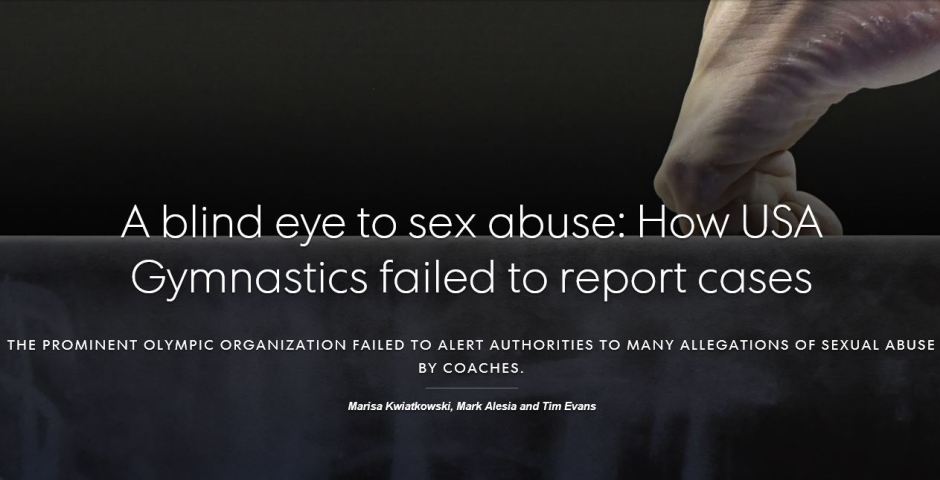
And in 2016, we are again aghast about news that USA Gymnastics simply kept quiet despite case after case of sexual abuse allegations against coaches in its organization.
It is inconceivable to most parents that their child would be abused by people they know, and in whose care they entrust their child’s well-being. And yet, in the afterglow of the Rio Olympics, when the Final Five, the young American female gymnasts, dominated in the women’s gymnastics competition to easily take glory and gold in the team competition, we find USA Gymnastics in retreat.
According to The Indianapolis Star, officials of USA Gymnastics were aware of sexual abuse of female gymnasts, including pre-teens, for years, often doing nothing or acting only if asked.
USA Gymnastics were given a detailed complaint in 2011 about 2010 national Women’s Coach of the Year, Marvin Sharp, but only reported him to the police after a second allegation of abuse of a 12 year old, four years later.
USA Gymnastics apparently has a large dossier of complaints against a coach named Mark Shiefelbein, but the parents of a 10 year old abused by Shiefelbein, who went to the police, was surprised to learn that USA Gymnastics knew he was a serial sexual abuser and did nothing.
USA Gymnastics knew about a coach named James Bell and his cases of sexual abuse at least 5 years before being arrested for molesting three gymnasts in 2003.
USA Gymnastics was told by a gym owner in 1998 that a coach named William McCabe “should be locked in a cage before someone is raped”. Despite knowing of at least four complaints against McCabe, USA Gymnastics allowed him to coach for seven more years.
Kaylin Maddox Brietzke was a gymnast under the guidance of James Bell, and many years later in this interview, eloquently expresses the emotion of that vulnerability of her childhood and that betrayal by adults and authority she naturally trusted.
Any corporation that puts their reputation above safety, honestly is not something I want to be a part of at all. And I was a part of USA Gymnastics for a very long time. It doesn’t matter who you are protecting. It doesn’t matter that they are a part of your organization and you want to save face. How about saving me.


You must be logged in to post a comment.