Garcetti Bach Hidalgo
Eric Garcetti, IOC President Thomas Bach, and Anne Hidalgo

Most Olympians who do not win a gold medal are happy to receive a silver or bronze medal. But in the dramatic selection process, in which IOC members choose an Olympic host city through a series of votes that thousands of people in candidate cities watch with hands clasped in prayer, there has been no silver medal.

Years of planning and millions of dollars spent in putting together a powerful bid can go to waste as a city’s mayor watches powerlessly in a winner-take-all vote by the IOC.

But this year, the mayors of the two top bids for the 2024 Summer Olympics, Anne Hidalgo of Paris and Eric Garcetti of Los Angeles, have an opportunity to do something that no other mayor has had: to choose when their city holds an Olympic Games. The choices, albeit, are not that broad – the IOC voted on July 11, 2017 to accept the bids of both Paris and LA for 2024 and 2028.

The bids of both cities were too strong to drop either of them. And the fear of having fewer cities bidding down the road was too great, as cities like Hamburg, Rome and Budapest pulled themselves out of the campaign to host in 2024. They withdrew primarily due to growing local unpopularity of hosting expensive big-tent events. For those reasons, the IOC decided – yes, we have two gold medal winners.

According to this BBC article, “The IOC wants….the cities to reach an agreement on who hosts in 2028 by then.” And if the two cities don’t agree to who hosts in 2028, then the IOC reverts back to the original plan of voting death-match at the 131st IOC session on September 13 in Lima, Peru.

Most pundits are saying that a likely scenario is Paris going first. Both cities have many of the major venues and much of the critical infrastructure in place, unlike Rio and Sochi in recent years. But Paris does not yet have an Olympic Village, and keeping the property available for the building of the Village for a period beyond 2024 would be difficult, Paris organizers say.

According to this ESPN article, the mayors Hidalgo and Garcetti understand that this is a historic moment, when the mayors have the decision in their hands, and that they are willing to work together to make it work.

The IOC is lucky in the sense that it wound up with two 2024 bid committees capable of cooperating and a pair of mayors who have an established relationship. What if the only cities left standing had come from countries with hostile relations or diametrically opposed forms of government? How likely is a repeat of this juxtaposition of two urban areas capable of handling and absorbing the unwieldy event and possibly — an important qualifier — emerging without serious post-Games issues?

This is part two of the photographs taken by Dick Lyon, member of the United States rowing team. After his four-man coxless team won the bronze medal at the Toda Rowing course, Lyon had the time to walk around Tokyo with his Bronica Camera. Here are a few of them:

Tokyo 1a

Outside a candy store – It’s a common story during the 1964 Olympics: the best athletes in the world visibly sticking out in homogenous Japan, particularly those who hovered around 200 cm tall. Lyon’s rowing teammates, who joined him in these perambulations around the Olympic Village in Yoyogi, were no exception. Here is Lyon’s rowing mate, Theo Mittet, with two giggling women from the candy shop. Note Mittet’s fancy footwear.

TOkyo 5 001


A pub in Tokyo that appears to be connected to a racetrack – The signs appear to list names of horses and jockies. These “taishyuu sakaba” were low-cost drinkeries for the everyday salaried worker, whom, I suppose, had a love for the horses. This one lists all items as selling for 100 yen, or some 28 cents at the time.

Tokyo 11 reading racing forms


A man studying the horse racing data of the day – This image of intent concentration belies the fact that the Japanese government ultimately decided that this form of gambling was a necessary form of recreation for the average citizen, as well as the well as the tax revenue it generated. The Japanese government thought briefly in the early 1960s about banning such forms of gambling, but thought better of it, according to this report.

Tokyo 1b


Shimbashi Station – In 1964 and today, this was the hangout for salarymen where they ate and drank in the many tiny eateries underneath and near the train tracks.

Tokyo 12a


Ginza and the San Ai Building – In 1964 and today, Ginza is the upscale shopping area of Tokyo, and has for a long time been considered the most expensive real estate in the world. A symbol of Ginza glitz and glamor has been the San Ai Building, a glass tower that has gleamed electric light since it opened in 1962, a couple of years before the Olympics.

Tokyo 13 001


A View from Tokyo Tower – In 1964, the Tokyo landscape around Tokyo Tower was flat. And yet, my guess is that 19 years before, at the end of the Second World War, after enduring considerable firebombing by allied planes, the landscape would have been considerably flatter. In less than two decades, Tokyo was re-built and transformed, a miraculous revival for the world to see.


Ajinomoto Ad_Tokyo Olympics Official Souvenir
Ad from the book Tokyo Olympics Official Souvenir 


It’s 1964 and Ajinomoto is at the top of the world.

Housewives in the growing post-war economies were benefiting from advances in food sciences. In America, it was easy to bake a Betty Crocker cake, or create a Jell-O dessert, or slap together a meal with a Swanson’s TV dinner.

For those who actually had to cook, particularly in Asia, mother’s little helper came in a little glass bottle with white crystals. This chemical substance, when added to food, instantly transformed bland vegetables, soups of meats into something savory and tasty. Created in 1908 by a chemist named Kikunae Ikeda, who extracted an element of sea kelp, Ajinomoto (or “the essence of taste”) became a global phenomenon in the first half of the 20th century.

It started with post-Meiji Era housewives of the upper classes, who believed that to be Western and cultured, they had to cook meals themselves. When they learned how easy it was to enhance the flavor of their prepared meals by adding Ajinomoto, sales took off.

Because this was the era of Imperialism, and Japan had colonies in East Asia, Ajinomoto made its ways to the kitchens of Taiwan and China. Restaurants in Taiwan quickly became addicted to the use of Ajinomoto, and this particular flavor and brand became associated with quality. According to this fascinating history of Ajinomoto called A Short History of MSG – Good Science, Bad Science and Taste Cultures, by Jordan Sand, display of the container that Ajinomoto was shipped in became proof of the quality of that establishment.

Some Taiwanese restaurants and noodle shops helped market the product unsolicited. If the tabletop glass shaker symbolized Ajinomoto’s mature position in the metropolitan Japanese food system, in Taiwan it was the square, gold colored, one-kilogram can, which was first imported in 1928. Food vendors and noodle shops displayed these cans toshow customers they used Ajinomoto. Presumably they did so in part to announce they were not using an imitationbrand, several of which had appeared in the 1920s. The large gold cans had particular significance for individual consumers, too, since Taiwanese merchants began opening them in the shops and selling small quantities by weight.

Ajinomoto ad_Jordan Sand
Ajinomoto advertised in a Chinese magazine from the 1920s. From Ajinomoto kabushiki gaisha shashi [Company History of Ajinomoto Incorporated] (Ajinomoto kabushiki gaisha, 1971), volume 1.
To succeed in China, Ajinomoto was marketed as the Buddha’s hand, again, according to Sand, and was particularly useful in making vegetarian food in China more palatable. And once something in China becomes popular or commonplace, it was only a matter of time before it made its way further abroad. The Chinese diaspora is one of the biggest, and when Chinese immigrants poured into America to help build the railroads, Chinese food became a staple of not only the migrants, but also the locals.

Fast forward to the 1960s, and this miracle food enhancer was at its peak, and beginning its descent. Rachel Carson’s Silent Spring educated the world on the unintended but dangerous consequences of pesticides in our ecosystem and our food supply, and more generally on man’s impact on nature. Eventually, people began to suspect that Ajinomoto, otherwise known as monosodium glutamate (MSG), was making people nervous because of its linkage to headaches, sweating, rapid heartbeats, sweating and even chest pain and nausea. In America, this particular ailment was informally called Chinese Restaurant Syndrome”, thanks to migrant cooks inordinate dependence on Ajinomoto.

Eventually, negative reactions to Ajinomoto in the United States spread to Japan. When the 1970s rolled around, Ajinomoto’s sales fell. Ajinomoto diversified and recovered, and today, Ajinomoto is certainly a giant among food manufacturers in Japan. But at the early parts of its existence, Ajinomoto was a company, by virtue of a single product, that had a significant global impact.

And in 1964, during the Tokyo Olympics, Ajinomoto was held up as one of Japan’s great success stories.

phelps vs shark

Jesse Owens was without a doubt the star of the 1936 Berlin Olympics. A black man winning four gold medals in Arayan Germany was interpreted as a symbol of America’s strength in diversity. And yet, when Owens returned to America, he struggled to earn a consistent income, unthinkable if he were a star today.

One way Owens earned a living – he was an owner of a Negro baseball league team, The Portland Rosebuds. In order to bring fans in, I suppose, he footraced against horses between games at double headers.

Michael Phelps never had to do that to make a living.

And yet, the single most decorated Olympian ever, including a record 23 gold medals, Phelps is engaging an even more absurd race….against a shark.

In promotion of Discovery Channel’s annual “Shark Week”, Phelps will swim a race against a great white shark on July 23, 2017.

What can I say? This is the height of absurdity.

I can see in my head what a race with a horse looks like. I cannot imagine what a race between a man and shark is. How long would the race be? Since sharks are always in motion, does this particular great white shark getting a running start, as it were? Are man and shark racing together, in the same ocean lane? If yes, I imagine that would motivate Phelps in a uniquely visceral way.

But the simple reason why this whole exercise is clearly a gimmick, according to this article, great white sharks reach speeds of 25-35 mph, while a swimmer of Phelps’ caliber tops out at 6.

So silly. But, I’ll watch.

Olympic National Stadium design_Kengo Kuma
Images of Kengo Kuma’s National Stadium

When you walk through Meiji Shrine, a peaceful oasis of green in the middle of Tokyo, your pulse rate drops and you forget the hustle bustle of one of Asia’s most dynamic mega-cities. Its location next to the National Stadium for the 1964 Tokyo Olympics and the Olympic Village made the wooded park of Meiji Shrine a wonderful place for runners to train, a la middle distance double gold medalist, Peter Snell.

When images of the planned National Stadium for the 2020 Olympics were released, there was a mixture of groans and puzzlement. Globally renown architect, Zaha Hadid, presented a design of sleek modernity. Frankly, I thought it looked like a bicycle helmet, somewhat out of place in its surroundings.

National Stadium and Meiji Shrine_google maps
National Stadium and Meiji Shrine on Google Maps

Then suddenly, in July, 2015, Prime Minister Shinzo Abe scratched plans for the design of the new National Stadium planned for the 2020 Tokyo Olympics. It was revealed that the estimated cost of the stadium ballooned from JPY252 billion, from the original proposal of JPY130 billion, an approximate difference of USD1 billion. Scrapping Hadid’s design meant a massive delay, resulting in a particularly embarrassing broken promise. Plans to have the new national stadium host the 2019 Rugby World Cup also had to be scrapped, resulting in a move of the tournament to Yokohama.

TOCOG quickly put together another search for a stadium designer. And suddenly, Kuma Kengo, whose design was selected, was in the spotlight. Not only will the cost of the Kengo stadium be closer to the originally proposed estimate (JPY150 billion), the design of the stadium will more seamlessly blend into the environment.

Kuma has built a reputation for his use of wood, and plans to employ wood, particularly wood grown in all prefectures of Japan, to fashion a stadium that folds into the relatively green surroundings, as he explains in this Nippon.com interview:

Instead of the old-fashioned idea of putting up a huge monument, my idea is to create a stadium that people will remember as part of the Meiji Shrine outer gardens, the wooded area in which it’s located. And we’re planning to uncover the Shibuya River, which was put underground during the rapid-growth years, and have it flow at surface level through the stadium grounds. I believe that creating something sustainable for future generations, with the surrounding nature open to the public, is a more important considerations than the physical shape of the edifice, and so that’s what I’ve been focusing my efforts on.

Kuma was 10 years old when the 1964 Olympics came to Tokyo. He remembers witnessing the rapid growth of the post-war years, and being amazed in particular by the two complementary buildings of the Yoyogi National Gymnasium, built for the aquatic and basketball events. According to the Nippon.com article, he remembers often visiting the First Gymnasium designed by legendary architect, Tange Kenzo. “The light shining down from the windows in the high ceiling made the water of the pool sparkle. I was captivated by this sublime sight, and that was what made me decide that I wanted to become an architect.”


Yusuhara Town Hall_Kengo Kuma
Yusuhara Town Hall


Over the years, Kengo has become known for his use of wood in his designs, in ways that recall times when wood was the primary construction material, layered, and exposed to the elements. Design website, Icon, describes Kengo’s work in detail:

Kuma’s approach is perhaps best illustrated by a series of buildings he has built in and around a small town called Yusuhara on Japan’s southern Shikoku island. The Yusuhara Town Hall (2006) sits under a roof and frame of Japanese cedar in a traditional structural arrangement, but one that gives off more than a hint of high-brutalism in the strong articulation of its thick beams and columns. The outside features a series of timber panels of various dimensions, alternating with glazed panels – a genuinely interesting take on the “barcode” facade.

Yuuhara hotel and market_Kengo Kuma
Yusuhara hotel and shops

A small hotel and market (2010) that Kuma built nearby is just as unconventional, with a curtain wall on the main facade made of straw bales and bamboo that can actually be opened out to allow light and ventilation through – a very odd combination of rustic material and hi-tech detailing. But the wooden bridge building (ICON 101) that Kuma built over a road to link a spa and hotel on the outskirts of the town is stranger still. Here is a version of traditional Japanese roof construction blown up to super-large scale, a series of single wooden elements all overlapping and stepping up towards the bridge itself. It is this radical re-imagining of a historic building material or method of construction that one sees time and time again in Kuma’s work.

I’m truly excited for the debut of Kengo Kuma’s national stadium. I feel it will not only be appreciated for its uniquely Japanese sensibilities, but will be a lasting legacy of the 2020 Games, a fitting complement to its green surroundings, particularly the peaceful Meiji Shrine.

“I want to go beyond the era of concrete,” Kuma, 62, said in this Japan Times interview. “What people want is soft, warm and humane architecture. We will show the model of a mature society in the stadium. That’s the way to live a happy life relying on limited natural resources from a small land.”

Kengo Kuma profile
Kengo Kuma

Roy with 1964 Tokyo Olympic Torch
The Olympians has been a labor of love for exactly two years. It is my sketchbook as I prepare for the mural masterpiece, a book on the 1964 Tokyo Olympics.

While my book’s focus is on the XVIII Tokyo Olympiad, I use my blog as an excuse to write about anything even remotely related to these areas: the Tokyo Olympics, the Olympics overall, Japan, and sports in general. In other words, I think of my blog as therapy for a restlessly curious mind.

How else could I go 730 straight days without missing a post?

Enjoy!

Japan 1964


Tokyo 2020


Random Rambles

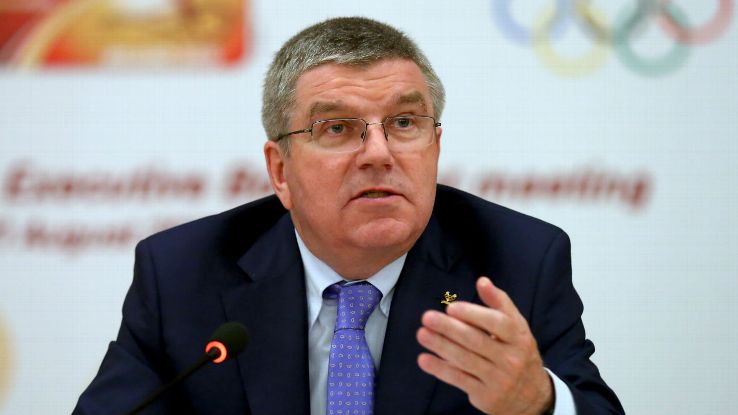
President Thomas Bach
IOC President Thomas Bach
In July, 2015, there were only two cities vying for the 2022 Winter Games: Almaty, Kazakhstan and Beijing, China. Just 10 months before, Oslo, Norway, the host of the 1952 Winter Olympics, pulled out of the running. Sochi a year before famously cost $50 billion, and the Norwegian government was expecting the cost for their city to be billions more than they had an appetite for.

That left Almaty, a city generally unknown, and Beijing, a well-known city that gets very little snow.

With the ugly photos coming out of Rio de Janeiro of the crumbling Olympic infrastructure after only some 7 months, more and more city denizens and governments are convinced they don’t want an Olympics in their metropolis. In fact, Budapest, Hungary, which submitted a strong bid for the 2024 Summer Games, withdrew its bid a week ago on March 1.

So like the 2022 bid, now there are only two for the 2024 Games.

This must be causing considerable heartburn for leaders of the International Olympic Committee (IOC). The bidding process has resulted not in a celebration of city pride with the hopes of bringing the biggest sports tent their way, but in opportunities for large numbers of people to publicly and loudly proclaim their disenchantment, if not diffidence with having the Olympics in their back yard.

Rio Swimming Venue Before and After
Fortunately, the 2024 has two solid prospects: Los Angeles and Paris. As Tim Crow writes in this great article, “And Then There Were Two“,

LA is the most compelling, with its vision of Californian sunshine, West Coast tech innovation and Hollywood storytelling power combining to ‘regenerate the Games’ and ‘refresh the Olympic brand around the world’.

Paris is more traditional, a classic piece of Olympic realpolitik, invoking de Coubertin in a ‘new vision of Olympism in action’ in the grand old city, linked to those time-honoured Olympic bid promises of urban regeneration and increased national sports participation.

So, as Crow extrapolates, if the president of the IOC wants to avoid further embarrassment of the citizens of the Great Cities open scorn, at least for a while, he may encourage his fellow leaders to decide the next two Olympic hosts when the IOC meet in Lima, Peru in September, 2017. As has been gossiped about for the past several months, Crow believes the IOC will select either Paris or LA for 2024, and the other one for 2028. By so doing, that would guarantee great Summer Olympic hosts throughout the 2020s, as well as avoid unwanted anti-Olympic discussion that would most certainly lead up to the 2028 process, that is currently scheduled for 2021.

Crow also speculates that the IOC may award the 2024 Summer Games to Paris, and the 2028 Summer Games to Los Angeles. Here are the three reasons why:

  • One, because an LA 2028 Games will give President Bach the ideal timing to play the American market for the IOC’s next US broadcast deal beyond NBC’s current contract.
  • Two, because it will also give Bach significant leverage in his attempts to persuade his six US-based TOP sponsors to extend their current deals, all of which end into 2020, for eight years.
  • But most of all, because it will buy Bach and the IOC both time and two key partners in its battle to find a new relevance and credibility for a new era and a new generation.

That last one is the tricky one. Can the Olympics be saved for the next generation?

world-marathon-challenge-map

Right now, a 5K would intimidate me. 10k would be a desperate slog. A marathon? Well, I’d definitely pull a Rosie Ruiz.

But seven marathons? Seven days in a row? On seven different continents? Isn’t that what Satan makes people do in the ninth circle of hell?

And yet, this is a thing.

The World Marathon Challenge debuted in January, 2015, and it has been held in the past two years in Union Glacier (Antarctica), Punta Arenas, Chile (South America), Miami, USA (North America), Madrid, Spain (Europe), Marrakech, Morocco (Africa), Dubai, UAE (Asia), and Sydney (Australia/Oceania). As their website states, “participants will run 295 km (183 miles) over the seven-day period, spend 59 hours in the air and fly approximately 38,000 km.”

A runner named David Gething won the first event in 2015 with a total time of 25 hours, 36 minutes and 3 seconds, for an average marathon time of 3 hours, 39 minutes and 26 seconds. That’s a good marathon time run once. But 7 times?

Olympian Ryan Hall ran in the 2016 event and blogged about  his experiences:. Here are a few excerpts.

Antarctica – Marathon time: 3 hours 26 minutes and 31 seconds

The most challenging part of being in Antarctica is getting used to 24-hour-a-day sunlight. We were staying in camping tents so it was impossible to get darkness. I’m really looking forward to getting a good night’s rest tonight at a hotel in Punta Arenas, Chile.

ryan-hall-running-in-antarctica
Ryan Hall running in Antarctica

Punta Arenas, Chile – Marathon time: 3 hours 6 minutes and 33 seconds

This entire course was concrete, which is brutal on the legs—my calves were absolutely hammered the last 10k. Luckily I have my extra cushy Asics 33-M to help offset the pounding. I would never recommend running a step on concrete. It’s 10 times harder than asphalt.

Miami, Florida – Marathon time: 3 hours 15 minutes and 36 seconds

The marathon is going to hurt no matter if you run a 5-minute pace, a 7-minute pace, or a 10-minute pace, so I figure if I run fast than I’ll get done in less time. I also think it’s a lot easier to establish a good tempo early and just try to hold it. Even if you slow down later in the race you will have bagged so much time that you’ll still come in ahead of schedule.

Madrid, Spain – Marathon time: 3 hours 41 minutes and 41 seconds

I had a much more conservative race strategy this time and was just trying to run around eight minutes per mile. My calves felt like rocks from mile one so I was only able to maintain that pace through 20 miles before the wheels completely came off and I had to do a couple hundred meters of walking, which was a first for me.

Marrakesh, Morocco – Marathon time: 3 hours 4 minutes and 56 seconds

When I woke up I felt like death and nearly toppled over when I took my first steps. On the starting line I was planning on trying to run as much as I could before doing some walk/running. So when I began I was surprised to find that my previously rock-tight calves felt surprisingly normal. Not only that, but my energy actually felt good and my Surge showed that my heart rate was low. I gradually increased my speed until I was clipping along at a 6:40 pace feeling like a million bucks.

Dubai, UAE – Marathon time: 3 hours 46 minutes and 20 seconds

The other challenge of the day was the heat and humidity. We were running in mid-80-degree weather with high humidity, and that’s in winter—imagine the summers! I was drinking fluids and taking gels and candy every 2.62 kilometer, or 1.6 miles. Yet despite all the hydration and calories I still got chills in the last lap, which is a sign of dehydration. My advice for running in the heat: Drink as much electrolyte-rich fluids as your stomach can handle and drink it before you feel like you need it. Another thing that worked really well for me today was putting crushed ice in my hat to help bring my body temperature down.

Sydney, Australia – Marathon time: 5 hours, 15 minutes and 34 seconds

I knew I was in trouble today as soon as I walked off the plane. The subtle pain in my right hip had been getting worse and worse over the course of the last two marathons. I wasn’t able to walk without a limp, so I knew I wouldn’t be able to run without a limp either. It was a long day, to say the least. I may have set the world record for the biggest time differential between your fastest and slowest marathon as I took over 5 hours to finish today. I got a massage part way through the race, which helped for a couple of miles, but it was clear today was going to be one of those days you just have to put your head down and find a way to keep moving forward.

Hall wrote that Sydney was the last marathon he would ever run. What a way to finish.

nocs-visit-tokyo_february2017
Representatives of various National Olympic Committees are given tours of 26 Olympic venues, including Ajinomoto Stadium in Tokyo on Monday. | PHOTO COURTESY OF TOKYO 2020 / UTA MUKUO / VIA KYODO
When you think about the number of events in an Olympic Games, and the varied types and sizes of venues required for a mega-sports event like the Olympics, one wonders why we would saddle an emerging economy with such a beast of a logistics and budget burden. Sochi, Rio and Athens are recent examples of this challenge.

While Japan was an emerging economy in 1964, its economy was booming and could absorb the massive change and cost with ease. And when we look at the Paris and Los Angeles bids for 2024, one gets the sense that they are at an advantage due to their already massive and modern infrastructure along with its varied and numerous sports facilities packed into their metropolitan areas.

Tokyo has that advantage as well and was able to propose in its bid that 90 percent of the sports venues would be within 8 kilometers of the Olympic Village. Tokyo2020 has framed the physical footprint in an infinity loop which encloses two areas: the Heritage Zone and the Tokyo Bay Zone. The Heritage Zone represents facilities that are in and around the area of the 1964 Tokyo Olympics, the Shinjuku – Yoyogi area. That would include the location of the National Stadium, both then and in 2020. The Tokyo Bay Zone is primarily reclaimed land about 3.2 km southeast of central Tokyo. This will include the site of the Olympic Village in Harumi.

On February 10, the 2020 Tokyo Olympic Organizing Committee hosted visitors from the National Olympic Committees from Australia, Austria, Belgium, Brazil, Canada, Denmark, Finland, Ireland, Liechtenstein, Luxembourg, the Netherlands and New Zealand. For three days they got a guided tour of 26 of the approximately 40 venues planned for the 2020 Tokyo Olympics. And the reviews, apparently, are good.

infinity-heritage-and-tokyo-bay-area-zones
Heritage and Tokyo Bay Zones
Here are a few comments from Luke Pelligrini, the acting general manager of games support and operations for the Australian Olympic Committee:

  • Across all the NOCs in the bus yesterday, everyone was saying this is going to be a good games. Everyone is confident that it’s on track, ahead of the game at the moment and will continue to be.
  • (Some of the venues) looked like they could run sporting events next week. The taekwondo and fencing venue (Makuhari Messe in Chiba Prefecture) literally looked like it could stage sporting events next week if it needed to. The 1964 stadiums for table tennis, the water polo, they look ready to go now. In that respect, we are thrilled. We don’t see anything, 3½ years out, that is a concern to us. We’ve been pleasantly surprised by the experience
  • The most impressive thing is how central 70 percent of the venues are. We were amazed at the location of the Olympic village literally being downtown. That is a fantastic opportunity for our athletes to experience the games and also Tokyo. It is a very central location to get to the venues for all our athletes.

Here is a great video explaining the venue locations planned for the 2020 Tokyo Olympics.

phones
There be gold in them thar phones!

If you’re living in Japan, and you buy smartphones like you buy a fashionable spring jacket, then you’ve got a bunch of phones in your cabinet that are just gathering dust.

Tokyo2020 wants your phone! Starting April, Japan telecommunications conglomerate, NTT Docomo, will set up collection boxes in over 2,400 NTT Docomo stores across Japan. Additionally, the Japan Environmental Sanitation Center, will also set up collection centers to collect old PCs, tablets, wearables, monitors, and other electronic devices that can be mined for metals.

The goal is to collect 8 tons of metal, which will yield 2 tons of gold, silver and bronze, and eventually result in the production of 5,000 medals for winners in the Tokyo 2020 Olympic and Paralympic Games.

Said Japanese gymnast Kohei Uchimura of this initiative, “computers and smart phones have become useful tools. However, I think it is wasteful to discard devices every time there is a technological advance and new models appear. Tokyo 2020 Olympic and Paralympic medals will be made out of people’s thoughts and appreciation for avoiding waste. I think there is an important message in this for future generations.”

Sustainability will be a key theme of Tokyo2020. And my hope and expectation is that Tokyo2020 will be a shining model of how to present the Olympics, as it was in 1964. Tokyo2020 will stand in stark contrast to past Olympics.

For example, there are already signs of decay in Rio de Janeiro as venues used for the 2016 Rio Olympics have been abandoned. This is an oft-told tale, with plenty of photographic evidence of waste from past Olympics. Only six months later, the main venue for the Rio Olympics is an empty, pilfered and unused shell of a stadium.

The IOC knows its reputation and perhaps its long-term survival are dependent upon making the Olympics more in line with the host country’s economic plans and means, and more conscious of its obligations to be more socially tolerant and more purposeful in driving sustainability.

kohei-uchimura_gold-medal_rio_ap
Kohei Uchimura’s next gold medal might be made from recycled smartphones

Since its inception in 2014, IOC President, Thomas Bach, has driven home the 40 tenets of his vision – The Olympic 2020 Agenda – a list of priorities, principles and actions that will guide the IOC in the coming years. Some of the hopes is to help ensure that host cities do not end up with an overly burdensome budget to hold the Games, to make the bidding process less complicated and less expensive, to ensure non-discrimination on the basis of sexual orientation, and to drive greater sustainability.

The IOC has been working closely with Tokyo2020 to bring its operational budget down from USD30 billion, which is four times the budget put forth in the 2013 bid for 2020. The current goal is to get the budget down to under USD20 billion, which is far under Sochi’s USD50 billion spend, Beijing’s USD40 billion spend, and more in line with London’s USD20 billion spend. I believe that Tokyo Governor Yuriko Koike is making an honest attempt to drive the budget down, as well as create a legacy of sustainability and inclusiveness in Japan.

If you’re in Japan, you too can help! Look for your old smartphones, and the signs at NTT Docomo. Donate a phone, and ensure that a piece of your property becomes a piece of the winning medal for Olympians in 2020.