Over 30,000 people crowded the streets of Shibuya near the famous zebra scramble to dance on August 5, 2017.
Of that huge crowd, in one of Tokyo’s most popular shopping and entertainment centers, 30 members of the Tokyo 2020 team dressed in yukata and happi coats performed a dance that was popular over 53 years ago. Reviving a hit song from that time, the organizers re-released an updated version of “Tokyo Gourin Ondo”(東京五輪音頭), which roughly translates to The Tokyo Olympic Dance Song.
Tokyo 2020 Bon Odori in Shibuya
This song by Kouhei Fukuda, amidst the follow up to the 1964 Tokyo Olympics, helped created Olympic fever in Japan at that time.
It is mid August, in the heat of summer, when families often come together to visit and clean family gravesites. It is also an opportunity for neighborhoods to come together in a bon odori, which you can see in almost any neighborhood in Japan. And anyone can join in the dance.
Watch this video to see how the Tokyo Gourin dance is done.
Unemployment in Brazil was 10%. Inflation was 10%. Brazil’s credit rating was junk status. The currency had devalued by a third at that point in December 2015.
The Olympics left behind a new subway line extension, high-speed bus service and an urban jewel: a renovated port area filled with food stands, musicians and safe street life in a city rife with crime. These probably would not have been built without the prestige of the Olympics. But the games also imposed deadlines and drove up the price. A state auditor’s report said the $3-billion subway was overbilled by 25 per cent.
July 27, 2017 Guanabara bay. (AP Photo/Silvia Izquierdo)
But generally, the bad according to that article outweighed the good.
The Olympics left a half-dozen vacant sports arenas in the Olympic Park and 3,600 empty apartments in the boarded-up Olympic Village. Deodoro, a major complex of venues in the impoverished north, is shuttered behind iron gates.
A $20-million golf course is struggling to find players and financing. A few dozen were on the course on a recent, sunny Saturday. The clubhouse is mostly unfurnished, and it costs non-Brazilians 560 reals ($180) for 18 holes and a cart.
Since the Olympics, the bankrupt state of Rio de Janeiro has ceased major efforts to clean the bay, its unwelcome stench often drifting along the highway from the international airport. “I think it’s gotten worse,” Brazil’s gold-medal sailor Kahena Kunze said in a recent interview. “There was always floating trash, but I see more and more. It’s no use hiding the trash because it comes back. I figured it would get worse because I haven’t seen anything concrete being done.”
Some of the politicians behind the Olympics have been accused of graft, and organizers still owe creditors about $30 million to 40 million. Former President Luiz Inacio Lula da Silva, who wept when Rio was awarded the games, was convicted last month on corruption charges and faces a 9 1/2-year prison term. He is appealing. Former Rio de Janeiro Mayor Eduardo Paes , the local moving force behind the Olympics, is being investigated for allegedly accepting at least 15 million reals ($5 million) in payments to facilitate construction projects tied to the games. He denies wrongdoing.
The Rio Olympic organizers are still struggling under the weight of an approximate USD40 million debt. When the organizers appealed to the IOC for relief, the IOC replied no, saying “it had already contributed a record $1.53 billion to the Rio Olympics.
Fortunately, the Brazilian government was able to find more sympathetic ears in the British government. It was announced on August 1, 2017 that the British government would donate GBP80 million (over USD100 million) to Brazil, the ninth largest economy, to help “reduce poverty and fund economic development.”
Of course, it’s not all bad news.
At least Ryan Lochte, the American swimmer who lied about being robbed at gunpoint at a Rio gas station, was actually cleared last month of charges that he falsely communicated a crime to authorities.
The top activity for foreign tourists in Japan is:
a) Shopping
b) Eating Japanese Food
c) Getting Swallowed Up by Hundreds of People Wading Through the Famous Shibuya Scramble Crossing While Attempting to Take a Selfie
d) Visiting All of the Sites/Buildings Godzilla has Knocked Down and Blazed to the Ground in His Career
e) All of the Above
According to the Japan Tourism Agency (JTA), which recently released the results of its Q1 2017 survey of foreign tourists visiting Japan, the answer is……
b) Eating Japanese Food
As explained in Terrie Lloyd’s blog, Terrie’s Take, “69.1% (of the foreign tourists surveyed) listed food as their top anticipated experience, followed 16 points further back by 52.5% wanting to go shopping. Perhaps even more importantly, the JTA’s survey of people exiting Japan lists the Number One experience during the trip as ‘Eating Japanese food’, which came in at an amazing 95.3%! Next after food was shopping, at 83.5%.”
Three of my favorites!
Lloyd went on to provide interesting insight from the survey. He noted that the most popular Japanese dishes were sushi, ramen, Wagyu steak or sukiyaki. He also added that depending on the region from where the tourists come, the Japanese food of choice differs.
For travelers from Vietnam, India, Germany, Italy, Spain, Russia, Canada, or France, the number one choice is sushi.
For tourists from Taiwan, Thailand, Malaysia, China, Singapore, Indonesia, Philippines, United Kingdom, United States, or Australia, the number one craving is ramen.
And for those travelling foodies from South Korea or Hong Kong it’s all about the beef – wagyu steak or sukiyaki.
I can’t argue with sushi, ramen and Wagyu. Frankly, they are so good here, I’d eat any of those items only in Japan if I had the choice.
Dick Lyon was in Japan for the 1964 Tokyo Olympics, and was a member of the bronze-medal winning team of the American coxless fours. And after a tense week of competition in the week of the Tokyo Olympiad, Lyon had a week to enjoy the Olympics as a spectator, and Japan as a tourist.
Lyon and his friends ventured into a public bath, bought sweets in a Ginza boutique, got around in subways and taxis, took the newly-launched Bullet Train to Kyoto, and climbed Mt Fuji.
Like so many athletes, Lyon bought a camera – a Bronica SLR, from a company called Zenza Bronica, founded by Zenzaburo Yoshino. Yoshino was fascinated by photography and cameras, and started a small camera store in Kanda, Tokyo, selling foreign cameras.
Eventually, Yoshino’s business became very popular among GI’s during the Allied post-war occupation of Japan. With profits from his store, Yoshino invested in a factory to manufacture luxury watch cases and lighters. Soon after he was also manufacturing cameras of his own design, the Bronica.
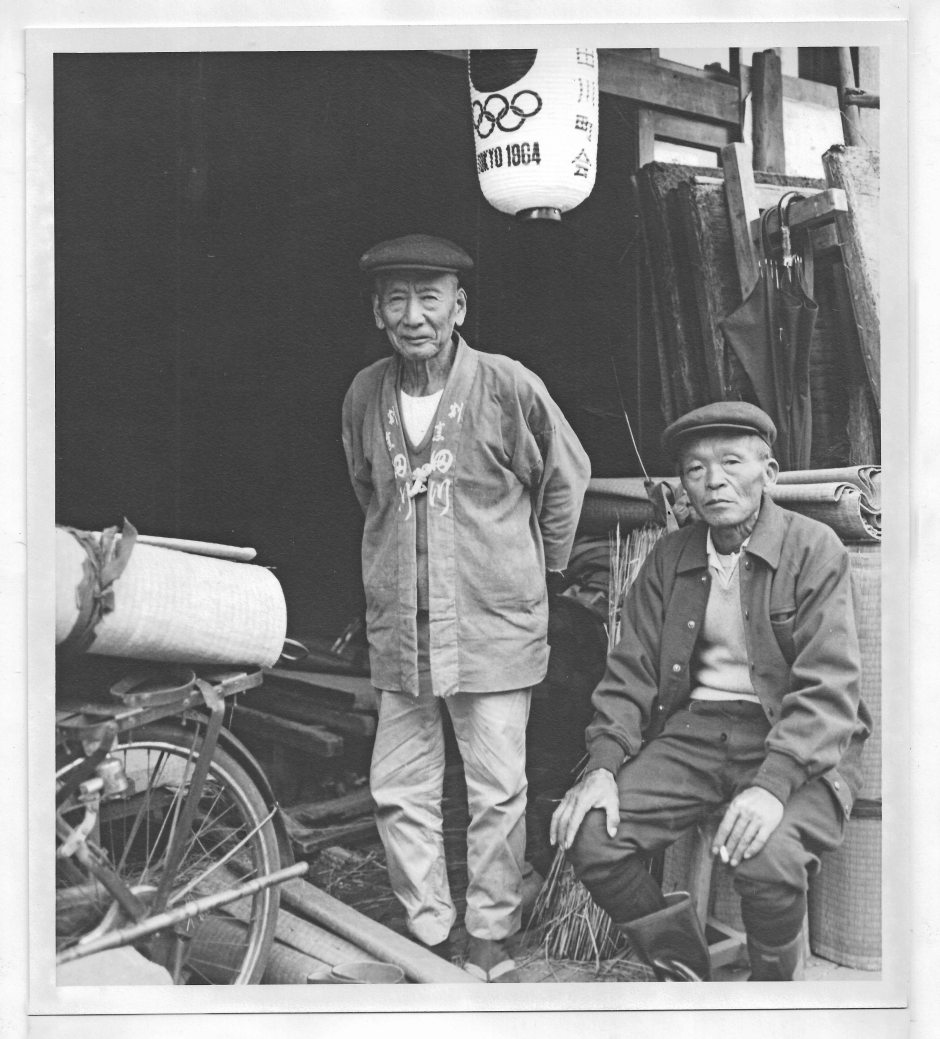
Lyon shared with me some of the pictures he took with his Bronica, a fascinating look into a time capsule from 1964.
Children on a street in Tokyo – It’s late October, and undoubtedly a tad chilly, but kids in Japan, then and now, are commonly seen wearing shorts in the Fall.
A little girl skipping rope – no social commentary here, just a wonderful shot of a girl having a fun time!
Two elderly gentlemen in Tokyo – this is likely in front of a small light manufacturing operation or repair shop, with two members of the commerce association of some town in Tokyo called Tagawa. I love the Olympic lantern – would love to find one that still exists!
A bricklayer at work – A wonderful shot of a day laborer, likely prepping the façade of a building for a set of steps, as an elderly lady looks on.
A day laborer taking a rest – This somewhat elderly man is wearing the shoes of the farmer or construction worker: the “tabi,” with its distinctive split-toe design. Since this is Tokyo, he was probably employed in construction. The hat, however, is a nice touch.
A man on his “Ri-ya-kaa”– Here’s a gentleman who owns his own business, or works for a business that needs to transport heavy items, like alcohol bottles, sacks of rice or bags of vegetables. This vehicle is called “ri-ya-kaa” based on an extrapolation of an English word: “side car”. The side car is the carriage that you sometimes see attached to a motorcycle. The Japanese figured if you can call that part a “side car”, then attaching something similar to the back could be called a “rear car”. (I didn’t know this!)
When you walk through Meiji Shrine, a peaceful oasis of green in the middle of Tokyo, your pulse rate drops and you forget the hustle bustle of one of Asia’s most dynamic mega-cities. Its location next to the National Stadium for the 1964 Tokyo Olympics and the Olympic Village made the wooded park of Meiji Shrine a wonderful place for runners to train, a la middle distance double gold medalist, Peter Snell.
When images of the planned National Stadium for the 2020 Olympics were released, there was a mixture of groans and puzzlement. Globally renown architect, Zaha Hadid, presented a design of sleek modernity. Frankly, I thought it looked like a bicycle helmet, somewhat out of place in its surroundings.
National Stadium and Meiji Shrine on Google Maps
Then suddenly, in July, 2015, Prime Minister Shinzo Abe scratched plans for the design of the new National Stadium planned for the 2020 Tokyo Olympics. It was revealed that the estimated cost of the stadium ballooned from JPY252 billion, from the original proposal of JPY130 billion, an approximate difference of USD1 billion. Scrapping Hadid’s design meant a massive delay, resulting in a particularly embarrassing broken promise. Plans to have the new national stadium host the 2019 Rugby World Cup also had to be scrapped, resulting in a move of the tournament to Yokohama.
TOCOG quickly put together another search for a stadium designer. And suddenly, Kuma Kengo, whose design was selected, was in the spotlight. Not only will the cost of the Kengo stadium be closer to the originally proposed estimate (JPY150 billion), the design of the stadium will more seamlessly blend into the environment.
Kuma has built a reputation for his use of wood, and plans to employ wood, particularly wood grown in all prefectures of Japan, to fashion a stadium that folds into the relatively green surroundings, as he explains in this Nippon.com interview:
Instead of the old-fashioned idea of putting up a huge monument, my idea is to create a stadium that people will remember as part of the Meiji Shrine outer gardens, the wooded area in which it’s located. And we’re planning to uncover the Shibuya River, which was put underground during the rapid-growth years, and have it flow at surface level through the stadium grounds. I believe that creating something sustainable for future generations, with the surrounding nature open to the public, is a more important considerations than the physical shape of the edifice, and so that’s what I’ve been focusing my efforts on.
Kuma was 10 years old when the 1964 Olympics came to Tokyo. He remembers witnessing the rapid growth of the post-war years, and being amazed in particular by the two complementary buildings of the Yoyogi National Gymnasium, built for the aquatic and basketball events. According to the Nippon.com article, he remembers often visiting the First Gymnasium designed by legendary architect, Tange Kenzo. “The light shining down from the windows in the high ceiling made the water of the pool sparkle. I was captivated by this sublime sight, and that was what made me decide that I wanted to become an architect.”
Over the years, Kengo has become known for his use of wood in his designs, in ways that recall times when wood was the primary construction material, layered, and exposed to the elements. Design website, Icon, describes Kengo’s work in detail:
Kuma’s approach is perhaps best illustrated by a series of buildings he has built in and around a small town called Yusuhara on Japan’s southern Shikoku island. The Yusuhara Town Hall (2006) sits under a roof and frame of Japanese cedar in a traditional structural arrangement, but one that gives off more than a hint of high-brutalism in the strong articulation of its thick beams and columns. The outside features a series of timber panels of various dimensions, alternating with glazed panels – a genuinely interesting take on the “barcode” facade.
Yusuhara hotel and shops
A small hotel and market (2010) that Kuma built nearby is just as unconventional, with a curtain wall on the main facade made of straw bales and bamboo that can actually be opened out to allow light and ventilation through – a very odd combination of rustic material and hi-tech detailing. But the wooden bridge building (ICON 101) that Kuma built over a road to link a spa and hotel on the outskirts of the town is stranger still. Here is a version of traditional Japanese roof construction blown up to super-large scale, a series of single wooden elements all overlapping and stepping up towards the bridge itself. It is this radical re-imagining of a historic building material or method of construction that one sees time and time again in Kuma’s work.
I’m truly excited for the debut of Kengo Kuma’s national stadium. I feel it will not only be appreciated for its uniquely Japanese sensibilities, but will be a lasting legacy of the 2020 Games, a fitting complement to its green surroundings, particularly the peaceful Meiji Shrine.
“I want to go beyond the era of concrete,” Kuma, 62, said in this Japan Times interview. “What people want is soft, warm and humane architecture. We will show the model of a mature society in the stadium. That’s the way to live a happy life relying on limited natural resources from a small land.”
In the land of kawaii (cute), where sports teams, companies, and cities have their own mascots, The Tokyo Organizing Committee of the Olympic and Paralympic Games is offering you a chance to animate that essence of joy you experienced as a child.
Tokyo 2020 has requested the Japanese public to submit their designs for the mascots of the Tokyo 2020 Games – both the Olympics and Paralympics. Whether you’re a professional illustrator or a convenience store freeter, you can submit a design, although you need to be 18 years or older. Non-Japanese living in Japan are also eligible.
An entry can be submitted by a group as well. The group can have a max of 10 people in it. Above age and nationality conditions apply to all group members.
Start working on those lovable characters now, because the design submission period is August 1 – 14.
But be forewarned. Shortlisted designs will have a tough group of evaluators. The organizing committee requires that elementary school classes across Japan, the international schools, will vote and thus end up selecting the winner.
There were fears at one stage that costs of the Tokyo2020 Olympics would balloon to some USD30 billion, which would approach the USD40 billion that was spent on the 2008 Beijing Olympics.
While it is unlikely that cost estimates will drop to the initial budget of USD7.5 billion, the amount presented to the selection commission of the IOC at the bid presentation, the IOC and the organizers of Tokyo2020 are hoping to get the costs below USD 15 billion.
Currently, costs estimates for Tokyo2020 are JPY1.8 trillion or nearly USD16 billion. But there are always hidden costs, or at least costs not spoken about openly, like cost overruns. In this March 2017 article, The Japan Times cites Asahi Shimbun, which reported that “the original bid estimate for constructing new Olympic venues was ¥499 billion and that is now ¥680 billion. Transportation costs have increased from ¥23.3 billion to ¥140 billion, security from ¥20.5 billion to ¥160 billion and ‘software’ expenses from ¥257 billion to ¥520 billion.”
Currently, organizers intend to host the media and broadcasting center for the 2020 Tokyo Olympics at Tokyo Big Sight, which is a large convention center in the Odaiba waterfront district. To accommodate the Olympics, plans include closing off the convention center to all trade shows from April 2019 to November 2020. In a January, 2017 article, The Japan Times cites The Japan Exhibition Association, which claims that the shut down could translate to more than ¥1 trillion in lost sales and affect 1,000 companies associated with the exhibition industry, including booth decorators and logistics firms, if exhibitions are canceled or downsized.
It’s a “matter of life and death,” said Masato Suzuki, deputy general manager of Tokyo-based manufacturer Sanko Tsusho Co. Ltd.’s inspection equipment department. “We small and midsize firms don’t want the Olympics if it means canceling or scaling down exhibitions. It’s by far our most important business opportunity,” he said, adding that about 70 percent of his company’s sales are generated by clients established at the exhibitions.
In a May, 2017 article in Japan Today, it was reported that the city government may be losing a fight to get the national and regional governments to pick up part of the costs of refurbishing sports venues or building temporary sports venues in locales outside Tokyo. As an example of possible costs unanticipated by the organizers in Tokyo, the governor of Kanagawa is looking to add to the bill. Enoshima, the intended venue for sailing events, is a part of Kanagawa prefecture. Governor Yuji Kuroiwa believes his prefecture will have to compensate fishermen who will be prevented from fishing during the Olympic Games, and thus will lose revenue.
Very often, organizers cite the increase in tourism revenues for a city and country hosting the Olympics. But that argument is countered by economist, Andrew Zimbalist, in his book, Circus Maximus – The Economic Gamble Behind Hosting the Olympics and the World Cup. He explained in his book that at big tent events like the Olympics or the World Cup, tourism actually falls.
Still another problem is that when a foreign soccer fan spends $100 at a Brazilian restaurant during the World Cup competition, it might not be a net gain for the Brazilian economy. This is because between June 12 and July 13, 2014, there may have been tens or hundreds of thousands of people (tourists or businesspeople) who would otherwise have traveled to Brazil but instead chose to avoid the congestion, tight security, and high prices during the World Cup and either went elsewhere or stayed home.
This plays out in real life: tourism in Beijing fell during the 2008 Summer Games, as it did in London during the 2012 Olympics. That is, even counting the athletes, the media, the administrators, and the Olympic tourists, the total number of visitors to these cities fell during the month of the Olympic Games. Further, some local residents may have the same impulse that foreigners have: they believe their city or country will be excessively crowded and expensive during the mega-event and that the period of the competition would be a good time to take a vacation outside the country. The amount of outbound tourism from China grew by 12 percent in 2008, the year China hosted the Summer Olympics.
Will the pride that comes with hosting a successful Olympics, and the legacy infrastructure of the 2020 Tokyo Olympics outweigh the hidden costs of running the biggest show on earth? That’s the debate that’s taking place as we head towards September 13 and the IOC meeting in Lima, Peru, when IOC members gather to decide on the fates of Paris and Los Angeles.
Roy with 1964 Tokyo Olympic TorchThe Olympians has been a labor of love for exactly two years. It is my sketchbook as I prepare for the mural masterpiece, a book on the 1964 Tokyo Olympics.
While my book’s focus is on the XVIII Tokyo Olympiad, I use my blog as an excuse to write about anything even remotely related to these areas: the Tokyo Olympics, the Olympics overall, Japan, and sports in general. In other words, I think of my blog as therapy for a restlessly curious mind.
How else could I go 730 straight days without missing a post?
Roy’s 2nd BirthdayIt’s been exactly two years since I started my journey to understand the context, the organization and the stories of the 1964 Tokyo Olympics. My father was at those games as a news producer for NBC, and I turned one years old on Opening Day.
I moved to Tokyo for a third time in January, 2014, excited by Tokyo’s selection as the host city for the 2020 Summer Games. Surprised to find not a single book on the 1964 Tokyo Olympics in English, I endeavored to write the definitive record. On May 1, 2015, I started my blog, The Olympians is in many ways, the first draft of my book.
All, thank you for your wonderful comments and support!
The Gates by Christo and Jean Claude, in front of thePlaza Hotel
It was February, 2005. The International Olympic Committee’s evaluation commission was in New York City, checked in at the prestigious Plaza Hotel, overlooking a picturesque Central Park draped in snow. The once-in-a-lifetime Christo and Jean-Claude exhibition known simply as The Gates – massive saffron-colored banners dotting the walkways of the park.
To this IOC commission, the one that would decide whether New York City, Paris, London, Madrid or Moscow would win the right to host the 2012 Olympics, the messaging was consistent. There’s no place like New York City. And there’s no better place to host the Summer Olympics than the Big Apple.
Picture this, they likely said to the commission members:
See the iconic Batman symbol of Gotham City, see the Olympic Rings shining in the New York night.
Imagine athletes of the world floating down the Hudson River in an armada, their procession leading them to the Olympic Stadium on the newly revitalized West Side.
Know that the world’s best athletes would compete in iconic, world-renown venues: basketball at Madison Square Garden, baseball at Yankees Stadium, tennis at Arthur Ashe Stadium (where the US Open is held), soccer at Giants Stadium, the triathlon in Central Park!
How about a closing ceremonies that includes a massive ticker tape parade down Broadway and the Canyon of Heroes.
And don’t forget that New York City is a microcosm of the world. The Statue of Liberty has welcomed the world for over a century. As the NYC2012 slogans stated, “Every Country Gets Home Field Advantage” and “Every Flag Will Wave”.
At this time, I had just moved from Bangkok, Thailand to Tokyo, Japan. My mind was filled with the tsunami that had just hit Thailand and other parts of Southeast Asia, and my relocation to Japan. I had no idea what was going on in my hometown of New York City. But if I had been aware, I’m sure I would have been on the bandwagon.
I could see that vision. I can still see that vision. It is worthy of New York City.




You must be logged in to post a comment.